Addressable Fire Alarm Systems: UK Business Guide 2026
It usually starts with a panel message that isn't quite specific enough.
A member of staff hears the sounders, looks at the display, and sees something like “Fire, Zone 3”. If you run a multi-floor office in Bristol, a student accommodation block in Cardiff, or a warehouse on an industrial estate near Newport, that answer is only half-useful. Zone 3 might mean a whole floor, a wing, or a bank of rooms. You still have to send someone to investigate, decide whether it's a real fire or a dirty detector, and work out how much of the building needs to stop.
That uncertainty is exactly why many UK businesses have moved towards addressable fire alarm systems. In large premises, they've become the practical choice because they tell you which device has activated, not just which area. Adoption in new large premises reached an estimated 70 to 80% by 2020 according to UK fire alarm market data referenced here, reflecting how strongly modern compliance and building management now favour device-level information.
If you're reviewing your current setup, it also helps to look beyond the alarm panel itself. Fire safety works best when alarms, emergency lighting, access routes, and maintenance planning all support each other. For a useful companion read on that wider picture, Forward Electrical installation insights offer a practical overview of emergency lighting installation that many building managers find helpful alongside alarm system planning.
Table of Contents
- Your Guide to Smarter Fire Safety
- What Is an Addressable Fire Alarm System
- Conventional vs Addressable A Head-to-Head Comparison
- Key Benefits for Your Business or Property
- Addressable Systems in Action UK Use Cases
- Design Installation and UK Compliance
- FAQs About Addressable Fire Alarms
Your Guide to Smarter Fire Safety
A vague alarm message creates three problems at once. It slows down the first check, it disrupts more people than necessary, and it makes decision-making harder at the exact moment you need clarity.
In a smaller shop, that might be manageable. In a larger building, it quickly becomes expensive and risky. If a detector activates on an upper floor, the person responding needs to know whether it's a kitchen area, a plant room, a riser cupboard, or a storeroom with a bit of dust in the air. The difference shapes how staff respond and how quickly the fire service can be directed to the right place.
That's where addressable systems change the day-to-day experience of fire safety. Instead of broad zones only, the system identifies the specific detector, call point, sounder, or interface that's reporting an alarm, a fault, or a maintenance issue.
A better answer than Zone 3
Think of it as the difference between being told a problem is somewhere on one street, and being given the exact building number.
Practical rule: The more complex the premises, the more valuable precise device information becomes.
For a business owner, landlord, or facilities manager, that precision isn't just a technical extra. It supports quicker investigation, clearer evacuation decisions, and cleaner maintenance records. It also fits the direction of UK fire safety expectations, where building operators are increasingly expected to know exactly what their life safety systems are telling them.
Why many UK businesses now choose them
In many commercial settings, addressable technology is no longer the unusual option. It's the system type people compare everything else against.
That shift happened because large and complex premises need stronger information from the panel, not just louder alarms. The practical benefit is simple. Staff know where to go first, engineers know what device needs attention, and building managers have a clearer record of what happened and when.
What Is an Addressable Fire Alarm System
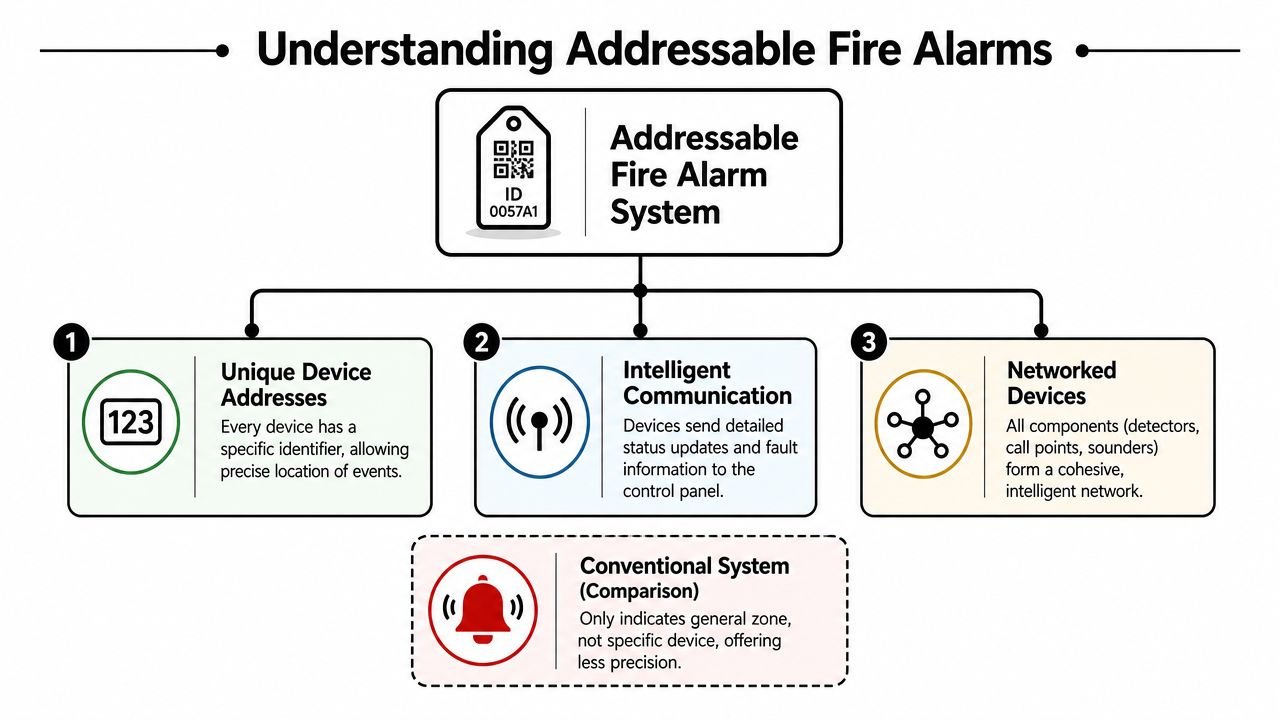
An addressable fire alarm system is a fire detection system where each device has its own unique digital identity. The panel doesn't just say that something happened in a general area. It can identify the exact device and its programmed location.
The simple idea behind addressability
A conventional system is a bit like a postcode. It gets you to the general area.
An addressable system is more like a full street address. It tells you the exact point you need to attend.
In UK systems, each device is assigned a unique digital address, often within a range such as 001 to 254, allowing the control panel to identify the exact device and physical location that triggered an event, as described in this technical overview of addressable system operation.
That matters during a fire alarm, but also during ordinary maintenance. If a detector starts to drift out of tolerance, gets contaminated, or develops a fault, the panel can point your engineer to the right device instead of forcing a long manual search.
The main parts working together
Most business owners don't need to know every wiring detail, but it helps to understand the basic structure:
- Control panel: This is the brain of the system. It receives information, displays events, stores logs, and controls outputs.
- Addressable loop: This is the circuit that connects devices together and back to the panel.
- Field devices: These include smoke detectors, heat detectors, manual call points, sounders, interfaces, and modules.
- Programming and text labels: These enable a device to become useful in real life. “Detector 043” is less helpful than “First floor comms room”.
The word “intelligent” is often used for these systems because the panel and devices are constantly communicating. That communication can include alarm status, fault conditions, and maintenance alerts.
A good addressable system doesn't just detect fire. It reports condition, location, and system health in a way that supports faster human decisions.
A common point of confusion is this. Addressable doesn't mean every building gets a completely bespoke system. The principle is standard, but the design still depends on the layout, risks, occupancy, and how the building is managed. A two-storey office, a warehouse, and a block with multiple tenants can all use addressable technology, but they won't be configured in the same way.
Conventional vs Addressable A Head-to-Head Comparison
The choice usually comes down to one question. Do you only need to know the zone, or do you need to know the exact device?
For a small, simple property, a conventional system can still be suitable. For larger, busier, or more changeable buildings, addressable systems usually make management much easier over time. If you want a background primer on the older format, this guide to conventional fire alarm systems is a useful companion.
What matters in day-to-day use
Here's the practical comparison most businesses care about:
| Feature | Conventional System | Addressable System |
|---|---|---|
| Alarm location | Shows the affected zone only | Shows the specific device and programmed location |
| Fault finding | Engineer often has to inspect the whole zone | Panel identifies the exact device or point of issue |
| Wiring approach | Separate radial circuits by zone | Devices connected on loops |
| Expansion | Can become awkward if the layout changes | Easier to add or reprogramme devices |
| Best fit | Smaller, lower-complexity premises | Larger, multi-room, multi-floor, or multi-tenant premises |
| Panel information | Basic zone-based indication | Detailed device-level events and records |
| Operational disruption | Investigation can take longer | Staff can go straight to the likely source |
| Long-term flexibility | More limited | Better suited to changing layouts and future growth |
There's no point pretending addressable is always the cheapest at the point of purchase. It often isn't. Panels, devices, commissioning, and programming can mean a higher initial cost.
But that isn't the full decision. Building owners should also think about how often the layout changes, how disruptive false alarms are, how long fault-finding takes, and whether multiple occupiers need clearer incident location.
A common pattern looks like this:
- Small single-unit premises: Conventional can still make sense.
- Growing businesses: Addressable often avoids an early replacement later.
- Complex managed buildings: Addressable usually gives the control and visibility the site team needs.
The mistake is choosing only on panel price. Fire alarm systems are used in emergencies, tested regularly, and maintained for years. Day-to-day usability matters as much as first cost.
Key Benefits for Your Business or Property
For most businesses, the primary value of addressable systems isn't that they're clever. It's that they remove friction when something goes wrong.
In the UK, commercial and industrial premises experience thousands of fires annually, with losses reaching hundreds of millions of pounds, and market projections indicate that by 2025 more than 70% of new medium and large commercial installations in England and Wales specify addressable control panels, according to UK market reporting on advanced fire detection. That's one reason these systems are now widely viewed as the sensible option where speed, continuity, and asset protection all matter.
Less disruption when alarms activate
If the panel tells you the exact detector location, your investigation starts in the right place.
That sounds obvious, but it changes the practical response. In a busy office, the responsible person or facilities team can direct checks to the precise room or area first. In a large premises, that can mean a more controlled response instead of everyone trying to interpret a vague zone message.
Some sites also use the detailed event information to support phased or managed evacuation strategies where the fire strategy permits. That's especially helpful in larger or more complex buildings where immediate whole-building disruption may not always be the most proportionate first response.
When a panel names the exact device, staff spend less time searching and more time acting.
Maintenance becomes more manageable
Addressable systems also help when there isn't a fire.
Modern systems can report faults, contamination issues, and device conditions in a more targeted way than a basic zonal system. That gives maintenance providers a better starting point and often reduces wasted time trying to locate an issue across a broad area.
For property managers, the operational benefit is straightforward:
- Clearer fault reporting: Engineers know which device needs attention.
- Better event history: Panels keep a more useful log of alarms, faults, and resets.
- Easier planning: Device-level information helps with maintenance scheduling and record-keeping.
- Less avoidable downtime: Problems can often be isolated more quickly.
Here's a short explainer that shows how modern fire alarm panels and devices work together in practice:
Compliance support, not just convenience
Detailed logs and clear device identification also strengthen your compliance position. If a detector faults, is disabled, or repeatedly alarms, that's visible in a way that's easier to document and follow up.
That doesn't replace fire risk assessments, routine inspections, or competent maintenance. It does give the responsible person better information to act on. In practice, that often means fewer blind spots and a cleaner audit trail.
Addressable Systems in Action UK Use Cases
The technical explanation only goes so far. It becomes much clearer when you look at the kinds of problems these systems solve on real sites.
Office buildings with multiple occupiers
Take a shared office building in Bristol. Several businesses occupy different suites, visitors come and go, and reception staff are usually the first people looking at the panel.
If the display only shows a zone, staff may have to search several rooms before they know whether there's a genuine incident. An addressable panel can identify the exact detector or call point, which helps the building team direct the check to the correct tenant area immediately.
That matters for two reasons. First, it shortens the time between alarm and investigation. Second, it reduces confusion between occupiers who may not know the building as well as the managing agent does.
Warehouses and logistics sites
Now consider a warehouse near Swansea or along the M4 corridor. The footprint is larger, shelving may change, forklift traffic creates dust movement, and a broad zone indication can leave a lot of ground to cover.
On these sites, knowing the precise activated point can help the team decide whether they're dealing with a loading bay issue, a plant space, a high-level detector over storage, or a manual call point near an exit route.
In a warehouse, “which detector?” is not a minor detail. It shapes how quickly the team reaches the right aisle, bay, or service area.
Addressable systems are also well suited to premises that change over time. If racking layouts, internal partitions, or tenancy lines move, the system can often be reprogrammed and extended more flexibly than a basic zonal arrangement.
HMOs, flats, and growing SMEs
In HMOs and apartment blocks, clarity matters because the responsible person may be dealing with residents, communal areas, and service contractors all at once. If a panel identifies the exact communal detector or interface point, the response is more controlled and records are easier to keep.
For smaller businesses, the decision is often about future-proofing. A company may start with one unit, then take on the neighbouring unit, add a mezzanine, or reconfigure office and storage space. An addressable system often handles that growth more cleanly than a setup designed around fixed broad zones.
Typical examples include:
- Managed apartment buildings: Better visibility across communal fire alarm devices.
- Small manufacturers: Easier adaptation when production areas change.
- Retail with stockrooms: Quicker distinction between a shop floor issue and a back-of-house issue.
- Professional services firms: Cleaner maintenance management in multi-room office layouts.
The best fit always depends on the building and fire strategy. But once a site becomes larger, busier, or more fragmented, addressable systems start solving problems that conventional systems can only describe in broad terms.
Design Installation and UK Compliance
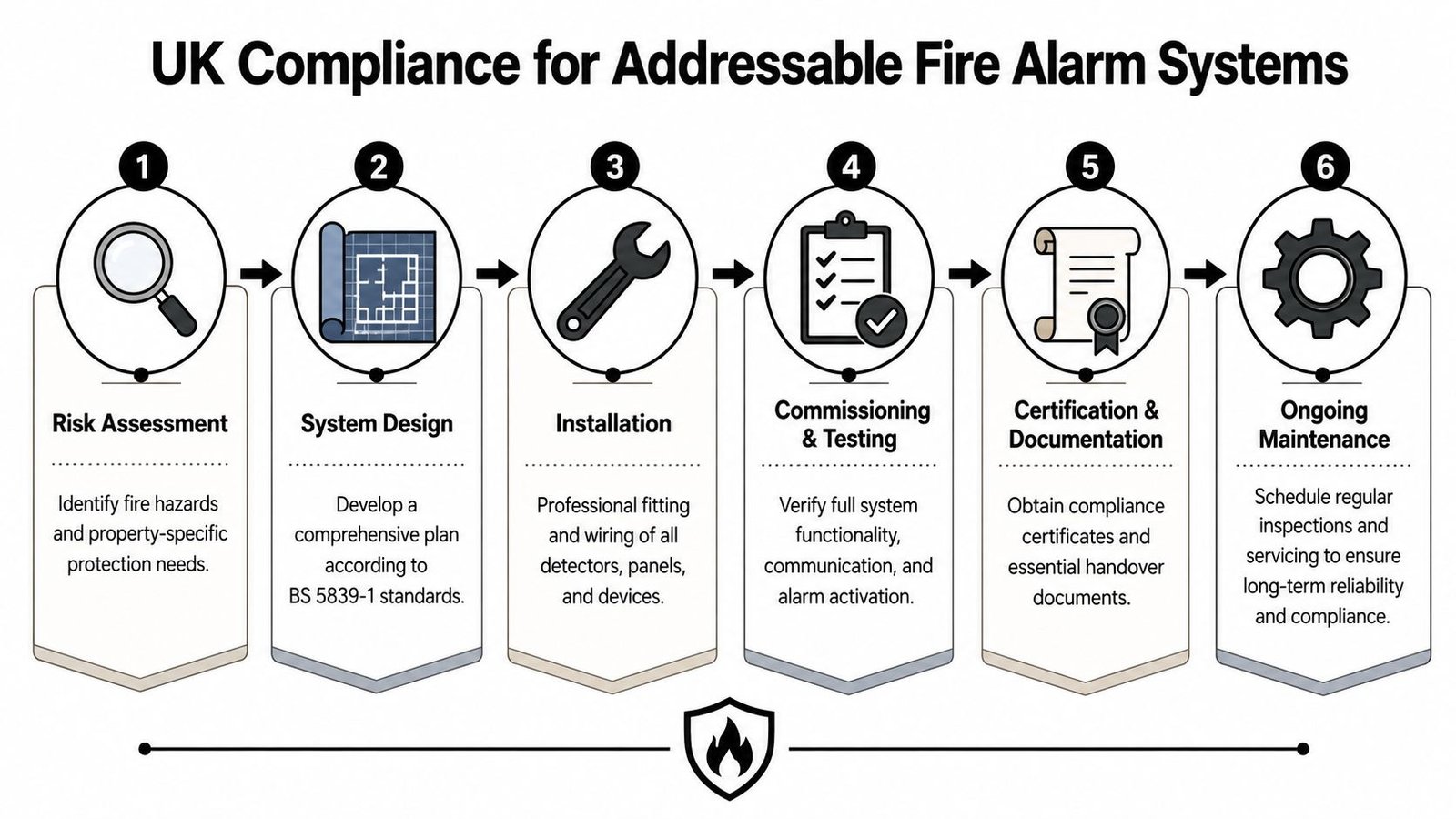
A fire alarm system can have excellent hardware and still perform poorly if the design is weak. Most compliance problems don't start with the detector. They start with assumptions made too early about layout, device choice, interfaces, or future expansion.
Why loop design matters
Addressable devices are commonly connected on loops, and loop capacity has a direct effect on scalability and resilience. A single addressable loop can support up to 250 devices, depending on the panel manufacturer and protocol, and this overview of conventional versus addressable system design notes that BS 5839-1 recommends designing with sufficient headroom for future expansion.
That point is often missed when a building owner is focused on today's layout only. If you're fitting out a premises in Cardiff Bay or refurbishing a mixed-use building in Bath, it's worth asking what happens when rooms are subdivided, tenancy changes, or extra interfaces are needed later.
Some sites also use dual-loop arrangements for greater continuity. That can help maintain coverage if part of the loop is damaged or isolated for maintenance, depending on the panel design and cause-and-effect strategy.
Integration needs proper planning
Addressable systems can do much more than sound alarms. In the right building, they can also trigger related safety functions such as:
- HVAC shutdown: Helping limit smoke movement through ventilation.
- Door release: Allowing escape routes to function correctly where access control is fitted.
- Damper control: Supporting compartmentation measures.
- Emergency lighting coordination: Helping the wider life safety response.
- Building management interfaces: Giving facilities teams clearer oversight.
Those integrations need to be documented, tested, and aligned with the fire strategy. They can't be treated as optional extras added loosely at the end.
For design teams working in BIM-based projects, detailed modelling resources such as Revit fire alarm drawings can be useful for coordinating detector locations, panel positions, and interfaces before installation starts.
Documentation is part of the system
A compliant installation is more than equipment on walls and ceilings. It includes the records that show why the system was designed that way, how it was commissioned, and how it should be maintained.
That usually includes the cause-and-effect logic, device schedules, zone plans where relevant, test results, user information, and maintenance arrangements. UK businesses also need to consider the wider duties attached to the responsible person role and building fire safety management. For a practical overview of that broader duty set, this guide to fire safety compliance requirements is worth reading.
A fire alarm system isn't compliant because it exists. It's compliant when the design, installation, records, and ongoing maintenance all stand up together.
This is why competent design and installation matter so much. The right system should match the building, support the evacuation strategy, and leave the responsible person with clear, usable information rather than a box of unexplained features.
FAQs About Addressable Fire Alarms
Are addressable systems only for large buildings
No. They're often associated with larger premises because the benefits become more obvious there, but smaller businesses can still benefit if the layout is split into several rooms, if false alarm disruption would be costly, or if the business expects to grow.
A small office with meeting rooms, stores, and staff areas may still value exact device identification. The right answer depends on complexity, not just square footage.
Can you upgrade from a conventional system
Often, yes, but it isn't always a direct swap.
Some projects involve a full replacement of the panel and field devices. Others can reuse parts of the existing infrastructure if the condition, compatibility, and design approach allow it. The only reliable way to answer this is with a site survey, because cable routes, building use, and compliance gaps all affect the scope.
Do they cost more to maintain
Not necessarily in a way that hurts the long-term business case.
The hardware and commissioning can be more involved at the start, but the system usually gives clearer fault information and better event history. That can make routine servicing and fault diagnosis more efficient. Over time, many businesses find the day-to-day management is easier, especially where the building is busy or operational downtime is expensive.
How often should the system be tested and serviced
Testing and maintenance should follow the system design, the applicable standards, and your maintenance contract. There's a difference between routine user checks, weekly testing arrangements where applicable, and planned professional servicing.
If you want a practical summary of routine expectations, this guide on how often fire alarms should be tested is a helpful starting point for responsible persons and site managers.
What should you look for in an installer
Look for competence first.
That means experience with similar buildings, a clear understanding of BS 5839, proper commissioning and documentation, and the ability to explain the design in plain language. You want an installer who can tell you why detectors are placed where they are, how interfaces will operate, what happens during faults, and what your team needs to do after handover.
It also helps to choose a company that can support the full life of the system, not just the initial installation. Fire alarms aren't fit-and-forget equipment. They need servicing, records, and sensible ongoing advice.
If you're reviewing fire protection for a site in Cardiff, Bristol, Newport, Swansea, or the wider South Wales and South West region, Wisenet Security Ltd can help you assess whether an addressable fire alarm system is the right fit. Their team designs, installs, and maintains compliant fire alarm solutions for businesses, landlords, and property managers who need clear advice, reliable workmanship, and ongoing support.