Night Vision CCTV Cameras: 2026 Buying Guide
You're usually looking into night vision CCTV cameras at the point where daylight has already failed you.
It might be a car on the drive that's been tampered with twice. A side gate that keeps getting left open. Staff arriving early to open a unit when the yard is still black. Or the simple fact that most of the worry starts after sunset, when you can hear something outside but can't tell whether it's a fox, a delivery, or someone testing a door.
From South Wales to the South West, that pattern is the same. People don't ring about cameras because they want more tech on the wall. They ring because they want certainty at the time of day when certainty is hardest to get. That's where night vision earns its keep. Not as a marketing feature, but as the difference between “something moved” and “that's the face, clothing, direction of travel, and vehicle involved”.
A lot of online advice stops at buzzwords. Infrared. Starlight. Colour at night. Thermal. Useful terms, but they don't answer the question most clients want answered. Will the footage still be usable in real UK conditions, with wet ground, streetlights, fog, reflections, and awkward mounting positions? That's the standard worth judging any system by. If you're weighing up a home setup in Cardiff, a shopfront in Newport, or a warehouse edge in Bristol, the same rule applies.
Table of Contents
- Why 24/7 Security Starts with Seeing in the Dark
- How Night Vision Technology Sees in the Dark
- Decoding Key Specs for Evidence-Grade Footage
- Choosing the Right Camera for Your UK Property
- Smart Installation and System Integration
- UK Legal Rules and Essential System Maintenance
- Your Purchaser's Checklist with Wisenet Security
Why 24/7 Security Starts with Seeing in the Dark
A typical callout starts the same way. The incident happened after dark, the camera was recording, and the footage still fails at the point it is meant to help. You can see a person-shaped figure near a side gate or a vehicle entering a yard, but not enough detail to identify a face, number plate, or sequence of events with confidence.
That is the real test of a CCTV system. Daytime footage can look sharp on a phone app and still fall apart on a wet Welsh evening. Rain, mist, backlit porches, sodium streetlights, and headlights entering frame all reduce usable detail. For UK sites, night performance is less about marketing terms and more about whether the camera can hold contrast, control glare, and keep detail in the parts of the scene that matter.
Clients usually want one thing. Footage they can use.
- For homes: clear images of anyone approaching the front door, side access, gate, or parked car
- For landlords and managing agents: reliable coverage of communal entrances, bin stores, rear paths, and parking bays
- For shops and small businesses: footage that supports break-in investigations, after-hours disputes, and delivery queries
- For commercial premises: consistent visibility across yards, shutter lines, service roads, and loading areas
Practical rule: If a camera only shows that somebody was present, it records activity. If it shows who arrived, where they went, and what they did, it gives you evidence.
I make this point early because buyers often focus on resolution and ignore the conditions the camera has to work in for half the year. A polished brochure image tells you very little about how a camera will perform against wet tarmac, reflective vans, patchy security lighting, or fog hanging over a yard at 5:30 in the morning. The distinction is important because evidence-grade footage depends on the whole scene, not just the sensor spec.
If you are still weighing up whether a system is worth installing, start with the wider benefits of CCTV surveillance and then judge the night-time side properly.
Some sites also need a higher-grade low-light camera where standard IR will not be enough. A good example is a long driveway, forecourt, or business perimeter with mixed lighting and deeper viewing distances. In those cases, a model such as the Dahua 4MP Starlight camera shows the type of hardware people often compare, but the result still depends on placement, angle, and the lighting conditions on the property.
How Night Vision Technology Sees in the Dark
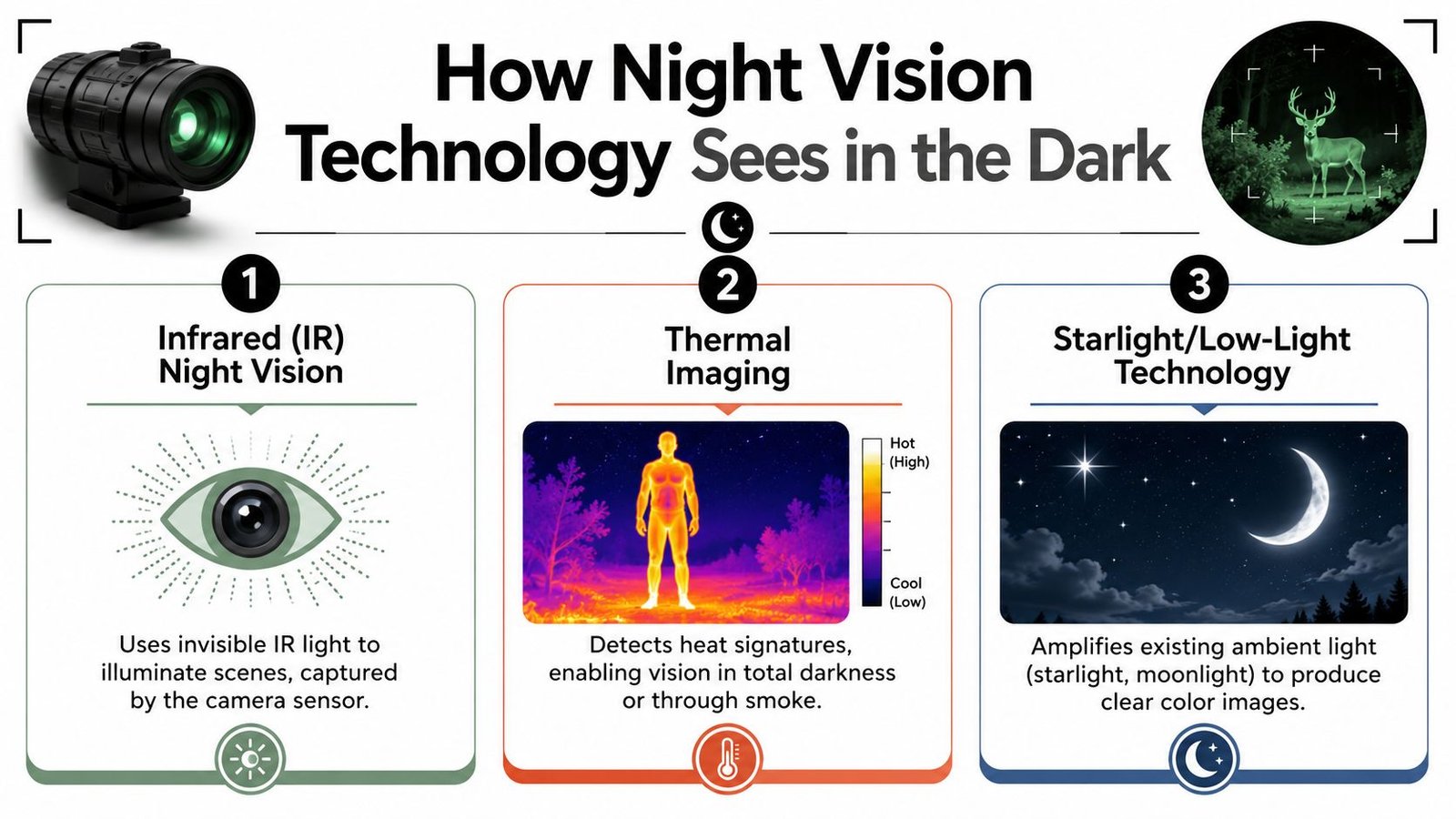
Night vision isn't one thing. It's three different approaches to the same problem, and each solves a different version of darkness.
Infrared is the standard starting point
Infrared, or IR, is the technology typically referenced when discussing a night vision camera. The camera uses invisible light to illuminate the area, and the sensor captures that reflected light. In total darkness, that usually gives you a black-and-white image.
For homes and smaller business sites, IR is often the right answer because it's straightforward and cost-effective. It works well when the target area is defined. A driveway, front path, side gate, or rear fire exit are all good examples. If the camera is aimed properly and the scene isn't too deep, IR can produce very serviceable footage.
Its weakness is scene behaviour. Wet paving, reflective signs, glossy vehicles, and some painted surfaces can bounce the illumination back unevenly. That's one reason a camera that looked fine in a showroom can struggle on a rainy UK evening.
Low-light cameras keep colour for longer
Low-light cameras, often sold under terms like starlight, work differently. Instead of depending entirely on infrared light, they make better use of the small amount of ambient light that already exists. Streetlights, spill from nearby buildings, a security lamp, or even modest background glow can be enough for the camera to hold colour longer than a basic IR model.
That matters because colour can carry evidence value. A dark jacket versus a bright high-vis top. A blue hatchback rather than a silver estate. Those distinctions can matter in statements, insurance conversations, and incident reviews.
On commercial jobs where mixed lighting is common, I often prefer this category over basic IR alone. A good example of the sort of camera people look at when comparing options is the Dahua 4MP Starlight camera, because it represents the kind of low-light design aimed at retaining more detail under poor lighting rather than relying on a simple “night mode” label.
A camera that keeps colour later into the evening can be more useful for identification, but only if the available light is consistent enough for it to work cleanly.
Thermal is for detection first
Thermal cameras don't need visible light in the same way. They detect heat differences. That makes them very strong at spotting a person moving along a fence line, across open ground, or through difficult conditions where ordinary optics struggle.
For larger sites, that can be a major advantage. Thermal is often the right choice when the question is, “Has someone entered the perimeter?” rather than, “What colour was their coat?” It's especially relevant where there's fog, foliage, or long boundary lines.
Guidance for commercial sites notes that the choice between IR, low-light, and thermal depends on the operational goal. IR works well at short range but can struggle with wet surfaces, low-light cameras maintain colour longer, and thermal cameras are strongest for pure detection along perimeters in fog or foliage, as discussed in this review of night-time camera setups for large commercial sites.
| Technology | How it Works | Best For | Main Limitation |
|---|---|---|---|
| Infrared | Uses invisible IR illumination to light the scene for the camera sensor | Driveways, doors, gates, small yards, short to medium range coverage | Can struggle with reflections and uneven scene lighting |
| Low-light / Starlight | Uses highly sensitive imaging to make the most of available ambient light | Colour footage in streets, forecourts, shopfronts, mixed-light areas | Needs some usable ambient light to perform well |
| Thermal | Detects heat signatures rather than visible detail | Perimeter detection, fence lines, open yards, poor visibility conditions | Better for detection than detailed visual identification |
Decoding Key Specs for Evidence-Grade Footage
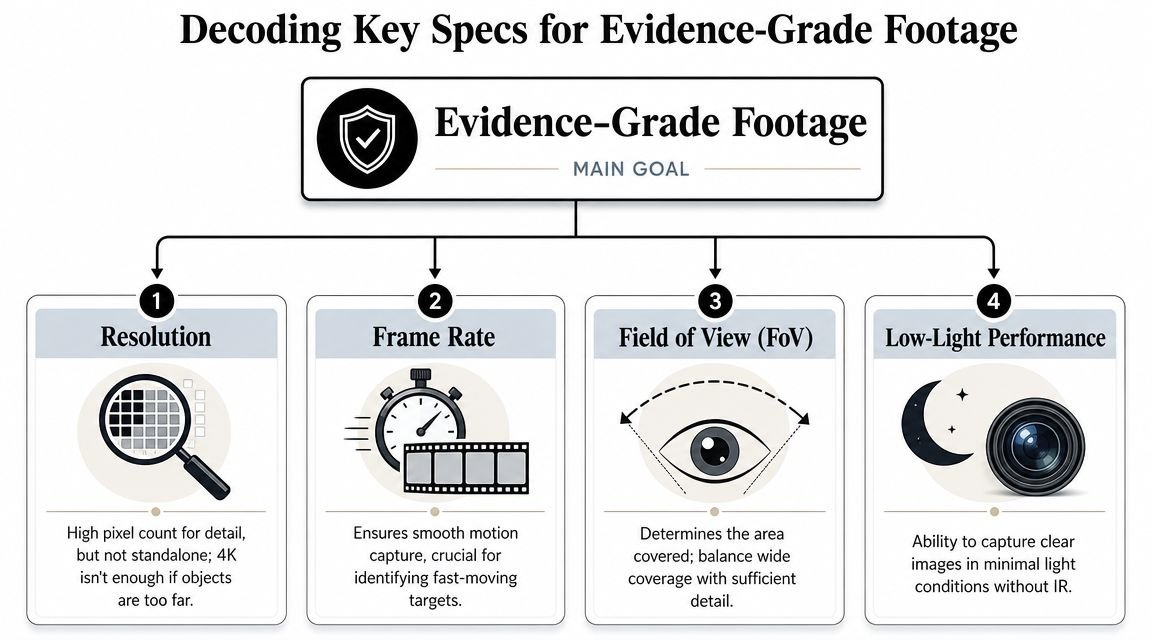
If you've compared cameras online, you've already seen the usual race. More megapixels. More promises. More labels on the box. In practice, evidence-grade footage comes from the right combination of resolution, illumination, sensor quality, lens choice, and setup.
Resolution only matters if the target is lit
A useful baseline for UK night work is 1080p, but that only works if the camera's infrared range covers the distance you're asking it to monitor. Commercial-grade IR bullet cameras are commonly specified at around 66 ft, while higher-output models can reach 200 ft in zero-light conditions, as shown in this night vision CCTV camera specification.
That relationship matters more than people realise. More pixels don't rescue an underlit scene. If the camera sees a face at the far edge of the frame but the IR has already fallen off, the extra resolution won't recover detail that was never illuminated properly.
A simple way to think about it is this:
- Resolution tells you how much detail the camera can record
- Illumination range decides whether that detail is available at the distance you need
- Lens choice determines how tightly that detail is distributed across the scene
The specs that actually affect usable evidence
For UK installations, I pay closer attention to the camera's behaviour in poor light than the headline resolution. A solid CMOS sensor is part of that. So is the lens and aperture. So is how the camera handles bright spots within a dark scene.
The common failure point is mixed lighting. A front door under a lamp with a dark drive behind it. A service yard with one floodlight on one wall and deep shadow elsewhere. A camera that can't balance that contrast won't give consistent results.
Here's what matters in plain terms:
- Sensor quality: Better low-light handling usually beats inflated headline specs.
- Field of view: Wider isn't always better. A camera covering too much area often spreads detail too thin.
- Frame handling: If people or vehicles move quickly, smooth capture matters. Otherwise faces and registration details become harder to assess.
- Compression and storage: Modern codecs help preserve footage without filling storage too quickly, which matters if you need to retain recordings for review.
- Power and cabling: PoE simplifies installation and tends to support more stable fixed-camera deployments.
For many buyers, the bigger decision sits one step earlier. Should you choose a modern IP setup or a legacy-style HD analogue system? This practical guide to the difference between IP cameras and HD analogue CCTV helps frame that choice properly.
Field note: The right question isn't “How many megapixels is it?” It's “At the exact point where someone will stand, can I identify them after dark?”
Choosing the Right Camera for Your UK Property
The right camera for a semi-detached house in Swansea isn't the right camera for a builders' yard outside Newport. One-size-fits-all advice is where most buying mistakes begin.
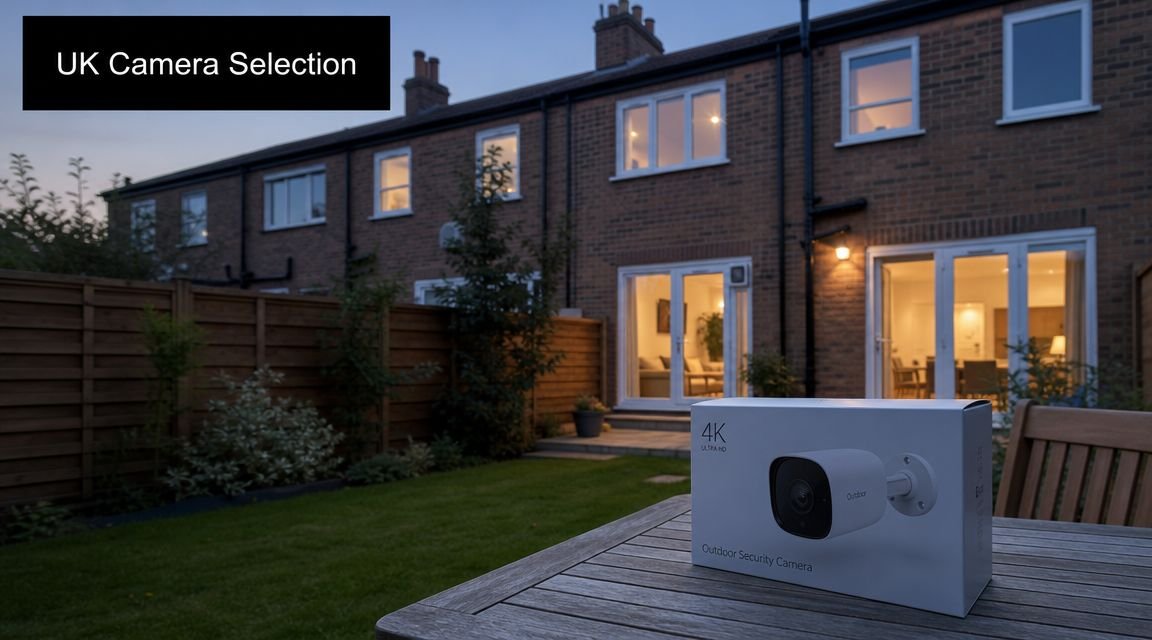
The question that matters most in the UK is whether the camera gives usable evidence after dark, not whether it technically “has night vision”. Independent guidance points out that real-world performance in rain, fog, and bright light often depends more on sensor quality, aperture, and placement than on megapixels alone, especially for faces or number plates at access points and in car parks, as explained in this piece on security camera night vision in low light.
Homes and small residential blocks
At a house, the highest-value zones are usually predictable. Front door. Driveway. Side access. Rear patio doors. Garden gate. That means fixed cameras often outperform more complicated setups because they're aimed at known approach routes.
For homes, I'd usually lean towards:
- A tighter view at the entrance: Better for facial detail than one ultra-wide camera trying to do everything.
- Careful use of ambient lighting: A modest porch or side light can improve usable results for low-light cameras.
- Disciplined placement: Avoid mounting where the lens faces straight into a light source or shiny vehicle panels.
A common mistake is fitting a camera too high because it feels safer from tampering. That often gives you the top of a head rather than a face.
Shops offices and small business premises
Small business sites often have awkward lighting. Shop signs, roller shutters, passing traffic, streetlamps, and glass can all make a scene harder than it first appears.
In those settings, the buying decision should follow the job the camera needs to do:
- Deterrence at the frontage: Visible cameras and clean coverage of the entrance work well.
- Identification at choke points: Till access, rear doors, alley gates, and staff entrances need tighter framing.
- Out-of-hours review: Good recorder setup and reliable storage matter as much as the camera itself.
This is also where integrated systems start to make sense. A practical setup might combine fixed night cameras, an alarm trigger, and remote review through a mobile app. That's the sort of joined-up design firms such as Wisenet Security Ltd install for homes and commercial premises in South Wales and the South West, alongside alarms and access control, when the requirement goes beyond a few standalone cameras.
A useful demonstration of what installers and buyers often compare in real use is below.
Warehouses yards and larger perimeters
Larger sites break domestic assumptions very quickly. A small camera with modest IR may be fine for a back garden and completely unsuitable for a yard, compound, or logistics edge.
For bigger areas, I'd separate the problem into layers:
- Entry points need identification. Gates, barriers, doors, and loading bays benefit from tighter, evidence-focused views.
- Open ground needs awareness. PTZ, long-range low-light, or specialist detection tools help here.
- Perimeters need early warning. The goal may be spotting movement before someone reaches the building line.
On these sites, trying to cover everything with one lens is usually what fails. Better results come from assigning a clear role to each camera.
Smart Installation and System Integration
A lot of poor night footage starts with a simple mistake. The camera is technically good enough, but it has been fixed too high, aimed across reflective paving, or pointed straight into a streetlight that looks harmless in daylight and ruins the scene after dark.
Installation decides whether night vision gives you usable evidence or a vague record that something moved. In South Wales, I see the same problems repeatedly on houses, yards, small industrial units, and shared access roads. Rain on block paving, mist hanging in a valley, sodium streetlights, and car headlights on wet tarmac all change what the camera can produce at night.
Placement decides whether night vision works
Night cameras need to be positioned for the job they are meant to do. A wide overview may help with general awareness, but it rarely gives the face detail or number plate detail needed after an incident. For identification, the camera has to be closer, lower, and aimed at the point where a person naturally pauses, approaches, or turns toward the lens.
A few installation rules make a real difference:
- Keep bright light out of the frame where possible: Streetlights, security lamps, and vehicle approaches can wash out darker parts of the image.
- Watch for nearby reflections: White soffits, gutters, signs, and wet walls can bounce infrared back into the lens.
- Cover the approach, not just the area: A clear view of the route someone uses is usually more useful than a very wide shot of the whole frontage.
- Set height to match the evidence needed: Cameras mounted too high often show the top of a hood instead of a usable face.
- Check the scene at night, in weather: An angle that looks fine on a dry afternoon can perform badly in rain or fog.
Higher is not always better.
For domestic properties, the best position is often lower and more deliberate than people expect. A front door camera should see a face before the person reaches the threshold. A driveway camera should deal with headlights, side spill from neighbouring lamps, and reflections from wet vehicles. A rear garden camera may need to avoid throwing infrared into fences, sheds, or nearby branches.
Integration makes footage faster to review and easier to act on
A camera that records on its own can still do the job. A connected system usually makes incidents easier to confirm and easier to manage, especially outside working hours.
The useful integrations are practical:
- Intruder alarms can mark the time of an activation so review starts with the relevant clip.
- Access control can tie a door event or gate entry to the matching video.
- Remote apps let a homeowner, manager, or keyholder check whether a real response is needed.
- Recorder search tools shorten the time spent hunting through hours of footage after a complaint, break-in, or trespass report.
For business sites, integration often matters more than adding another camera. If a staff entrance opens at 22:14, the video should be easy to pull up. If an alarm trips in a stock area, the system should show what happened around that time without a long manual search. That is usually what saves time after an incident.
Privacy and system design need to be considered together as well, particularly on mixed-use sites, shared yards, offices, and customer-facing premises. If the setup captures areas beyond your boundary or monitors staff and visitors, it helps to review CCTV and GDPR requirements for UK businesses before final commissioning.
The strongest systems are planned around real behaviour on site. Where people enter. Where they stop. Where vehicles turn. Where light falls apart in bad weather. That is what produces footage you can use.
UK Legal Rules and Essential System Maintenance
Plenty of systems fail long before the hardware wears out. They fail because nobody cleaned the lens, checked the recorder, reviewed the aim after building work, or thought through the legal side properly.
Know your responsibilities before you switch it on
For homeowners, the main issue is usually privacy. If your cameras view beyond your own boundary, you need to think carefully about what you're capturing and why.
For businesses, the duties are broader. You need a lawful purpose, sensible retention, and clear handling of the footage. Signage matters. Policies matter. Staff awareness matters. If you run cameras in a workplace or customer-facing environment, read this guide on CCTV and GDPR in the UK for businesses before commissioning or expanding a system.

Maintenance keeps night footage usable
Night cameras are less forgiving of neglect than people expect. A thin film of grime, spider activity near the housing, a shifted bracket, or water marks on the cover can all reduce image quality when the light drops.
For larger sites, maintenance matters even more because the equipment may be more specialised. Long-perimeter systems can use advanced CMOS sensors, motorised zoom, and high-output IR or laser illumination to extend surveillance from tens of metres to very long ranges, as shown in this long-range laser night vision PTZ overview. Equipment like that needs periodic checking if you expect it to keep performing.
A straightforward maintenance routine should include:
- Clean optics and housings: Dirt and residue show up far more at night than in daylight.
- Check alignment: A slight knock can shift the useful view off the target area.
- Review recordings after dark: Daytime checks don't reveal night-time weaknesses.
- Confirm storage is healthy: A camera that records badly is a problem. A camera that doesn't record at all is worse.
- Inspect seals and fixings: Welsh and West Country weather will exploit any weakness in the housing.
Don't judge a night camera by the image at midday. Test it in the exact conditions you're relying on it for.
Your Purchaser's Checklist with Wisenet Security
If you're narrowing down options, keep the purchase decision practical. Most mistakes happen when buyers choose a camera category before deciding what outcome they need.
Use this checklist before you commit:
- Define the job first: Are you trying to deter, detect, identify, or monitor an area after an alert?
- Name the exact locations: Front door, gate, driveway, shutter, loading bay, rear lane, car park edge. Vague coverage plans produce vague results.
- Match the technology to the scene: IR suits many short and medium-range jobs. Low-light is useful where ambient light helps. Thermal earns its place where perimeter detection is the main requirement.
- Think about night conditions, not catalogue photos: Wet ground, streetlights, mist, reflective vehicles, and dark clothing all change performance.
- Treat placement as part of the purchase: The same camera can succeed or fail depending on angle, height, and background lighting.
- Plan recording and response: Footage has to be easy to retrieve, review, and use.
- Decide whether integration matters: Alarm events, access logs, and remote viewing often make the whole system more useful than camera specs alone.
- Check legal responsibilities early: Especially if the cameras cover staff, customers, neighbours, or shared areas.
For most homes and businesses, the sensible route is a site-specific assessment rather than buying from headline specs alone. A local engineer can look at access points, lighting, cable routes, storage, privacy concerns, and the evidence standard you need after dark.
If you want a practical recommendation rather than a generic product list, Wisenet Security Ltd can assess your property in South Wales or the South West and advise on a night vision CCTV setup that suits the site, the lighting, and the evidence standard you need.