Burglar Alarm Installation Cost: 2026 UK Guide & Prices
A basic professionally installed burglar alarm in the UK usually starts at £500 to £525 for a simple bell-only system. That's the right starting point, but it's only the starting point, because the actual cost depends on the property, the install method, and whether you add monitoring and maintenance.
If you're reading about burglar alarm installation cost, you're likely doing the same thing. You've searched online, seen a few broad price ranges, and you're trying to work out whether your own house, shop, office, or unit will land at the low end or the painful end. The problem is that many guides stop at the headline number and never explain why one property gets a straightforward quote and the next needs more labour, more equipment, and ongoing fees that change the budget completely.
That's where a lot of surprise costs come from in South Wales and the South West. A modern semi in Cardiff is one thing. A stone property in Swansea, a listed building, a retail unit in Bristol, or a warehouse in Newport is another. The quote can look similar at first glance, but the job on site often isn't.
This guide gives you the practical version. No vague ranges without context. No pretending every building is the same. If you're comparing basic bells-only systems, smart app-controlled alarms, or fully monitored setups, the useful question isn't just “what does the alarm cost?” It's “what will I pay to buy it, fit it, run it, and keep it working properly?”
Table of Contents
- Understanding Your Burglar Alarm Cost
- UK National vs South Wales Price Benchmarks
- Decoding Your Quote The Key Cost Drivers
- Beyond Installation The True Cost of Ongoing Fees
- Cost Scenarios For Homes and Businesses
- How to Get Accurate Quotes and Reduce Costs
- Get a Clear Quote for Your Property in South Wales
Understanding Your Burglar Alarm Cost
If you're trying to set a realistic budget, start with the known baseline and then add the two things most online guides miss. First, the property itself changes the labour. Second, the ongoing ownership costs can matter as much as the install.
For a typical homeowner, the starting figures for a basic professionally fitted system are sensible enough. But a starting figure isn't a quote. It doesn't tell you whether your walls are easy to cable, whether the layout needs extra detection coverage, whether you want app control, or whether you're comparing a simple external siren with a monitored response package.
That's why I'd separate burglar alarm installation cost into three layers:
- Base system cost: The core alarm equipment and a standard installation.
- Property complexity: Extra labour caused by access, construction, layout, and cabling routes.
- Ownership cost: Monitoring, maintenance, servicing, and any compliance-related add-ons.
Practical rule: If you only budget for the install day, you probably haven't budgeted properly.
A lot of confusion also comes from mixing completely different systems into one conversation. A bell-only setup and a professionally monitored intruder alarm aren't the same purchase, even if both are sold as “alarm systems”. One is mainly an upfront cost. The other becomes a service contract as well.
When people want to understand the options before they ask for a site survey, it helps to look at examples of reliable intruder detection systems that show the difference between bell-only, smart, and monitored approaches. The useful part isn't the branding. It's seeing what features tend to sit in each category and how those choices affect the final bill.
UK National vs South Wales Price Benchmarks
The national numbers are useful because they give you a proper anchor. They stop the conversation drifting into guesswork.

What the national baseline looks like
According to Checkatrade's 2026 burglar alarm installation pricing guide, a basic bell-only wireless burglar alarm system with supply and professional installation typically starts at £525, while a wired bell-only system for the same configuration starts at £500. That example is based on 2 sensors and 1 door contact.
The same guide also states that professional burglar alarm installation labour averages £60 to £80 per hour, and that for a standard 2 to 3 bedroom house, installation costs excluding VAT begin at £500, with higher-specification systems going beyond £1,000.
For larger homes, the supply and install cost rises. The same source puts 4 to 5 bedroom houses at £800 + VAT and 6 to 8 bedroom homes at £1,200 + VAT.
That gives you a solid UK benchmark:
| Property size | Typical system level | Benchmark price |
|---|---|---|
| 2 to 3 bedroom home | Basic bell-only wired or wireless | From £500 to £525 |
| 4 to 5 bedroom home | Larger supply and install scope | £800 + VAT |
| 6 to 8 bedroom home | Large residential layout | £1,200 + VAT |
Why local properties change the number
South Wales and the South West don't have one property type. That matters more than people think.
A straightforward new-build in Cardiff or a clean, modern detached house outside Newport is usually predictable. Access is easier, routing is cleaner, and wireless devices often go in without much drama. Older terraces, converted properties, thick internal walls, awkward loft access, and mixed-use buildings are where the quote starts to move.
In practical terms, local pricing pressure usually comes from things like:
- Older construction: Solid walls and awkward cable routes slow the job down.
- Multi-storey layouts: Extra floors can mean more time testing signal paths, routing cables, or splitting zones sensibly.
- Mixed residential or business use: Shops with stock rooms, offices over retail, and multi-entrance buildings need more planning than a standard house.
- Expectations around finish: If the client wants minimal visible trunking or highly discreet placement, the labour usually goes up.
In this trade, the difference between an easy job and a frustrating one often isn't the panel or the sensors. It's the building.
This is why two alarm systems that look similar on paper can price differently once an engineer walks the site. The national figures are useful. They just aren't the last word for a property in South Wales or the South West.
Decoding Your Quote The Key Cost Drivers
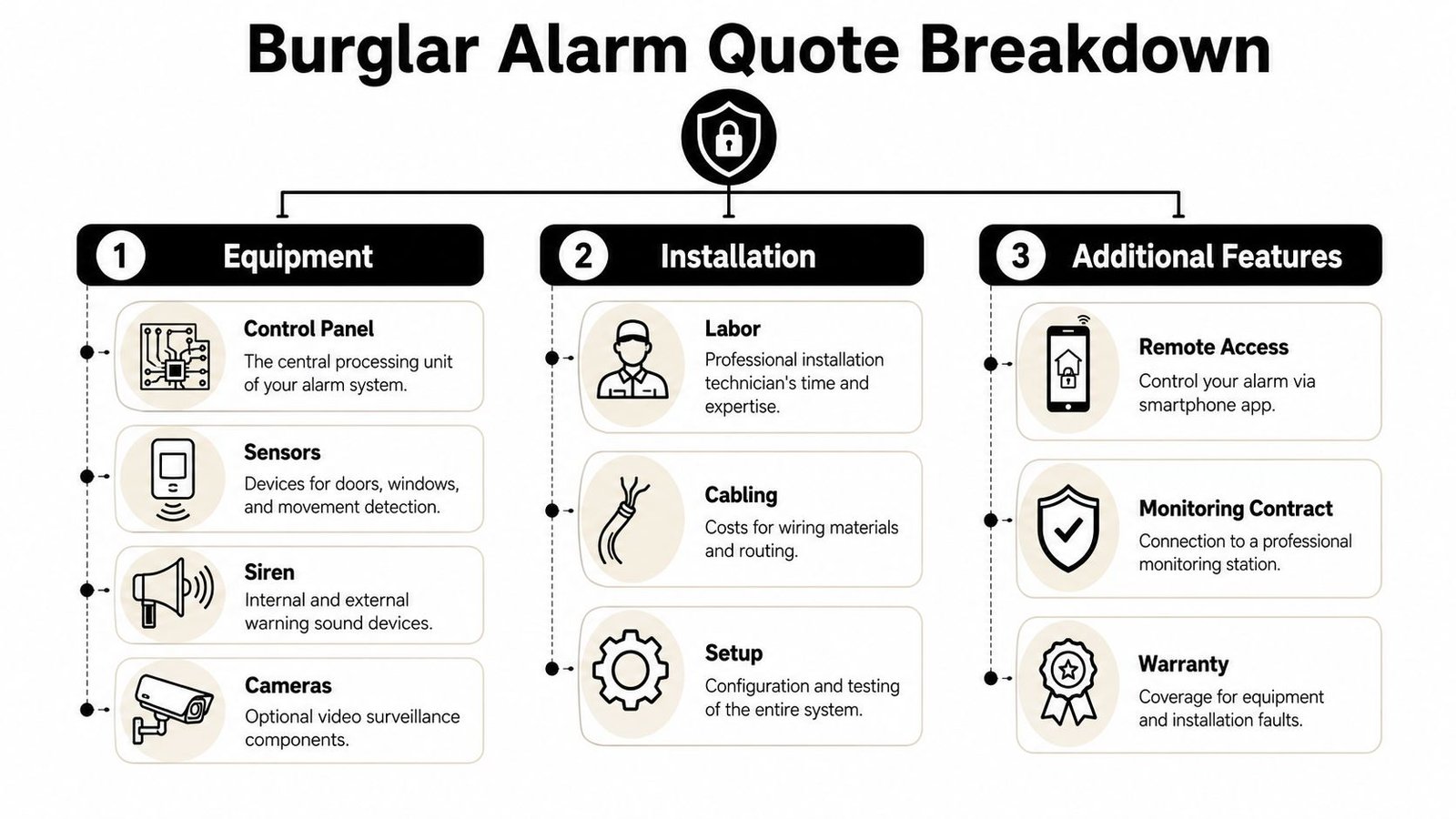
A burglar alarm quote is a bit like pricing a custom-built PC. Two systems can both be called “good”, but the final number changes depending on the parts, the complexity of the build, and what the user needs the system to do.
What you are actually paying for
At the equipment level, the quote usually covers the control panel, keypad, external sounder, internal warning device, and the detection devices themselves. In a basic home system that might mean door contacts and PIR sensors. In a more customized setup it could include pet-friendly sensors, extra zones, app control, or linked smart features.
The decision that changes the feel of the job most is wired versus wireless. If you want a useful plain-English comparison, this breakdown of types of intruder alarms shows why there isn't one “best” option for every property. Wireless is often cleaner and faster to retrofit. Wired can make sense where cabling is already accessible or where a larger commercial site needs a more fixed infrastructure.
A quote also reflects how much planning is needed before anything is fixed in place. Good alarm design isn't just counting doors and windows. It's deciding where a detector will work reliably, where a keypad will be convenient, how users will set and unset the system, and how to avoid nuisance activations.
Why labour moves more than the equipment
This is the part most guides gloss over. Equipment matters, but labour is where many jobs go off the standard baseline.
Existing guidance often misses how wiring complexity, multi-storey layouts, and heritage building restrictions in South Wales can push costs beyond the normal £500 to £525 starting point. In those harder installs, hardwired systems often exceed £1,500 because of the extra cabling and labour, as outlined in Bell Fire & Security's UK pricing guide for alarm systems.
That's believable from a practical site perspective. If an engineer can route cables cleanly through accessible voids, the job stays efficient. If the property has stone walls, finished décor, restricted access, old extensions, or listed-building limitations, every cable run takes longer and every device location needs more care.
The same source also notes that police response monitoring adds £300 to £700 in extra installation fees. That tends to surprise people because they assume monitoring only affects the monthly bill. It can also affect setup, signalling, and compliance requirements from the start.
Here are the cost drivers that usually matter most on a real quote:
- System type: Bell-only, smart self-managed, or professionally monitored.
- Property layout: More entrances, detached outbuildings, split levels, and long corridors all affect detector planning.
- Install method: Wireless retrofit tends to reduce disruption. Hardwired systems can become expensive when routes are awkward.
- Finish standard: Hiding cables neatly and preserving décor takes more time than surface-running everything.
- Response level: Police response options usually bring extra setup requirements.
“Cheap” quotes often stay cheap by leaving out the difficult parts. The system still has to work when the building is cold, occupied, empty, noisy, or being opened and closed every day.
Beyond Installation The True Cost of Ongoing Fees
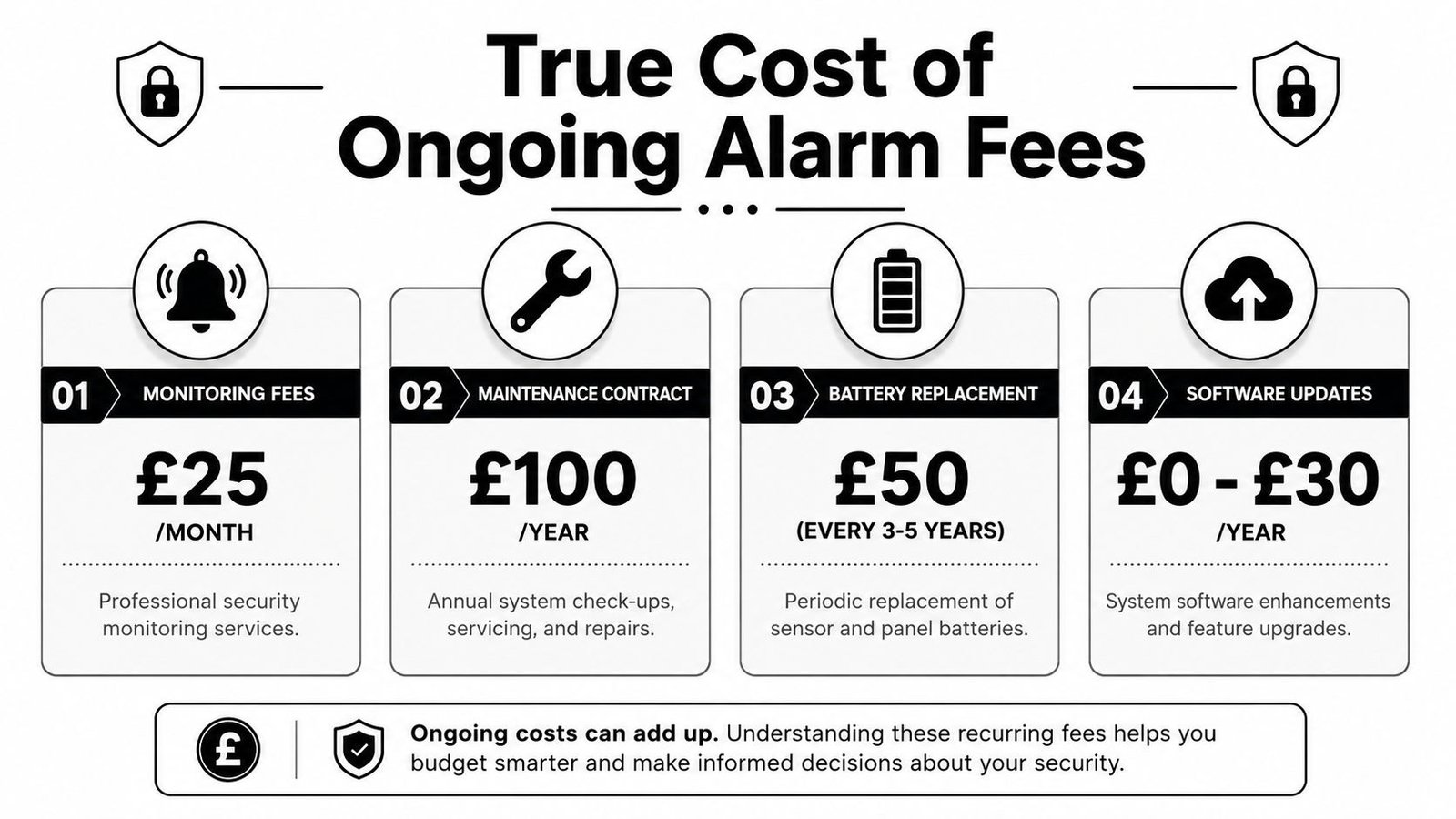
The biggest mistake in budgeting for burglar alarm installation cost is assuming the purchase ends when the engineer leaves site. For some systems it does. For many it doesn't.
Bell-only and monitored are not the same purchase
A bell-only system is closest to a one-off capital cost. You pay for the equipment and installation, and after that there's no mandatory monthly monitoring attached to the alarm itself. You may still want servicing, but the ownership model is simple.
A monitored system is different. It's partly an installation and partly an ongoing service. That service may include an alarm receiving centre, key-holder response processes, signalling, and annual maintenance expectations. If you only compare the day-one quote, you're not comparing the complete commitment.
That's why the first-year numbers matter more than the headline install figure. According to A Matter of Security's guide to alarm system cost, many guides underestimate the true first-year cost by quoting only the upfront installation price of £500 to £1,200 and ignoring monthly monitoring fees of £10 to £50 and annual maintenance costs of £120 to £500. Those recurring costs add £240 to £1,080 in the first year alone, making monitored systems range from £740 to over £2,200 annually.
What catches people out in year one
The trap is easy to spot once you know where to look. A system can appear affordable when the installer discusses only the panel, sensors, bell box, and fitting. Then the monitoring level gets chosen later, and the annual maintenance requirement appears as a separate line.
That isn't necessarily bad practice. It's just often explained poorly.
Use this checklist when you review a monitored alarm quote:
- Ask what is mandatory: Is the monitoring plan optional, or required for the chosen signalling setup?
- Check annual servicing terms: Some systems are only really sensible with a maintenance agreement in place.
- Separate installation from ownership: Put the one-off cost in one column and every recurring fee in another.
- Clarify response type: Self-managed app alerts, key-holder monitoring, and police response do not sit in the same cost bracket.
A lot of owners also benefit from understanding monitored options before they sign. A plain-language explanation of what a monitored alarm system is helps when you're deciding whether you need response handling or whether app alerts are enough for your property.
A monitored alarm can be the right decision. It's just not the same budget decision as a bell-only alarm.
If you're a homeowner, that difference affects monthly household outgoings. If you run a shop, office, or industrial site, it affects operating cost and contract planning. Either way, the wrong time to realise that is after installation.
Cost Scenarios For Homes and Businesses
Real quotes make more sense when you see how the logic changes from one property to another. The figures below are examples built from the verified UK benchmarks and recurring-cost ranges already covered, not one-size-fits-all promises.
Three common quoting situations
A modern family home usually lends itself to a wireless or hybrid setup. A small business often needs clearer zoning, opening and closing routines, and a decision on monitoring. A warehouse or industrial unit pushes hard toward more labour, tougher infrastructure, and stronger response planning.
Here's a practical comparison:
| Property Type | System Type | Estimated Installation Cost | Estimated Annual Monitoring & Maintenance | Estimated Total 1st Year Cost |
|---|---|---|---|---|
| 3-bedroom semi-detached home | Basic professionally installed bell-only wireless alarm | From £525 | Lower ongoing cost, depending on servicing choices | Starts from £525 plus any chosen maintenance |
| Small retail shop | Professionally monitored alarm | From the typical professional install range, often above basic home pricing | Monitoring and maintenance can add significant recurring cost | Can move into the monitored first-year range of £740 to over £2,200 |
| Industrial warehouse | Hardwired or complex commercial system with higher labour input | Can exceed £1,500 where cabling and layout are demanding | Ongoing support depends on monitoring level and maintenance contract | Usually requires a bespoke total-cost calculation |
For the 3-bedroom semi in Cardiff, the normal decision is convenience versus long-term fees. Many owners want app control, clean fitting, and enough coverage for the main entry points and circulation areas. If the property is straightforward, the bell-only wireless baseline often makes sense because it keeps the first bill easier to manage.
For a small retail shop in Bristol, the thinking changes. The owner may want separate areas for front-of-house and stock rooms, reliable unset routines for staff, and monitoring so activations are handled when the premises are closed. That doesn't automatically mean the system is expensive. It means the install quote is only part of the business cost. If you're weighing that against general overheads, a finance-focused reference such as this guide for limited company owners can help frame how security spend fits into broader company costs.
The warehouse in Newport is where generic online estimates usually fail. Larger footprints, roller shutter access, perimeter entry points, plant areas, office sections, and awkward cable routes all push the job away from standard domestic pricing. In these sites, the labour and design complexity often matter more than the basic control equipment.
The key lesson from all three is simple. Similar product names don't mean similar jobs. A domestic wireless alarm, a monitored retail install, and a hardwired industrial system all sit under “burglar alarm installation cost”, but they behave like three different purchasing decisions.
How to Get Accurate Quotes and Reduce Costs
The cheapest quote is rarely the lowest cost over time. The better target is a quote that matches the property properly, includes the right response level, and doesn't leave out the awkward details that appear later as extras.

How to compare quotes properly
Ask each installer to break the quote into the same categories. If one price includes supply, fitting, setup, and user handover, while another only includes hardware and a basic install, the comparison is useless.
A monitored system needs even more scrutiny. Midland Alarm's house alarm cost guide notes that professional monitoring ranges from £8 to £50 per month, that the true first-year cost of a monitored system can exceed £2,000 when subscription fees are included, and that annual maintenance contracts start from £80 + VAT per year. If that isn't shown clearly in the quote, ask for it in writing before you agree.
Use these questions when reviewing proposals:
- What exactly is included: Equipment, labour, commissioning, app setup, and user training.
- What happens after year one: Monitoring renewal terms, maintenance renewal, and service call charges.
- How will the system be installed: Wireless, wired, or hybrid, and how visible the final cabling will be.
- What standard is the system designed to meet: For many buyers, independent standards matter more than a brand name on the bell box.
If you want to check whether an installer works within recognised industry expectations, look at their relationship to the Security Systems and Alarms Inspection Board. That won't tell you whether a quote is the cheapest. It does help you judge whether the firm takes compliance and workmanship seriously.
Where it makes sense to save and where it does not
There are sensible ways to reduce cost. There are also false economies.
Saving money usually works when you reduce unnecessary coverage, choose the right response level, or go wireless in a property where wireless is clearly the cleaner fit. It usually does not work when the quote is cut by under-specifying awkward entry points, skipping maintenance planning, or treating a difficult building like a simple one.
A useful parallel exists with other property-related costs. The same way survey fees change with complexity, condition, and purpose, alarm pricing changes with risk and structure. This overview of factors affecting house valuation price is a good reminder that property services rarely price well from headline averages alone.
One good question: “What have you assumed about my property to reach this price?”
That single question often tells you whether the quote is realistic.
Get a Clear Quote for Your Property in South Wales
The right burglar alarm installation cost for your property won't come from a generic online range. It comes from a proper survey that accounts for the building, the risk level, the system type, and the long-term ownership model.
A simple bell-only alarm for a smaller home may stay close to the standard entry point. A monitored business system or a hardwired install in an older South Wales property can move well beyond that once labour, response options, and maintenance are accounted for. That isn't overpricing. It's the difference between quoting a product and quoting a working system.
For homeowners, landlords, retailers, offices, and industrial sites across Cardiff, Newport, Swansea, Bristol, and the surrounding area, the useful next step is to get a site-specific assessment. That's how you find out whether wireless is suitable, whether hardwiring is worth it, and what your first-year cost will look like.
If you want a transparent, property-specific quote, contact Wisenet Security Ltd. They serve South Wales and the South West with custom alarm design, installation, and maintenance, and can advise on bell-only, smart, and monitored systems based on your building rather than a generic online estimate.