

The Real Benefits of CCTV for UK Homes & Businesses
A lot of people still think CCTV only matters after something has gone wrong. In practice, the strongest argument starts much earlier. The College of Policing says CCTV reduces crime by an average of 13% where it is installed, compared with areas without it. For homeowners and businesses in South Wales and the South West, that changes the conversation. CCTV isn't just about recording incidents. It's about making your property a harder target in the first place.
That matters whether you're protecting a family home in Newport, a shop in Cardiff, a yard in Swansea, or a warehouse outside Bristol. A properly specified system can deter opportunists, capture usable evidence, let you check your site remotely, and in some business settings, help you run operations more efficiently. It also comes with legal responsibilities, especially if your cameras capture public areas or people at work.
Table of Contents
- Is a CCTV System Worth the Investment
- Deter Crime Before It Happens
- Gather Undeniable Evidence When It Counts
- Monitor Your Property From Anywhere in the World
- Gain Operational Insights for Your Business
- Navigating UK Legal Rules and Best Practices
- Your Next Steps to a Safer Property
Is a CCTV System Worth the Investment
For most property owners, the primary question isn't whether cameras are useful. It's whether they'll deliver enough practical value to justify the spend. In most cases, the answer depends on how the system is designed, where cameras are placed, and whether the setup matches the actual risks on your site.
Cheap, badly positioned cameras often disappoint. They record the top of someone's hood, miss the gate, blow out at night, or stop being useful the moment weather turns. A well-designed system does the opposite. It covers the approach routes, entrances, vulnerable edges, and key internal spaces that matter when something happens.
There's also a big difference between older analogue thinking and current IP-based systems. If you want a useful overview of the advantages of network security cameras, it's worth looking at how IP setups improve image quality, remote access, and flexibility. Those are the features that usually make the investment feel worthwhile day to day, not just after an incident.
What owners are really paying for
A good CCTV system usually delivers value in four ways:
- Deterrence: Visible cameras and signage can make offenders move on.
- Evidence: Clear footage helps police, insurers, and managers establish what happened.
- Visibility: Remote viewing lets you check a property without being there.
- Control: Business owners can use modern systems to monitor risk, workflow, and access patterns.
For anyone budgeting realistically, installation cost matters. A useful starting point is this guide to CCTV installation costs, because price varies with property size, camera count, recording method, lighting conditions, and whether you need remote monitoring.
Practical rule: Don't buy cameras by count alone. Buy coverage of the risks you actually have.
In South Wales, I'd usually tell owners to think less about “How many cameras do I need?” and more about “What do I need to see clearly, at what time of day, and what action do I want to take when something happens?” That's where CCTV stops being a gadget and starts becoming part of a working security system.
Deter Crime Before It Happens
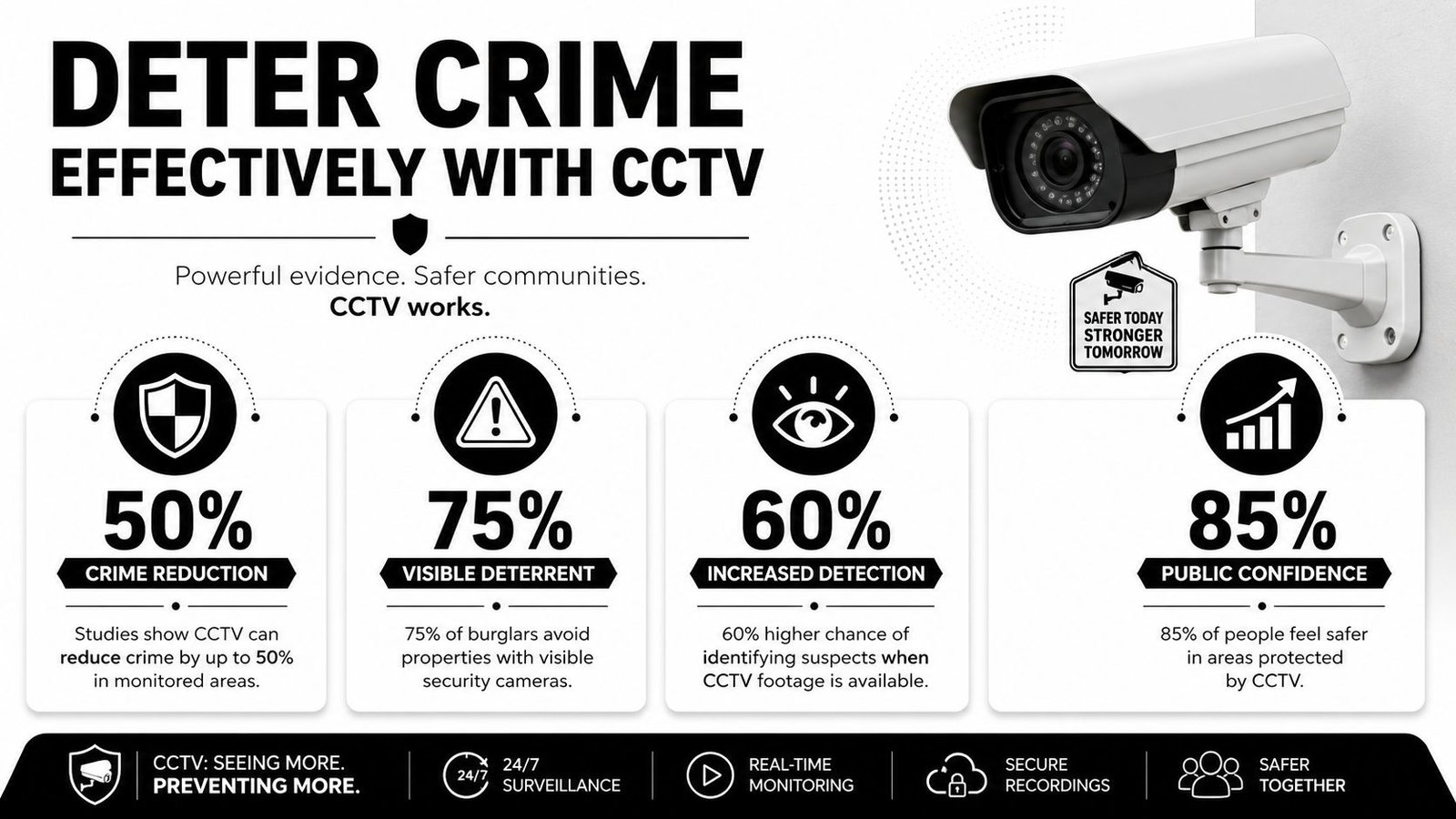
A camera does its best work before anyone touches a door, gate, shutter, or vehicle. In practice, deterrence comes from changing the risk calculation. If a property looks hard to approach without being seen, many opportunist offenders decide it is easier to move on.
That matters in South Wales and the South West, where the day-to-day problems are often practical ones rather than dramatic ones. Door-handle checks on quiet streets. Theft from vans on driveways. Rear-lane access to gardens, garages, yards, and trade premises. A visible CCTV system raises the chance of being spotted, identified, and interrupted, and that alone can be enough to prevent the attempt.
The Home Office's surveillance camera guidance for homes and domestic properties also reflects a point installers see every week. Cameras work best when they are positioned for a clear purpose, not just mounted wherever there is a convenient wall.
Why visible CCTV changes behaviour
Opportunistic crime usually depends on three conditions. Quick access, low visibility, and an easy exit. CCTV disrupts each one.
A well-placed camera tells a would-be offender that entry points are covered, time on site carries more risk, and the route away may also be recorded. That is why entrances, side passages, driveways, rear gates, loading bays, and car park exits often matter more than a single wide shot from high level.
I see this mistake regularly. Owners fit one camera to “cover the building” and feel reassured because they can see the whole frontage on screen. The problem is that wide coverage often means weak detail. For deterrence, people need to feel exposed. For that, the camera has to be visible and obviously aimed at the route they intend to use.
Homes and businesses need different deterrent layouts
For homes, the usual pressure points are the front approach, driveway, side access, rear garden entrance, and any detached garage or shed. On many domestic jobs, the weak point is not the front door. It is the side path or back fence line where someone can work without being noticed from the street.
Commercial sites need a different layout because the risks are different. Shops benefit from visible coverage at the entrance, till area, and stock hotspots. Offices often need reception, delivery points, and staff-only access doors. Yards, warehouses, and industrial units usually need gates, loading areas, perimeter blind spots, and out-of-hours coverage where vandalism, trespass, or fly-tipping is a concern.
Good deterrence comes from covering the approach, the entry point, and the exit route clearly enough that the site no longer looks easy.
What works in practice, and where owners get it wrong
| Approach | What works | Common mistake |
|---|---|---|
| Visible cameras | Makes the site look watched and raises the perceived risk of being identified | Mounting cameras too high or too wide to influence behaviour at entry points |
| Signs and clear notices | Warns people before they enter and supports UK privacy expectations | Treating signage as a substitute for proper coverage |
| Motion alerts or live monitoring | Helps owners or keyholders respond faster when someone enters a risk area | Relying on alerts without checking lighting, mobile signal, or notification settings |
| Lighting paired with CCTV | Improves visibility and makes cameras more obvious after dark | Adding bright lights that create glare and wash out the image |
There is a trade-off here. Highly visible cameras are good at discouraging casual offenders, but the layout still needs to serve the property. A detached house may need obvious front coverage and more discreet protection at the rear. A business may want cameras that are clearly visible to customers while keeping staff entrances, service yards, and stock access under tighter observation.
Signage helps too, both for deterrence and for compliance. In the UK, if your system captures people beyond your boundary or records staff, visitors, or members of the public, clear notices are part of doing the job properly. They also have a plain security benefit. They tell someone, before they commit to entering, that the property is monitored and that their time on site may be recorded.
Gather Undeniable Evidence When It Counts
Deterrence is the first win. Evidence is the second. When something does happen, clear footage can settle arguments quickly, support a police investigation, and help an insurer understand what transpired.
That only works if the footage is usable. The prosecution value of IP CCTV footage is critical in the UK criminal justice system, and evidentiary clips were notably instrumental in bringing looters and rioters to justice during the 2011 London riots. That tells you something important. Footage isn't just there for your own review. It can become part of a formal legal process.
What makes footage useful
A camera can be recording all day and still fail when it matters. In practice, usable evidence usually depends on a few basics being done properly:
- Resolution matched to the task: a wide overview is useful, but entrances often need tighter identification shots.
- Night performance: if your problem risk is out of hours, daytime image quality doesn't tell the whole story.
- Accurate time and date stamping: footage loses value quickly if the timeline is unreliable.
- Stable recording and storage: dropped footage, overwritten clips, and failed drives create obvious problems.
For businesses, I'd add one more point. If the system covers tills, stock movement, or staff-only areas, camera angles need to show actions clearly without creating unnecessary privacy concerns. That's part technical design, part policy.
Why professional setup matters
Many poor systems fail for ordinary reasons. The camera faces direct glare. The night image is overexposed. The recorder is tucked away in an insecure cupboard. The internet viewing works, but nobody has checked whether playback is smooth enough to export clips quickly.
Field advice: If you can't identify a face or follow the sequence of events without guessing, the footage won't do the job you bought it for.
For homes, clear evidence can support claims after theft, trespass, or criminal damage. For businesses, it can resolve disputes about deliveries, break-ins, anti-social behaviour, and incidents involving staff or customers. Good footage also saves time. Police don't want hours of vague video. They need clips that are time-specific, clear, and easy to review.
That's why image quality should be specified around outcomes, not marketing labels. “HD” on the box isn't the same as reliable evidence at the gate, in the car park, or under low light.
Monitor Your Property From Anywhere in the World
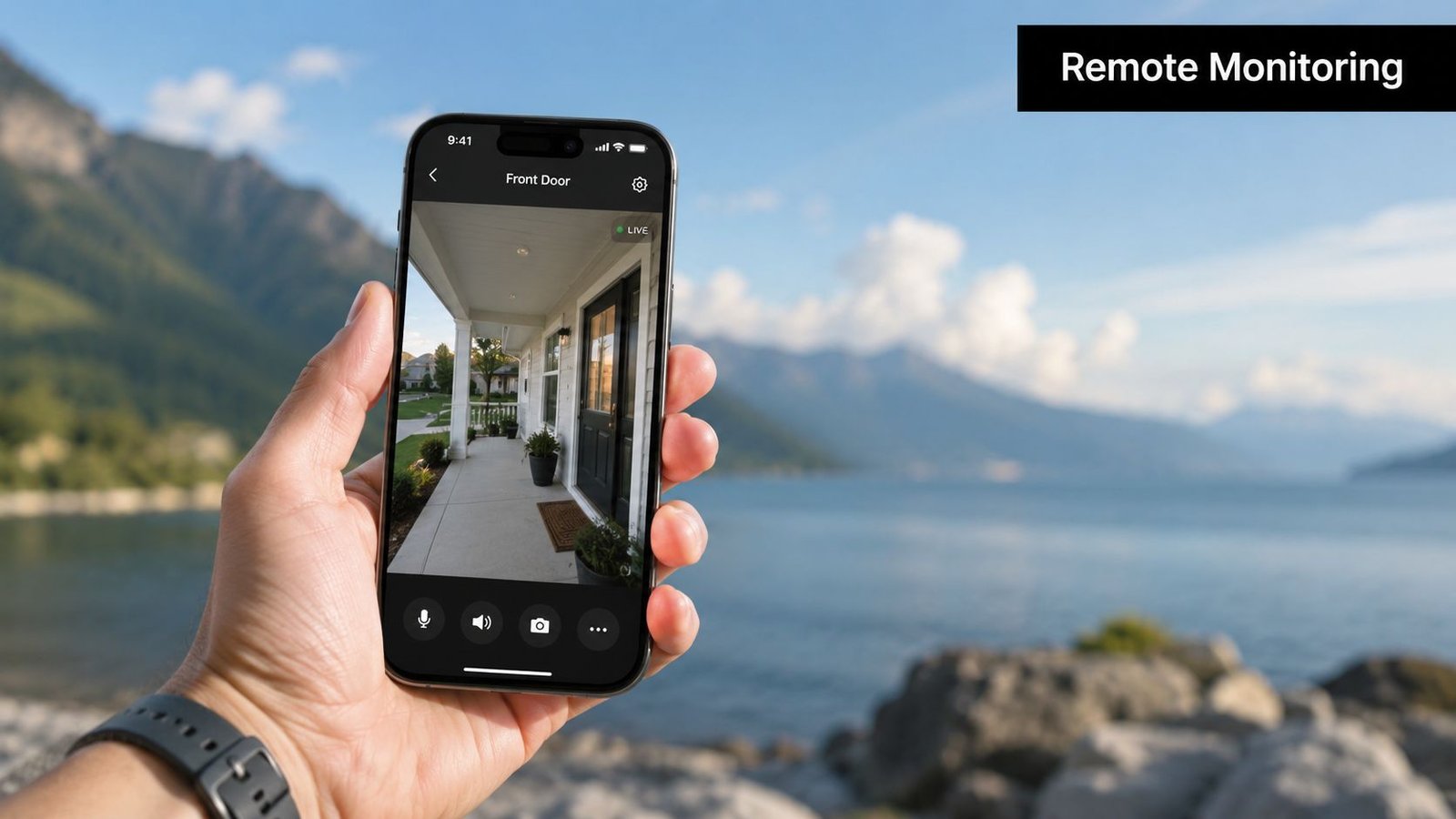
One of the most practical benefits of CCTV today is simple. You don't have to be on site to know what's happening. A decent system puts live and recorded views on your phone, so you can check a property in seconds instead of driving over or waiting for someone else to look.
For homeowners, that usually means everyday reassurance. You can confirm a parcel was delivered, check whether the side gate was left open, look in on the driveway while you're away, or see what triggered a late-night alert. For landlords and holiday-home owners, remote viewing helps when the property sits empty for stretches of time.
Self-monitoring and professional monitoring are not the same
A lot of buyers blur these together, but they're different.
Self-monitoring means your phone gets the alerts and you decide what to do. That's fine for many homes and some small sites. It gives you visibility and control, but it still depends on you being available, awake, and willing to act.
Professional monitoring is different. For businesses in South Wales and the South West, monitored CCTV services can reduce or eliminate the need for on-site security guards, with monitoring costs being 80 to 90% cheaper than employing human guards during out-of-hours periods. That's one reason monitored systems are so common for warehouses, compounds, trade counters, and retail units that can't justify a physical guard overnight.
Real-world use cases that matter
Remote access proves its value in ordinary situations:
- Homeowners on holiday: a motion alert arrives, you check the live feed, and decide whether it's a fox, a neighbour, or something worth escalating.
- Shop owners after closing: you confirm the shutter is down, the front is clear, and no one has stayed inside.
- Warehouse managers: you check loading areas before first arrival or after an alarm activation.
- Property managers: you review communal access issues without waiting for a contractor visit.
There is a trade-off, though. More access and more convenience mean you need the system configured properly. User permissions, strong passwords, secure apps, and sensible notification settings all matter. Otherwise, owners get drowned in alerts or leave remote access looser than it should be.
Remote viewing is only useful if the system is easy to use
If opening the app is clunky, playback takes too long, or alerts arrive constantly for harmless movement, people stop checking. The best systems feel routine. Open the app, view the right camera, review the clip, and act if needed.
For businesses considering a broader setup, AI CCTV systems that improve security can also help reduce nuisance alerts by making detection smarter and more targeted. That matters because the key convenience of CCTV isn't just seeing everything; it's seeing the right thing at the right time.
Gain Operational Insights for Your Business
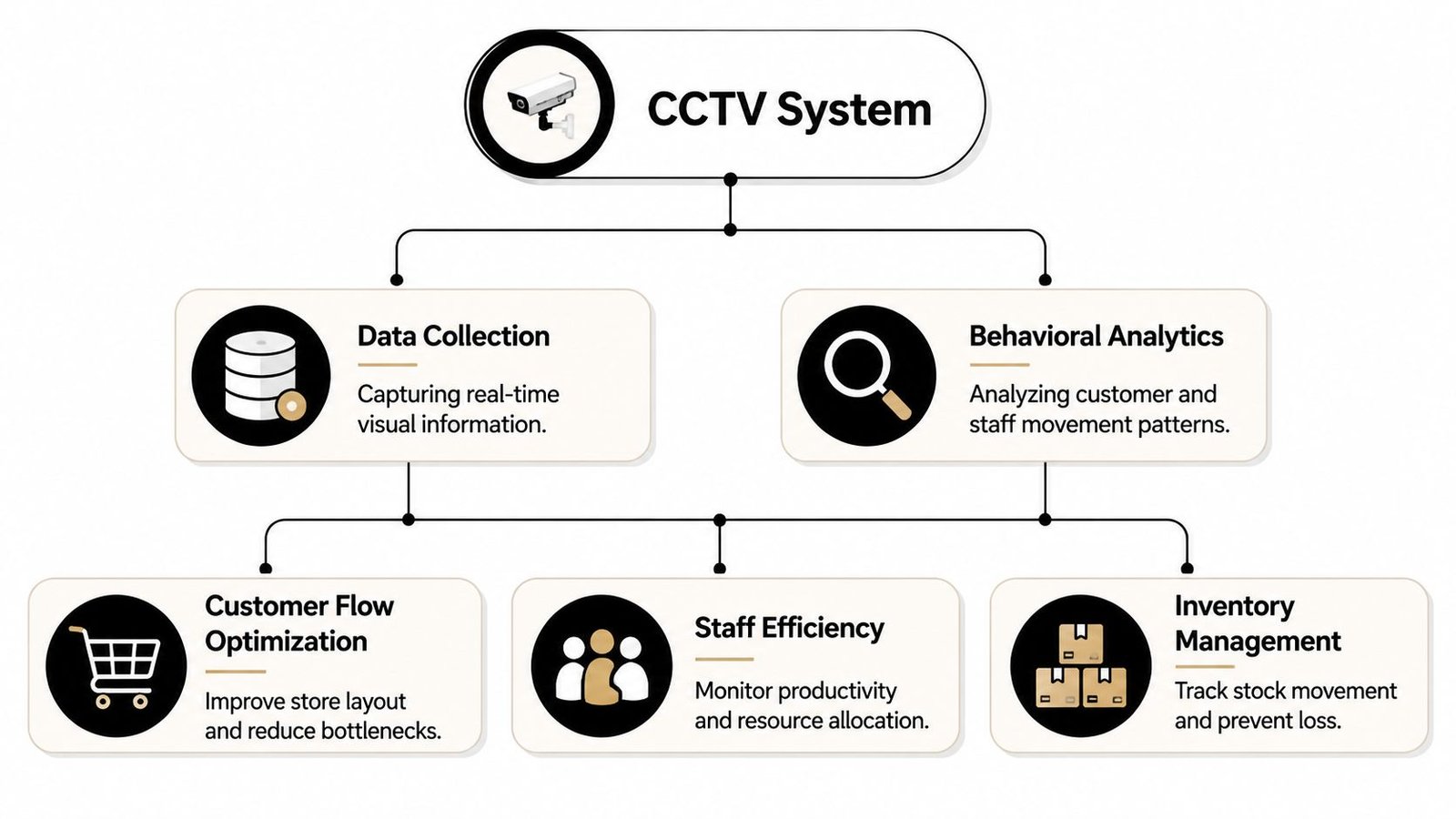
A well-planned CCTV system does more than record incidents. For many shops, warehouses, offices, and multi-occupancy sites across South Wales, it also shows how the site runs day to day. That matters because owners often make staffing, layout, and process decisions based on habit, not evidence.
In practice, the useful question is simple. What is happening on site that is costing time, money, or control?
Where businesses see the benefit
In retail, camera footage can show true peak periods, queue pressure, dead areas in the shop floor, and whether displays are drawing people where you want them. That helps with rota planning, till coverage, and product placement.
In warehouses and industrial sites, the value is usually different. Managers use footage to review loading routines, gate activity, stock handover points, vehicle movements, and repeated process failures that lead to delays or disputed losses.
For landlords and property managers, CCTV often highlights patterns that are easy to miss in complaint logs alone. Recurring delivery congestion, misuse of shared entrances, doors being left unsecured, and access bottlenecks all show up clearly on video.
Security footage can improve operations as well
The same camera can serve more than one purpose if it is positioned and configured properly. A customer entrance camera may help with loss prevention and footfall review. A loading bay view can support theft investigations, driver disputes, and safer vehicle movements. Internal corridor coverage can help review incidents, monitor restricted access, and check whether procedures are being followed.
That is where return on investment often improves. One system supports security, supervision, and process checking instead of doing only one job.
A practical way to assess the value looks like this:
| Business area | What CCTV can help you see |
|---|---|
| Customer flow | Busy periods, queue build-up, entry patterns |
| Staff deployment | Whether team coverage matches real demand |
| Stock handling | Movement through internal risk points |
| Risk management | Accidents, disputes, unauthorised access |
Better analytics save management time
Some business owners want more than standard recording and playback. They want searchable footage, better alert filtering, and event-based review so staff are not scrubbing through hours of video to find one incident.
For a broader view of how platforms are applying advanced artificial intelligence for public safety, it is useful to see how AI tools classify activity and turn video into searchable events. On a business site, that can mean finding a person, vehicle, or movement event much faster than manual review.
For firms considering that route, AI CCTV systems that improve security can also reduce nuisance alerts and make footage easier to work with for real operational decisions.
There is a trade-off, though. More analytics is not automatically better. If the system is badly specified, owners end up with too many reports, unclear retention rules, and features nobody uses. The best results come from deciding in advance what the cameras need to answer, whether that is queue pressure, stock discrepancies, delivery disputes, or repeated access problems.
That is how CCTV starts paying back in more than one way. It helps prevent loss, tightens day-to-day management, and gives business owners in South Wales a clearer picture of what is really happening on site.
Navigating UK Legal Rules and Best Practices
CCTV in the UK is not a free-for-all. If your system captures people beyond your private domestic use, data protection rules can apply. That's where many owners get uneasy, especially business owners who want stronger security but don't want to create a compliance problem.
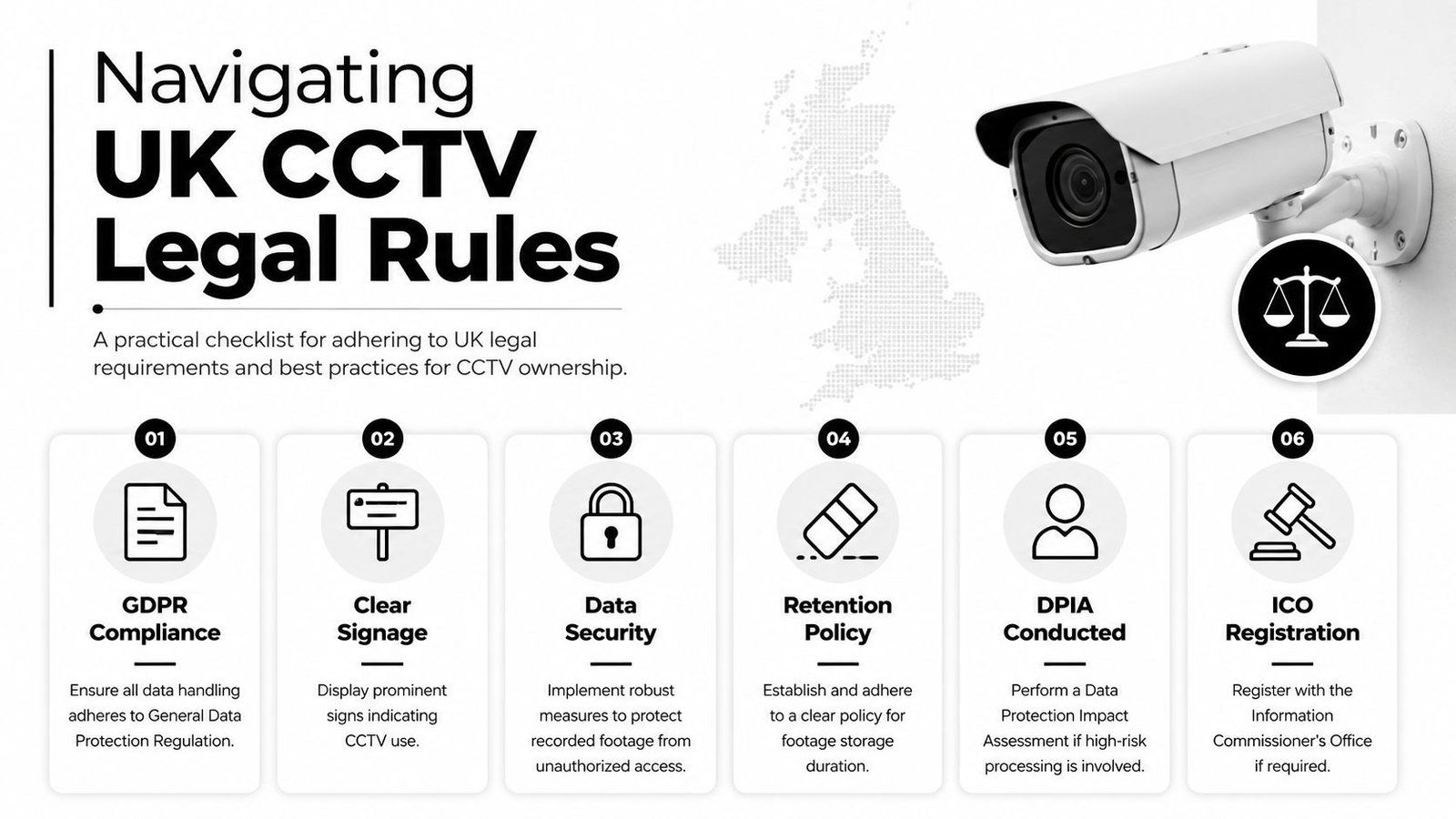
For businesses, the basics are straightforward. You need a clear reason for using CCTV, appropriate signage, secure handling of footage, and policies that match what the system is doing. If your cameras are monitoring staff, shared access routes, public-facing areas, or customer spaces, you should be able to explain why that surveillance is necessary and proportionate.
What homeowners need to watch for
If your cameras only cover your own private space, the legal burden is usually lighter. Problems start when the system captures a neighbour's garden, a shared alley, or a public footpath more than incidentally. At that point, privacy expectations become relevant.
A practical homeowner checklist looks like this:
- Aim cameras carefully: cover your boundary and access points, not the neighbour's living space.
- Use signage where appropriate: especially if the coverage is visible and extends beyond purely private space.
- Secure app access and recordings: household footage can still be sensitive.
- Keep recordings for a sensible reason: don't keep clips indefinitely without need.
What businesses should have in place
Business use needs more structure. In simple terms:
- Defined purpose: crime prevention, staff safety, access control, incident investigation, or another legitimate reason.
- Clear notices: people should know CCTV is in use and who operates it.
- Restricted access to footage: not every manager needs full viewing or export rights.
- Retention rules: keep footage in line with your purpose and policy.
- Documented assessment where needed: particularly if surveillance is intrusive or higher risk.
- ICO obligations considered: many businesses will need to register and handle CCTV as part of their wider data protection duties.
If you need a practical business-focused overview, this guide on CCTV and GDPR in the UK is a sensible starting point.
The legal test is rarely “Can you install cameras?” It's usually “Can you justify what they cover, how you use the footage, and how you protect it?”
Best practice in system design
Legal compliance and technical design go together more than people think. A poorly designed system often creates legal headaches. Cameras are pointed too widely. Audio is enabled without a good reason. Staff are monitored in a way that feels excessive. Passwords are shared informally. Clips are exported and passed around without control.
For that reason, specification matters. Good installers think about:
- Resolution for the task: overview versus identification
- Night vision and lighting conditions: especially for yards, lanes, and external doors
- Recorder security: where footage is stored and who can access it
- Retention settings: so footage isn't kept longer than intended
- User permissions: separate access for owners, managers, and authorised staff
This is also where professional installation earns its keep. A local installer familiar with home and commercial environments in South Wales can design coverage that protects the property without overreaching into spaces that create unnecessary privacy issues. In that context, Wisenet Security Ltd installs and maintains CCTV alongside alarms, access control, and other integrated systems for properties across South Wales and the South West, which is often useful where owners want one joined-up setup rather than isolated devices.
Your Next Steps to a Safer Property
The strongest CCTV systems do more than record. They discourage opportunists, help you respond faster, preserve useful evidence, and give you visibility when you're away from the property. For businesses, they can also support staffing decisions, site oversight, and incident management.
The return comes from matching the system to the risk. A family home doesn't need the same layout as a shop. A warehouse yard doesn't need the same alert strategy as a block of flats. That's why camera position, night performance, storage, signage, and user access matter just as much as the camera brand itself.
If your wider concern is asset protection beyond the main site, it also helps to think practically about where vulnerable stock, documents, or seasonal equipment are kept. In some cases, CCTV works best alongside other measures such as alarms, access control, stronger physical barriers, or even finding secure storage for items that don't need to stay on the premises.
A good next step is simple. Walk the property and identify the moments you most want to see clearly: approach, entry, exit, handover, loading, payment, and after-hours movement. Once those are clear, the right specification usually becomes obvious.
If you want a practical assessment of what would work for your home or business, Wisenet Security Ltd offers local CCTV advice across South Wales and the South West. A site-specific consultation can help you decide on camera placement, recording quality, remote access, and legal compliance before you invest in equipment that may not suit the property.