
Outdoor CCTV Systems: The Complete Buyer’s Guide for 2026
The most popular advice about outdoor CCTV systems is also the least useful: buy the highest resolution camera you can afford, point it at the property, and crime will fall. That approach treats security as a hardware purchase. In practice, a camera that faces the wrong direction, loses detail after dark, or captures a neighbour's garden creates expense without delivering reliable protection.
Across South Wales and the South West, exposed cameras deal with driving rain, wind-blown spray, glare, salt air, poor lighting, unstable networks, and buildings with awkward cable routes. A dependable installation starts with a defined security problem, then matches camera placement, image quality, weather protection, recording, privacy controls, and response procedures to that problem. The aim isn't to cover every square metre. It's to capture useful evidence at the places where people, vehicles, and access decisions matter.
Table of Contents
- Where Outdoor CCTV Actually Reduces Crime
- Understanding Camera Types and Resolution Options
- Weatherproofing and Night Vision Performance
- Strategic Camera Placement for Maximum Coverage
- UK Legal Compliance and Privacy Requirements
- Integrating CCTV with Alarms and Access Control
- Costs, Maintenance, and Choosing a Local Installer
Where Outdoor CCTV Actually Reduces Crime
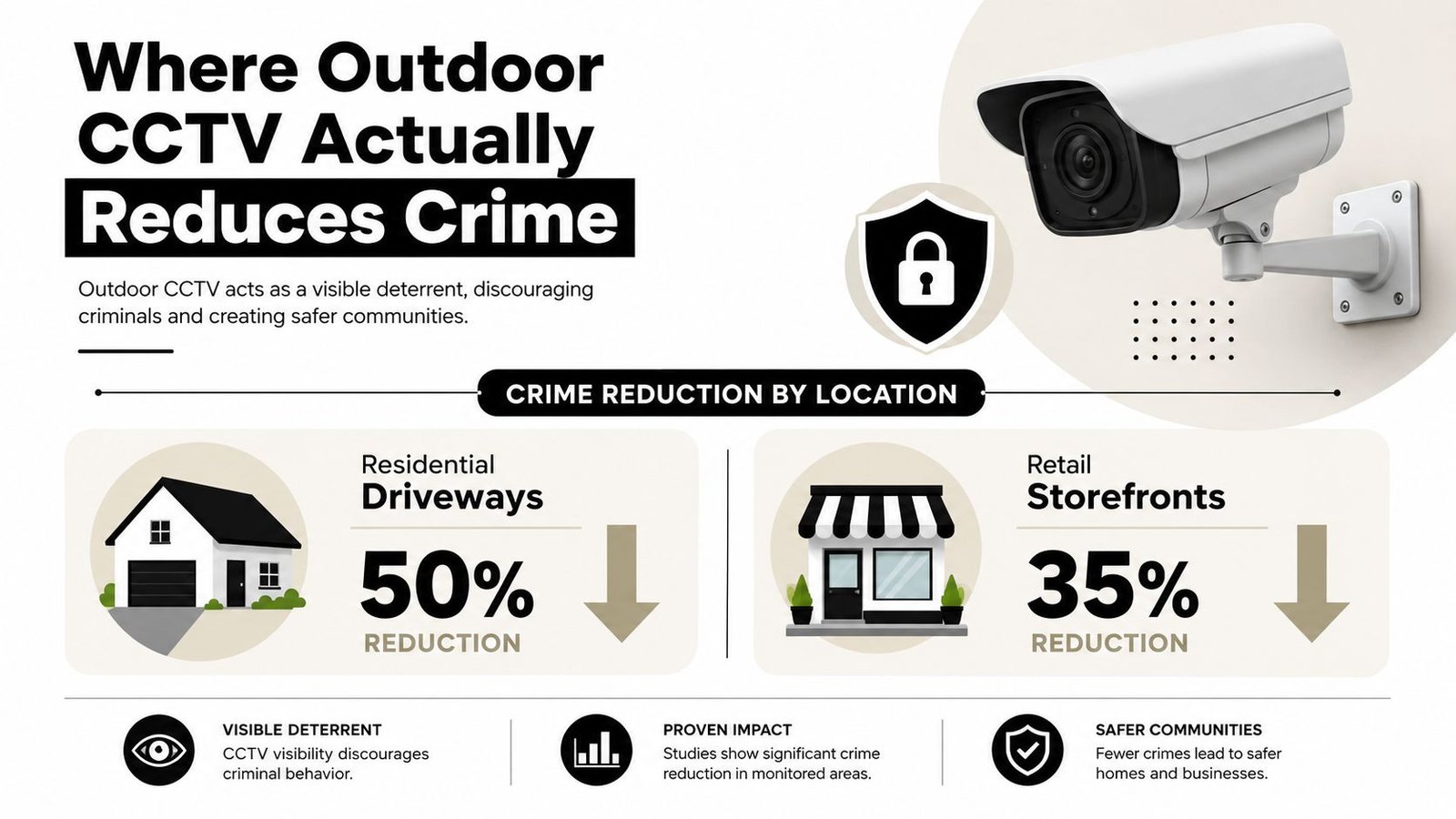
Outdoor CCTV doesn't deter every type of crime equally. UK evidence reviewed by the College of Policing indicates that CCTV is strongest in car parks, has a smaller positive effect in residential areas, and shows no clear overall effect on violent crime or disorder. The same evidence base reports an overall reduction of about 13% in reviewed settings, with car parks showing a 37% reduction and residential areas a smaller but meaningful effect. These figures aren't a promise for an individual property. They show why the location and purpose of a system matter more than the camera count.
Match coverage to the risk
A camera overlooking a car park can support deterrence, incident review, and safer management of vehicle movements. A camera covering a side alley may be more valuable for identifying repeated trespass than for preventing a spontaneous incident. Retail entrances, delivery gates, bin stores, payment areas, and warehouse yards each need different views and different image detail.
Ask what the system must do:
- Perimeter protection: Detect movement along boundaries and show the direction of travel.
- Gate or entrance monitoring: Capture a usable face view or vehicle detail as someone approaches.
- Car park surveillance: Provide broad context while protecting pedestrian routes, payment points, and vulnerable corners.
- Bin and service areas: Record access, fly-tipping, or unauthorised activity without unnecessarily viewing neighbouring properties.
- Residential driveways: Focus on vehicles, front paths, and approach routes rather than recording the whole street.
Practical rule: A camera should have a named operational job. “Cover the outside” isn't a useful specification.
Blanket coverage often produces overlapping views with poor identification detail. Targeted coverage usually gives the installer more freedom to choose the right lens, mounting position, illumination, and recording rules for each risk. It also makes privacy management easier, particularly for landlords, businesses, and homes whose cameras can see beyond their own boundary.
The UK's surveillance environment has grown far beyond isolated experiments. Bournemouth is widely cited as the first successful outdoor street CCTV trial in 1985, followed by the first public-space rollout by local government in King's Lynn in 1987, according to Farsight's CCTV history. Later estimates cited by government and industry sources put the UK camera count at around 5.2 million in 2020 and 7.3 million in 2022, with later reporting describing roughly 21 million cameras and about one camera for every 11 people, as summarised by First County Monitoring. Scale alone hasn't made every installation effective. The specification still has to follow the risk.
Understanding Camera Types and Resolution Options
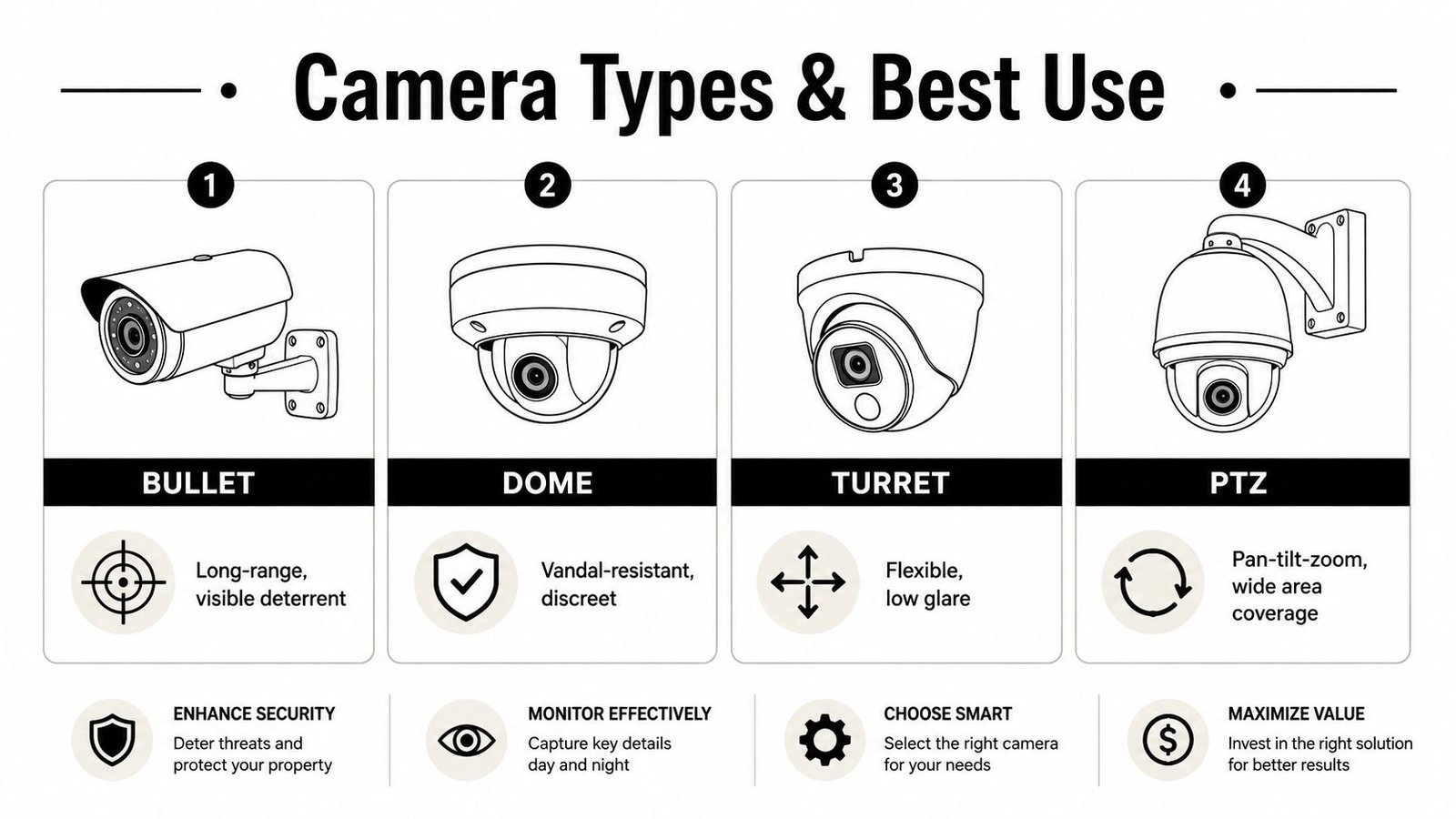
Camera shape affects visibility, vandal resistance, adjustment, and the area that can be covered. It doesn't determine whether a system is good or bad. The useful question is whether the chosen model produces the required view at the distance and lighting level where an incident is likely to happen.
Choose the housing for the location
A bullet camera suits a long driveway, boundary line, or loading approach where a visible deterrent and directional view are useful. Its shape can make the intended coverage obvious, although it may be more exposed to tampering if mounted within easy reach.
A dome camera is a sensible choice above a shop entrance or sheltered exterior. The curved housing can make it harder for an observer to tell where the lens is aimed, and vandal-resistant versions suit locations where people can reach the camera. Reflection from the dome can become a problem if the lens is positioned too close to a wall or strong light source.
A turret camera gives installers flexible adjustment and often avoids some of the glare issues associated with domes. It works well on façades, eaves, and gateposts where precise alignment matters.
A PTZ camera can pan, tilt, and zoom across a warehouse yard, car park, or industrial perimeter. It covers a wide area, but it shouldn't be treated as a replacement for fixed cameras at critical entrances. If the PTZ is looking elsewhere when an event occurs, it won't provide the same continuous detail as a dedicated fixed view.
For a broader explanation of these formats, compare the different CCTV camera types before discussing a layout with an installer.
Resolution is only useful at the scene
HD, higher-megapixel, and 4K cameras offer different amounts of image detail, but a pixel count doesn't guarantee identification. Lens choice, distance, compression, lighting, focus, and the subject's position all influence the result. A wide lens may show an entire frontage while leaving a face too small to identify. A narrower lens can deliver more detail at a gate but cover less surrounding context.
UK guidance places the operational requirement first. The GOV.UK recommended standards for the surveillance camera industry points installers towards BS EN IEC 62676-5 for data specifications and image-quality performance, with picture quality selected for identifying, recognising, observing, or detecting subjects.
Before choosing 4K, ask for a demonstration at the actual gate, doorway, or parking point after dark. A well-positioned lower-resolution camera can be more useful than a poorly aimed high-resolution model. Storage, network capacity, and export quality also need consideration, because footage that cannot be retrieved or exported clearly has limited evidential value.
Weatherproofing and Night Vision Performance
Outdoor equipment fails most often at the details installers rush. A camera body may be properly sealed, yet water can enter through an exposed connector, poorly fitted gland, unsealed junction box, or cable that directs rain towards the housing.
IP ratings don't seal the installation
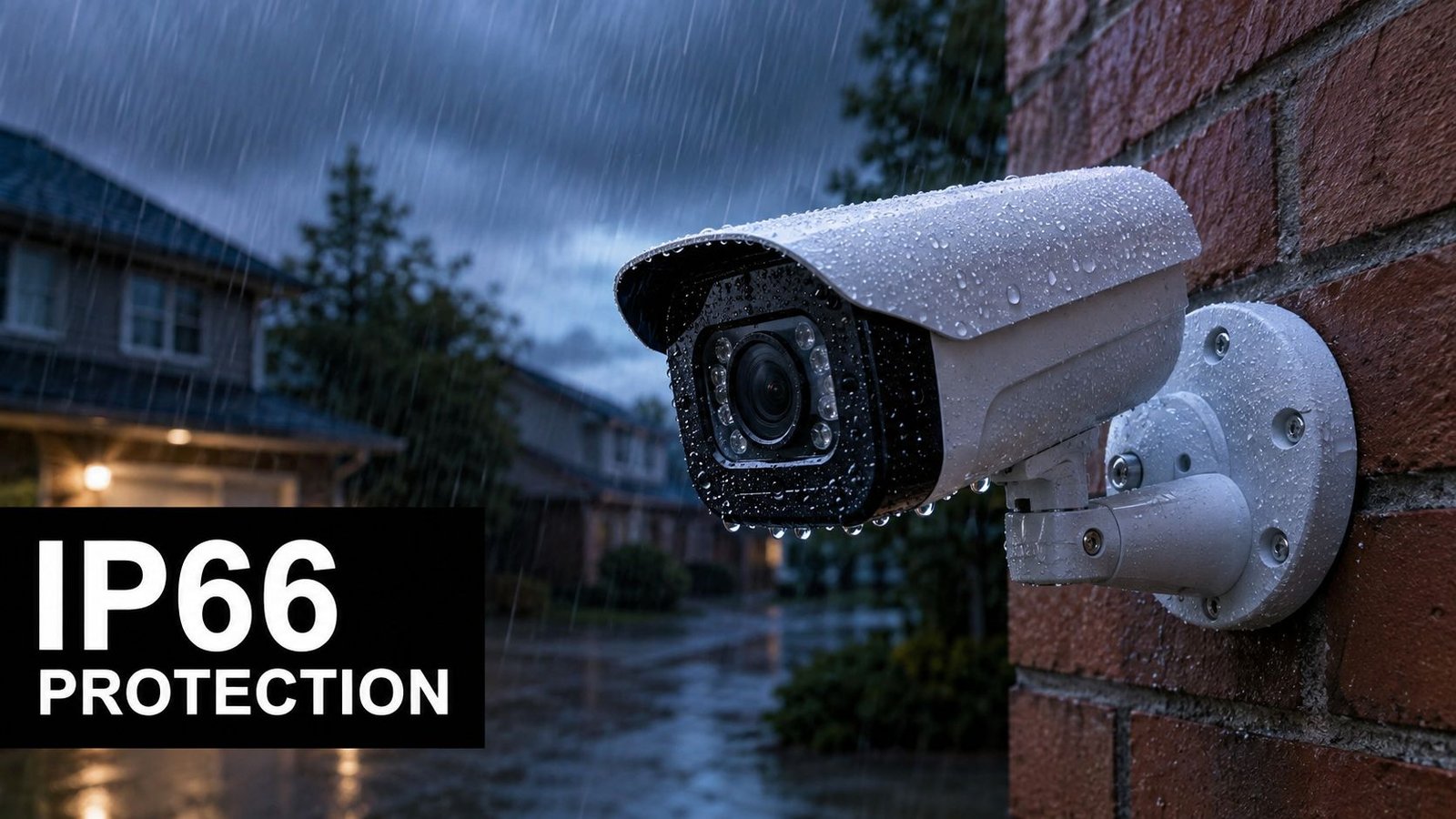
For exposed UK façades, gables, and gateposts, IP66 is the sensible technical baseline. Under IEC 60529, IP66 means the enclosure is dust-tight and resistant to powerful water jets, which suits driving rain and wind-driven spray. The rating applies to the protected enclosure, not automatically to every connection around it. Doberman Watch's guidance on weatherproof outdoor CCTV highlights why cable entries and junction points must be weather-sealed separately.
Coastal locations around South Wales and the South West need extra attention. Persistent moisture and salt air accelerate corrosion, particularly around brackets, fixings, connectors, and lower-quality housings. Use suitable glands, sealed junction boxes, corrosion-resistant fixings, sensible drip loops, and cable routes that don't leave water running into the connection.
Installation detail: The weakest point is often the cable entry, not the camera shell. Seal the route as carefully as the housing.
Night vision must preserve useful detail
Infrared illumination can show movement in darkness, but a bright monochrome image isn't automatically an identification image. Reflections from pale walls, number plates, wet tarmac, and nearby foliage can cause the camera to reduce exposure or produce glare. Built-in infrared may also illuminate a nearby surface while leaving a gate or face outside the useful range.
Low-light colour cameras can work well where ambient lighting is consistent, but colour requires enough usable light. White-light illumination may improve detail and discourage activity, although it can affect neighbours and create its own privacy or nuisance considerations. Test the camera at the exact scene, with the lights normally used and the weather conditions that expose the property.
The night-vision CCTV camera guidance should be treated as a starting point, not a substitute for a night-time site assessment. UK guidance prioritises image quality against the operational requirement rather than preserving storage by accepting unusable footage. Specify the required result first, then set illumination, lensing, frame settings, and compression to protect that result.
Strategic Camera Placement for Maximum Coverage
A camera mounted in the wrong place can record a great deal and prove very little. Installers need to separate overview coverage, which shows context and movement, from identification coverage, which places a person or vehicle in a controlled view at a useful distance.
Start with the approach, not the wall
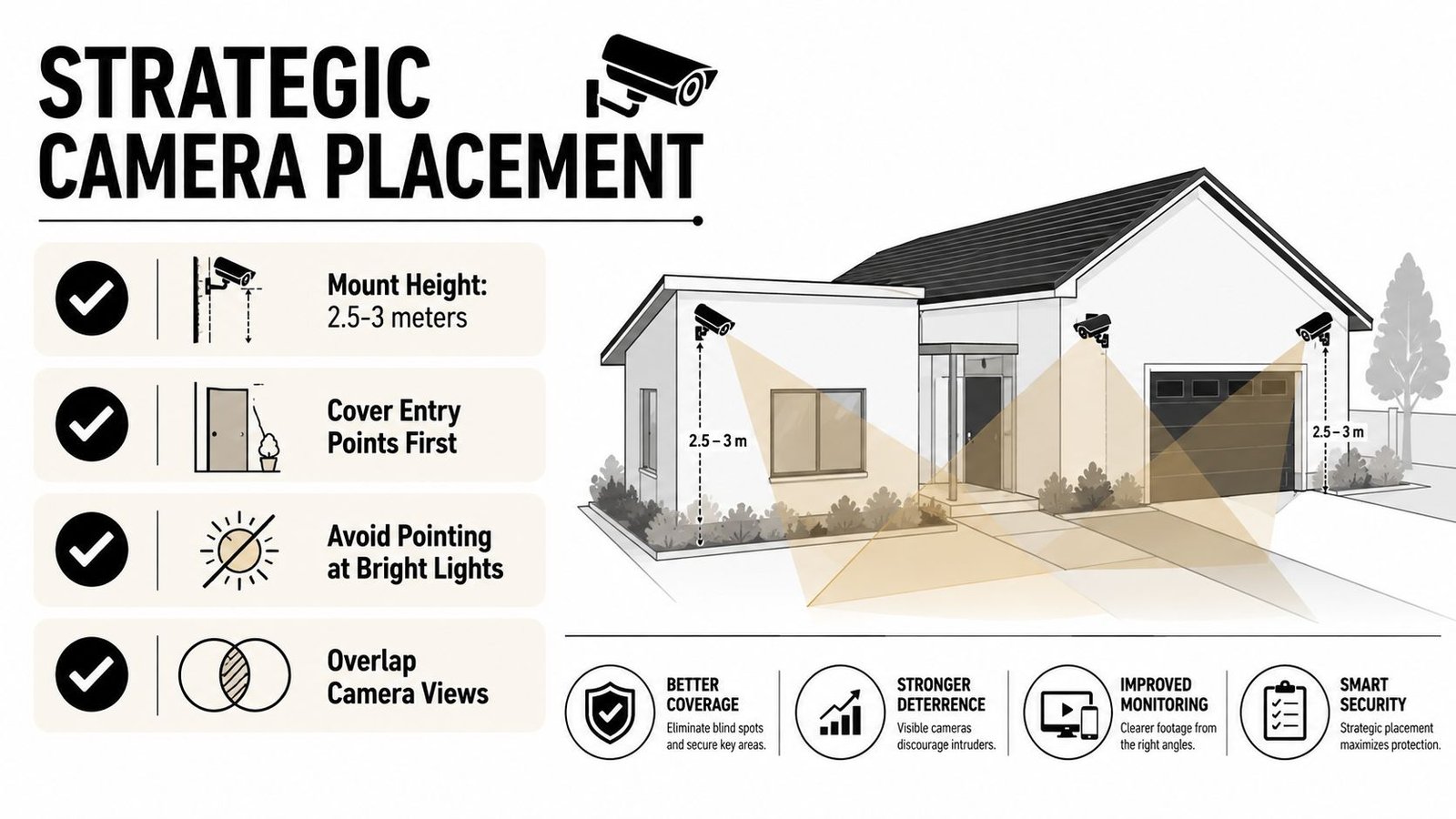
Entry doors, vehicle gates, delivery points, and side passages deserve attention before decorative or low-risk areas. Mounting high can protect a camera from tampering and provide a broad view, but excessive height makes faces appear from above and reduces identification detail. A position around 2.5 to 3 metres is commonly used for practical coverage, but the correct height depends on the scene, access risk, lens, and required image standard.
Avoid pointing directly towards the sun's path, security lights, vehicle headlights, or bright street lamps. Backlighting can turn a person into a silhouette. Windows and glossy surfaces create reflections, while wet paving can bounce infrared or visible light back into the lens.
Build layers for different decisions
A home may need one camera to show the driveway approach and another aimed at the front door. A retail property benefits from an overview of the frontage, a controlled entrance view, and coverage of the service route. A warehouse or logistics site usually needs fixed cameras at gates and building corners, supported by wider views across yards and loading areas.
Car parks need careful height and angle choices. A wide overview helps establish where people and vehicles moved, while a narrower view can protect a payment area or pedestrian entrance. Multi-tenant buildings require a clear distinction between communal access, private balconies, neighbouring homes, and areas that don't form part of the justified security purpose.
Use a simple placement check before drilling:
- Approach: Can the camera see the subject before they reach the protected point?
- Light: What happens at dawn, dusk, night, and under vehicle headlights?
- Detail: Is the subject large enough in the image for the required task?
- Privacy: Does the view unnecessarily include a neighbour, bedroom window, or public area?
- Maintenance: Can an engineer safely clean, adjust, and service the camera?
Cable routing matters as much as the lens. Concealed routes protect the cable from cutting and reduce visual impact, but installers must still leave accessible, sealed service points. A neat installation follows the building's lines, avoids trapping water, and doesn't compromise insulation, drainage, or fire separation.
UK Legal Compliance and Privacy Requirements
Outward-facing cameras can process personal data as soon as they capture identifiable people. That makes compliance part of the design, not paperwork added after installation. The ICO's video surveillance guidance addresses systems that may include traditional CCTV, ANPR, and smart doorbells, and it is under review following the Data (Use and Access) Act 2025.
Define the purpose before recording
A homeowner, landlord, or business should be able to explain why each camera is needed, what area it covers, who can view recordings, and how long footage is retained. The purpose might be protecting a gate, investigating damage, managing access, or safeguarding staff and visitors. “General security” is less useful than a documented, specific reason connected to the property's risks.
Signage should tell people that surveillance is taking place and identify the responsible organisation or person. Businesses need to consider employees, contractors, customers, and delivery drivers. Landlords should inform tenants about communal cameras, explain the purpose, restrict views into private areas, and establish who can access footage.
Control the field of view
Privacy masking, carefully selected lenses, and physical positioning can prevent a camera from recording neighbouring gardens or windows. If a domestic system captures beyond the property boundary, the household may need to consider data protection responsibilities rather than assuming the purely domestic exemption applies. The ICO framework also means smart doorbells and ANPR should not be treated as separate from wider surveillance governance because their housings look different.
A privacy-aware design can still protect a property. It may use motion zones, restricted user permissions, secure export procedures, and a written retention approach instead of recording everything indefinitely. If you're planning the wider appearance of a garden or frontage alongside security equipment, a backyard design AI tool can help visualise layouts, but it doesn't replace a privacy assessment or a compliant CCTV specification.
Integrating CCTV with Alarms and Access Control
CCTV records what happened. An integrated system can help someone respond while an event is developing. The right combination depends on whether the priority is verification, immediate warning, controlled entry, or a monitored response.
An intruder alarm adds a clear event signal to video. A camera can show movement near a rear door, while the alarm identifies that a protected contact or detector has activated. This pairing suits homes, shops, and offices where the owner or keyholder needs to verify an alert through an app before deciding what to do.
Access control addresses a different problem. Keypads, cards, fobs, and biometric readers manage who can enter, while CCTV provides visual context around the decision. For a multi-tenant building, user permissions and logs can be more valuable than a camera covering an empty corridor. A video intercom is useful where visitors need to communicate before a gate or door is released.
For a remotely operated gate, review the access hardware separately from the camera. Guidance on choosing a best cellular gate opener can help clarify connectivity, user management, and the practical limits of mobile control. The camera still needs its own suitable view of the vehicle approach and pedestrian route.
Select integration by outcome
- CCTV and alarm: Strong choice for event verification and mobile alerts. It adds configuration work but usually makes alerts more meaningful.
- CCTV and access control: Suits offices, apartments, warehouses, and restricted yards. The benefit is accountability around entry, not merely more video.
- CCTV and intercom: Useful at homes, gates, and reception points where a person needs to speak before granting access.
- CCTV and remote monitoring: Appropriate for premises that need an organised response outside working hours. The service, escalation process, and recording standard must be agreed in advance.
Alarm installations may need to follow BS EN 50131, while remotely monitored detector-activated CCTV may need consideration of BS 8418, depending on the design and service arrangement. The integrated security solutions guidance is useful when comparing a standalone recorder with a coordinated system. Smartphone viewing and mobile alerts are convenient, but they don't replace reliable networking, strong account security, clear permissions, and a plan for what happens when an alert arrives.
Costs, Maintenance, and Choosing a Local Installer
A credible quote should explain the security outcome, not just list camera models. The price depends on the number of views, cable routes, mounting surfaces, lighting, recording requirements, network work, access equipment, alarm integration, and whether monitoring is included. A basic home system and a commercial yard may both be described as “four cameras”, yet the installation effort and operational requirements can be completely different.
Compare proposals against the same questions:
- Coverage: Which entrances, boundaries, yards, and service areas will be visible?
- Image task: Is each camera intended to detect, observe, recognise, or identify?
- Night performance: Has the installer assessed the lighting rather than relying on a brochure?
- Recording: Where is footage stored, how is it exported, and who can access it?
- Resilience: What happens if the network, power, or a camera fails?
- Compliance: Will the design address signage, privacy masking, access permissions, and retention?
- Support: What maintenance, firmware management, call-out cover, and training are included?
Maintenance is not optional. Dirt, cobwebs, salt deposits, condensation, vegetation, firmware issues, full storage, and changed lighting can all reduce the value of footage. Schedule lens and housing checks, inspect cable entries and brackets, review recording health, update authorised users, and test alerts after building or network changes.
Local knowledge matters in exposed parts of South Wales and the South West. A suitable installer should provide evidence of insurance, relevant accreditation, engineer screening, and experience with the property type. Ask for a site survey, a marked-up camera plan, equipment specifications, recording terms, privacy measures, and a written handover. A cheap quote that omits cable protection, night testing, or ongoing support may cost more when the system is needed.
Wisenet Security Ltd designs, installs, and maintains outdoor CCTV, alarms, access control, intercoms, fire systems, and gate automation across South Wales and the South West, with remote viewing, night-vision options, and integrated security planning.
If you need outdoor CCTV that works in real weather, produces usable footage after dark, and respects UK privacy obligations, arrange a site survey before buying equipment. Visit Wisenet Security Ltd to discuss an installation or maintenance plan for your home, business, car park, warehouse, or managed property.