CCTV Monitoring Services: 2026 UK Guide for Businesses
You lock up, check the shutters, glance at the yard, and head home knowing the building is now relying on whatever security decisions you made months or years ago. For many businesses in South Wales and the South West, that's when the worry starts. A retail unit goes dark. A warehouse sits quiet. A shared commercial site has no staff on hand, but stock, tools, vehicles, and records are still inside.
That's why CCTV monitoring isn't really about cameras. It's about what happens when nobody from your team is there to see an issue unfold.
For buyers, key questions are usually practical. Will professional monitoring help stop nuisance incidents becoming expensive ones? Will the footage be useful if there's a dispute, theft, break-in, or insurance claim? And will the whole setup stand up to UK legal scrutiny, not just technically work on the day it's installed?
Table of Contents
- Your Business After Hours A Growing Concern
- What Are Professional CCTV Monitoring Services
- Exploring the Types of CCTV Monitoring
- The Real-World Benefits and Practical Limitations
- Navigating UK CCTV Legal and Compliance Rules
- Understanding Cost Drivers and System Integration
- Choosing Your Security Partner in South Wales
Your Business After Hours A Growing Concern
A familiar example is the owner of a small trade depot or retail premises who already has cameras installed, but still checks their phone late at night if they hear about trouble nearby. The cameras may be recording perfectly well. That doesn't mean anyone is actively verifying an intrusion, checking whether a person on site is authorised, or deciding whether police, a keyholder, or a site manager needs to act.
That gap matters because CCTV now sits inside day-to-day incident response at a very large scale. The Office for National Statistics reported 33,454,300 incidents of camera-detected offences recorded by the police in England and Wales in the year ending March 2024, including 18,723,400 theft offences and 2,648,400 criminal damage and arson offences, which shows how embedded camera evidence has become in policing and case review (camera-detected offences in England and Wales).
For a business owner, that doesn't mean a camera prevents every incident. It means footage and monitoring already play a serious role in what happens after an event starts.
Most losses after hours aren't caused by not owning cameras. They happen because nobody responds quickly enough, or the footage isn't clear enough to support action later.
That's why many firms stop thinking of CCTV as a passive record and start looking at it as part of continuity planning. If your site includes stock, vehicles, tools, cash handling areas, loading bays, bin stores, car parks, or shared entrances, the issue isn't whether risk exists. It's whether your current setup gives you a live operational response as well as a recording.
If you're still weighing whether monitoring is worth the move from basic surveillance, this guide to the benefits of CCTV surveillance is a useful starting point before you compare specific monitoring models.
What Are Professional CCTV Monitoring Services
Professional CCTV monitoring services are often misunderstood as someone sitting and watching screens all day. In practice, a good system is more structured than that. It combines camera capture, a network video recorder or video management system, and remote monitoring, often with analytics such as motion detection, object tracking, and alarm linkage so operators can prioritise likely incidents instead of scanning endless footage manually (CCTV monitoring architecture guidance).
Recording versus response
The simplest way to explain it is this. Unmonitored CCTV is like a smoke detector sounding in an empty building. It may record the problem, but it doesn't create a response on its own.
Monitored CCTV is closer to a managed fire alarm arrangement. An event is detected, assessed, and escalated according to an agreed process.
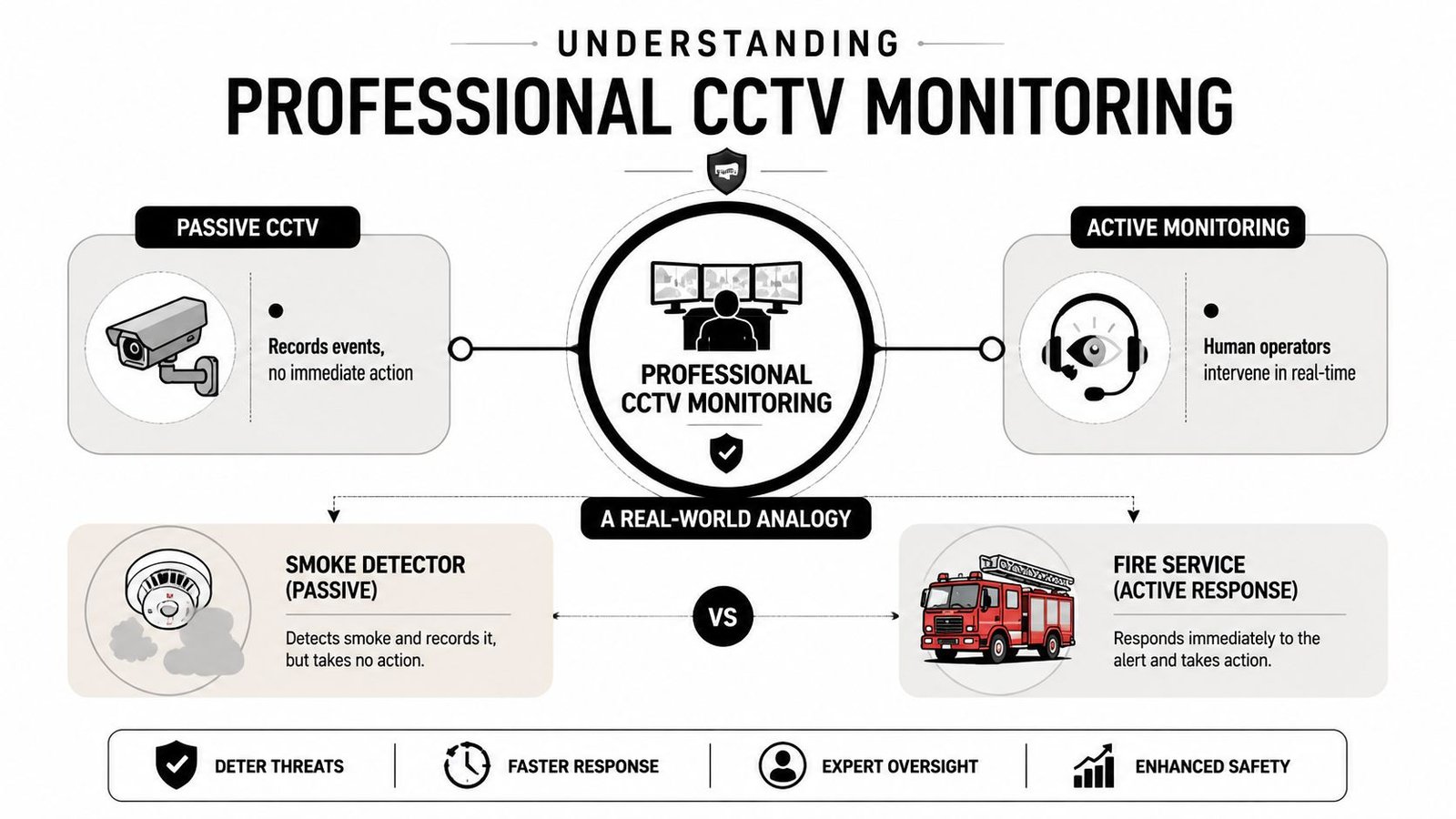
That difference changes the commercial value of the system. Recording helps with review. Monitoring helps with intervention.
How a monitored event is handled
A workable monitored setup usually follows a sequence like this:
- Detection happens on site. A camera analytics rule, linked alarm, or scheduled out-of-hours profile flags movement or unusual activity.
- Video is presented for review. An operator sees the relevant feed rather than searching hours of footage.
- Human verification takes place. A real monitoring service earns its fee as a person distinguishes between a genuine issue and a harmless trigger.
- Escalation follows the site plan. That might mean an audio warning, a call to a keyholder, or a report to emergency services where appropriate.
- Evidence is retained and handed over properly. If there's a break-in, staff issue, or liability dispute later, the material is easier to retrieve and explain.
A short walkthrough helps make that process more concrete:
Practical rule: If your current CCTV only helps after someone asks, “Can you check the footage?”, you don't yet have a monitoring solution. You have a recording solution.
The biggest mistake buyers make is assuming any camera with phone access counts as monitored security. Remote viewing is useful. It isn't the same as having trained operators, defined escalation paths, and a system built to detect, verify, and act.
Exploring the Types of CCTV Monitoring
Not every site needs the same monitoring model. A retail unit in Cardiff, a yard in Newport, and a multi-tenant commercial building near Bristol all carry different risks, hours, and staffing patterns. The best fit depends on when incidents are likely, how often false triggers happen, and what kind of response you need.
For evidential use, the standard most commonly relied on is 1080p to 4K IP video, because higher resolution preserves more pixel detail for digital zoom on faces and number plates, especially where operators may need to review footage from a distance or in poor light (1080p to 4K IP video for evidential usability).
The main service models
Some buyers are sold on features when they should be choosing a service model. These are the main ones.
| CCTV Monitoring Service Comparison | How It Works | Best For | Pros | Cons |
|---|---|---|---|---|
| 24/7 live manned monitoring | Operators actively supervise live feeds or prioritised camera groups around the clock | High-risk premises, large yards, critical infrastructure, vulnerable sites | Immediate oversight, useful where incidents are frequent or consequences are high | Higher running cost, can be excessive for lower-risk premises |
| Event-driven alarm video verification | Cameras or alarms trigger clips for operator review when rules are breached | Shops, offices, warehouses, schools, small industrial sites | More efficient for most commercial sites, focuses attention on actual events | Depends heavily on good camera placement and sensible trigger rules |
| Scheduled out-of-hours monitoring | Monitoring only runs during set windows such as nights, weekends, or holidays | Sites occupied in the day but empty after hours | Targets the riskiest periods without paying for full-time live cover | Less useful for daytime issues like customer disputes or internal theft |
| Analytics-led exception monitoring | Software flags behaviour such as line crossing, loitering, or object movement for human review | Car parks, perimeters, logistics areas, shared estates | Cuts down manual review and helps operators prioritise | Poor configuration creates nuisance alerts and wasted operator time |
| Self-monitoring with app access | Owner or staff receive alerts and check cameras themselves | Very small sites with low risk tolerance for cost | Cheap and flexible, helpful as a secondary layer | No guaranteed response, relies on staff availability and judgement |
A lot of SMEs do best with event-driven monitoring, not continuous live watching. It tends to be the most sensible middle ground between capability and cost.
Cloud storage versus on-premise recording
Storage decisions affect both usability and risk.
Cloud-led systems make remote access and off-site resilience easier. They can suit multi-site businesses and landlords who need authorised people to review footage without visiting each property. The trade-off is dependence on connectivity, subscription cost, and making sure user access is tightly controlled.
On-premise recording gives you direct local control through an NVR or VMS on site. Many businesses prefer it for predictable retention and easier ownership of the recording environment. The weaknesses are obvious too. If the recorder is poorly secured, damaged, or stolen, you have a problem.
A lot of stronger systems use a hybrid approach: local recording for continuity, with selected clips or alerts available remotely for review and escalation.
A few buying checks help separate a sound design from a weak one:
- Ask about night scenes. Daytime clarity can hide poor low-light performance.
- Check identification points. Gates, till areas, entrances, and number plate views need more than wide overview shots.
- Review alert logic. If trees, headlights, rain, and foxes trigger the same workflow as a person climbing a fence, operators will miss what matters.
The Real-World Benefits and Practical Limitations
The main commercial question isn't whether CCTV monitoring sounds reassuring. It's whether it changes outcomes enough to justify the ongoing spend. That's the right question to ask.
The need for a hard-headed answer is obvious. The Crime Survey for England and Wales estimated 9.61 million crime incidents in the year ending September 2024, and businesses want to know whether monitoring reduces opportunistic crime and improves response time enough to create a tangible return, rather than adding another monthly service (UK crime context and ROI question).
Where monitored CCTV usually earns its keep
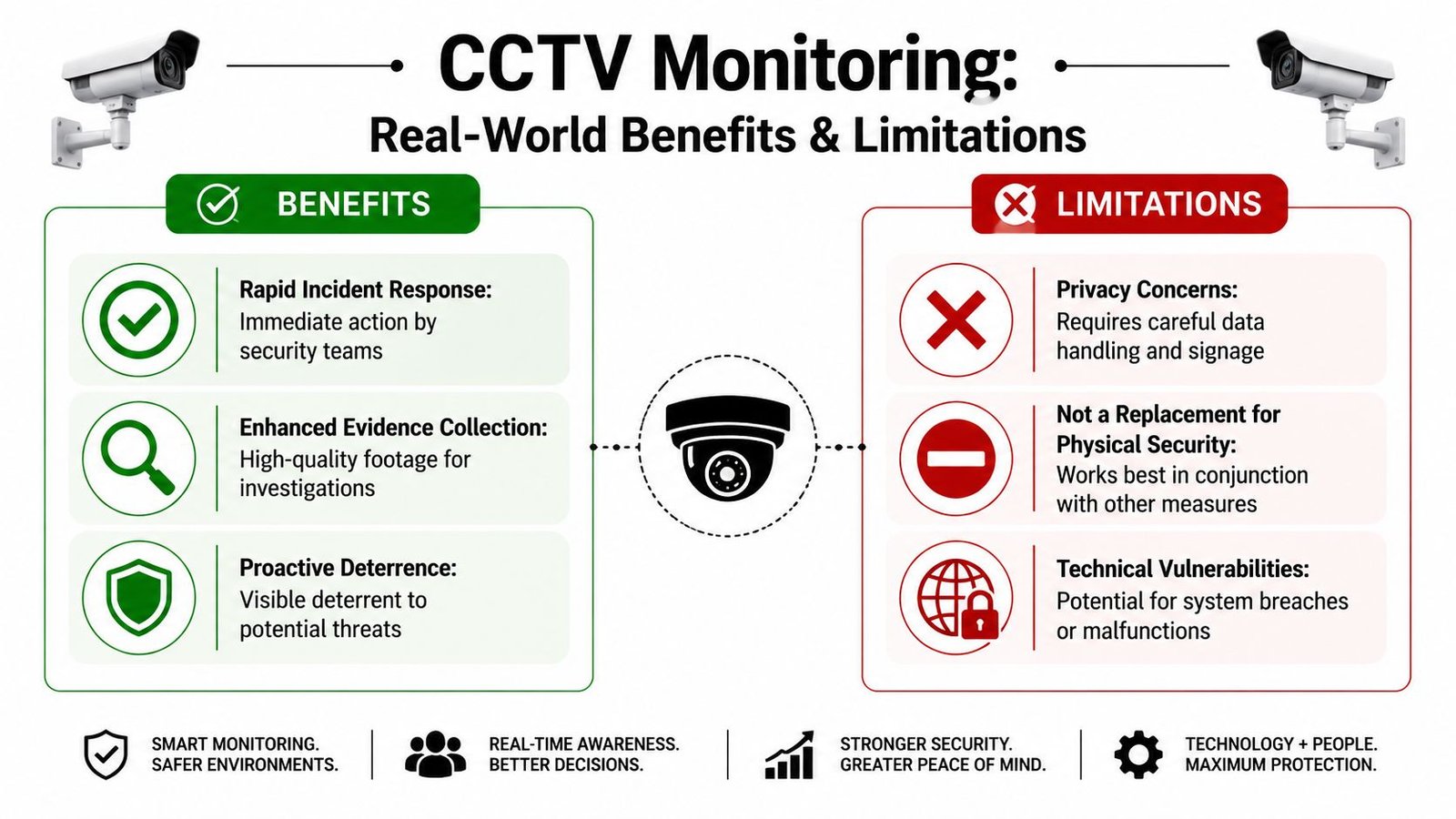
In practice, monitored CCTV tends to deliver value in four areas.
First, it improves incident verification. A triggered alarm without video context can waste time. A verified event gives a keyholder, manager, or responder a clearer basis for action.
Second, it supports faster operational decisions. If someone is on a yard after hours, the issue isn't only recording them. It's deciding quickly whether they're a delivery driver, a contractor, a trespasser, or a thief.
Third, it creates better evidence for disputes and claims. That includes break-ins, fly-tipping, staff allegations, vehicle damage, delivery arguments, and third-party liability complaints.
Fourth, it can reduce security waste. Not necessarily by eliminating every other measure, but by cutting pointless call-outs, reducing blind spots in coverage, and allowing guarding or patrols to be used where they matter most.
Buyers usually see the strongest return when monitoring is aimed at a specific business problem, not when it's installed as a vague “extra layer”.
What it will not fix on its own
At this stage, many sales pitches become less honest.
Monitored CCTV won't compensate for poor perimeter security, broken lighting, weak locks, unmanaged keys, or unrestricted access control. It also won't create usable evidence if the cameras are in the wrong place, the image quality is poor, or the retention policy means footage is overwritten before anyone checks it.
It's also not equally effective across every risk type. It's generally stronger for intrusion, unauthorised access, perimeter events, and after-hours verification than it is for every form of fraud, internal misconduct, or conflict in crowded public areas.
A more realistic decision framework is:
- Use monitoring when response matters. Yards, depots, car parks, and vacant periods benefit most.
- Use access control when entry needs to be governed. Doors and shared buildings need rules, not just footage.
- Use physical guarding when presence itself is the deterrent. Some sites need a person on the ground.
- Use lighting and layout improvements where cameras currently struggle. Monitoring can't identify what the camera never captures clearly.
Good CCTV monitoring services work best as part of a layered system. They're valuable. They're not magic.
Navigating UK CCTV Legal and Compliance Rules
For UK businesses, the legal side of CCTV is not an afterthought. It shapes what you can justify, how long you keep footage, who can access it, and whether the system helps you in a dispute or creates another problem.
A major policy milestone was the Surveillance Camera Code of Practice under the Protection of Freedoms Act 2012, which came into force on 25 June 2013 and established a framework for proportionality and accountability that professional monitoring services need to work within (Surveillance Camera Code of Practice milestone).
What UK businesses need in place
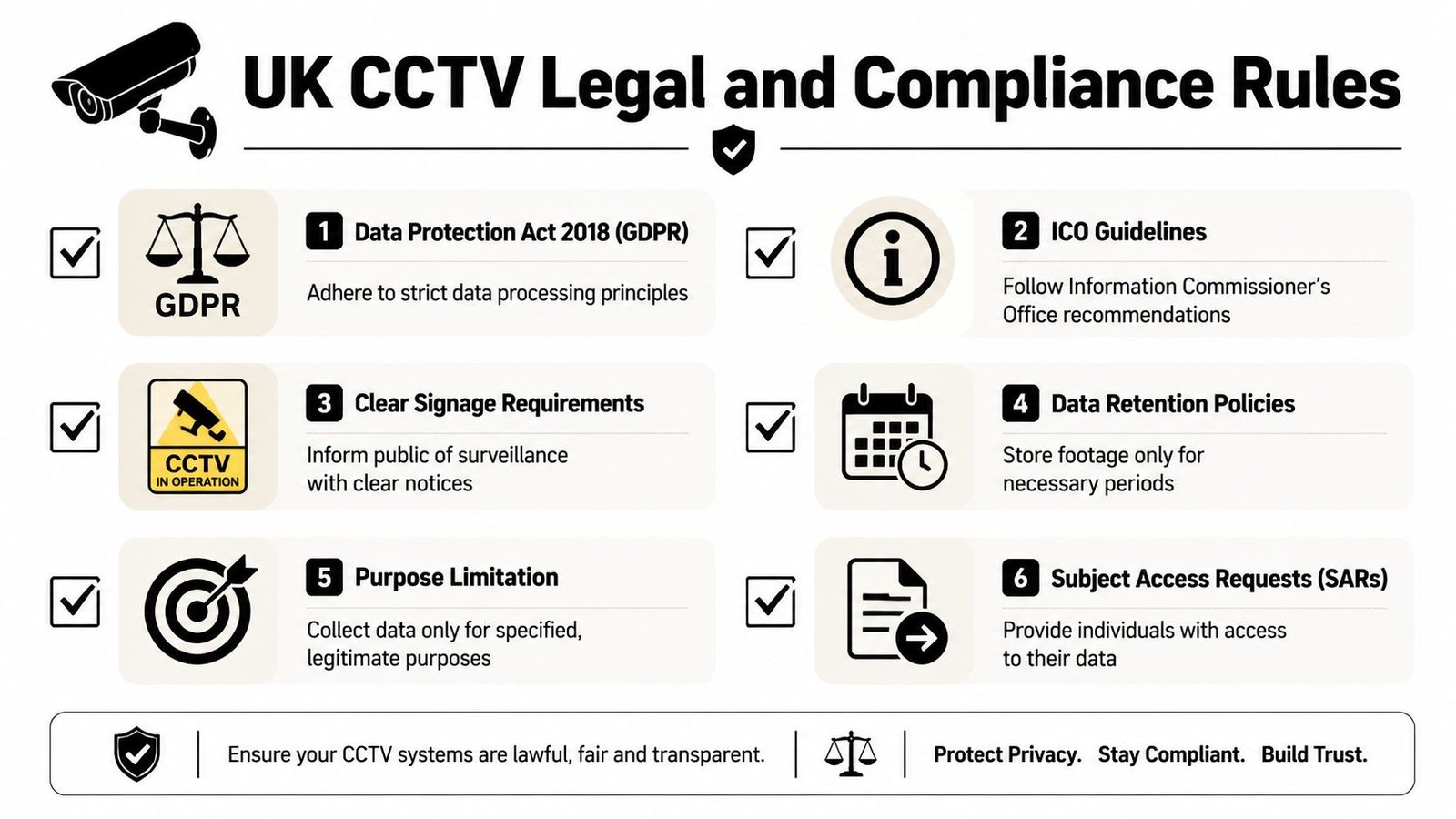
The legal test is usually less about whether CCTV exists and more about whether its use is necessary, proportionate, transparent, and controlled.
A practical compliance checklist should include:
- A defined purpose. You should be able to state why each camera exists. “General security” is often too vague on its own.
- Visible signage. People need clear notice that surveillance is in operation and who controls it.
- Retention discipline. Keep footage for a justified period, then remove it securely.
- Restricted access. Not every manager or staff member should be able to browse recordings.
- A process for footage requests. If police, insurers, employees, or members of the public request relevant material, your handling needs to be organised.
- A documented policy. This matters especially for landlords, employers, and multi-site operators.
If you want a practical business-level overview, this guide on CCTV and GDPR in the UK is worth reviewing alongside your installer's advice.
Where buyers get caught out
The weak point is often not the camera. It's governance.
Audio recording, facial recognition features, broad remote access permissions, and cross-site viewing all create extra sensitivity. So does using CCTV for one stated purpose, then drifting into another, such as staff performance monitoring without a clear policy basis.
Retention is another common failure. If footage is no longer needed, it shouldn't sit indefinitely on an old recorder, exported USB device, or unmanaged office server. Secure disposal of stored data and devices matters. For businesses reviewing disposal procedures for old drives, servers, and storage media, understanding NAID AAA certification is useful background because it helps explain what controlled destruction standards look like in practice.
Legally defensible surveillance is not the same thing as technically functioning surveillance. A camera can work perfectly and still be used badly.
The businesses that handle CCTV well usually treat it like any other regulated operational system. They set the purpose, limit access, document decisions, and review whether the setup still matches the risk.
Understanding Cost Drivers and System Integration
The cost of CCTV monitoring services is rarely driven by one line item. Buyers often focus on the monthly fee, but the complete picture includes hardware quality, installation design, monitoring model, retention needs, connectivity, and how the system ties into the rest of the building.
What usually affects price
Some cost drivers are straightforward.
- Camera count and placement. More important than the raw number is whether cameras need specialist mounting, long-range views, number plate capture, or difficult cabling.
- Monitoring model. Event-led monitoring usually costs less than continuous live oversight.
- Retention expectations. Longer storage and easier retrieval usually increase system requirements.
- Site complexity. A single retail unit is different from a multi-building estate or shared industrial yard.
- Support and maintenance. A cheap install becomes expensive when faults sit unresolved and recordings fail when needed.
For a broader budgeting framework, this guide to CCTV installation costs helps put the monitoring element into the wider system decision.
Why integration matters more than camera count
A monitored camera system on its own has limits. Full operational value is realized when CCTV is linked to intruder alarms, access control, gates, intercoms, and lighting.
That changes the workflow. An out-of-hours door alarm can pull the nearest camera view for verification. A gate event can be checked against authorised access. A shared building can combine intercom, door release, and video evidence instead of treating each as a separate silo.
A joined-up installer is particularly important. Wisenet Security Ltd, for example, designs and maintains integrated systems covering CCTV, alarms, access control, fire systems, intercoms, and gate automation for businesses in South Wales and the South West. That kind of integration-focused approach is often more valuable than buying isolated products from different suppliers and expecting them to behave like one system later.
Choosing Your Security Partner in South Wales
Choosing a monitoring provider is not just a question of hardware brands. It's a question of judgement, system design, and aftercare. That matters even more for businesses spread across South Wales and the South West, where response expectations, site types, and building layouts vary widely.
Questions worth asking before you sign
A decent supplier should be comfortable answering direct questions such as:
- How do you decide where monitored cameras should go? You want a risk-based answer, not “we'll cover everything”.
- How are alerts verified before escalation? That tells you whether false activations are being managed properly.
- What's your process for GDPR and access control? If the answer is vague, expect problems later.
- How is footage retained, exported, and handed over? This matters for insurers, police, and internal investigations.
- How will CCTV integrate with alarms, gates, or access control? Separate systems often create gaps.
- Who supports the system after installation? A strong design still needs maintenance and troubleshooting.
Local support changes the outcome
For buyers in Cardiff, Newport, Swansea, Bristol, and surrounding areas, local knowledge has practical value. A provider familiar with mixed-use buildings, industrial estates, logistics yards, and regional response realities is usually better placed to recommend sensible monitoring windows, camera positions, and integration priorities than a purely remote sales operation.
Wisenet's profile is straightforward. The company is fully insured, works across South Wales and the South West, uses DBS-checked engineers, and has over 20 years' experience with integrated security systems. That doesn't remove the need for you to ask hard questions. It does mean there's a local option that understands the mix of CCTV, alarms, access control, and compliance issues businesses in this region deal with every week.
The best buying decision is usually the least glamorous one. Choose the provider that can explain what will work on your site, what won't, and why.
If you want a practical review of your site, Wisenet Security Ltd can assess your current CCTV, identify whether monitoring is the right fit, and advise on a setup configured for your premises in South Wales or the South West.