Mastering Fire Safety Compliance in 2026
You're probably dealing with one of two situations right now. Either you know fire safety matters but the rules feel scattered across assessments, alarms, doors, lighting, logbooks, and inspections, or you've inherited a building and you're not fully sure whether what's already in place is compliant.
That confusion is normal. Most UK SMEs and landlords don't struggle because they don't care. They struggle because fire safety compliance isn't a single purchase or certificate. It's an ongoing management job. For businesses in South Wales and the South West, that usually means balancing legal duties with busy premises, limited time, live trading, tenants, staff turnover, and buildings that have changed use over time.
The good news is that the path from confusion to compliance is much clearer when you strip away the jargon and focus on what authorities expect to see in practice. That means a suitable fire risk assessment, appropriate systems, working procedures, evidence of testing, and records that match what's happening on site.
Table of Contents
- Understanding Your Legal Duties for Fire Safety
- How to Complete a Fire Risk Assessment
- Essential Fire Detection and Protection Systems
- Creating Your Testing and Maintenance Schedule
- Enforcement Actions and Penalties for Non-Compliance
- Your Fire Safety Compliance Action Plan
Understanding Your Legal Duties for Fire Safety
The starting point is simple. If you control a non-domestic premises, or any part of one, you likely have legal fire safety duties.
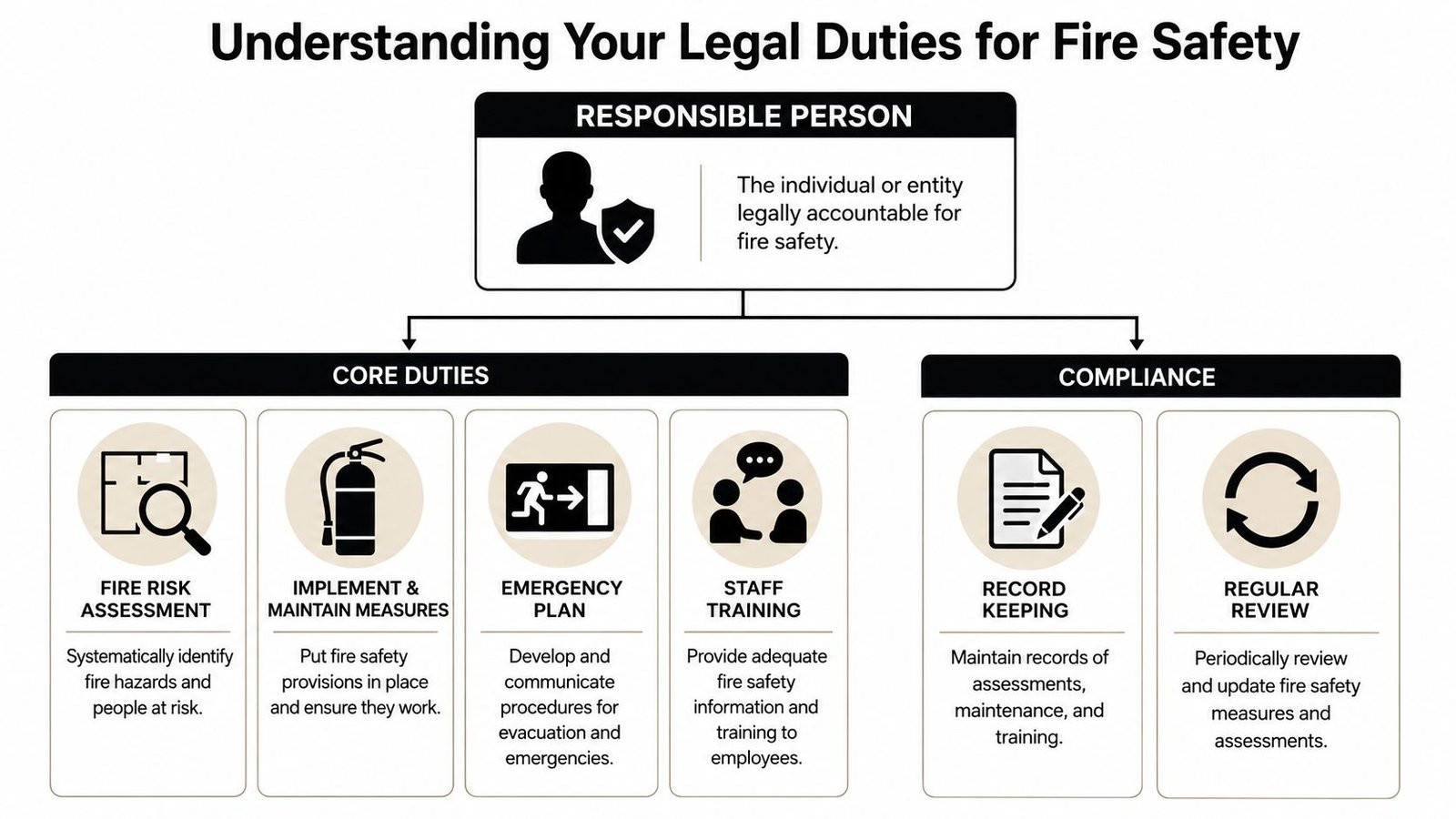
The major legal shift came with the UK Fire Safety Order 2005, which placed a duty on the responsible person to carry out a suitable and sufficient fire risk assessment and to implement and maintain preventive and protective measures for most non-domestic premises in England and Wales. It established a continuous legal duty built around assessment, maintenance, staff instruction, and periodic review rather than a one-off certificate model, as outlined in this summary of the UK Fire Safety Order 2005 duties.
Who the responsible person is
In plain terms, the responsible person is usually one of these:
- Business owner or employer if you run the premises
- Landlord or managing agent for common parts in multi-occupied buildings
- Facilities manager or site manager if control has been delegated operationally
- More than one person in shared buildings, where duties overlap
That last point catches people out. In a mixed-use building in Cardiff, Bristol, Newport, or Swansea, the shop tenant may control the unit, while the landlord controls corridors, entrance lobbies, and service areas. Compliance only works when those lines are clear.
Practical rule: If you control the space, the staff, the layout, or the day-to-day use, assume you have duties until proven otherwise.
What the duty looks like in practice
The law is broad, but the practical expectations are not mysterious. You need to be able to show that you have identified fire risks, decided what controls are needed, put them in place, and kept them working.
For most businesses and landlords, that means:
- A current fire risk assessment that reflects the building as it's used
- Suitable fire detection and warning for the risk
- Safe escape routes kept clear and usable
- Emergency procedures that staff understand
- Training and instruction for employees and relevant occupants
- Maintenance records for alarms, lighting, extinguishers, and related systems
- Review after change such as refurbishment, new stock, altered layouts, or different occupancy
Fire doors are a good example of how legal duty becomes a practical task. If a fire door is wedged open, damaged, missing seals, or altered with the wrong ironmongery, it may no longer perform as intended. For owners trying to understand the legal duties for commercial fire doors, that's one area where detail matters because small defects can undermine the whole escape strategy.
If your building needs a new alarm design, alterations to existing detection, or proper commissioning after changes, a specialist service such as fire alarm installation and commissioning services can help align the system with the site's actual fire strategy.
How to Complete a Fire Risk Assessment
A fire risk assessment doesn't need to be theatrical. It needs to be honest, specific, and usable. The best assessments aren't the longest ones. They're the ones that clearly identify what could go wrong, who could be harmed, and what you're going to do about it.
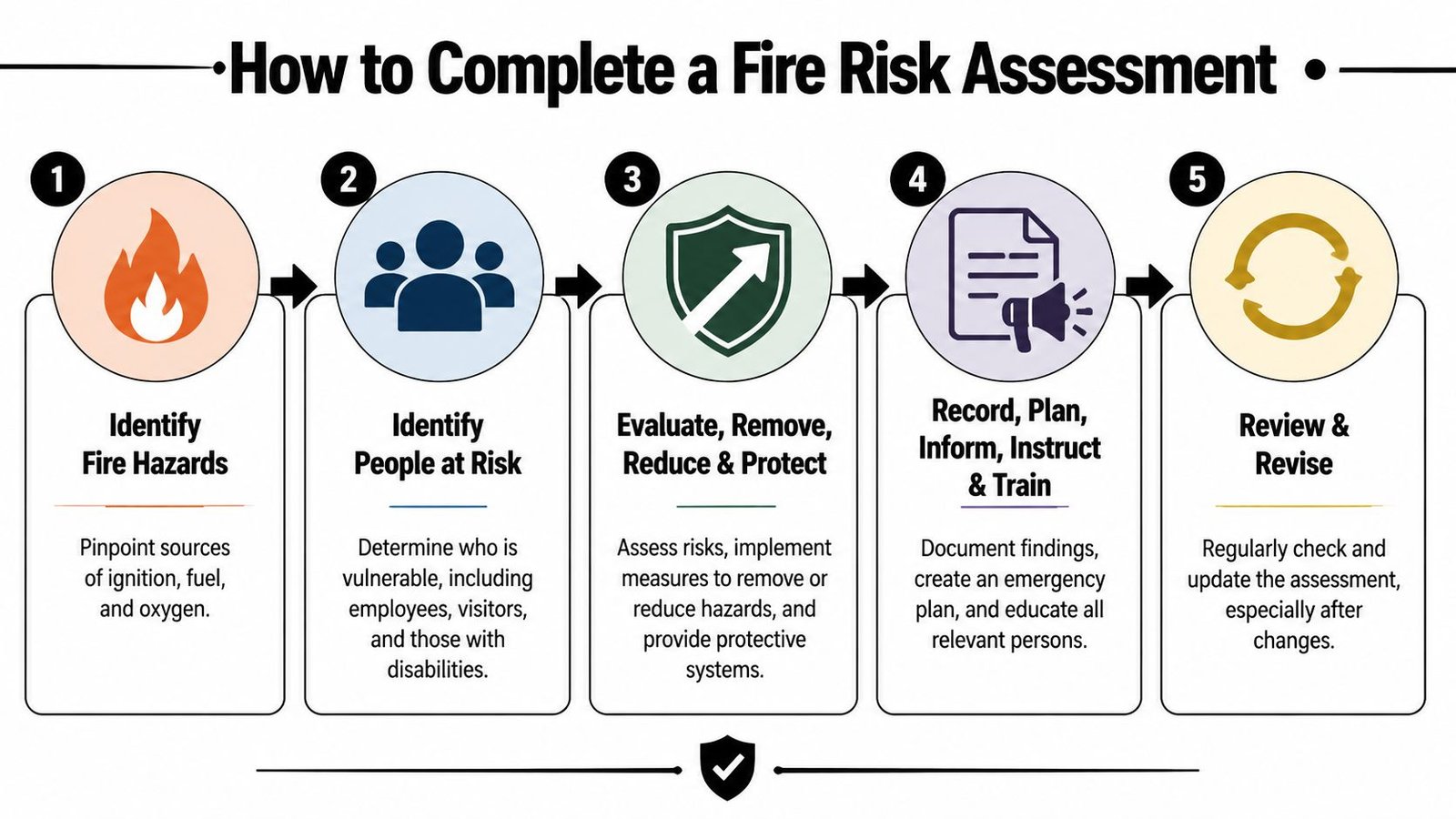
This visual gives a straightforward view of the process.
The five steps that matter
The standard five-step approach is still the most practical way to do it.
Identify fire hazards
Look for ignition sources, fuel, and anything that could help a fire spread. In small businesses, common findings include overloaded sockets, heaters too close to stock, poor housekeeping in storerooms, kitchen extraction grease, and combustible waste left near exits.Identify people at risk
Don't just list staff. Think about customers, contractors, cleaners, lone workers, sleeping occupants, mobility-impaired people, and anyone unfamiliar with the building.Evaluate the risk and decide controls
Weak assessments usually fail at this stage. They describe hazards but don't decide action. If your rear exit is partially blocked by deliveries every morning, the control isn't “monitor issue”. The control is to change the storage plan or delivery process so the route stays clear.Record findings and make a plan
Your records should show what you found, what action is needed, who is responsible, and how it will be checked. If staff need training, schedule it. If detectors are missing in a changed area, note that. If an emergency light doesn't cover a stair landing properly, document the remedial action.
A useful benchmark for occupied premises is whether somebody unfamiliar with the building could understand what's expected in an emergency from your records and arrangements.
- Review and revise
Review isn't just an anniversary exercise. Revisit the assessment after layout changes, new equipment, higher stock loads, altered staffing patterns, or refurbishment works.
A fire risk assessment that doesn't match the building today won't help you during an inspection tomorrow.
When a simple assessment is not enough
Some small, straightforward premises can manage an internal assessment if the person doing it is competent and the risks are low. A compact office with a simple layout is very different from a mixed-use building, a house in multiple occupation, or a retail unit with storage at mezzanine level.
Bring in a competent specialist when any of these apply:
- Complex layout with multiple floors, hidden voids, or unusual escape routes
- Sleeping risk such as residential accommodation above commercial space
- Shared occupancy where landlord and tenant duties overlap
- High fire load from packaging, warehousing, or stock density
- Recent alterations that may have changed detection, escape, or compartmentation
- People needing assisted evacuation where standard procedures won't be enough
For SMEs around South Wales and the South West, the biggest mistake isn't failing to produce a document. It's treating the document as the job, instead of using it to drive real actions on site.
Essential Fire Detection and Protection Systems
Once the risk assessment identifies what could happen, the next question is what systems are needed to detect a fire early, warn people, support escape, and contain harm. Many owners receive poor advice at this point because they're sold equipment before anyone has tied the system back to the building's use.
In UK practice, the technical benchmark is the British Standards framework. For non-domestic buildings, BS 5839-1 covers fire detection and fire alarm systems, including categories, design, installation, commissioning, and maintenance, while BS 9999 helps translate the building's risk profile into evacuation and management measures. If occupancy, compartmentation, or means of escape change, the alarm category, detector placement, audibility, and maintenance regime may need changing too, as described in this overview of BS 5839-1 and BS 9999 in fire safety compliance.
Alarm systems must match the building
A small single-storey shop may suit a conventional fire alarm system if the layout is simple and the zones are easy to interpret. A larger office, school, warehouse, or multi-tenant site often benefits from an addressable setup because staff can identify the triggered device or location more precisely.
That decision shouldn't be based on price alone. It should be based on how quickly people need to understand where the problem is, how complicated the building is, and how easy the system will be to maintain over time.
If you're comparing system types, this guide to conventional fire alarm systems is useful for understanding where simpler zoned systems fit and where they can become limiting.
The other systems owners forget
Alarm panels get attention because they're visible. Other essentials are often neglected until an inspection or fault exposes the gap.
Consider these as part of one working package:
- Emergency lighting helps people escape when normal lighting fails. It matters most on stairs, corridors, changes of level, final exits, and plant areas.
- Fire extinguishers support first-aid firefighting where appropriate, but only when staff know what they're for and when not to use them.
- Manual call points need sensible placement so people can raise the alarm quickly.
- Sounders and audibility must suit the environment. A noisy workshop and a quiet office won't have the same practical needs.
- Door release interfaces and shutdowns may be needed where fire doors, access control, or plant need to respond automatically in alarm conditions.
Electrical ignition remains a common concern in real premises, especially where extension leads, chargers, kitchen kit, or ageing appliances build up over time. Even though it's written for domestic settings, this home electrical fire prevention guide is still useful for spotting everyday behaviours that often carry over into offices, rented flats, and staff areas.
Good fire safety compliance doesn't start with a product list. It starts with the question, “What has to happen in this building if a fire starts at 2 pm on a Tuesday?”
Creating Your Testing and Maintenance Schedule
A compliant installation can drift out of compliance surprisingly fast. People move stock into corridors. Faults get silenced and forgotten. A detector head gets covered during decorating. A fire door closer is removed because someone got tired of the door shutting properly.
That's why maintenance is where fire safety compliance becomes visible. If your records are thin, inconsistent, or missing, regulators will assume your controls aren't being actively managed.
What needs checking and when
The easiest way to stay organised is to use a fixed schedule and a logbook that someone updates. Keep it simple enough that it gets used.
| Frequency | Item/System | Action Required |
|---|---|---|
| Daily | Escape routes and final exits | Check routes are clear, doors open properly, and nothing has been stored in protected areas |
| Daily | Alarm panel | Check for visible faults, disablements, or warning indicators |
| Daily | Fire doors in regular use | Look for obvious damage, wedging, missing closers, or obstruction |
| Weekly | Fire alarm | Carry out a test in line with your site procedure, confirm sounders operate, and record the result |
| Weekly | Manual call point rotation | Rotate test points over time so the same device isn't used every week |
| Weekly | Emergency arrangements | Confirm staff know assembly points, reporting lines, and any temporary changes to routes |
| Monthly | Emergency lighting | Complete a functional check and record any failures |
| Monthly | Extinguishers visual check | Confirm units are in place, accessible, and show no obvious damage or tampering |
| Periodically | Fire risk assessment actions | Review outstanding remedial actions and close what has been completed |
| Annually | Fire alarm service | Arrange inspection, servicing, and certification by a competent professional |
| Annually | Emergency lighting full duration testing | Carry out the required full test and remedy any failures |
| Annually | Extinguisher servicing | Have extinguishers serviced by a competent provider |
| After change | Whole fire safety arrangement | Recheck routes, detector coverage, signage, training needs, and records after layout or occupancy changes |
That schedule isn't a substitute for site-specific advice. It is a workable baseline that stops the most common things from being missed.
Why the logbook matters
A fire safety logbook does two jobs. First, it prompts action. Second, it proves action happened.
If you can't show when the alarm was tested, when faults were fixed, what training staff received, or whether emergency lights were checked, you've created an evidence gap. In practice, that's often what turns a manageable issue into a serious compliance problem.
Use the logbook to record:
- Tests completed with dates, locations, and outcomes
- Faults found and what was done about them
- Servicing visits by external contractors
- Staff instruction including briefings after changes
- Temporary issues such as blocked routes during works and how they were controlled
For owners who want a clearer view of routine alarm duties, this guide on how often fire alarms should be tested helps turn broad obligations into a repeatable schedule.
One more point matters for busy sites. If a building is occupied during refits, stock movements, or phased works, you need temporary controls that are just as real as permanent ones. A missing detector, isolated sounder circuit, or diverted exit route should always trigger a review of the arrangement on the ground, not just a note to sort it later.
Enforcement Actions and Penalties for Non-Compliance
Most enforcement doesn't begin with drama. It begins with a gap between what the building needs and what the responsible person can demonstrate.
Inspectors tend to look for practical failures. Missing records. Inadequate risk assessment. Poor maintenance. Inoperative systems. Escape routes that work on paper but not in daily use. When those failures are serious enough, authorities can require improvements, restrict use of the premises, or escalate further.
What enforcement usually focuses on
Enforcement is driven by risk, not just paperwork. A neat folder won't rescue a site where exits are compromised, alarm coverage is unsuitable, or staff have no idea what to do.
The broader reason regulators take compliance seriously is obvious from workplace safety data. The Health and Safety Executive reported 5,283 fatal work injuries in 2023, equal to 3.5 fatalities per 100,000 full-time equivalent workers, across all causes, showing why compliance systems must be embedded in operations rather than treated as a formality, according to this published summary of workplace fatal injury figures and enforcement context.
Why paperwork and reality must match
Informal advice can be enough for minor issues. It won't be enough if the premises present significant risk. In more serious cases, authorities can require works by a deadline or prevent part of a building from being used until risks are controlled. Where failures are severe or persistent, prosecution is possible.
The business impact usually starts before any final legal outcome. Sites lose trading time. Projects stall. Landlords struggle with tenant confidence. Managing agents face difficult conversations with leaseholders. Insurance discussions get harder.
If your fire risk assessment says one thing and the building does another, the building wins every time.
That's why fire safety compliance should be built into routine management. Not because the law likes paperwork, but because buildings change constantly and small unmanaged changes are exactly how larger failures develop.
Your Fire Safety Compliance Action Plan
The fastest way to get moving is to stop thinking about compliance as one giant problem. Treat it as a checklist tied to your type of property, your people, and the way the building operates day to day.

For the SME owner
If you run a shop, office, clinic, café, salon, or small industrial unit, start with the basics and verify them physically.
Use this short action list:
- Confirm who is responsible: Name the person who owns the fire safety tasks and records.
- Read the current risk assessment: Don't just file it. Check whether it still matches the premises, stock, staffing, and opening pattern.
- Walk the escape routes: Open final exits, check corridors, and look for anything staff have gradually accepted as normal.
- Test management routines: Make sure alarm tests, light checks, servicing visits, and staff instruction are all scheduled.
- Check staff understanding: Ask simple questions. Where is the assembly point? Who calls the fire service? What happens if the alarm panel shows a fault?
For many SMEs, the biggest improvement comes from tightening routine discipline rather than buying more hardware. Clear routes, current records, and staff who know what to do will solve more compliance problems than a stack of neglected paperwork.
For the landlord
Landlords and managing agents have a more layered job, especially in multi-occupied residential buildings and mixed-use blocks. The basic issue is that many public guides oversimplify what's required and focus too narrowly on standalone alarms inside individual dwellings.
Recent UK guidance for responsible persons in multi-occupied residential buildings places emphasis on risk-based assessment, recordkeeping, and regular checks, while the Fire Safety Act and Fire Safety (England) Regulations have clarified duties around external walls, flat entrance doors, and information-sharing in buildings over 11 metres, as summarised in this note on higher-risk residential building fire safety expectations.
Your practical checklist is different from that of a single business occupier:
- Define the boundary of control: Identify what sits with the landlord, what sits with tenants, and where they overlap.
- Review common parts carefully: Corridors, stairs, risers, service cupboards, entrance doors, and plant spaces often create the largest unmanaged risks.
- Check fire door condition and management: Flat entrance doors and communal doors need consistent inspection and follow-up.
- Keep records centralised: Don't scatter documents between agents, caretakers, and contractors.
- Review after works and tenant changes: A small fit-out can affect escape routes, alarm interfaces, and compartmentation far beyond the unit itself.
If you manage several smaller sites across South Wales or the South West, consistency matters. Use the same inspection method, same logbook standard, and same escalation process at every property.
For the warehouse manager
Warehouses, logistics units, trade counters, and car parks rarely stay static. Racking changes. Stock profiles change. Charging areas appear. Temporary storage becomes permanent. Routes that were clear at handover become operational shortcuts.
UK guidance from the Health and Safety Executive and the National Fire Chiefs Council stresses that risk assessments must be kept under review and adapted when use, layout, or occupancy changes, especially where live operations continue during reconfiguration, as reflected in this summary of fire safety during occupied, refitted, and operational premises.
On these sites, focus on movement and change:
- Track layout drift: Compare the current floor layout with the one assumed by the risk assessment and alarm strategy.
- Protect escape routes during works: Temporary materials, pallets, cages, and contractor kit often create the first problem.
- Review detection after reconfiguration: High-level storage, partitioning, or new rooms can affect coverage and warning.
- Plan disabled evacuation realistically: Don't leave this as a generic line in the assessment.
- Coordinate contractors properly: If parts of the alarm, lighting, or access routes are affected, somebody must own the temporary controls.
This is also the one place in the article where a practical system example is worth mentioning. On larger managed sites, access control workflows that support mustering can help staff verify who has left the building after an evacuation and quickly identify who may still need checking. That doesn't replace evacuation procedures, but it can support them.
For businesses and landlords in Cardiff, Newport, Swansea, Bristol, and surrounding areas, the most effective next step is usually a site-based review that compares the paperwork, the installed systems, and the reality of how the building is used. That's where many hidden issues surface. Not in the standard you bought, but in the mismatch between design and daily operation.
If you need a practical review of your current fire safety compliance, Wisenet Security Ltd provides fire alarm design, installation, commissioning, and maintenance support for businesses and landlords across South Wales and the South West. A straightforward site assessment can help identify what already complies, what needs updating, and what should be prioritised first so you can move from uncertainty to a workable plan.