Warehouse Security Systems: 2026 SME Guide for South Wales
You lock up on a Friday in Newport, check the roller shutter twice, and still spend the drive home thinking about the loading bay. There's stock inside that took weeks to land, a couple of agency staff you don't know well yet, and a yard that looks very different at 2pm than it does at 2am. If your warehouse sits near the M4, close to Cardiff, Bristol, or one of the busy industrial estates around South Wales, that nagging feeling isn't paranoia. It's good operational instinct.
In the UK, freight crime remains a recurring threat to logistics sites. The National Vehicle Crime Intelligence Service has repeatedly highlighted that the supply chain is targeted through theft from lorries, trailers, yards, and depots, often near major transport corridors and distribution hubs, as noted in this UK warehouse security overview. That's exactly why serious warehouse security systems aren't built around one camera and a siren box anymore.
For most SME operators, the hard part isn't realising there's a risk. It's deciding what to upgrade first, how far to go, and how to avoid spending money on kit that looks impressive but leaves obvious gaps. The same businesses that are tightening route control, driver accountability, and dispatch visibility to improve sales force performance are also realising their depot and warehouse protection has to be just as joined up.
Table of Contents
- Securing Your Stock and Staff in 2026
- Understanding Your Security Toolkit
- From Blueprint to Fortress A Practical Layout Guide
- Navigating UK Security Standards and Regulations
- Integrating Systems for 24/7 Intelligent Monitoring
- Costing Your System and Proving Its ROI
- Choosing Your Security Partner in South Wales & The South West
- Frequently Asked Questions about Warehouse Security
- What is the real difference between a bell only and monitored alarm
- Can security cameras run on the same internet connection as the office
- How often should a commercial warehouse security system be maintained
- Are pet friendly sensors suitable for warehouses
- Should every internal door be on access control
- Is cloud recording always better than on premises recording
Securing Your Stock and Staff in 2026
A first major upgrade usually starts with a simple problem. The building has grown, stock values have crept up, operating hours have stretched, and the original security setup no longer matches the business. What worked when you had one shutter door and six staff won't hold up when you're running late collections, pallet storage, and early vehicle movements across a larger site.
In Cardiff and Bristol, I often see the same pattern. A warehouse manager inherits a mix of older cameras, a keypad alarm that no one fully trusts, and a side door with too many keys in circulation. None of those issues looks dramatic on its own. Together, they create a site that's easy to test and hard to investigate after the fact.
The overnight problem most managers recognise
The vulnerable periods are usually predictable:
- Last man out: One person sets the alarm, but no one checks whether all internal doors are secured.
- Early deliveries: Drivers arrive before office staff, which creates pressure to leave access arrangements looser than they should be.
- Loading bay churn: Goods, vehicles, agency labour, and visitors all mix in the same area.
- Quiet weekends: A minor breach on a Friday night can become a full loss event by Monday morning.
Practical rule: If your system can't tell you who entered, where they went, and what happened on camera, it isn't a warehouse security system. It's a collection of disconnected devices.
This matters just as much for staff safety as it does for stock protection. Warehouses aren't static environments. People move between yard gates, offices, mezzanines, cages, dock doors, and staff-only areas all day. Security has to control movement without slowing legitimate work to a crawl.
What works in real warehouses
The sites that hold up best don't rely on a single deterrent. They use layers. Physical barriers shape movement. CCTV records key activity. Access control limits who gets where. Alarms flag out-of-hours events. Lighting supports all of it.
What doesn't work is buying around a single headline feature. A sharper camera won't fix a blind spot caused by poor placement. A monitored alarm won't help much if every member of staff shares one access code. A tall fence won't compensate for an unsecured pedestrian gate beside the loading area.
That's the shift many SME operators are making in 2026. They're moving from “we have security” to “our site is designed to resist, record, and respond”.
Understanding Your Security Toolkit
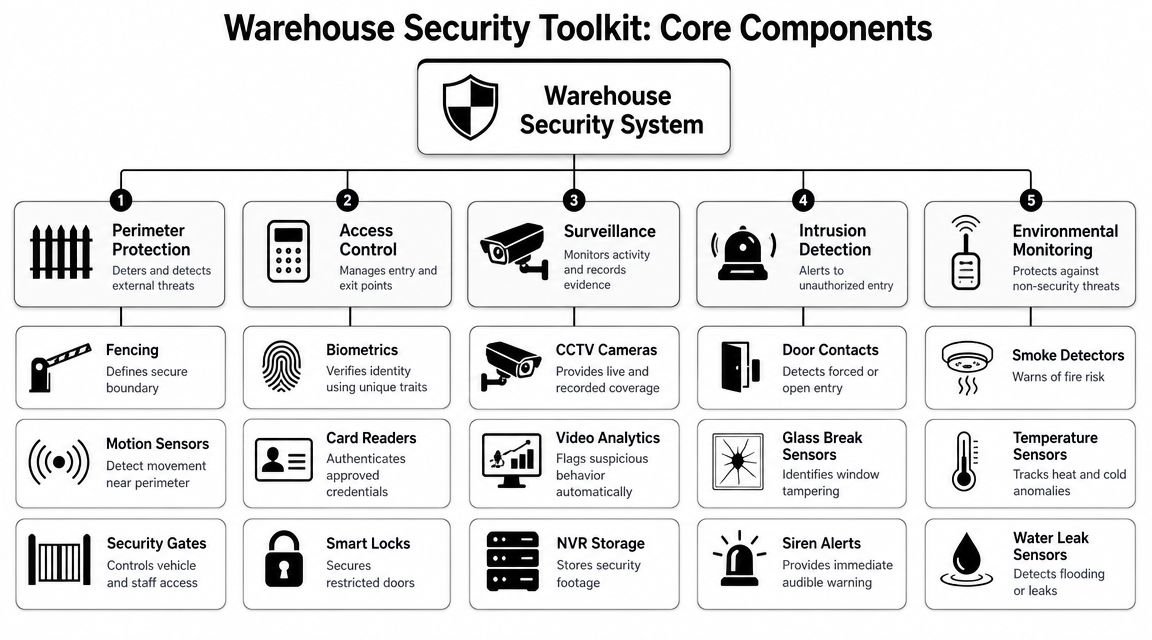
Before you choose brands, installers, or budgets, get clear on the jobs each element should do. Good warehouse security systems are built like a team. Each part has a role, and each part covers a weakness in another.
CCTV as your digital witness
CCTV in a warehouse isn't there just to “watch the building”. Its real job is to create usable evidence around movement, handling, and access. That means clear views of shutter doors, loading bays, pedestrian entrances, stock aisles, dispatch benches, and any area where high-value goods pause before leaving site.
For most SME warehouses, HD or 4K IP cameras are the practical baseline. Dome cameras suit internal open areas. Bullet cameras often work well on external walls and perimeter lines. Low-light performance matters. So does lens choice. A camera pointed in roughly the right direction is not the same as a camera that can identify a person or confirm which pallet was moved.
Common CCTV mistakes include:
- Covering space instead of events: Wide shots look reassuring but often miss the detail you need.
- Ignoring height and glare: A loading bay camera facing bright daylight can produce poor evidence at the exact moment goods are moved.
- No overlap: If one camera fails or is blocked, the event disappears from view.
If your site uses connected devices, readers, controllers, and networked cameras, it's worth understanding the wider security implications too. This embedded system security guide is useful background for non-specialists who want to understand why device hardening matters.
Alarms access control and fire systems
An intruder alarm is your rapid alert layer. In warehouses, it usually protects periods when the site should be empty or highly controlled. The practical choice is between bell-only and monitored setups. Bell-only systems create local noise and may trigger app alerts. Monitored systems send events to an external monitoring point, which gives you a clearer response path when no one on your team is available.
Access control is the gatekeeper. It replaces vague key control with traceable permissions. Cards, fobs, PINs, and biometric readers each have a place, but the key question is always the same. Can you grant, remove, and review access quickly? A warehouse with staff churn, temporary labour, or multi-tenant use should not rely on mechanical keys alone.
If you're comparing credential types and door strategies, this guide to commercial access control options gives a useful UK-focused overview.
Fire systems sit slightly apart from security, but in practice they need to coexist. In a working warehouse, your fire alarm, emergency lighting, door release logic, and access routes all affect how the building behaves under pressure. A security upgrade that ignores fire interface creates headaches later.
What each tool is best at
| Component | Best use in a warehouse | Where it falls short on its own |
|---|---|---|
| CCTV | Evidence, deterrence, incident review | Won't physically stop access |
| Intruder alarm | Fast alerts outside operating hours | Limited value without response process |
| Access control | Restricting and logging movement | Doesn't show what happened after entry |
| Fire system | Life safety and compliant alerting | Not a theft or intrusion control |
| Lighting | Visibility and deterrence | Not a substitute for cameras or locks |
A warehouse manager should expect every system to answer a different question. CCTV answers “what happened?” Access control answers “who went there?” Alarms answer “when did it start?”
The strongest setups combine those answers. That's where security becomes operationally useful rather than decorative.
From Blueprint to Fortress A Practical Layout Guide
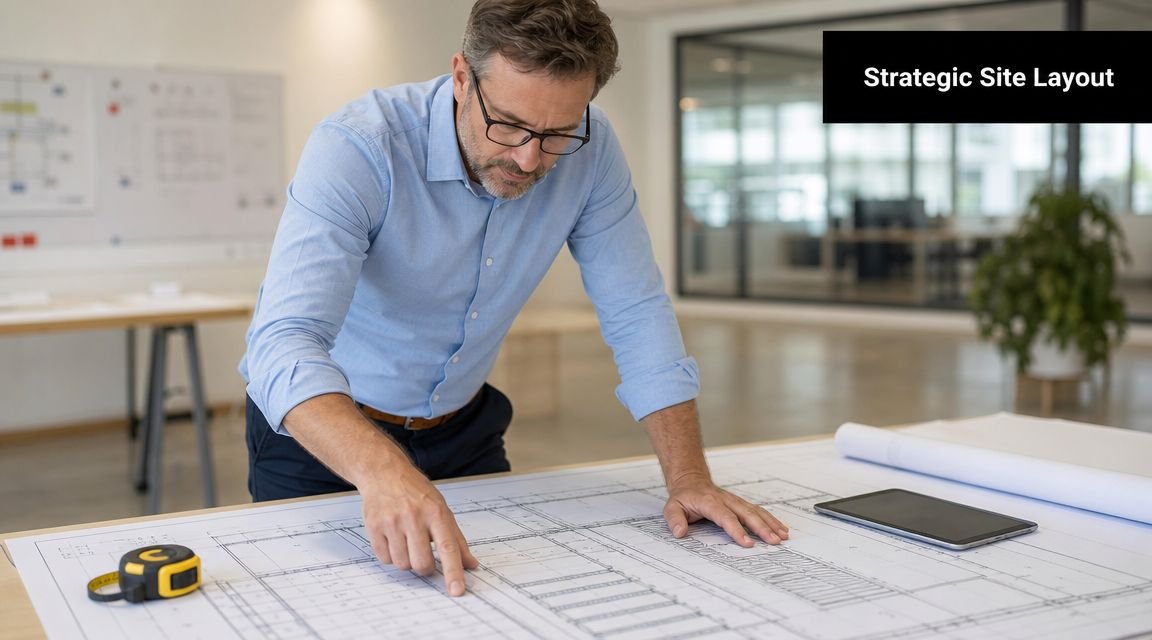
The best layout plans start on paper, not on a ladder. Before anyone quotes camera counts, mark up the site as it operates on a normal day and on a bad day.
Start with movement not hardware
Walk the route of a driver, a picker, a warehouse supervisor, a visitor, and a cleaner. Those routes tell you more about risk than a floorplan alone. Problems usually appear where different traffic types cross or where people can enter one zone and drift into another without challenge.
For UK warehouses, the most effective baseline is a layered architecture with high-definition CCTV at entry and exit points, loading docks, storage aisles, and perimeter approaches, plus role-based access control and intrusion sensors tied into central monitoring, according to this warehouse security systems guide. The practical gain is that when cameras and access control are integrated, your team can correlate an alarm event with identity, timestamp, and video evidence.
Map these first:
- Outer edge: Gates, fencing, yard approaches, vehicle entry, pedestrian entry.
- Transfer points: Loading bays, goods-in, goods-out, shutter doors, staging zones.
- Inner control points: Server cupboards, stock cages, manager offices, returns, high-value shelving.
- Quiet corners: Rear fire exits, side alleys, bin stores, unlit compounds, void space around the building.
Build layers around your highest risk zones
A practical warehouse layout doesn't try to watch every inch equally. It applies more control where loss is most likely or most damaging.
Use this sequence when reviewing your plan:
- Catch the approach: External cameras should see people and vehicles before they reach the building.
- Control the threshold: Every pedestrian and vehicle entry should have a clear permission point.
- Watch the handover: Loading bays need especially careful coverage because that's where goods, drivers, staff, and time pressure all meet.
- Protect the prize: High-value cages, returns, and restricted stock should sit behind another access layer.
- Preserve the exit trail: Cameras should show how goods or people leave, not just how they arrived.
If a thief can move from yard to stock without crossing a controlled point, the site design is doing half their work for them.
One common mistake in SME sites is putting excellent cameras on the front elevation and almost nothing at the side or rear. Another is letting all staff use the same internal route regardless of role. A better design funnels people through fewer, better-controlled points. That reduces blind spots and simplifies review when something goes wrong.
Navigating UK Security Standards and Regulations
A warehouse security upgrade in the UK isn't just a hardware decision. It sits inside standards, insurer expectations, and data protection duties. That sounds dry until the day you need a claim accepted or footage relied on after an incident.
Why standards matter to a warehouse manager
Modern warehouse security in Britain has increasingly been shaped by standards-based compliance. Intruder alarm installations are commonly designed to BS EN 50131, while access control and CCTV are routinely combined in risk-assessed systems, as described in this UK warehouse security best practice article. In plain terms, that means the better systems are designed around risk, evidence, and repeatable performance, not just visible deterrence.
For a warehouse manager, standards matter for three practical reasons:
- Insurer confidence: A standards-led design is easier to explain and justify than a piecemeal setup.
- System reliability: Proper grading, device choice, and programming reduce nuisance events and weak points.
- Maintenance clarity: Engineers can test and service against an understood benchmark.
A site with a professionally designed alarm, defined setting procedures, and auditable user management is in a stronger position than one with ad hoc additions made over several years.
CCTV data protection and practical compliance
CCTV often creates the most confusion. Managers worry that GDPR means they can't monitor staff areas, yards, or entrances properly. That's not the right reading. The issue isn't whether you use CCTV. It's whether you use it proportionately, lawfully, and with sensible controls.
That usually means:
- Recording for a clear business purpose: theft prevention, site safety, access control, incident review.
- Positioning cameras carefully: cover operationally relevant areas, not private or irrelevant spaces.
- Controlling access to footage: not everyone in the office should be able to browse recordings.
- Keeping audit discipline: know who can export footage and why.
For a practical UK overview, this guide on CCTV and GDPR for businesses is a useful reference point.
Compliance done properly doesn't weaken security. It gives your system credibility when you need to rely on it.
The same principle applies to visitor control, staff access, and alarm records. If your system logs events but nobody can interpret them, review them, or show they've been handled properly, you've paid for data without gaining much protection.
Integrating Systems for 24/7 Intelligent Monitoring
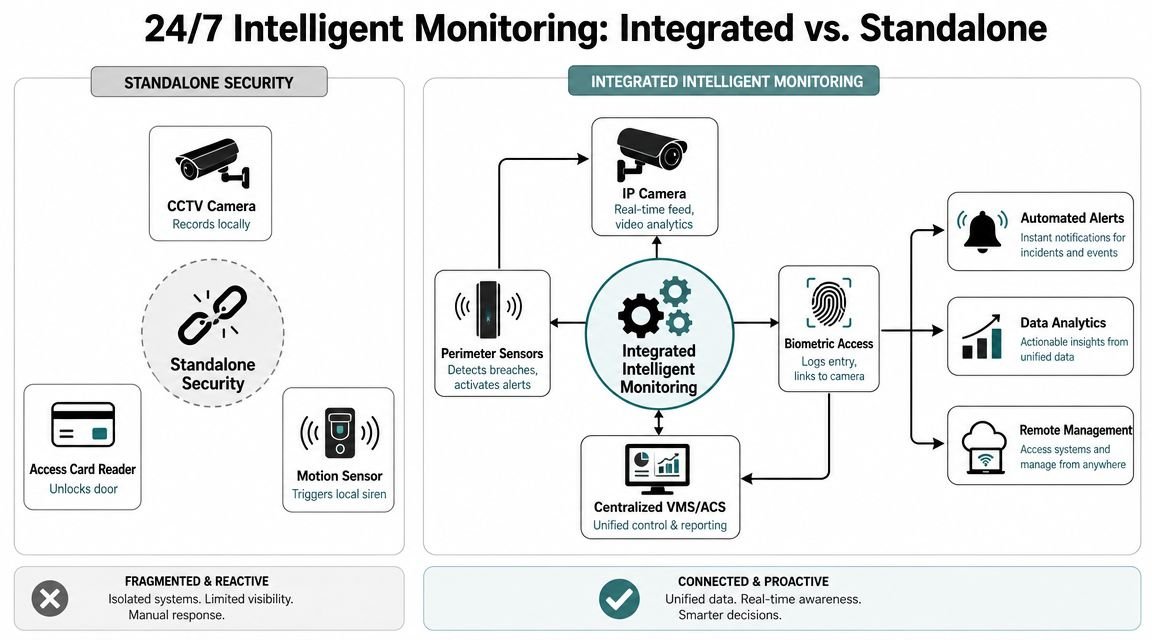
Standalone systems create administrative noise. Integrated systems create operational control. That's the difference between checking three apps after an alert and seeing one coherent event timeline.
What integration actually looks like on site
In a properly integrated warehouse, systems trigger and verify each other. A door forced open after hours can cue the nearest camera view, log the event, and push an alert to the right person. A staff access event at a restricted stock cage can be matched against video without anyone manually hunting through footage.
That changes how quickly a team can respond. It also changes how confidently they can rule events in or out. In a busy warehouse near Swansea or Bristol, false assumptions waste time. Integration cuts down the guesswork.
Useful examples include:
- Access control plus CCTV: Every restricted door event has matching video.
- Perimeter detection plus lighting: Movement on the boundary line improves visibility before someone reaches the building.
- Intruder alarm plus internal doors: Sensitive areas can stay isolated even if one zone is breached.
- Mobile alerts plus event tagging: Managers can see whether an event needs immediate action or morning review.
A short visual explainer helps if you're comparing old and new approaches:
Cyber security now sits inside physical security
This is the part many warehouse guides skip. Modern warehouse security systems are networked systems. Cameras, recorders, cloud video, mobile apps, remote diagnostics, and access control databases all create convenience. They also create exposure if they're badly configured.
The UK government's 2025 Cyber Security Breaches Survey found that 43% of UK businesses experienced a cyber breach or attack in the previous 12 months, highlighted in this warehouse cyber security discussion. For warehouses, that matters because the physical security stack often shares infrastructure with the rest of the business.
A practical cyber-physical checklist for SMEs looks like this:
- Separate critical systems: Don't treat security devices as casual add-ons to the office network.
- Control remote access: Convenience for managers and engineers should be tightly managed.
- Harden credentials: Shared logins and default passwords have no place in a commercial installation.
- Review update paths: Devices need supported firmware and a maintenance plan.
- Decide on recording resilience: On-premises, cloud, or hybrid should be chosen around risk and recovery, not fashion.
A camera with remote access is not just a camera. It's a connected endpoint inside your business.
That's why 24/7 monitoring now means two things. Someone must be able to see events when the site is closed, and the system itself must be protected from becoming the weak point.
Costing Your System and Proving Its ROI
Most warehouse managers don't struggle to justify security in principle. They struggle to put a sensible number against it. The right way to budget isn't to ask, “What's the cheapest way to get cameras?” It's to ask, “What level of loss, disruption, and evidential weakness can the business afford?”
What you are really paying for
A proper system cost includes more than devices. It includes design, cabling, power, storage, commissioning, user setup, integration, training, documentation, and maintenance. Cheap quotes often hide weakness in one of those layers.
The business case is stronger than many SME operators first assume. The British Retail Consortium's 2025 Crime Survey reported retail crime losses of £2.2 billion, and while that figure is retail-focused, it has clear relevance to warehouses feeding retail and e-commerce supply chains, especially where auditable evidence is needed for claims and loss investigations, as discussed in this warehouse security and insurance article.
A manager normally gets approval faster when they frame the investment around these outcomes:
- Reduced shrinkage exposure: Better control at dispatch, returns, and restricted stock areas.
- Stronger claims support: Time-stamped video and access logs help establish what happened.
- Less disruption after incidents: Faster review means less downtime and less staff speculation.
- Operational visibility: Security footage often resolves process disputes as well as criminal ones.
Ballpark UK Warehouse Security System Costs 2026 Estimate
These aren't fixed market rates. They're planning figures for SME discussion and budgeting. Final costs depend on site size, cabling routes, building fabric, existing infrastructure, and how much integration you need.
| System Tier | Components Included | Estimated Installation Cost |
|---|---|---|
| Entry level | Basic external and internal CCTV, bell-only intruder alarm, limited user setup | Ballpark only. Obtain a site survey for an exact quote |
| Mid-range integrated | HD or 4K CCTV, monitored intruder alarm, role-based access control on key doors, mobile alerts, recorder setup | Ballpark only. Obtain a site survey for an exact quote |
| Advanced SME warehouse | Expanded CCTV coverage, integrated alarm and access control, remote management, restricted area control, stronger evidence workflow | Ballpark only. Obtain a site survey for an exact quote |
That table is deliberately non-numeric because fixed prices without a survey are often misleading. A compact warehouse in Cardiff with easy cable runs and one loading bay is a different job from a split-unit site in Bristol with outbuildings, yard gates, and poor legacy wiring.
The better ROI question is this. If a disputed stock loss happened next month, would your current system help you resolve it quickly, or would it leave you arguing over assumptions?
Choosing Your Security Partner in South Wales & The South West
A good design can still fail in procurement. I've seen businesses buy capable hardware and end up with a weak result because the installer treated the project as a box-drop exercise instead of a site-specific security plan.

What to ask before you sign anything
Start with the proposal itself. If it talks mainly about camera count, app access, and image quality, it's incomplete. A warehouse proposal should explain site logic. It should identify controlled routes, vulnerable transfer points, after-hours behaviour, user permissions, and maintenance responsibilities.
Ask direct questions such as:
- How have you assessed this site? You want to hear about movement, risk zones, and operational patterns.
- How will the systems integrate? If the answer is vague, assume they'll remain largely separate.
- What happens after an alert? Response workflow matters as much as detection.
- Who maintains it and how quickly can they attend? Support quality shows up after handover, not during the pitch.
- How will access rights be managed when staff change? This is a daily operational issue, not a technical footnote.
If you're comparing local providers, reviewing established security companies in Cardiff can help you benchmark what a serious commercial service should include.
Why local support matters more than a slick proposal
For warehouses across Cardiff, Newport, Swansea, and Bristol, local engineering support has real value. Not because “local” is automatically better, but because warehouse faults are rarely convenient. A failed reader on a staff entrance, a recorder issue after a weekend event, or a false alarm pattern on a side elevation needs practical response, not a national call centre script.
Look for partners who can show:
- Commercial and industrial experience: Warehouses behave differently from offices and shops.
- Standards awareness: They should talk comfortably about compliant alarms, evidence quality, and audit trails.
- Integrated thinking: CCTV, alarms, access control, and fire interface should not be treated as separate sales departments.
- Ongoing account ownership: You want a relationship that survives the installation date.
The right contractor doesn't just install equipment. They make the site easier to manage on an ordinary Tuesday and easier to defend after a bad Saturday night.
One final filter helps. Ask the bidder what they would remove from the specification if budget gets tight. The strongest consultants won't strip out the backbone and leave you with cosmetic features. They'll protect the core architecture first, then phase enhancements sensibly.
Frequently Asked Questions about Warehouse Security
What is the real difference between a bell only and monitored alarm
A bell-only alarm makes noise on site and may send app notifications to nominated users. It suits lower-risk premises or businesses that have reliable internal response procedures. A monitored alarm sends signals to a monitoring service, which is better when the warehouse is empty for long periods or when keyholders can't always respond quickly.
For many SME warehouses, the decision comes down to how often the building is unattended and how confident you are in your out-of-hours response process.
Can security cameras run on the same internet connection as the office
They can, but that doesn't mean they should share everything in the same casual way. Security traffic needs planning around resilience, permissions, and cyber risk. A warehouse that relies on remote viewing, cloud features, or app alerts should think carefully about segmentation, user access, and what happens if the office network has problems.
If your current setup grew organically, ask for a review before adding more devices.
How often should a commercial warehouse security system be maintained
Commercial systems need regular maintenance, testing, and review. The right frequency depends on the system type, how critical the site is, insurer expectations, and how hard the environment is on equipment. Dust, vibration, forklifts, yard weather, and frequent door use all affect wear.
In practice, maintenance should cover more than fault fixing. It should include detector checks, camera cleaning, recorder health, battery condition, user permissions, event logs, and a review of whether the system still matches current operations.
Are pet friendly sensors suitable for warehouses
Sometimes, but don't assume they are the answer to every false alarm problem. “Pet-friendly” sensors are designed to reduce unwanted activation from small animals, not to compensate for poor detector choice or bad positioning. In warehouses, false alarms are often caused by draughts, shifting temperatures, door movement, pests in roof voids, or detectors aimed at the wrong space.
The better fix is normally proper sensor selection and placement based on the environment.
Should every internal door be on access control
No. That usually adds cost without much benefit. Focus first on doors that protect stock, control flow, separate staff-only zones, or support investigation after an incident. Main entries, stock cages, dispatch areas, comms rooms, and management offices usually deserve stronger control before general internal circulation doors do.
Is cloud recording always better than on premises recording
Not automatically. Cloud can improve remote access and simplify some management tasks. On-premises recording can offer stronger local resilience and predictable retention control. Many warehouses end up with a hybrid approach because it balances convenience with operational recovery.
The best option depends on your site, internet reliability, and how you expect to review and retain evidence.
If you're planning a warehouse security upgrade in Cardiff, Newport, Swansea, Bristol, or the wider South Wales and South West region, Wisenet Security Ltd offers practical site surveys, integrated system design, and ongoing maintenance for CCTV, intruder alarms, access control, fire systems, and monitored protection. If you want advice grounded in UK standards and real warehouse operations, they're a strong local team to speak with.