
Choosing Security Companies Cardiff: Your 2026 Guide
If you're searching for security companies Cardiff, you're probably already dealing with a practical problem. A shop in the city centre has had out-of-hours issues. A warehouse on an industrial estate has blind spots at the rear gate. A landlord wants better control over shared entry doors. Or you're a homeowner who no longer feels comfortable relying on a basic alarm bell and luck.
Cardiff has a broad mix of property types, risk profiles, and security providers. That matters. The right setup for a retail unit near the centre isn't the right setup for a detached home in Cyncoed or a multi-tenant commercial building with frequent staff turnover. Good security starts with matching the system, the installer, and the response plan to the site you have.
Table of Contents
- First Steps Defining Your Security Needs in Cardiff
- Decoding Security Systems and Technologies
- How to Verify a Security Company's Credentials
- Key Questions to Ask During Your Consultation
- Understanding Security System Pricing and Contracts
- Your Final Checklist for Choosing a Cardiff Security Firm
First Steps Defining Your Security Needs in Cardiff
Most buyers start in the wrong place. They look at cameras, alarm apps, and headline prices before they've defined what needs protecting, when the risk occurs, and what a successful outcome looks like.
Cardiff's market is established and competitive, with multiple providers holding over 20 years of experience and many operating across sectors from retail to construction, according to this overview of Cardiff security firms. That gives you options, but it also means you need a clear brief before speaking to anyone.
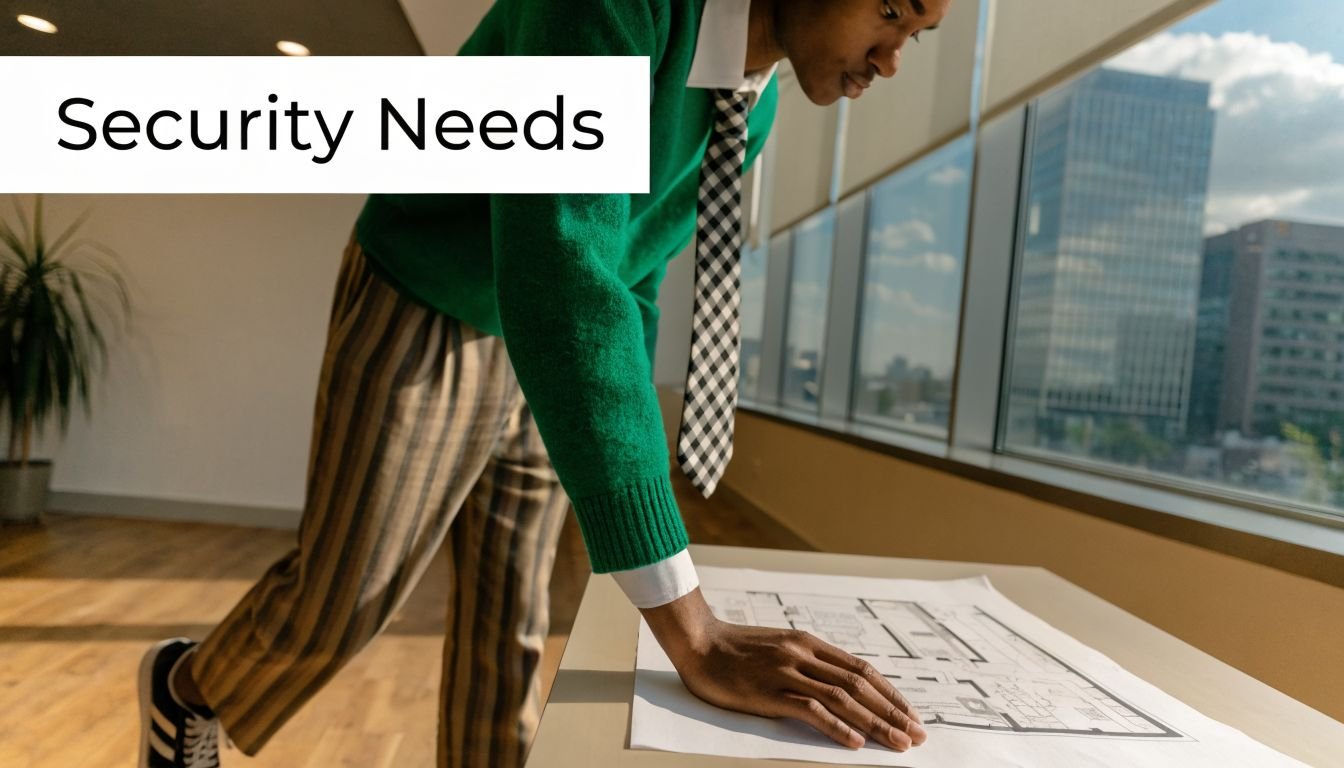
Start with the problem, not the product
Write down the actual issue in plain language. Not "I need CCTV". More like: "staff can't see the rear service yard", "deliveries arrive before opening", or "the side alley feels exposed at night".
That changes the conversation immediately. A reputable firm can design around a defined risk. It can't do much with a vague request for "something secure".
Use this simple self-check before calling local providers in Cardiff and surrounding areas:
Identify the asset
Decide what matters most. People, stock, tools, vehicles, cash handling areas, server rooms, or family access points all require different priorities.Pinpoint the weak time
Some sites are vulnerable only after closing. Others have risk during deliveries, shift changes, school runs, or contractor visits.Define the required outcome
You may need deterrence, evidence, controlled entry, remote alerts, or a full monitored response plan. Those aren't the same thing.
Practical rule: If you can't describe the incident you're trying to stop, you aren't ready to approve a system design.
Match the risk to the property type
A city centre retail unit usually needs strong front-of-house coverage, clear till views, stockroom protection, and controlled staff access. A warehouse in an industrial area often needs perimeter awareness, gate control, external lighting coordination, and reliable night coverage that still produces usable evidence. A family home may need simpler priorities: visible deterrence, smartphone alerts, and confidence that the system won't become a daily nuisance.
The same goes for multi-tenant properties. Shared entrances, changing occupiers, and trades coming and going create a different risk pattern from owner-occupied premises.
A good brief often includes these points:
- Entry points: Front doors, rear exits, roller shutters, side gates, loading bays.
- Blind spots: Bin stores, alleys, stairwells, service corridors, plant areas.
- User groups: Staff, tenants, children, couriers, cleaners, contractors.
- Daily routine: Opening times, handover periods, weekends, vacant periods.
Shortlist your needs before you compare companies. You'll get better advice, cleaner quotes, and far fewer unnecessary extras.
Decoding Security Systems and Technologies
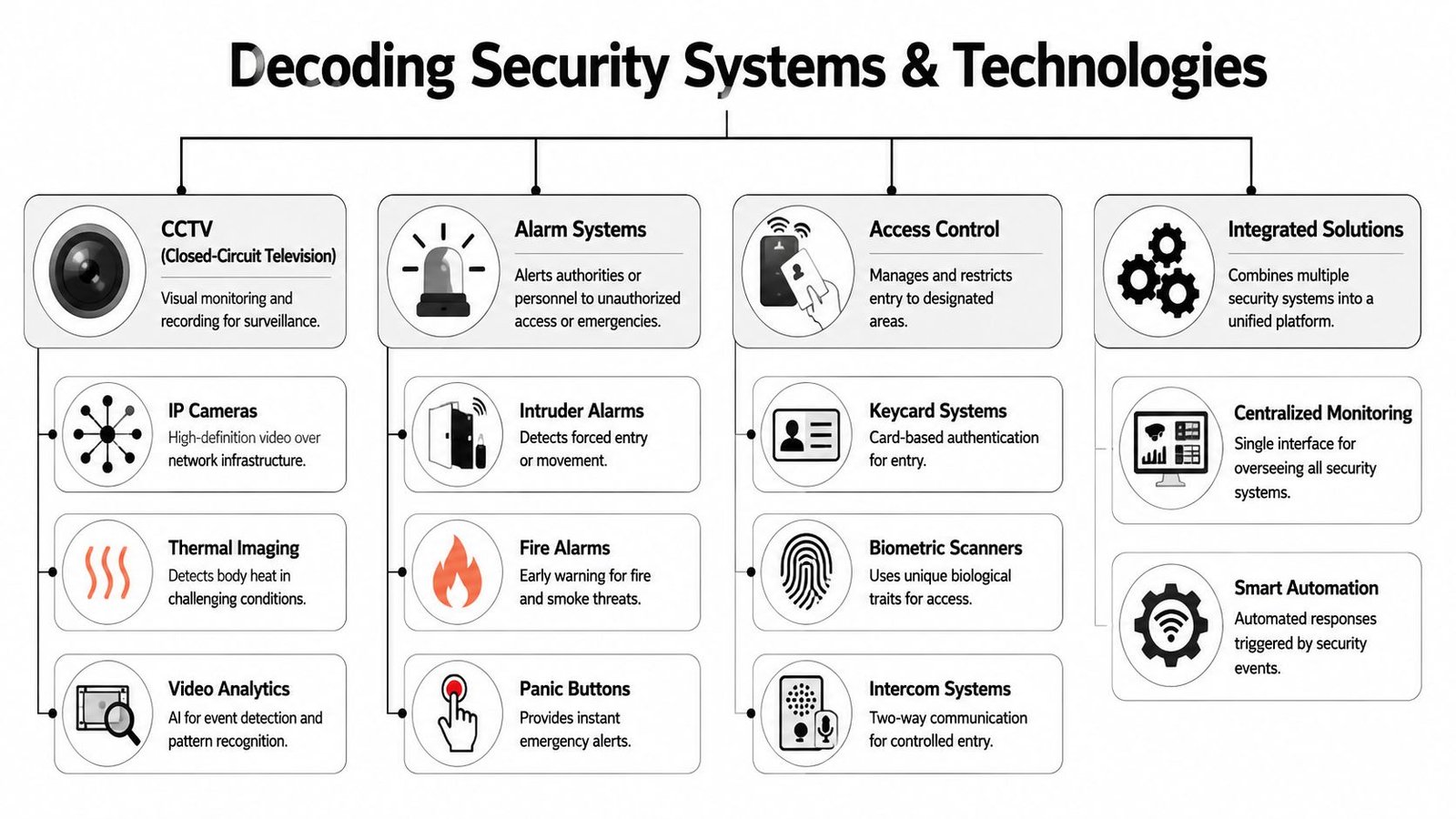
Security technology only helps if you understand what you're buying. The biggest mistakes usually come from buying on labels alone. "4K CCTV", "smart alarm", and "access control" can mean very different things once the equipment is on the wall and expected to work in rain, darkness, and busy real-world conditions.
What matters in CCTV and alarms
For CCTV, resolution matters, but placement matters more. A badly positioned high-resolution camera still gives you poor evidence. You want correct angle, useful lighting performance, and coverage planned around how people move through the site.
If you're comparing camera types, this guide on the difference between IP cameras and HD analogue CCTV is worth reading before a quote review. It helps you judge whether a proposal fits your building and cabling rather than just sounding modern.
For intruder alarms, ask whether the system is designed to BS EN 50131 and whether it will be bell-only or monitored. That choice affects how incidents are handled, how quickly you're informed, and how useful the system is when the building is empty.
A practical comparison looks like this:
| System type | Best fit | Common mistake |
|---|---|---|
| CCTV | Evidence, deterrence, operational oversight | Covering too much area with too few cameras |
| Intruder alarm | Early warning of unauthorised entry | Choosing sensors without considering pets, layout, or user habits |
| Access control | Managing who goes where and when | Treating every door the same |
| Intercom or gate automation | Controlled entry for homes and managed sites | Ignoring network security and maintenance |
Why integration and cyber hygiene matter
The strongest systems don't work in isolation. A camera records. An alarm detects. Access control logs movement. When those elements are integrated, the site becomes easier to manage and incidents become easier to verify.
That matters even more because modern security is partly digital. Socura's cybersecurity release notes a 300% rise in IoT exploits and says pairing physical deterrents with 24/7 digital monitoring can boost effectiveness by up to 60%. If a gate controller, alarm communicator, or access device isn't patched and maintained, it can become the weak point in an otherwise solid installation.
A smart system that isn't maintained properly can be less secure than a simpler one that's configured correctly.
For businesses, integrated access control can also improve daily operations. Fobs, cards, keypads, and biometric readers each have trade-offs. Cards are easy to issue and revoke. Keypads are simple but codes get shared. Biometrics can tighten control on sensitive doors, but they need careful planning around user management and privacy expectations.
One local option in this market is Wisenet Security Ltd, which installs integrated CCTV, alarms, access control, intercoms, fire systems, and gate automation across South Wales. That's the type of joined-up offering worth considering when you want one firm to take responsibility for how the whole system works together.
How to Verify a Security Company's Credentials
In security, credentials aren't a nice extra. They're your first filter. Cardiff has plenty of legitimate providers, but the market also attracts firms that look polished online and fall apart when you ask technical or compliance questions.
If a company becomes evasive when you ask for proof, move on.
The credentials that aren't optional
For guarding roles, SIA licensing is mandatory. For installation work, the benchmark shifts toward standards, insurance, vetting, and safe working practice. You should also pay attention to whether the firm is used to working in occupied homes, schools, shared commercial sites, or higher-risk premises.
Cardiff providers often differentiate themselves through customer satisfaction, insurance-backed reliability, and accreditations. Prime Secure's Cardiff security page notes that many firms hold SafeContractor approval, provide fully insured services, and that security installations can contribute to reductions in property insurance premiums.
Check these points in writing:
- Insurance cover: Ask for confirmation of current public liability and any relevant employer cover.
- Engineer vetting: For residential and sensitive commercial sites, ask whether engineers are DBS-checked.
- Safe working standards: SafeContractor approval is a useful signal, especially for corporate and public-sector-facing work.
- Compliance knowledge: Installers should be comfortable discussing standards such as BS EN 50131 for alarms.
If you need background on the alarm standard itself, this plain-English guide to EN 50131 alarm compliance helps you separate real compliance from sales talk.
How to check reputation properly
Reviews matter, but not in the lazy way many buyers use them. Don't just count stars. Read for patterns. Are complaints about missed appointments, poor handover, lack of support, messy installation, or confusing invoices? Those patterns tell you more than a headline score.
The utility of why online reputation is important lies in its explanation of why reputation should be assessed as a body of evidence, not just a marketing asset. For security companies Cardiff clients can trust, consistency matters more than polished claims.
Ask for evidence that the company finishes jobs cleanly, trains users properly, and responds when faults appear. Installation day is only the start.
Key Questions to Ask During Your Consultation
A consultation isn't just for the company to inspect your site. It's your chance to test whether they think like professionals or salespeople.
The strongest firms usually start with a proper survey. According to Double Check Security's Cardiff security page, professional providers begin with a site survey and customized planning, and firms with over 98% client retention are associated with solutions that can reduce intrusions by as much as 75% on monitored sites. That tells you something important: custom design beats off-the-shelf packages.
Questions that expose weak proposals
Use questions that force specific answers.
- Coverage planning: "Show me exactly where the blind spots are and how you'll deal with them."
- Alarm design: "Why have you chosen those detector positions for this layout?"
- Entry control: "How will you handle lost fobs, code changes, staff leavers, and contractor access?"
- Remote use: "What will I be able to see and control from my phone, and what will still require engineer access?"
- Evidence quality: "At night, what image quality should I realistically expect at the gate, front door, and till area?"
Those questions reveal whether the proposal is based on your building or on a standard template.
Ask about aftercare too. Fault response, maintenance intervals, user training, and documentation matter more after installation than most buyers realise.
What a solid consultation usually includes
A proper site visit should feel methodical, not rushed. You should see the engineer or consultant checking routes, lighting conditions, entry points, network considerations where relevant, and how users will interact with the system day to day.
These are good signs:
They ask operational questions
Not just where you want cameras, but who opens up, who locks up, who needs access, and when the site is empty.They challenge poor assumptions
If you ask for a camera in the wrong place, they should explain why and propose something better.They explain trade-offs clearly
For example, wider coverage versus tighter identification, convenience versus control, or lower upfront spend versus better lifecycle reliability.They discuss handover
You should know who gets trained, what documents you'll receive, and how changes are requested later.
"Can you walk me through an incident from detection to response on this exact site?" is one of the best questions you can ask.
If the answer stays vague, the design probably is too.
Understanding Security System Pricing and Contracts
The cheapest quote often leaves out the parts that make the system dependable. That's why security pricing needs to be read in layers, not as one headline number.
What you're actually paying for
Most professional quotes have two main parts. The first is equipment and installation. The second is ongoing cost, usually maintenance, monitoring, or both.
A sensible quote should spell out:
- Hardware: Cameras, recorder, detectors, keypad, control panel, readers, intercoms, locks.
- Labour: Installation time, commissioning, testing, user setup.
- Support: Maintenance visits, call-out terms, software updates where relevant.
- Monitoring or connectivity: If alarms or systems report events remotely.
Outright purchase gives you ownership and fewer long-term contractual ties. Subscription or managed models can smooth upfront cost, but you need clarity on cancellation terms, equipment ownership, and what happens if you stop the service.
Where cheap quotes usually fall apart
Low quotes often cut corners in ways the buyer won't spot immediately. Fewer devices. Poorer cable routes. Minimal commissioning. Weak user training. No realistic maintenance plan.
That becomes expensive later. False alarms frustrate staff and neighbours. Unreliable notifications get ignored. A failed gate or access door becomes an operational problem, not just a security one.
A better way to compare proposals is to ask one question: what am I committing to over the life of the system, and who is responsible when something stops working? The firm that answers that clearly is usually safer to deal with than the one that wins on price.
Your Final Checklist for Choosing a Cardiff Security Firm
By the time you've spoken to a few security companies Cardiff clients commonly shortlist, the decision should be less about presentation and more about proof. You're looking for a firm that understands your site, explains trade-offs plainly, documents what it proposes, and stays accountable after installation.
Use this checklist when comparing final options:
| Verification Point | Company A | Company B | Notes |
|---|---|---|---|
| SIA relevance understood for guarding roles | |||
| Insurance confirmed in writing | |||
| SafeContractor or equivalent health and safety evidence | |||
| Engineers vetted for site type | |||
| System standards clearly explained | |||
| Site survey felt tailored, not generic | |||
| Blind spots and operational risks addressed | |||
| Quote includes maintenance and support detail | |||
| Remote access and user permissions explained | |||
| Handover and training plan provided |
A good company won't mind being checked carefully. In fact, they usually prefer it. Informed clients ask better questions, approve the right design, and end up with systems that get used properly.
If you want a practical second opinion on your property, Wisenet Security Ltd can arrange a no-obligation consultation across Cardiff and South Wales. Bring your concerns, your layout, and any existing quote. We'll tell you what makes sense, what doesn't, and what a properly specified system should look like for your site.