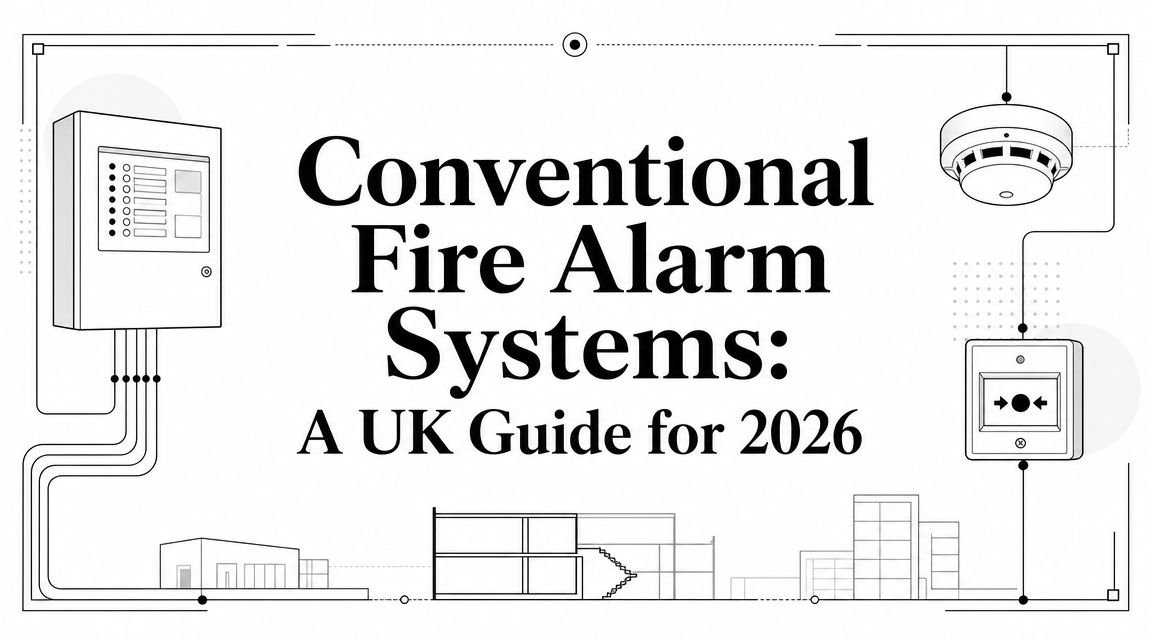
Conventional Fire Alarm Systems: A UK Guide for 2026
You're probably looking at a practical problem, not a technical hobby. A shop fit-out is nearly finished in Cardiff. A small office in Newport has taken on extra space. An HMO in Bristol needs its fire precautions reviewed before the next tenancy cycle. The fire alarm has to be compliant, reliable, understandable to staff, and sensible on cost. That usually narrows the conversation very quickly.
For many smaller UK properties, conventional fire alarm systems are still a realistic answer. They aren't fashionable, and they don't offer the same level of detail as addressable systems, but they still suit a large part of the market. That matters even more in a period when advanced fire technology keeps expanding. The smart fire alarm market was valued at US$ 21.4 billion in 2023 according to Fact.MR's smart fire alarm market report, yet smaller and budget-sensitive UK premises still often choose conventional systems because the simpler zone-based approach is enough for the building and the risk profile.
Before anyone signs off a specification, it also helps to step back and review the wider fire safety picture. Good housekeeping, clear escape routes, and basic inspection discipline still make a major difference, which is why practical checklists such as these expert property fire safety tips are useful alongside system planning. If you're already comparing installers or trying to understand what a compliant package looks like, it's also worth reviewing a specialist provider's fire alarm installation and commissioning services so you can see how design, commissioning, and maintenance fit together in practice.
Table of Contents
- Choosing Your First Line of Fire Defence
- What Is a Conventional Fire Alarm System
- How Conventional Alarms Pinpoint a Fire
- Ideal Building Types for Conventional Systems
- Weighing the Pros and Cons
- Conventional vs Addressable Systems A Direct Comparison
- UK Compliance Installation and Maintenance Essentials
Choosing Your First Line of Fire Defence
A lot of owners start in the same place. They know they need a fire alarm, they know they have duties to occupants, and they don't want to overspend on a system that's more complex than the building requires. The wrong decision usually happens when people buy on labels alone. “Conventional” sounds old. “Addressable” sounds better. In practice, the right choice depends on layout, occupancy, how quickly staff can investigate an alarm, and how the building is used day to day.
Take a typical independent retailer in South Wales. The premises may have a sales floor, stock room, staff area, and rear exit, all within a compact footprint. In that kind of setting, a system that identifies the affected area can work well because staff can reach and check the space quickly. The same can apply to a small office, a workshop, or a modest landlord-owned property with a straightforward layout.
Where simple works well
Conventional systems remain popular because they solve the core problem without unnecessary complexity. They detect fire, raise the alarm, and indicate the relevant area. That's often enough when travel distances are short and the building doesn't have a confusing internal arrangement.
Practical rule: If your staff or tenants can quickly identify and reach the area shown on the panel, a conventional system may still be a sensible fit.
That doesn't mean the cheaper option is always the better option. A mixed-use building with several occupiers, awkward circulation routes, or frequent nuisance alarms can make a simple system harder to manage. In those properties, operational disruption matters just as much as purchase cost.
What owners usually get wrong
The mistake isn't choosing conventional equipment. The mistake is choosing it without asking the right questions first.
- Building layout matters: Open, compact, low-complexity sites are easier to protect with zone-based indication.
- Occupancy matters more than appearance: A small building with multiple tenants can be harder to manage than a larger single-occupancy unit.
- Response needs to be realistic: If an alarm means someone must search a whole area, that search has to be practical under pressure.
A conventional system is best viewed as a deliberate choice, not a compromise by default.
What Is a Conventional Fire Alarm System
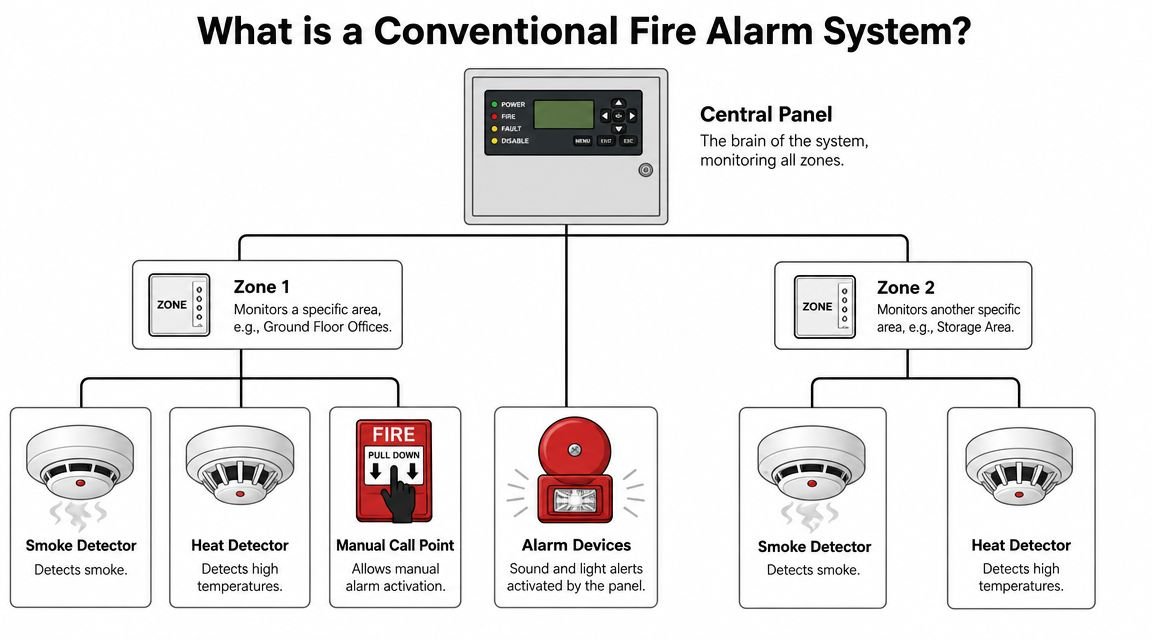
A conventional fire alarm system divides a building into separate zones. Each zone contains one or more initiating devices, and the panel tells you which zone is in alarm. It does not tell you which exact detector or call point within that zone has activated.
A simple way to think about it is a lighting circuit. If one switch controls all the lights in a room, you know the problem is in that room, but you still need to look around to find the failed fitting. A conventional fire alarm works in a similar way. The panel points you to the area, not to the individual device.
The three parts that matter
At site level, most owners only need to understand three core elements.
- Control panel: This is the system's decision point. It monitors the incoming circuits, shows which zone is in alarm or fault, and triggers the notification devices.
- Initiating devices: These include smoke detectors, heat detectors, and manual call points. They are the parts that detect fire conditions or allow someone to raise the alarm manually.
- Alarm devices: These are the sounders and, where fitted, visual warning devices that tell occupants to evacuate or follow the site's fire procedure.
Why zones are central to the design
The wiring architecture is what defines the system. In a conventional arrangement, initiating devices are grouped onto circuits assigned to zones. That makes the system relatively easy to understand for many small premises. It also means that fault-finding often starts by checking the affected zone rather than interrogating a list of individually addressed devices.
For UK specification work, this zone-based approach isn't an informal habit. Conventional panels sold for the UK market are built around UK and European compliance expectations. Eaton's UK manual for an 8-zone conventional panel notes certification to EN54-2 and EN54-4 and design to BS 5839 recommendations, as shown in the Eaton conventional panel manual.
A conventional panel gives useful location information, but only at zone level. That's enough in some properties and limiting in others.
What that means in day-to-day use
For a small business owner, the benefit is clarity. Staff can be trained to read the panel, identify the affected area, and investigate if the fire procedure allows it. For a landlord or managing agent, the simplicity can also help when explaining the system to occupants and contractors.
What it won't do is pinpoint “Detector outside Flat 3 kitchen” or “manual call point at rear warehouse door”. If you need that level of precision, you're already moving beyond what conventional systems are designed to provide.
How Conventional Alarms Pinpoint a Fire
When a conventional system goes into alarm, the sequence is straightforward. That simplicity is one reason these systems have remained so common in smaller buildings.
What happens first
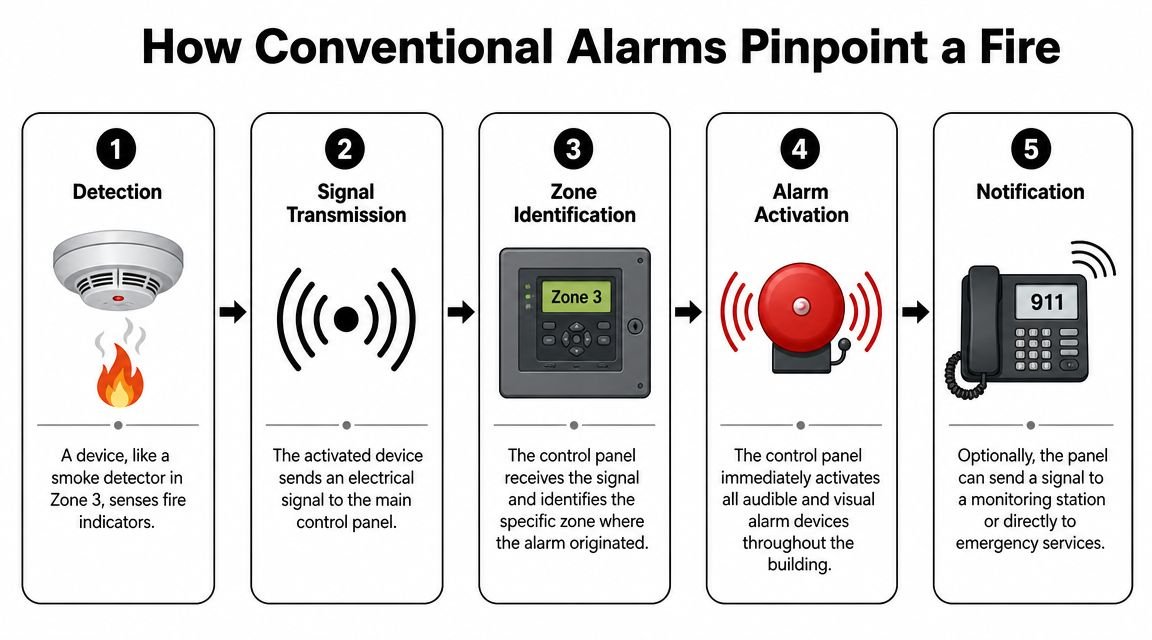
A detector senses smoke or heat, or someone operates a manual call point. That device changes the electrical condition on its zone circuit. The control panel recognises that change and marks the relevant zone as being in alarm.
At that point, the panel doesn't know the exact device. It only knows the alarm came from that circuit.
What the panel shows
This is the operational difference that owners need to understand clearly. According to Advanced's guide to conventional and addressable fire alarm systems, when a detector trips on a conventional system, the fire alarm control panel only identifies the zone in alarm. The same guide notes that sounders are often wired on separate circuits, which helps with fault isolation because a wiring issue is contained within a detector zone rather than affecting the whole network.
That has practical consequences in a real incident:
- The alarm starts and occupants hear the warning devices.
- The panel indicates a zone, such as a floor, wing, office area, or stock room circuit.
- Staff or responders investigate that zone to locate the actual detector, call point, or fire source.
- The building procedure takes over, whether that means full evacuation, confirmation, or call-out handling depending on the site arrangement.
If the affected zone is compact and obvious, that investigation is usually manageable. If the zone covers a messy, busy, or shared area, it can slow everything down.
Why fault isolation is often easier than people expect
Conventional systems are often described as basic, but basic doesn't mean crude. Separate sounder circuits and separate zone circuits can make some faults easier to contain and track at circuit level. In a simple building, that can be useful for maintenance engineers and for responsible persons trying to understand what the panel is telling them.
That said, there's no escaping the main limitation. If an alarm is raised in a storage area with multiple rooms, or in a building where several people need to coordinate access, someone still has to search that area physically.
The real test
A conventional system works well when the indicated zone gives people enough information to act quickly. If it doesn't, the issue isn't that the panel failed. The issue is that the system type no longer matches the building's operational needs.
Ideal Building Types for Conventional Systems
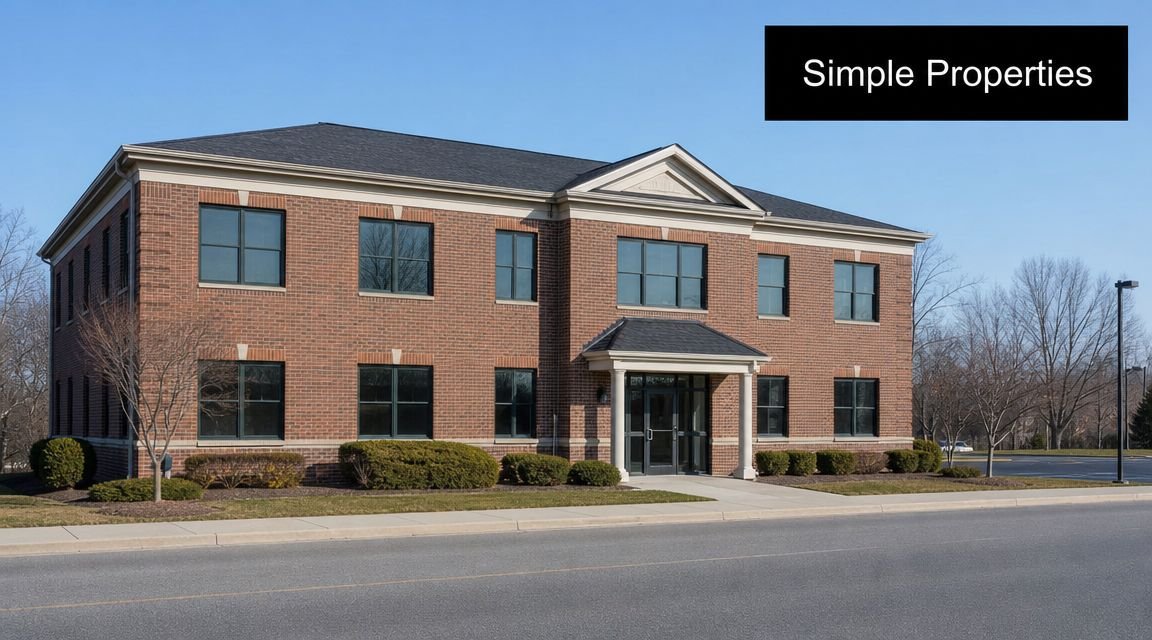
Conventional systems are best suited to buildings where zone-level information is enough to support a quick, safe response. The building doesn't have to be tiny, but it does need to be manageable. That usually means straightforward layouts, clear compartmentation, and occupancy patterns that don't make alarm investigation awkward.
The UK size limits that shape the choice
The most useful benchmark comes from UK fire safety guidance summarised by the Fire Protection Association. A single conventional alarm zone should not exceed 2,000 square metres, and a building can only be treated as a single zone if its total floor area is under 300 square metres, as noted in the Fire alarm system guidance summary. Those limits explain why conventional systems are such a practical fit for smaller and simpler premises.
Those figures aren't a shortcut to design. They are a reminder that zoning has limits. Once the building grows, the practicality of searching a whole zone starts to deteriorate.
Where conventional systems tend to fit well
In practice, these properties often suit conventional fire alarm systems:
- Small retail units: Staff usually know the layout well and can identify the alarmed area quickly.
- Independent offices: A few rooms or a compact two-storey arrangement can often be zoned sensibly.
- Small warehouses or workshops: Open floor areas make visual checks easier, especially where access is straightforward.
- Some HMOs and landlord-managed properties: These can work if the layout is simple, access is clear, and the response procedure is realistic.
If you manage storage or logistics space, the wider security environment matters as well. A warehouse that needs coordinated fire, intruder, and perimeter protection often benefits from reviewing its broader warehouse security systems rather than treating the alarm in isolation.
Where they stop being efficient
The system starts to lose its advantage when the building creates delay.
| Building condition | Conventional suitability |
|---|---|
| Compact and single occupancy | Usually strong |
| Shared access and multiple occupiers | Depends on management and layout |
| Large footprint with long travel distances | Often weaker |
| Frequent layout changes | Often weaker |
A conventional system is a strong option when the zone shown on the panel is small enough to investigate without confusion, delay, or access problems.
That's why the same equipment can be perfectly suitable in one property and a poor fit in the one next door.
Weighing the Pros and Cons
Conventional systems stay in the market for good reasons. They are familiar, proven, and often cost-effective at the front end. For a straightforward building, they can do exactly what the site needs without loading the project with features that won't be used.
What they do well
The main strengths are practical rather than glamorous.
- Lower initial complexity: Panels and devices are generally easier for owners and staff to understand.
- Good fit for simple layouts: If a zone corresponds neatly to a clear part of the building, alarm response can be efficient.
- Proven approach: The architecture has been used for years and is still well suited to many routine commercial and residential settings.
Where the limitations bite
The trade-offs become obvious when the building is busy, layered, or shared.
- You only get zone information: That means somebody may have to search a whole area to find the source.
- Fault location can take longer: If there's an issue on a zone circuit, engineers may need to inspect multiple devices and connections within that zone.
- Growth is less flexible: As buildings change, adding zones and revising circuits can become awkward.
The cheapest compliant system at installation stage isn't always the cheapest system to live with.
That's the point owners often miss. A conventional system can be exactly right for the current building. It can also become a poor operational fit if the occupancy changes, the site expands, or the nuisance alarm burden rises.
The sensible way to judge it
Don't ask whether conventional systems are good or bad. Ask whether zone-level information is enough for your premises, your staff, and your management process. If the answer is yes, conventional can still be a very sound choice. If the answer is no, spending more on better location data is usually justified.
Conventional vs Addressable Systems A Direct Comparison
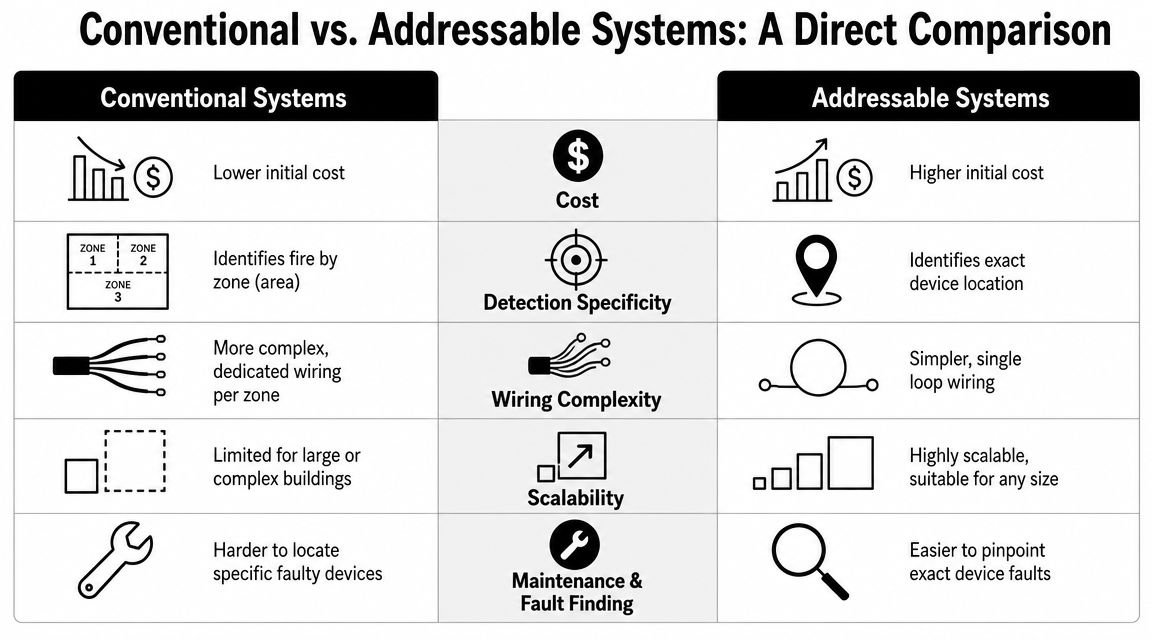
The practical distinction is simple. A conventional system tells you the area. An addressable system tells you the exact device. Everything else flows from that.
Here's the visual comparison first.
Side-by-side decision factors
| Feature | Conventional System | Addressable System |
|---|---|---|
| Cost | Lower initial cost | Higher initial cost |
| Detection | Identifies fire by zone | Identifies exact device location |
| Wiring | Dedicated wiring by zone | Loop-based arrangement |
| Scalability | More limited in larger or changing buildings | Better suited to expansion and change |
| Maintenance and fault-finding | Harder to pinpoint individual faults | Easier to identify the exact affected device |
A short video can also help if you want to see the distinction explained in a more visual format.
What the difference means on site
For a small single-occupancy unit, the precision of an addressable system may not add enough value to justify the extra spend. If the panel says the rear workshop zone is in alarm and staff can safely confirm that area quickly, conventional may be entirely appropriate.
In a multi-tenant property, the calculation changes. The operational impact of only identifying a zone, not a device, is a serious consideration in HMOs, retail parades, and other shared premises. UK fire and rescue services attended around 150,000 fires in England in the year ending June 2024, and unwanted fire signals remain a significant burden, as discussed in The Alarm Masters article on conventional fire alarm systems. In those environments, the choice between conventional and addressable can affect disruption, call-out handling, and how quickly someone can verify what's happening.
When conventional is enough and when it isn't
A practical rule of thumb works better than a sales pitch.
- Choose conventional when the building is compact, the layout is stable, and zone-level investigation is realistic.
- Choose addressable when the building has multiple floors, multiple occupiers, awkward access, or an operational need for precise alarm and fault data.
- Pause and review when the property sits in the middle. Some sites aren't obvious, especially mixed-use buildings with modest size but complicated occupancy.
The cost question owners actually mean
A common question is which system is cheaper. What they really mean is which system creates the lowest overall management burden for the property they have now and the one they're likely to have in a few years. That's the better question, because a lower purchase price can be offset by slower investigation, longer maintenance visits, and more disruption when the building becomes harder to manage.
UK Compliance Installation and Maintenance Essentials
A conventional fire alarm can meet the standard on paper and still create problems on site. I see this most often after a change of tenant, a small extension, or years of patch repairs. The panel still works, but the zone chart is out of date, call points are poorly labelled, and nobody is fully sure what the system is supposed to cover. Under UK fire safety law, that gap falls back on the responsible person.
For a conventional system in a UK commercial or residential building, compliance sits on three levels. The equipment must be suitable for the market, typically with components built to EN 54 product standards. The system then has to be designed, installed, commissioned, and maintained in line with BS 5839. After that, the day-to-day management has to hold up, because records, testing, and fault handling are what inspectors and insurers look at when something goes wrong.
BS 5839 matters because it affects practical decisions, not just paperwork. It influences how zones are divided, where manual call points and sounders go, how false alarms are reduced, and what information is left for the user. In a small shop or office, a basic conventional layout may be perfectly acceptable. In an HMO, mixed-use property, or older building with awkward access, a poor zoning plan can turn a compliant-looking installation into a slow and frustrating system to manage.
The ongoing duties are straightforward, but they need consistency:
- Routine testing: Weekly user tests help confirm the panel, sounders, and call points are operating and that staff know how to respond.
- Planned servicing: Periodic maintenance by a competent fire alarm engineer picks up contamination, battery issues, wiring faults, and device failures before they affect protection.
- Accurate records: The logbook, service certificates, zone chart, and any variations or isolations should be current and easy to find.
If the testing schedule is unclear, this guide on how often fire alarms should be tested gives a practical starting point.
Documentation is often the weak point. During a fire alarm activation, nobody wants to waste time working out whether "Zone 3" means the rear stockroom, the first-floor landing, or an extension added five years ago. Clear records reduce delay, reduce confusion, and make contractor visits shorter.
Monitoring also needs a site-specific decision. Many conventional systems in smaller occupied buildings rely on local response only. Others need remote signalling because the premises are empty overnight, hold higher-value stock, or have no reliable out-of-hours attendance. Options vary by building and operating model, but ABCO Security monitoring solutions show the kind of monitoring arrangements some owners review as part of their wider fire and security planning.
For businesses and landlords in South Wales and the South West, the practical question is not whether a conventional system is old-fashioned. It is whether it is suitable for the building, easy to maintain, and capable of supporting your legal duties without creating avoidable confusion. In many smaller premises, it is. In more complex properties, the compliance burden can start to outweigh the lower install cost.
Wisenet Security Ltd provides fire alarm design, installation, commissioning, and maintenance in South Wales and the South West. Used properly, that kind of joined-up support helps keep the system aligned with the building as it changes. It does not transfer the responsible person's duties, but it does make those duties easier to carry out properly.