CCTV Installation Cardiff: Your 2026 Security Guide
You're probably here because something has shifted. Maybe parcels keep disappearing from a front step. Maybe staff are opening up early and closing late, and you want better visibility without hovering over them. Maybe you manage a block, a shop, a yard, or a mixed-use property in Cardiff and you've realised that “we should probably get cameras” isn't really a plan.
Good CCTV gives you more than footage. It gives you a clear record of what happened, a better chance of identifying the right person or vehicle, and a system you can use when something goes wrong. Bad CCTV does the opposite. It records the wrong areas, floods you with useless alerts, creates privacy issues, and still fails when you need evidence most.
That's why CCTV installation in Cardiff needs to be approached as a full design job, not just a box of cameras and an app. The right setup depends on the property, the risk points, the quality of evidence you need, your budget, and whether the system is lawful in the way it captures and stores video.
Table of Contents
- Securing Your Peace of Mind in Cardiff
- Choosing the Right CCTV System for Your Property
- Staying Compliant with UK CCTV Laws in Cardiff
- Understanding CCTV Installation Costs and Quotes
- What to Expect During Your Professional Installation
- Your Checklist for Choosing a Cardiff CCTV Installer
- Secure Your Property with Cardiff's Trusted Experts
Securing Your Peace of Mind in Cardiff
Cardiff isn't new to CCTV. In the city, cameras are a familiar sight across retail areas, public spaces, car parks, and shared buildings. That familiarity matters. It means CCTV installation in Cardiff sits within a mature UK security environment rather than a new or experimental one.
Cardiff Council states that its CCTV service exists to monitor public places and support crime prevention, community safety, and evidence gathering. The wider UK picture is similarly established, with the British Security Industry Association estimating between 4 million and 5.5 million CCTV cameras in the UK according to this Cardiff CCTV overview. For homeowners and businesses, that means the market is well developed, but it also means expectations are higher. People now expect clear images, dependable recording, sensible monitoring, and professional maintenance.
The practical question isn't whether CCTV belongs on homes and business premises in Cardiff. It often does. The real question is whether it has been designed properly.
Why a visible camera isn't enough
A visible dome over a doorway can help with deterrence, but deterrence alone is only part of the job. If an incident happens, you need footage that shows the right angle, holds enough detail, and can be exported quickly. That's where many budget systems fall short.
For landlords, retailers, offices, schools, industrial sites, and homes, the strongest systems do three things at once:
- Deter unwanted behaviour with visible coverage at obvious approach routes
- Record usable evidence at entrances, exits, tills, gates, loading points, and vehicle choke points
- Stay manageable day to day so alerts, playback, and remote checks don't become a chore
Good CCTV should answer a simple question fast: what happened, when did it happen, and can we clearly see who was involved?
The local reality
In Cardiff, I'd usually advise clients to think about CCTV as part of a wider site routine. Lighting, locks, gates, alarms, access control, staff habits, and camera placement all affect the result. A camera can't compensate for poor layout or poor system design.
That's why the strongest installations are planned around actual use of the property. A family home needs different coverage from a takeaway, a dental practice, a warehouse, or a mixed-use building with bins, delivery access, and shared entrances. The details matter. So does the legal side, especially once cameras start capturing public areas or neighbouring property.
Choosing the Right CCTV System for Your Property
The wrong starting point is “How many cameras do I need?” The better starting point is “What am I trying to see, and what would I need to prove?” That one change leads to a much better system.
Start with the risk, not the camera
A detached house usually needs a different mix from a city-centre flat, and both differ from a shop, salon, workshop, office, car park, or storage yard. Some areas need identification quality. Others only need overview coverage.
For example:
- Front doors and gates usually need tighter framing so faces are easier to recognise.
- Driveways and vehicle entrances often benefit from better detail and sensible lighting.
- Rear access routes need reliable night performance because they're commonly darker and less overlooked.
- Stock areas, loading doors, and service yards often need alerting as much as recording.
That's why one high-detail camera at a choke point can be more valuable than several badly placed wide-angle units.
IP, analogue, wired and wireless
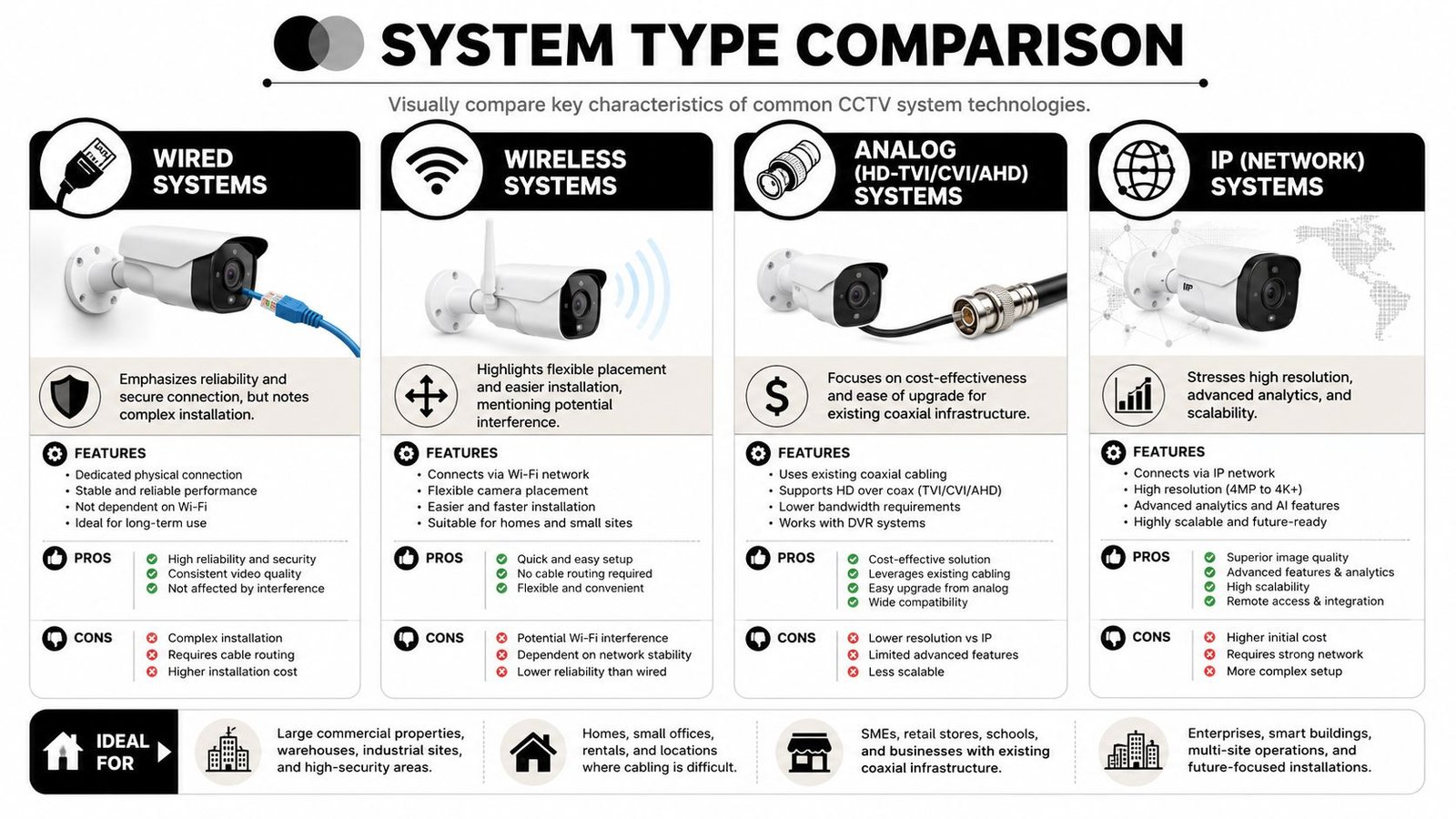
Most buyers are choosing between IP systems and HD analogue systems, then deciding whether the site is better suited to wired or partly wireless devices. If you want a plain-English comparison, this guide on the difference between IP cameras and HD analogue CCTV is a useful starting point.
Here's the short version:
| System type | Where it works well | Main trade-off |
|---|---|---|
| HD analogue | Upgrades where existing coaxial cabling can still be used | Less flexible for advanced features |
| IP CCTV | New installs, multi-camera sites, remote access, analytics | Needs stronger network planning |
| Wired systems | Reliable long-term setups in homes and businesses | Installation can be more involved |
| Wireless devices | Short-term needs or awkward areas where cabling is difficult | Dependence on signal quality and power planning |
For most permanent installations, hard-wired equipment is still the safer choice. It's usually more stable, more predictable, and better suited to long-term recording. Wireless cameras have a place, but they often look easier on paper than they are in practice.
The features that actually matter
Image quality matters, but only when it matches the job. Independent South Wales installers note that resolution up to 4K/8MP is used for effective property protection and evidential needs, and that analytics which distinguish humans and vehicles can reduce false alerts on busy sites, as outlined in this CCTV pricing and specification guide.
In real terms, these are the features worth paying attention to:
- Resolution that matches the task. High-detail cameras are useful at entrances, tills, gates, and vehicle approach routes.
- Night performance. A camera is only as good as its image after dark. Poor lighting can ruin an otherwise decent setup.
- Remote viewing. App access is useful when it helps you check alerts, verify an opening or closing routine, or review an incident without travelling to site.
- Smart detection. Human and vehicle filtering can cut out a lot of wasted playback time on busy scenes.
- Export and playback. If retrieving footage is clumsy, the system becomes frustrating the first time you need it.
People sometimes ask whether specialist live-view cameras in other niches offer clues about streaming quality and app usability. In that sense, it can be helpful to learn about live feed wildlife cameras, because those products highlight some of the same questions around connectivity, live access, and image delivery, even though security use needs a much stronger focus on reliability and evidence.
Practical rule: Buy cameras for the scene, not for the spec sheet. A huge field of view with no identification detail usually disappoints.
One local option in this space is Wisenet Security Ltd, which installs integrated CCTV systems across Cardiff and South Wales with 4K/HD recording, remote viewing, night vision, and related security systems. What matters most, though, isn't the logo on the van. It's whether the installer designs the system around your actual risk points, lighting conditions, and evidence requirements.
Staying Compliant with UK CCTV Laws in Cardiff
A lot of CCTV problems aren't technical. They're procedural. The camera works, the app works, the recorder works, but the system has been pointed too widely, recordings are kept without a clear reason, or nobody knows how to handle a request for footage.
When CCTV becomes a compliance issue
The legal line is straightforward in principle and easy to mishandle in practice. If your system captures areas beyond your private domestic boundary, or if you're using CCTV for a business, tenancy, shared access area, or public-facing setting, privacy obligations become relevant.
The Information Commissioner's Office guidance applies to domestic and commercial CCTV, and businesses need to think about lawful basis, minimisation, retention, and subject access requests, as explained in this article on CCTV and GDPR in the UK.
What usually causes trouble is over-capture. A camera that sees part of your own entrance is one thing. A camera that constantly covers a neighbour's garden, a shared hallway beyond necessity, or a wide stretch of pavement without justification creates a different issue.
A safer approach is to ask:
- Do we need this exact view?
- Can we narrow the angle or reposition the camera?
- Are we capturing more than the security purpose requires?
- If someone asks, can we explain why the camera is there?
What lawful and useful footage looks like
Compliance isn't just about avoiding complaints. It also improves the quality of your evidence. A well-run CCTV system has a clearer purpose, cleaner camera views, and more defensible footage.
Key points to get right include:
- Signage. If people are being recorded in a business or shared setting, clear notice is usually part of doing it properly.
- Retention. Keep footage for a reason, not indefinitely by default.
- Access handling. Someone should know who can review footage, who can export it, and how requests are logged.
- Camera positioning. Aim for relevant zones, not maximum coverage for its own sake.
A lawful system is usually a better evidence system, because it's been planned with purpose instead of installed to watch everything at once.
For landlords and SMEs in Cardiff, this matters most in mixed-use buildings, frontages near public footpaths, rear service lanes, shared bin stores, staff entrances, and car parks. Those are the places where people often drift into excessive coverage without gaining any real security benefit.
If you want footage to help after an incident, treat CCTV as an evidence-management system. That means checking timestamps, ensuring playback is easy, and making sure exported clips are clear and retrievable without confusion.
Understanding CCTV Installation Costs and Quotes
Most buyers ask about price first, which is fair enough. The useful question, though, is what the quote includes and whether it matches the job. Two proposals can look similar at a glance and still be very different in practice.
What a Cardiff quote usually includes
Local market data for Cardiff puts a typical CCTV installation at around £615, with quotes commonly starting from £468, while a standard domestic Hikvision package in South Wales is often about £600 to £800 plus VAT. The same local cost data notes that labour alone can range from £200 to £700, depending on complexity, according to this Cardiff-area CCTV installation cost guide.
Those numbers are useful because they show where basic domestic work tends to sit. They also explain why some jobs rise quickly. The cameras are only part of the total.
A proper quote usually covers:
- Cameras suited to the scene and mounting location
- Recorder hardware such as an NVR or DVR
- Storage capacity for the footage you want to retain
- Cabling and power
- Labour for mounting, routing, termination, setup, and testing
- Network and app configuration
- User handover
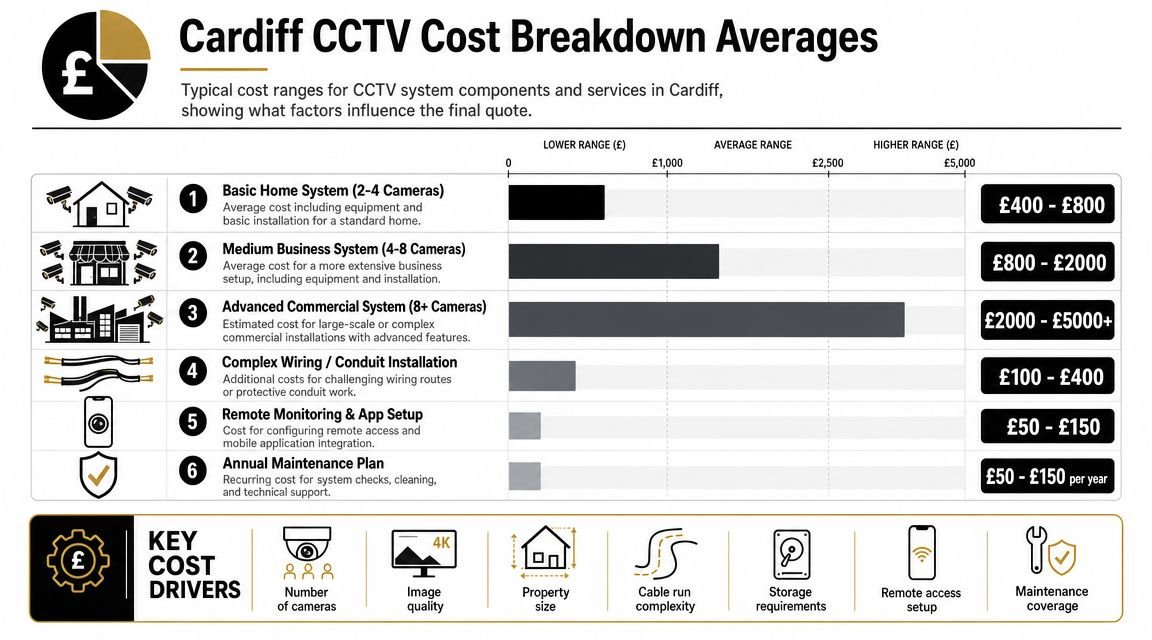
If you're comparing proposals, it also helps to read through what affects CCTV installation costs so you can see why one quote may include work that another has left unmentioned.
Why the cheapest quote often costs more later
A low headline price can hide several problems. The most common are under-specced storage, poor camera positioning, limited setup time, weak night performance, and no allowance for difficult cable routes.
Here's a simple comparison:
| Cheap quote warning sign | What it often means later |
|---|---|
| No detail on recorder or storage | Footage retention disappoints |
| No mention of labour scope | Extra charges appear mid-job |
| Very wide camera views promised everywhere | Weak identification where it counts |
| No handover or app setup detail | You inherit a system nobody has explained |
| No maintenance discussion | Small faults go unnoticed until an incident |
The best value quote is the one that solves the actual problem with no surprises. For a home, that may be a modest system placed properly. For a business, it may mean fewer overview cameras and stronger detail at the points that matter.
If a quote only talks about camera count, it probably hasn't spent enough time thinking about evidence quality, cable routes, storage, and day-to-day usability.
What to Expect During Your Professional Installation
A professional install shouldn't feel chaotic. It should feel organised, deliberate, and tidy. Most of the quality comes from the planning that happens before the first hole is drilled.
Before tools come out
The day normally starts with a final walk-round and confirmation of camera positions. During this stage, practical realities get checked on site. Trees may block a view in summer. A signboard may create glare. A doorway may need a tighter angle than it seemed on the original survey.
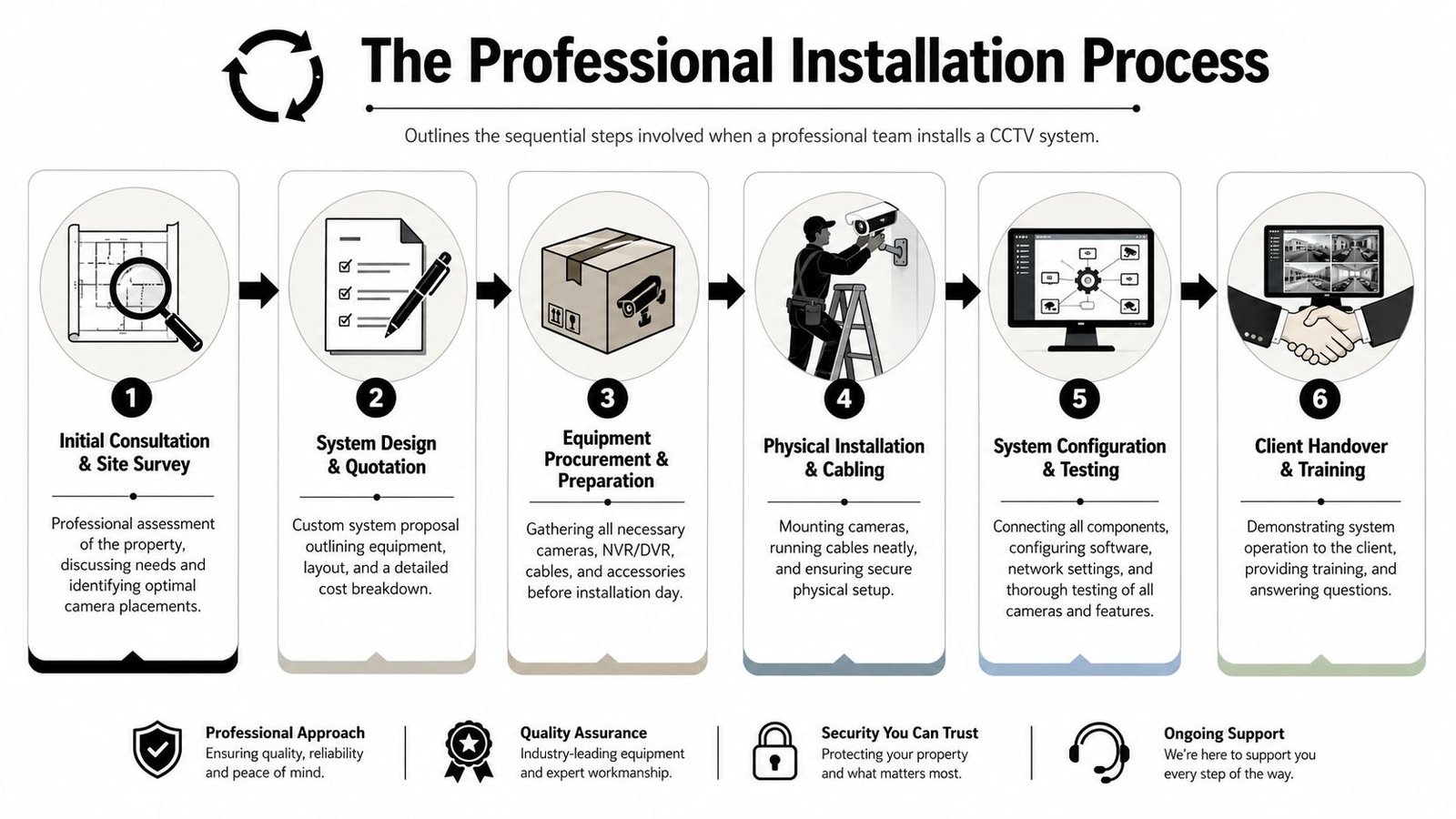
At this stage, a good engineer is thinking about three things at once:
- How the camera sees the scene
- How the cable route stays neat and protected
- How future servicing will be handled
That often means adjusting a camera position slightly to improve both the image and the finish of the installation. The neatest route isn't always the best view, and the best view isn't always easiest to service. The job is to balance both.
On the day and at handover
Once positions are confirmed, the work usually moves in a steady order. Cables are run, cameras are mounted, the recorder is installed, and the system is brought online for configuration. On a house, disruption is usually limited. On a business site, engineers often work around opening hours, customer flow, or restricted areas.
This walkthrough gives a visual sense of how a professional setup is typically carried out:
The final part matters more than many clients expect. A proper handover should include live view, playback, exporting footage, app access, and a clear explanation of what each camera is for. If the system has analytics, those should be tuned to the site rather than left on generic defaults.
A good handover usually includes:
- Viewing test so you can see each camera in normal conditions
- Night check plan because some angles only reveal issues after dark
- Playback demonstration so you can find incidents quickly
- Export process for sharing footage when needed
- User permissions if multiple staff or managers need access
The install isn't finished when the picture appears on screen. It's finished when the customer knows how to use the system confidently.
The difference between DIY and professional work usually shows up months later. That's when badly protected cables, poor connectors, awkward playback, and badly chosen angles start to irritate people. A tidy, tested install avoids most of that.
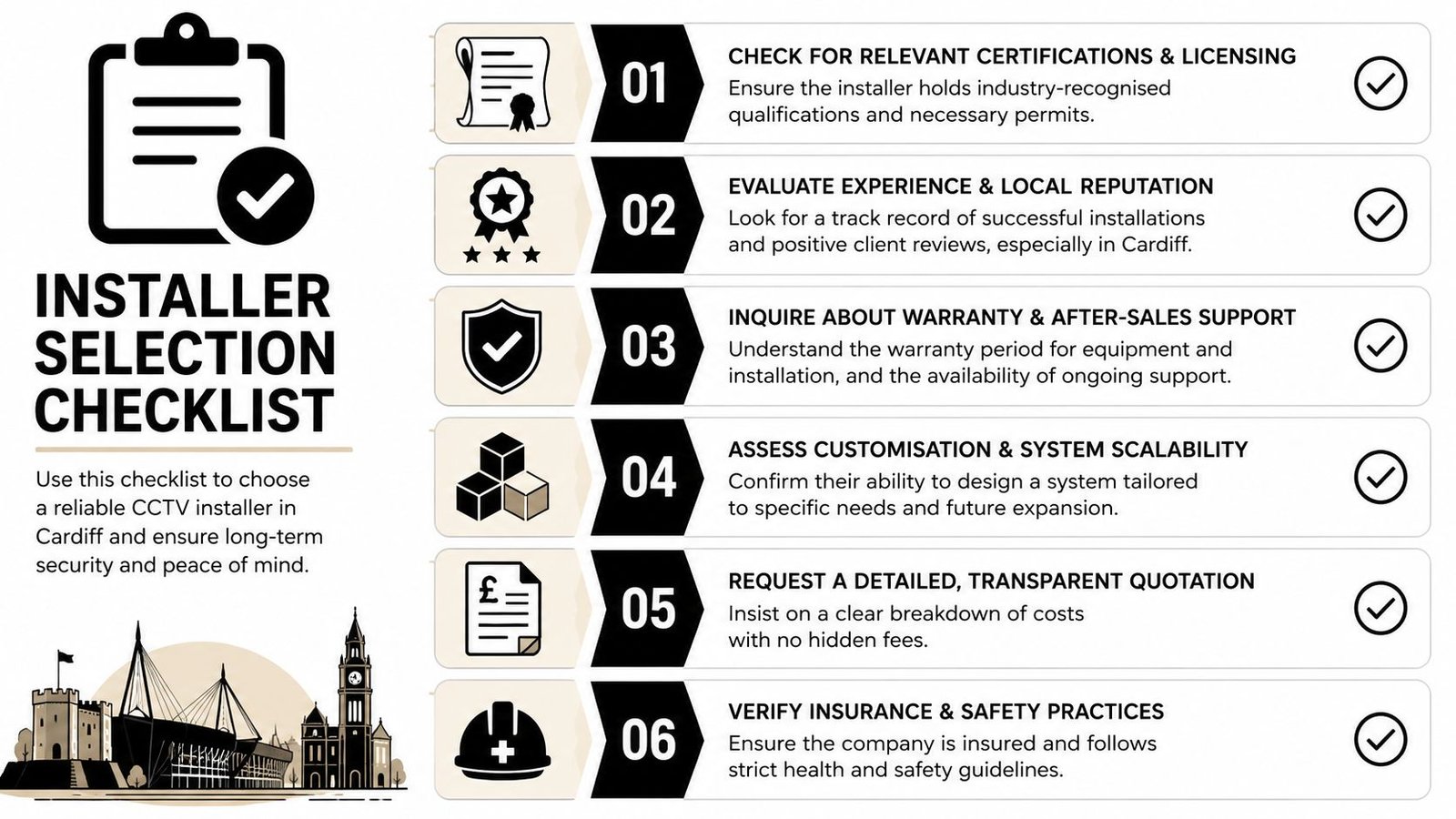
Your Checklist for Choosing a Cardiff CCTV Installer
Not every installer approaches CCTV the same way. Some sell boxes. Some design systems. If you're comparing firms for CCTV installation in Cardiff, the questions you ask at the start will tell you a lot.
Questions worth asking before you agree to anything
Use this shortlist when speaking to installers:
- What are your accreditations? If insurer acceptance or evidential credibility matter, ask directly about certification and standards.
- Who will carry out the work? You want to know whether engineers are vetted, experienced, and used to working in occupied homes or live business environments.
- What exactly is included in the quote? Ask about recorder spec, storage, cabling, setup, app configuration, and handover.
- How will you handle privacy and camera positioning? This is important for landlords, shared spaces, and business premises.
- What happens after installation? Fault support and maintenance matter just as much as day-one fitting.
What separates a reliable installer from a risky one
The strongest installers don't rush to talk about camera count. They ask about incidents, lighting, access routes, hours of use, staff movement, neighbours, data handling, and how quickly footage may need to be retrieved.
Watch for these signs:
| Good sign | Why it matters |
|---|---|
| They ask where identification is needed | Shows they're designing for evidence, not just coverage |
| They discuss compliance early | Reduces privacy mistakes later |
| They explain limitations honestly | Builds a more realistic system |
| They talk about maintenance | Helps the system remain reliable |
| They provide a clear written scope | Makes quote comparisons easier |
There's also a service side to this that buyers don't always think about. A responsive office process helps with surveys, follow-ups, support calls, and scheduling. If you're curious how some firms structure that side of the business, this overview of a receptionist platform for security installers gives a useful look at how security companies can manage enquiries and customer communication more efficiently.
One more point is worth making. Local experience matters. Cardiff properties vary a lot. Victorian terraces, newer estates, city-centre retail units, industrial buildings, converted flats, and mixed-use premises all create different installation challenges. An installer who understands those building types will usually make better decisions on cable routes, discreet mounting, and realistic coverage.
Secure Your Property with Cardiff's Trusted Experts
The strongest CCTV systems in Cardiff are the ones that match the site, the risk, and the legal context. That usually means resisting the temptation to buy on camera count alone. Placement, storage, night performance, retrieval, and compliance all matter just as much.
For a homeowner, that might mean clear views of the approach to the property, reliable night images, and simple app access without overcomplicating the setup. For a landlord or business, it usually means something more disciplined. Targeted coverage, documented purpose, usable exports, and a system that staff can operate without guesswork.
If you remember only a few points, make them these:
- Choose cameras based on the scene and the evidence you need
- Treat compliance as part of the design, not an afterthought
- Read quotes for scope and quality, not just price
- Expect a proper handover so you can use the system confidently
- Pick an installer who asks sensible questions before recommending equipment
That's what turns CCTV from a visible deterrent into a dependable working system. When it's done properly, it supports prevention, incident review, and everyday peace of mind without becoming a burden to manage.
If you're looking into CCTV installation in Cardiff now, the sensible next step is a site-specific conversation. Every property has its own blind spots, lighting issues, access patterns, and compliance considerations. A survey on site will always tell you more than an online bundle deal ever can.
If you want practical advice on a home, shop, office, warehouse, car park, or mixed-use building, contact Wisenet Security Ltd for a free, no-obligation consultation and site survey. You'll get a clear recommendation based on the property, the risks you want to address, and the kind of footage you'd need if an incident occurred.