Burglar Alarm Bristol: Top Systems For Home Security
If you live or work in Bristol, the concern about break-ins isn’t overblown. Bristol’s overall crime rate is about 80% higher than the South West average and 36% higher than the national average, while theft rose by 13% in 2024 according to local Bristol crime reporting discussed here. That changes the conversation. A burglar alarm in Bristol isn’t a nice extra for cautious people. For many properties, it’s a sensible baseline.
The good news is that modern alarm systems are far better than the old “box on the wall and hope for the best” setups. You can choose clean wireless installs for older terraces, hard-wired systems for major refurbishments, and smart control from your phone if that suits how you live. The hard part isn’t whether alarms work. It’s choosing the right type, the right grade, and the right installer.
Table of Contents
- Why Securing Your Bristol Property Is More Important Than Ever
- Choosing Your System Wireless Wired or Smart
- Monitored Alarms vs Bell-Only Alarms The Critical Decision
- Understanding UK Standards and Alarm Grades
- The Installation Process and Typical Costs in Bristol
- How to Choose a Reputable Bristol Alarm Installer
- Frequently Asked Questions About Burglar Alarms
Why Securing Your Bristol Property Is More Important Than Ever
A lot of alarm buying starts with a feeling. Someone notices more suspicious activity on the street, a nearby shop gets hit, or a neighbour mentions an attempted break-in. In Bristol, those concerns sit in a real local context, not just general anxiety.
The key point is simple. Bristol has a higher crime burden than many people assume. It’s not just above nearby averages. It’s well above them, and that affects how homeowners and business owners should think about perimeter security, external lighting, door protection, and alarm design.
For anyone comparing options, one detail matters more than sales talk. The system has to match the property. A compact flat in Redland, a Victorian terrace in Bedminster, a semi in Bradley Stoke, and a retail unit with rear access in central Bristol all need different detector placement, entry routes, and response planning.
Practical rule: The best alarm system is the one designed around how someone would actually enter your property, not the one with the longest feature list.
A proper approach usually starts with these questions:
- How would someone get in: Front door, side gate, kitchen window, flat communal entrance, rear alley access, or shop roller shutter all create different risks.
- What happens when the alarm triggers: A loud siren alone may be enough for some homes. Others need keyholder contact or monitored escalation.
- How visible should the system be: External sirens and warning devices can deter. Internal protection matters just as much if the outside box is ignored.
- Who needs to use it daily: A family home, HMO, office, or shop counter each needs different arming habits and user permissions.
Bristol property stock also influences what works. Older buildings often need a more careful install to avoid disruption. Newer homes may be easier to wire cleanly. Mixed-use premises need extra care around access times, staff movement, and false alarm management.
That’s why a good burglar alarm Bristol quote should feel like a risk assessment first and a product recommendation second.
Choosing Your System Wireless Wired or Smart
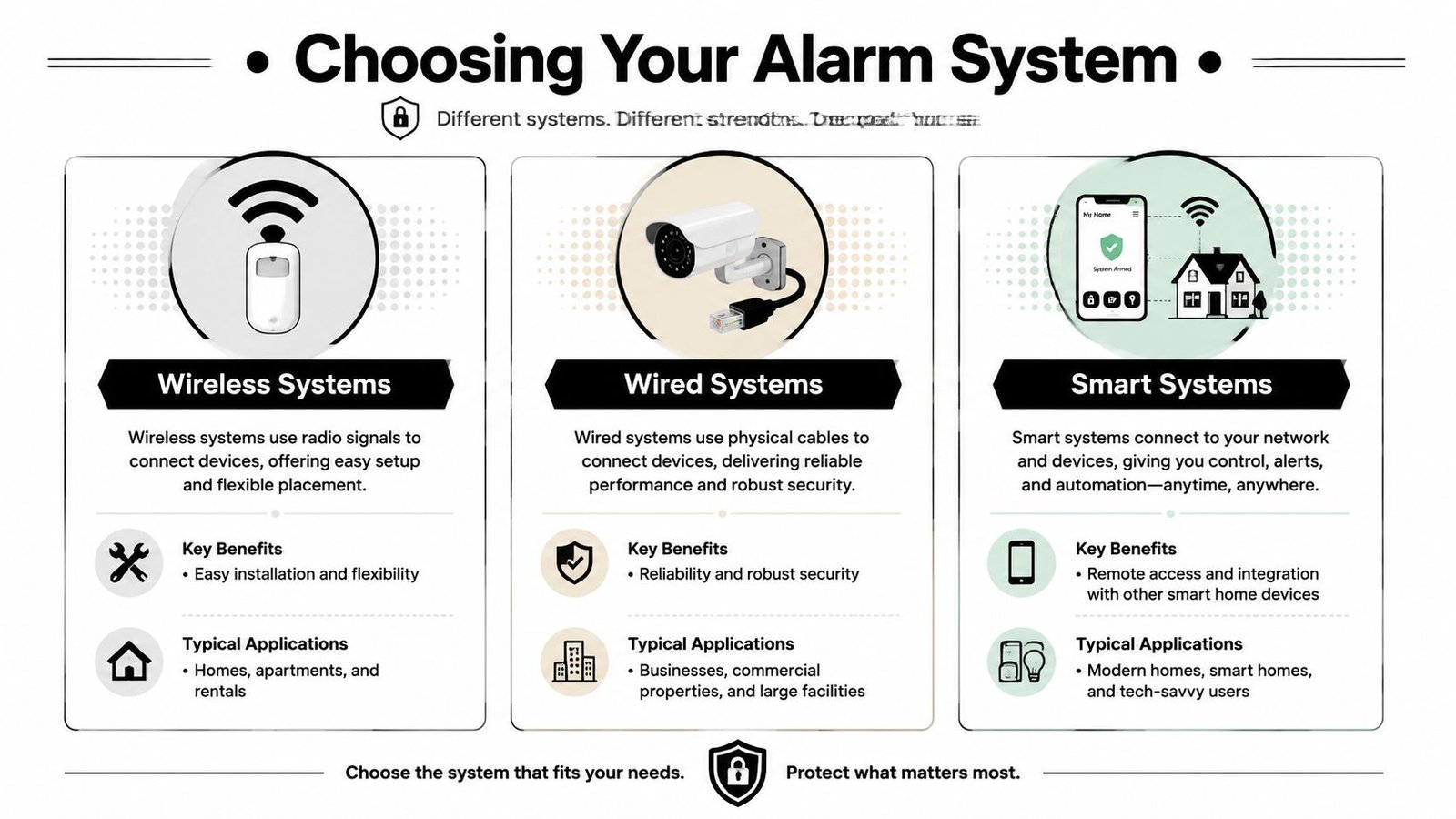
Asking for a price is a common starting point. A better first question is what kind of system suits the building. The three main options are wireless, wired, and smart-enabled systems. They overlap, but they’re not the same thing.
Wireless alarms for existing Bristol homes
Wireless systems are often the cleanest fit for lived-in properties. That includes terraces, converted flats, and homes where you don’t want carpets lifted or walls chased just to add door contacts and PIRs.
Their main advantage is installation flexibility. A good engineer can place detectors where they’re needed without turning the house upside down. If layout changes later, it’s also easier to adapt.
Wireless isn’t automatically the right choice for every job, though.
- Best fit: Existing homes, listed-style interiors, rental properties, and quicker retrofits.
- Watch for: Battery maintenance, signal planning, and sensor siting around thicker walls or awkward extensions.
- Good outcome: Clean appearance, fast installation, less disruption.
A badly planned wireless job can be frustrating. Sensors may be placed for convenience rather than coverage, and that’s where blind spots appear.
Wired alarms for renovation and long-term reliability
If a property is being renovated, extended, or built from scratch, wired alarms deserve serious consideration. Once access is available behind walls and ceilings, cables can be run neatly and the finished result is usually very tidy.
Wired systems are often chosen where the owner wants a more fixed infrastructure. They also make sense in some commercial settings where consistent device power and long-term dependability matter more than speed of install.
A wired system tends to make the most sense when the building work is already happening. Retrofitting one into a finished home can turn a sensible job into an intrusive one.
Typical situations where wired works well:
| Property type | Why wired may suit it |
|---|---|
| Renovated family home | Cables can be hidden during works |
| New-build or extension | Easier to design in from the start |
| Small commercial unit | Stable infrastructure with fixed detection points |
Smart alarms for control and visibility
“Smart” usually means the system connects to an app and gives you remote access, alerts, user control, and sometimes integration with cameras or other devices. It doesn’t always mean DIY, and it shouldn’t be confused with a consumer gadget system bought off a shelf.
For many Bristol homeowners, smart control is what makes an alarm usable. You can check whether the system is armed, review activations, and manage access when you’re out. That matters if you travel, manage a second property, or forget whether you set the alarm on the school run.
A few practical points make smart systems better, not just newer:
- Simple arming routines: If it’s awkward to use, people stop using it properly.
- Clear user permissions: Helpful for cleaners, relatives, staff, or tenants where appropriate.
- Useful notifications: Good alerts tell you what happened and where, not just that “something” triggered.
A lot of professionally installed systems now combine wireless sensors with smart control. That’s often the sweet spot for a Bristol home. Minimal disruption, practical coverage, and visibility from your phone without overcomplicating daily use.
Monitored Alarms vs Bell-Only Alarms The Critical Decision
Beyond the system type, this decision dictates how the alarm functions when a security breach occurs. A bell-only alarm triggers an audible siren on the premises. A monitored alarm transmits signals to an external location to initiate a formal response process.
What a bell-only system does well
Bell-only alarms still have a place. They’re straightforward, they create an immediate audible deterrent, and for some homes that’s enough. If the property is occupied regularly, neighbours are attentive, and the main aim is to make an intruder leave quickly, a bell-only setup can be perfectly reasonable.
They also keep things simple. No monitoring contract, fewer moving parts in the response chain, and easier budgeting.
That said, bell-only alarms depend on someone hearing them and deciding to act. In busy areas, people often assume the noise is accidental. In quieter streets, there may not be anyone around at the right time.
A bell-only alarm is strongest as a deterrent. It’s weaker as a response system.
Where monitoring changes the outcome
Monitoring adds a process after activation. Instead of relying only on the outside siren, the system communicates with a monitoring centre or response setup. Depending on the arrangement, that can mean contacting keyholders, escalating to a keyholding service, or supporting police response where the system and registration meet the required standards.
For readers weighing that option, this overview of 24/7 monitored alarm systems is useful because it explains what monitoring is meant to achieve in practical terms, not just marketing terms. If you want a more direct explanation of how a monitored setup works day to day, Wisenet’s page on what a monitored alarm system is covers the basics clearly.
What matters most: Monitoring isn’t just about getting a notification on your phone. It’s about having a defined response path when you can’t act yourself.
The properties that usually benefit most are:
- Homes left empty for long periods: Travel, second homes, and frequent overnight absences make self-response harder.
- Businesses with stock or cash handling: Out-of-hours risk is different when loss affects trading.
- Larger sites: More entry points create more opportunity for missed alerts if nobody is watching.
- Owners who want procedure, not guesswork: A monitored system replaces uncertainty with a response plan.
The wrong reason to choose monitoring is because it “sounds better”. The right reason is that you need response beyond the building itself.
Understanding UK Standards and Alarm Grades
Alarm quotes start to sound technical. If an installer mentions BS EN 50131, Grade 2, Grade 3, signalling paths, or police response eligibility, they’re talking about how the system is designed, installed, and classified.

What BS EN 50131 means in plain English
In plain terms, BS EN 50131 is the framework used for intruder alarm systems in the UK. It affects equipment choice, how devices are configured, how zones are set up, and whether the installation meets the level expected by insurers and response arrangements.
That matters because a professional alarm isn’t just a collection of sensors. It’s a designed system. Entry and exit routes need to make sense. Detector types need to match the risk. Delay settings, internal confirmation, and signalling all need to work together.
If you want a straightforward background read, this guide on BS EN 50131 alarm standards helps decode the terminology before you compare quotations.
Grade 2 and Grade 3 in real Bristol properties
The grade is one of the most important parts of the specification. Grade 2 systems are designed to withstand casual intruders for up to 3–5 minutes, suitable for most homes. Grade 3 systems are engineered to resist determined attacks using professional tools for up to 10–12 minutes, specified for higher-risk premises, and this affects insurance and Police response eligibility under SSAIB and NSI guidance as outlined in this explanation of intruder alarm grades.
That sounds technical, but in practice the difference is familiar.
- Grade 2 usually suits: Standard houses, flats, and smaller low-risk commercial premises.
- Grade 3 is more likely for: Retail, cash-handling sites, multi-entry commercial units, logistics spaces, and higher-risk properties.
- The system design changes too: Grade 3 setups often involve more layered detection, not just a stronger external bell box.
Here’s the mistake to avoid. Don’t assume a higher grade is always better for you. If the property doesn’t need it, the extra complexity may add cost and user friction without solving a real problem. On the other hand, under-specifying a site can create trouble with insurance expectations or monitoring arrangements later.
“Ask the installer why they’ve chosen that grade for your building. If they can’t explain it in simple terms, keep asking.”
A good engineer should be able to walk around the property and justify the grade based on occupancy, entry points, risk profile, and any insurer requirements. That explanation should make sense even if you’ve never looked at an alarm quote before.
The Installation Process and Typical Costs in Bristol
Most alarm problems begin before installation day. They start with poor surveying, rushed assumptions, or using a standard package that doesn’t match the building. A proper installation process is usually a better indicator of quality than the brochure.
One local reality is that risk hasn’t disappeared just because some burglary figures improved. Bristol county recorded approximately 2,600 burglary incidents, even though burglary numbers showed a modest 5.1% year-on-year decrease in the period to November 2025 according to Bristol county burglary crime data. That’s why people still sensibly invest in alarm protection rather than waiting until after an incident.
What should happen before any drilling starts
A professional job usually begins with a site survey. The engineer should look at doors, windows, internal routes, blind spots, likely entry points, and how the building is used in daily life. In homes, that includes pets, bedtime routines, and whether anyone needs part-setting at night. In commercial spaces, it includes opening hours, staff access, and areas that need separate protection.
The handover matters as much as the install. You should be shown how to arm, part-set, unset, review events, and deal with a false activation. If the system has app access, it should be configured properly before the installer leaves.
A good process often includes:
- Survey first: No serious installer should price purely from a rough guess and a postcode.
- Clear detector plan: You should know what protects each area and why.
- Neat cable or device placement: The system should look intentional, not added as an afterthought.
- User training: If the household or staff can’t use it confidently, false alarms rise.
What changes the final price
There isn’t one fixed cost for a burglar alarm Bristol installation because the property drives the scope. The main factors are the number of entry points, whether the system is wired or wireless, whether you want app control, and whether the alarm is bell-only or monitored.
In practical terms, these choices tend to affect budget most:
| Cost factor | Why it changes the quote |
|---|---|
| Property size and layout | More rooms and routes usually mean more devices |
| Type of system | Wired, wireless, or hybrid affects labour and equipment |
| Monitoring choice | Ongoing service arrangements change the total cost |
| Grade and compliance needs | Higher-risk sites may need more advanced design |
| Add-ons | Extra keypads, external detection, or integrated devices increase scope |
One caution on “cheap” quotes. If the price seems unusually low, check what’s missing. Sometimes that means fewer detectors than the property needs. Sometimes it means no maintenance support, weak signalling, or poor-quality siting that leaves vulnerable areas uncovered.
When budgeting, a sensible approach is to decide the response level first, then build the system around the actual risk points of the building.
How to Choose a Reputable Bristol Alarm Installer
The installer matters as much as the hardware. A good panel and good detectors won’t save a poor design, loose commissioning, or weak aftercare. If you’re comparing firms for a burglar alarm Bristol job, start with competence and compliance, not branding.

Credentials that matter
The basics should be easy to verify. Look for recognised accreditation, suitable insurance, and engineers who are vetted for work in homes and businesses. Local experience also helps because Bristol properties vary a lot, from period housing to mixed-use sites and modern estates.
A useful general checklist on how to find a licensed contractor can help if you’re building your shortlist and want a sensible way to compare firms. If you specifically want a local company active in the area, Wisenet lists its Bristol coverage area and provides intruder alarm installation among its services.
Check these points carefully:
- Accreditation: SSAIB or NSI recognition is a strong signal that the company works to accepted standards.
- Insurance: Ask whether the firm is fully insured for installation and maintenance work.
- DBS-checked engineers: Important when installers are working inside occupied homes and managed premises.
- Maintenance support: Ask who returns if there’s a fault or user issue later.
One useful way to gauge an installer is to listen to the questions they ask. A serious surveyor will ask about pets, typical absences, rear access, neighbour visibility, cleaners, staff routines, and who needs access rights. A weak one jumps straight to “package A or package B”.
Questions worth asking before you agree to anything
Before you sign off on a quote, ask the installer to explain the design in plain English. Which doors are protected first? Are vulnerable windows covered? Will the upstairs landing need a detector? Can the system be part-set at night? What happens if the broadband drops? How are false alarms reduced?
This kind of walkthrough reveals whether the company is designing around your property or dropping in a generic template.
Here’s a quick overview that helps show what a more professional install conversation should look like:
Local advice: Ask who programmed the system, who commissioned it, and who will maintain it. If those answers are vague, future support may be vague too.
You also want clarity on handover. Will you receive user instructions, code management guidance, app setup, and a maintenance schedule if relevant? Good installers don’t just fit devices. They leave you with a system you can use properly.
Frequently Asked Questions About Burglar Alarms
Some questions come up on nearly every survey. The answers below are the practical version, not the showroom version.
| Question | Answer |
|---|---|
| Can I have an alarm if I’ve got pets? | Yes, often you can. Pet-friendly sensors are commonly used, but they still need correct placement and the right setting strategy. Large pets, climbing pets, and unusual room layouts all affect how the system should be designed. |
| Will a burglar alarm reduce my home insurance premium? | It can be relevant to insurers, especially if the system is professionally installed and properly maintained, but the actual effect depends on your insurer and policy terms. It’s best to ask your insurer what level of alarm, certification, or monitoring they recognise before you buy. |
| What happens if the alarm goes off by mistake? | With a well-set-up system, false alarms are manageable. The key is user training, sensible detector placement, and clear entry and exit routines. If monitoring is involved, you should understand exactly what the response procedure is and who gets contacted first. |
A final practical point. Don’t choose an alarm just because it has the most app features or the loudest siren. Choose the one that fits the way the building is used, the level of risk, and the response you need.
If you want straightforward advice on a burglar alarm Bristol installation, Wisenet Security Ltd can arrange a consultation and talk through the right setup for your home or premises without burying you in jargon.