How Often Should Fire Alarms Be Tested: Essential 2026
You’ve probably done some version of this already. You press the test button on a smoke alarm, hear a short beep, and assume you’re covered. Or you manage a shop, office, warehouse, or block of flats and know the fire alarm “gets checked”, but you’re not fully sure what that should mean in practice.
That uncertainty is common, and it’s where people get caught out.
The answer to how often should fire alarms be tested depends on what you have. A single battery alarm in a hallway is not the same as an integrated fire alarm system with call points, detectors, zones, batteries, sounders, and a control panel. A house in Cardiff isn’t treated the same way as a retail unit in Bristol, and neither is managed like a multi-occupied building in Swansea.
A lot of the confusion comes from mixed advice online. Some guidance is aimed at simple domestic detectors. Some comes from US standards. Some skips over the legal duties that apply to businesses, landlords, and anyone responsible for shared buildings. If you’re also trying to make sense of wider understanding facility safety regulations, it helps to separate everyday user checks from the formal maintenance duties that sit behind them.
Table of Contents
- Is Your Fire Alarm System Truly Protecting You
- The Three Tiers of UK Fire Alarm Testing
- Your Simple Guide to Weekly and Monthly Tests
- Fire Alarm Testing for Your Home
- Commercial and Industrial Fire Alarm Obligations
- Special Guidance for Landlords and Property Managers
- Why Professional Servicing Is Non-Negotiable
Is Your Fire Alarm System Truly Protecting You
A fire alarm system only helps if it detects, signals, and clears people out when it should. That sounds obvious, but in day-to-day building management, fire alarms often become background equipment. People notice them only when a fault light appears, a battery fails, or a false alarm disrupts the day.
The bigger problem is false confidence. Many owners and managers assume one quick button press tells them everything they need to know. It doesn’t. On an integrated system, that basic check only confirms part of the chain. It doesn’t tell you whether every call point communicates correctly, whether each zone responds as expected, whether standby batteries hold up under load, or whether a detector has drifted out of tolerance.
That’s why the right testing schedule has layers. Some checks are routine and can be handled on site. Others belong to a competent engineer with the right tools, test equipment, and documentation process.
Practical rule: If your system has a control panel, multiple detectors, manual call points, or covers shared areas, don’t treat it like a single household smoke alarm.
For homeowners, the main risk is assuming a more advanced system can be maintained with the same habits as a basic detector. For businesses, the risk is legal as well as practical. For landlords and property managers, the risk includes gaps in records, gaps in responsibility, and gaps between communal and in-flat systems.
The safest approach is simple. Identify what type of system you have, match it to the correct testing routine, and make sure user checks and professional servicing both happen on time.
The Three Tiers of UK Fire Alarm Testing
A householder pressing the button on a single smoke alarm is doing one job. A facilities manager testing an addressable fire alarm panel in a block of flats or a commercial building is doing a very different one. UK fire alarm testing gets confusing because both actions get called a "test", but the legal and technical standard is not the same.
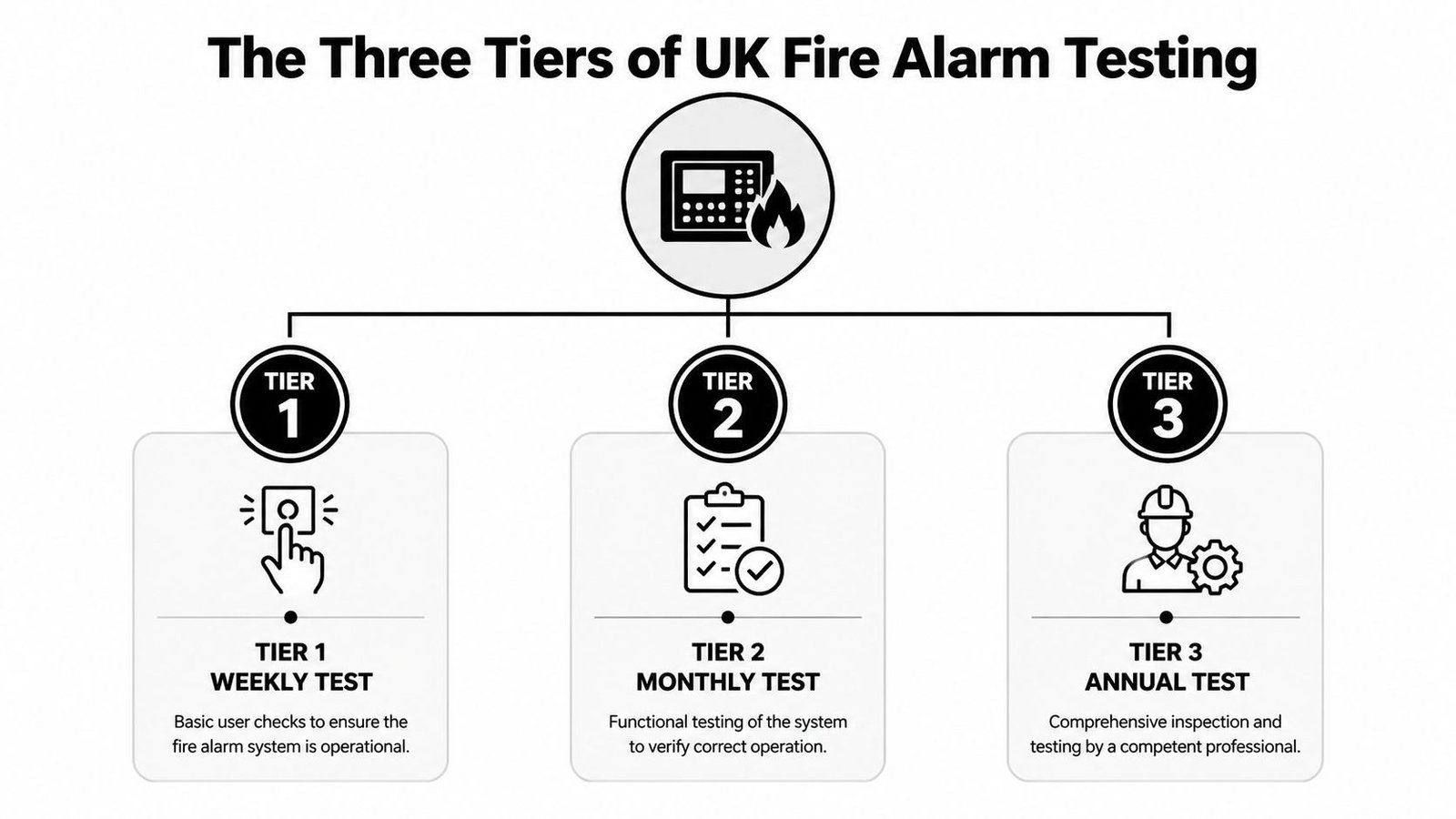
The practical way to answer how often should fire alarms be tested is to split the work into three tiers. That keeps simple user checks separate from planned system checks and engineer servicing. In South Wales, Bristol, and across the South West, that distinction matters because many sites have a mix of domestic detectors, communal systems, door release interfaces, and monitoring links. One quick button press does not cover all of that.
Weekly user checks
For integrated systems covered by BS 5839-1:2017, the weekly test is a routine user check, usually carried out by operating a different manual call point each week on rotation. The aim is straightforward. Confirm that the panel receives the signal and that occupants can hear the alarm.
This is the level many people understand, because it is visible and quick.
It is also the level people overestimate. A successful weekly activation does not confirm detector condition, battery performance under load, cause-and-effect programming, or whether every interface still works correctly. It tells you the system responded to that test, at that time, from that point.
For a plain-language reference, these fire alarm test procedures give a useful overview of the basic process.
Monthly system checks
The second tier is broader. Monthly checks are used to confirm that the system is being tested across its zones and functions over time, rather than relying on the same point or same area again and again.
On a small site, this may be simple. On a larger building in Cardiff, Newport, Swansea, or Bristol, it often is not. Different zones may serve plant rooms, shared corridors, offices, workshops, or stair cores. If one area is repeatedly missed, the panel can look normal while part of the building is poorly protected.
A sensible monthly routine should verify:
- Zone indication: the correct area shows at the panel
- Alarm devices: sounders and visual indicators operate where needed
- Interfaces: any linked equipment responds correctly where relevant
- Reset and fault status: the panel returns to normal and any issues are recorded
This tier is where on-site discipline matters. Logs need to be clear, the rotation needs to be planned, and any recurring faults need action rather than a note in the book.
Professional inspection and servicing
The third tier is professional servicing, which involves a competent fire alarm engineer checking the parts of the system that routine user tests do not prove, including detector condition, standby power, device performance, panel functions, and system records.
For many commercial premises and multi-occupancy buildings, servicing is arranged at six-month intervals, with the exact frequency depending on the system category, building use, risk profile, and insurer or enforcing authority expectations. In practice, higher-risk or more complex sites often need closer attention than a simple office.
This is the line that causes the most confusion. Weekly and monthly tests help confirm the system operates. Servicing checks whether the system remains reliable, compliant, and fit for the building it protects.
If you are responsible for a communal system, mixed-use property, school, warehouse, office, or HMO, planned fire alarm maintenance and servicing should sit alongside your user testing schedule, not replace it and not be replaced by it.
A properly managed regime uses all three tiers. User checks catch obvious failures early. Monthly checks give wider coverage across the system. Professional servicing deals with the deeper faults and gradual deterioration that routine tests will miss.
Your Simple Guide to Weekly and Monthly Tests
Routine testing shouldn’t be complicated, but it does need to be disciplined. If you leave it vague, people skip it. If you make it overly technical, nobody wants to touch it.

How to run a weekly test properly
For most integrated systems, the weekly check is done from a different manual call point each time. If you need a plain-language walkthrough, these fire alarm test procedures are useful as a reference point.
Keep the process short and repeatable:
- Notify people first: Tell staff, residents, or occupants that a test is about to happen. If the system is monitored, make sure the relevant monitoring path is handled correctly before the test starts.
- Use the proper test key: Don’t improvise with tools that can damage the call point.
- Confirm the panel reacts: The correct zone or device should register.
- Listen and look: Check that sounders operate and any visual indicators do what they should.
- Reset the system: The panel should return to normal status cleanly.
- Write it down: Record date, time, location, result, and any fault.
A common failure is doing the physical trigger but not the record. From a compliance point of view, undocumented tests might as well not have happened.
What the monthly check should cover
The monthly check is more about coverage than routine. You’re looking beyond a single activation and asking whether the wider system still behaves correctly across the building.
A practical monthly review should include:
- A zone-based test: Trigger from a point or detector in the relevant zone.
- A panel review: Check for fault history, disabled devices, or unresolved issues.
- A quick visual pass: Make sure detectors and call points aren’t blocked, painted over, or physically damaged.
- A logbook update: Note what was tested and whether any follow-up is needed.
Site habit that works: Keep the fire logbook near the panel, not buried in an office drawer. People record tests more consistently when the paperwork is right there.
If you already know your system needs deeper attention, don’t wait for the next annual date. Book proper support through a planned fire alarm maintenance service. Small faults tend to become awkward faults when everyone keeps resetting the panel and hoping for the best.
Fire Alarm Testing for Your Home
Most homeowners get told one thing. Press the button once a month. For a basic standalone alarm, that’s sensible advice. For an integrated domestic system, it’s often incomplete.
There’s a real gap in UK guidance here. Basic smoke alarms should be tested monthly, but there’s little clarity on integrated systems, and UK advice is often mixed up with US standards, leaving homeowners with more advanced systems unsure whether simple DIY checks are enough under the Fire Safety Act 2021 and Building Safety Act 2022, as noted in this discussion of home smoke and CO detector checks.
A battery alarm is not the same as an integrated system
If you’ve got one or two standalone alarms with test buttons, your routine is straightforward. You check them regularly, replace them when required, and deal with low-battery warnings promptly.
An integrated home system is different. It may be mains-powered, interlinked, connected to a control panel, or spread across several storeys. It may also include heat detectors, sounders, and backup power. In those cases, pressing one local button doesn’t tell you much about the rest of the system.
That’s where people get caught. They use simple detector advice for a system that behaves more like a small commercial installation.
What homeowners can do and when to call an engineer
For a larger home or a property with an installed system, the sensible split is this:
- You can do routine user checks: Test the user functions you’ve been shown, listen for audibility, and keep an eye on the panel if there is one.
- You should pay attention to faults: Chirping, fault lights, repeated resets, or devices that stop responding all need action.
- You shouldn’t guess with technical issues: Sensor drift, battery condition, and device response need proper test equipment.
If the system covers an outbuilding, a loft conversion, several floors, or sleeping areas beyond a simple domestic setup, it’s worth treating maintenance more seriously. That doesn’t mean panic. It means recognising that a professionally installed system needs more than occasional button pressing.
If your home alarm setup includes a control panel and multiple detection points, think in terms of a maintenance routine, not just a monthly reminder.
The safest domestic approach is consistency. Do the simple checks you can do properly. If the system is more advanced than a standard household alarm, get competent servicing rather than relying on guesswork.
Commercial and Industrial Fire Alarm Obligations
For businesses, this is not just good housekeeping. It’s part of fire safety compliance.
Commercial premises, warehouses, industrial units, retail sites, and offices all rely on a designated responsible person to make sure the alarm system is maintained in working order. That usually means somebody has to own the schedule, own the logbook, and act quickly when faults appear. In practical terms, the most reliable setups are the ones where testing is tied to a clear routine rather than left to memory.
What the responsible person needs to manage
A business fire alarm regime usually breaks down into three duties.
First, there are user tests. These are the weekly and monthly checks already described. Second, there are records, because without a proper log you’ll struggle to demonstrate that the system has been looked after. Third, there is professional servicing, which needs to be booked and completed on time.
If you’re managing a business site with other security systems in place, it often helps to review fire alarms alongside wider commercial security systems, especially where access control, monitored alarms, or out-of-hours operation affect how the building is used.
A fire panel full of old faults is usually a management problem before it becomes an engineering problem.
Industrial sites add another layer. Dust, temperature variation, loading areas, vehicle movement, and long cable runs all increase the chance that devices become obstructed, contaminated, or ignored. In warehouses and logistics environments, an alarm system might look fine from reception while a local issue develops in a remote zone.
UK fire alarm testing frequency by property type
The table below is a practical guide based on the UK testing pattern described earlier.
| Test Type | Residential Home (Integrated System) | Small Office / Retail (Low Risk) | Large Commercial / Industrial (High Risk) | Who Performs It |
|---|---|---|---|---|
| Weekly manual call point test | Where applicable on integrated systems, follow the system design and user instructions | Required as part of the routine site check | Required, usually on a rotating basis across call points | User or responsible person |
| Monthly zone verification | Sensible where the system includes zones or a panel | Required as part of routine system verification | Required, with careful attention to all zones and sounder response | User or responsible person |
| Periodic servicing | Professional servicing is advisable for integrated systems | Professional servicing should be scheduled | Professional servicing should be tightly managed and documented | Competent engineer |
| Annual full inspection | Appropriate for advanced home systems | Required as part of maintenance duty | Required as part of maintenance duty | Qualified competent person |
What doesn’t work is relying on one caretaker, manager, or team member who “normally deals with it” but keeps no records and has no backup. Buildings stay compliant when duties are written down, assigned clearly, and checked.
Special Guidance for Landlords and Property Managers
Landlords and managing agents usually sit in the hardest position. They’re expected to keep systems compliant across shared areas, tenanted spaces, changing occupants, and mixed responsibilities. That is where confusion turns into exposure.
For UK landlords managing multi-unit properties, the documentation burden is immense. Under the Fire Safety Order 2005, they must retain detailed logs to prove compliance, and many still don’t fully understand their liabilities, especially after post-Grenfell reforms tightened accountability for shared alarm systems in HMOs and multi-occupied buildings, as discussed in this overview of landlord fire alarm testing duties.
Where responsibility usually becomes blurred
The difficult part isn’t always the alarm hardware. It’s the line between communal responsibility and private occupation.
In a block of flats, HMO, or mixed-use property, you may have:
- Communal systems: Panels, detectors, call points, and sounders in shared corridors or entrances.
- Private accommodation: Devices inside flats, rooms, or managed units.
- Different parties involved: Landlord, agent, tenant, maintenance contractor, and possibly a monitoring provider.
Problems start when everyone assumes someone else is testing the relevant part. The communal panel may be serviced, but in-unit devices may not be checked properly at turnover. Or the opposite happens. Someone checks inside units but no one keeps proper records for the shared system.
The records you need to keep
Good property management is often boring on paper, and that’s exactly the point. Clear records win arguments before they start.
Keep these as standard:
- Test logs: Dates, times, locations, results, and the name of the person who carried out the test.
- Service reports: Engineer visit notes, corrective actions, and certificates where issued.
- Fault history: What failed, when it was reported, and when it was repaired.
- Access records: Missed appointments, refused access, and follow-up actions for occupied units.
In multi-occupancy buildings, the missing document is often more damaging than the missing test.
The strongest approach is to treat the alarm system like a managed asset. Put dates in the calendar, keep one record set for the building, and make sure handovers between agents, caretakers, and contractors don’t break the chain.
Why Professional Servicing Is Non-Negotiable
A fire alarm can pass a weekly button test and still fail where it matters. We see that regularly on integrated systems in flats, HMOs, shops, offices, and mixed-use buildings across South Wales and Bristol. The panel may look healthy. A detector may chirp on cue. That does not confirm detector sensitivity, standby power condition, cause-and-effect programming, or whether a fault has been left isolated.
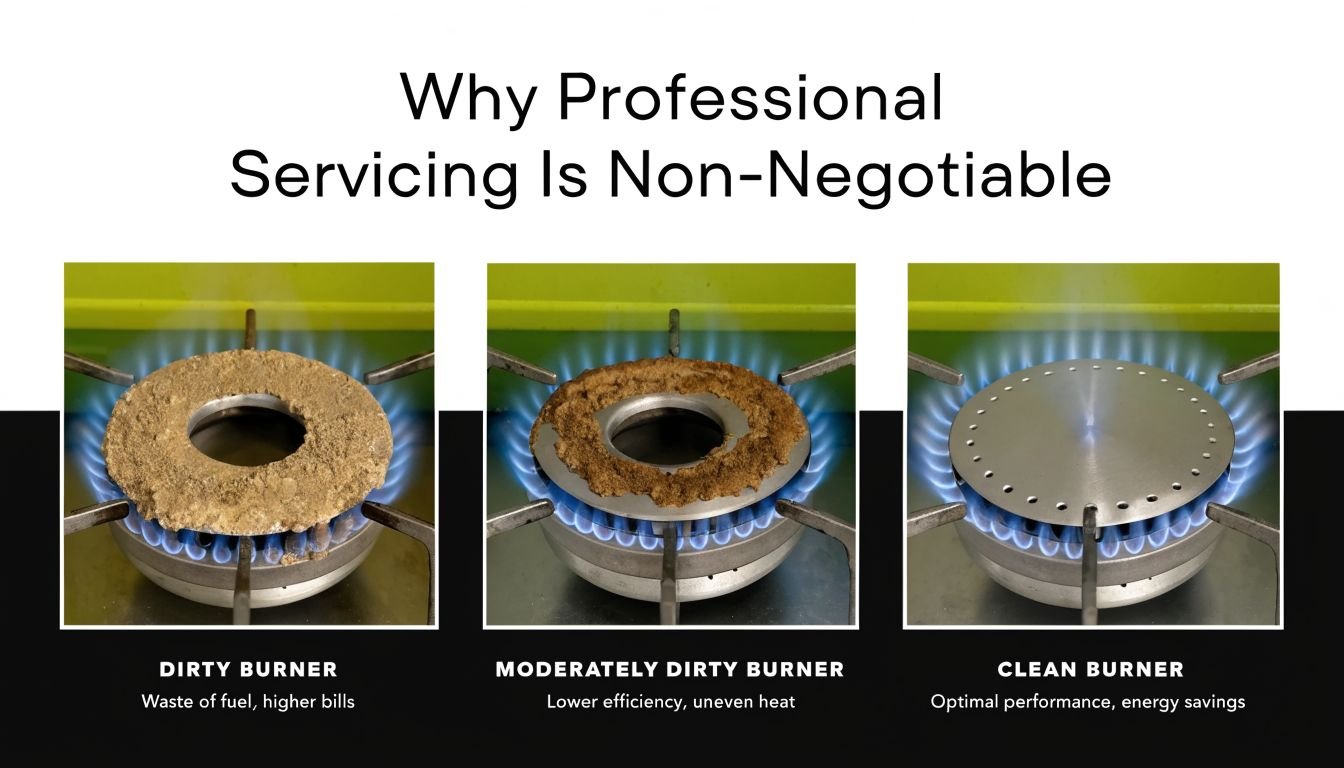
For businesses and the common parts of multi-occupied residential buildings, the legal duty is maintenance. In practice, that means planned inspection and servicing by a competent engineer, not just user checks. Article 17 of the Regulatory Reform (Fire Safety) Order 2005 requires fire precautions to be kept in efficient working order and in good repair. BS 5839 servicing schedules then set the standard most insurers, enforcing authorities, and risk assessors expect to see followed.
A proper service visit is hands-on and methodical. The engineer should test devices in rotation, review the panel history, check batteries under load, confirm sounders and interfaces operate correctly, and identify faults that routine occupants would never spot. On older systems, this work often picks up drift in detector performance, damage from past decorating or fit-out work, and changes that were never recorded on the zone plan or logbook.
Typical servicing work includes:
- Detector checks: confirming smoke and heat detectors respond correctly and are suitable for their location
- Battery and power supply testing: checking standby capacity and charger condition
- Panel inspection: reviewing faults, disablements, event logs, indicators, controls, and cause-and-effect operation
- Device and circuit testing: checking call points, sounders, relays, interfaces, door releases, and warning devices across the system
- Records and compliance review: updating the logbook, noting defects, and recommending repairs or corrective action
The trade-off is simple. Regular servicing costs less than chasing repeat faults, dealing with false alarms, or finding out after an incident that a device was isolated months ago.
That matters even more where responsibilities are split. In a block with communal protection and detectors inside individual units, a basic tenant test does not cover the building system. In a business with monitoring, the panel can still report healthy while a field device, standby battery, or interface is degrading. Professional servicing closes that gap.
For new systems and major upgrades, design and maintenance should be considered together. Good fire alarm installation and commissioning services make later servicing more straightforward because zones, documentation, device labelling, and cause-and-effect logic are set up properly from the start.
If you want the practical answer, keep the routine weekly and monthly checks in place, then put professional servicing on a fixed schedule that matches the building and the system standard. That is how you move from “the alarm made a noise” to “the system is being maintained to protect people and meet your legal duty.”