
Security Companies South Wales: Your 2026 Guide
You're probably in one of two situations right now. Either something has happened, a break-in nearby, a failed alarm, a vulnerable outbuilding, a warehouse with too many access points, a retail unit with staff opening up alone, or you've just taken on a property and realised security was left as an afterthought.
That's when individuals searching for security companies in South Wales often run into the same problem. Every website says it installs CCTV, alarms, and access control. Far fewer explain how to judge whether the system will be reliable, compliant, maintainable, and worth paying for.
That gap matters. The UK private security services market was estimated at £10.1 billion in 2026, with 6,572 businesses in the industry, operating in a mature and competitive market that includes major national players such as MITIE Security Ltd, G4S Secure Solutions (UK) Ltd, and OCS Group UK Ltd, according to IBISWorld's UK private security services industry data. In practice, that means buyers in Cardiff, Newport, Swansea, Bridgend, and the Valleys have plenty of choice, but not every option is equal.
Table of Contents
- Securing Your South Wales Home or Business
- Understanding Your Core Security System Options
- Decoding Technology and Essential Certifications
- How to Choose the Right South Wales Installer
- What to Expect from Costs and Installation
- The Case for a Local and Accredited Installer
Securing Your South Wales Home or Business
If you own a house in a quiet suburb, a shop in Cardiff, a unit in Newport, or a warehouse near Swansea, the basics are the same. You need to know what you're protecting, how someone could get in, how quickly you'd know about it, and who responds when there's a real incident.
Most buying mistakes happen before any equipment is fitted. People compare camera counts, siren volume, or app screens, but skip the harder questions. Is the system appropriate for the site? Will it still work properly after six months of weather, staff turnover, and daily use? Can anyone verify an event quickly, or are you just paying to create noise?
The building blocks that matter
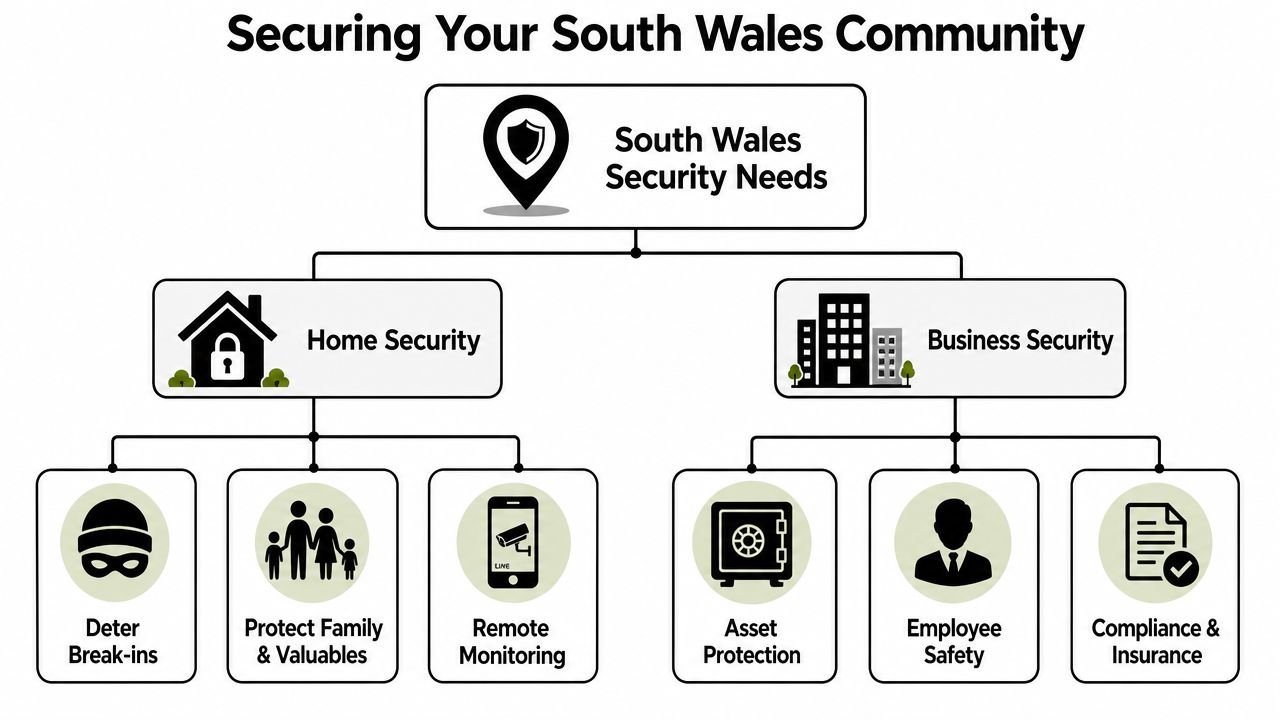
A sound security setup usually combines a few core layers:
- CCTV: Not just for recording after the fact. Good CCTV helps you verify activity, check deliveries, review incidents, and manage vulnerable areas remotely.
- Intruder alarms: These create the trigger. They tell you that a door, room, perimeter, or motion zone has been breached.
- Access control: This decides who should be there in the first place. It's often more useful for daily risk reduction than buyers expect.
- Fire and life-safety integration: Separate discipline, but often part of the same property conversation.
For many buyers, the smart starting point is to look at integrated CCTV and security systems rather than treating each product as a separate purchase. That doesn't mean every site needs every feature. It means the system should work as one joined-up solution.
Practical rule: Buy for response and reliability first. Deterrence is useful, but a system that nobody trusts or maintains won't protect much.
South Wales buyers should also remember that local firms aren't operating in a small bubble. They're competing in a broad UK market where compliance, service quality, and differentiation matter. That's good for the customer, but only if you know how to compare providers properly.
The right provider won't start by pushing a package. They'll ask about your opening routines, blind spots, staff access, insurance requirements, out-of-hours risks, and whether you need evidence, deterrence, or active response. That's the difference between buying a system and buying protection.
Understanding Your Core Security System Options
Many searches for security companies in South Wales start with a product name. “Need CCTV.” “Need an alarm.” “Need entry system.” Real sites rarely fit neatly into one box. The better question is which part of your risk each system handles, and where one system on its own leaves a gap.
Start with risk not gadgets
An intruder alarm is there to detect unauthorised entry or movement. For a homeowner, that may be external doors, downstairs rooms, and a garage. For a business, it might include stock rooms, office areas, shuttered entrances, and internal zones that arm separately.
The important split is between bell-only and monitored systems. A bell-only alarm is like an old car alarm. It makes noise locally and may put someone off. A monitored alarm is closer to a vehicle tracking setup. It creates a signal outside the building, allows escalation, and can support a real response process. Bell-only still has a place, especially on lower-risk properties, but buyers often overestimate what a siren alone will achieve.
CCTV does a different job. It gives visibility. Good systems provide clear footage, useable night performance, remote viewing, and sensible camera placement. What matters isn't having cameras everywhere. What matters is covering approach routes, entrances, cash or stock areas, yards, loading points, and any place where you'd later ask, “How did that happen?”
Access control is often overlooked by smaller businesses. Yet it solves a lot of daily problems. Keys get copied, lost, or never returned. Fobs, cards, PINs, and managed credentials are easier to control. On larger sites, access logs also help with investigations, contractor movement, and opening procedures.
Fire alarms belong in the same conversation because many sites don't want four unrelated contractors touching four separate systems. Integration can simplify maintenance, but only if the installer understands both compliance and operational use.
A recurring issue in the local market is that buyers are shown long service lists but not the operational trade-offs. As noted by Cutting Edge Security's Cardiff systems page, a common question in South Wales is whether to prioritise integrated systems or single-product installs, especially across premises such as retail units, warehouses, and multi-tenant buildings.
Key Security System Comparison
| System Type | Primary Function | Ideal For |
|---|---|---|
| Intruder alarm | Detects unauthorised entry or movement | Homes, offices, shops, warehouses |
| CCTV | Provides visual monitoring and evidence | Homes, retail, car parks, yards, communal areas |
| Access control | Manages who can enter specific areas | Offices, flats, schools, multi-tenant buildings, stock rooms |
| Fire alarm | Protects life and supports compliance | Homes in some settings, commercial and managed properties |
A simple way to think about it is this:
- Alarm systems tell you something is wrong
- CCTV helps confirm what's happening
- Access control reduces the chance of the problem starting
- Fire systems cover a different but essential risk
A cheap install often looks fine on day one. The problems show up later, with missed detection, poor coverage, awkward apps, false activations, and no support when a fault appears.
There's also a modern wrinkle. Many sites now have internet-connected cameras, door controllers, intercoms, and mobile apps. That convenience creates exposure if devices are poorly configured or left unmanaged. If your system connects to workplace networks, this guide on critical smart device security vulnerabilities for companies is worth reading before you approve any design.
Decoding Technology and Essential Certifications
A lot of poor buying decisions happen because technical language sounds impressive when it isn't explained. Buyers hear standards, grades, analytics, cloud access, dual-path signalling, and remote management, then compare quotes on price because everything else feels opaque.
That's exactly where weak installs slip through.
What standards actually tell you
For intruder alarms, BS EN 50131 matters because it sets expectations around system design, grading, components, tamper protection, and performance. Most domestic properties and many lower-risk commercial sites are commonly discussed around Grade 2. Higher-risk commercial settings may require Grade 3 depending on threat level and insurer expectations.
You don't need to memorise the standard. You do need to ask the installer what grade they're proposing and why. If they can't explain it in plain English, that's a warning sign.
Accreditations matter for the same reason. SSAIB, NSI, and contractor vetting schemes aren't decorative logos. They indicate that an installer has been assessed against recognised requirements. They don't remove the need to vet the company, but they reduce the chance you're dealing with a firm making things up as it goes.
If you want a practical benchmark for what proper independent oversight looks like, review the role of the Security Systems and Alarms Inspection Board before comparing quotations.
Why verification matters more than noise
The strongest operational advantage in modern systems is often rapid alarm verification. In South Wales and across the UK, response pathways have tightened around unverified intruder alarms. Profm Group's Wales security guidance notes the increasing importance of verified alarms, with practical implications for Cardiff, Newport, and Swansea sites that need genuine incidents escalated quickly while reducing false activations.
That changes what good design looks like.
A siren on its own may still deter. It doesn't tell a responder whether a fox crossed the yard, a cleaner opened the wrong door, or someone is actively forcing entry. Video verification, event logs, dual-path signalling, and sensible zoning help separate nuisance events from real threats.
Ask providers specific questions such as:
- How is an alarm verified? Through CCTV clip, detector sequence, audio, or operator review?
- What happens if broadband drops? Is there a resilient signalling path?
- How are false alarms reduced? Better detector choice, better zoning, better commissioning?
- Who sees the event first? You, a monitoring station, a keyholder, or all three?
Physical security now overlaps with cyber hygiene more than many buyers realise. Cameras, controllers, mobile apps, and remote portals need sensible management. For businesses reviewing supplier assurance more broadly, SES Computers' Cyber Essentials insights are a useful companion read, especially when security devices sit on the same estate as business systems.
How to Choose the Right South Wales Installer
The installer matters as much as the equipment. Good hardware fitted badly becomes a liability. Average hardware fitted thoughtfully, commissioned properly, and supported over time will often outperform a flashy system sold on features alone.
Treat the buying process like an interview.
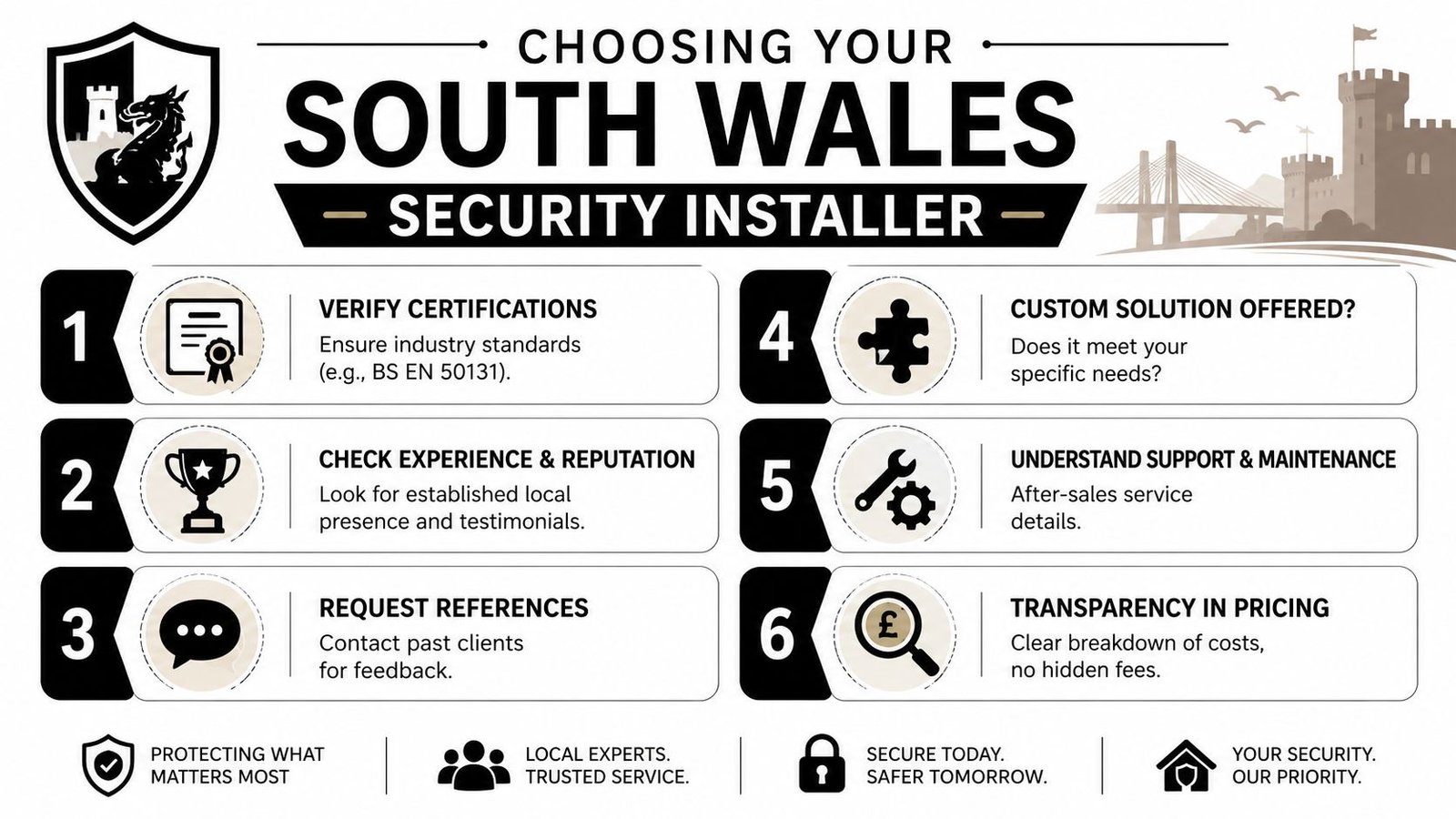
Questions worth asking every installer
Start with direct questions and insist on clear answers.
- Who will do the work? Ask whether engineers are directly employed, vetted, and trained on the systems being installed.
- What happens after installation? You want to know about maintenance, fault response, battery changes, firmware updates, and user support.
- Which manufacturers do you work with? A serious installer can explain why a Hikvision camera, Paxton controller, Pyronix alarm, or Fike fire panel suits a given environment.
- Will you carry out a site survey? A proper survey should look at entry routes, lighting, Wi-Fi limitations, cable routes, power, user habits, and insurance obligations.
- Can you provide a written specification? “Four cameras and an alarm” is not a specification.
- What training is included? If the handover is rushed, staff stop using the system properly.
The handover matters more than people think. If no one on site knows how to review footage, isolate a door, arm partitions, or manage users, the system becomes dead weight.
A useful way to judge any trade professional is to see how they handle urgent, trust-based work where the customer is under pressure. The same buying logic applies in adjacent fields such as understanding emergency car key services, where competence, identification, and method matter more than whoever quotes fastest.
This video gives a useful visual sense of what to look for in a professional installation conversation:
Red flags that should slow you down
Some warning signs are obvious. Others are easy to miss.
- Pressure selling: “Sign today for this price” is rarely a good basis for a security decision.
- No meaningful survey: If they quote properly without understanding the site, the quote is guesswork.
- Vague standards talk: If they mention compliance but avoid specifics, push harder.
- No maintenance discussion: Every system needs support. If that's skipped, expect trouble later.
- One-size-fits-all packages: Homes, schools, industrial units, and mixed-use buildings don't share the same risk profile.
- Poor cable discipline or sloppy positioning: You can often spot standards from existing installs in photos or site visits.
The best installer usually sounds calmer than the salesperson. They ask more questions, make fewer promises, and document more detail.
One local example of a provider model worth benchmarking is Wisenet Security Ltd, which states that it designs, installs, and maintains integrated CCTV, alarms, access control, fire alarms, intercoms, and gate automation across South Wales and the South West. That's useful as a factual reference point because it shows what a multi-system, maintenance-focused installer relationship can look like.
What to Expect from Costs and Installation
Price is the part buyers ask about first, but it makes more sense once the process is clear. Without a proper survey, any price is only a rough sketch. The same property can need very different solutions depending on risk, layout, cable access, outbuildings, user count, and whether you need verification, remote management, or monitoring.
How the job usually unfolds
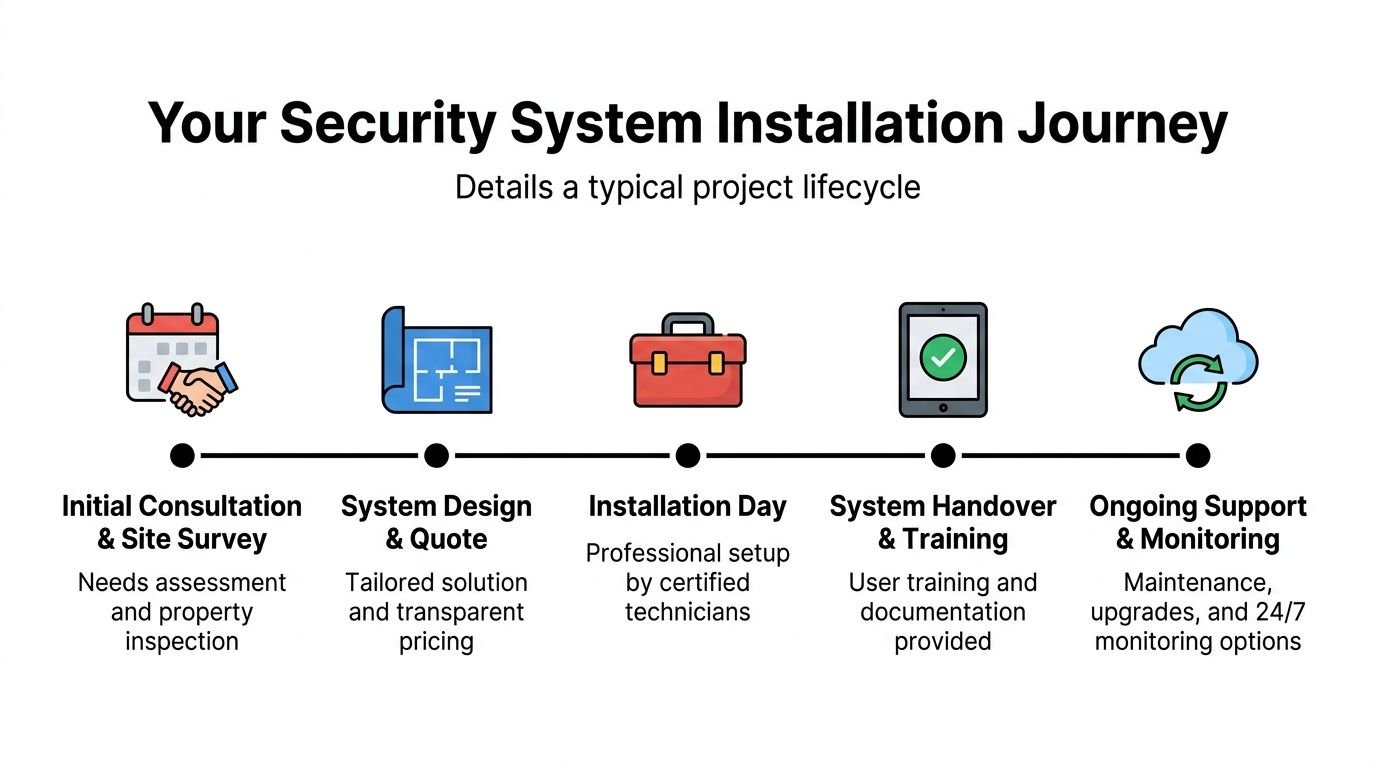
A straightforward project tends to move through five stages:
Initial consultation and site survey
The installer checks the property, listens to concerns, and identifies practical constraints.System design and quote
You should receive a proposal that explains equipment, coverage, options, and what is or isn't included.Installation day or phased works
Smaller homes may be simple. Larger commercial sites may need staged works around staff, trading hours, or tenant access.System handover and training
During this stage, users learn the app, alarm routines, footage playback, and basic troubleshooting.Ongoing support and maintenance
Batteries age, devices fail, users change, and software needs attention.
Many buyers underestimate the final stage. The system you buy is only part of the cost. The system you can still rely on later is the actual purchase. If you want a breakdown of the factors that shape quotations, this guide to security system costs is a useful reference point.
What changes the price
Even without putting exact figures on local installs, the main cost drivers are predictable:
- Property size and layout: Detached homes, split-level offices, and wide warehouses all affect labour and equipment.
- Wired versus wireless choices: Cable routes, building fabric, and finish quality change installation time.
- System depth: A few cameras and a bell box cost less than monitored alarms, managed access, intercoms, and integrated fire interfaces.
- Monitoring requirements: Ongoing services create recurring costs, but they may reduce dependence on constant on-site presence.
- Environmental conditions: External lighting, weather exposure, and long-distance perimeter runs all matter.
A major shift in the market is the move towards remote monitoring and video analytics for sites that need round-the-clock oversight without permanent guarding. Navigation Security's coverage of modern monitoring approaches highlights how many South Wales buyers still underestimate this option when comparing long-term cost and effectiveness.
Cheap quotes often leave out the expensive part. Not the hardware, but commissioning, support, maintenance, and the time needed to get the layout right.
Ask every provider to separate one-off installation costs from ongoing support. That makes comparison fairer and stops low upfront prices hiding poor long-term value.
The Case for a Local and Accredited Installer
Local doesn't automatically mean better. Accredited doesn't automatically mean better either. Put them together, though, and you usually get a stronger result. A local firm has to live with its reputation. An accredited firm has to meet external expectations. That combination tends to produce better surveys, tidier installations, and more accountability when something needs attention.
Why local knowledge still counts
South Wales has a long-established security-services ecosystem. One concrete marker is the Sell2Wales listing for Specialist Security in Cardiff, established in May 2001 at Capital Quarter, offering electronic, physical, and manned security services, including CCTV, alarms, access control, key holding, alarm response, turnstiles, and gates, as shown on the Sell2Wales supplier record. That tells you the market here didn't appear yesterday. Buyers have had access to integrated, professional services in the region for over two decades.
That matters because local properties have local patterns. City-centre retail behaves differently from rural homes. A school in the Valleys doesn't share the same risk profile as a managed office in Cardiff Bay. A provider that already works across the region usually understands those practical differences faster.
The buying decision that holds up
The provider you want is rarely the one with the loudest website. It's the one that does the following well:
- Surveys the site properly
- Explains trade-offs in plain English
- Designs for the property's practical use
- Documents standards and maintenance clearly
- Supports the system after handover
Security companies in South Wales vary widely. Some are product-led. Some are sales-led. The better ones are process-led. They start with risk, match equipment to the environment, and build in long-term support from the beginning.
If you remember one thing, make it this. Don't buy a box of hardware. Buy a documented, maintainable system from a company you'd still trust to call back when the app fails, a detector starts false alarming, or a gate won't release on a wet Monday morning.
If you want a practical, no-pressure conversation about protecting a home, business, warehouse, school, car park, or multi-tenant building, Wisenet Security Ltd offers consultations across South Wales and the South West for CCTV, alarms, access control, fire systems, intercoms, and gate automation. Ask for a site survey, a written specification, and a clear explanation of maintenance before you decide.