Expert Fire Alarm Installation: South Wales & SW
If you're running a shop in Cardiff, managing an HMO in Newport, or looking after a mixed-use building in Bristol or Swansea, you're probably dealing with the same frustration I hear every week. You know you need a fire alarm system that satisfies insurers, protects occupants, and stands up to inspection, but the rules can feel scattered across legislation, standards, and local expectations.
That confusion matters because a fire alarm isn't just a few detectors and a bell. It's a life-safety system. If the design is wrong, if devices are in the wrong place, or if maintenance slips, the installation can still fail when people need it most. For a business owner or landlord, that turns into risk on three fronts: legal exposure, operational disruption, and danger to staff, tenants, or visitors.
The practical answer is to treat fire alarm installation as a process, not a product purchase. The right starting point is understanding your duty, then matching the system to the building, then installing and maintaining it properly. That's how compliant projects stay compliant after handover, not just on the day the panel is commissioned.
Table of Contents
- Your Guide to Compliant Fire Alarm Installation
- Understanding Your UK Fire Safety Obligations
- Conventional vs Addressable Systems Which Is Right for You
- The Professional Site Survey and Design Process
- The Installation and System Integration Phase
- Local Costs and Ongoing Maintenance Requirements
- Fire Alarm Installation FAQs
- What records should a landlord or managing agent keep after a fire alarm service visit
- What is cause and effect, and why does it matter in a commercial building
- How does a phased evacuation fire alarm work
- What happens if a tenant keeps causing false alarms
- Do I need to upgrade the alarm if I change the use of part of the building
Your Guide to Compliant Fire Alarm Installation
For most premises in South Wales and the South West, compliant fire alarm installation starts with one question. What risk does this building present to the people inside it? A small ground-floor office, a three-storey guest house, and a warehouse unit all need different approaches, even if they sit on the same road.
That is where many problems begin. Owners often ask for "a fire alarm system" as if there's a universal template. There isn't. A compliant design depends on occupancy, sleeping risk, escape routes, building layout, kitchen locations, ceiling geometry, and whether other systems need to respond when the alarm operates.
Practical rule: Buy the design before you buy the hardware.
In practice, the job usually follows five stages:
- Duty and risk review. Identify who the responsible person is and what the premises are being used for.
- Survey and category selection. Decide what level of coverage the building needs.
- System design. Choose conventional or addressable, detector types, sounders, interfaces, and cable routes.
- Installation and commissioning. Fit, test, label, verify cause-and-effect, and record the system properly.
- Ongoing maintenance. Keep the system serviceable, testable, and trusted by occupants.
For landlords and business owners, what works is a system that people can understand during an alarm, that contractors can service without guesswork, and that doesn't create constant nuisance activations. What doesn't work is copying another building's layout, placing detectors by eye, or treating commissioning paperwork as an afterthought.
Understanding Your UK Fire Safety Obligations
The legal starting point for most non-domestic premises is the Regulatory Reform (Fire Safety) Order 2005. If you control a workplace, common parts of a block, a shop, office, licensed premises, or many forms of multi-occupancy property, you're likely the Responsible Person or acting for them. That duty isn't passive. It requires active management of fire precautions, including suitable detection and warning.
Who carries the duty
For a business, the duty usually sits with the employer, owner, managing agent, or person in control of the premises. For a landlord, it often applies to common areas and shared escape routes, particularly in HMOs and mixed-use buildings.
The key obligations are practical, not theoretical:
- Assess the risk. A fire risk assessment should identify ignition sources, occupancy risk, means of escape, and where detection is required.
- Provide suitable warning. Occupants must be able to detect fire and react in time.
- Maintain equipment. A system that hasn't been serviced or tested properly won't satisfy the fundamental purpose of compliance.
- Keep records. Testing, maintenance, faults, and remedial works all need documenting.
A useful way to stay current on common compliance issues is to review specialist commentary such as Wisenet's posts on fire safety compliance guidance, especially if you're managing more than one property.
What the standards mean in practice
British Standards shape what an appropriate system looks like in practice. In everyday terms, the standard helps determine system category, detector siting, sounder coverage, call points, panel function, and maintenance expectations. That matters because legal compliance isn't just about having devices on the ceiling. It's about whether the system has been designed for the building people occupy.
One fact is worth keeping in view. In England, smoke alarms were present, operated, and raised the alarm in only 38% to 43% of dwelling fires reported between 2013 and 2018, which is why correct placement and maintenance are decisive for life safety according to this smoke alarm analysis.
A panel can be compliant on paper and still underperform if the design ignores how people sleep, move, and escape in that building.
For landlords dealing with HMOs or mixed-use properties, the issue is often choosing the right grade or category rather than installing the most expensive panel. For businesses, it's usually about matching coverage to operational risk, then proving the system has been designed and maintained by competent people.
If you want broader technical context around how fire safety systems are evaluated in practice, it's worth taking time to explore Knight Tek's findings, particularly alongside your own risk assessment and installer advice.
Conventional vs Addressable Systems Which Is Right for You
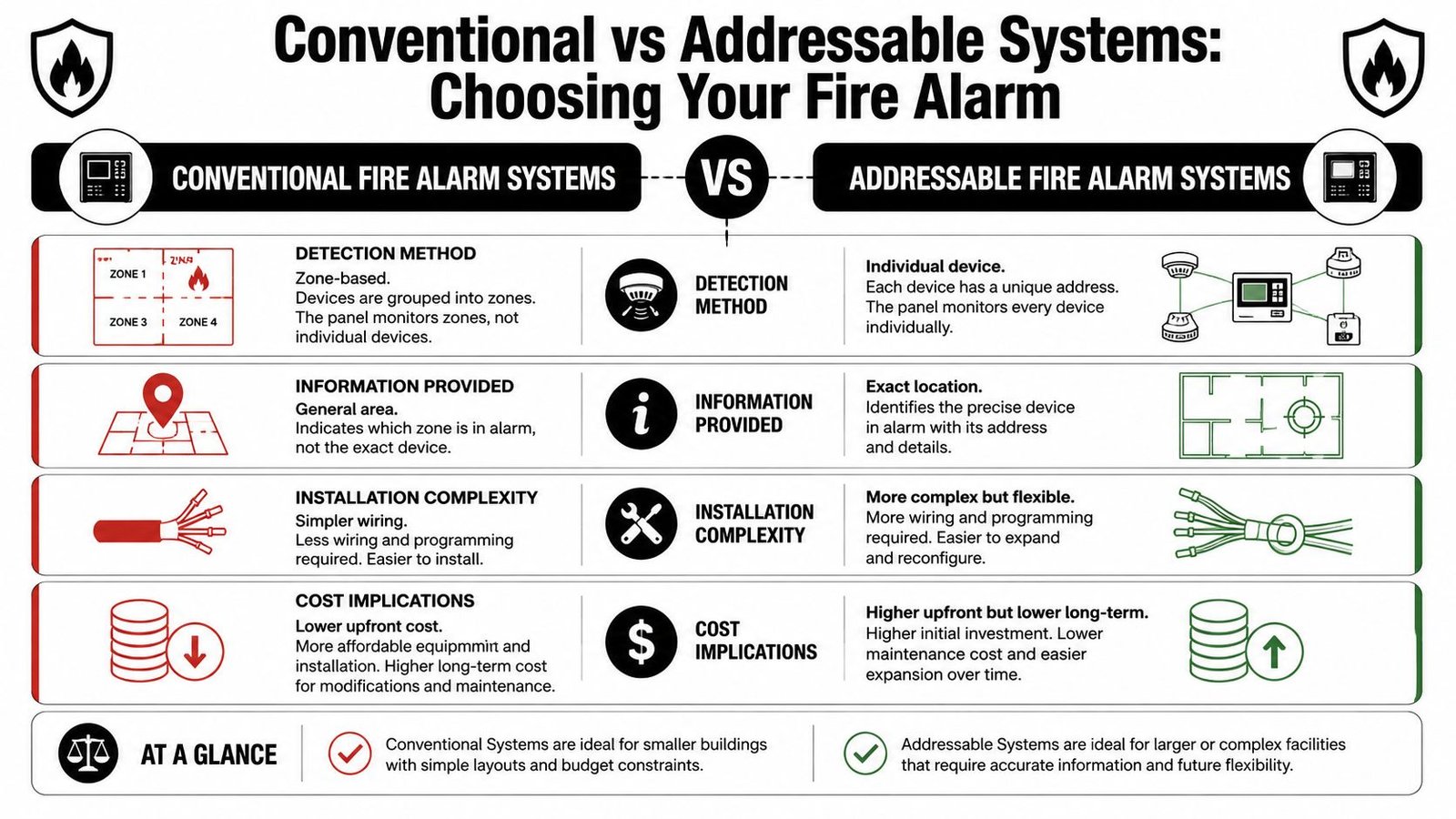
Most commercial clients narrow the decision to two system types. Conventional and addressable. The easiest way to think about them is this: a conventional system tells you the fire is in a part of the building, while an addressable system tells you which device has activated.
How a conventional system behaves
A conventional panel divides the building into zones. If a detector or call point activates, the panel identifies the zone, not the exact detector. For a smaller building, that's often enough.
This approach suits straightforward layouts such as:
- Small retail units. One or two floors, simple circulation, limited back-of-house space.
- Compact offices. Clear departmental separation and short escape routes.
- Smaller community buildings. Premises where staff can quickly check the indicated zone.
The strengths are simplicity and easier fault-finding on modest installations. The weakness appears when the building becomes more complex. If "first floor rear" is still too broad to act on quickly, the zone-based approach starts to show its limits.
For readers comparing categories and layouts in rental and shared buildings, this guide to fire alarm system types is a useful companion to your risk assessment.
When addressable makes more sense
Addressable systems give each detector, call point, interface, and sounder base its own identity on the loop. When a device operates, the panel can display the exact location that has been programmed into it.
That changes the response in larger sites:
- A hotel team can see the specific bedroom corridor detector in alarm.
- A warehouse manager can identify a device near a loading bay rather than search an entire zone.
- A managing agent can isolate and trace faults with less disruption in a multi-tenant building.
Addressable systems also handle cause-and-effect logic more elegantly. That matters when the alarm needs to trigger other actions such as magnetic door release, smoke control interfaces, or phased evacuation logic.
A cable fault has bigger consequences in poorly designed loop systems, which is why installation quality matters as much as panel choice. If you're weighing up whether a simpler zone layout is enough or whether you need device-level intelligence, Wisenet's page on conventional fire alarm systems helps frame the comparison from a UK installation perspective.
A short visual walkthrough can also help if you're deciding between the two.
A simple decision guide
| Building situation | Usually the better fit |
|---|---|
| Small, simple premises with clear zones | Conventional |
| Multi-storey site with many rooms or tenants | Addressable |
| Building where staff need exact alarm locations | Addressable |
| Modest property with tighter upfront budget | Conventional |
The wrong choice isn't always the cheaper one. It's the one that makes alarm response slower, maintenance harder, and future alterations more disruptive.
The Professional Site Survey and Design Process
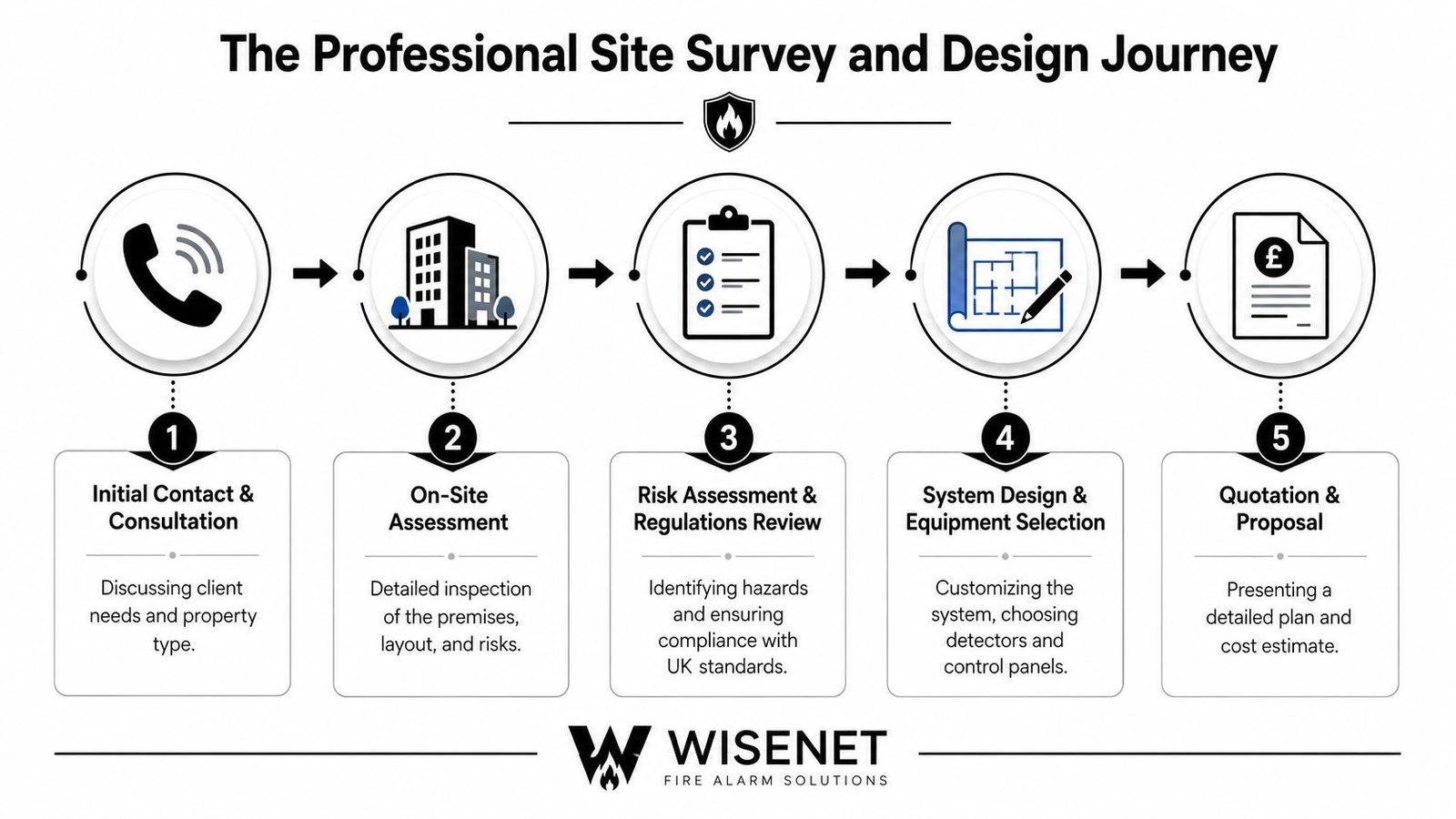
A proper site survey decides whether the rest of the project goes smoothly or turns into rework. On a visit to a business unit in Swansea or an HMO in Cardiff, the engineer isn't just counting rooms. They're building a picture of how fire could start, how smoke might travel, and how people will get out.
What gets checked on site
The first layer is building use. A quiet office, a takeaway, and an HMO with shared cooking areas all create different false alarm risks and different evacuation behaviours.
The second layer is physical layout. That includes escape routes, stairwells, dead ends, plant areas, kitchens, bathrooms, loft spaces, service risers, and any spaces where smoke detection may be unsuitable and heat detection may be the better answer.
A competent survey also checks the awkward details that generic advice leaves out:
- Ceiling form. Sloped roofs, beams, coffers, and changes in height affect detector performance.
- Air movement. Fans, open vents, extract systems, and open loading doors can disrupt smoke travel.
- Occupancy pattern. Sleeping risk, lone working, public access, and vulnerable occupants all change the design.
- Interface needs. Door releases, emergency lighting, monitoring links, and shut-down signals must be planned early.
Where design errors usually happen
One of the most common failures is oversimplified detector placement. UK-aligned technical guidance is specific about geometry and obstructions. For example, voids deeper than 800 mm may need their own detector coverage, and obstacles deeper than 250 mm require specific clearance according to this technical placement guidance.
That level of detail matters because poor placement creates two expensive outcomes. The first is nuisance alarms. The second is delayed detection in the very area the device was meant to protect.
Site reality: "Put one in the middle of the ceiling" is not a design method.
The better approach is to match detector type and location to the environment. Near kitchens, plant rooms, shower areas, or places with airborne contaminants, the correct answer often isn't "more smoke detectors". It's a more considered combination of heat detection, multisensor devices, spacing adjustments, and better routing.
A good survey should end with a design that answers practical questions clearly: what covers what, why that category was selected, how the alarm will be heard, where faults can occur, and how future servicing will be carried out without guesswork.
The Installation and System Integration Phase
A poor installation usually looks tidy on day one and starts causing trouble a few weeks later. In South Wales, I see the same pattern in shops, offices, care settings, and HMOs. Devices are fitted without enough thought to access, tenant disruption, or how the alarm needs to interact with doors, vents, lifts, and monitoring. The result is snagging, false alarms, missed interfaces, and delays to handover.
A proper installation follows the approved design and records any site change before it becomes a compliance problem. That matters in occupied buildings, where engineers often have to work around trading hours, residents, contractors, or restricted access. On multi-occupancy sites, sequencing is part of the safety job. Cable routes, drilling, temporary isolations, and detector changes all need control so the building is never left without suitable protection.
What happens during installation
The first stage is first fix. Engineers install containment, fire-resisting supports, cable routes, and penetrations in line with the design. The work has to suit the building as it exists, not just the drawing. Older premises across South Wales and the South West often bring awkward ceiling voids, solid walls, surface finishes that need protection, or limited access above occupied areas.
Second fix comes next. Detectors, manual call points, sounders, interfaces, and the control equipment are mounted in their approved positions, labelled correctly, and checked against the device schedule. On HMOs and mixed-use buildings, this is usually where practical issues show up. A detector may need to move because of a beam, a vent, a kitchen extract path, or a door swing that was not obvious at survey stage.
Then the system is terminated, programmed, and commissioned. On an addressable system, that includes device text, cause-and-effect logic, fault monitoring, and output configuration. On a conventional system, the discipline is different but no less important. Zones, sounder circuits, interfaces, and panel labelling must still match the building layout and the fire strategy.
Typical installation flow looks like this:
- Pre-start coordination. Confirm drawings, access times, permits, and any temporary fire precautions.
- First fix works. Install routes, containment, supports, and cable runs.
- Second fix works. Fit and label field devices in the agreed locations.
- Panel termination and setup. Connect circuits, configure zones or addresses, and set outputs.
- Commissioning and testing. Prove every device, interface, sounder, and fault condition.
- Handover. Issue records, certificates, user guidance, and the testing regime.
Integration is where many projects succeed or fail
The panel is only one part of the system. If the building has access control, smoke ventilation, lift grounding, gas shut-off, plant shutdown, or remote monitoring, those functions need to operate in the right order and be witnessed during testing.
Shortcuts in fire alarm installation pose real risks. A door release wired incorrectly can leave a final exit locked. A shutdown signal sent to the wrong plant can create operational damage. A monitoring path that reports unclear events can slow the response from keyholders or attending services. For business premises and larger residential blocks, the installation has to reflect how the whole building behaves in an alarm condition, not just whether the sounders ring.
That is also why staged testing matters. Good commissioning is methodical. Engineers check device activation, panel response, interface operation, audibility, fault reporting, standby supply, and any link to external monitoring. The client or responsible person should know what has been tested, what remains isolated, and what weekly user checks are expected after handover. If you need clarity on ongoing routine checks, this guide on how often fire alarms should be tested sets out the basic expectation.
The final handover should leave you with usable records, not a panel code and a quick demonstration. That includes zone charts or address lists, logbook details, certificates, cause-and-effect information where relevant, and clear notes of any variation from the original design. If a fire ever leads to business interruption or reinstatement work, those records become far more important than many owners expect. AMPM Restoration's recovery insights give a useful picture of what happens after a serious incident, and why accurate system documentation helps from the first day of operation.
Local Costs and Ongoing Maintenance Requirements
A Swansea landlord gets three quotes for the same mixed-use building and picks the cheapest. Six months later, the panel is faulting, detector coverage does not match the escape routes, and the maintenance contract excludes the remedial work needed to put the system right. I see that pattern often. The lowest quote can become the highest overall cost once call-backs, false alarms, missed compliance points, and disruption to tenants are taken into account.
What affects the price
In South Wales and the South West, pricing is driven more by the building and its use than by location alone. A small open-plan office above a shop is usually straightforward. A care setting, licensed premises, HMO, or older converted property with restricted access is not.
The price usually shifts because of five practical factors.
- System type. Conventional systems are often cheaper to install at the outset. Addressable systems usually cost more but make fault finding, device identification, and later alterations easier in larger or more complex premises.
- Building fabric and access. Thick masonry, listed features, occupied rooms, asbestos controls, and poor ceiling void access all add labour time and can limit cable routes.
- Device count and interfaces. More detectors, manual call points, sounders, door retainers, smoke control links, and monitoring connections mean more installation time, more programming, and more testing.
- Cable specification. Fire alarm wiring is not standard low-voltage cable. It has to maintain circuit integrity in fire conditions, so the cable type and installation method matter for compliance as well as reliability.
- Handover standard. Clear drawings, zone information, programming records, certificates, and logbook setup all take time. If they are missing, the system is harder to maintain and harder to defend if an insurer or enforcing authority asks questions later.
For South Wales businesses and landlords, one trade-off comes up repeatedly. Spending less on the initial install can make future changes more expensive, especially in buildings that are likely to be re-let, reconfigured, or extended.
What Maintenance Involves
Once the system is live, the responsible person still has legal duties. A compliant installation is only the starting point. The system then needs routine user checks, planned servicing, accurate records, and prompt repair of faults or damaged devices.
That usually means:
- User checks. Regular testing of manual call points on rotation, confirmation that the panel shows normal status, and logbook entries for tests, faults, and alarm events.
- Professional servicing. Periodic inspection by a competent fire alarm company to test devices, inspect standby power, review faults, clean detectors where needed, and confirm that the system still suits the building's use.
- Remedial work. Replacement of failed detectors, batteries, sounders, interfaces, or damaged call points, plus programming updates after layout changes or tenancy changes.
- Record keeping. Service sheets, certificates, logbook entries, and evidence of action taken on faults. Those records matter during audits, after unwanted fire signals, and after any serious incident.
For a practical explanation of test intervals and logbook expectations, see this guide on how often commercial and landlord fire alarms should be tested.
Cheap maintenance contracts often look acceptable on paper. The problem is what they leave out. Dirty detector heads, ageing standby batteries, recurring faults, and undocumented isolations can sit in the background for months until an inspection or activation exposes them.
Typical cost ranges in South Wales and the South West
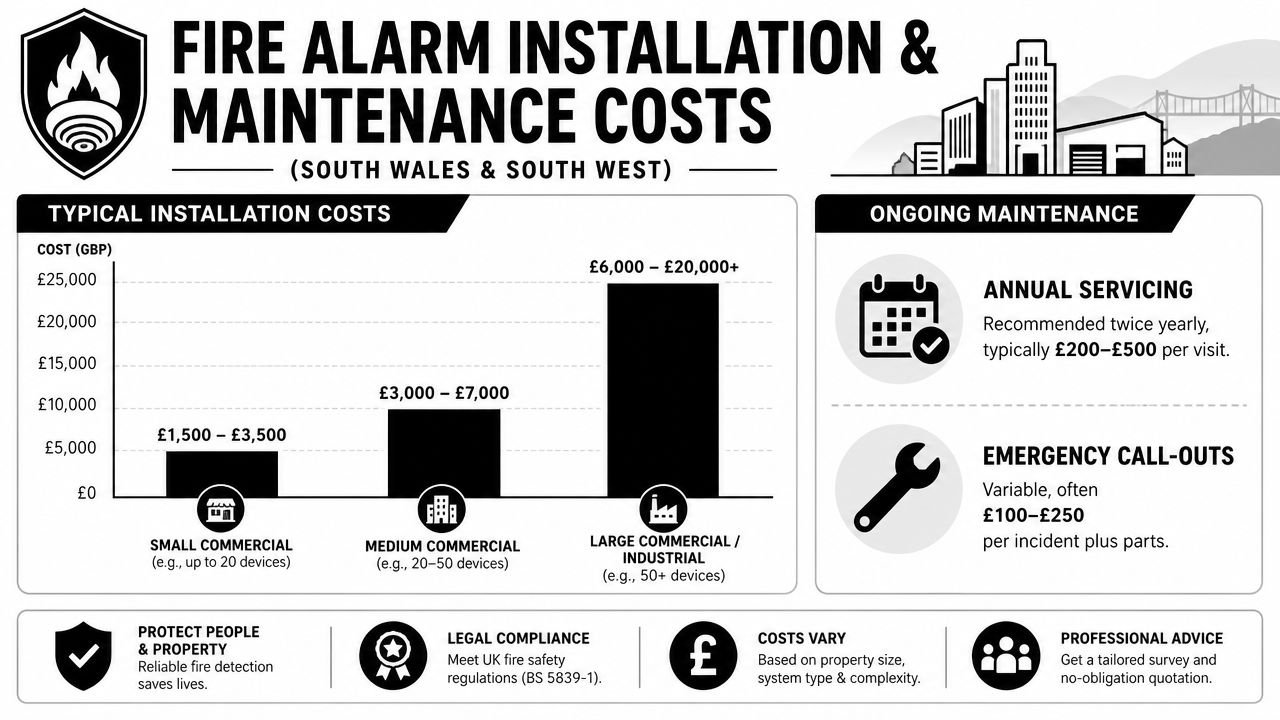
The graphic above gives broad planning ranges, and that is the right way to use it. No responsible engineer should price a business premises, block, or HMO properly from floor area alone. The actual figure depends on access, occupancy pattern, fire risk category, existing infrastructure, out-of-hours working, and what needs to interface with the alarm.
For budgeting, I advise owners and managing agents to ask three direct questions. Does the quote include design responsibility. Does it include commissioning and certification. Does it include a defined maintenance proposal with response terms and exclusions clearly stated. If any of those points are vague, the number on the front page is not the true project cost.
If you are costing works after a fire, reinstatement can quickly overtake the original alarm budget. AMPM Restoration's recovery insights show how alarm decisions, access limitations, and building recovery become linked once damage has occurred.
The sensible route is straightforward. Get a proper survey, read the design basis in plain English, and compare quotes on scope, compliance, and maintenance liability, not on equipment price alone.
Fire Alarm Installation FAQs
What records should a landlord or managing agent keep after a fire alarm service visit
For an HMO, block, or mixed-use property, keep more than the invoice. The service record should show the date of visit, engineer details, devices tested, faults found, parts replaced, zones or devices left isolated, and any recommendations that still need action. If the panel log and the service sheet do not match, that becomes a problem during an audit, after an incident, or when management changes hands.
I also advise keeping call-out reports, commissioning certificates, zone charts, cause and effect information, and a clear record of who is authorised to silence, reset, or isolate the system. In older South Wales properties, paperwork is often the weakest part of the fire alarm package.
What is cause and effect, and why does it matter in a commercial building
Cause and effect is the programmed response of the system when a specific detector, call point, or input activates. In a small shop, that may be simple. Sound the alarm throughout and release the magnetic door holders. In a larger office, school, or multi-tenant building, the response may also open vents, return lifts, shut plant, signal an access control system, or trigger phased evacuation tones in selected areas.
Poorly written cause and effect causes disruption and confusion. I have seen buildings where one detector in a low-risk room shut down critical doors across the site, and others where interfaces had been added over time with no updated matrix to show what should happen. Owners should ask for that logic in writing, in plain English, before installation starts.
How does a phased evacuation fire alarm work
Phased evacuation is common in larger offices, hospitals, and some multi-storey buildings where emptying the whole site at once could create congestion or put people at greater risk. The system gives an immediate evacuation signal to the fire floor and adjacent areas, while other parts of the building receive an alert tone or voice message telling occupants to stand by.
That arrangement must match the fire strategy, staffing level, and management procedures. It is not a feature to add because the panel can do it. If the building team does not understand the tones, the zones, and the escalation sequence, the system can slow people down instead of helping them.
What happens if a tenant keeps causing false alarms
Treat repeated false alarms as a management issue as well as a technical one. The first step is to identify the pattern. Which device, which tenant, what time, and what activity was taking place. In South West office blocks and mixed-use premises, common causes include aerosols near detectors, contractors creating dust, poorly controlled cooking, and tenants tampering with heads or call points.
The right fix may be detector changes, protective covers, revised housekeeping rules, permit controls for hot works, or tenant briefings. If false alarms continue, the responsible person should document the action taken and, where needed, enforce lease or occupancy conditions. A system that is frequently ignored becomes dangerous long before it fails.
Do I need to upgrade the alarm if I change the use of part of the building
Often, yes. Converting storage into offices, splitting a floor for multiple tenants, adding sleeping accommodation, or changing how common parts are managed can all affect category, detector selection, sound coverage, interfaces, and the evacuation plan. The original system may still function electrically while no longer matching the risk.
This catches out landlords who make small operational changes over time. One new partition wall, one new tenancy, and one access control alteration can be enough to justify a design review. At Wisenet, we usually find the issue during survey work rather than after an enforcement query, which is the better time to correct it.