CCTV Camera for Shop: A South Wales Business Guide
The first sign is usually ordinary. A staff member mentions a gap on the shelf that nobody logged. A customer lingers too long by the till. The back door sticks, the stockroom feels busier than it should, and you're left wondering whether you need another camera, a better one, or a proper plan. For a shop in Cardiff, Bristol, Newport, Swansea, or anywhere in between, a cctv camera for shop setup only works when it helps you stop loss, protect staff, and produce footage that stands up to scrutiny.
Table of Contents
- Why Your Shop Needs More Than Just a Camera
- Decoding the Jargon Essential CCTV Features Explained
- The Right Camera for the Right Job Dome Bullet and Turret
- Strategic Camera Placement to Protect Your Premises
- UK Law and Your Shop CCTV A Plain English GDPR Guide
- Storing and Accessing Your Footage Securely
- Choosing a Pro Installer in South Wales and The South West
- Your Next Steps to a Secure Shop
Why Your Shop Needs More Than Just a Camera
A camera that records a blurry ceiling and half a hooded face is cheap to buy and expensive to own. In a shop, the job is not just to show that something happened. It is to produce evidence that can help identify a suspect, support police enquiries, and settle staff disputes or incidents at the till. That is the difference between a passive gadget and a business tool.
UK retail crime makes that difference matter. The British Retail Consortium's Annual Crime Survey for 2024 reported more than 16 million incidents of theft in a year, with customer theft losses estimated at £2.2 billion and total crime costs reaching £4.3 billion once prevention and security spending are included British Retail Consortium retail crime figures. The same survey reported 59,000 incidents of violence and abuse per day on average, which is why staff safety has to sit alongside stock protection.
Practical rule: if a system cannot help you answer who, where, and when, it is not a proper retail security system.
For independent shops in Cardiff, Bristol, and across South Wales and the South West, the decision is whether the system will deliver usable footage at the points that matter most while staying within UK data protection rules. A thoughtful installation matters more than a box of cameras. The old view of CCTV as a simple deterrent has shifted into a regulated evidence system, and the business value now sits in image quality, placement, retention control, and access discipline ICO guidance summary.
Retailers also need to be honest about trade-offs. A cheap setup can look adequate on a day of testing and fail the moment someone moves quickly, wears a hood, or stands under poor lighting. Good systems reduce that risk by matching the camera to the job, keeping the picture readable at the till, and making sure the footage is stored and accessed in a way that stands up to scrutiny.
If you want a plain-English overview of what CCTV can actually do for a shop, this guide to the real benefits of CCTV is a useful companion.
Decoding the Jargon Essential CCTV Features Explained
A spec sheet can read like noise if you have not worked through one before, but only a few features usually decide whether the system helps on the shop floor. Get those right, and you are more likely to end up with footage that answers a real question, instead of a hard drive full of clips that do little after a theft, dispute, or staff incident.
Resolution, frame rate, and compression
For a shop CCTV system, a practical technical baseline is 4K/8MP capture at 25/30 fps with H.265 compression CCTV specification baseline. In plain terms, resolution controls how much detail the camera can retain. Higher resolution gives you a better chance of keeping faces, logos, clothing, and movement detail that matter later, especially when you are trying to identify someone from a till area or entrance.
Frame rate, measured in fps, affects how smoothly movement is recorded. Retail incidents often happen fast, especially at entrances, tills, and stockroom doors, so a decent frame rate reduces the risk of missing a hand movement or a brief interaction that explains what happened. H.265 compression matters because it preserves more usable detail without filling storage as quickly as older codecs, which helps keep retention practical for a small business that still needs clear evidence.
Power, weather resistance, and practical reliability
The same baseline also points to PoE, Power over Ethernet, and IP67 protection for reliable indoor and outdoor use. PoE keeps cabling simpler because power and data travel through one network cable. In a shop, that is useful because you do not want separate power supplies hanging awkwardly near an entrance, a stockroom doorway, or other visible access points.
IP67 tells you the camera is built to cope with tougher exposure. For an exterior camera on a shopfront, rear lane, or car park, that matters more than a vague claim that the unit is “weatherproof”. If a camera cannot keep working when the light drops, the rain comes in, or the doorway is cold and dark, it will fail at the point when evidence matters most.
What the spec should really tell you
A strong spec is not about showroom language. It is about whether the camera can produce clean evidence in your actual premises, with your lighting, your sightlines, and your customer flow. That means you should care less about long feature lists and more about whether the camera holds detail in low light, stays stable over time, and fits the layout you already have rather than the layout a brochure assumes.
For a straight comparison of camera architectures, the difference between IP cameras and HD analogue CCTV is worth reading before you commit to a system. For many independent retailers in Cardiff, Bristol, and across South Wales and the South West, the practical decision comes down to evidence quality, installation quality, and whether the system will still be easy to manage when a real incident happens. Buy for evidence, not for buzzwords.
The Right Camera for the Right Job Dome Bullet and Turret
The housing matters because shops don't have one kind of risk. The entrance needs deterrence and facial capture. The till needs identification. The stockroom needs reliable monitoring without turning the place into a maze of obvious hardware. A mixed system is usually more effective than trying to make one camera type do everything.
| Retail CCTV Camera Type Comparison | Best For | Key Advantage | Consideration |
|---|---|---|---|
| Dome | Indoor customer areas, ceilings, shared spaces | Discreet look, less obvious direction of view | Needs correct angle, and cheap domes can struggle if mounted poorly |
| Bullet | Exteriors, rear doors, car parks, perimeter lines | Visible deterrent and clearer directional focus | More exposed, so it needs a sensible mounting position |
| Turret | Entrances, tills, mixed indoor-outdoor spots | Strong night performance and less maintenance than some domes | Still depends on good placement and lens choice |
| PTZ | Larger premises, changing sightlines, managed oversight | Can pan, tilt, and zoom when actively monitored | Not ideal as the only camera for evidence, because it watches one place at a time |
If you need a broad guide to these options, the cctv camera types overview is a useful reference.
What actually works in a shop
A dome camera often makes sense in customer-facing interiors because it blends into the environment and doesn't dominate the room. That suits aisles, queue lines, and wider sales floors where you want quiet coverage rather than a fortress look.
A bullet camera is better when you want people to see it. On an exterior wall, above a rear entrance, or watching a yard, visibility helps with deterrence and usually gives you a clearer directional view. A turret camera is often the easiest all-rounder for a small retailer because it handles night scenes well and is easier to live with in day-to-day maintenance.
Practical rule: use PTZ for active oversight, not as a substitute for fixed cameras at tills and entrances.
Matching the camera to the risk
The right answer is rarely “more cameras.” It's often “the right camera in the right place.” A fixed lens with clear focus on a till gives better evidence than a fancy model pointed at the ceiling. A customer aisle needs a different view from a stockroom door, and a rear lane outside the shop needs a more obvious, more durable unit.
That's also where camera type and lens choice have to be planned together. A small shop in Bristol doesn't need the same layout as a convenience store in Swansea. The point is to choose the form factor that suits the job, then make sure the lens and mounting height support the evidence you're trying to collect.
Strategic Camera Placement to Protect Your Premises
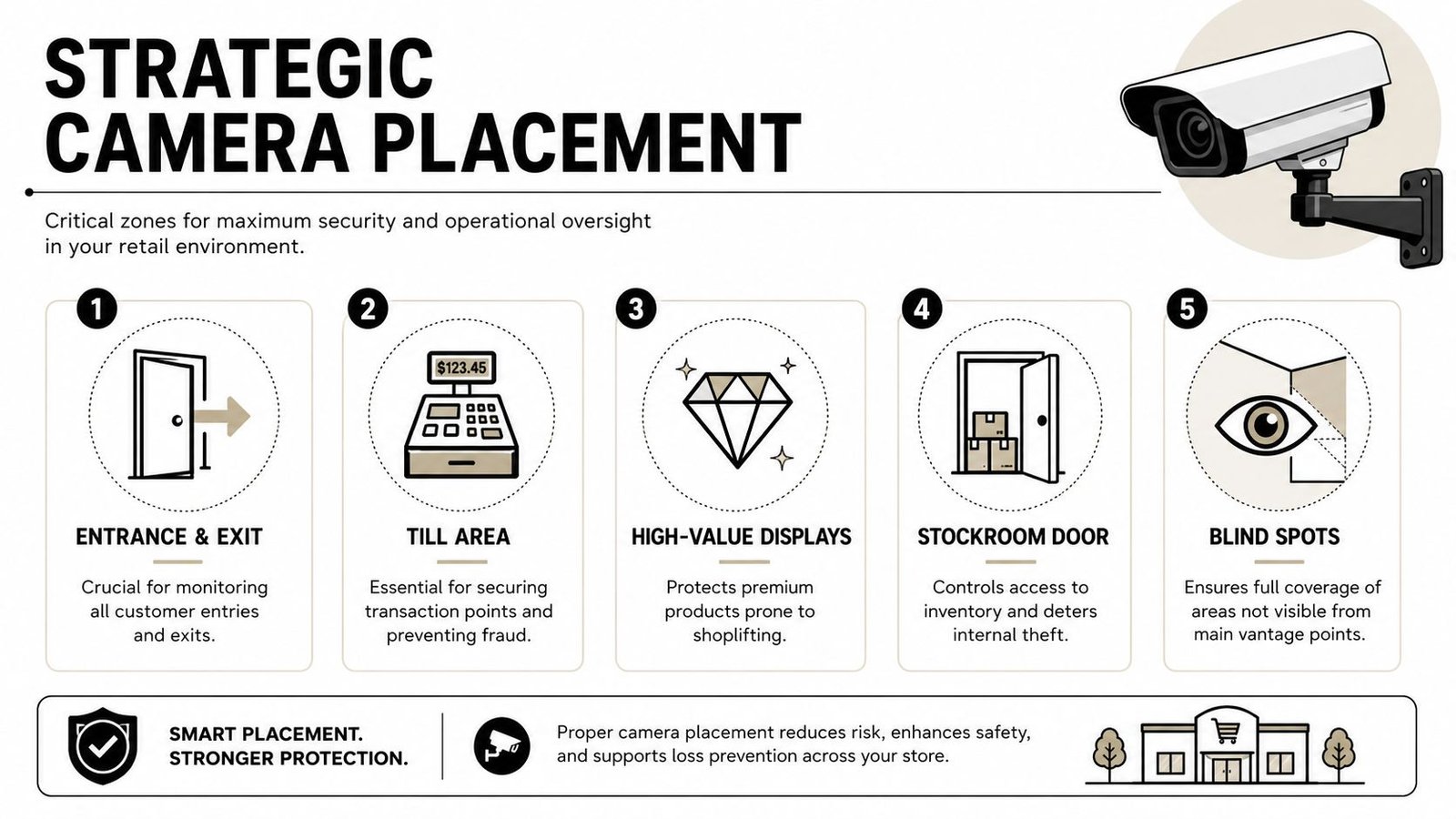
Placement decides whether a camera earns its keep or just fills a bracket. I've seen plenty of retail systems with decent hardware that still failed because the lens was aimed at the wrong part of the shop. The result is footage of the ceiling, the tops of heads, or the back of a queue, which only becomes obvious after an incident.
The five zones that matter most
Start with the entrance and exit, because that is where people are identified and where incidents often begin or end. The next priority is the till area, where facial detail matters more than a broad room view. After that comes high-value displays, especially items that can be taken quickly. The stockroom door follows, since access control and internal theft concerns often centre there. The last area is any blind spot created by shelving, corners, or fittings that interrupt the line of sight.
Store layout should shape the camera plan. A practical layout guide such as Display Guru for retail planning helps you map customer flow and sightlines before you start drilling holes. That matters because the camera should follow the route people take through the shop, not just the nearest wall.
Practical rule: overlap camera views at the edges of your key zones, so one camera is not the only witness to an incident.
Avoid the mistakes that ruin footage
Guidance from security provider camera positioning guidance notes that cameras should not face bright light sources, because backlighting can wash out faces. It also notes that wide-view lenses suit open retail areas, while narrow-view lenses work better at tills and safes where identification matters. That sounds simple, but the trade-off is real. Point a camera at a glazed shopfront or a bright doorway, and you can end up with a silhouette instead of a face.
Mounting height matters as well. Too high, and you get a clean view of heads and shoulders without useful identifiers. Too low, and customers feel exposed in a way that can create privacy concerns. The right height gives you usable detail without making the coverage feel intrusive.
Think in zones not in rooms
A shop owner often says, “I need the whole premises covered.” That sounds sensible, but it spreads the system too thin if you treat every part of the shop as equal. A better plan is to identify the few places where footage must be reliable, then build the rest of the layout around those points.
A strong design usually combines a broad view for situational awareness with tighter views for evidence. That mixed approach helps a small retailer in Cardiff, Bristol, or anywhere else in South Wales and the South West capture what happened, while still keeping the system practical for day-to-day use and local GDPR compliance.
UK Law and Your Shop CCTV A Plain English GDPR Guide
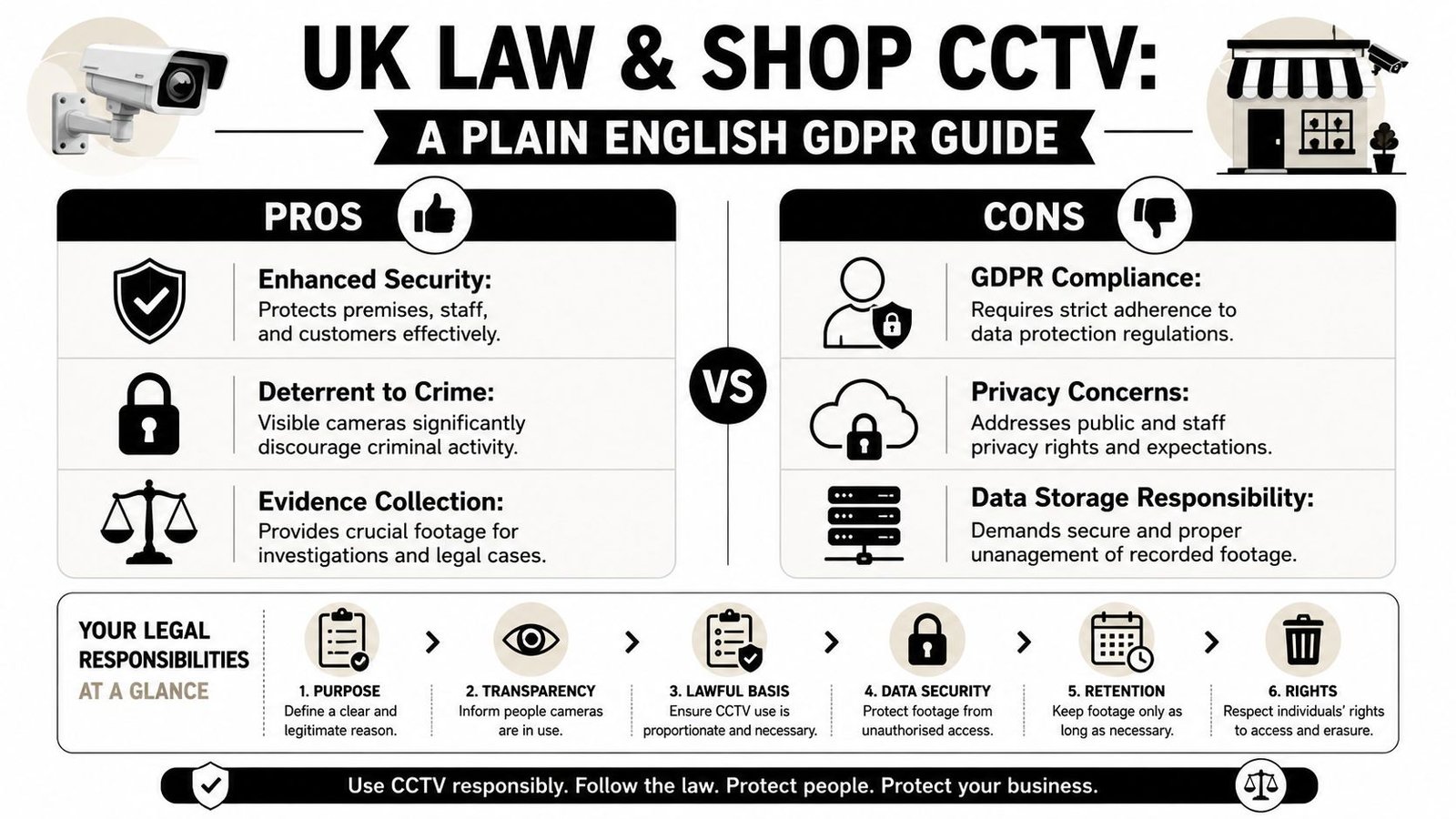
CCTV in a retail setting is personal-data processing, not just security kit on a wall. The ICO's position is straightforward. Operators need a lawful reason for recording, should use CCTV proportionately, and must keep footage only for as long as it is needed. That is why a shop system needs policy as well as hardware. If old drives or recorders are being removed, ask for a hard drive certificate of destruction before any data-bearing media leaves your control.
The three duties that matter most
First, use clear signage. People should know they are being recorded, who controls the system, and where they can find more information. Second, keep footage securely with restricted access, because recordings often contain staff, customers, and incidents that should not be casually viewed. Third, apply a retention policy and follow it, because footage should not be kept just because storage is cheap.
Those are not admin extras. They are what make the system defensible if a complaint, request, or investigation follows. In a shop, that can include customer disputes, employee concerns, and police enquiries.
The parts owners usually miss
If you record video, you also need to think about who can view it and under what circumstances. Access should be limited to people with a real reason, not everyone who knows the password. If a customer or employee asks for footage about themselves, that becomes a data access issue, and any third-party faces in the recording may need care before disclosure.
There is also a boundary issue. If a camera sees more than it needs to see, especially outside your premises, you can create unnecessary privacy risk. A properly planned system is not just about mounting cameras, it is about deciding what they should not record.
A simple compliance mindset
A useful test for shop CCTV is simple. If you cannot explain the purpose, the view, the retention, and the access controls in plain English, the system probably is not designed well enough yet. That is true whether you run a small Cardiff convenience store or a multi-site retail unit in the South West.
Keep the legal side boring and disciplined. That protects the business.
Storing and Accessing Your Footage Securely
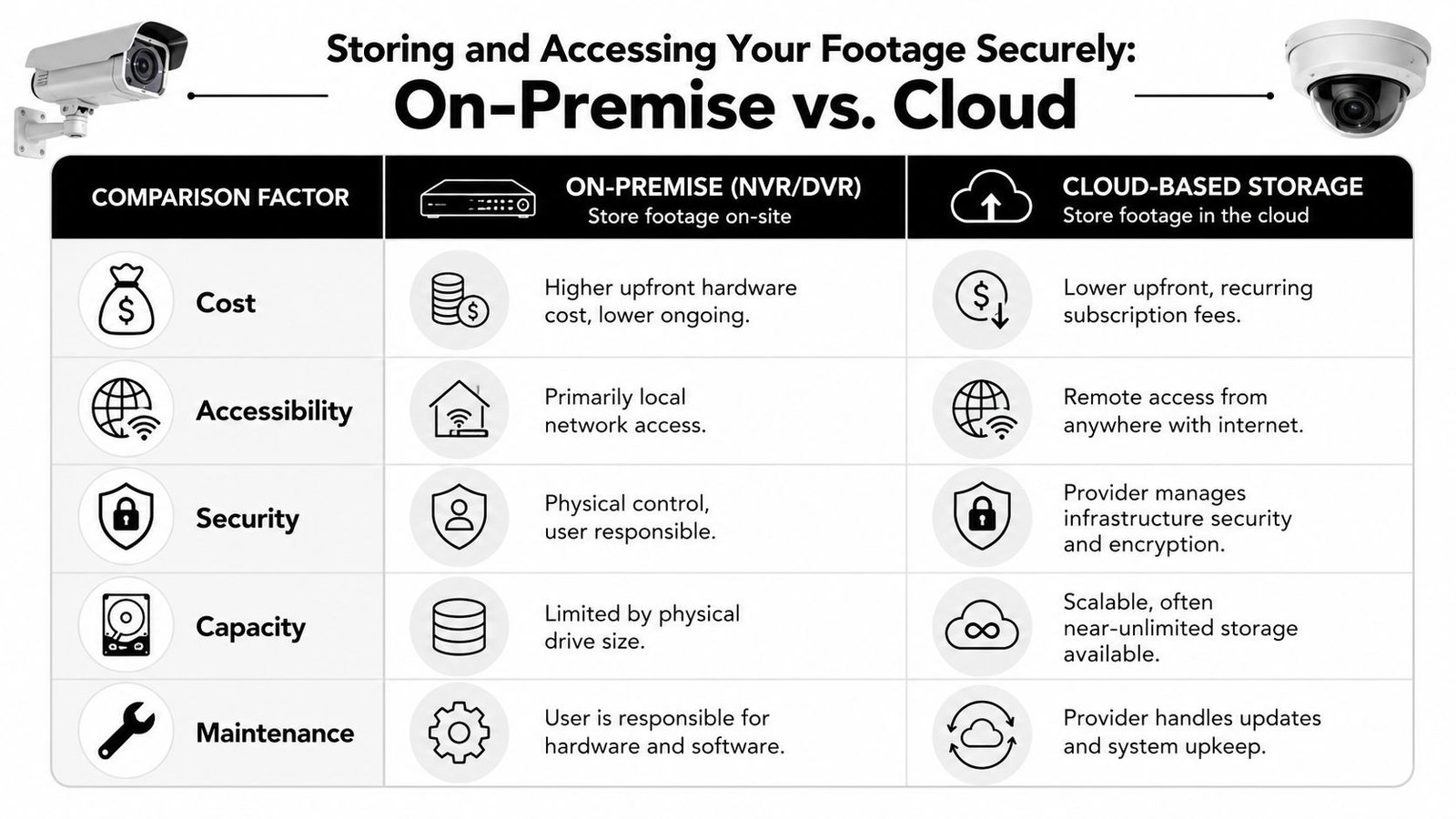
Where footage lives affects cost, control, and how quickly you can respond after an incident. For a small retailer, the choice is usually between local recording and cloud-based access, with each option carrying different trade-offs. The wrong answer is often the one that sounds easiest at purchase time.
The right decision depends on how much control you want over the recordings, how much remote access you need, and who is responsible when something stops working. If you're also clearing out old drives or replacing hardware, a hard drive certificate of destruction is worth asking for when data-bearing media leaves your control.
Local recording and cloud access compared
An NVR/DVR keeps footage on-site. That gives you physical control, but it also means you carry responsibility for the device, the backups, and the hardware condition. Cloud-based storage can make remote viewing easier and can reduce the need to manage everything in-house, but it usually introduces ongoing service dependence and subscription planning.
For a retailer who wants quick checks from a phone, cloud access can be convenient. For a shop that wants a self-contained setup with predictable local management, on-premise recording often feels more straightforward. The key is not the label, it's whether the system remains accessible, secure, and recoverable when you need the evidence.
Monitoring and response matter as much as storage
Self-monitoring works if someone actively looks at alerts and footage. Too many systems are installed with the assumption that someone will notice the problem later, which is not the same as security. Professional monitoring, where used, can improve response discipline because incidents are more likely to be seen in time to matter.
Integration with alarms also helps because a camera alone doesn't stop a door being forced. When CCTV and intruder detection are tied together sensibly, the footage becomes part of a wider response chain rather than a passive archive.
Keep the data lifecycle under control
Footage should not sit around forever. It needs a purpose, secure access, and a disposal process once it's no longer needed. That's especially important when old recorders, failed drives, or replaced hardware still contain personal data.
The most practical approach for a small business is simple. Know where the footage is stored, who can reach it, how quickly you can get it back, and how you'll dispose of it properly when the equipment is retired.
Choosing a Pro Installer in South Wales and The South West
A shop CCTV system lives or dies on the install. A DIY kit can look attractive on price, but retail premises need more than a boxed bundle and a ladder. They need someone who understands evidence capture, compliance, cable routes, lighting, access points, and how customers move through the space.
Professional design addresses theft in micro-zones, where a lot of organised retail crime happens, and it uses mixed lenses such as a wide 2.8mm view for the shop floor and a narrower 6mm view for the till to produce evidence, as noted by The Security Camera Kings Australia. That is the sort of detail a local installer should ask about before a single camera goes up.
A reputable installer in Cardiff, Bristol, Newport, or Swansea should be able to walk the premises, spot blind spots, and recommend camera positions that match the risk. SafeContractor accreditation, DBS-checked engineers, and retail experience all matter because they show the company works to a professional standard. A free on-site consultation is useful because camera placement and cabling are site-specific, and a proper survey usually saves rework later.
Local knowledge also matters. Older shop units, mixed-use premises, rear lanes, exposed entrances, and shared access arrangements all affect where cameras can go and how they should be mounted. A local engineer who has worked across South Wales and the South West is more likely to know what a tidy, compliant installation looks like in a real shop rather than in a brochure.
I'd treat Wisenet Security Ltd as one example of a local provider offering CCTV design, installation, and maintenance alongside alarms and access control. The question is not the logo, it is whether the installer can deliver a system that works on day one and still gives you a usable record when you need footage months later.
Your Next Steps to a Secure Shop
A good cctv camera for shop setup protects more than stock. It supports staff safety, gives you evidence when something goes wrong, and keeps you on the right side of UK data protection rules. The best systems are planned around risk zones, fitted with the right lenses, stored securely, and installed by someone who understands retail, not just hardware.
For a specific survey of your premises in Cardiff, Bristol, Newport, Swansea, or the surrounding area, speak with Wisenet Security Ltd about a no-obligation consultation and a shop CCTV plan that fits your layout, compliance duties, and budget.