Business Fire Alarm Systems: Your 2026 UK Guide
A workplace fire is rarely a single-issue problem. It becomes a safety emergency, an operations failure, an insurance question, and a cashflow shock all at once. In England during 2024/25, fire and rescue services attended 6,665 fires in non-residential workplace buildings, with 12 fatalities, and the average cost of a single major workplace fire incident is £657,074, while the total annual cost to UK businesses exceeds £1 billion according to UK workplace fire statistics.
That's why business fire alarm systems need to be treated as part of business continuity, not a box-ticking exercise. For firms across South Wales and the South West, the right system choice usually comes down to four things: what your building needs, what the law expects, what your insurer expects, and whether the system will still perform properly after years of day-to-day use.
Table of Contents
- Why Fire Safety is Non-Negotiable for Your Business
- Understanding Your Legal and Insurance Obligations
- Choosing the Right Fire Alarm System for Your Premises
- The Fire Risk Assessment Your Starting Point
- Monitoring and Maintenance Your System's Lifeline
- Integrating Fire Alarms with Your Security Systems
- Your Next Steps A Checklist for Local Businesses
Why Fire Safety is Non-Negotiable for Your Business
Small fire incidents cause major disruption long before a loss adjuster gets involved. In commercial buildings across South Wales and the South West, the first sign is often a fault on the panel, an unwanted alarm, or a detector that no longer matches the layout of the premises. Those are operating risks. They interrupt trading, distract staff, and expose a gap between what the building has now and what the business needs.
For many owners, the actual problem is not the absence of a fire alarm. It is the assumption that an existing system is still fit for purpose after a refit, stock change, tenancy change, or extension. I see this regularly. A business passes day to day with a panel on the wall and call points in place, but no one has checked whether the coverage, audibility, cause-and-effect, and maintenance records still stand up to scrutiny.
That matters because fire safety is not only about meeting a legal duty. Insurers often expect more than the bare minimum, especially where there is higher stock value, plant, out-of-hours risk, or a history of claims. A system that looks acceptable on paper can still leave you exposed if it does not reflect the current use of the building.
What owners often get wrong
Many premises have some form of alarm. That does not mean the system is suitable, compliant, and practical to maintain.
The failures are usually predictable:
- Outdated device positions: detectors and call points stay where they were, even after partitions move, racking goes up, or offices are reconfigured.
- Weak alarm coverage: the panel operates correctly, but staff in warehouses, yards, plant areas, or back-of-house spaces do not hear the warning clearly.
- Poor ownership on site: no one is responsible for weekly testing, fault logging, call-out decisions, or checking that false alarms are being addressed properly.
- False confidence: owners assume that because an alarm is installed, the premises are protected to the standard their insurer would expect.
A practical rule applies here. If the building has changed and the fire alarm design has not been reviewed, the system needs attention.
The consequences are wider than fire damage alone. Even a contained incident can halt operations, contaminate stock with smoke, affect servers and electrical equipment, and force difficult decisions about cleanup, salvage, and temporary closure. If you want a clear picture of what recovery can involve after a serious incident, Expert commercial fire restoration shows how quickly the job extends beyond putting the fire out.
Business owners who want to keep pace with current expectations should also follow fire safety compliance guidance for commercial premises. That helps you check whether your system still matches your building, your risk profile, and the standards that often sit behind both enforcement and insurance decisions.
Understanding Your Legal and Insurance Obligations
The fastest way to buy the wrong fire alarm system is to ask only one question: “What's the minimum I need?” That question misses how commercial fire safety works in practice.

What the law actually asks of you
Under UK fire safety rules, businesses must have an appropriate fire detection system and make sure it is adequately maintained. That sounds straightforward, but “appropriate” depends on the building, the risks inside it, how people use it, and what your fire risk assessment identifies.
That's where many owners get tripped up. The law sets the duty. BS 5839 is the practical code used to guide design, installation, testing, and maintenance. It tells competent engineers and responsible persons what a suitable standard of work looks like. It also shapes the inspection regime and the everyday habits that keep a system ready for use.
A good compliance conversation usually covers:
- Your premises use. Office, retail, warehouse, workshop, mixed-use, managed block, or something more specialised.
- Occupancy and escape routes. Who's in the building, when they're there, and how they get out.
- Detection and notification strategy. Where detection is needed and how alarm signals reach people quickly enough.
- Maintenance responsibility. Who tests weekly, who services professionally, and who records issues.
If you're comparing installer credentials or trying to understand recognised alarm standards, this guide to what SSAIB alarm approval means is useful background.
Where insurance expectations go further
The bigger issue for many firms in South Wales and the South West isn't legal duty on its own. It's the gap between legal duty and insurance underwriting.
According to guidance on fire alarm regulations and insurer expectations, UK regulations may require only an appropriate fire detection system, but insurers frequently require full Grade A systems linked to BAFE SP203 compliance to validate claims. Businesses can risk policy invalidation if they install only to the legal minimum and never check the stricter standard their underwriter expects.
That changes how you should buy business fire alarm systems.
A legal minimum can keep you on the right side of regulation. It may still leave you on the wrong side of a claim decision.
This is why I tell owners to speak to their insurer before final sign-off, not after installation. Ask for the alarm specification they expect to see on file. Ask whether monitoring, certification, or a specific category of system is required. Ask whether refurbishments or occupancy changes trigger a policy review.
Even though it's a US market example, the logic behind Orlando business property insurance is still useful because it highlights a universal point. Property insurance decisions turn on documentation, declared risk, and proper protection standards. Fire alarm compliance and insurance compliance aren't automatically the same thing.
Choosing the Right Fire Alarm System for Your Premises
There isn't one “best” commercial fire alarm system. There's only the system that fits the building, the risk profile, and the way the site operates every day.
A small retail unit in Newport doesn't have the same needs as a warehouse in Bristol or a multi-occupancy commercial building in Cardiff. That's why system type matters. If you choose the wrong architecture at the start, maintenance becomes harder, fault-finding takes longer, and future expansion gets expensive.
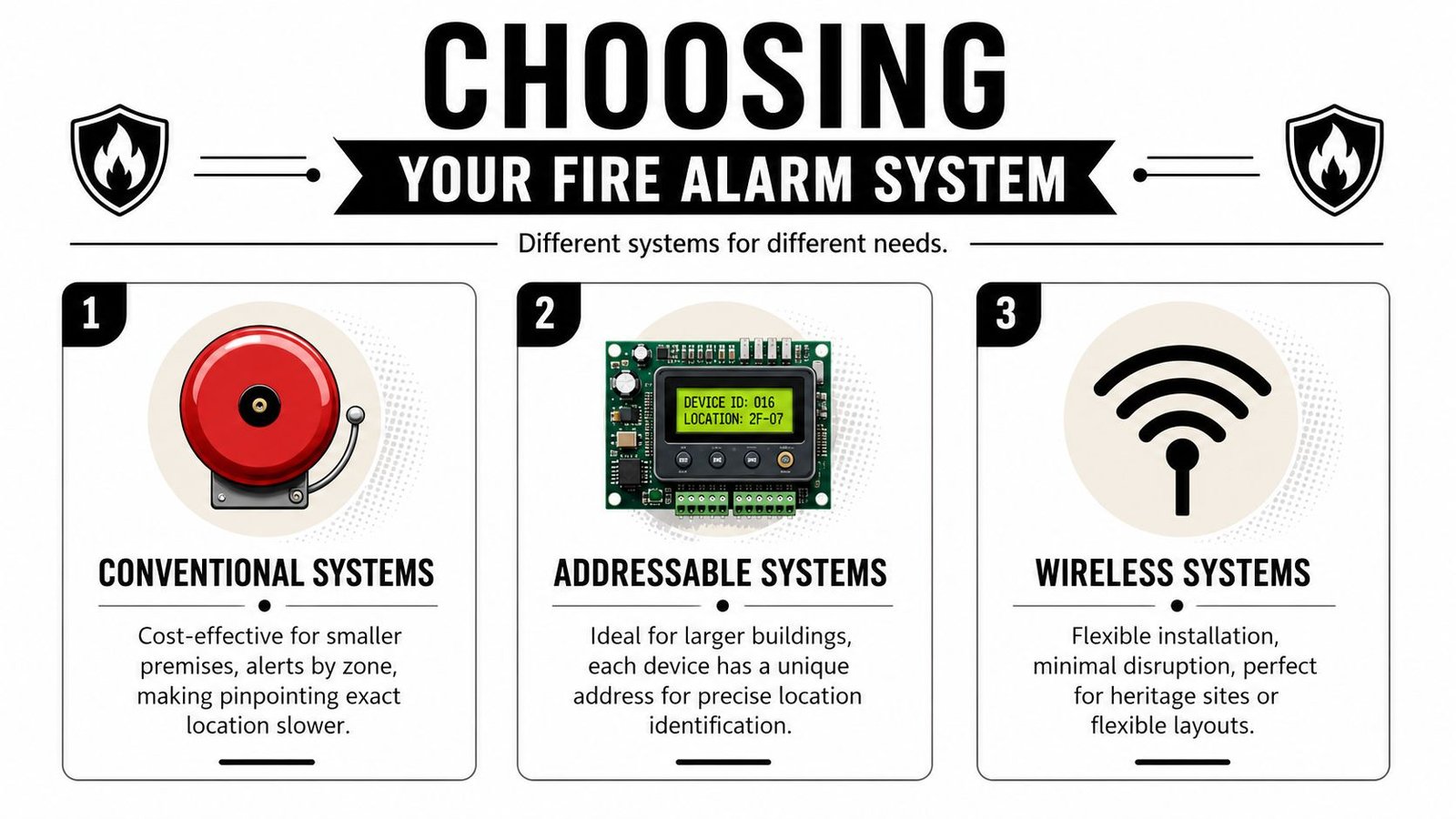
Conventional, addressable, and wireless in plain English
A conventional system is like older Christmas lights wired in sections. If something activates, the panel tells you the general zone, not the exact device. That can work perfectly well in a small shop, office, or straightforward single-floor premises.
An addressable system gives every device its own identity. If a smoke detector activates, the panel can point to that exact detector. In larger or more complex sites, that saves time during evacuations, investigations, and maintenance.
A wireless system removes much of the cabling burden. It's often useful where installation disruption needs to be kept low, where cable routes are awkward, or where the building fabric makes hardwiring difficult.
Here's the practical comparison.
| System type | Best fit | Main advantage | Main limitation |
|---|---|---|---|
| Conventional | Smaller, simpler premises | Lower complexity and straightforward operation | Alarm location is identified by zone, not device |
| Addressable | Larger or more complex buildings | Precise device identification and easier fault-finding | Higher upfront system complexity |
| Wireless | Buildings where cabling disruption is a problem | Flexible installation and easier adaptation | Not every site is equally suitable for wireless design |
For larger sites or businesses expecting growth, it's worth understanding how addressable fire alarm systems work before deciding purely on initial cost.
A short visual overview can help if you're comparing options with colleagues or a landlord.
What good installation looks like on site
The system type is only half the job. Installation quality decides whether the design works when people need it.
Under BS 5839-1:2025, commercial fire alarm systems must achieve a minimum sound pressure level of 65 dB(A) at designated points so occupants can hear the alarm. The same standard also requires each smoke detector to have 500mm of unobstructed space around and below it so smoke can enter without delay, as set out in this commercial fire alarm guide.
Those details matter on real sites:
- Warehouses and logistics units: high background noise can mask weak alarm sounders.
- Stock rooms and mezzanines: stored goods often end up too close to detectors.
- Open-plan offices: partition changes can alter sound coverage and escape behaviour.
- Mixed-use buildings: different occupancies can create blind spots if the original design wasn't updated.
Don't judge a system by the panel on the wall. Judge it by audibility, detector placement, access for servicing, and whether the layout still matches the building you use today.
The cheapest quote often trims exactly the things that matter later. Panel capacity. Device flexibility. Cable routes. Cause-and-effect planning. Future additions. On a live commercial site, those omissions show up fast.
The Fire Risk Assessment Your Starting Point
A fire alarm system shouldn't be chosen from a catalogue first. It should come out of the fire risk assessment.
Too many businesses reverse that order. They pick a panel, compare detector prices, or ask for a quick replacement quote before anyone has properly reviewed the risks in the building. That's how you end up with a system that technically exists but doesn't properly protect the people, processes, or assets on site.
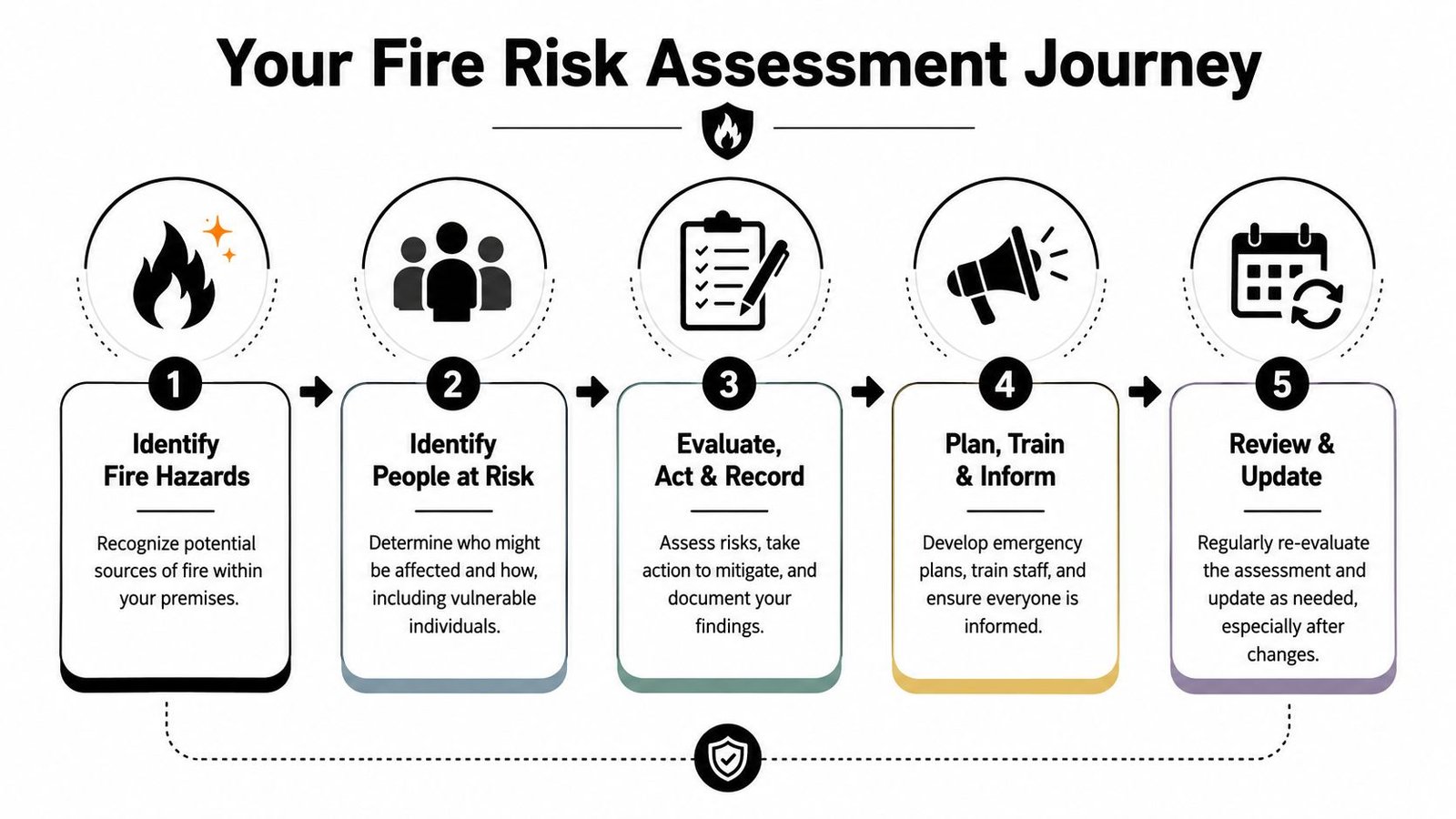
Why the assessment comes before the panel
A sound fire risk assessment does three jobs. It identifies the hazards, it identifies who is at risk, and it points toward the level of detection and warning the premises need.
That matters in practical terms. A small office with simple escape routes has one risk profile. A shared building with plant rooms, storage areas, shuttered exits, or vulnerable occupants has another. A landlord with common areas and multiple tenants needs a different strategy again.
A decent assessment should look at:
- Ignition sources: electrical equipment, cooking, charging points, plant, or process heat.
- Fuel sources: packaging, stock, waste build-up, archived paperwork, or flammable materials.
- People at risk: staff, visitors, contractors, lone workers, and anyone who may need assistance to leave safely.
- Building reality: compartmentation, travel distances, final exits, and what has changed since the last review.
If the fire risk assessment is vague, the alarm design will usually be vague as well.
Making sense of categories
The categories used in commercial fire alarm design can sound technical until you strip them back to their purpose.
L categories are about life protection. They focus on helping people get out safely. The level depends on how much of the building needs detection and how early warning must be given.
P categories are about property protection. They focus on detecting fire quickly enough to limit damage to buildings, stock, plant, and operations.
In simple terms:
- Life-focused systems suit premises where evacuation speed and occupant warning are the main concern.
- Property-focused systems suit premises where business continuity, asset protection, and insurer expectations also shape the design.
- Combined thinking is common in commercial settings because most owners need both people protection and operational resilience.
For businesses in Swansea, Cardiff, Bristol, Newport, and surrounding areas, the right category should come from the assessment first, then be tested against insurer requirements, occupancy, and how the site is run. That order prevents expensive retrofits and avoids the common mistake of installing a system that looks acceptable on paper but falls short under inspection or after a serious incident.
Monitoring and Maintenance Your System's Lifeline
A fire alarm that isn't maintained properly becomes unreliable in predictable ways. Detectors drift out of tolerance. Call points get damaged. Sounders are masked by layout changes. Faults are ignored because the system still appears to be “mostly working”.
That's why maintenance is not an optional add-on to business fire alarm systems. It's part of the system.
Why weekly testing still matters
Routine testing gets neglected more often than owners think. A survey reported by the Fire Industry Association found that one-third of UK businesses fail to test fire alarms weekly as required. The same report states that London Fire Brigade responded to over 52,000 false alarms in 2023/24, which led to a new Call Challenge Procedure to confirm a fire before sending crews to most commercial premises, as outlined in this FIA report on alarm testing and false alarms.
That has changed the practical reality for businesses. You can't assume an automatic attendance in every case. If your staff don't know the alarm procedure, if no one investigates sensibly, or if recurring faults are left unresolved, you create risk on both sides. You increase nuisance disruption and reduce confidence in genuine activations.
A sensible weekly routine should include:
- A different call point in rotation: this confirms devices and panel indication are functioning.
- A clear log entry: record date, time, result, and any issue found.
- Staff awareness: people should know a scheduled test is happening and what signal to expect.
- Immediate escalation of faults: if something fails, it shouldn't wait for the next service visit.
What proper servicing should cover
Professional servicing is where latent issues are found before they become operational failures. Under current guidance in the verified data, professional servicing should take place every six months, with a flexible 5 to 7 month window accepted under BS 5839-1:2025, and the work should be done by competent technicians, as described in this guide to BS 5839-1:2025 updates.
That same source states that all fire alarm wiring for the mains supply in UK commercial premises must use fire-resistant cable, and that these cables maintain circuit integrity for a minimum of 60 minutes during fire exposure. It also notes that non-compliant cable types have historically failed much sooner under fire conditions. On site, that's the difference between a system that continues supporting evacuation and one that drops out when the environment deteriorates.
A proper service visit should never be treated as a box to sign off quickly. It should include inspection, functional testing, fault review, device condition checks, and a hard look at whether the system still matches the building's current use.
Site reality check: if the building has changed and the alarm design hasn't, maintenance alone won't fix the underlying problem.
There's also a difference between bells-only systems and monitored systems. A bells-only setup warns people on site. A monitored connection adds another layer by passing signals to an Alarm Receiving Centre. For an occupied office in business hours, bells-only may be adequate if the risk assessment supports it. For higher-risk premises, out-of-hours sites, or buildings where continuity matters, monitoring often makes far more operational sense.
Integrating Fire Alarms with Your Security Systems
Standalone systems can do the basic job. Integrated systems usually offer superior performance.
When a fire alarm operates in a commercial building, the alarm signal shouldn't exist in isolation if the site also has access control, CCTV, intercoms, or emergency lighting. The best setups use those systems together so the building responds as a coordinated whole rather than a collection of unrelated products.
Where integration adds real value
The clearest example is access control. In a fire event, designated doors can release automatically to support evacuation and improve access for emergency responders. That reduces delay and removes the risk of people meeting a locked route during an urgent exit.
CCTV integration is just as useful. When an alarm activates, the relevant camera views can be checked quickly so keyholders or responsible persons can understand what's happening in the affected area. That doesn't replace emergency action, but it does improve situational awareness.
Other useful integrations include:
- Emergency lighting support: linked systems help keep escape routes usable when visibility is poor.
- Remote notifications: managers and keyholders can receive alerts without relying on someone on site to relay events.
- Intercom and entry management: front-of-house or gated areas can be managed more effectively during evacuation.
- Cause-and-effect programming: specific actions can follow specific inputs, rather than every activation creating the same response.
Integrated design also makes day-to-day management cleaner. Staff learn one coherent procedure. Site managers get clearer event information. Engineers can diagnose interactions between systems rather than trying to untangle separate platforms after an incident.
For business owners with multi-tenant sites, managed buildings, or higher-value premises in South Wales and the South West, integration often makes the difference between basic compliance and a reliably workable emergency response setup.
Your Next Steps A Checklist for Local Businesses
The right next move isn't always a full replacement. Sometimes it's a review, a category check, a monitoring upgrade, or a maintenance reset. What matters is making decisions in the right order.
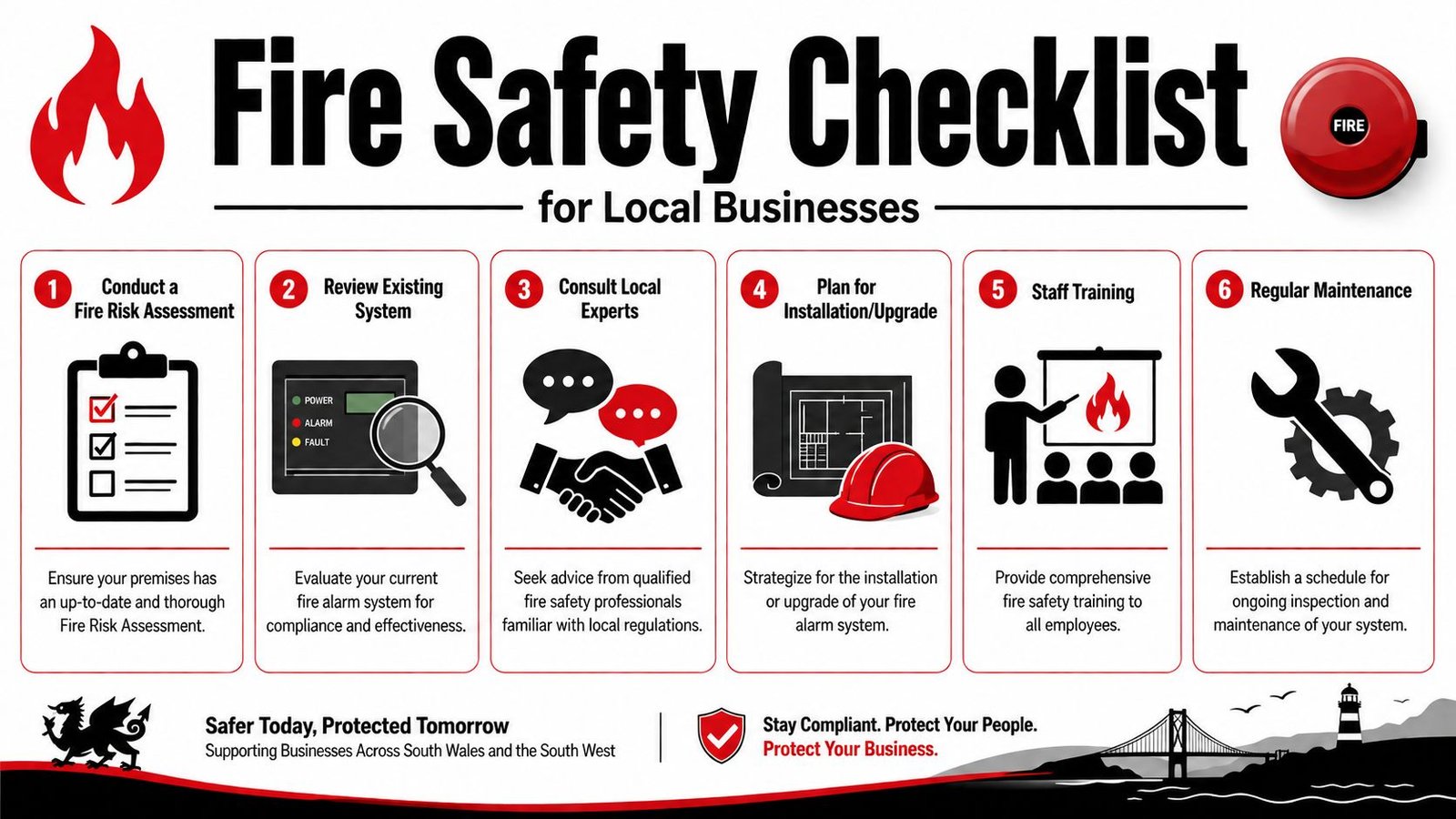
For businesses in South Wales and the South West, this is the practical checklist to work through:
- Update your fire risk assessment. If the building layout, occupancy, or use has changed, start there.
- Check your insurance position. Confirm whether your underwriter expects more than the legal minimum.
- Critically review the existing system. Ask whether audibility, detector locations, panel capacity, and monitoring still suit the building.
- Arrange a professional site survey. A proper survey should look at the premises as it operates now, not as it was originally built.
- Verify competence and certification. Don't rely on the cheapest quote if the installer can't show recognised standards and suitable experience.
- Set testing and staff procedures. Weekly testing, fault reporting, and evacuation responsibilities should be clear before an emergency happens.
- Plan maintenance in advance. Don't wait for faults, nuisance alarms, or insurer queries to force the issue.
A good fire alarm project is rarely about buying more kit. It's about matching risk, compliance, insurer expectations, and practical site use. When those line up, the system becomes easier to manage, easier to trust, and far more likely to perform properly when it matters.
If you need clear advice on business fire alarm systems in Cardiff, Bristol, Newport, Swansea, or the surrounding areas, Wisenet Security Ltd can help with a no-obligation consultation. Their team designs, installs, and maintains commercial fire alarm systems as part of wider integrated security solutions, so you can review compliance, system suitability, monitoring, and long-term maintenance with one local specialist.