Burglar Alarms Cardiff: Secure Your Home or Business
If you're looking at burglar alarms Cardiff options, you're probably already at the point where generic advice isn't enough. You may have moved into a new house, had a near miss with a side gate or garage, taken on a retail unit, or realised your current alarm is old enough that nobody really trusts it anymore. The usual questions come fast. Wired or wireless. Bell-only or monitored. Will the insurer accept it. And if something happens at night, who responds.
That last question matters more than most buyers expect. A burglar alarm isn't just a box on the wall with a siren attached. It's a decision about detection, signalling, response, maintenance, and paperwork. In Cardiff, the right answer depends as much on property type and insurer conditions as it does on the kit itself.
For homes, the issue is usually confidence and practicality. For shops, offices, landlords, and small industrial sites, it quickly becomes a compliance question too. The difference between a system that makes noise and one that fits the risk properly can show up later, when you're dealing with a claim, a fault, or an out-of-hours activation.
Table of Contents
- Why Cardiff Homeowners Are Upgrading Their Security
- Wired vs Wireless and Smart Alarms Explained
- Bells-Only vs Monitored Alarms What's the Difference
- Meeting Insurer Demands with BS EN 50131 Standards
- What Do Burglar Alarms Cost in Cardiff
- What to Expect from Your Wisenet Installation
- Frequently Asked Questions About Cardiff Security
Why Cardiff Homeowners Are Upgrading Their Security
A common Cardiff scenario is simple. Someone buys a house with an old alarm panel by the front door, a couple of yellowed PIRs in the hallway, and no clear record of what still works. The outside bellbox may or may not be live. There may be no app access, no service history, and no confidence that the system would signal anyone if it triggered at 2am.
That uncertainty is pushing people to upgrade. It's not only about fear of burglary. It's about wanting a system that fits how the property is used now. People work from home, leave parcels in porches, convert lofts, rent out rooms, and rely on mobile alerts when they're away.

There is a broader trend behind that shift. Statista's home security trend data shows households with home security installations in the recorded series reached 9,592 in 2018/19, up from 8,507 in 2017/18 and 8,131 in 2014/15. For Cardiff buyers, that matters because it shows alarm adoption wasn't a passing reaction. It was already moving steadily upward.
Why people stop delaying the decision
Some wait until after an incident nearby. Others act when they realise the weak points in their own layout.
- Rear access gets ignored: Alleyways, garden gates, side returns, and conservatory doors often create the primary entry concern.
- The old system can't be trusted: If nobody knows the engineer code, battery age, or detector condition, the alarm becomes decoration.
- Remote awareness matters now: Buyers want to know what happened, not discover it hours later.
Practical rule: If you can't say who receives an activation, how it's signalled, and whether the system is maintained, you don't yet have a complete security plan.
For Cardiff homes and smaller businesses, the most sensible upgrade isn't always the most feature-heavy package. It's the one that detects early, signals reliably, and matches the way the building is occupied.
Wired vs Wireless and Smart Alarms Explained
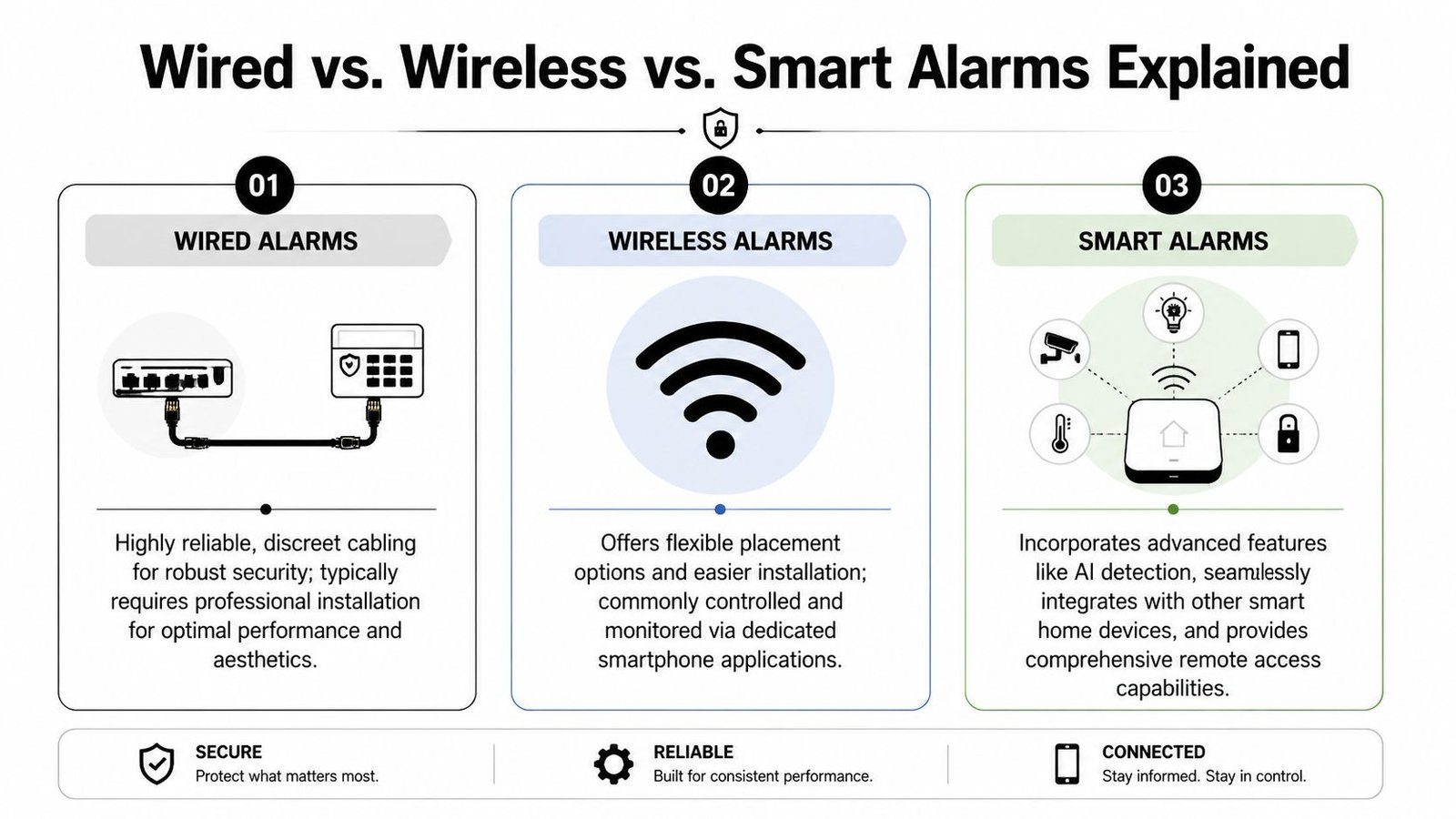
The easiest way to think about alarm types is this. Wired systems use fixed cabling between the panel and devices. Wireless systems use radio communication between devices and the panel. Smart alarms are usually wireless or hybrid systems that add app control, alerts, and remote management.
The differences matter less on a brochure than they do in a real building. A Victorian terrace in Pontcanna, a newer family house in the suburbs, and a mixed office-warehouse unit will each reward a different approach.
How each system behaves in a real property
Wired alarms are often the right fit where cabling can be installed cleanly. New builds, major refurbishments, and some commercial sites suit them well. Once installed properly, device locations are stable, and you don't have the same battery replacement pattern as a fully wireless setup.
Wireless alarms are often the practical answer for retrofits. If you don't want carpets lifted, walls chased, or decoration disturbed, wireless can solve that quickly. For homes, rental properties, and many small businesses, that's often the tipping point.
Smart alarms are about control and visibility. They appeal to people who want app notifications, remote arming, and status checks from anywhere. But smart doesn't automatically mean more resilient. As this Cardiff intruder alarm guide notes, buyers increasingly want smartphone alerts and remote arming, yet reliability depends on signal quality, battery management, and whether the site can support 4G backup or dual-path signalling.
A useful parallel sits outside alarms. If you use networked cameras or connected security kit, default credentials and weak setup create avoidable risk. That's why practical resources such as the OctoStream blog on Dahua logins are worth reading when you're reviewing any connected security device.
Before deciding, it helps to see the systems in action:
What usually works best in Cardiff buildings
There isn't a universal winner. There is a better fit for each property.
| Alarm type | Usually best for | Main trade-off |
|---|---|---|
| Wired | New builds, refurbishments, stable commercial layouts | More installation disruption |
| Wireless | Existing homes, rented properties, quicker retrofits | Ongoing battery management |
| Smart | Users who want app control and mobile alerts | Depends more on connectivity planning |
A smart alarm without resilient signalling is convenient, not necessarily dependable.
A few buying rules hold up well:
- Choose wired if the building work is already open and you want discreet permanent infrastructure.
- Choose wireless if speed, cleaner installation, or minimal disruption matters most.
- Choose smart features carefully: remote access is useful, but only if the system is set up to cope with outages and weak signal areas.
Bells-Only vs Monitored Alarms What's the Difference
Many buyers make the wrong comparison. They spend ages choosing between wired and wireless, then treat response as an afterthought. In practice, response often matters more than the panel type.
A bells-only alarm activates local sounders. It aims to deter, attract attention, and push an intruder out quickly. A monitored alarm sends signals off-site so a receiving centre or nominated contact can act on the activation.
What happens when the alarm activates
With bells-only, the immediate result is noise on site. That may be enough for some homes, especially in a busy street with close neighbours. But if the property is detached, unoccupied for long periods, or commercial, the limits show up fast. Someone still has to hear it, care about it, and decide what to do.
With monitoring, the response path is more structured. Activation data goes somewhere specific, and the next action depends on the service arrangement. That may mean keyholder contact, verification, or escalation under the agreed setup. If you're comparing options, this guide to how a monitored alarm system works gives the operational side that many sales pages skip.
Bells-only systems deter. Monitored systems add accountability to the response chain.
Who should choose which
A bells-only system can make sense when:
- The property is occupied most nights: someone is likely to hear and react quickly.
- You want a lower-complexity setup: no ongoing monitoring arrangement, fewer service dependencies.
- The main goal is visible deterrence: external sounders and local activation still have value.
A monitored system is usually the better fit when:
- The site is empty for stretches of time: offices, stockrooms, holiday absences, and landlords' voids all fall into this category.
- You need a documented response path: especially where keyholders, staff, or managing agents are involved.
- Insurer expectations are stricter: the system may need more than a siren to satisfy policy conditions.
For many Cardiff businesses, monitored alarms are less about gadget appeal and more about operational realism. If a unit is shut overnight in an industrial estate, local noise alone may not solve much. The right question isn't “will it make a sound?” It's “who gets the signal, and what happens next?”
Meeting Insurer Demands with BS EN 50131 Standards
People often ask whether an alarm will reduce insurance costs. The more important question is whether the insurer will accept the specification, installation, and maintenance in the first place. That's where BS EN 50131 comes in.
This standard is the practical framework UK intruder systems are commonly specified to. It isn't marketing language. It affects grading, device choice, signalling method, and whether the system matches the risk of the premises. A clear overview is in Wisenet's page on what EN 50131 means for alarm systems.

What the grades mean in practice
This local alarm standards reference outlines the grading framework clearly. Grade 1 is for low-risk domestic use. Grade 2 is for homes and small commercial sites. Grade 3 is for higher-risk commercial premises. Grade 4 is for very high-risk sites.
That means a family home in Cardiff, a corner shop, and a warehouse shouldn't be fitted from the same template. Detector grade, communication path resilience, and confirmation logic need to reflect what is being protected and when the building is occupied.
A few practical examples help:
- House or small office: Grade 2 is commonly the starting point.
- Retail with stock risk or repeated out-of-hours vacancy: system design may need stronger signalling and tighter zoning.
- Higher-risk commercial site: grade and communications usually need more deliberate planning.
Why compliance matters at claim time
A lot of disappointment happens after a theft, not before it. The owner thought they were covered because “there was an alarm”, but the insurer wanted evidence of correct grading, maintenance, or a specific response arrangement.
The wider theft backdrop shows why insurers stay focused on conditions. The ONS-linked summary on Cardiff burglar alarm insurance considerations notes that the Crime Survey for England and Wales estimated 1.7 million theft incidents in the year ending March 2024, while police-recorded burglary still ran into the hundreds of thousands nationally. That doesn't tell you what to buy on its own, but it does explain why insurers care about standards and service history.
If you rent rather than own, related insurance details matter too. Questions around contents valuation and policy wording are often misunderstood, so guidance on securing full replacement cost for tenants can help you line up the alarm side with the insurance side.
Insurance reality: a compliant alarm is not just hardware. It includes the right grade, the right records, and the right maintenance trail.
What Do Burglar Alarms Cost in Cardiff
Price matters, but raw headline pricing can mislead. The meaningful figure is the installed cost for a system that fits the building properly. A cheap quote with the wrong detector count, weak signalling, or no thought to entry routes often costs more later when upgrades and call-backs begin.
Typical Cardiff pricing
A useful local benchmark comes from Checkatrade's Cardiff burglar alarm cost listings. It lists average costs of £525 for a bell-only wireless alarm, £500 for a bell-only wired alarm, and £650 for a smart alarm system, based on two sensors and one door contact. It also lists installer hourly rates of £60 to £80 in Cardiff.
That gives you a grounded starting point, not a universal quote.
| System Type | Average Installed Cost |
|---|---|
| Bell-only wireless alarm | £525 |
| Bell-only wired alarm | £500 |
| Smart alarm system | £650 |
What changes the final quote
The benchmark above is based on a modest setup. Real projects move up or down depending on the building.
- Layout complexity: long hallways, split levels, extensions, detached garages, and awkward entry points change detector requirements.
- Signalling choice: app control, backup communication, and monitored paths add capability and cost.
- Labour time: access difficulty, cable routes, and making good all affect the final installation time.
For commercial buyers, it's often useful to compare security spending across asset types. Not because a vehicle tracker quote tells you what a building alarm should cost, but because it helps frame how hardware, fitting, and service combine into a total ownership cost. This breakdown of the total investment for vehicle security systems is a good example of that wider budgeting mindset.
A sensible Cardiff budget starts with the property risks, not the cheapest advertised package. If the rear door, side access, and downstairs circulation route aren't covered properly, saving a little on the quote doesn't buy much protection.
What to Expect from Your Wisenet Installation
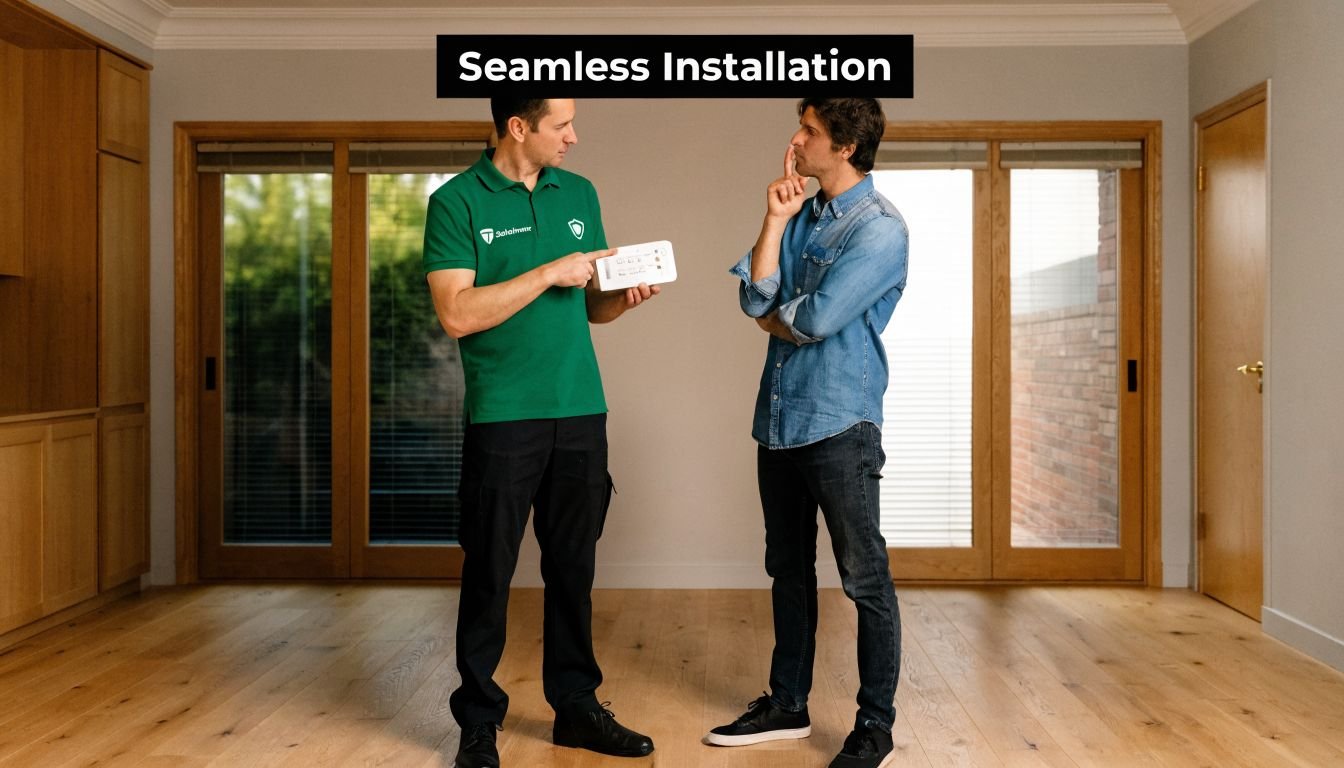
A good installation starts before any device goes on the wall. The first visit should feel more like a survey than a sales pitch. The engineer needs to understand how you enter and leave, which doors are used, whether pets roam at night, where blind spots sit, and what the insurer expects from the system.
If you're comparing local providers, the practical service outline for security system installation in Cardiff shows the sort of installation process you should expect to see set out clearly.
Survey and system design
The design stage is where strong systems separate themselves from generic ones. A properly engineered alarm should combine perimeter detection first, then interior confirmation, helping reduce false alarms while still catching entry early. This Cardiff intruder alarm reference also notes that for homes with pets or high-traffic retail premises, pet-tolerant PIR selection and zoning are critical because false alarms are usually caused by poor detector placement rather than the control panel.
In practice, that means the survey should identify:
- Likely first entry points: front door, rear door, patio doors, accessible windows, side passages.
- The movement route after entry: hallways, stairs, store access, or stock areas.
- Environmental issues: draughts, heat sources, glazed areas, pets, and busy internal routes.
This is also the stage where a provider such as Wisenet Security Ltd may specify a customized mix of intruder alarm devices, monitoring options, and maintenance support for Cardiff homes or business premises, rather than relying on a fixed package.
Installation day and handover
On the day itself, tidy work matters. So does communication. You should know where devices are going, what each zone does, how to set part-armed modes, and what happens if a detector or communication path faults.
A proper handover should include:
- System demonstration: set, unset, part set, alarm memory, and user routines.
- User guidance: which doors need consistent use, how to avoid false activations, and what to do after a trigger.
- Documentation: codes, contact process, service details, and maintenance expectations.
The best-installed alarm is the one the occupier actually understands and uses correctly every day.
For households with dogs, children, cleaners, or irregular schedules, this handover is not a minor detail. It's the difference between a system that protects the property and one that gets left unset because nobody trusts it.
Frequently Asked Questions About Cardiff Security
Do wireless alarms work well enough
Yes, in many properties they do. Wireless is often the most practical route for existing homes and light commercial sites where disruption needs to stay low. The important part is not whether it's wireless. It's whether the device placement, signal path, and maintenance plan are sensible.
What if the internet or power fails
This depends on how the system was designed. Some setups rely too heavily on one communication route. A better design considers backup signalling, panel power resilience, and what the user wants to happen during an outage. If outages are a realistic concern at your property, raise that before the quote is written.
Can one system cover a flat block shop or mixed-use property
Often yes, but not as a one-size-fits-all layout. Mixed-use buildings usually need clearer zoning, user permissions, and a stronger plan for common areas, private areas, and out-of-hours access. Shops with upstairs storage, landlords with communal entrances, and small office blocks all benefit from a proper site survey before anyone talks about package pricing.
Will a bells-only alarm be enough
Sometimes, but it depends on occupancy and location. If neighbours are close, the site is usually occupied, and the goal is strong deterrence, bells-only may be perfectly reasonable. If the property is empty for long periods or insurer conditions are tighter, monitored signalling is often the safer choice.
Do pets always cause false alarms
No. Poor design causes most of the trouble. Pet-tolerant detectors, the right mounting position, and proper zoning usually solve the issue far more effectively than changing the control panel.
Should I replace an old alarm or upgrade it
That depends on whether the existing cabling, panel, and detectors are still fit for purpose. Some older systems are worth upgrading. Others become false economy once reliability, support, and insurer expectations are taken into account.
If you're weighing up burglar alarms Cardiff options and want a system that matches the property, the insurer requirements, and the likely response reality, Wisenet Security Ltd is one local option to speak to. They install and maintain intruder alarm systems across South Wales, including Cardiff, with bell-only and monitored setups, BS EN 50131-aligned installations, and site-specific design for homes, shops, offices, and larger premises.