

What Is Motion Detection and How It Protects Property
Motion detection is a system that spots movement by sensing changes in heat, sound, microwaves or video pixels, then turns that change into an alert or recording trigger. In the UK, 75% of people reported that they didn't have motion sensors to detect intruders at home, so this important security capability still isn't standard in most properties. Direct Line Group's UK consumer survey
You're woken at 2am by a phone notification. A camera has detected movement near the side gate, but the notification doesn't tell you whether it's a person, a fox, rain on the lens or a branch moving in the wind. At a warehouse, the same basic event might switch on aisle lighting, start recording, notify a monitoring centre or trigger an alarm.
That's the practical meaning of motion detection. A sensor or camera notices a change, applies rules to that change and passes a result to another system. The result might be record, alert, ignore, activate lighting or request verification.
Understanding the difference between those stages matters. A sensor can detect movement without knowing whether the movement is a genuine intruder. A camera can identify a person without automatically deciding that the person is unauthorised. Reliable protection comes from connecting detection, decision-making and response into a carefully configured chain.
Table of Contents
- Introduction to Motion Detection in Modern Security
- How Motion Detection Actually Works
- Comparing Motion Sensor Types and Their Trade Offs
- Where Motion Detection Adds Real Value
- Setting Up Motion Detection and Reducing False Alarms
- Integrating Motion Detection with CCTV Alarms and Access Control
- Legal Privacy and Local Installation Guidance with FAQs
Introduction to Motion Detection in Modern Security
A motion detector is often treated as a small component hidden on a wall or inside a camera. In practice, it can be the event that wakes up an otherwise passive security system. Without a trigger, a camera may record continuously or follow a schedule. With a trigger, it can focus attention on activity that needs checking.
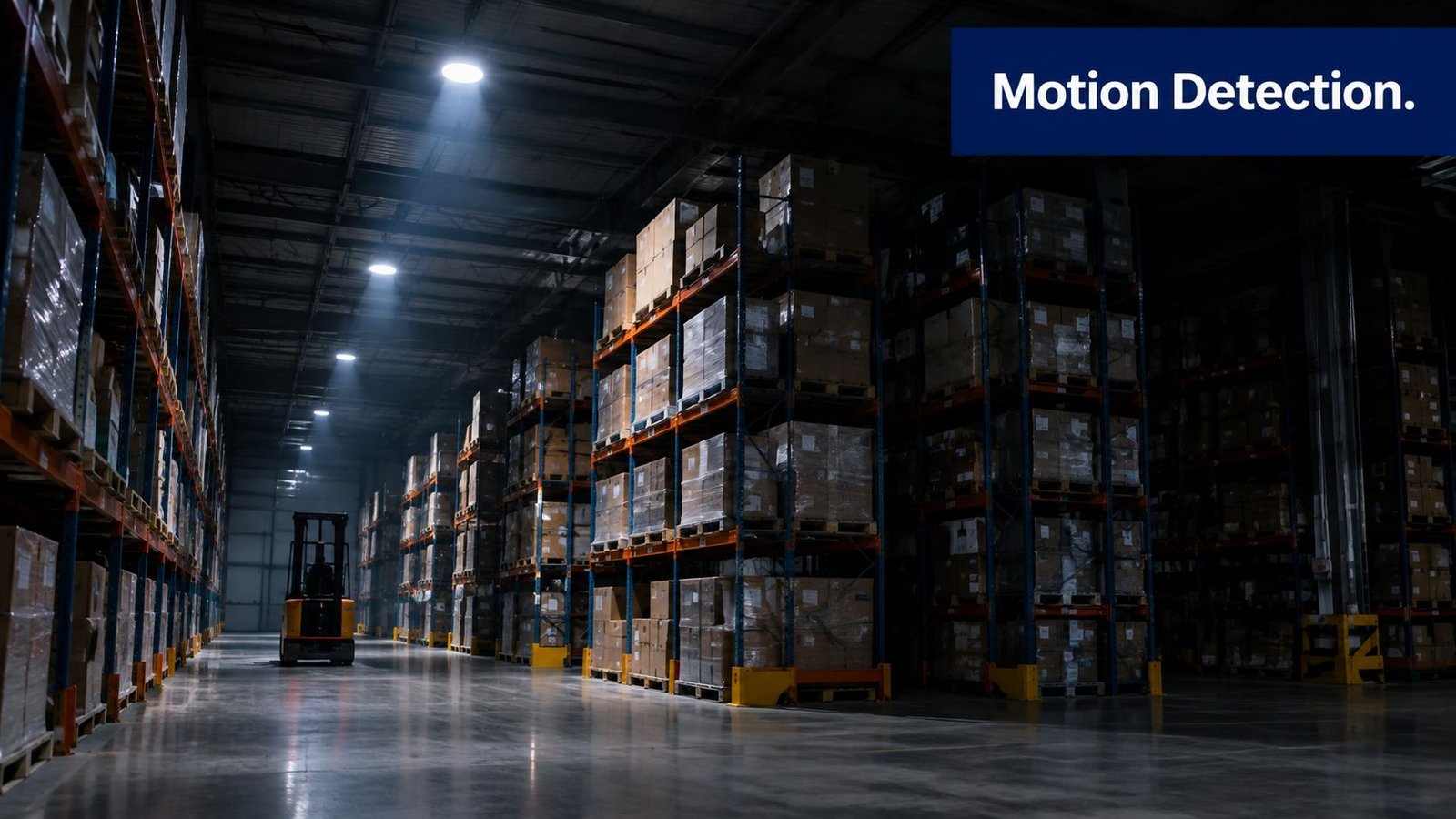
Consider a forklift moving through a dark warehouse aisle. A basic video system may see changing pixels as the vehicle passes between storage racks. A PIR sensor may detect the heat pattern of a person driving it. A more advanced camera may classify the object as a vehicle, apply an after-hours rule and send an alert only if it enters a restricted zone.
The same principle applies in a home. Movement near a rear door can trigger a light, prompt a camera to record and send a mobile notification. In a small shop, movement behind a counter outside trading hours can begin a verification sequence. In a shared building, activity in a plant room can be recorded for review without sending an alert every time someone uses the main entrance.
The useful mental model
Think of motion detection as a chain with four questions:
- What changed? Heat, reflected microwave energy, sound patterns or image pixels.
- Where did it change? Inside a detection zone, across a doorway or near a boundary.
- What caused the change? A person, vehicle, animal, weather condition or unknown object.
- What should happen next? Record, notify, illuminate, alarm or ignore.
The first question belongs to the sensor. The later questions depend on configuration, camera analytics, alarm logic and human verification. This is why a well-installed system can feel calm and useful, while a poorly positioned one can produce notifications that people quickly learn to dismiss.
The rest of the subject becomes easier once you separate sensing movement from confirming an event. The hardware detects a physical or visual change. Software and alarm rules decide whether that change meets the threshold for action. Installation determines whether the system is looking at the right area in the first place.
How Motion Detection Actually Works
Start with the simplest idea. A motion detector doesn't usually recognise a complete story. It notices that conditions in a monitored area have changed. The technology behind the detector determines which type of change it measures.
Passive infrared detection
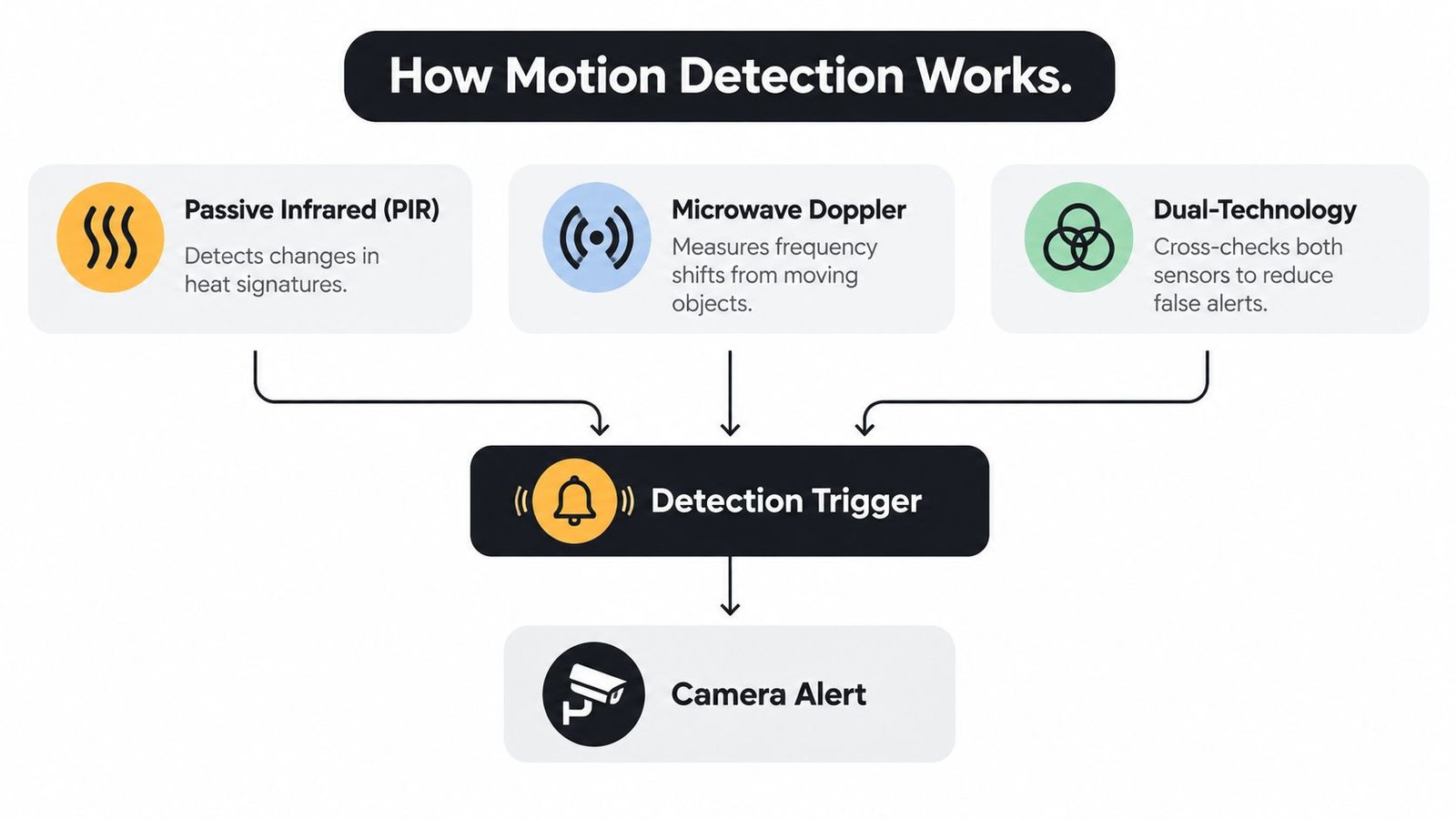
A PIR sensor detects changes in infrared radiation, which is associated with heat emitted by people and other objects. It doesn't transmit a signal. Instead, it watches for a changing heat pattern, rather like noticing a warm shadow crossing a doorway.
A moving person usually produces a stronger, more structured change than a static background. PIR detection works particularly well indoors, but its performance depends on the sensor's position and its relationship with heat sources, windows, heaters and airflow. A UK PIR manual gives an example operating envelope of up to 12 metres at a 2.5 metre mounting height with a 180-degree field of view, while warning that heaters, sunlight, windows and strong airflows can increase false alarms. The PIR sensor operating guidance
Microwave and ultrasonic sensing
A microwave detector transmits energy and measures changes in the returned signal. Movement changes the frequency or characteristics of that return, creating an invisible detection field similar to a radar tripwire. Microwave systems can cover areas that are awkward for PIR, although their sensitivity can allow movement outside the intended zone to influence detection.
Ultrasonic sensors use high-frequency sound waves and monitor how those waves return from nearby surfaces. They're more common in controlled indoor applications because reflections and moving objects can complicate the result.
Dual technology and video analytics
A dual-technology detector combines two sensing methods, commonly PIR and microwave. The system can require both technologies to agree before it creates an alarm event. That cross-check can reduce nuisance alarms in areas where one sensing method alone would be vulnerable to environmental change.
Video motion detection takes a different route. The camera compares image regions over time, then may apply rules for direction, zone, object size or object type. Modern analytics can distinguish categories such as a person or vehicle, but classification still depends on camera angle, lighting, image quality and sensible configuration. Readers looking at vehicle-focused systems may also find it useful to find fleet telematics AI tools, while broader guidance on how AI CCTV systems improve security explains how analytics can support verification.
Practical rule: Detection tells you that something changed. Verification tells you whether that change deserves a response.
Comparing Motion Sensor Types and Their Trade Offs
Choosing a motion technology is less about finding one universally superior sensor and more about matching the detector to the environment. A PIR can be a sensible choice for a stable indoor hallway. A camera with object analytics may suit a car park where people, vehicles, shadows and headlights share the same view.
| Technology | How It Detects | Best For | Key Limitation |
|---|---|---|---|
| PIR | Changes in infrared heat patterns | Indoor rooms, alarm zones and controlled approaches | Sensitive to installation conditions and heat changes |
| Microwave | Changes in reflected microwave energy | Wider areas and locations needing active sensing | Can detect movement outside the intended area |
| Dual technology | Agreement between two sensing methods | Higher-confidence alarm zones | More complex specification and commissioning |
| Beam sensor | Interruption of a defined invisible beam | Gates, corridors, perimeters and access routes | Needs careful alignment and a clear path |
| Video motion detection | Changes in image regions and configured video rules | CCTV recording, visual verification and open areas | Affected by scene complexity, lighting and poor settings |
A homeowner protecting an entrance may value simple indoor coverage, low power use and pet-aware alarm design. A car park manager has a different problem. The system must handle headlights, weather, vehicles and pedestrians while recording useful evidence. In that setting, camera analytics can provide visual context, but the operator still needs well-defined zones and object rules.
Microwave can help where PIR placement is difficult, though its wider sensing behaviour requires disciplined boundary setting. Dual technology can be useful where nuisance alarms carry a high operational cost, but it won't compensate for a sensor aimed at a heater or a camera pointed towards a busy road.
Privacy also affects the choice. A standalone alarm sensor reports an event without creating a visual record. CCTV can provide evidence and verification, but it may capture neighbours, visitors or shared areas. A property manager therefore needs to consider not only detection performance, but also camera positioning, access to recordings and retention practice.
For systems that depend on networked cameras or connected devices, it's also worth assessing how guest Wi-Fi camera integration fits the site's access and network arrangements. The right choice is the one that produces meaningful events in the actual environment, not the one with the longest feature list.
Where Motion Detection Adds Real Value
At home, motion detection often works in the background. A camera covering a side path can remain in a low-attention state until someone approaches the gate. The system can then illuminate the route, record the approach and send a notification, giving the homeowner visual context rather than a silent camera archive to search later.
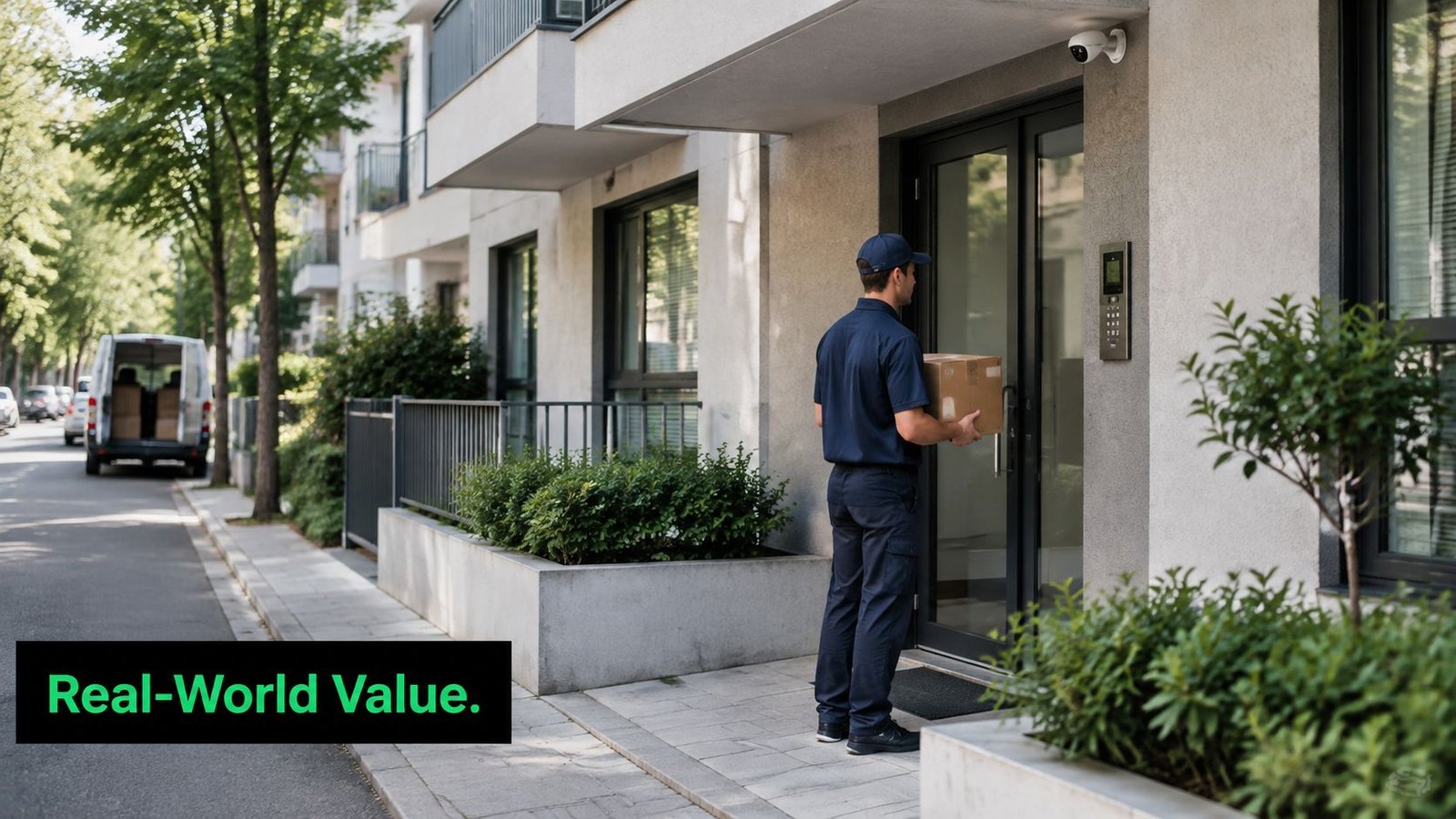
A delivery driver at a shared entrance creates a different event from someone entering a restricted stairwell. In a block of flats, camera zones and access control can separate those activities. Motion detection can support recording at the entrance while a door event or movement in a protected area prompts a more urgent alert.
Small businesses and retail premises
A shop manager may want recording during opening hours but immediate notification for movement behind the till after closing. The system can apply a schedule, define a restricted zone and link the event to a mobile alert or monitoring workflow. This avoids treating every customer crossing the shop floor as a security incident.
In an office, motion can also support practical operations. A room camera or sensor can activate lighting, record activity near a server room or help facilities staff investigate an out-of-hours visit. The value comes from connecting detection to a clear action.
The warehouse from the opening example shows why context matters. A forklift in a loading area may be expected during a shift but unusual at night. Video analytics can help distinguish people and vehicles, while a separate alarm zone can protect doors, stock rooms and plant areas.
A useful event is not simply “movement detected”. It's “a person entered this restricted area during an active schedule”.
Open car parks are more challenging because the scene changes constantly. Headlights, rain, shadows, birds and passing traffic can all create visual movement. Properly configured zones can focus attention on pay stations, gates, disabled bays, loading areas or building entrances instead of treating the entire image as equally important.
The same principle helps landlords and facilities managers. Motion detection can support a layered response across communal doors, refuse stores, plant rooms and external paths. The owner can decide which areas should record and which should create an alert.
The following video illustrates how motion-led CCTV systems can support visual verification in a practical security setting.
Setting Up Motion Detection and Reducing False Alarms
False alarms usually come from a mismatch between the sensor and the scene. A detector aimed at a road, a camera exposed to low winter sunlight or a PIR placed beside a heater is being asked to interpret conditions it wasn't designed to handle.
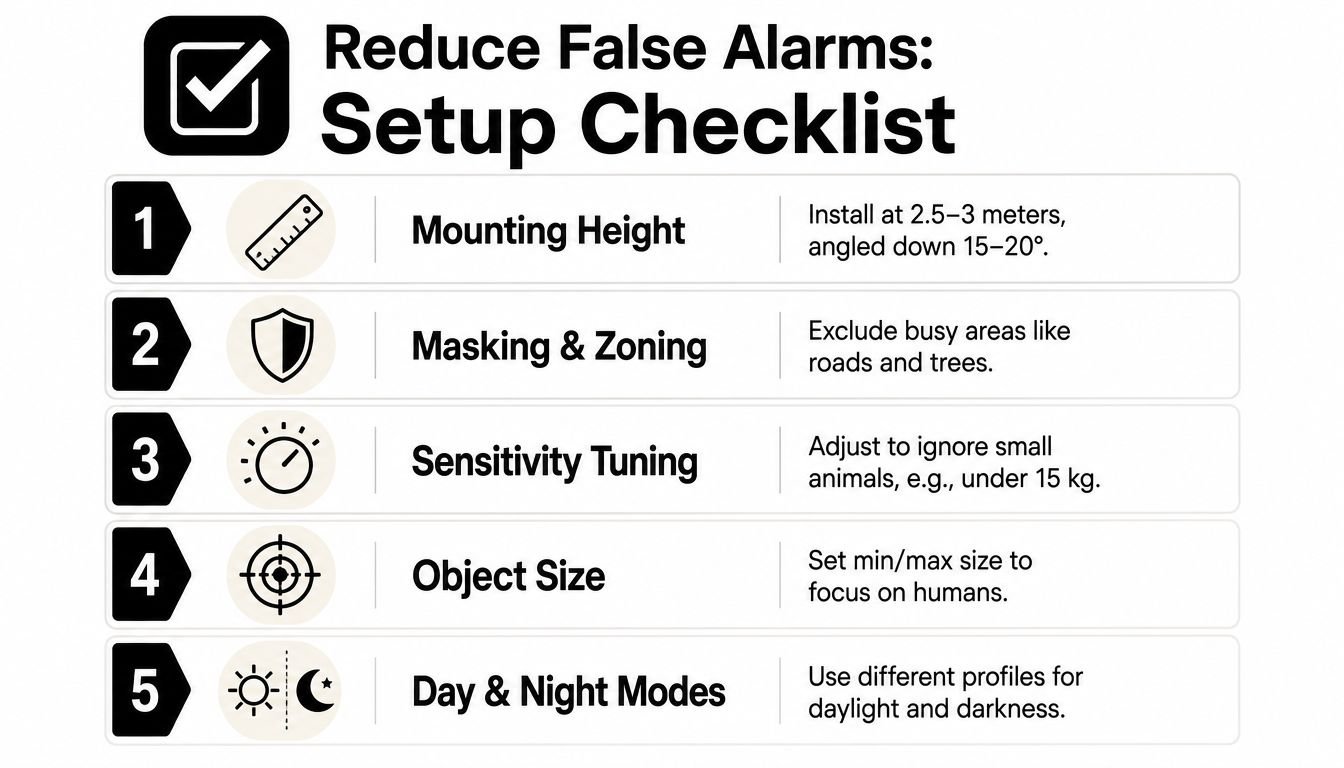
Begin with geometry
The mounting position determines what the detector sees and how movement crosses its field. For a PIR, movement across the detection pattern is generally more useful than movement directly towards it. Avoid pointing sensors at heaters, windows, strong airflow, reflective surfaces or unstable vegetation.
Outdoor cameras need particular care in British conditions. Rain on the lens, moving shadows, headlights, swaying trees, birds and insects can all create nuisance events. A local security report identifies rain, shadows, headlights, vegetation, birds and poor default settings as common causes of unwanted triggers, while also showing a gap between having video motion capability and configuring it effectively. The UK CCTV motion detection report
Tune the scene, not just the slider
Sensitivity is only one control. Use activity zones to exclude roads, trees, open sky and neighbouring property. Set object-size rules so tiny movements don't receive the same treatment as a human-sized subject, then test the system during daylight, darkness, rain and vehicle activity.
For an outdoor camera, separate day and night profiles can be useful. Headlights may need different handling after dark, while strong sunlight can create changing shadows during the day. Keep a record of adjustments so another installer or facilities colleague can understand what changed.
A security-grade alarm system also needs proper alarm logic. UK intrusion-detection guidance says a single disturbance, such as a spider crossing a detector or a window opened by wind, must not create a confirmed alarm. It also says enhanced or high-rated installations should use masking detection, and that a person shouldn't be able to cross more than 3.0 metres across the detection area without generating an alarm. The UK intrusion-detection guidance
Use this commissioning checklist:
- Check the view: Remove obstructions and exclude unstable backgrounds.
- Confirm the angle: Make sure the detector covers the intended approach, not a busy road or open sky.
- Set zones: Define where movement matters and mask irrelevant areas.
- Adjust object rules: Focus on meaningful subject sizes rather than every pixel change.
- Test conditions: Review events in daylight, darkness and poor weather.
- Review notifications: If alerts aren't actionable, refine the rule before increasing sensitivity.
Homeowners considering animals should also review pet-immune motion sensors with an installer, because pet immunity depends on the sensor design, animal behaviour and room layout.
Integrating Motion Detection with CCTV Alarms and Access Control
A motion event becomes useful when the alarm, camera and access system interpret it together. A PIR detector can signal the alarm panel, which checks whether the system is armed, applies confirmation rules and communicates with monitoring equipment. A camera can record the same area before and after the trigger, giving an operator visual context.
CCTV analytics can also generate the first event. A camera may identify a person crossing a virtual line, begin higher-quality recording and notify a phone or control room. The alarm panel can receive a defined event instead of treating every change in the image as a confirmed intrusion. That behaviour depends on the system design, configuration and certification.
Access control supplies identity and permission. A valid staff fob at an entrance can explain movement that would otherwise appear unusual. Movement inside a locked plant room without a matching authorised access event warrants closer attention. Facilities teams can compare these events with user logs and time-based rules, although compatible equipment and careful commissioning are required.
System design principle: One sensor notices activity, another source adds context, and a defined response determines what happens next.
The chain is regulated in the UK. BS EN 50131 covers intrusion and hold-up alarm systems, PD 6662 provides the UK application standard, and BS 8243 addresses installation and confirmed alarm conditions. UK guidance states that newly installed remotely monitored systems installed since June 2019 must conform to PD 6662:2017 and BS 8243:2021. Detector-activated CCTV used for police response is associated with BS 8418. These requirements affect how detectors, cameras, signalling and monitoring work as one certified arrangement.
Commercial sites also need a clear plan for recording, retention, access, bandwidth and resilience. Guidance on video security architecture and storage helps facilities managers assess those requirements before adding cameras or increasing recording quality.
A documented commissioning test should then confirm each hand-off. Trigger movement in a protected zone, verify the alarm state, check the related camera clip, match any access event and confirm that the intended notification reaches the correct person. Security system integration provides further context on connecting these systems and checking their responses.
Legal Privacy and Local Installation Guidance with FAQs
A motion event can be harmless, but a camera may record identifiable people beyond your property. Position cameras to cover only the necessary area, avoid views into neighbouring homes or gardens, display clear signage where appropriate, and limit access to recordings. Property managers should document who may review footage, the purpose of that access, and the retention period.
Privacy is only one part of responsible installation. In the UK, a detector begins a regulated chain: it identifies a presence, sends an alarm signal, and may trigger camera verification, monitoring or a defined response. Grading, installation, signalling and monitoring can affect police response arrangements, insurer requirements and professional certification. UK alarm standards developed from earlier national arrangements into harmonised European standards on 1 October 2005, with later UK updates in 2017 and 2021. The UK alarm standards overview explains the framework for purchasers.
For a home, shop, warehouse or car park in South Wales or the South West, request a building survey rather than a quote based only on sensor numbers. The installer should examine approach routes, lighting, weather exposure, neighbouring views, network connectivity, alarm grading, access control and maintenance. These details determine whether detection works reliably in the building's actual conditions.
A professional survey also clarifies what happens after an alert. Ask how the system distinguishes a likely nuisance event from a confirmed incident, who receives notifications, and how faults are recorded. Documented testing, user permissions and scheduled maintenance matter particularly where monitored response or insurer recognition is required.
Common questions
Does bad weather make motion detection unreliable?
Outdoor CCTV can produce nuisance events during rain, strong wind, moving vegetation, reflections and changing light. Reduce them through camera placement, detection zones, masking and separate day or night profiles. Weather-resistant equipment supports reliable operation, but commissioning still needs to test local conditions.
Can a pet trigger a motion sensor?
Yes. The outcome depends on the sensor, the animal, the room and the detection pattern. Pet-friendly equipment can reduce unwanted alarms, but the installer should test likely routes and keep the sensor away from places where an animal can approach it closely.
When should I use a professional installer?
Choose professional installation for monitored alarms, standards-based systems, multiple technologies, external coverage, access control or dependable operation across a business site. Request documented tests, clear permissions, maintenance arrangements and an explanation of how each alert becomes a response.
Wisenet Security Ltd designs, installs and maintains CCTV, intruder alarms and access control for homes, businesses, warehouses, property managers and car parks across South Wales and the South West. Visit Wisenet Security Ltd to discuss motion detection around your building, its weather conditions and your response requirements.