

Pet Immune Motion Sensors Explained for UK Homes
The alarm goes off at 2am, the monitoring centre calls back, and by the time everyone realises it was only the family dog walking downstairs, nobody's getting back to sleep. That's the reason pet immune motion sensors exist, not as a fancy upgrade, but as a way to keep a home armed when pets are part of everyday life. In British homes, especially where cats and dogs move through hallways, stairs, and living rooms, the difference between security and nuisance can be one badly placed detector.

Table of Contents
- Why Pet Alarms Drive Most False Alerts
- How PIR and Dual-Tech Detection Work
- The Engineering Behind Pet Immunity
- Placement Rules That Actually Hold Up at Home
- When Pet Immunity Stops Working
- Common False Alarms and How to Fix Them
- Standards, Grades, and Why BS EN 50131 Matters
- When to Call a Professional Installer
Why Pet Alarms Drive Most False Alerts
A family in a terraced house arms the alarm before bed. The dog wanders out of the kitchen, crosses the landing, and the panel sounds within seconds. The monitoring centre calls, the owner answers half asleep, and the whole house is awake while everyone checks doors, windows, and the app.
That's the moment most homeowners first understand the point of pet-immune detection. A standard PIR is built to react to motion and heat changes, which is useful for spotting an intruder, but it doesn't naturally know the difference between a person and a cat on a sofa. The goal of pet-friendly technology is simple, it reduces nuisance activations while still catching human movement, so you can arm the system with pets inside the property.
Why this matters in British homes
This isn't a niche problem. In Great Britain, around 31% of households owned a dog and 29% owned a cat in 2024, so pet-friendly detection is relevant to a very large share of homes rather than a specialist corner of the market, according to the UK government's animal ownership statistics cited in the brief. That matters in places like South Wales and the South West, where a lot of family homes, flats, and terraces are lived in by people who don't want to choose between protection and peace.
The historical shift in the UK was from simple PIR detection to filtered, application-specific detection logic. Installers now treat pet immunity as a normal domestic feature, not an add-on, because modern households expect motion detection to work around cats, dogs, sofas, staircases, and all the other things a real home contains.
Practical rule: if you want the alarm armed when pets are home, the detector has to be configured for that life, not for an empty showroom.
How PIR and Dual-Tech Detection Work
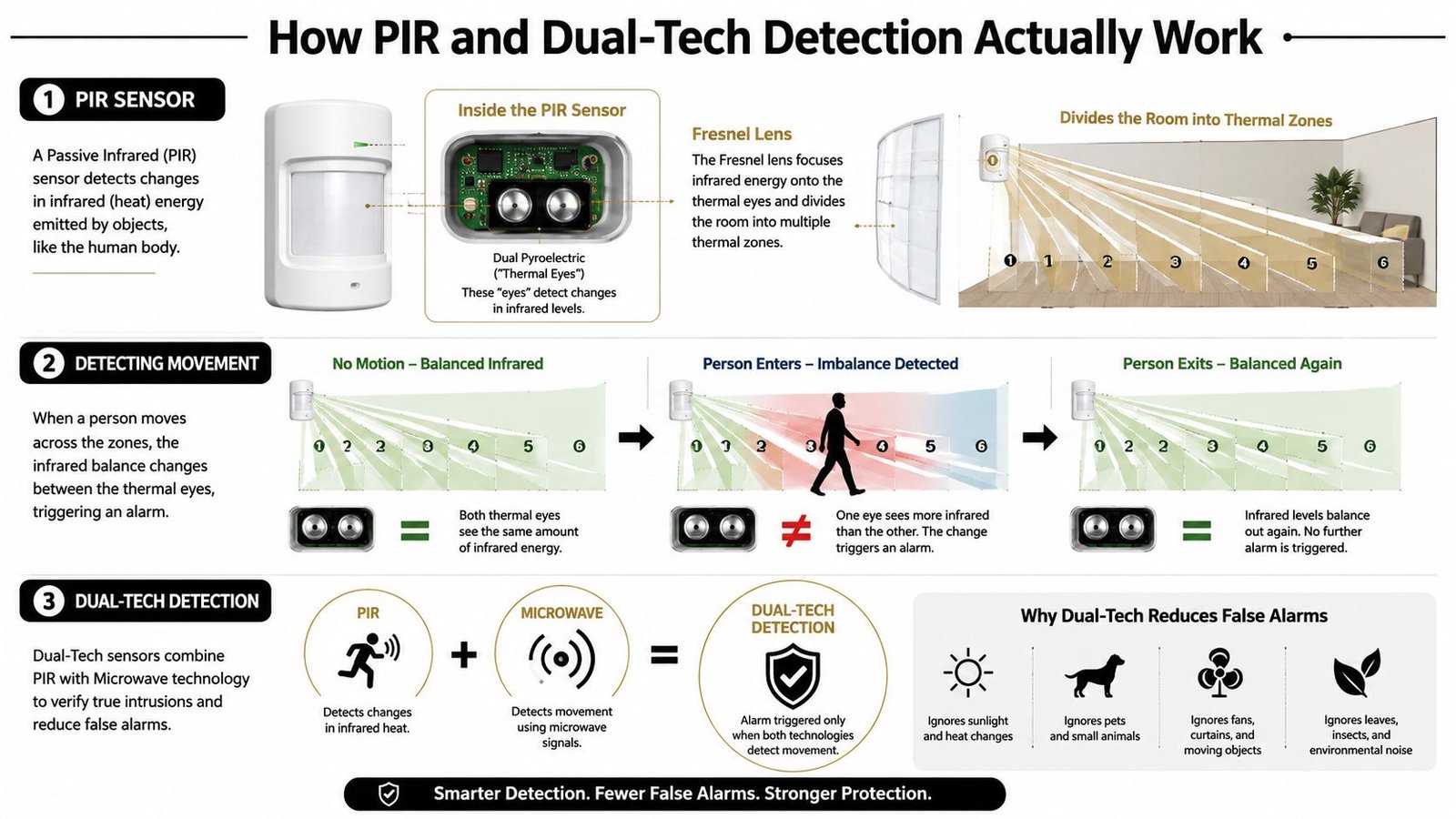
A PIR sensor works like a pair of thermal eyes. It does not “see” a room the way a camera does, it watches infrared changes across zones created by the Fresnel lens. When a warm body crosses from one zone to another, the balance tips, and the detector decides movement has happened.
That makes a PIR easier to understand as a thermal seesaw. If the room looks still but a person walks across the beam pattern, the infrared picture shifts from one part of the sensor to the next. A pet can trigger the same response if it is large enough, climbs furniture, or moves through the wrong part of the room.
Why a second channel helps
Dual-tech detection adds a second witness. The PIR channel sees heat and movement, while the second channel, usually microwave, has to agree before the alarm fires. One sensor is asking, “Did something warm move?” and the other is asking, “Did the movement look real enough to count?”
That extra confirmation is why dual-tech units are often chosen for harsher spaces such as garages, conservatories, or rooms with more background movement. It does not make them magic. It does make them more selective, which is what you want when temperature shifts, drafts, or odd room shapes make a basic detector too twitchy.
Here's how they differ: a single-tech PIR is fast and efficient, but it can be fooled more easily by the room and by placement. A dual-tech detector waits for agreement before it triggers, so it is slower to respond but better at reducing nuisance activations in awkward spaces.
You can also see how installers think about the wider system in 8 key types of intruder alarms for 2026. It helps frame motion detection as one part of the whole setup, not the whole answer.
To see the logic in action, watch the way a motion sensor divides a room into zones and reacts when a person crosses them.
The Engineering Behind Pet Immunity
Pet immunity isn't one setting buried in a menu. It's a combination of beam geometry, mounting height, lens design, and signal processing. The detector is built to ignore low movement close to the floor while still catching a person walking through the protected area, which is why the manufacturer's installation position matters so much.
A useful UK-oriented example is the guidance that the detector is positioned so it ignores smaller animals near the floor while detecting a person at about 3.5 metres, with the pet-immune zone extending to roughly 7.5 metres in the cited example Jablotron guidance. That's the important idea, the sensor isn't just “pet proof”, it is looking for a specific pattern of movement in a specific space.
Why height and angle can make or break it
Manufacturer specs show how much installation affects performance. The Vi-Pet is rated for animals up to 27 kg (60 lb) and has a current drain of 9 mA at 12 VDC, which tells you it's designed as a low-power, permanently supervised wired PIR Johnson Controls product data. The weight limit sounds straightforward, but it only holds when the detector is mounted and aimed exactly as intended.
Pet immunity is a blend of where the detector looks and how it interprets what it sees, not a single toggle you switch on and forget.
Digital temperature compensation matters too. When a room warms up, the difference between a moving body and the background can shrink, so the detector needs signal processing that stays stable as ambient conditions change. Multi-beam Fresnel optics help by shaping the field of view into usable zones instead of one blunt open area.
This is also why a detector rated for a large pet can still misfire if it's pointed at stairs, furniture, or any route where an animal can climb into the active detection band. The label on the box is only half the story. The other half is where the beam lands in your house.
Placement Rules That Actually Hold Up at Home
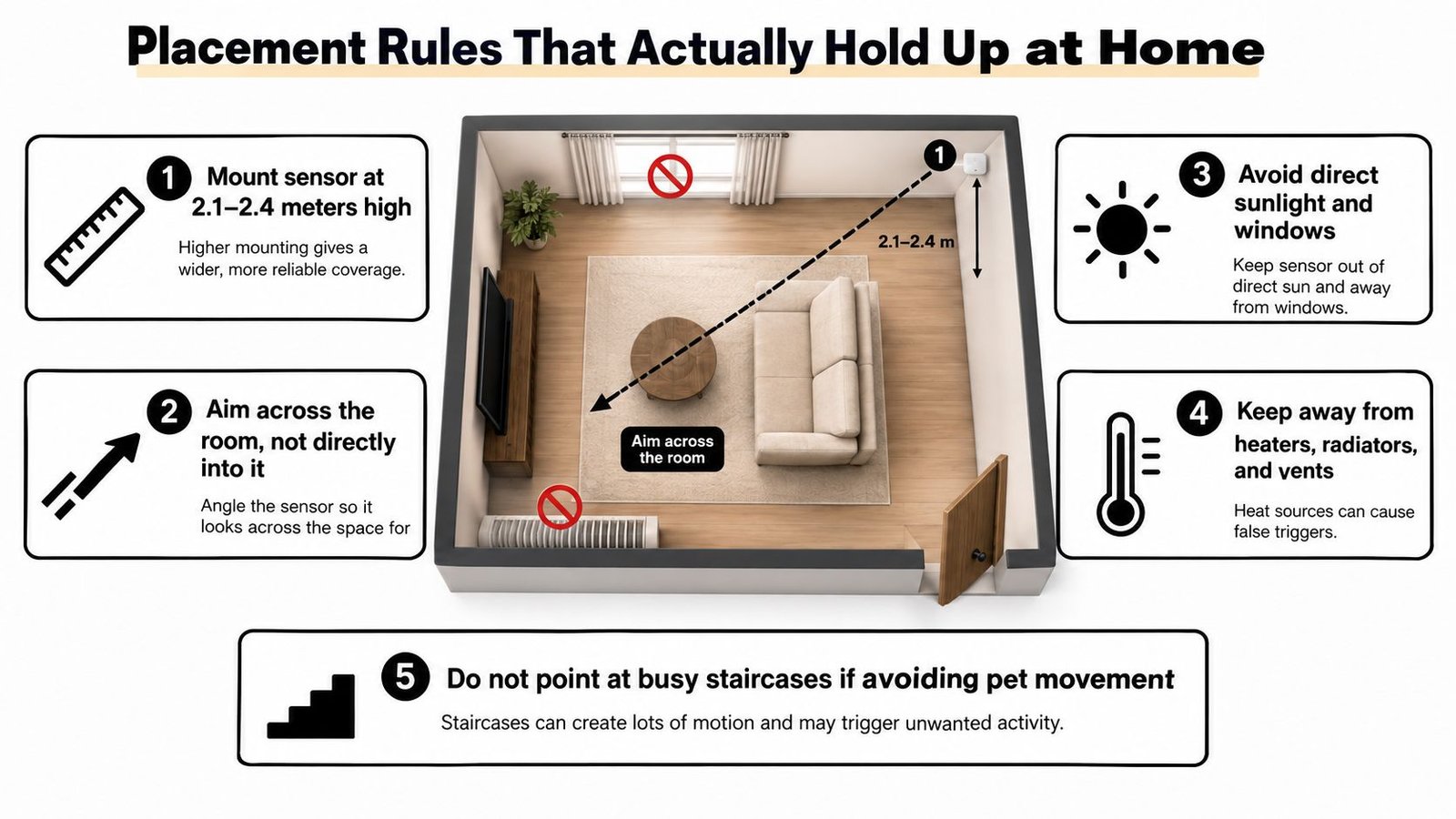
A detector sees a slice of the room, not the whole room. If you aim that slice the wrong way, a cat on the back of a sofa or a dog on the stairs can enter the active zone even if the sensor itself is technically “pet immune”. That's why installers think about movement paths, not just walls.
The basic rule is to mount the sensor at the manufacturer's height and aim it across the space rather than straight into it. In practice, that often means wall mounting around 2.1 to 2.4 metres high, then testing the room from the sensor's point of view before drilling permanently. A corner that looks neat on a floor plan can be a poor choice if it watches a staircase, a radiator, or a sunlit window.
The household features that quietly ruin good placement
A cat flap near the sensor can create constant movement at the edge of the protected zone. Tall furniture gives a cat a route upward, which is where pet immunity starts to fail. Stairs are a bigger issue than many people expect, because a dog stepping partway up a staircase can move through the beam pattern in a way the detector reads as human-sized motion.
A good installer will also avoid direct sunlight, heaters, radiators, and draughts. Those things don't just annoy the sensor, they change the thermal backdrop the PIR is trying to interpret. If you want a useful walkthrough of placement logic in a different domestic setting, the Perth motion detector guide gives a helpful example of how room layout and path choice affect detection.
The best test is simple, if the detector can “see” a route your pet uses every day, it can probably see the pet.
That's why professionals often walk a property with a laser pointer or similar practical aid before fixing anything to the wall. They're mapping movement, not decorating a room.
When Pet Immunity Stops Working
Pet-immune motion sensors are useful, but they are still pattern readers, not mind readers. They work best in homes with one or two pets, a sensible room layout, and a detector fitted exactly to the maker's coverage pattern. Once a house gets more complicated, the limits become easier to see.
A busy household can push a detector into edge cases all the time. A large dog may move higher in the field of view than the sensor expects, while an active indoor cat can climb furniture, jump to a windowsill, or cross a stair in a way that looks less like a small animal and more like a person moving through the protected area. The lesson is simple. Pet immunity is useful, but it only works inside a fairly narrow set of conditions.
When motion isn't the right tool on its own
Some homes need motion detection paired with door contacts on the back door or cat flap, so one detector is not asked to handle every event. In homes where proof matters, a video-verified CCTV setup can fit better than forcing a PIR to do more than it was built for. Motion sensors are good at spotting movement, but they do not always show you why that movement happened.
There is always a trade-off. Pet immunity reduces false alarms, but it can also trim sensitivity and usable coverage. In a compact British home, that trade-off shows up fast. A dog turning on a stair landing, a cat hopping onto a sofa beside the beam, or movement in a narrow hallway can all sit right on the edge of what the detector can separate from normal pet activity.
That is where BS EN 50131 context matters for monitored alarms. A system can meet the right grade and still fail in daily use if the room layout is awkward, because compliance does not cancel bad physics. It only sets the baseline for how the alarm should behave, so the true test is whether the detector still performs cleanly in the rooms you regularly use.
You still need to walk-test and adjust. The first position is often a starting point, not the final answer. In a difficult room, even a compliant sensor may need a different angle, a different mounting point, or a different type of detector altogether.
Common False Alarms and How to Fix Them
A false alarm check should start at the room, not the sensor. A pet-immune detector is a bit like a goalkeeper with a narrow field of view, it can only ignore what stays inside the rules it was built around. If the layout pushes movement, heat, or reflections into the wrong part of the beam, the detector can still complain.
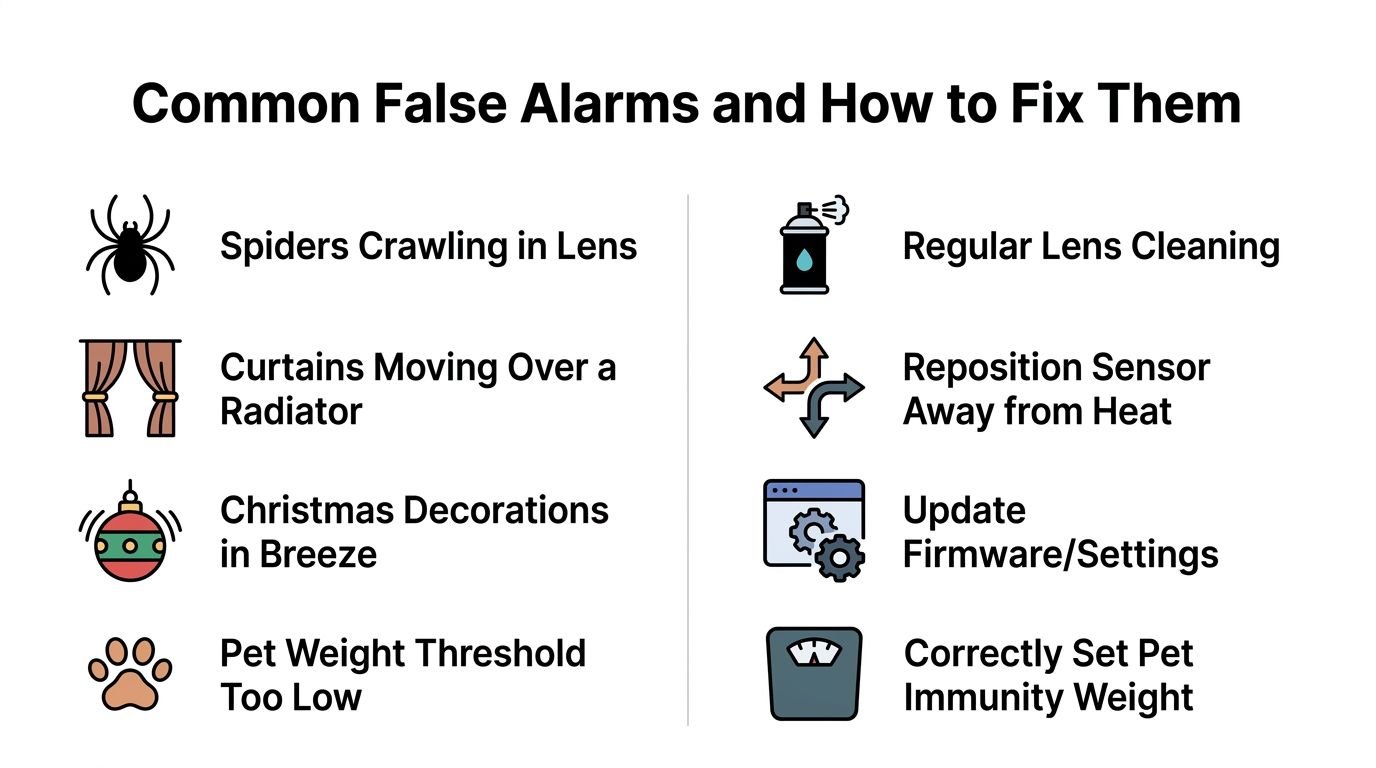
A lot of nuisance calls come from ordinary things that look suspicious to a PIR. Spiders in the lens are a common one. So are curtains brushing over a radiator, decorations moving in a draught, or a pet crossing a stair landing that sits squarely inside the active zone. In compact British homes, that often means the problem shows up on the stairs, beside a sofa, or in a hallway where people and pets share the same narrow path.
A simple diagnostic flow
- Check the lens first. Dust, a cobweb, or an insect inside the cover can look like a detector fault, so clean that before touching the settings. The homeowner sensor repair tips page gives the same practical lesson, simple mechanical issues often masquerade as electrical ones.
- Look for heat movement. Radiators, vents, and strong sunlight can create thermal changes that a PIR reads as motion. Move the sensor, or reduce the source of the heat pattern.
- Watch the pet's route. If the cat jumps onto a sofa or the dog uses the stairs, the detector may be aimed at a live route instead of a quiet background area.
- Review the pet threshold. A setting that is too low for the animal in the room can make the detector over-sensitive, while a setting that is too high can leave gaps in coverage.
- Test again after every change. Walk-tests matter because a setting that looks fine on paper still has to work in your actual room, with your furniture, your pet, and your daily movement patterns.
Wireless detectors can also act unstable if batteries are ageing or the device is getting frequent activations from the same awkward spot. That is why the maintenance checklist is worth keeping in the routine. A sensor that behaved well last season may need checking again after furniture moves, curtains change, or a pet starts using a different route through the room.
Standards, Grades, and Why BS EN 50131 Matters
In the UK, alarm design doesn't happen in a vacuum. BS EN 50131 is the framework that shapes how a monitored intruder alarm is specified, and it's the reason professional installations don't treat a pet-immune sensor as just a box on a shelf. For domestic systems, Grade 2 is the typical reference point, while Grade 3 is used where the risk profile is higher.
The key detector standard for PIRs is EN 50131-2-2, which sits underneath the wider system rules. A datasheet that says “pet-immune to 27 kg” only means something useful when you know what grade, detector class, and installation context it belongs to. A compliant system also depends on coverage, wiring or wireless integrity, and whether the whole setup is designed for bell-only or monitored response.
Why that changes the buying conversation
A DIY detector can be perfectly fine for a simple local alert, but it may not provide the same documentation or assurance as a professionally specified system. That matters where insurers, monitored alarm arrangements, or site-specific requirements come into play. It also matters because a pet-friendly sensor in a compliant system is part of a broader design, not an isolated gadget.
Wisenet Security's approach to intruder alarms is to install to BS EN 50131 standards with bell-only or monitored options, and to include pet-friendly sensors as part of normal domestic specification rather than a niche extra, as noted on the company site Wisenet Security and in its EN50131 explainer. That's the language to use when comparing quotes, ask what grade the system is, how the zones are planned, and how pet immunity is being achieved in the actual house, not just on the brochure.
When to Call a Professional Installer
If you've got one small cat in a flat, self-installation can be enough. If you've got two large dogs, a converted loft, stairs, and a monitored alarm requirement, the conversation changes fast. The more complex the house, the more likely it is that placement, grade, and walk-testing need a proper survey.
A professional survey makes sense when false alarms keep happening, when insurance conditions mention alarm grading, or when you want monitored response rather than a standalone bell. It also helps where the layout is awkward, because a DBS-checked, SafeContractor-accredited installer can test coverage room by room and specify a system that fits how the property is lived in.
For homeowners in South Wales and the South West, that usually means a site visit, a walk-through of pet routes, and a BS EN 50131-compliant design that doesn't rely on guesswork. If you're weighing up whether a detector belongs above a hallway, across a landing, or out of the room entirely, that's the point where expert advice saves time and repeat visits.
If you're dealing with pet-triggered alarms in South Wales or the South West, Wisenet Security Ltd can survey the property, test the coverage properly, and specify a system that suits your pets as well as your alarm grade. Visit Wisenet Security Ltd to ask about pet-friendly intruder alarm installation, monitored options, and a practical site assessment for your home or business.