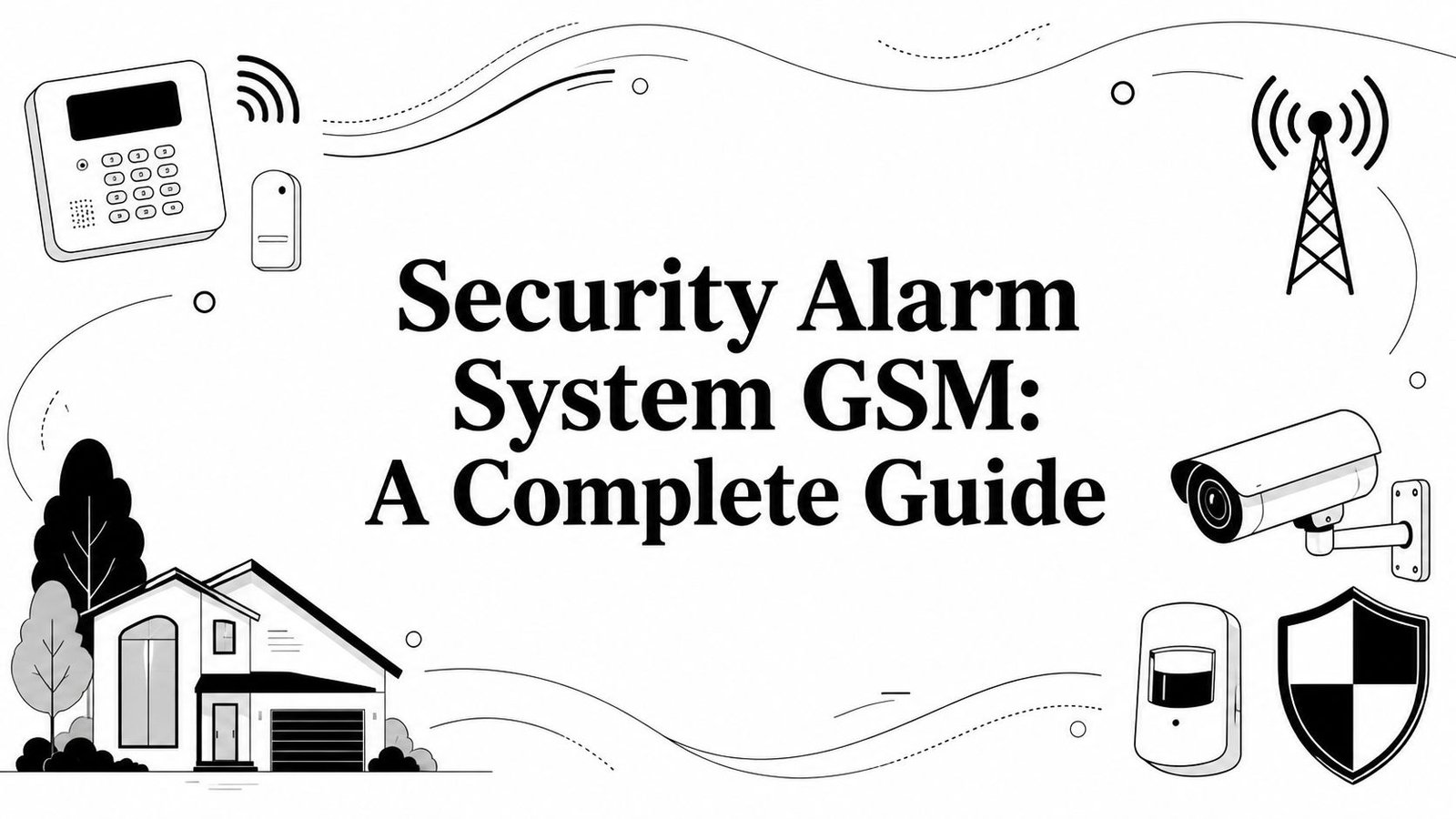
Security Alarm System GSM: A Complete Guide
You're standing in the hallway, the old alarm panel is still on the wall, and the phone line it once relied on has either been cut, buried under broadband, or never existed in the first place. That's where a security alarm system GSM setup earns its keep, because it keeps talking when a copper line doesn't. For a lot of homes and small businesses in the UK, that's the question, not whether the panel looks modern.
A GSM alarm uses the mobile network instead of a fixed line, so the panel can send alerts even when the landline is dead. That simple idea has become mainstream, not niche, and the scale of the UK market reflects that shift, with one industry estimate putting the U.K. alarm monitoring market at £3.2 billion in 2023 and 4.2 million U.K. alarm monitoring subscribers that same year, while global cellular IoT connections for home and small-business security systems reached 42.4 million in 2022 and were forecast to rise to 58.8 million by 2027 (industry estimate). If you've ever wondered why neighbours now have panels that work off a SIM rather than a copper pair, that's the answer.
Table of Contents
- What a GSM Security Alarm System Actually Does
- How GSM Signalling Works Inside an Alarm Panel
- Comparing GSM With Other Alarm Communication Paths
- Monitoring Options From Bell Only to Dual Path
- Installation, Compliance and Integration Considerations
- Typical Costs, Use Cases and How to Choose
- Security Risks, Misconceptions and the 2G 3G Switch-Off
- Frequently Asked Questions and Next Steps With Wisenet Security
What a GSM Security Alarm System Actually Does
A few years ago, I visited a terrace in South Wales where the homeowner had just moved in and discovered there was no working landline at all. The old alarm panel was still there, but it was basically a box with lights on it and no practical way to tell anyone if the front door was forced. A GSM alarm solved that problem without needing fresh phone cabling.
The plain-English version
A GSM security alarm system uses a SIM card and the mobile network to send an alert when a sensor trips. That alert can be a text message, a phone call, or a signal routed to a monitoring centre, depending on how the system is set up. If you want a quick overview of how ordinary alarm systems fit together, this alarm systems explainer is a useful companion.
The important point is that GSM isn't the alarm itself, it's the communication path. The sensors still do the detecting, the panel still makes the decision, and the GSM module still gets the message out. That's why people sometimes misunderstand it, they think “GSM alarm” means a completely different type of burglary system, when it's really the same alarm logic with a different way of speaking to the outside world.
Why that matters in real life
If broadband drops, a GSM panel can still alert you. If a landline is cut outside the house, the panel can still alert you. If you've got a remote workshop, a holiday home, or a shop that doesn't deserve a landline bill just to support alarm signalling, GSM is often the cleaner answer.
Practical rule: if the alarm can't tell anyone when the building's usual communications fail, it's not doing the whole job.
That's why homeowners often start with the wrong question. They ask whether they need “a GSM alarm”, when the better question is whether they need mobile signalling, monitoring, or both. Once that clicks, the rest of the decision gets much easier.
How GSM Signalling Works Inside an Alarm Panel
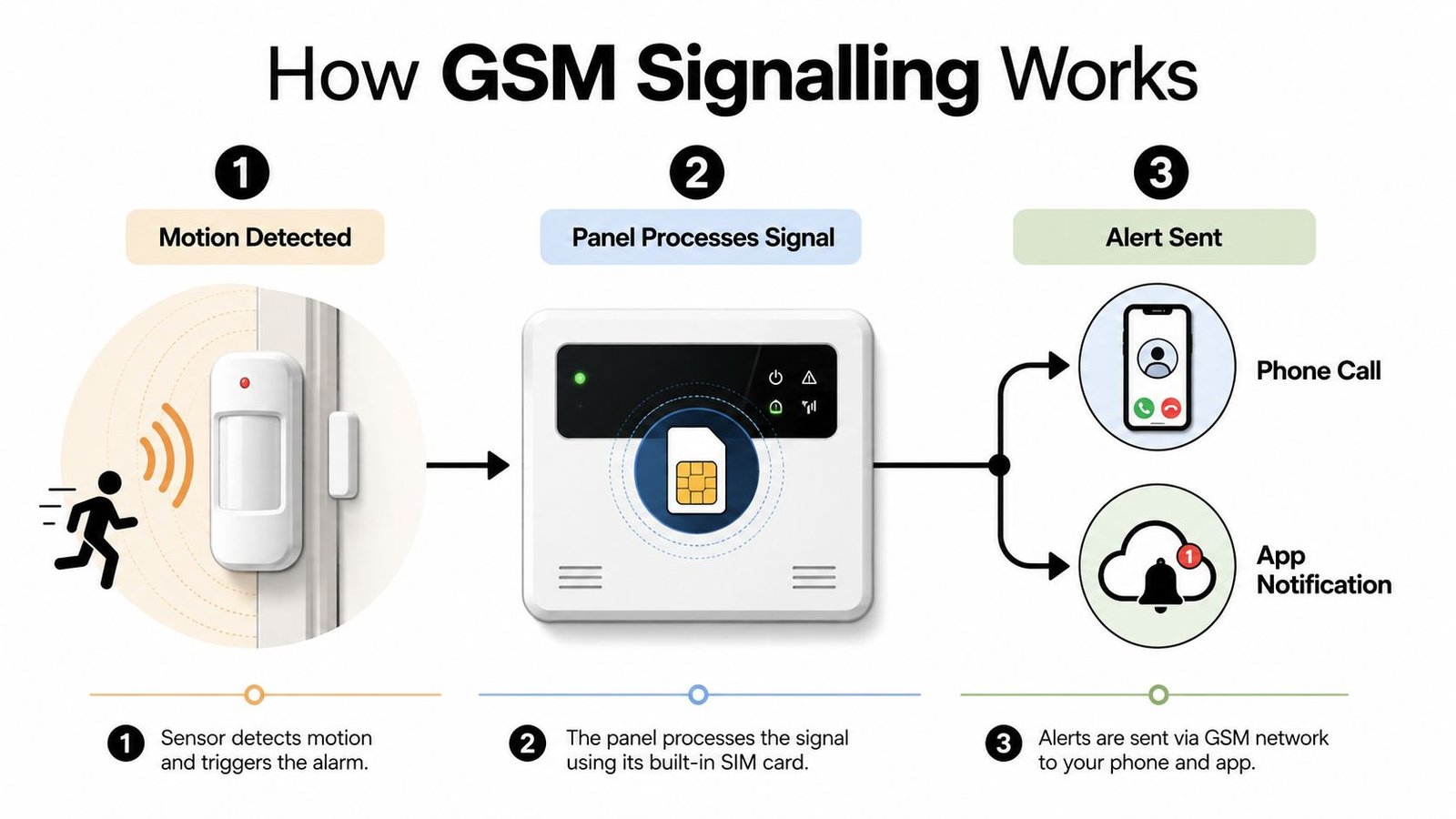
Inside the panel, the GSM module is one more communication path, not the part that detects the break-in. The zone logic still comes first, the panel still decides whether an event counts as an alarm, and then the GSM side sends the message out through the mobile network. In practice, that message might reach your phone, an app, or an Alarm Receiving Centre if the system is set for professional monitoring.
A useful way to understand the process is to follow the signal in order. A door contact opens or a PIR trips, the panel checks the programmed response, then the GSM module uses its SIM to pass the alert over the mobile network. That SIM behaves like the subscription side of a phone service, which is why homeowners sometimes get stuck on the SIM-versus-landline question. A landline system depends on fixed copper or broadband telephony, while GSM depends on the mobile network and the quality of signal inside the building.
From sensor trigger to alert
The signalling path is straightforward once you break it into pieces. The sensor reports the event, the panel classifies it, and the GSM module hands the alert to the network. A text alert, a push notification, and an ARC message all begin with the same panel decision, but they are handled differently after that. The phone message is for direct awareness, the app notification is for quicker user visibility, and the ARC route is for a receiving station that is expected to log and act on it.
Installers also look at the electrical side, because communication hardware is only useful if the panel can keep running properly. Common panel specs show quad-band GSM operation, 850/900/1800/1900 MHz, with standby currents typically below 55 mA and alarm currents from about 120 mA to 450 mA (spec sheet). Those figures matter because a panel has to sit idle for long periods and still cope with the higher demand when it is sending an alarm.
Why battery sizing isn't an afterthought
This is the point where a lot of budget systems fall short. They look fine while the mains is on, then become much less convincing once the power fails and the panel has to rely on backup. The same spec sheet notes that battery-backup autonomy in low-cost systems is often only 4.5 to 24 hours depending on battery size and load. That is why the battery is part of the signalling design, not a box-ticking extra.
The key question for resilience is whether the panel can still reach the network when the power goes and the signal gets poor at the same time.
That matters even more in real homes and small businesses, because batteries age, signal strength varies room by room, and mobile coverage indoors is never as neat as it looks on a coverage map. UK alarm buyers should also check whether the equipment aligns with the right grade and signalling expectations for the job, and the guidance on EN 50131 alarm system grading is a sensible place to start. For firms that need to think beyond the alarm box itself, these compliance tips for companies are a useful reminder that signalling, power backup and record keeping all sit in the same risk picture.
Comparing GSM With Other Alarm Communication Paths
| Method | Resilience to line cuts | Needs broadband or landline | Typical UK use case | Relative running cost |
|---|---|---|---|---|
| Landline dialler | Low if the line is cut or removed | Landline | Older domestic systems still on fixed lines | Usually low, but increasingly poor value |
| GSM | Good against line cuts, depends on mobile coverage | Neither | Rural homes, shops without fixed lines, retrofits | Moderate because of SIM and service costs |
| IP broadband | Good if the router and broadband stay live | Broadband | Homes and offices with stable internet | Often low to moderate |
| Dual-path | High, because one path backs up the other | Usually broadband plus mobile | Higher-risk homes, retail, commercial sites | Higher, but the most robust option |
The old copper-line dialler was simple, but simplicity can become weakness when the line itself is the thing being attacked or retired. Broadband signalling is convenient, but it depends on the router, power, and the internet connection staying healthy. GSM sits in the middle, because it ignores the landline completely, but it still depends on usable mobile signal inside the building.
Where GSM fits best
In practice, GSM is strongest where you need independence from fixed-line infrastructure. That makes it a good fit for premises that are remote, awkward to cable, or not worth tying to a conventional phone line. It's also useful where the property may be vacant for periods and you want a simple alert path that doesn't rely on a home router.
Where dual-path makes more sense
Dual-path means the system can send signals two ways, usually IP and GSM. If one route fails, the other can still carry the alarm. For monitored commercial premises, that extra layer is often what turns a decent setup into a proper resilience plan.
The same European market backdrop that normalised cellular signalling also helps explain why buyers now expect more than a single path. An industry report found 18.2 million active monitored alarm systems in the EU27+3 at the end of 2022, up from 16.8 million in 2020, and forecast growth to 22.6 million by 2027 (regional monitored-alarm report). That doesn't tell you which system to buy, but it does show that monitored and cellular signalling are now firmly part of normal practice.
Monitoring Options From Bell Only to Dual Path
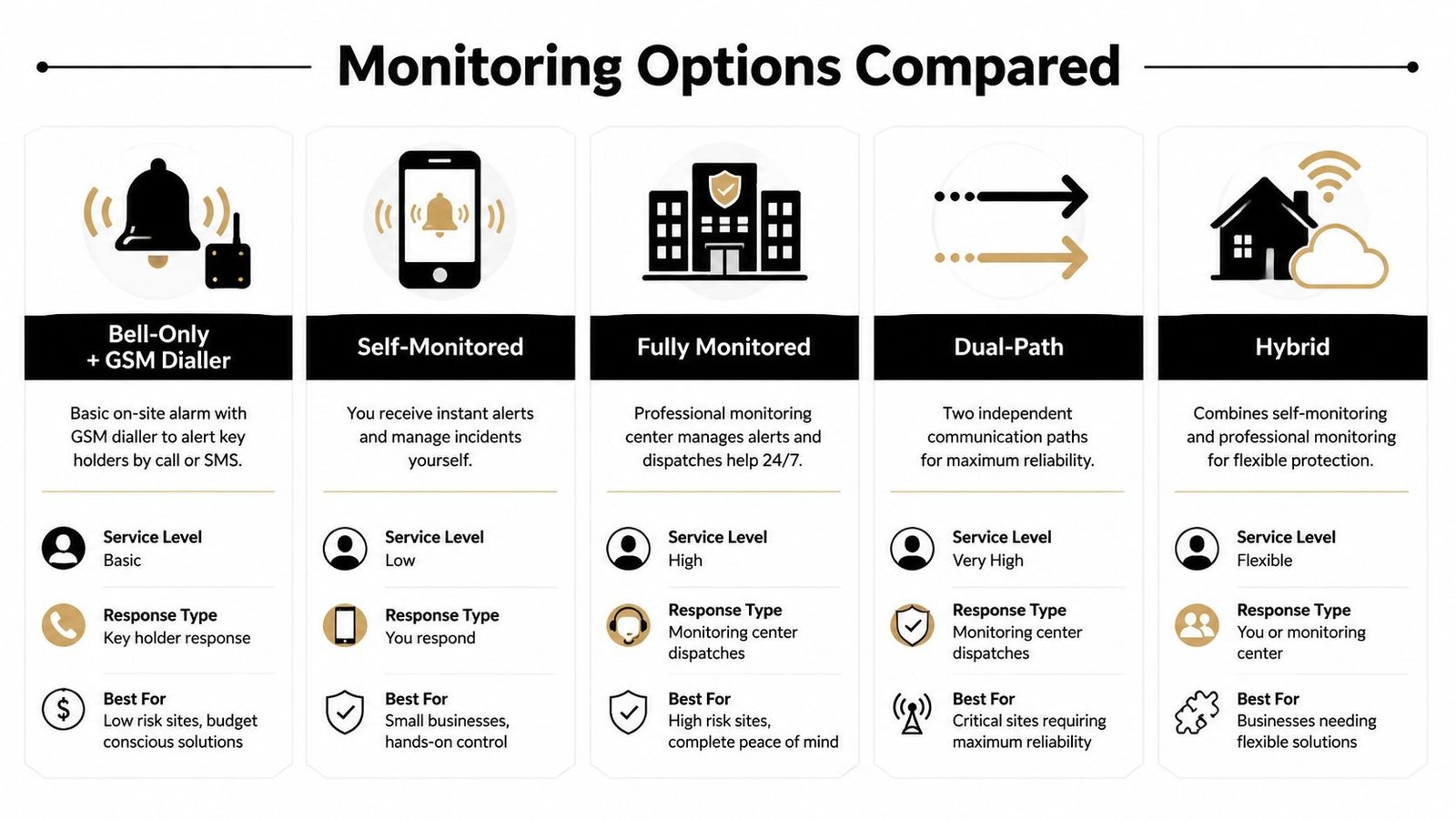
A lot of confusion comes from people using “GSM alarm” to describe everything from a basic siren to a fully monitored system. They're not the same thing. The GSM part only tells you how the panel communicates, not who receives the alert or what happens next.
The five common setups
A bell-only + GSM dialler setup sounds simple because it is. The siren goes off, and the dialler sends alerts to chosen numbers. That suits owners who want to know quickly but don't want an ARC involved.
A self-monitored system pushes alerts to your phone. You decide what to do next, which works well if you're usually reachable and comfortable being your own first responder.
A fully monitored system sends signals to a professional receiving centre, and a police-monitored setup goes one step further, but only where the signalling and verification requirements are met. Police response is not automatic, and people often assume it is when they hear the word “monitored”.
A dual-path system uses two routes and is common where resilience matters more than simplicity. A hybrid system sits between those ideas, often mixing app alerts, keyholder alerts, and monitored signalling.
Real-world examples
A Cardiff terrace often suits self-monitored GSM if the owner wants straightforward alerts and easy app access. A Bristol retail unit usually needs something stronger, especially if stock loss or repeat incidents are a concern. A Swansea warehouse with backup SIM failover can keep alerting even if one mobile route becomes unreliable.
For a clearer view of what monitored systems do in practice, this monitored alarm overview is worth reading alongside the table above.
Installation, Compliance and Integration Considerations
A GSM alarm can be technically sound and still be badly installed. In South Wales and the South West, I've seen strong systems let down by weak indoor signal, poor battery planning, or the wrong detector choice for the building type. The hardware matters, but the site survey matters more.
What to check before fitting
Start with the signal, and don't stop at one network if the site is awkward. Rural valleys, basements, metal-clad units, and mixed-use buildings can all behave differently indoors than they do outside the front door. A decent installer should test the actual alarm location, not just glance at the phone in their hand.
Then decide what the system is for. A basic audible alarm is a different animal from a monitored setup with police-facing signalling. If the property needs a formal installation standard, you should also ask how the design sits with BS EN 50131. If that term is new to you, this BS EN 50131 guide explains the grading clearly.
Compliance and integrations that actually help
Pet-friendly PIRs aren't a GSM feature, they're a sensor choice. That distinction matters because a dog, a stairwell, and a hallway don't all need the same detector. CCTV and access control integration can also save time, especially where an alarm event needs to line up with camera footage or door logs.
Installer's habit that prevents headaches: test the signal where the panel will live, not where the strongest phone signal happens to be on install day.
For companies that handle customer data, alarm events, user contact details, and access records, the security side of compliance matters too. A sensible companion read is compliance tips for companies, because the same discipline that protects business data also helps keep alarm management tidy and controlled.
A practical pre-install checklist
- Confirm indoor cellular strength: Don't assume outside coverage means the panel will behave the same way indoors.
- Choose the right signalling mode: Decide early between bell-only, self-monitored, ARC-monitored, or dual-path.
- Specify the right detectors: Use pet-friendly sensors where the household needs them.
- Plan backup power properly: Size battery backup for real alarm load, not just standby.
- Use a competent local engineer: Ask about DBS checks, ongoing servicing, and familiarity with UK standards.
Typical Costs, Use Cases and How to Choose
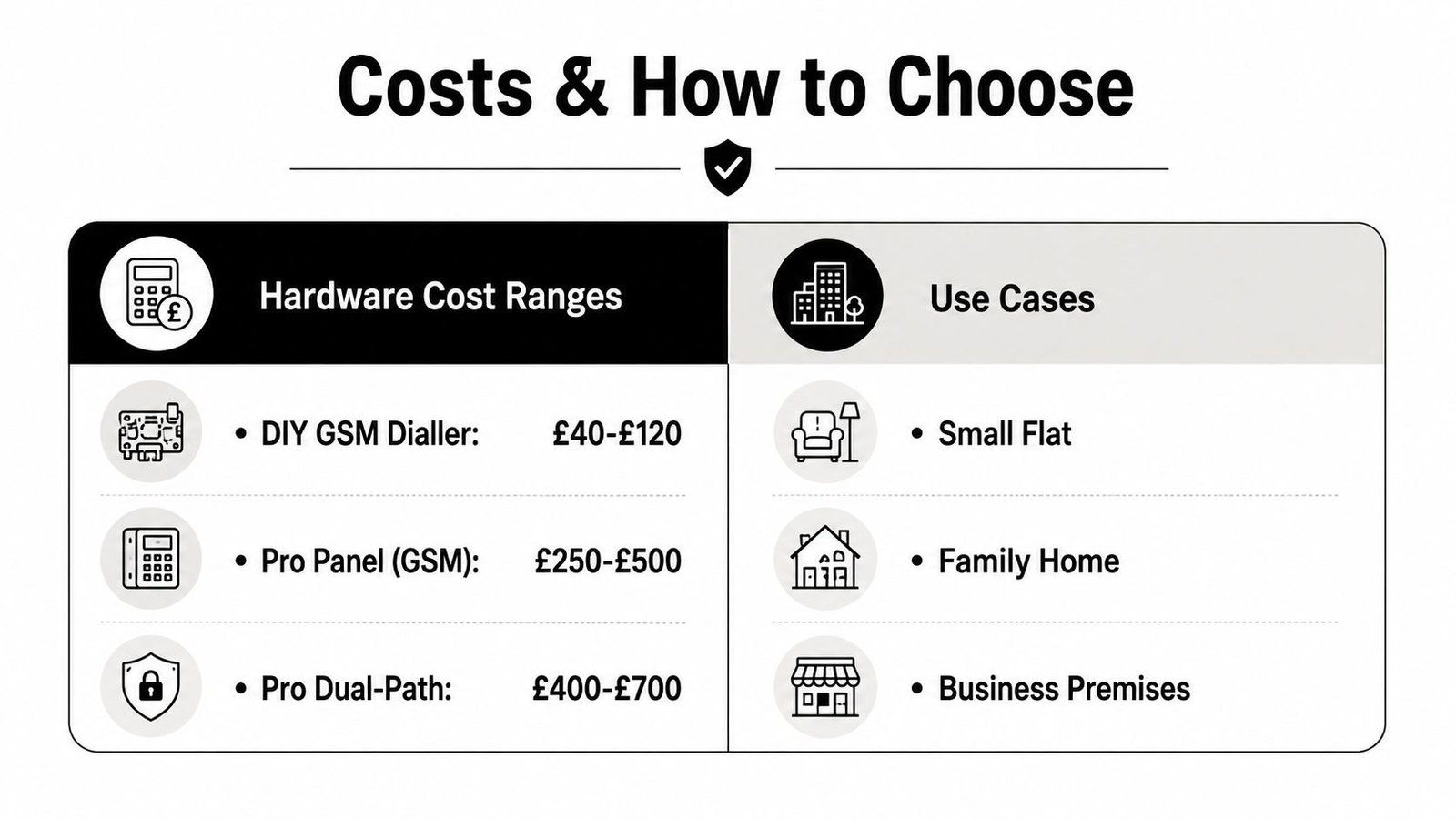
The best GSM system is the one that matches the building, the risk, and the people who'll use it. A tiny flat, a busy retail unit, and a warehouse do not need the same design, even if they all want the same thing at heart, a reliable alert when something's wrong.
Reading the numbers without overcomplicating it
For homeowners, DIY GSM diallers are often the cheapest route, while professionally installed panels sit higher because you're paying for design, fitting, and proper configuration. For businesses, the price rises again if you need monitored signalling, access control, CCTV integration, or dual-path resilience. Those are different jobs, so they should not be judged on hardware alone.
A Cardiff family home often does fine with self-monitored GSM and a decent app. A Bristol independent retailer usually benefits from monitored dual-path, especially when the door opens early and closes late. A Newport warehouse is a better candidate for a more structured setup with backup signalling and access control. A multi-tenant block in Swansea may need alarm, fire, and intercom systems to work together, not separately.
A simple decision filter
Ask yourself three questions. First, do I want to know, or do I want someone else to act? Second, can this property tolerate a communications outage? Third, do I need a system that satisfies insurance, landlord, or business continuity requirements?
If you answer “someone else” to the first and “no” to the second, you're drifting towards monitored or dual-path. If you answer “yes” to both and the site is simple, GSM self-monitoring may be enough. That's usually the cleanest way to cut through sales talk and get to the right design.
Security Risks, Misconceptions and the 2G 3G Switch-Off
A common mistake is to treat GSM as if it's automatically secure and future-proof. It isn't. Like any signalling path, it has weaknesses, and the UK network environment has changed enough that old assumptions can leave you exposed.
The myths people still repeat
GSM doesn't make a system immune to attack. SMS-based control can be exposed if the remote control method is weak, and security researchers have shown that GSM alarm channels can be vulnerable when authentication is poor or remote access is left too open (research paper). That doesn't mean GSM is bad, it means the implementation has to be sensible.
The other myth is that “it's only an alarm, so the network details don't matter.” They do. The UK has been moving away from legacy mobile networks, and buyers now need to ask whether a panel uses legacy 2G SMS only, 4G/LTE fallback, or dual-path signalling. A system bought today is a 2026 commitment, not a nostalgic piece of kit from a simpler network era.
What to check before you buy
- Ask about network support: Don't assume a GSM panel will be happy on tomorrow's networks just because it works today.
- Avoid SMS-only thinking: Prefer systems that have a sensible fallback or a wider signalling approach.
- Treat resilience as part of security: A panel that can't communicate reliably isn't doing its job.
- Think about tamper resistance: A proper install should consider more than just the alert message.
The phrase “GSM alarm” still gets used as if the mobile network never changes. That's the trap. The safe way to buy now is to treat the panel as a living communication device, not a fixed, one-time gadget.
Frequently Asked Questions and Next Steps With Wisenet Security
A homeowner often gets to the last stage of a purchase and asks the same practical questions. Will the alarm still talk to the outside world if the network changes, will the detectors suit the rooms, and who responds if something goes wrong?
Will my GSM alarm still work after the 2G 3G switch-off, and should I choose 4G?
Only if the panel's communication module is compatible with the network it needs to use. If it is tied to older legacy signalling, that creates a problem that may show up later rather than at installation. For a new install, ask for a panel that is built around current network realities, not one that only talks about SMS.
A good installer should explain whether the panel uses 2G, 4G or a dual-path arrangement, because the word “GSM” gets used loosely. Many people hear “SIM card” and assume that means the alarm is future-proof, but the SIM is only the identity card for the network. The primary question is which network the panel can still use when mobile infrastructure changes.
Can I use a pet-friendly PIR with a GSM panel?
Yes. Pet-friendly PIRs are about the detector, not the GSM part, so they can be paired with the right panel as long as the alarm is programmed and installed correctly. The important bit is matching the detector to the room, the pet's size and behaviour, and the way the property is used.
That is where confusion often starts. A GSM panel communicates the alarm, while the PIR decides what counts as movement. Get the detector choice wrong and you can end up with nuisance alarms, even if the signalling side is sound.
Is an app alert as good as keyholder monitoring, and what about police response?
An app alert is quick and convenient, but it still leaves the next action with you. Keyholder monitoring or ARC monitoring gives you another layer of response, and police response depends on the system type, verification, and the rules that govern it. If the property matters enough that an unanswered alert would be a serious problem, professional monitoring deserves a close look.
Bell-only, monitored, and dual-path systems are not the same thing, even though brochures sometimes blur the differences. Bell-only makes noise on site, monitored systems send the event onward, and dual-path signalling gives the panel more than one route to get the message out. That distinction matters if you are comparing a simple alert with a setup that is expected to keep working through signal trouble.
How often does a GSM alarm need servicing?
Regular servicing matters because batteries age, signal conditions change, and sensors drift. A panel that looked fine on install day can behave differently after years of power cuts, temperature swings, and network change. Good maintenance keeps the system honest.
It also gives an installer a chance to check weak signal spots, damaged antennas, low backup batteries, and devices that are starting to misbehave. In South Wales and the South West, that can be especially useful where building construction, rural reception, or local topography affects mobile coverage.
If you are in South Wales or the South West and want a straight answer on whether GSM, monitored, or dual-path suits your property, Wisenet Security Ltd can help with a no-pressure survey, a compliant design, and an installation built around your signal, your building, and your risk. Their team works across Cardiff, Bristol, Newport, Swansea, and surrounding areas, so if you want to compare options properly, visit Wisenet Security Ltd and ask for a free consultation.