
Intruder Alarm System Guide for UK Homes and Businesses
An intruder alarm system is an electronic network of sensors, a control panel, and sounders that detects and announces unauthorised entry. In the UK, the right setup depends on your property type, risk level, and whether you want professional monitoring or a self-managed bells-only system.
You may be looking at an alarm after finding a side gate open, hearing about a nearby burglary, or reviewing insurance requirements for a shop, warehouse, rental property, or car park. The sensible question isn't whether you need an alarm. It's which combination of detection, signalling, monitoring, and maintenance makes sense for your premises.
Intruder alarms are already embedded in the UK security market. A government-commissioned report estimated overall general security expenditure at £2.2 billion per year, with intruder alarms accounting for 55%, implying approximately £1.2 billion annually for alarm systems and related costs (the government report on the economic and social costs of crime). That doesn't mean every property needs the same specification. It means the decision deserves more care than choosing the loudest bell box or the cheapest wireless kit.
Table of Contents
- What an Intruder Alarm System Actually Does
- Wired vs Wireless and Bells-Only vs Monitored
- UK Standards and Alarm Grades Explained
- What Happens When the Alarm Goes Off
- Modern Features Worth Knowing About
- Choosing the Right Setup for Your Property Type
- Installation and Ongoing Maintenance
- Getting a Tailored Intruder Alarm System
What an Intruder Alarm System Actually Does
You open the front door after work and notice the side gate is slightly open. Nothing looks obviously damaged, but you pause before entering. An intruder alarm system is designed for precisely this uncertainty. It monitors selected points, recognises conditions associated with unauthorised entry, and creates an alert that gives people or a monitoring service a chance to respond.
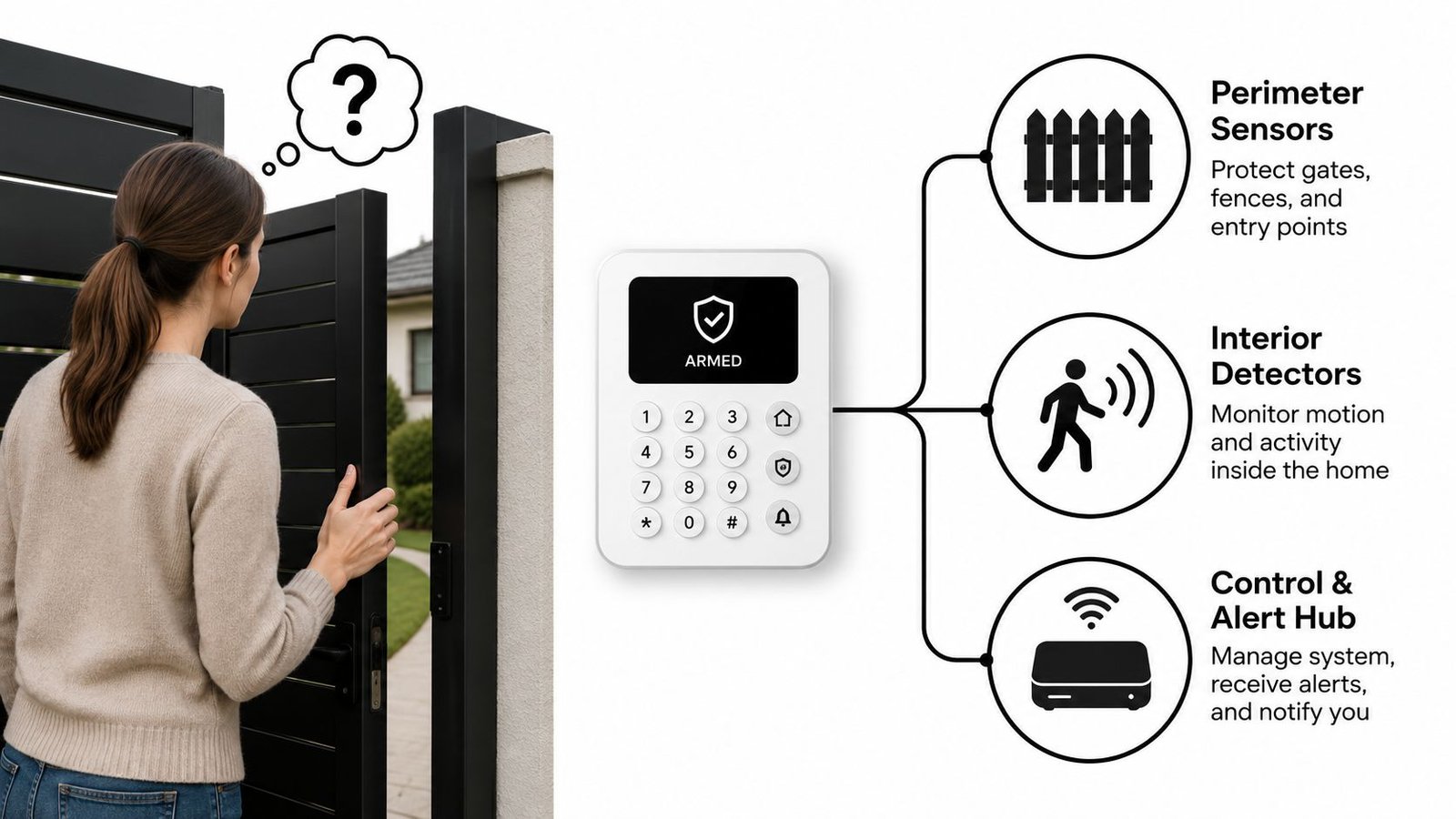
The system has three core layers:
- Detection devices identify a physical change.
- The control panel receives and assesses signals.
- Sounding and communication equipment announces the event and passes information to the right people.
The detection layer
A door or window contact checks whether a protected opening has been opened. A PIR, or passive infrared detector, senses changes in heat and movement within its field of view. A glass-break detector listens for the acoustic pattern associated with breaking glass. Each sensor has a specific job, so good design places the right device at the right point rather than filling every room with identical motion detectors.
Perimeter protection can warn of an entry attempt before someone reaches the main living or working areas. Interior detectors provide another layer if an intruder gets through a door, window, roof access point, or internal partition.
The panel and the response
The control panel is the system's decision-making centre. It receives signals from sensors, manages arming and disarming, records events, supervises batteries and tamper circuits, and controls the alert path. A user normally operates it through a keypad, app, key fob, or another authorised method.
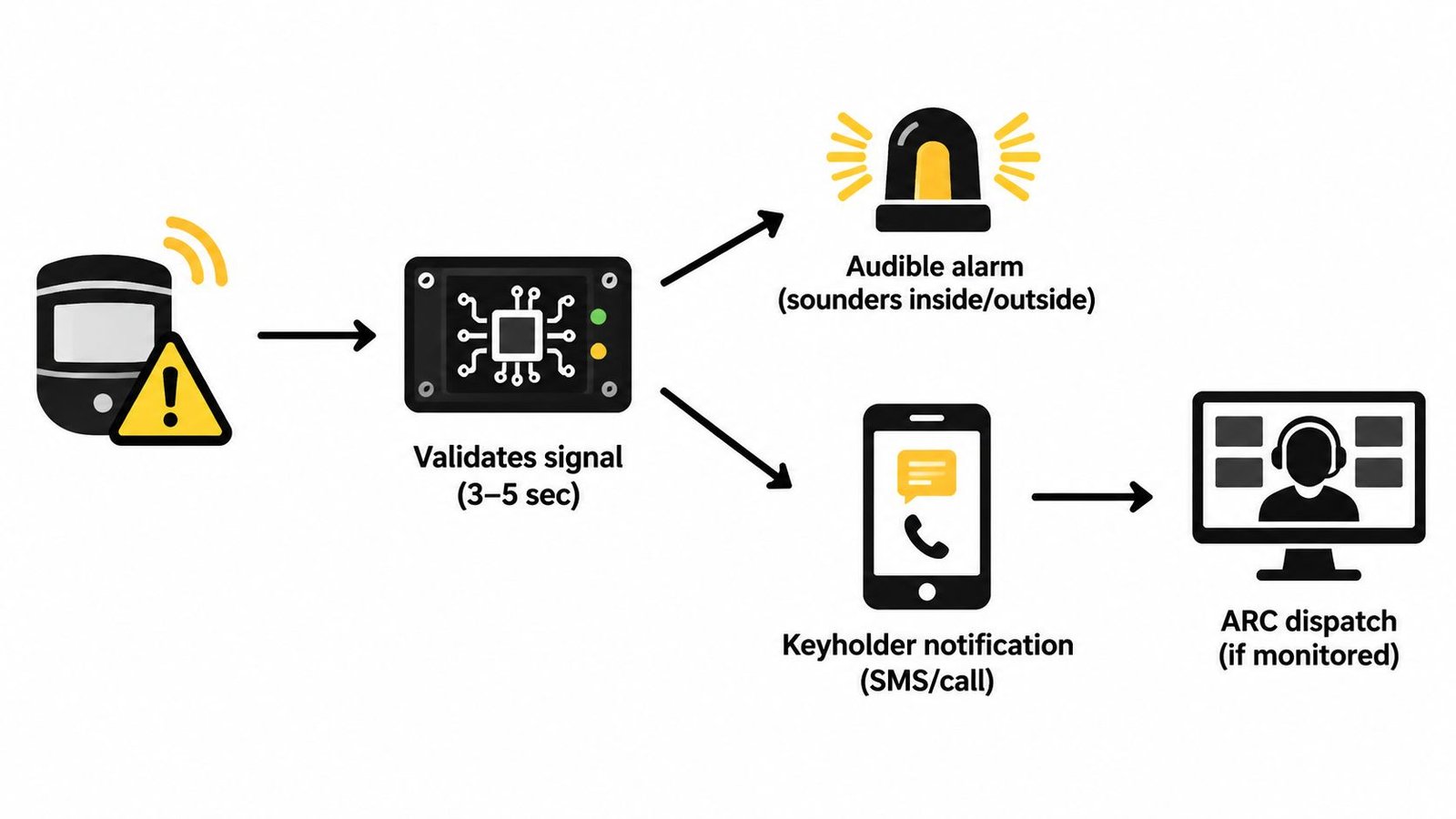
The final layer may be an external bell, internal sounder, app notification, telephone call, or connection to an Alarm Receiving Centre. A modern alarm therefore does more than make noise. It can tell you which zone activated, show whether the system is armed, and send the event beyond the building.
For a straightforward explanation of the sensor, panel, and alert sequence, see this guide to how alarm systems work. The important point is that an alarm only performs well when all three layers are matched to the building and the expected response.
Wired vs Wireless and Bells-Only vs Monitored
Alarm systems are usually compared on two separate decisions. The first concerns how devices communicate with the panel. The second concerns what happens after an activation.
A wired system uses physical cable between the panel and its detectors. It can be a strong choice during a new build or major refurbishment, when cables can be concealed easily and power arrangements can be planned from the outset. Retrofitting cable into a finished home or shop may involve more disruption, although a professional installer can often route it discreetly.
A wireless system communicates by radio. Modern equipment typically supervises the connection and uses encrypted communication, but the installer still needs to assess radio performance, battery access, building materials, and possible interference. Wireless is often practical where the décor is finished, the property is occupied, or the building layout may change.
The second decision is more consequential for response.
Comparing the main configurations
| Type | Installation | Alert method | Ongoing cost | Best suited to |
|---|---|---|---|---|
| Wired bells-only | Cable to detectors and panel | External and internal sounders | Maintenance arranged separately | Refurbishments and properties with reliable nearby keyholders |
| Wireless bells-only | Radio-linked detectors | External and internal sounders, possible app alert | Batteries and maintenance | Finished homes, flats, and smaller premises |
| Wired monitored | Cable to detectors and panel | ARC communication, sounders, keyholder or police procedures | Monitoring and service contract | Higher-risk commercial sites and buildings with insurer requirements |
| Wireless monitored | Radio-linked detectors | ARC communication, sounders, keyholder or police procedures | Monitoring, servicing, and battery management | Occupied premises where reduced installation disruption matters |
| Hybrid monitored | Wired and wireless devices on one panel | ARC communication and local alerts | Monitoring and servicing | Expanding sites, mixed construction, and complex layouts |
A bells-only system depends on someone nearby hearing the siren and deciding what to do. A monitored system sends the event to an ARC, where operators follow the agreed response process. Monitoring brings an ongoing subscription and requires proper setup, keyholders, and dependable signalling.
The choice isn't always wired versus wireless or bells-only versus monitored. Hybrid panels can combine both connection methods, while a monitored alarm can still include local sounders and app alerts. If you want the ARC model explained in more detail, read this guide to what a monitored alarm system is.
UK Standards and Alarm Grades Explained
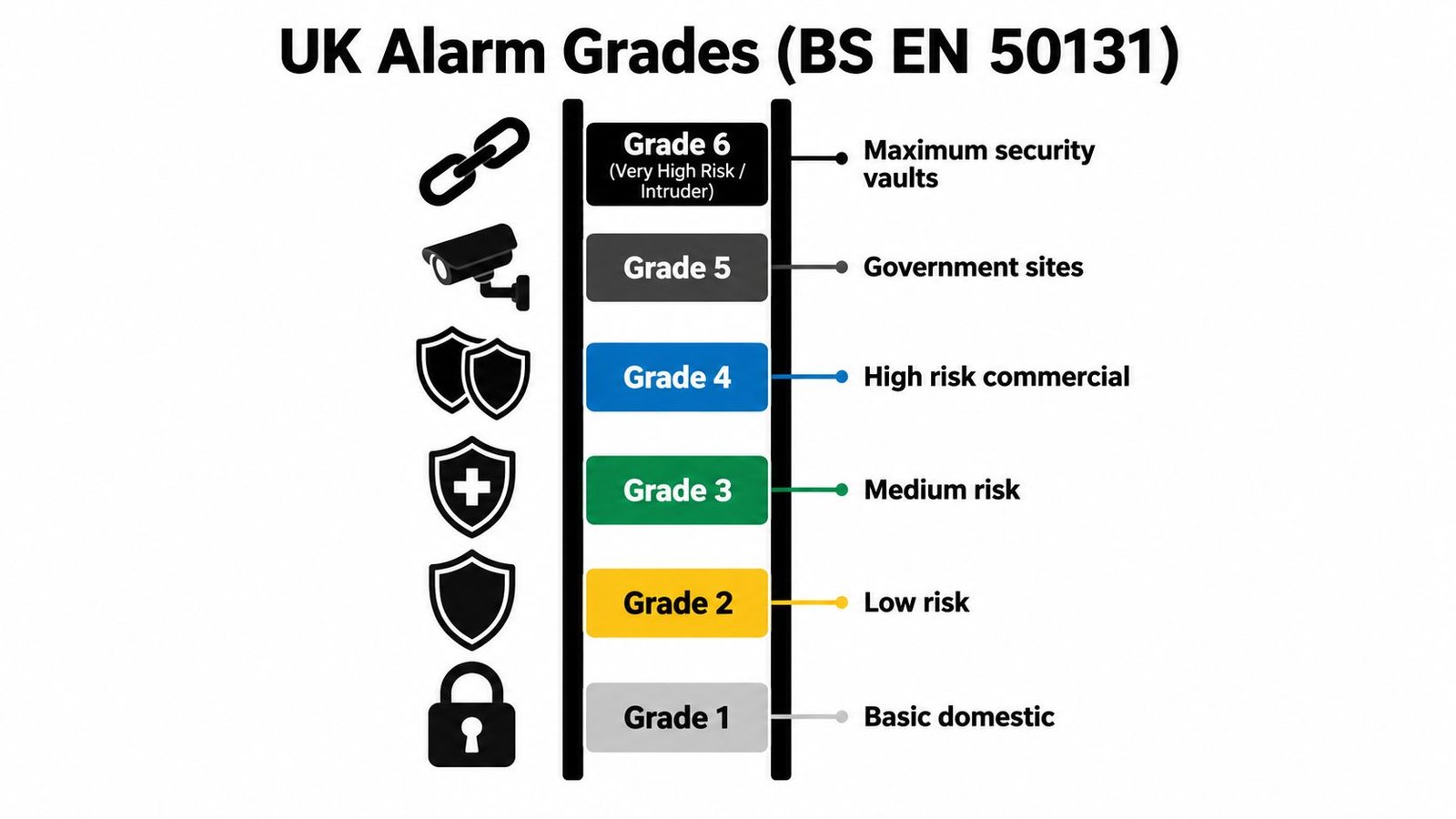
A credible UK specification should identify the applicable BS EN 50131 grade rather than describing an alarm only by brand, app features, or siren volume. The standard uses grades to reflect the assumed capability of an intruder and the level of protection required.
The UK moved from older standards, including BS 4737, BS 7042, and BS 6799, towards the EN 50131 family. Those older standards were withdrawn in 2004, the UK moved to EN 50131 from October 2005, and the later UK application scheme includes PD 6662:2017, with the dual-running period ending on 31 May 2019 (the UK standards timeline).
What the grades mean in practice
The grade reflects the type of attack the system is expected to resist. Lower grades address more opportunistic intrusion. Grade 3 assumes a more knowledgeable attacker who may use portable electronic equipment, while Grade 4 addresses a planned and resource-backed attack.
The National Protective Security Authority identifies Grade 2X as typical for bell-only domestic systems. It also identifies Grade 3 as the minimum commonly expected for remotely monitored systems, higher-value domestic risks, and many commercial applications (NPSA guidance for security managers).
That doesn't mean every home needs Grade 3, or that a higher grade automatically makes a poor design effective. The installer should consider entry points, stock or valuables, occupancy, building construction, access to the site, and the required response path.
Why PD 6662 and approval matter
PD 6662 helps apply BS EN 50131 within the UK and is commonly considered alongside recognised installer schemes such as NSI or SSAIB approval. This matters when an insurer, landlord, managing agent, or response provider needs evidence that the system has been designed and installed under a recognised framework.
Ask the installer to state the proposed grade, signalling method, maintenance arrangement, and any conditions attached to police response. You can also use this plain-English guide to EN 50131 alarm standards before comparing quotations.
What Happens When the Alarm Goes Off
A door contact opens after closing time. The detector sends its signal to the control panel, which applies the programmed rules. It may allow an entry delay, check linked devices, identify the zone, activate internal and external sounders, and transmit the event through the chosen communication path.
The response then depends on whether the system is bells-only or monitored.
A bells-only alarm depends on local attention. A neighbour, passer-by, employee, or keyholder might hear the sounders and decide whether to investigate or call the police. This arrangement can suit a property where trusted people live or work nearby. It cannot guarantee that anyone hears the alarm, recognises what it means, or responds quickly.
A monitored system sends the event to an Alarm Receiving Centre, or ARC. Operators follow an agreed procedure involving keyholders, sequential confirmation, audio verification, visual verification from linked cameras, or other approved methods. The exact process depends on the system design, installer, monitoring provider, and local police requirements.
Practical rule: The response plan matters as much as the detector layout. Before choosing a signalling package, establish who receives the event, what they are expected to do, and whether they can reach the property.
False alarms show why this matters. One UK discussion cites 92% of alarm activations are false alarms (the UK alarm response discussion). It also notes that immediate police response can be withdrawn after three false activations in a rolling 12-month period. Unreliable sensors, poor user training, and neglected maintenance can therefore reduce the protection available in practice.
A market projection from the source covering monitored alarm adoption and response estimates that 542,600 UK households will use professional home security monitoring in 2025, representing 31% year-on-year growth. Treat this as a projection, not evidence that monitoring suits every property. The right choice depends on the site, available keyholders, insurer requirements, and the response that can realistically follow an activation.
Modern Features Worth Knowing About
A current intruder alarm system can combine security, communication, and property management functions. The useful question isn't whether a feature sounds modern. Ask what problem it solves, how it behaves during a fault, and whether people in the property will use it correctly.
Notifications and remote control
A mobile app can send an activation alert, show the panel status, identify a zone, and allow authorised users to arm or disarm remotely. This helps when a family member forgets to set the alarm or a manager needs to check a shop after closing. It also creates a responsibility. Anyone receiving alerts should know whether to contact a keyholder, monitoring centre, emergency service, or installer.
Partitioned areas can be armed independently. A homeowner might protect the garage and ground floor while using the upstairs bedrooms, while a business could keep an office armed while staff work in a separate area.
Sensors that reduce nuisance activations
Pet-friendly PIR detectors use sensor design and processing intended to distinguish human movement from smaller animals. The weight threshold varies by manufacturer and installation conditions, so don't accept “pet-friendly” as a complete specification. The installer still needs to consider the animal's movement, furniture, heating sources, sunlight, and detector height.
Outdoor detection requires extra care because wind, vegetation, animals, changing temperatures, and weather can create unwanted signals. Anti-masking features can identify attempts to obstruct a detector, but they don't replace correct positioning.
Tamper protection and connected devices
A professional system should supervise its covers, cables or radio links, power supply, and backup battery. Wireless devices need suitable encryption and signal supervision, while smart-home integrations should be limited to functions that don't weaken the alarm's core operation.
If an alarm connects to cameras, lighting, locks, voice assistants, or other internet-connected equipment, review the wider exposure. Guidance on MSP support for IoT risks can help businesses think beyond the alarm panel itself and consider device management, access control, updates, and network security.
Panic buttons, medical alerts, and app-based emergency functions may also be appropriate, but they're not substitutes for a properly designed intruder response. Treat each addition as part of a response plan, not as a gadget purchased in isolation.
Choosing the Right Setup for Your Property Type
A family home, convenience shop, warehouse, and multi-tenant building may all need an intruder alarm system, but the right setup depends on how each property is used. Start by reviewing daily occupancy, vulnerable openings, likely response times, and any requirements from an insurer, landlord, or managing agent.
A market source reported that 65% of British homeowners did not have an alarm system in 2023 (the UK homeowner research). That figure does not make an alarm necessary for every property. It does support a practical discussion about exposure, rather than assuming a typical home already has suitable protection.
| Property type | Suggested grade | Signalling | Core sensor package |
|---|---|---|---|
| Typical family home | Grade 2 or a specification matched to the insurer | Bells-only, app alerts, or monitoring | Door contacts, hallway PIR, selected window contacts, pet-friendly detectors where needed |
| Flat | Grade 2, subject to building risk | Bells-only or monitored | Entry-door contact, discreet internal detection, selected window coverage, shared-area coordination |
| Small retail premises | Often Grade 3 where stock and response requirements justify it | Monitored ARC connection | Door contacts, dual-technology detection, panic button near the till, protected stock areas |
| Warehouse or logistics site | Grade 3 or Grade 4 after risk assessment | Monitored with resilient signalling | Perimeter detection, loading-door contacts, internal volumetric detection, roof or access-point protection |
| Multi-tenant building | Grade matched to each unit and common-area risk | Zoned signalling and managed response | Independent tenant areas, shared entrance protection, plant-room and circulation-area detection |
A home with visible neighbours and a short keyholder journey may suit a well-designed wireless bells-only system. The same choice may leave an isolated warehouse dependent on someone hearing a siren. That site usually calls for stronger detection, monitored signalling, and a response plan with clear responsibility.
For a shop, a panic button near the till may address a different risk from an overnight break-in. Detector selection should reflect both situations, while avoiding coverage that creates repeated false alarms. Staff who regularly receive unnecessary alerts may start treating every activation as background noise.
Landlords also need separation between units. Independent zones can prevent one tenant's activity or user settings from disarming protection elsewhere in the building. Shared entrances, plant rooms, and circulation areas may require their own arrangements.
The practical test is simple: match the alarm's grade, signalling, detection, and response to the property and its likely consequences. A smaller system that addresses the risks and prompts a workable response can serve a home better than a larger specification chosen without a site assessment.
Installation and Ongoing Maintenance
Professional installation is especially valuable when the system needs a defined BS EN 50131 grade, insurance recognition, or monitored response. Look for an installer working under a recognised scheme such as NSI or SSAIB, then ask exactly what the certification covers.
A competent DIY installation may suit a simple, low-risk property where the owner accepts responsibility for sensor placement, programming, batteries, user permissions, and future faults. It becomes less suitable when the property has complex access routes, multiple occupiers, valuable stock, or a policy requiring professional installation.
Commissioning is more than fixing devices to walls
The installer should survey likely entry routes, choose detector positions, check radio paths or cable routes, programme zones, test tamper conditions, confirm sounders, configure users, and explain the response process. A handover should include basic operating instructions and a record of the equipment and settings.
Don't judge a quotation only by the number of sensors. A cheaper quote may omit a vulnerable side door, fail to separate working areas from protected areas, or provide no clear maintenance arrangement.
Keep the system dependable
NSI's code of practice references periodic servicing and includes at least annual maintenance for alarm systems (the NSI code of practice for intruder alarms). A service visit should test more than the external bell.
- Detection: Check contacts, PIRs, panic devices, and any specialist detectors.
- Power: Test mains failure behaviour, backup batteries, and battery warnings.
- Tamper circuits: Confirm that covers, panel access, and device faults create the correct event.
- Signalling: Verify the route to the ARC or the owner's app, not just the local sounder.
- User practice: Remove former users, review codes, and make sure keyholders understand the procedure.
Users should respond promptly to fault messages, avoid changing furniture in front of detectors, and test the system according to the installer's instructions. Monitored contracts may include servicing, but the contract should say what is included and what happens if a battery or device needs replacement.
Getting a Tailored Intruder Alarm System
Generic advice can identify the important questions, but an on-site survey reveals the details that product pages can't. An installer can see whether a rear extension creates a blind route, whether a warehouse roof is accessible, whether a flat shares a vulnerable entrance, and whether existing wiring is suitable for reuse.
The survey should connect four decisions:
- Risk profile: What is being protected, and what type of intrusion is plausible?
- Grade: Which BS EN 50131 level matches the property and insurer's requirements?
- Detection: Which doors, windows, rooms, roof areas, and external approaches need protection?
- Response: Should the alarm notify an owner, keyholder, ARC, or more than one recipient?
A written quotation should identify the proposed equipment, grade, signalling path, monitoring arrangement, warranty, maintenance terms, app access, and any conditions for police response. Ask at least two NSI or SSAIB-approved installers to quote so you can compare the specification rather than comparing headline prices.
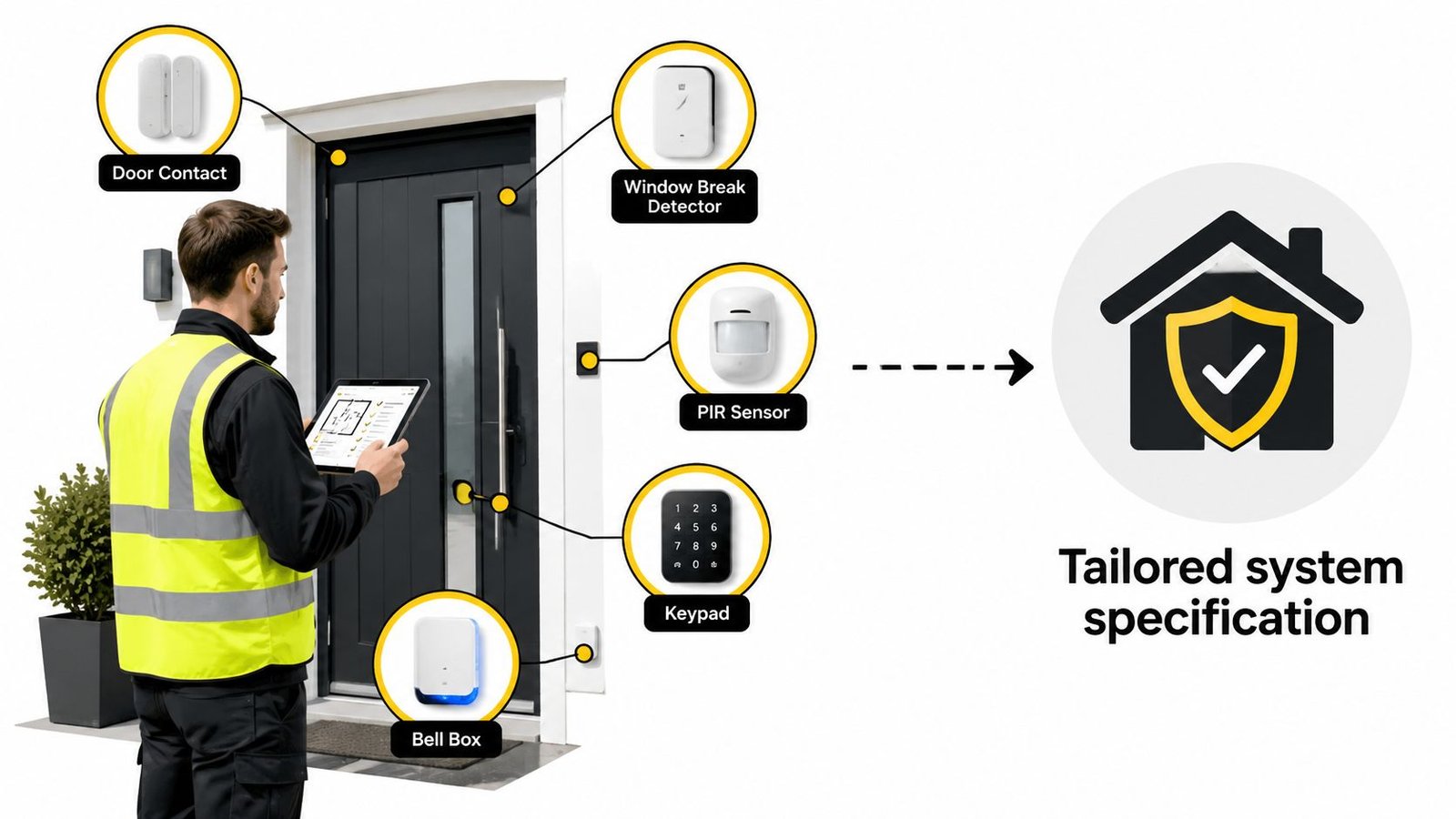
A professional consultation isn't automatically an upsell. It can prevent you paying for detectors that add little value while exposing an entry route that a claim assessor or insurer may expect to see covered. For homes, shops, warehouses, landlords, and multi-tenant buildings, the best specification is the one that fits the building's use and produces a response people can carry out.
Wisenet Security Ltd designs, installs, and maintains intruder alarm systems for homes, businesses, warehouses, and multi-tenant properties, with BS EN 50131 installations, bells-only or monitored options, app alerts, and pet-friendly sensors. Visit Wisenet Security Ltd to arrange a consultation for your property in South Wales, the South West, or nearby areas.