Gate Automation Installation: Your Complete Local Guide
88% of surveyed automated gates failed to meet current HSE safety guidelines, so the answer is simple: professional gate automation installation is essential in the UK. If you're budgeting for a residential system, expect costs to vary by gate type, motor choice, groundwork, and compliance work, and insist on proper installation, testing, and certification rather than chasing the cheapest quote.
A gate is supposed to make a property safer and easier to use. In the UK, a badly installed powered gate does the opposite. It becomes a crushing, impact, drawing-in, or shearing hazard, and the history behind today's standards shows exactly why that matters. The modern expectation is clear, every new or upgraded gate needs formal risk controls, not just a motor and a remote.
Table of Contents
- Why Professional Gate Automation Installation Matters More Than You Think
- Understanding Gate Types and Motor Options for Your Property
- Site Survey and Preparation Workflow Before Installation
- The Installation Process and UK Compliance Requirements
- Integrating Gate Automation with Your Existing Security Systems
- Costs, Timelines, and Maintenance Contract Options
- Common Problems and Preventive Maintenance Troubleshooting
- Frequently Asked Questions About Gate Automation Installation
Why Professional Gate Automation Installation Matters More Than You Think
The UK safety picture is blunt. Industry coverage of a UK survey found that 88% of automated gates failed to meet current HSE safety guidelines, 53% could not be stopped manually while closing, 59% lacked recommended safety edges, and 35% had no regular service agreement in place (industry coverage of the survey). Those failures turn a convenience upgrade into a liability fast.
The reason the rules tightened is clear. After two child fatalities in 2010, the Health and Safety Executive reviewed the standards covering powered doors, gates and barriers (HSE guidance). That changed the baseline. A gate is treated as powered machinery with foreseeable risks, and the installation has to prove it can manage them.
If an installer talks mostly about style, colour, or opening speed, and barely mentions risk controls, walk away.
Poor installation is where the danger starts. If the gate cannot be stopped, if the closing force is wrong, or if the safety devices are badly positioned, the operator's convenience comes at the cost of safety. For homeowners, that can put children, visitors, and delivery staff at risk. For businesses, it creates workplace exposure, along with legal and insurance problems that are expensive to undo.
Custom metalwork can still be part of a good design, but only after the safety case is right. A useful example of that balance is timeless custom ironwork designs, which shows why appearance should support the engineering instead of overriding it.
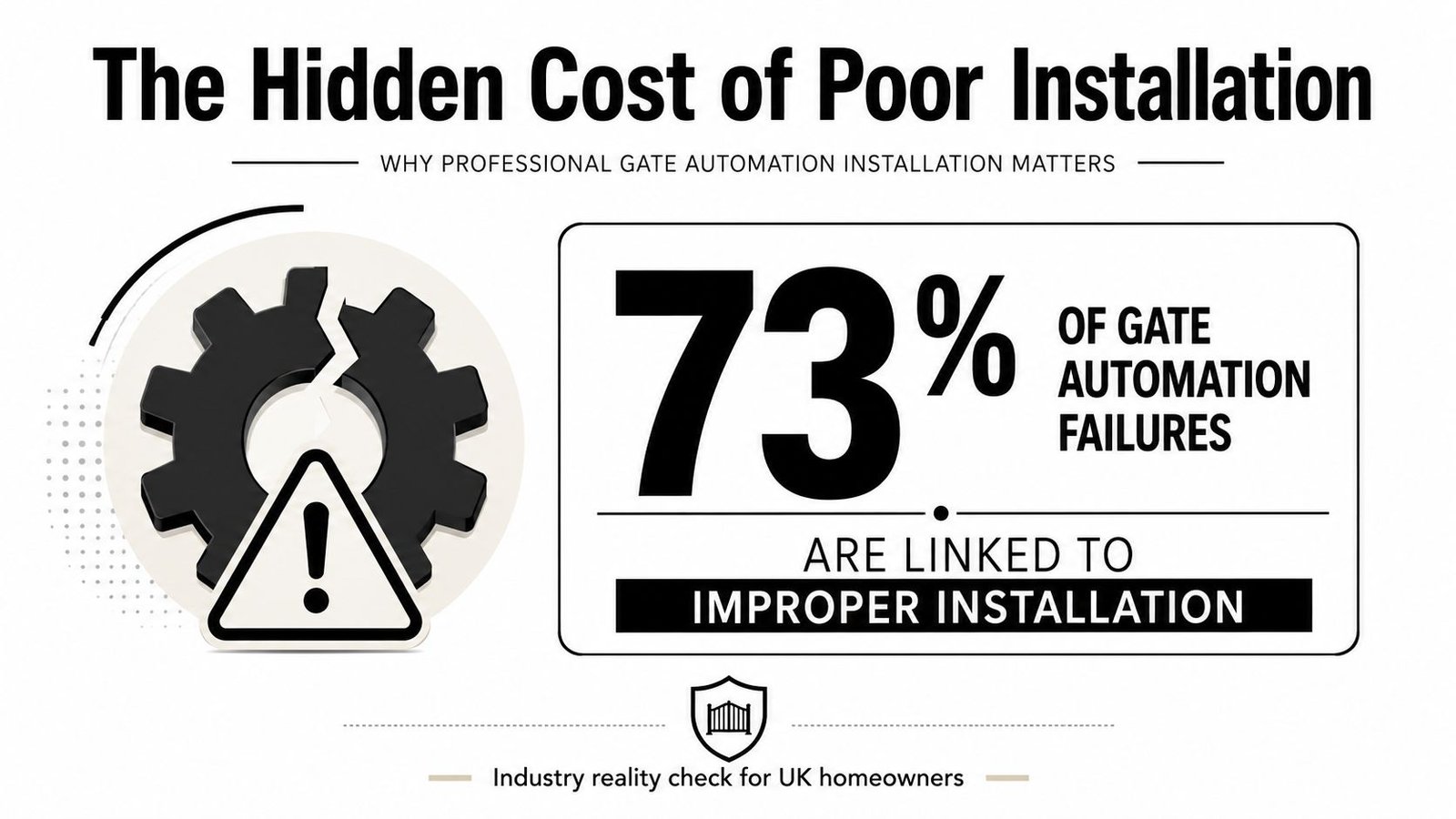
The lesson is straightforward. Cheap fit-outs often cost more later in remedial work, downtime, and safety corrections. In gate automation installation, quality is not a premium extra, it is the point.
Understanding Gate Types and Motor Options for Your Property
The right gate starts with the site, not the brochure. If the layout is wrong, no motor will make it feel right, and no aesthetic choice will fix a bad fit. The three common formats are sliding gates, swing gates, and vertical-lift systems, and each solves a different problem.
Match the gate to the ground
Sliding gates suit properties where there's room for the leaf to travel sideways along a track, but not enough depth for a wide swing arc. They're a strong choice for drives with limited opening clearance or awkward setbacks. Swing gates suit narrower domestic drives where the leaves can open inward or outward without striking walls, parked vehicles, or public paths. Vertical-lift systems are a different class entirely, better for sites that need compact ground use and controlled vehicle throughput.
| Gate Type Comparison Guide | Best For | Space Requirement | Speed | Typical Motor |
|---|---|---|---|---|
| Sliding gate | Wider openings, limited swing clearance | Side run space for the track | Steady | Gear-drive |
| Swing gate | Domestic drives with clear arc space | Clear opening arc on one or both sides | Moderate | Belt-drive or screw-drive |
| Vertical-lift system | Commercial sites with tight ground footprint | Minimal side sweep, more vertical planning | Fast | Gear-drive |
Choose the motor for the duty cycle
Motor choice should follow usage, weight, and noise tolerance. Gear-drive motors are the sensible choice for heavier commercial gates because they're built for steady load and tougher duty. Belt-drive systems make more sense in residential settings where quieter operation matters. Screw-drive mechanisms sit in the middle, often fitting medium-duty applications where you want a balanced compromise.
A quiet motor is useless if it's undersized for the gate leaf. The load comes first, the convenience comes second.
If you're comparing kit options, use the right reference point from the start, such as a gate automation kit overview, then judge each quote against your actual site conditions. The wrong gate type creates ongoing wear, and the wrong operator makes that wear expensive. Get the pairing right now, and you'll avoid constant adjustment work later.
Site Survey and Preparation Workflow Before Installation
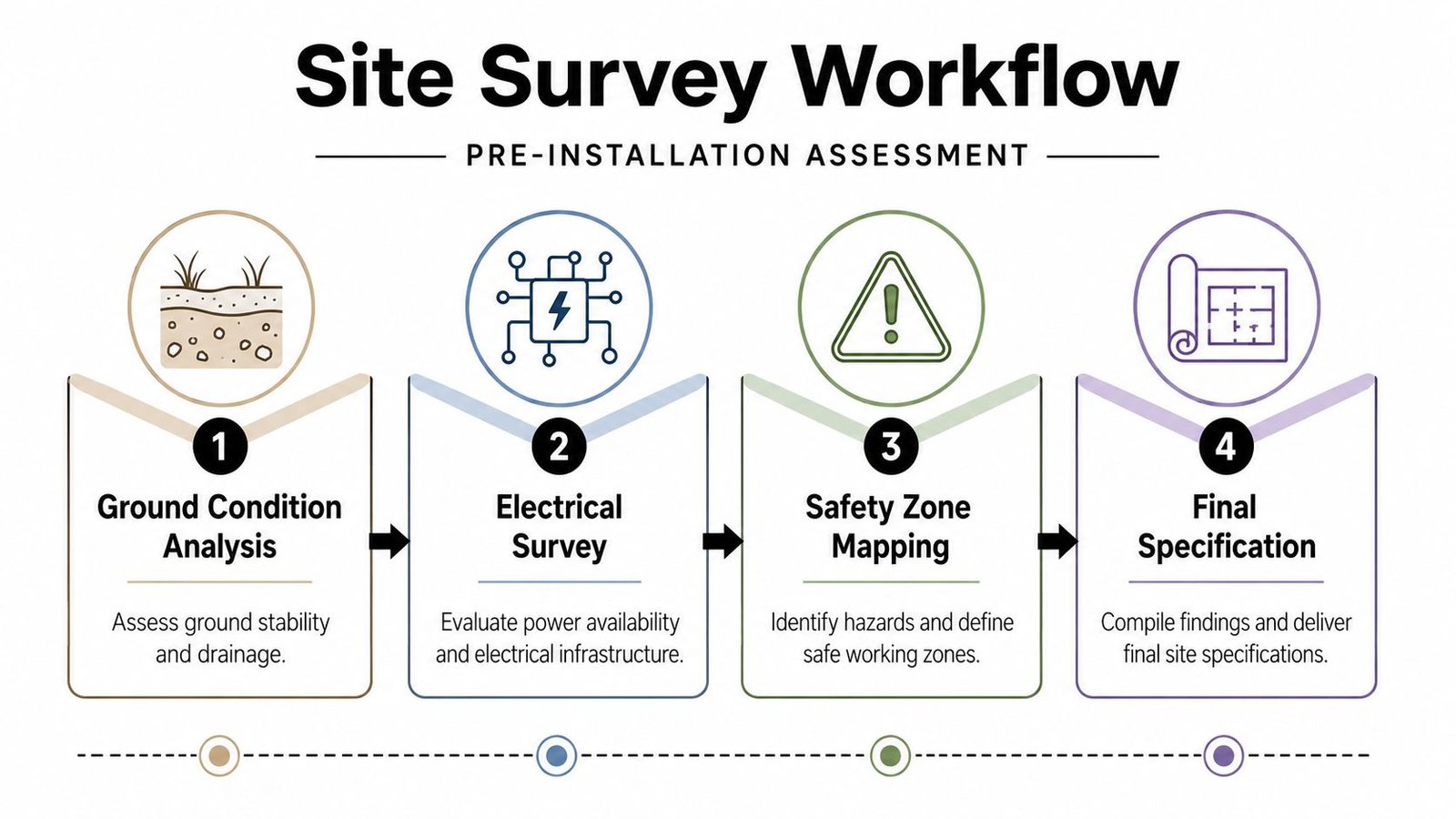
A proper survey tells you whether the project is straightforward, awkward, or a bad idea in the current form. That judgement has to happen before anyone orders motors or pours concrete. If an installer skips the survey or rushes it, the rest of the job usually pays for that shortcut.
Start with the ground and the power
The first check is ground condition. Soil type, drainage, slope, and stability affect foundation depth and the quality of the mounting points. Poor drainage can undermine posts and bases, while weak ground can shift the gate out of alignment after installation.
Next comes the electrical survey. The installer needs to confirm access to a suitable supply and a layout that can support the motor and control equipment, with wiring verified to the relevant electrical standard where applicable. If the system can't be powered safely, everything else becomes secondary.
Map the space before you commit
A good survey also measures the boundary, leaf geometry, and safe movement zones. It should account for wind exposure, nearby pedestrian routes, and how vehicles will approach the entrance. For commercial properties, the survey should include fire escape access, loading bay movements, and any need to connect the gate with existing security systems.
Paperwork matters too. Planning permission, building control considerations, and restrictions linked to listed buildings or conservation areas can affect what you're allowed to install and how it can look. A serious installer flags these issues early instead of discovering them after the foundation work is finished.
If a survey feels like a sales visit instead of a technical assessment, it's not a proper survey.
A thorough pre-installation visit should leave you with a clean specification, a realistic scope, and clear red flags if the site needs extra groundwork or a different gate design. Anything less means the installer is gambling with your money and your safety.
The Installation Process and UK Compliance Requirements
A bad gate installation fails long before the first fault call. It starts with poor foundations, sloppy alignment, weak wiring, or a motor fitted to a gate that was never stable enough to carry it. Method matters here, because safety and compliance are built into each stage.
Installation is a build process, not a fitting exercise
A competent installer fixes the base, mounts the operator securely, sets the geometry, and checks that the leaf moves without pinch points or unnecessary resistance. If the structure shifts under load, the system is already compromised, no matter how smart the controller looks.
For UK-powered gate installations, the legal starting point is the Supply of Machinery (Safety) Regulations 2008 when the gate is first supplied or first put into service (Gate Safe installer guidance). The customer should also receive English-language user instructions and a Declaration of Conformity. Where the gate serves a workplace, car park, private road, or managed residential premises, the installer also has to account for the Workplace (Health, Safety and Welfare) Regulations 1992 and the Health and Safety at Work etc Act 1974 (Gate Safe installer guidance).
Force testing is not optional
Validation must include force testing after installation and after any modification, using an annually calibrated instrument and repeating the test when results go above 90% of the maximum permitted value (BS EN 12453 and EN 12445 guidance). The published thresholds used in UK practice include 25N for indefinite duration, 150N for up to 0.75 seconds, 400N at crush, shear, and draw-in hazards, and 1400N at impact-only hazards (BS EN 12453 and EN 12445 guidance). Those figures drive motor torque, closing speed, and sensor placement.
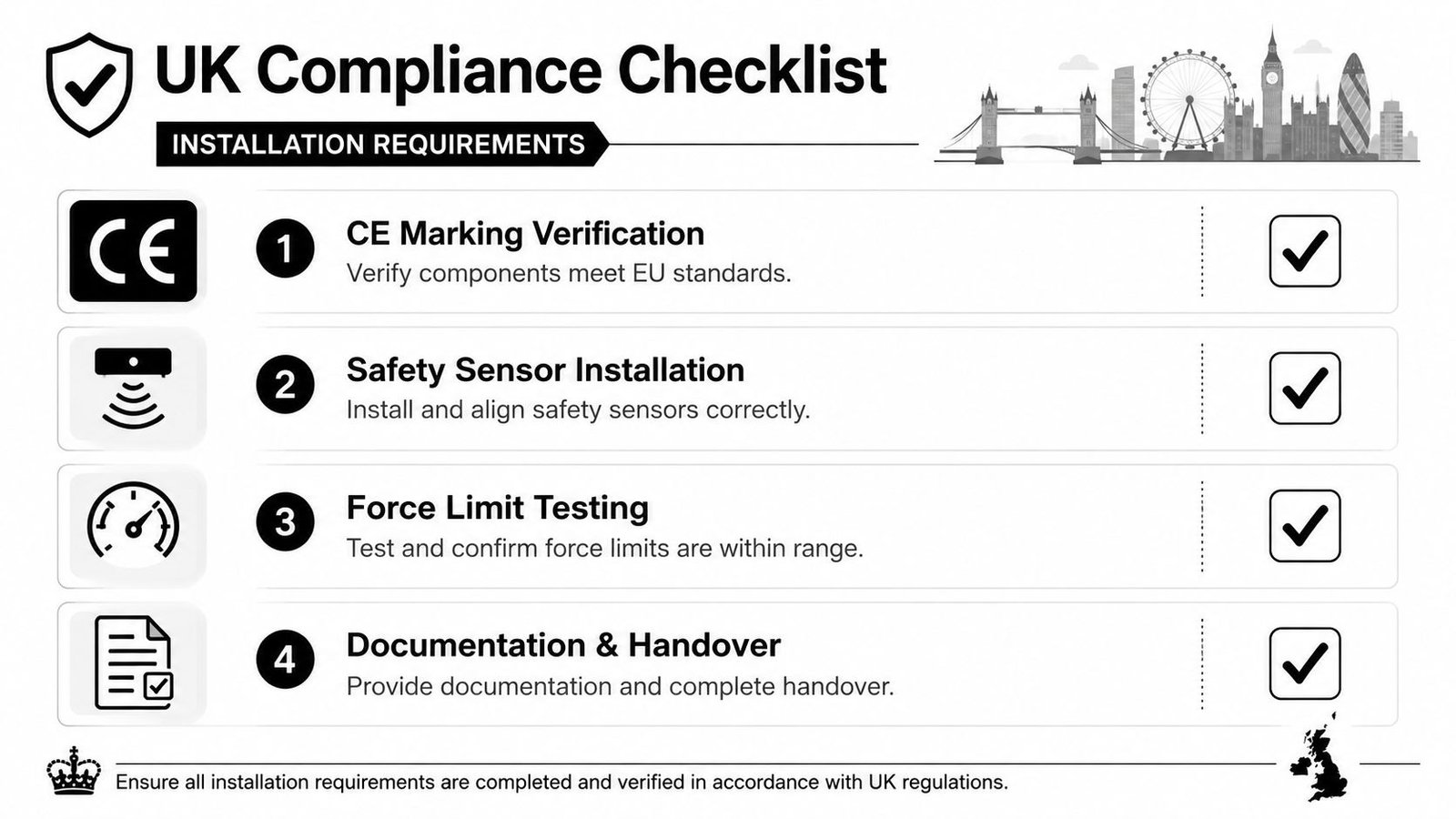
Gate Safe also advises at least two different safety device types, such as photocells or laser scanners paired with pressure edges, because force limitation alone does not cover every risk (BS EN 12453 and EN 12445 guidance). The installer's calibration and device placement decide whether the system is safe in practice, not just on paper.
Integrating Gate Automation with Your Existing Security Systems
A gate on its own closes a driveway. A gate tied into CCTV, access control, and intercoms controls an entrance properly. That difference matters most where multiple users, visitors, or vehicles need managed access.
Build a layered system, not a single gadget
CCTV integration should do more than record a driveway. In a well-planned setup, gate activation can trigger recording, motion zones, and alert presets, so the camera system responds when the gate does. That gives you a cleaner audit trail and better incident review, especially at entrances that see frequent traffic.
Access control makes the gate usable without making it open to everyone. Keypads, card readers, fobs, and biometric readers each control who gets entry authority and when. For landlords, business owners, and facilities teams, remote management and user logs are practical tools, not extras. They show who entered and when, which is exactly what you want when responsibility is shared across multiple users.
The best integrations feel boring day to day. That's usually a sign the installer got the networking and the gate mechanics right.
Intercom and video door station integration closes the loop for visitors. People ask for entry before the gate responds, which reduces tailgating risk and stops random drive-in access. On commercial sites, time and attendance links can also align gate events with staff shifts, which keeps access permissions tied to actual use.
If you're planning that kind of layered setup, start with access control system options for gates and make interoperability a written requirement, not a verbal promise. Wisenet Security Ltd also installs and automates gates with safety sensors, remote controls, keypads, and intercom access, so it's one of the local firms that can cover the mechanical and electronic sides in one job.
A fragmented install, where one contractor fits the gate and another later tries to force the systems together, usually creates avoidable faults. One team should own the full integration, or you'll end up debugging compatibility problems at the worst possible time.
Costs, Timelines, and Maintenance Contract Options
A cheap gate install is usually expensive later. The quote that looks lowest often leaves out groundworks, compliance checks, commissioning, or the servicing that keeps the system safe after handover.
What drives the budget
Price depends on gate type, motor class, site preparation, wiring, documentation, and how much integration you want. A basic domestic swing gate on a tidy site is straightforward. A commercial sliding gate with access control and CCTV linkage takes more labour, more parts, and more commissioning time.
Timelines follow the same logic. A simple residential installation can finish in a couple of days if the power and groundworks are already sorted. Add foundations, electrical work, and system integration, and the schedule stretches fast.
Don't skip the maintenance plan
Ongoing service is where many owners cut corners and pay for it later. Industry coverage of a survey on unsafe automated gates shows how often maintenance is missed (industry coverage of the survey). A gate that goes without regular servicing drifts out of adjustment, loses safety margin, and becomes harder to keep compliant.
| Maintenance Contract Comparison | Frequency | Includes | Best Suited For |
|---|---|---|---|
| Annual safety inspection | Once a year | Force testing, device validation, general condition check | Domestic gates, low-traffic sites |
| Quarterly service | Every three months | Mechanical checks, safety device testing, calibration review | Busy commercial entrances |
| Emergency call-out cover | As needed | Fault response and urgent repairs | Sites that can't afford downtime |
Choose the contract that fits the site, not the sales pitch. Annual checks are a sensible baseline for smaller domestic systems. High-use entrances need closer oversight because wear, vibration, and misalignment show up faster.
Keep the approach area in good shape too. A stable surface reduces strain on the gate and cuts down on repeat call-outs, which is why low-maintenance driveway solutions Dublin is a useful reference when you are planning the space around the entrance.
For practical servicing and repair, agree the maintenance contract before the first installation visit ends. That forces the installer to spell out inspection intervals, fault response, and what is covered.
Common Problems and Preventive Maintenance Troubleshooting
Most gate problems start as small mechanical or electrical annoyances. If you catch them early, you're usually dealing with a service issue. If you ignore them, you're buying a bigger repair and a possible safety fault.
Read the symptom, don't guess
Slow or uneven movement usually points to worn rollers, misaligned tracks, or lubrication that's breaking down. If the gate is dragging, the motor works harder than it should, and that strain shortens the life of the system. A quick visual check often tells you more than a random reset ever will.
Closing faults are more serious. If the gate won't close fully, or reverses unexpectedly, the problem is often a sensor fault, debris blocking the photocells, or a force setting that's drifted out of tolerance. Grinding, knocking, or straining noises suggest wear in gears, chains, or hydraulic rams.
Electrical issues show up differently. Intermittent operation, control board faults, or unexplained stops can come from water ingress, corroded connections, or unstable voltage. That's when the diagnosis should move from simple inspection to proper electrical testing.
Practical rule: clean, inspect, verify sensors, check mechanics, then move to electrical fault-finding. Don't reverse that order.
A documented maintenance schedule is the best defence against all of it. If you want a deeper fault-finding reference, use electric gate troubleshooting guidance as a practical checklist, not a substitute for proper servicing. If the structural base itself is failing, the repair can go well beyond the gate operator, and a useful reference for that kind of substructure work is the reinforced concrete garage pad guide.
The point is simple. Most serious failures develop gradually, and a competent service visit catches them before they turn into unsafe movement or total downtime.
Frequently Asked Questions About Gate Automation Installation
What ongoing compliance do I need after installation
Keep the gate in a safe state after commissioning. Hold onto the handover documents, keep the Declaration of Conformity, and record any force testing or safety checks so you can answer future audits or insurance queries. If the site is workplace-related, responsibility continues through maintenance and periodic checks.
Is DIY gate installation worth the risk
No. The UK safety picture makes that a poor gamble, especially when 88% of surveyed automated gates failed to meet current HSE safety guidelines. A weekend install can leave you with the wrong force settings, weak sensor placement, or a gate that cannot be stopped properly while closing. On premises used by employees, residents, or visitors, that creates legal exposure as well as physical risk.
How long should a gate system last
It depends on duty cycle, maintenance, and whether the original installation was done correctly. A well-installed gate can often be refurbished partway through its life. Once the motor, controls, and structure all start showing age, replacement usually makes more sense than repeated patch repairs.
Review the whole system as a long-term asset, not a one-off purchase.
Wisenet Security Ltd designs, installs, and maintains gate automation alongside CCTV, access control, alarms, and intercom systems across South Wales and the South West. If you want a gate fitted for compliance, not just convenience, visit Wisenet Security Ltd to discuss a site survey, a proper specification, and a maintenance plan that keeps the system safe after handover.