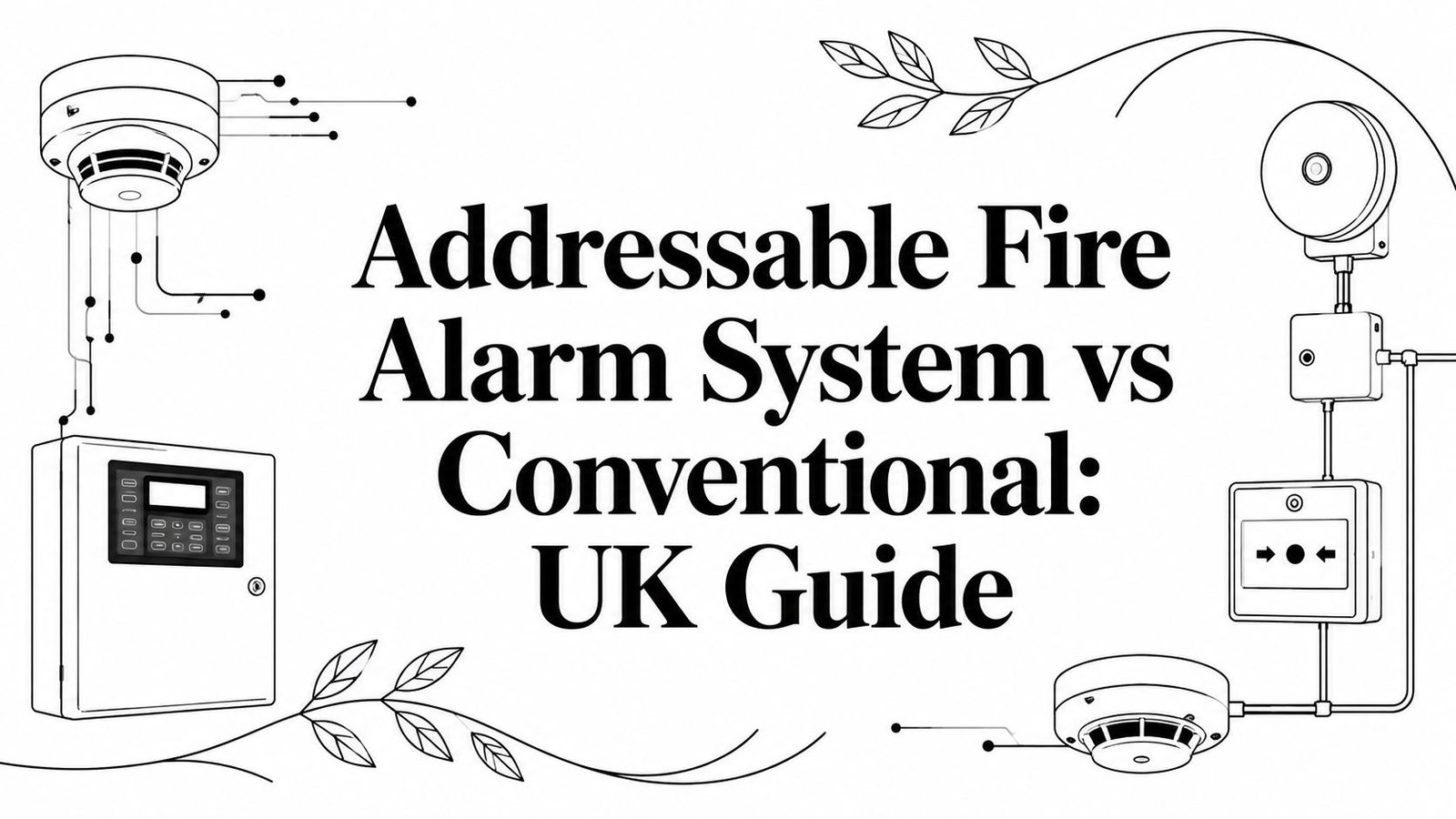
Addressable Fire Alarm System vs Conventional: UK Guide
A fire alarm sounds at 3am in a Cardiff HMO, a Newport care home, or a Bristol warehouse. The panel tells staff either “Zone 2, first floor” or identifies one exact detector and its programmed location. That difference affects how quickly someone can investigate, how confidently occupants can be managed, and how clearly the fire service receives information.
The right choice in an addressable fire alarm system vs conventional comparison isn't the system with the most features. It depends on your building's layout, occupancy, sleeping risk, maintenance arrangements, and tolerance for disruption from unwanted alarms. UK guidance, including BS 5839-1 guidance on conventional and addressable systems, gives property owners a practical framework, but the panel type alone doesn't determine whether a site is safe or well managed.
| Criterion | Conventional system | Addressable system |
|---|---|---|
| Alarm information | Identifies the affected zone | Identifies the individual device |
| Best fit | Smaller, simpler premises | Larger, multi-storey, complex, or higher-risk premises |
| Fault investigation | Requires zone searching | Provides device-level information |
| Expansion | Can become restrictive as the building changes | Usually offers greater flexibility |
| Initial installation | Often simpler | Requires more sophisticated equipment and programming |
| False-alarm prevention | Depends on detector choice and maintenance | Also depends on detector choice and maintenance |
Table of Contents
- Why the Panel Detail Matters When an Alarm Sounds
- How Conventional and Addressable Systems Actually Work
- Side by Side Comparison of Both Systems
- UK Compliance and BS 5839-1 Requirements
- The False Alarm Problem Neither System Solves Alone
- Which System Fits Your Property Type
- Costs Maintenance and Your Final Decision
Why the Panel Detail Matters When an Alarm Sounds
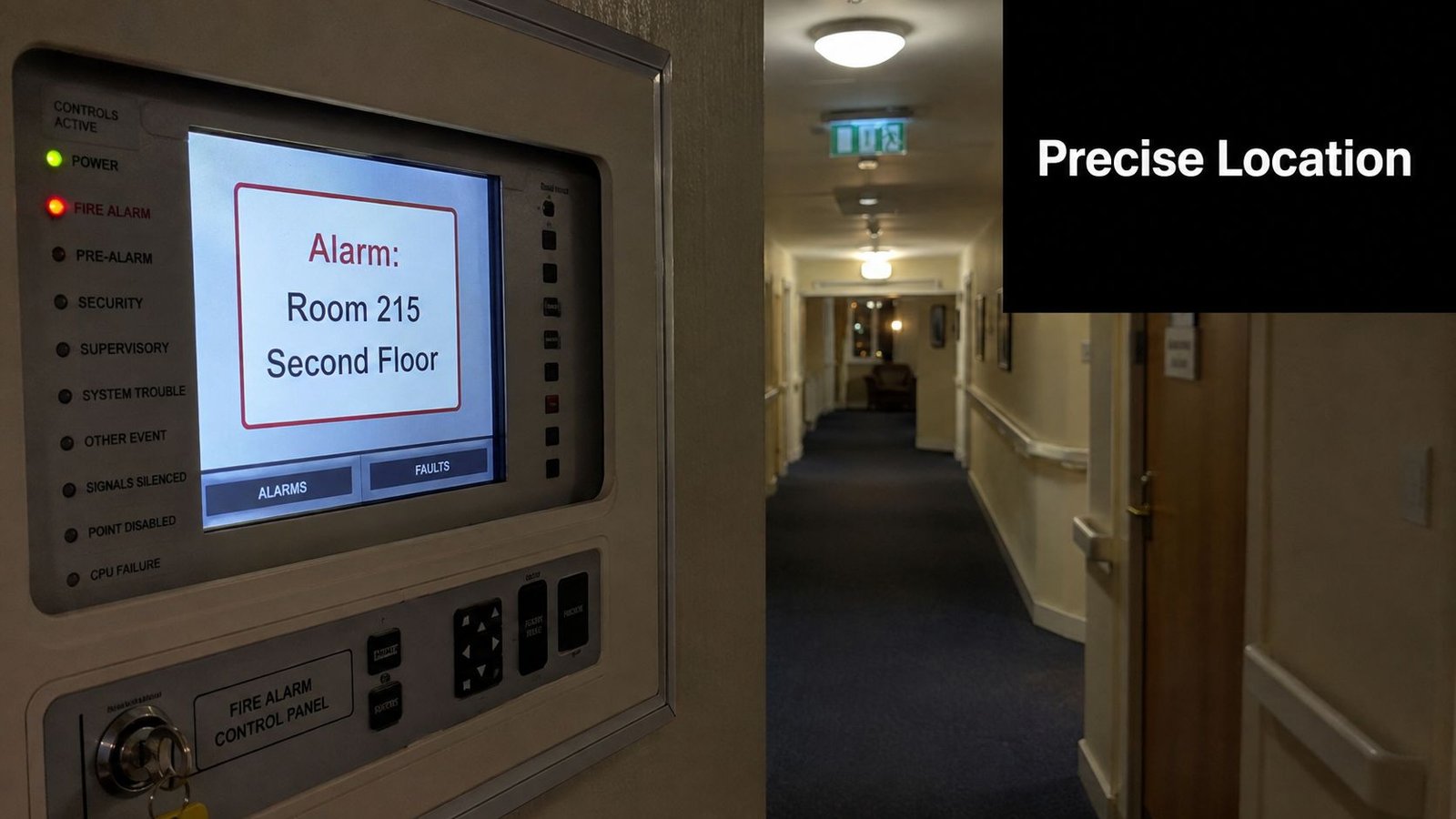
At 3am, a care worker hears the alarm and reaches the control panel. A conventional display may identify Zone 2, First Floor. That information is useful, but it still leaves the responder searching rooms, corridors, cupboards, and communal areas across the affected zone.
An addressable panel can identify the specific detector or call point that sent the alarm, provided the system has been correctly designed and its device descriptions are accurate. In a building with bedrooms, vulnerable occupants, several floors, or complicated access routes, that extra detail can change the first few minutes of the response.
The first five minutes are operational, not theoretical
A zone-only indication doesn't mean a conventional system has failed. It tells staff where to begin. The problem is that a large zone can create uncertainty, particularly if the building has locked rooms, long corridors, multiple access points, or residents who need assistance.
Device-level information can help staff check the right area sooner and give attending firefighters a more precise starting point. It also helps facilities teams distinguish an alarm activation from a fault condition, assuming the system has been properly commissioned, labelled, tested, and maintained.
Practical rule: If finding one detector requires staff to search a substantial part of the building, zone-level information may be too coarse for the risk you're managing.
The same principle applies to smaller domestic alarms. If you're trying to understand what different audible patterns mean in a home, a guide to what 3 beeps from your smoke detector can help separate an alarm signal from a warning or fault indication. Commercial premises need a properly designed fire alarm strategy, not just interpretation of a sound.
The decision, then, is straightforward. Ask whether your people can locate an incident quickly from a zone indication, or whether the building needs the panel to identify the actual device. In a compact shop, conventional may earn its place. In a multi-storey care home or HMO, addressable usually provides the operational clarity worth paying for.
How Conventional and Addressable Systems Actually Work
Both systems use detectors, manual call points, sounders, interfaces, and a control panel. The important difference is how the panel knows where an event occurred.
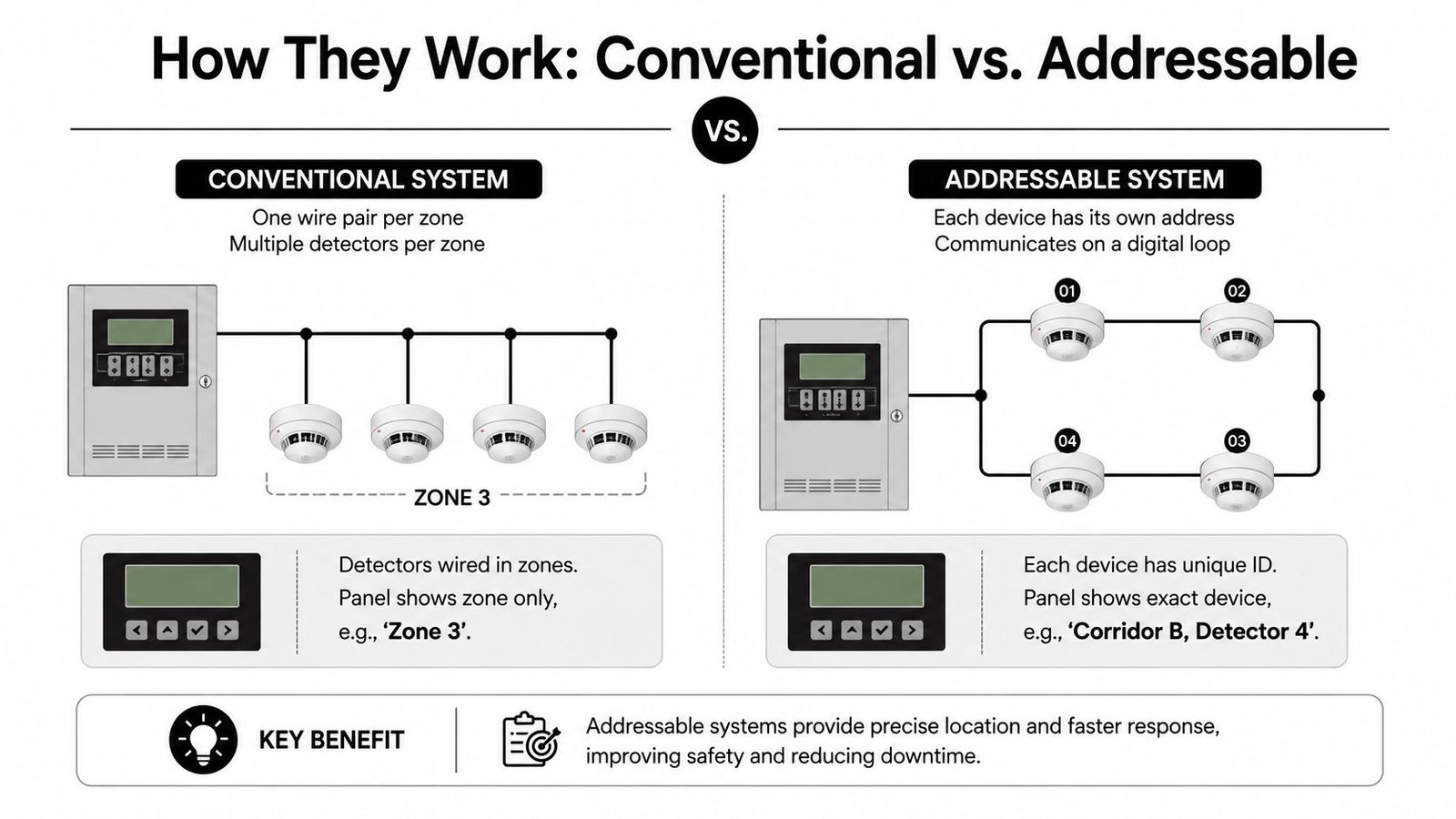
Conventional systems report by zone
A conventional installation divides the premises into zones. Detectors and call points within each zone connect to the control panel on that zone's circuit. When a detector senses smoke or heat, or someone operates a call point, the panel identifies the affected zone rather than the individual device.
The display might show Zone 3 or First Floor East, depending on how the installer has labelled the system. During a fault, the panel can indicate that a zone or circuit has a problem, but staff may still need to inspect several devices to find the cause.
That arrangement suits premises with a simple floor plan and zones that can be searched without delay. It isn't automatically obsolete, and it can be an appropriate UK solution when the building's use, occupancy, layout, and fire risk support it.
Addressable systems identify each device
An addressable system gives every detector, call point, and other compatible device a unique electronic address. The devices communicate with the control panel, commonly over a loop arrangement, so the panel can identify the particular device reporting an alarm or fault.
The display can provide a programmed description such as a room, corridor, or other location. The quality of that information depends on accurate device labelling and commissioning. A badly named addressable device won't provide much practical value, even though the hardware is more advanced.
Addressable doesn't mean wireless. It describes the way devices are individually identified and monitored. Conventional doesn't mean unsafe or non-compliant. The design still has to match the premises and the relevant British Standard recommendations.
The control panel also manages outputs. Depending on the design, it can operate sounders and interfaces associated with fire doors, HVAC shutdown, lifts, access control, or other life-safety functions. Those cause-and-effect relationships need careful design, testing, and documentation. They shouldn't be treated as an automatic benefit of buying an addressable panel.
For a practical overview of how individually identified devices support building protection, see addressable fire alarm systems. The central distinction remains simple: conventional systems tell you the zone, while addressable systems tell you the device.
The video below offers another visual explanation of the two approaches.
Side by Side Comparison of Both Systems
A fair comparison must look beyond the purchase price. A panel affects how people investigate alarms, maintain equipment, trace faults, extend the system, and connect fire detection to other building controls.
Conventional vs Addressable Fire Alarm Systems
| Criterion | Conventional system | Addressable system |
|---|---|---|
| Detection precision | Reports the zone containing the activated device | Reports the individual detector, call point, or compatible device |
| Wiring approach | Devices are grouped into zone circuits | Devices communicate using unique addresses, commonly on loops |
| Installation | Simpler for straightforward layouts | More involved design, programming, and commissioning |
| Fault finding | Staff or engineers search the affected zone | Panel identifies the reporting device or address |
| False-alarm diagnostics | Gives limited location detail | Makes it easier to identify the device involved |
| Maintenance | Familiar and practical on smaller systems | Supports more detailed device-level investigation |
| Expansion | New areas may require additional circuit planning | Often more adaptable to changing layouts |
| Building integration | Possible, but generally less granular | Better suited to programmed interfaces and detailed cause and effect |
| Best operational fit | Small, uncomplicated premises | Complex, multi-floor, multi-tenant, or higher-risk premises |
Precision and response
Addressable systems win decisively where staff need to locate an event quickly. A panel that identifies a specific detector can reduce the area requiring investigation. That matters in a hotel, care home, hospital, or large commercial building where searching every room in a zone can delay decisions.
Conventional systems remain effective where zones are small, clearly marked, and easy to search. If the building manager can reach any point in the zone without confusion, the extra address-level detail may offer limited operational value.
Installation and maintenance
Conventional systems are usually easier for engineers and building staff to understand. The configuration is less demanding, and the hardware can be a sensible fit for a modest property with a stable layout.
Addressable systems require accurate programming. Device descriptions, interfaces, cause-and-effect logic, and records must remain aligned with the building. That complexity is justified when the site needs detailed information, but it creates a poor result if nobody maintains the database or updates it after alterations.
False alarms and diagnostics
Neither panel type prevents an unsuitable detector from activating because of dust, steam, aerosols, cooking fumes, or environmental conditions. Addressable equipment can show which device activated, helping an engineer investigate the cause more quickly. That's a diagnostic advantage, not a guarantee of fewer unwanted alarms.
Conventional systems can still be managed well. Detector selection, siting, cleaning, testing, investigation of recurring activations, and a clear alarm management procedure matter more than fashionable terminology.
Integration and future changes
Addressable systems are generally the stronger choice where the fire alarm needs to exchange information with other building systems. A complex premises may require programmed responses involving fire doors, ventilation, lifts, access control, or other equipment.
That doesn't mean every small office needs addressable technology. If the building has a simple layout and no meaningful integration requirement, a conventional installation can avoid unnecessary complexity. Choose the capability your risk assessment needs, not the feature list a salesperson wants to demonstrate.
UK Compliance and BS 5839-1 Requirements
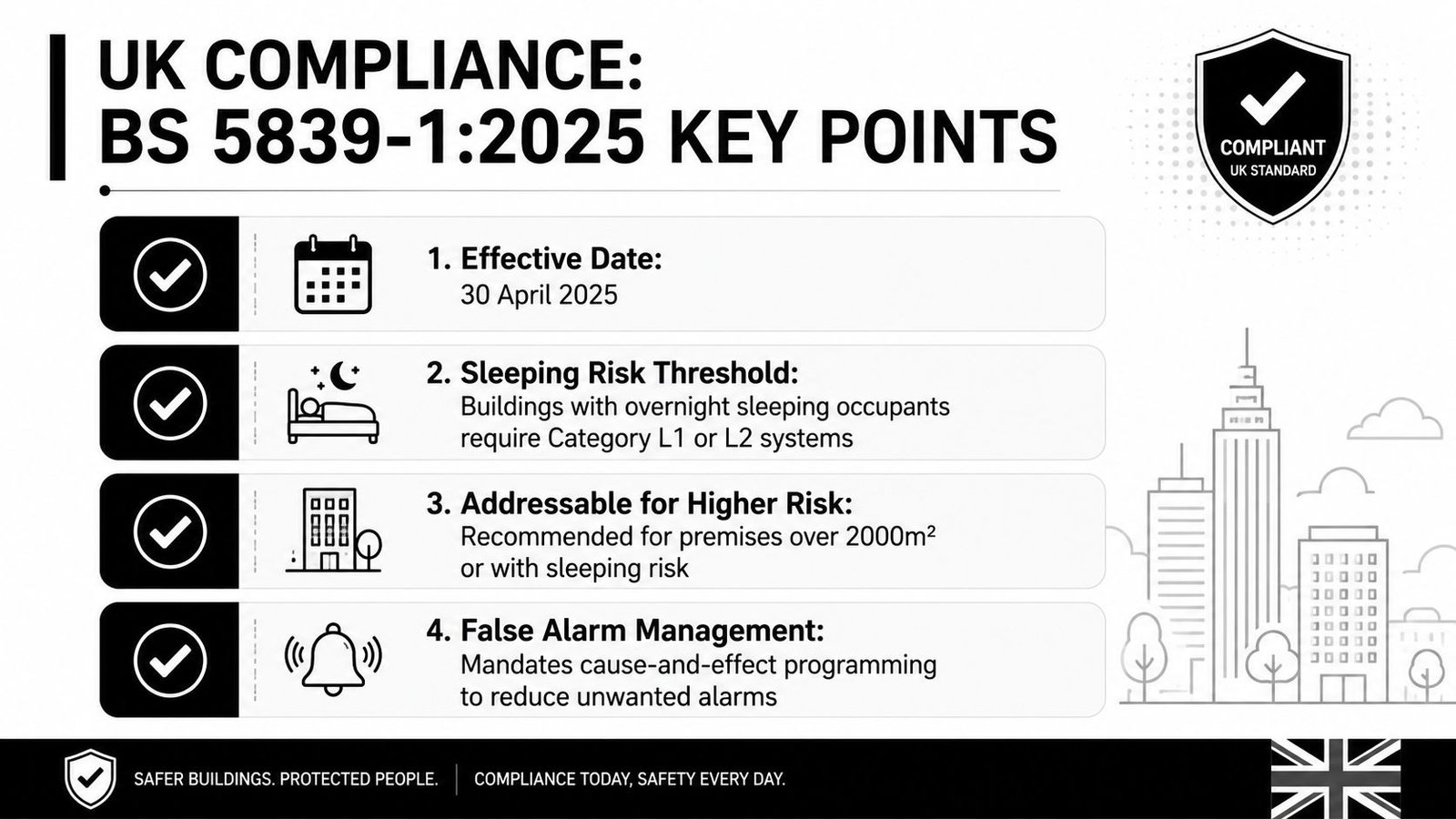
The current non-domestic British code of practice is BS 5839-1:2025, which came into effect on 30 April 2025 and replaced BS 5839-1:2017. The standard covers the design, installation, commissioning, and maintenance of fire detection and alarm systems in non-domestic buildings, including commercial premises, public buildings, and multi-occupancy residential blocks. The BS 5839-1:2025 fire alarm guide provides background on the updated framework.
The sleeping-risk threshold
UK guidance aligned with BS 5839 distinguishes system selection partly by occupancy and sleeping risk. Premises with facilities for more than 10 people to sleep should use an addressable system, while premises with up to 10 beds can use a non-addressable or conventional arrangement, subject to the overall design and risk assessment. This isn't a blanket instruction to replace every conventional panel. It's a risk-based application rule.
That threshold is particularly relevant to HMOs, hotels, hostels, care homes, student accommodation, and other premises where people may be asleep or need help evacuating. A Cardiff HMO with several occupied floors deserves more scrutiny than a small daytime-only retail unit, even if both have a similar footprint.
The standard's continuity across the 2017 and 2025 guidance matters. The UK approach hasn't changed to "addressable everywhere". Instead, it continues to connect system suitability to building use, occupancy, sleeping risk, and the consequences of delayed investigation.
Zone searching still affects design
For a conventional system, zone planning has to support a practical search. Guidance summarised in the BS 5839 pocket guide states that zone searching shouldn't require travel of more than 60 m from entry into a zone to identify a fire.
That requirement is easy to overlook during refurbishment. A zone that appears acceptable on an old drawing may become unsuitable after partitions, locked doors, tenant alterations, or a change in use. If staff must cover a confusing or extended route, addressable identification may be the more defensible choice even where the building isn't automatically forced into it.
Owners should keep the fire risk assessment, alarm design, logbook, cause-and-effect documentation, and maintenance records consistent. Practical protective fire safety tips for property managers can support wider inspection routines, but they don't replace a competent UK fire alarm design.
For premises managers, fire safety compliance guidance is most useful when it leads to a site-specific review. Do not approve an addressable upgrade because it sounds more modern, and do not retain a conventional system because it already works. Check the occupancy, sleeping arrangements, zone search, evacuation strategy, and required interfaces against the current standard.
The False Alarm Problem Neither System Solves Alone
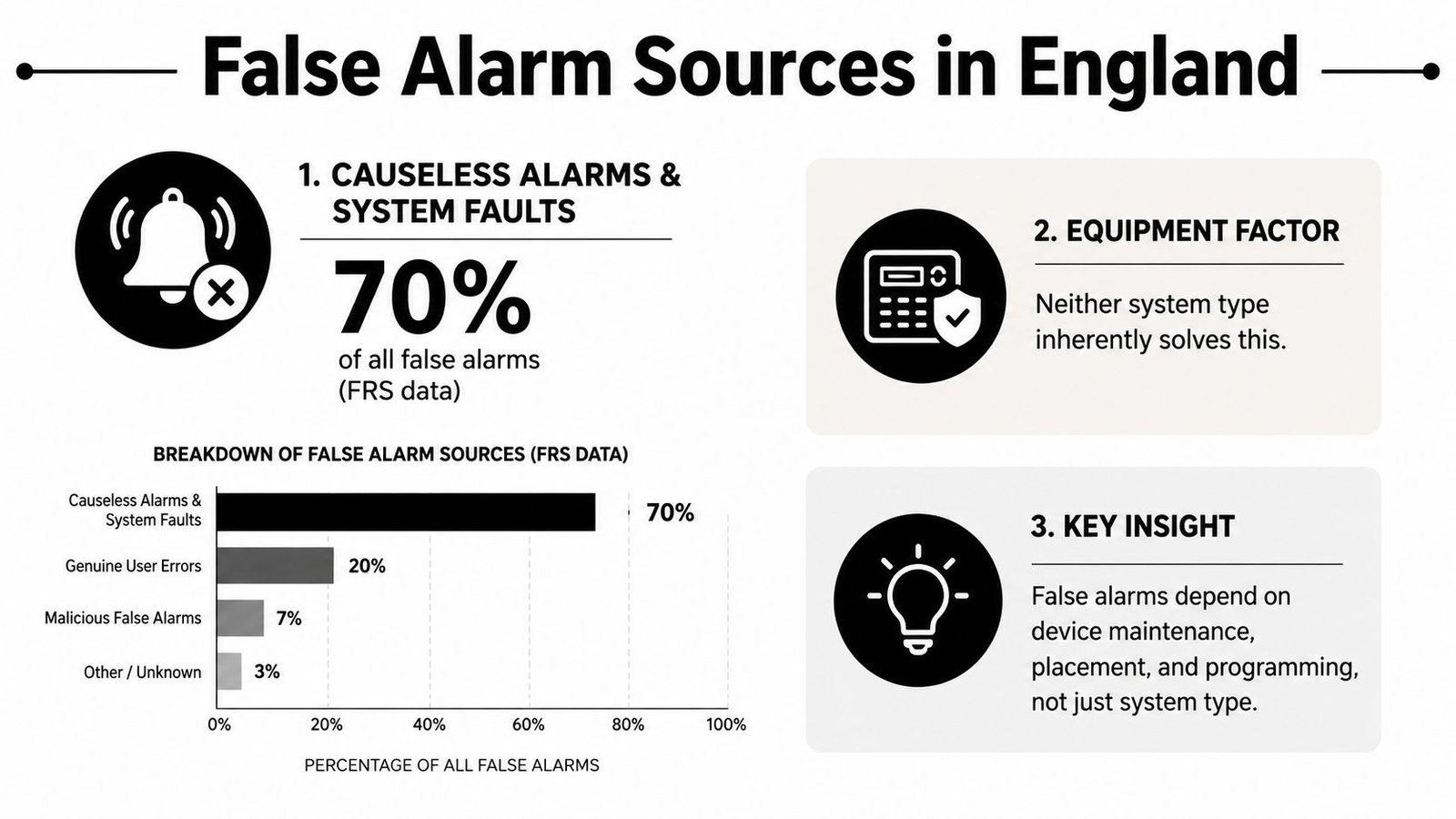
England's fire and rescue services attended 250,226 fire false alarms in the year ending March 2025, and 70% were attributed to apparatus rather than actual fire conditions, according to the official fire and rescue incident statistics.
That data changes the question. Property owners often ask whether addressable systems reduce false alarms, but a more useful question is whether the site has controlled its detector environment, maintenance, alarm management, and response process.
What actually drives unwanted activations
A detector installed too close to steam, dust, cooking activity, vehicle exhaust, or another local source of contamination can activate regardless of whether the panel is conventional or addressable. Poor maintenance can leave a device dirty or damaged. Building works can introduce dust, change airflow, or alter the space without updating the detection design.
Alarm management also matters. Staff need clear instructions for investigating signals, recording causes, contacting the monitoring provider where applicable, and escalating repeated activations. Engineers need to look for patterns instead of repeatedly resetting the panel without addressing the underlying cause.
Where addressable earns its keep
An addressable panel can identify the exact device involved in an unwanted alarm. That can save time for a maintenance engineer investigating a warehouse detector, an HMO corridor, or a communal area in a multi-tenant building.
It won't automatically stop the detector activating again. The engineer may still need to clean, relocate, replace, or reconfigure the device, or change the environmental conditions around it. Treat addressable technology as a better investigation tool, not a substitute for competent design and maintenance.
A precise alarm message helps you find the problem. It doesn't, by itself, prevent the problem.
For a South Wales or South West property with repeated call-outs, review the alarm history before replacing the panel. The correct remedy may be detector technology, siting, cleaning, programming, staff behaviour, or a documented investigation process. Upgrade to addressable when its diagnostic detail solves a genuine operational weakness.
Which System Fits Your Property Type
System choice becomes clearer when you start with the building rather than the catalogue.
Residential homes and small retail units
A private home or small, uncomplicated retail unit may not need the complexity of a commercial addressable system. The design still has to match the applicable fire safety requirements, but a conventional arrangement can be reasonable where the premises are compact, the layout is straightforward, and responders can quickly locate an alarm.
A small shop in Swansea or a standalone office near Bridgend should be assessed on its actual risk, not dismissed or upgraded solely because addressable technology is available. The panel must remain accessible, clearly labelled, tested, and supported with proper records.
SME offices and small commercial premises
For an SME office, ask whether the layout is likely to change. A simple office with clear zones may suit conventional equipment. An office split across floors, occupied by several businesses, or connected to access control and ventilation may gain more from addressable reporting.
If tenants regularly alter partitions, a device-level system can make future investigation and documentation easier. The decision should also consider whether the fire alarm must trigger other building functions.
Warehouses and logistics hubs
A Bristol warehouse often has long travel routes, high storage, changing stock arrangements, loading areas, plant rooms, and forklift activity. Conventional zoning can become blunt when one alarm covers a large or divided space, particularly if staff don't know where to start searching.
Addressable is usually my recommendation for a complex warehouse or logistics site. It provides clearer incident information and gives the design more scope for interfaces, but detector selection and placement still need to account for dust, temperature, airflow, and operational activity.
HMOs and multi-tenant buildings
A Cardiff HMO or Newport multi-tenant building creates a strong case for addressable identification when several floors, bedrooms, communal kitchens, locked rooms, or vulnerable occupants are involved. Sleeping risk is central, and the system selection should be checked against the BS 5839 approach rather than based on the panel already installed.
For a building with several tenants, the panel description must be meaningful. “Flat B corridor detector” is more useful than an unexplained device number, especially when the person responding at night isn't the installer.
Care homes and hotels
Care homes and hotels normally justify a more detailed design because occupants may be asleep, unfamiliar with the premises, or unable to evacuate without assistance. Addressable technology supports more precise investigation and can help staff manage an event across bedrooms, corridors, kitchens, plant areas, and communal spaces.
For these premises, I wouldn't choose conventional merely to reduce the installation price. The operational consequences of searching a broad zone during a night-time alarm can outweigh the initial saving, particularly where the building has multiple floors or complex evacuation arrangements.
Costs Maintenance and Your Final Decision
Conventional systems often have a lower initial installation cost because the equipment and configuration are simpler. Addressable systems require more advanced devices, programming, commissioning, and accurate records, so the initial quotation can be higher.
The purchase price isn't the full cost. Include planned maintenance, engineer time during fault finding, panel or device availability, future alterations, false-alarm investigations, and disruption to tenants or operations. A conventional system may be economical where a zone can be searched quickly. An addressable system can justify its additional investment when it reduces uncertainty in a complex building.
Use this checklist before approving a design:
- Occupancy: Does anyone sleep on the premises, and could occupants need help to evacuate?
- Layout: Can staff search each conventional zone quickly and confidently?
- Building changes: Are partitions, tenants, extensions, or refurbishments likely?
- Alarm history: Are repeated unwanted alarms caused by devices, the environment, maintenance, or procedures?
- Interfaces: Does the system need to control or signal fire doors, HVAC, lifts, access control, or monitoring equipment?
- Records: Can your team keep device descriptions, drawings, test results, and cause-and-effect information current?
For a practical discussion of the financial factors, review fire alarm installation cost guidance, then obtain a site-specific assessment rather than comparing headline prices alone. Wisenet Security Ltd can assess premises across South Wales and the South West, design and commission conventional or addressable systems, and provide ongoing compliant maintenance.
Wisenet Security Ltd can survey your premises, review its occupancy and alarm history, and recommend a conventional or addressable system that fits the actual risk. Visit Wisenet Security Ltd to arrange a consultation for your property in Cardiff, Newport, Swansea, Bristol, or the surrounding areas.