Fire Alarm Installation Cost: UK Prices 2026 Guide
For a typical UK home, a basic fire alarm installation usually costs £350 to £600, while commercial installations commonly start around £2,500 and often run to £8,000 or more. Those are averages, not promises, and the quote you receive in South Wales or the South West will depend on the building, the system type, the wiring route, and the level of compliance the property needs.
Enquiries into fire alarm costs often begin following a survey, a landlord query, an insurance question, or a nudge from a fire risk assessment. Suddenly, a simple question expands into a long list of technical terms and very different quotes. One installer talks about LD2, another mentions addressable panels, and a third says wireless might save labour.
That's where the confusion usually starts. The price gap between two quotes often isn't random. It usually comes down to scope, coverage, cable routes, device count, and whether the installer has priced for proper design, commissioning, and certification.
In South Wales and the South West, the same national cost ranges still apply, but local building stock changes the practical side of the job. Older terraces in Cardiff, mixed-use high streets in Bristol, converted HMOs in Newport, and light industrial units around the M4 corridor all bring different access issues and compliance demands. The useful question isn't just “what does a fire alarm cost?” It's “what am I paying for, and why?”
Table of Contents
- Estimating Your Fire Alarm Installation Cost
- Typical UK Fire Alarm Costs in 2026
- Understanding the Key Cost Drivers
- Sample Cost Scenarios in South Wales and The South West
- Navigating UK Fire Safety Regulations
- Smart Ways to Manage Your Fire Alarm Cost
- Frequently Asked Questions
Estimating Your Fire Alarm Installation Cost
If you're trying to set a budget before asking for quotes, start with the property type. For homes, the broad entry point is straightforward. A standard domestic system for a 2 or 3-bedroom home sits in the £350 to £600 range according to UK domestic fire alarm cost data from MyJobQuote.
Commercial premises work differently. The usual starting range for a standard compliant system is much wider because panel type, layout, and certification matter more. For business properties, Checkatrade's 2026 UK commercial fire alarm guide places most standard installations at £2,500 to £8,000, with small offices and shops often below larger addressable systems.
That gives you a sensible budget range, but it doesn't tell you why one quote lands at the bottom and another at the top.
Start with the building, not the product
A good estimate begins with four questions:
- What type of property is it? A three-bed house, a retail unit, a workshop, and an HMO all trigger different design decisions.
- How much coverage is required? Basic escape-route protection costs less than full-room coverage.
- Is the building easy to wire? Empty lofts, suspended ceilings, and clean cable routes keep labour under control. Solid walls, occupied spaces, and awkward risers push it up.
- What level of documentation is needed? Homes are simpler. Commercial jobs need proper design, commissioning, and certification.
Practical rule: If a quote looks surprisingly cheap, check what's missing before you check what's included.
In South Wales and the South West, that matters more than many buyers expect. Older housing stock, converted properties, and occupied trading premises often make installation slower than the headline national average suggests. The system itself might be standard. The route to installing it often isn't.
Typical UK Fire Alarm Costs in 2026
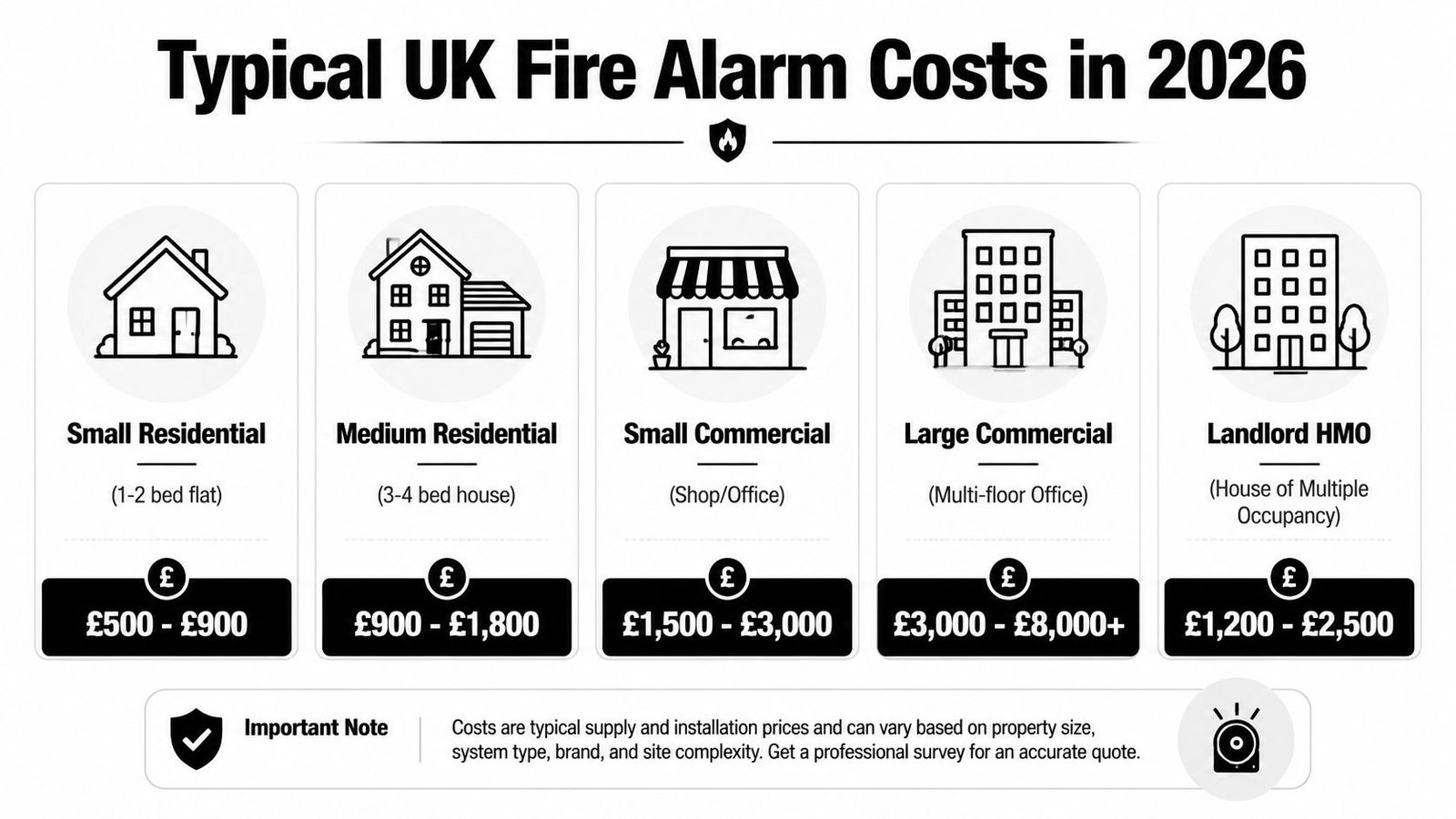
National averages are useful because they give you a baseline. They don't replace a site survey, but they do show whether a quote is broadly sensible or worth challenging.
Early in the process, it helps to see the market visually.
Residential properties
For a standard 2 or 3-bedroom home, MyJobQuote's UK 2026 pricing guide puts the average fire alarm installation cost at £350 to £600. The same source states that a full home system with 4 to 6 detectors is typically £200 to £450 when fully installed, while professionally installed interlinked mains-wired smoke and heat alarms in a 3-bedroom house usually sit at £300 to £600.
The bigger jump comes when the category changes.
According to Elec-Mate's guide to BS 5839-6 domestic categories, an LD2 system for a 3-bedroom house, covering escape routes and higher-risk rooms with 5 to 7 mains-powered interlinked units, averages £500 to £1,000. An LD1 system, covering all habitable rooms with 8 to 12 hardwired detectors, typically costs £1,000 to £2,000.
That gap makes sense in practice. More detectors mean more device cost, more cable, more labour, and more time testing every point.
Small to medium businesses
For commercial properties, Checkatrade's UK commercial fire alarm installation cost guide says small offices or retail shops commonly install conventional systems costing £1,500 to £5,000. The same guide notes that standard commercial systems average £2,500 to £8,000, including equipment, wiring, labour, and certification.
That's the bracket most SMEs in Cardiff, Bristol, Newport, and Swansea are likely to recognise. A small single-floor premises with a straightforward layout usually sits at the simpler end. Add multiple floors, stock rooms, staff areas, awkward cable routes, or a need for device-level fault finding, and the cost climbs.
Later in the buying process, it also helps to hear the basics explained in plain language.
Industrial and large commercial sites
Larger sites don't price well from guesswork. Here, square metre benchmarking is often the cleaner way to think about it. Fire Protection Engineers UK's 2026 commercial benchmark uses £22.50 per square metre as a standard benchmark, with a typical range of £10 to £25 per m² for materials, labour, and certification.
That same benchmark puts a 400 m² office at £4,000 to £10,000, depending on complexity. It also notes that larger facilities, especially those needing addressable systems and more extensive cable routing, can rise well beyond that.
A practical way to read these numbers is below.
| Property type | Typical cost picture |
|---|---|
| Standard house | Usually at the lower end of the market unless the category is upgraded |
| Small shop or office | Often conventional, with cost driven by layout and compliance scope |
| Medium office | Frequently needs a more capable panel and more detailed zoning |
| Warehouse, hotel, school, larger facility | Costs rise quickly when detection points, routing, and cause-and-effect requirements increase |
A fire alarm quote is rarely expensive because of one item. It rises because several moderate decisions stack together.
Understanding the Key Cost Drivers
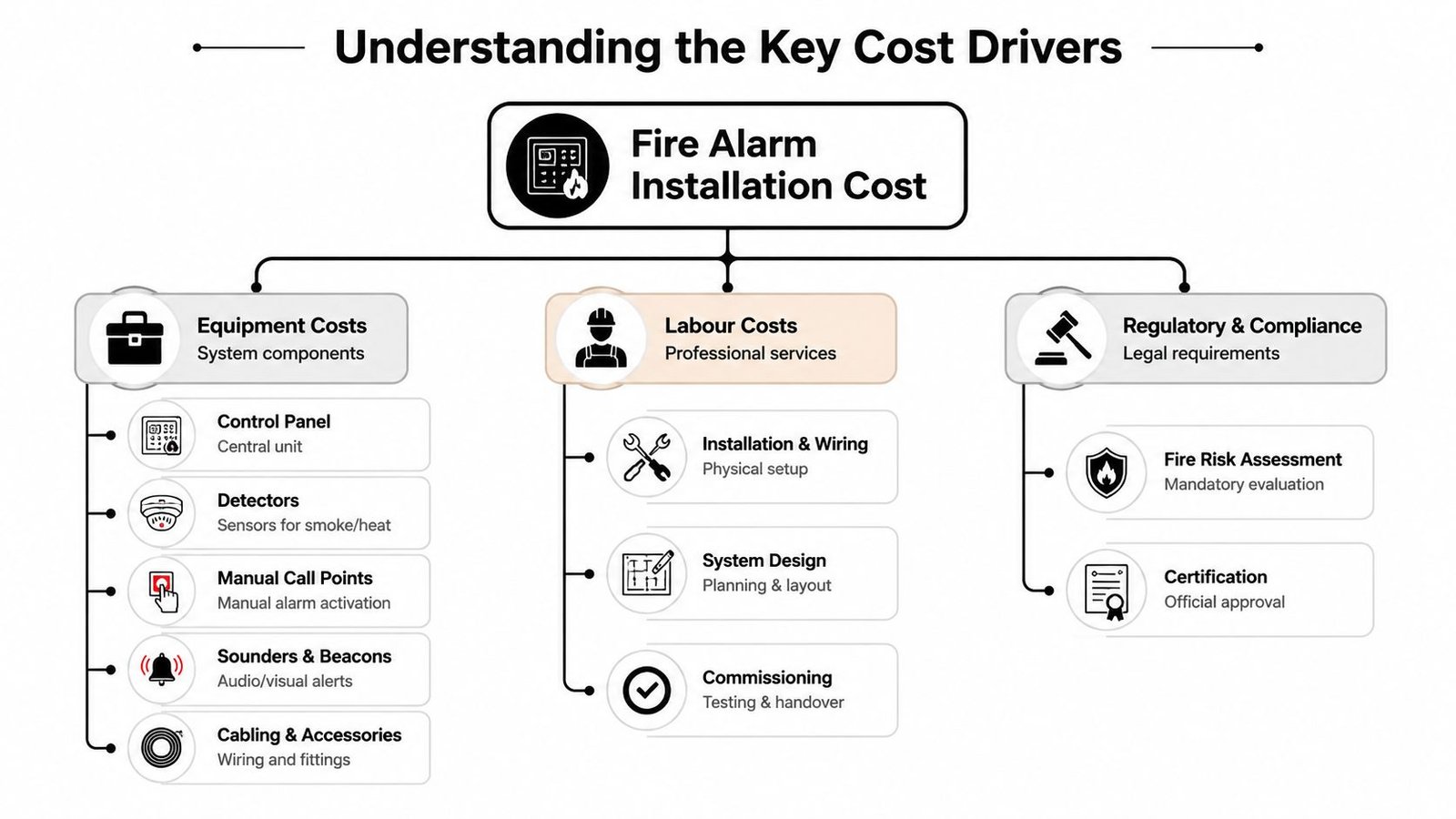
The final price comes from the design choices behind the system, not just the box on the wall. Two installations can look similar to a client and still be priced very differently because one needs broader coverage, harder wiring routes, or more involved certification.
System category and coverage
For domestic work, the first big cost driver is the system category. LD2 and LD1 don't mean “cheap” and “expensive”. They mean different levels of life protection.
An LD2 arrangement focuses on escape routes and higher-risk rooms. An LD1 setup extends protection across all habitable rooms. That extra coverage is why Elec-Mate's domestic category guide prices LD2 at £500 to £1,000 and LD1 at £1,000 to £2,000 for a 3-bedroom house.
The same source also explains one reason LD1 costs more. Fire-resistant cable such as MINIBUS or similar adds £1.50 to £2.50 per metre compared with simpler routing, which affects both materials and labour.
For commercial properties, the category question shifts into system architecture. A small, straightforward premises may suit a conventional setup. A more complex building often needs something more intelligent and easier to manage. If you want a plain-language example of that type of system, conventional fire alarm systems are the usual starting point for smaller, simpler buildings.
Wired, wireless, and the labour question
Clients often focus on equipment first, but labour is where many quotes diverge.
MyJobQuote's residential fire alarm cost guide notes that qualified electrician labour for more complex mains-operated domestic systems averages £100 to £150, with hourly rates typically £50 to £100. It also states that wireless interlinked alternatives such as Aico RadioLINK or FireAngel Pro can price competitively at £200 to £500 for a whole house because they reduce installation time.
That aligns with what tends to happen on site. Wireless can save money when cable routes are disruptive, decorative finishes need protecting, or the property is occupied. Hardwired systems still make sense where access is easy and a permanent wired route is practical.
A quick comparison helps:
- Hardwired systems work well in renovations, rewires, or properties where cable routes are accessible.
- Wireless interlinked systems suit finished homes where chasing walls and lifting floors would add unnecessary disruption.
- Commercial wireless options can help in awkward retrofit environments, but they still need proper design and aren't automatically the cheapest choice.
On site: The expensive part is often not the detector. It's the time needed to get to the right position cleanly and compliantly.
Panel type, devices, and certification
The panel and field devices also matter. Smoke detectors, heat detectors, manual call points, sounders, visual alarms, interfaces, and cabling all add to the materials list. So does the control panel itself.
Commercial quotes rise further when the system needs more refined control. Addressable systems usually cost more upfront than smaller conventional systems, but they make fault finding, expansion, and device identification easier in larger premises. That's why medium offices, schools, hotels, and warehouses often move away from the most basic setup.
Then there's the part clients don't see. Design, commissioning, testing, handover documents, and certification are part of the job. They're not optional extras if the installation has to stand up to inspection, landlord scrutiny, insurer questions, or enforcement review.
Sample Cost Scenarios in South Wales and The South West
National ranges are useful, but people usually want to know what those numbers look like in a real property nearby. The examples below use the UK benchmarks already covered and apply them to the sort of buildings commonly seen in Cardiff, Bristol, and Newport.

Cardiff three-bedroom semi-detached house
A common domestic job in Cardiff is a three-bedroom semi where the owner wants interlinked protection without turning the house into a building site. If the requirement is standard domestic coverage, the national benchmark of £350 to £600 for a 2 or 3-bedroom home is the right starting point, as noted earlier.
If that house needs LD2 coverage because the risk profile or occupancy calls for more than a basic setup, the likely budget shifts upward into the LD2 range discussed above. In a finished home with limited access above ceilings, wireless interlinked units can sometimes be the sensible choice because they avoid extra decorating and reduce labour disruption.
What usually pushes the quote up locally is not the postcode. It's the construction. Solid internal walls, limited loft access, or previous alterations can turn a simple cable route into half a day's work.
Bristol high-street retail shop
A small retail unit in Bristol often needs a conventional commercial system with detectors, manual call points, sounders, and a compliant panel. For this type of premises, the earlier commercial range for small shops and offices is the right benchmark.
The deciding factors are usually:
- Shop layout: Open-plan frontage is simpler than back-of-house rooms, stock areas, and staff spaces.
- Trading conditions: Night work or phased work may be needed if the business can't close for long.
- Building fabric: Mixed-use buildings above shops often complicate routing and access.
- Documentation: Commercial certification and records must be complete.
If you're comparing local proposals for this kind of premises, a specialist installer should be able to explain exactly what category is being priced and why. A proper fire alarm installation service quote should make the scope clear, not bury it in technical shorthand.
Newport small industrial unit
A small industrial unit in Newport is where costs can widen quickly. One unit may be clean, open, and easy to wire. The next may have mezzanine storage, roller shutters, separate offices, or harsher environmental conditions that change device selection.
Here, the square metre benchmark covered earlier is often more useful than a generic “small business” number. It gives the client a rough sense of whether the quote reflects the floor area and complexity. If the premises needs a more capable addressable setup, more sounder coverage, or more extensive cable routing, the cost increases for understandable reasons rather than arbitrary ones.
The lesson from local projects is simple. Two properties that look similar on paper can price very differently once access, risk areas, and certification requirements are properly assessed.
Navigating UK Fire Safety Regulations
Cost matters, but compliance decides whether the system is suitable. A cheap installation that doesn't meet the required standard usually becomes an expensive problem later.
For domestic properties, the relevant standard often discussed is BS 5839-6, which is where LD categories come in. For commercial premises, the conversation usually centres on BS 5839 more broadly, the fire risk assessment, and the obligations placed on the responsible person under the Regulatory Reform (Fire Safety) Order 2005.
What compliance looks like in practice
For a homeowner, compliance usually means choosing the correct domestic category and making sure the alarms are properly interlinked, positioned, tested, and installed.
For a business owner, landlord, or managing agent, compliance is more involved. It typically means:
- Matching the system to the fire risk assessment: The system should reflect the building's actual use, hazards, and occupancy.
- Using the right design standard: The installer needs to design and commission to the applicable British Standard, not guess.
- Keeping records: Certificates, zone charts, user instructions, and maintenance logs all matter.
- Maintaining the system: A compliant installation still needs regular testing and servicing.
If you haven't had the building's fire risk reviewed properly, independent guidance on Workplace fire risk assessments can help clarify what the premises requires before you commit to a system design.
Why paperwork and certification affect cost
Certification is part of the fire alarm installation cost because someone has to design, test, commission, and document the system properly. That applies even more strongly in commercial work.
Fire Protection Engineers UK's commercial benchmark states that £22.50 per square metre is a common benchmark for standard commercial premises and that a 400 m² office typically falls between £4,000 and £10,000, including materials, labour, and certification. That last part matters. Certification isn't an afterthought. It's built into the cost of a compliant installation.
Commercial clients should also pay attention to the installer's scope. A proper commercial fire alarm systems installation service should cover design, fitting, commissioning, and handover, not just the physical mounting of devices.
Compliance isn't just “having alarms fitted”. It's being able to show that the right system was designed, installed, and handed over correctly.
Smart Ways to Manage Your Fire Alarm Cost
The best way to control cost is to make the right technical decisions early. The worst way is to buy the cheapest quote and find out later that it excluded the work your building needed.
Spend where it matters
A sensible budget comes from fitting the system to the risk, not over-engineering it.
- Choose the right category: Don't pay for whole-property coverage if the property only requires a lower category. Equally, don't under-specify a system that should protect more areas.
- Use wireless where the building suits it: In finished domestic properties and awkward retrofit jobs, reduced installation time can make wireless the practical option.
- Think about future changes: A business expecting expansion should consider whether the panel and layout can grow without major rework.
- Protect the installation quality: Good commissioning and clear documentation reduce the chance of nuisance faults, confusion at handover, and expensive revisits.
Avoid the common buying mistakes
The cost problems I see most often don't come from premium equipment. They come from poor scoping.
One quote includes the right detector coverage, a suitable panel, full commissioning, and certification. Another quote leaves out key devices, assumes easier cable routes, or prices to a lower standard. On paper, the cheaper one looks attractive. On site, it turns into variation costs, delays, or a non-compliant result.
Use this checklist when comparing proposals:
| What to check | Why it matters |
|---|---|
| System category | Confirms whether both quotes are pricing the same level of protection |
| Device count | Shows whether one quote has simply omitted coverage |
| Wired or wireless basis | Affects labour, disruption, and future servicing |
| Testing and commissioning | Ensures the handover is complete |
| Certification included | Critical for compliance and records |
The cheapest fire alarm installation cost rarely stays cheap if the scope was wrong to begin with. A proper survey and a clear written proposal usually save money by preventing avoidable rework.
Frequently Asked Questions
How much does annual fire alarm maintenance cost
For small commercial systems, Checkatrade's commercial cost guide places annual maintenance contracts at £200 to £800, with costs increasing as systems become larger or more complex. For many businesses, maintenance is part of the ownership cost, not an optional add-on.
Do I really need a monitored fire alarm system
That depends on the building, its use, and the fire strategy. Some premises need monitoring because of risk profile, occupancy pattern, or insurer expectations. Others may only need a locally sounding system. The right answer comes from the fire risk assessment and the building's operating reality, not a generic sales pitch.
How long does a typical installation take
There isn't one fixed timescale that fits every job. A straightforward house can be much quicker than a small occupied commercial premises with access limits and documentation requirements. What affects duration most is usually access, wiring routes, occupancy, and whether the building stays in use during the works.
Should I choose wired or wireless
Choose based on the building, not preference alone. Wired systems suit properties where cable routes are accessible or where refurbishment already exposes the structure. Wireless can be the better option in finished homes, heritage-style interiors, and occupied spaces where disruption matters. Neither is automatically better in every case. The building decides.
If you want a clear, site-specific quote rather than a rough national average, Wisenet Security Ltd can assess your property in South Wales or the South West and advise on the right fire alarm system for the building, the risks, and your budget. A proper survey makes the numbers make sense. It also helps you avoid paying for the wrong system.