Gate Automation Kit: Your 2026 UK Buyer’s Guide
You pull onto the drive after work. It's dark, raining, and the gate is exactly where you don't want it to be. You stop the car, get out, wrestle with a heavy leaf that never quite swings cleanly, then do it all again once you're inside. For a business, the version is different but just as frustrating: staff waiting at an entrance, delivery vehicles blocking access, or a manager worrying that an unsecured gate has become the weak point in the whole perimeter.
That's usually the moment people start searching for a gate automation kit. Not because they want another gadget, but because they want the entrance to work properly. They want easier access, better control, and fewer security compromises.
Interest in automation isn't hard to understand. A market forecast estimates the UK gate openers market at US$0.13 billion in 2026, within a wider European market of US$0.65 billion in 2025. The same forecast links demand to bundled systems that combine openers, electronics, and safety sensors for security and access control, which is exactly how most buyers now approach the upgrade rather than treating it as a simple motor purchase (Fortune Business Insights gate openers market forecast).
The important shift is this. Buying an electric gate isn't really about buying a motor. It's about choosing a system that suits your gate, your property layout, your safety responsibilities, and how you'll live with it for years.
Table of Contents
- The End of Pushing Gates in the Rain
- Decoding the Kit What Is a Gate Automation Kit
- Swing or Slide Choosing the Right Gate Motion
- Key Factors for Your Gate and Property
- Understanding UK Gate Safety and Legal Compliance
- DIY vs Professional Installation A Cost and Risk Analysis
- Secure Your Entrance with Wisenet Security
The End of Pushing Gates in the Rain
A manual gate often feels manageable until the small annoyances pile up. A wet evening. A stiff hinge. A courier waiting outside. A parent trying to keep children inside the boundary while opening the entrance. At that point, the gate stops being a charming feature and starts behaving like a daily obstacle.
A good gate automation kit fixes the obvious inconvenience, but convenience is only the front layer. The bigger benefit is control. You decide who gets in, when they get in, and how the system responds if something is in the way.
For homeowners, that might mean opening the gate from the car rather than stepping into traffic or weather. For a small business, it can mean tidier access for staff, visitors, and deliveries. For shared properties, it's often about reducing the temptation to leave the gate unsecured because manual operation is too much hassle.
A gate that's awkward to use usually gets used badly. People prop it open, leave it unsecured, or stop bothering with it altogether.
That's why the right question isn't just, “Can I automate this gate?” It's, “Can I automate it safely, reliably, and in a way that suits the property I have?”
What buyers often miss
Many people start by comparing motor power or remote controls. Those matter, but they're not the first thing an engineer looks at.
A more useful starting point is:
- How the gate moves: Swing and sliding gates need different hardware and space.
- What the gate is made from: Timber, steel, and aluminium all place different loads on the operator.
- How old the gate is: Older gates often introduce alignment and clearance issues.
- Who uses the entrance: A family home, office yard, and shared driveway don't need the same setup.
If you keep those points in mind, a gate automation kit becomes much easier to judge. You stop shopping for a gadget and start specifying part of the property's security system.
Decoding the Kit What Is a Gate Automation Kit
A gate automation kit is best understood as a team of parts working together. If one part is weak, badly chosen, or badly installed, the whole system suffers. That's why treating it as “just a motor” causes so many problems later.
Industry descriptions now define a modern gate automation system as a set of connected components that includes gate openers, control electronics, safety sensors, and remote access capabilities. Market analysis also indicates that residential security accounts for about 56% of global application share in 2026, which helps explain why these kits are increasingly designed around controlled, safe entry rather than simple opening and closing alone (Quiko guide to automatic gate systems).
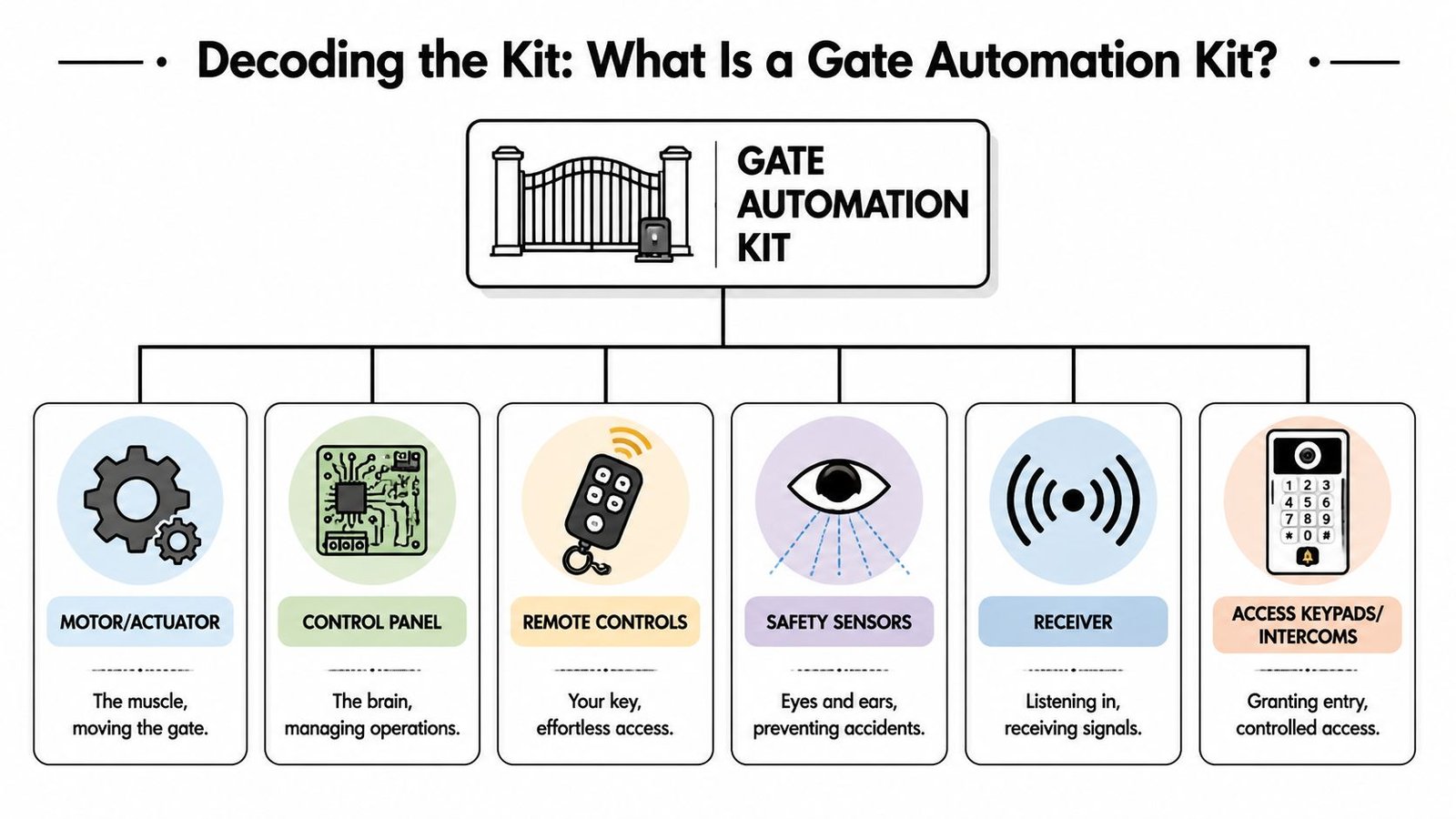
The muscle, the brain, and the senses
Think of the system like a small security team.
Motor or actuator
This is the muscle. It provides the force that moves the gate leaf or sliding panel. On a swing gate, it may push with a ram or pull through an articulated arm. On a sliding gate, it drives the gate along its travel path.Control panel
This is the brain. It decides what happens when you press the remote, when the gate should stop, and how it should react if a sensor detects a problem.Safety sensors
These are the senses. Photocells watch the opening. Obstacle detection monitors resistance. If the gate meets something it shouldn't, the system should react instead of continuing blindly.Receiver and remotes
This is the command layer. It listens for authorised signals and triggers the opening cycle.Keypads, intercoms, or access devices
These control who gets through. They matter more on busy homes, offices, yards, and shared entrances where not everyone should have a handheld remote.
Why the small parts matter
People often focus on visible hardware because it feels tangible. The hidden electronics deserve equal attention. A strong motor paired with poor controls is a bit like fitting a powerful engine to a car with weak brakes. The movement works right up until precision and safety matter.
Practical rule: Judge the kit by how it stops and protects, not only by how it opens.
A decent setup should feel calm and predictable. The gate starts smoothly, stops where it should, reacts when the path is blocked, and still makes sense to use during a power cut or fault.
That's the difference between a basic mechanical opener and a proper access system.
Swing or Slide Choosing the Right Gate Motion
The first technical decision is simple to state and surprisingly important in practice. Should the gate swing or slide?
The answer isn't about taste alone. It depends on the driveway shape, side clearance, slope, pillars, and how much room the gate has to move without hitting a wall, a parked car, or a pedestrian path.
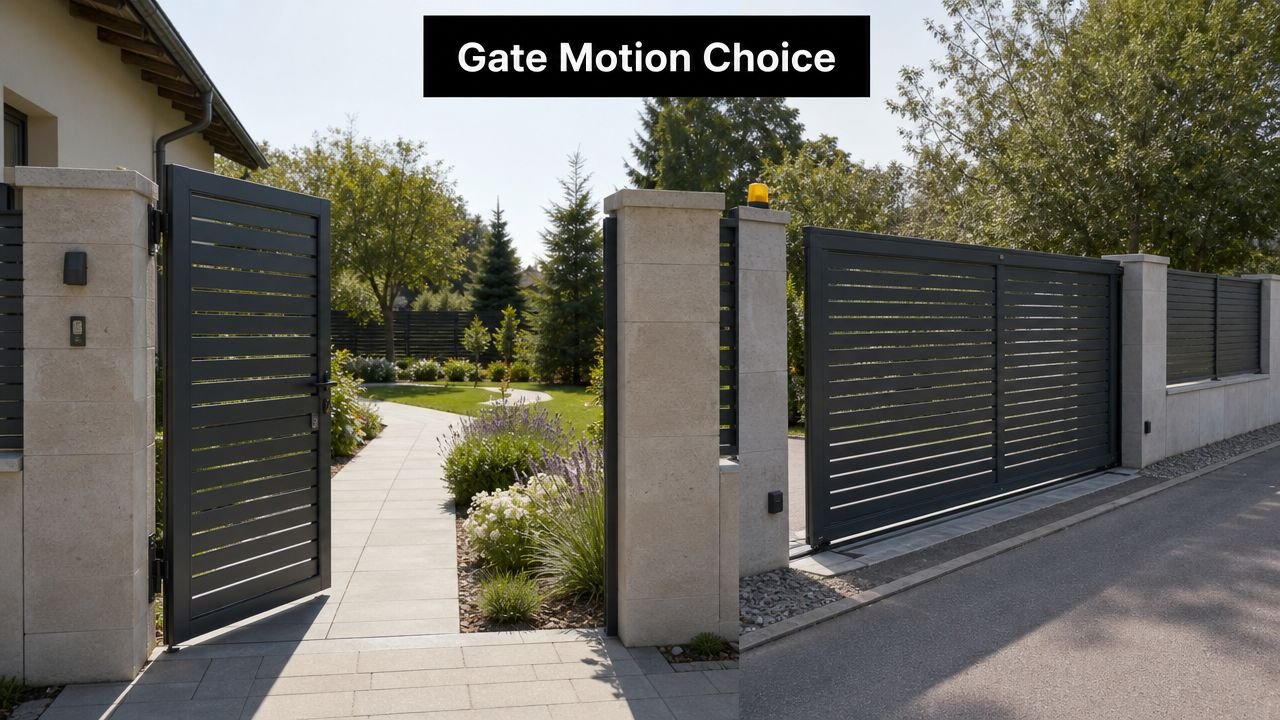
How swing systems behave
Swing gates are common on homes because they suit traditional entrances and pair well with timber or metal leaves. They open inward or outward on hinges, much like a door.
Common swing automation styles include:
Articulated arm operators
Useful where pillars are wide or hinge positions are awkward. The arm gives the motor some flexibility, which can help on gates that aren't laid out in the neatest modern geometry.Ram or linear operators
These are tidy and popular. They suit many domestic installations but depend heavily on correct bracket position and hinge geometry.Underground operators
These keep the mechanism out of sight and often appeal on heritage or high-end properties where appearance matters. They can also help preserve the look of older gates.
Swing systems need clear arc space. If a car stops too close, if the drive rises sharply, or if stone pillars limit bracket positioning, the installation gets more complicated.
Where sliding systems make more sense
Sliding gates move sideways instead of swinging. That can solve a lot of awkward site problems.
They often suit:
- entrances with short drive depth
- properties where gates must not swing into a public area
- sites with heavy or wide gate leaves
- commercial settings where a more controlled lateral movement is preferable
There are two broad arrangements people discuss most often:
- Tracked sliding gates, where the gate runs along a ground track
- Cantilever sliding gates, where the gate is supported without a track across the opening
The practical point is straightforward. A sliding gate needs side run-back space. If there's nowhere for the gate to travel when open, it won't be the right choice no matter how attractive the motor specification looks.
Swing vs Sliding Gate Automation Key Differences
| Feature | Swing Gate Kits | Sliding Gate Kits |
|---|---|---|
| Space needed to open | Need arc space in front of or behind the gate | Need clear side space for the gate to travel |
| Suitability for tight driveways | Can be awkward if cars stop close to the gate | Often better where depth is limited |
| Visual fit on traditional properties | Often suits period and domestic entrances | Can look more contemporary or more commercial |
| Ground conditions | Sensitive to slope and swing path obstruction | Better if swing arc would be blocked, but travel path must stay clear |
| Installation complexity | Strongly affected by hinge and pillar geometry | Strongly affected by alignment and support structure |
| Common use case | Homes, private drives, decorative entrances | Wider entrances, tighter forecourts, frequent access points |
A short demonstration helps people visualise the difference in movement and hardware layout:
If your entrance is constrained, the best gate motion is usually the one that asks the property to do the least work.
That's why choosing between swing and slide should happen before brand comparisons, remote options, or cosmetic finishes.
Key Factors for Your Gate and Property
Two gates can look almost identical from the road and behave completely differently under automation. One runs smoothly for years. The other strains, stalls, and slowly damages itself because the kit was chosen around assumptions instead of measurements.
Weight and length matter more than marketing
For swing gates in particular, the main engineering limit is usually the mass and length of each leaf. One commercial dual-swing opener package gives a useful illustration of those limits, with a specification of up to 294 kg per leaf, 4.9 m per leaf, and a 12-second 90° cycle time (Elite Gates swing opener specification).
You don't need that exact product to understand the lesson. Bigger gates place more demand on the operator. Add wind, stiffness in hinges, or swelling timber, and the load rises quickly.
Imagine pushing a wheelbarrow. A small increase in weight doesn't just feel slightly harder. Once balance and mechanical advantage shift, the effort climbs fast.
A practical assessment should include:
- Leaf length: Long leaves create an amplifying effect that multiplies strain at the hinge and actuator.
- Gate material: Solid timber catches wind differently from open-bar metalwork.
- Frequency of use: A family gate used a few times a day isn't the same as an entrance serving staff or tenants.
- Condition of hinges and posts: Automation won't cure a dragging or twisted gate.
If the kit is underspecified, the motor often compensates by drawing harder and running hotter. Over time, that's how you get poor starts, gear wear, and nuisance faults.
Older gates need a geometry check
This particular point often catches out many heritage and older UK properties. The issue often isn't raw power. It's whether the operator can physically fit and move through the required arc.
Installation guidance for swing gate openers commonly stresses bracket position, closed-gate alignment, and clearance. Some setups require at least 2.5 cm of clearance, while opening angle support can vary. One underground system is described for openings up to 125°, and another common swing opener supports 120° (TOPENS guide to maximum swing gate opening angle).
That matters on properties with stone piers, thick brick pillars, uneven reveals, or tight driveway geometry. An older wrought iron gate may look perfect for automation, but if the hinge line sits deep behind the pillar face, standard arms may struggle to achieve a clean opening.
Older gates don't fail automation because they're old. They fail because nobody checked clearances, hinge offset, and stopping points properly.
If you're still weighing the gate itself as part of the project, it helps to review secure and stylish metal gate options before choosing the automation hardware. The gate design and the operator should be planned together, not as separate purchases.
Understanding UK Gate Safety and Legal Compliance
A powered gate is not just a convenience feature. It's a moving machine at the entrance to a property where adults, children, vehicles, visitors, and delivery drivers all interact. That changes your responsibility.
The most important buying mistake I see is treating safety devices as upgrades. They aren't. They're part of the system.
Safety devices are part of the system
A representative swing-gate kit includes a control unit with obstacle detection, motor-force adjustment, photocells, and a rolling-code remote system on 433.9 MHz, with an integrated receiver range of about 20 m. The emphasis isn't on the remote frequency. It's on the safety architecture. Obstacle detection and photocells reduce impact and entrapment risk, while force adjustment lets the installer tune gate behaviour to friction, alignment, and weather exposure (swing gate kit safety feature overview).
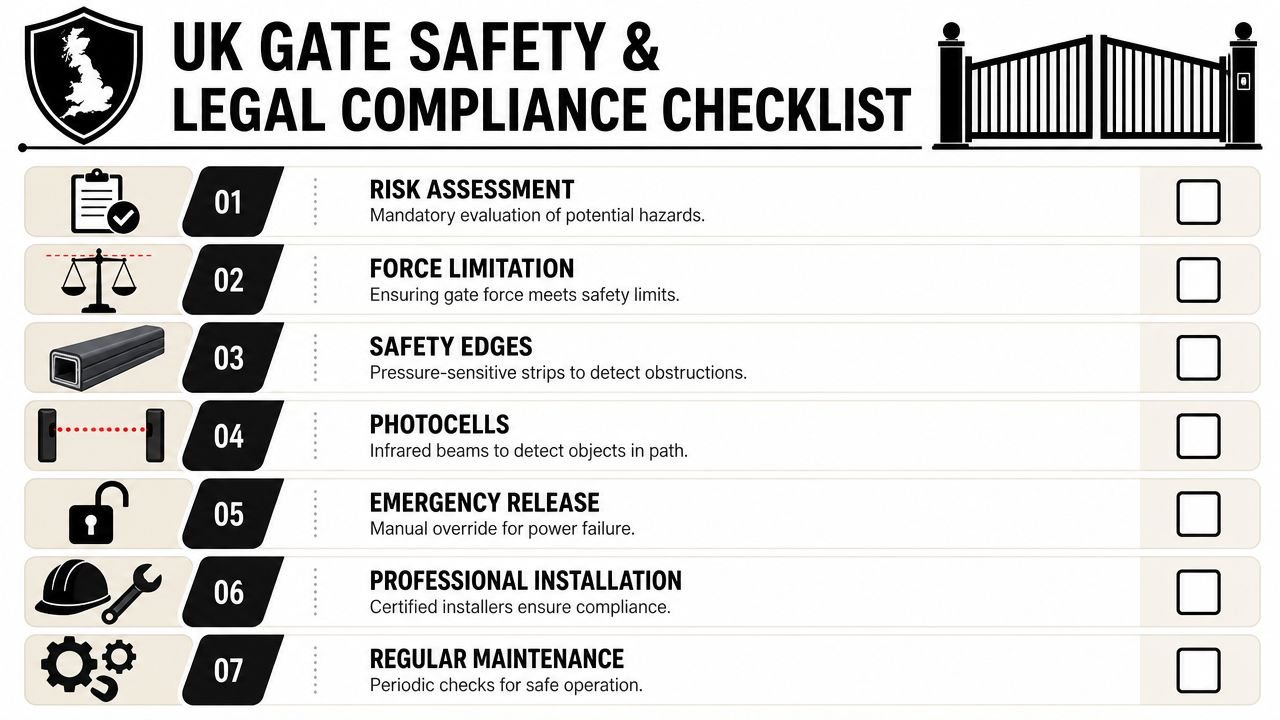
In plain language, these parts do different jobs:
- Photocells stop the gate closing through a person, pet, or vehicle crossing the opening.
- Obstacle detection helps the motor react if the gate meets unexpected resistance.
- Force adjustment prevents the installer from setting the gate to “maximum shove” and calling it done.
- Manual release gives access during a power cut or equipment fault.
If you're reviewing a wider property security setup alongside the gate, a sensible starting point is a proper security systems and alarms inspection board so the entrance isn't treated in isolation from alarms, CCTV, and access control.
Your duty doesn't stop after installation
UK buyers often think compliance ends when the installer leaves. It doesn't. The owner or operator still has a duty to keep the system safe.
That matters even more on:
- Shared driveways, where visitors may not understand the gate behaviour
- Business premises, where staff and contractors use the entrance regularly
- Residential blocks or managed properties, where user turnover is higher
A gate can become unsafe without looking broken. Sensor drift, ground movement, hinge wear, and frost can all change how it behaves.
That's why a gate should be assessed as a live system, not a one-off building job. Safe operation depends on the original design, the setup of the controls, and regular checking afterwards.
DIY vs Professional Installation A Cost and Risk Analysis
DIY gate automation is appealing for understandable reasons. The kits are widely available, the videos make the process look manageable, and many buyers already feel comfortable with wiring, fixings, and setup work around the home.
The problem is that a powered gate is unforgiving of small errors. A bracket that's slightly off. A force setting that's too high. A photocell placed where sunlight, spray, or poor alignment reduces reliability. Each issue may seem minor on its own. Together, they create an entrance that behaves unpredictably.
Why DIY looks simpler than it is
Consumer marketing often focuses on pairing remotes and mounting motors. The harder part is the geometry and safety setup.
One example of a more safety-conscious underground kit package explicitly includes obstacle detection, photocells, a flashing light, a warning sign, and a dedicated manual release key, which highlights the bigger decision buyers should make. It isn't just whether the gate opens. It's how the gate behaves when something goes wrong or someone is in the way (underground gate kit feature walkthrough).
A DIY installer has to get several things right at once:
- Mechanical alignment: The gate must move freely before automation begins.
- Mounting geometry: Swing operators depend on exact bracket placement.
- Electrical safety: Power and control wiring need to be sound and protected.
- Safety setup: Sensors and force settings must be tested, not guessed.
- Failure planning: There must be a safe way to release and use the gate during faults.
That's why local buyers often end up looking for specialist support such as electric gate installation in Cardiff after a kit has already been purchased but not fully commissioned.
What a professional install actually adds
Professional installation isn't only labour. It adds design judgement.
A competent installer should look at the entrance and ask questions a DIY buyer may not think to ask:
- Will the gate still clear the pillar if the hinge line shifts slightly over time?
- What happens in rain, frost, or leaf debris?
- How should closing force be tuned for this exact gate, not an ideal one?
- Where should safety devices sit so they protect the actual hazard zones?
The expensive part of a bad DIY gate isn't usually the first weekend. It's the years of faults, adjustments, and safety doubt that follow.
For a simple entrance with excellent geometry, a capable DIY owner may still choose to proceed. But they should do so with open eyes. This is not a flat-pack furniture job with a few wires attached. It's a powered perimeter control system.
Secure Your Entrance with Wisenet Security
A gate works best when it's treated as part of the wider security picture. The entrance point sits at the boundary between public and private space, so it often needs to interact with intercoms, cameras, alarms, and user permissions rather than operating as a standalone device.

Integrated security matters at the gate line
For homes, that might mean seeing who's calling before release. For commercial sites, it can mean tying gate access to staff credentials, logged entry events, and CCTV review. The logic is simple. A gate that opens smoothly but doesn't connect sensibly with the rest of the site can still leave operational gaps.
That's also why some property owners look beyond the gate itself and review related infrastructure such as secure smart building network solutions when planning access, remote management, and connected systems across a larger site.
For buyers in South Wales and the South West, one practical route is to work with an installer that covers both the gate hardware and the surrounding systems. Gate and barrier services from Wisenet Security Ltd sit alongside CCTV, intercoms, alarms, and access control, which is useful when the entrance needs to operate as part of a joined-up setup rather than as a separate project.
Who this suits best
This approach tends to make the most sense for:
- Homeowners with older entrances where gate compatibility and appearance both matter
- Businesses with regular vehicle movement that need controlled access without daily friction
- Property managers who need reliability, documented maintenance, and clear user control
- Mixed-use or shared sites where convenience must never come at the expense of safety
The long-term value in gate automation rarely comes from choosing the cheapest kit on day one. It comes from matching the operator to the gate, protecting people properly, and making sure the entrance still works when weather, wear, and everyday use test it.
If you're considering a gate automation kit for a home, business, or managed property, Wisenet Security Ltd can assess the gate, the site layout, and the safety requirements before any equipment is specified. That helps you avoid the common result of buying a motor first and discovering later that the gate, controls, or compliance details were the underlying issue.