

Security Gates Installation Guide: South Wales & SW 2026
A lot of people start looking into security gates installation at the same point. Something has changed. You've had a near miss on the driveway in Cardiff, you're tired of unknown vehicles turning into a yard in Newport, or you manage a small commercial site near Bristol and need proper control over who comes in and out.
The gate itself looks simple from the road. In practice, the job isn't simple at all. The right system has to suit the site, survive South Wales weather, comply with UK safety rules, and work day after day without becoming a nuisance. That's where many projects go wrong. Owners focus on the gate leaf and style first, then discover late in the process that the actual issues are ground levels, power supply, swing clearance, public footpaths, safety edges, photocells, and long-term servicing.
In this region, local conditions matter. A steep valley driveway, a wind-exposed coastal frontage, an older stone wall boundary, or a shared access lane all change what's practical. Generic advice rarely deals with that properly. A gate that looks right on paper can be wrong for the site.
Table of Contents
- A Secure Welcome Your Guide to Security Gates in 2026
- Choosing the Right Security Gate for Your Property
- Site Surveys Planning Permission and Local Rules
- The Professional Security Gates Installation Process
- Essential Safety Checks and UK Compliance
- Costs Timelines and Long-Term Gate Care
A Secure Welcome Your Guide to Security Gates in 2026
A good gate does three jobs at once. It controls access, supports the look of the property, and does it without creating a daily headache. That balance matters whether you're securing a family home in a Cardiff suburb or trying to manage vehicle entry at a busy unit in Avonmouth.
Homeowners often want privacy, safer driveway access, and something that doesn't spoil the front of the house. Businesses usually care more about deterrence, controlled entry, intercoms, vehicle flow, and being able to open or lock down the site quickly. The mistake is assuming the same gate design works for both.
Practical rule: choose the gate around the site and the daily use, not around a brochure photo.
In South Wales and the South West, poor drainage, exposed coastal air, sloping ground, and older boundary walls all affect what works. So does the way people use the entrance. A house with occasional daily traffic can often live happily with a simpler setup. A shared yard, car park, or warehouse entrance usually needs a more considered access-control setup and a proper maintenance plan from the start.
Professional security gates installation also isn't just about fitting metal to posts. It's a combined job involving civil work, alignment, wiring, automation, safety systems, and legal checks. If one part is weak, the whole system suffers. Gates that drag, motors that strain, photocells that false-trigger in bad weather, and entrances that open the wrong way all come from decisions made early.
The best installations feel uneventful once they're finished. The gate opens smoothly, closes predictably, protects the entrance, and doesn't make you think about it every day. That's usually the result of careful design, not luck.
Choosing the Right Security Gate for Your Property
A gate that suits a detached house in the Vale rarely suits a trade yard in Newport or a shared entrance in Bristol. The right choice comes from traffic, ground conditions, exposure, and how much control you want at the boundary.
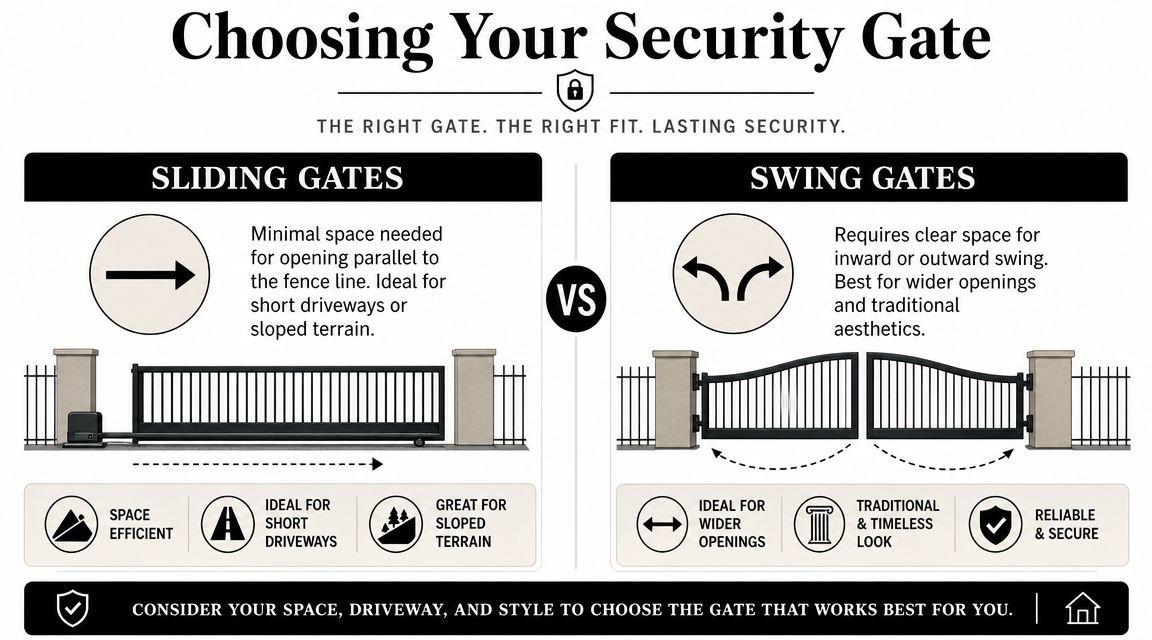
Sliding or swing
Gate movement sets the whole design.
A sliding gate runs along the boundary, so it works well where the driveway is short, the entrance sits close to the highway, or the ground falls across the opening. On commercial sites, sliding gates also help keep vehicle movements predictable because the gate stays out of the traffic path once open. The trade-off is side room. If there is no clear run beside the entrance, sliding may be ruled out before anything else is considered.
A swing gate suits many domestic driveways and can look right on traditional properties across South Wales and the South West. It usually gives more design flexibility on style and finish, but it needs a clean opening arc, solid hinge support, and enough set-back from the road. On exposed sites, wind loading matters as well. A large boarded swing gate may look good on paper and be a nuisance in real use.
That is why I usually start with a simple question. Where can the gate move safely every day, in bad weather, with a delivery van turning up and someone walking out at the same time?
Manual or automated
Manual gates still make sense on some homes. If usage is light and the priority is a simple, lower-maintenance entrance, a well-built manual gate avoids motors, control boards, safety edges, and the servicing that follows.
Automation earns its keep where convenience, controlled entry, or site security matter more. Homes with busy family use benefit from it. Businesses often need it. The mistake is treating automation as a bolt-on extra. It is a full system with operators, safety devices, controls, and cabling that all need to work together.
For day-to-day use, access control often matters more than decorative extras. A properly specified video intercom system for gated access can improve security and make the entrance easier to manage for visitors, staff, and deliveries.
Hydraulic automation also has a place, especially on heavier commercial gates or sites with high duty cycles. For owners comparing operator types, MA Hydraulics Ltd gives useful background on hydraulic power unit design, which affects servicing, reliability, and how the system copes with sustained use.
Material choices that suit local conditions
Material choice affects upkeep as much as appearance. In coastal parts of South Wales, salt air shortens the life of poor finishes. In wetter inland areas, standing water and moss around hinges, tracks, and posts create their own problems.
- Steel: Strong and suited to commercial premises, schools, compounds, and larger domestic gates. It handles impact and hard use well, but only if the fabrication and coating are done properly.
- Wrought iron style: Common on older homes and period properties. It can suit the building very well, though owners need to accept repainting and routine attention over time.
- Aluminium: Lighter than steel and often a sensible choice for residential automation. It resists corrosion well and usually keeps maintenance down.
- Timber: Best chosen for appearance, not low upkeep. In exposed Welsh conditions, it needs regular treatment and realistic expectations about movement and weathering.
Security Gate Type Comparison
| Gate Type | Best For | Space Required | Typical Cost Position | Maintenance Level |
|---|---|---|---|---|
| Sliding Gate | Short driveways, sloping entrances, commercial yards | Space along fence line | Often higher because of groundwork, track or cantilever hardware, and automation options | Moderate to high |
| Swing Gate | Wider domestic openings, traditional frontages | Clear arc for opening leaves | Varies with leaf size, posts, and operator type | Moderate |
| Manual Gate | Low-traffic homes, simple boundaries | Depends on swing or slide format | Lower upfront cost in many cases | Lower |
| Automated Gate | Homes and businesses needing controlled access | Depends on gate format plus safe placement of devices | Higher upfront cost, with ongoing servicing to budget for | Higher |
Site Surveys Planning Permission and Local Rules
A proper survey saves money because it rules out bad ideas before anyone digs a hole or orders a motor. On difficult sites around Swansea, Caerphilly, Newport, Bath, or Bristol, the survey is where the project is either rescued or set up to fail.
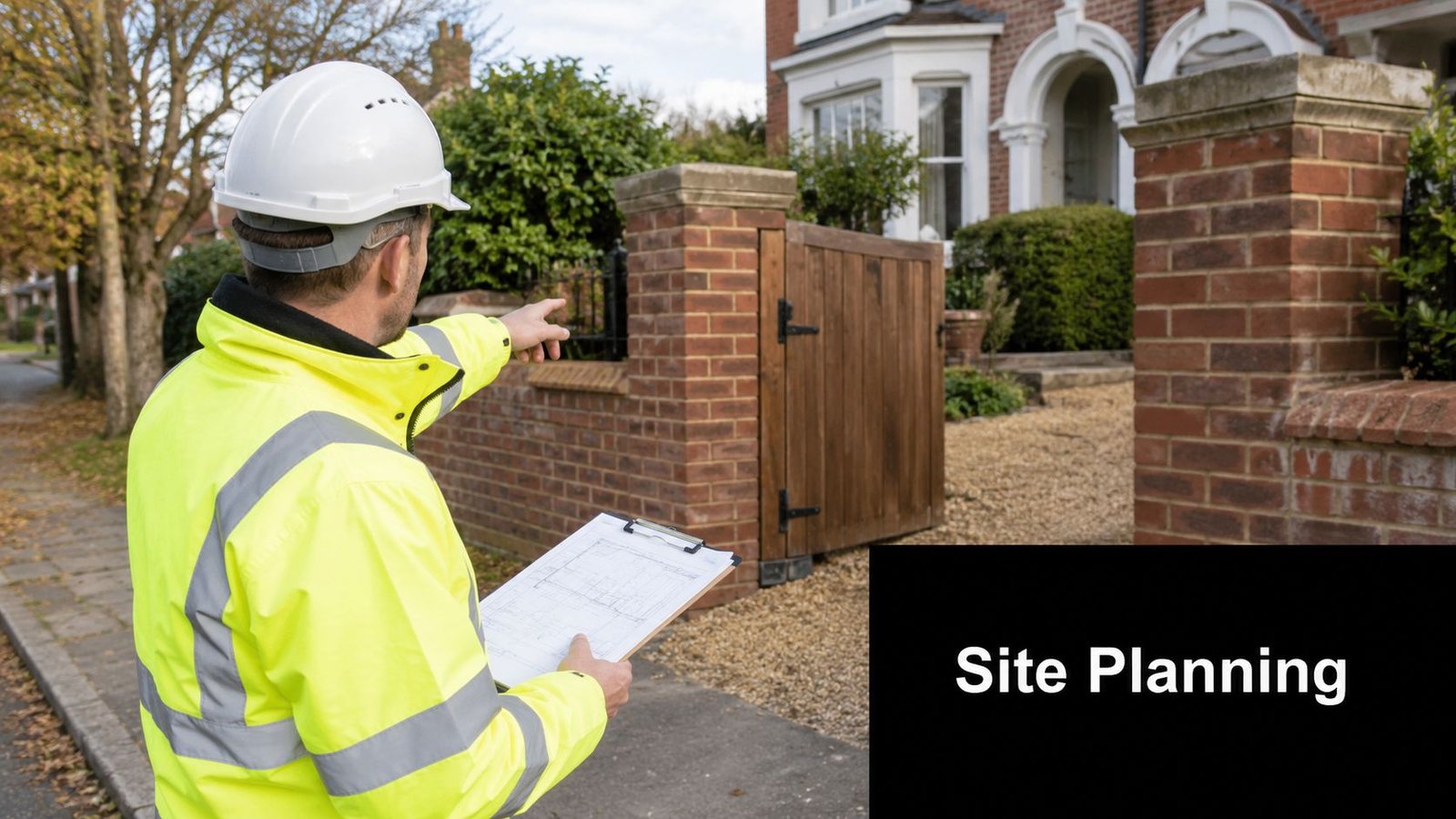
What a proper site survey should cover
An engineer should check the entrance width, crossfall, gradient, drainage, existing pillars or walls, hinge or track positions, and whether the ground can take the loads involved. On automated jobs, they also need routes for power and data cabling, safe positions for controls, and enough room for photocells and warning devices.
On older South Wales properties, boundary structures are often the hidden problem. Stone piers may look solid but not be suitable for the loads and forces created by a powered gate. On commercial sites, the challenge is often vehicle tracking. Articulated vehicles, vans, and forklifts don't use an entrance the same way a domestic car does.
A decent survey should also ask how the entrance operates on a normal day.
- Who uses it: family members, staff, delivery drivers, tenants, visitors.
- How traffic moves: single vehicle at a time, queueing, pedestrians alongside vehicles, shared access.
- What happens on failure: manual release, alternative access, out-of-hours entry.
Where people get caught out on permissions
This is the part many online guides gloss over. In the UK, gate installations can trigger planning permission, building-control safety duties, and highway-occupation constraints. Key decision points include whether the gate opens inward or outward and whether it obstructs a public footway. In some cases, the best answer is a less automated or simpler boundary solution because it reduces compliance risk, as outlined in this UK gate planning and legal guidance.
That matters on entrances opening directly onto pavements or roads, which are common in terraced streets and older urban plots. If the gate swings out across a public path, that can be a serious design problem. The owner may love the look of double swing leaves, but the site may only safely allow an inward-opening arrangement or a slider set back from the highway.
A gate project can fail before installation day if nobody checks the legal movement of the gate leaf.
Local reality in South Wales and the South West
Regional conditions change the practical answer. In Cardiff and Bristol, tighter urban plots often limit swing clearance and cable routes. In the valleys, steep driveways can make standard swing geometry awkward. Along exposed coastal stretches, hardware and finishes need more thought because moisture and salt don't forgive poor preparation.
If the property has shared access, tenanted use, or business traffic, expect more scrutiny of how the entrance behaves in daily operation. The electric gates Cardiff service overview is a useful reference for the kinds of systems commonly specified on local residential and mixed-use sites, particularly where access control and practical site constraints overlap.
The Professional Security Gates Installation Process
The difference between a tidy-looking gate and a professional installation usually shows up after the first few months of use. A gate can appear straight on handover day and still be poorly built underneath.
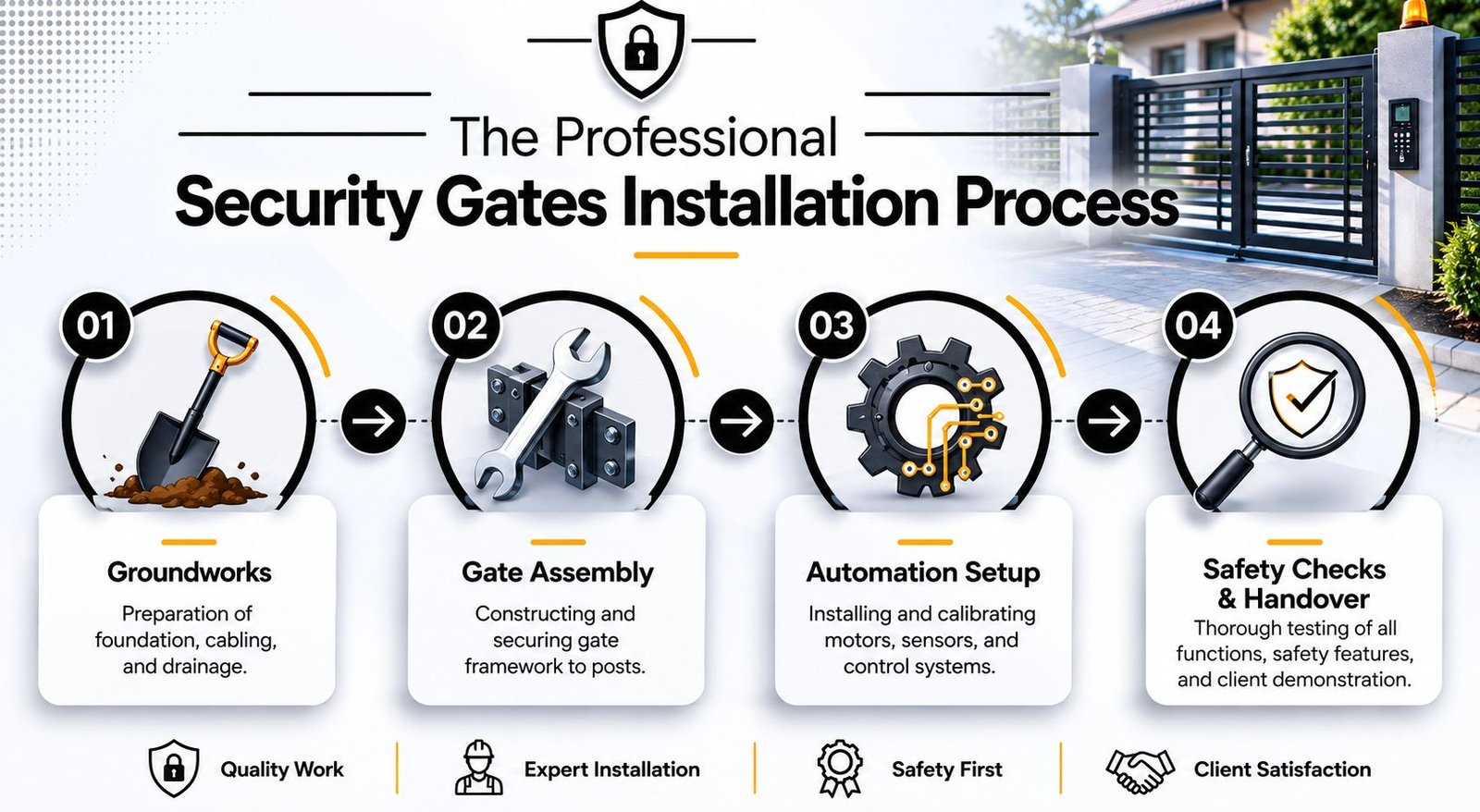
Groundworks first
Everything starts below ground. Posts, track supports, motor bases, and cable ducts need solid preparation. If the concrete bases are undersized, if the drainage is ignored, or if conduits are left vulnerable, the gate will tell on the installer later.
For swing gates, the post positions and hinge centres have to be exact. For sliding gates, the track line and supporting slab have to stay true through weather and use. On South Wales sites with poor runoff or heavy rain exposure, drainage isn't an extra. It's part of the gate working at all.
A proper install team also plans service access. Control cabinets, isolators, junction boxes, and release mechanisms shouldn't be squeezed into awkward corners where no one can reach them safely.
Hanging the gate and fitting automation
Once the structure is ready, the gate leaf or leaves are mounted and adjusted so they move cleanly without motors doing the hard work. That point gets missed by inexperienced fitters. Automation should move a well-hung gate. It shouldn't compensate for a badly hung one.
For metal fabrication detail, hinge load, and boundary integration, this expert guide for metal fencing is a useful companion read because it highlights the structural side of gate and fence design that owners often overlook.
After the gate moves freely, automation equipment goes in. That may include underground motors, articulated arm operators, ram motors, sliding gate motors, photocells, safety edges, warning lights, keypads, loop detectors, and intercoms. Weatherproof cable routing matters here. So does separation of power and control wiring where required by the equipment design.
For commercial and mixed-use sites, broader entrance control often sits within a larger gates and barriers setup rather than a stand-alone gate motor. That's common where the entrance needs coordinated access for vehicles, staff, and visitors.
A short installation video helps show the sequence in practice.
Commissioning is where quality shows
The final stage is where many faults are either found or missed. A critical benchmark for automatic gates is to treat alignment and safety-device wiring as a commissioning sequence. The gate path should be clear, level, and repeatedly tested after motor mounting, then sensors and obstruction devices should be checked during final commissioning to avoid rubbing, over-travelling, or failed safety reversals, as described in this automatic gate commissioning guide.
That repeated testing matters. A gate can behave differently once the motors are engaged, once the limits are set, and again once the safety devices are active. If the installer only runs a quick open-close check and leaves, the owner becomes the test engineer.
Commissioning isn't a button press at the end. It's a structured set of checks after the whole system is live.
Essential Safety Checks and UK Compliance
Powered gates are not just convenient entrances. In the UK, they're treated as machinery, which brings clear safety duties. If a gate can move under power, it can injure someone if it's poorly designed, badly installed, or left without proper maintenance.
What compliance means on a real gate
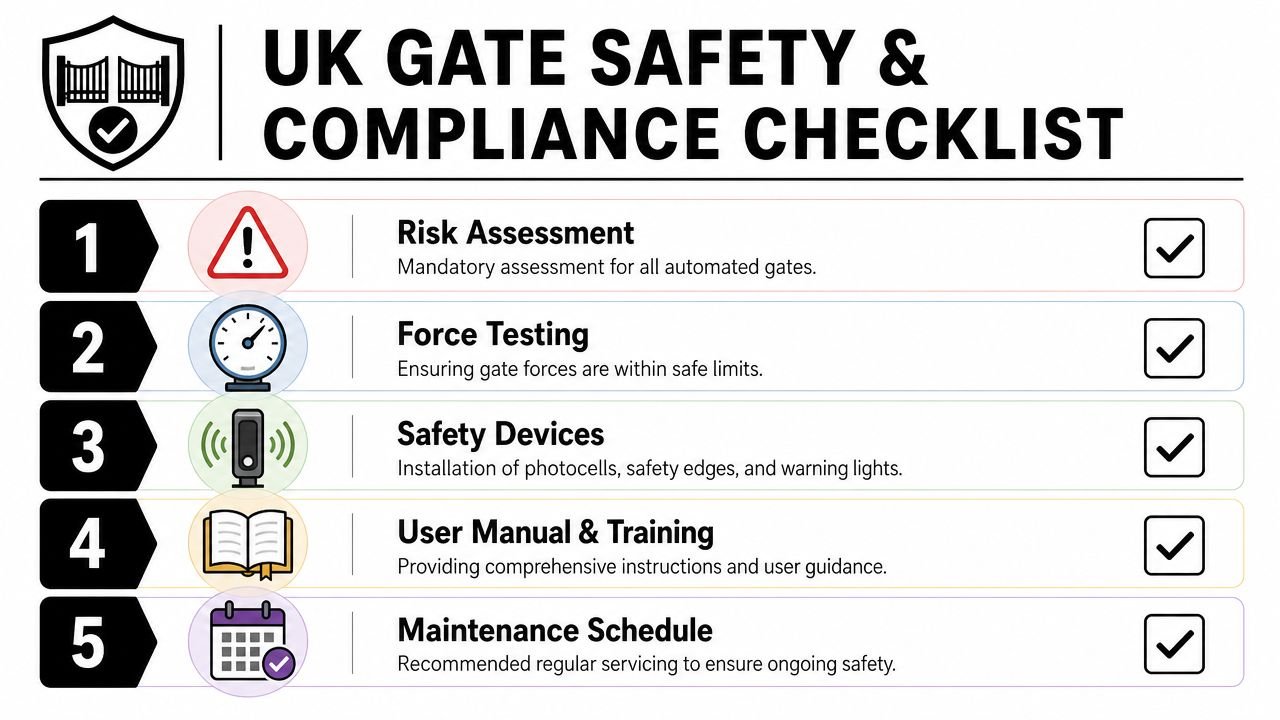
Automatic gate installation in the UK must follow the Machinery and BS EN 12453/12445 safety framework. The Health and Safety Executive warns that powered gates can crush or trap people if they are poorly installed or maintained. Safeguards include photoelectric sensing, calibrated force limiting, and emergency-release functionality, with common field failures including misaligned photocells, incorrect force settings after motor commissioning, and neglected hinges, tracks, and fixings, as summarised in this UK powered gate safety overview.
That sounds technical, but the practical meaning is straightforward. The gate needs a documented risk assessment. The installer should identify crush points, hinge zones, drawing-in hazards, and areas where pedestrians or children might be exposed. Then the safety devices and force settings have to address those risks.
The historical reason this matters is clear. Automatic gates are safety-critical systems. The U.S. CPSC reported that from 1990 to 2000, nearly 25,000 people were involved in automatic gate-related injuries, including 9,000 children under 15, which helped drive tougher safety requirements including the need for at least two anti-entrapment mechanisms. Those figures are not UK-specific, but they shaped the wider safety logic behind modern powered gate design, including reversing sensors, electric eyes, edge sensors, and obstruction protection, as noted in this gate safety and installation background.
Questions worth asking any installer
A competent installer shouldn't hesitate over these points.
- Risk assessment: ask whether a documented risk assessment will be produced for the finished powered gate.
- Safety devices: ask what photocells, safety edges, force limitation, and emergency release measures are included.
- Force testing and setup: ask how the impact forces are checked after fitting and after final adjustment.
- User handover: ask what instructions you'll receive for normal use, manual release, and fault response.
- Maintenance expectations: ask what needs periodic inspection to keep the gate safe and compliant.
If an installer talks only about motors and remote controls, they're talking about convenience. Safety compliance is the real test of competence.
This applies equally to homes and businesses. Domestic owners sometimes assume compliance is mainly a commercial issue. It isn't. A powered driveway gate at a family property still has to be safe for residents, visitors, delivery drivers, and children.
Costs Timelines and Long-Term Gate Care
A gate can look finished on day one and still turn into an expensive problem by the second winter. I see that most often where the buying decision focused on the gate leaf and motor, but not on drainage, coatings, cable routes, service access, and the actual duty cycle the entrance will face in South Wales.
What drives the price
The final price is usually shaped more by the site and the control package than by the gate itself. A simple manual gate on sound posts is one job. A powered gate with intercom, keypad, safety devices, underground cabling, and reliable operation through wet Welsh winters is a different level of work.
These are the cost drivers that change quotes fastest:
| Cost Driver | Effect on budget | Why it matters |
|---|---|---|
| Gate size and weight | Increases structural and motor requirements | Heavy leaves need stronger posts, hinges, foundations, and correctly matched operators |
| Material choice | Changes fabrication and finishing cost | Steel, aluminium, timber infill, and decorative work all affect workshop time and coating specification |
| Automation level | Often adds the largest extra cost | Motors, control panels, safety devices, intercoms, GSM access, and backup options all add equipment and setup time |
| Site conditions | Can increase groundwork and labour | Sloping drives, poor drainage, retaining walls, and long cable runs take time to resolve properly |
| Access control integration | Raises equipment and commissioning complexity | Intercoms, fobs, ANPR, timed access, and remote management all need setup, testing, and user handover |
On domestic jobs, owners often spend freely on appearance and then try to trim the controls package. On commercial sites, the opposite happens. Both approaches can be false economy. A smart-looking gate that is awkward to use gets left open. A heavily automated gate on weak foundations or poor drainage will keep generating call-outs.
In South Wales and the South West, ground conditions and weather exposure matter more than many online guides admit. Coastal air, standing water, and repeated freeze-thaw cycles can shorten the life of finishes, hinges, and low-mounted hardware if the specification is too light.
How long the job usually takes
A clean, uncomplicated installation can move quickly once fabrication is complete. The full job rarely starts at fitting day, though. Time is usually spent on survey, measurements, design approval, groundwork planning, cabling, fabrication, coating, and final commissioning.
Planning delays are not the only hold-up. I have seen projects lose more time to utility checks, drainage corrections, and revised opening widths after the customer realises a delivery van cannot turn cleanly through the entrance.
Weather also affects programme dates in this region. Heavy rain slows excavation, concrete work, trenching, and finishing. Business premises may need phased works so staff, residents, deliveries, or tenants can still get in and out safely while the entrance is being rebuilt.
Long-term care is part of the buying decision
A gate is not a fit-and-forget product, especially if it is automated.
Powered systems need routine attention on hinges, rollers, tracks, photocells, safety edges, motor fixings, release mechanisms, control cabinets, and any access control equipment. Even a well-installed system will need adjustment over time as the ground settles and components wear in. That is normal. The cost problem starts when servicing is skipped and small faults turn into failed motors, damaged arms, or repeated lockouts.
For some homes, a manual gate or a lightly automated setup is the better long-term choice. For a school, depot, apartment entrance, or busy business unit, automation often makes sense, but only if the owner also budgets for servicing, emergency access, and occasional part replacement.
Finish quality matters as much as mechanics. If you are choosing steel, ask what surface preparation and coating system is being used, especially near the coast or on exposed sites. Owners comparing galvanising, primer systems, and top coats should read these structural steel protection strategies before signing off the finish.
A sensible budget should cover four things:
- Upfront cost: fabrication, posts, foundations, trenching, wiring, automation, controls, and commissioning
- Service cost: inspections, adjustments, lubrication, force checks, fault finding, and replacement wear parts
- Operational cost: downtime, access disruption, manual release use, and staff time spent dealing with faults
- Asset life: how well the gate, finish, and hardware hold up in local weather and under real daily use
Cheap gates are often expensive to own. Correctly specified gates usually cost more at the start, but they last longer, fail less often, and are easier to keep safe and usable.
If you want a gate system that's designed around real site conditions in South Wales or the South West, Wisenet Security Ltd can help with survey, design, installation, automation, and long-term maintenance. They work across residential and commercial sites, with integrated security solutions that make the entrance safer, more practical, and easier to manage over time.