Integrated Security Systems: South Wales & South West
You're probably dealing with some version of the same mess I see across South Wales and the South West all the time. The CCTV is on one app. The burglar alarm has its own keypad and its own callout process. Staff or tenant access sits on a separate fob system. If something happens after hours, you're piecing the story together from three different systems that don't speak to each other.
That setup works until it doesn't. A door is forced, a camera records half the event, an alarm goes off, and nobody gets a clear picture quickly enough to decide whether it's a real incident or just another nuisance trigger. In older buildings around Cardiff, Newport, Swansea, Bristol, and the smaller towns in between, the problem is often worse because systems were added at different times by different installers.
Integrated security systems solve that by making the parts work as one. That sounds technical, but the practical benefit is simple. You get fewer blind spots, clearer alerts, and a system that helps people act instead of just reacting.
Table of Contents
- Your Security Should Work Together Not Harder
- What Are Integrated Security Systems Really
- The Key Components of an Integrated System
- Why Integration Is a Game Changer for Your Property
- Planning Your System Installation and UK Compliance
- Choosing the Right System and Local Provider
- Integrated Security in Action Across the South West
Your Security Should Work Together Not Harder
A common local example is a shop owner closing up at closing time. They set the intruder alarm, check the cameras, lock the rear access door, and head home. Later that evening, the phone rings because the alarm has activated. Now they're opening one app to view cameras, another to check access logs, and relying on guesswork to decide whether to call someone out.
That's the problem. Most sites don't lack hardware. They lack coordination.
The wider UK picture backs up why this matters. The Office for National Statistics recorded 6.7 million crime incidents in England and Wales for the year ending March 2024, and the UK government's 2022 Security Industry Authority review noted that technology-led security increasingly combines CCTV, access control, intruder detection, and remote monitoring into single managed platforms, as noted in this UK integrated security market summary.
What this looks like on a real property
In a disconnected setup:
- An alarm activates: You hear a siren or get a push alert.
- CCTV records separately: Someone still has to find the right camera and scrub through footage.
- Access events sit elsewhere: If a door was opened with a fob or forced manually, that record may not be visible in the same place.
In an integrated setup, one event can trigger a chain of useful actions. A forced door can bring up the nearest camera, log the exact time, flag who last used that entry point, and send a clearer alert to the person responsible.
Integrated security isn't about adding more gadgets. It's about removing delay between detection and decision.
Why local buildings need a different conversation
South Wales and the South West have plenty of properties that weren't built for modern connected systems. Victorian conversions, older industrial units, mixed-use blocks, detached homes with piecemeal upgrades, and business parks with legacy cabling all create awkward joins between old and new equipment.
That's why generic online advice often misses the mark. The challenge here usually isn't choosing a shiny system from a brochure. It's working out what can sensibly be linked, what should stay separate for resilience, and how to get better protection without turning the whole building into a complicated maintenance problem.
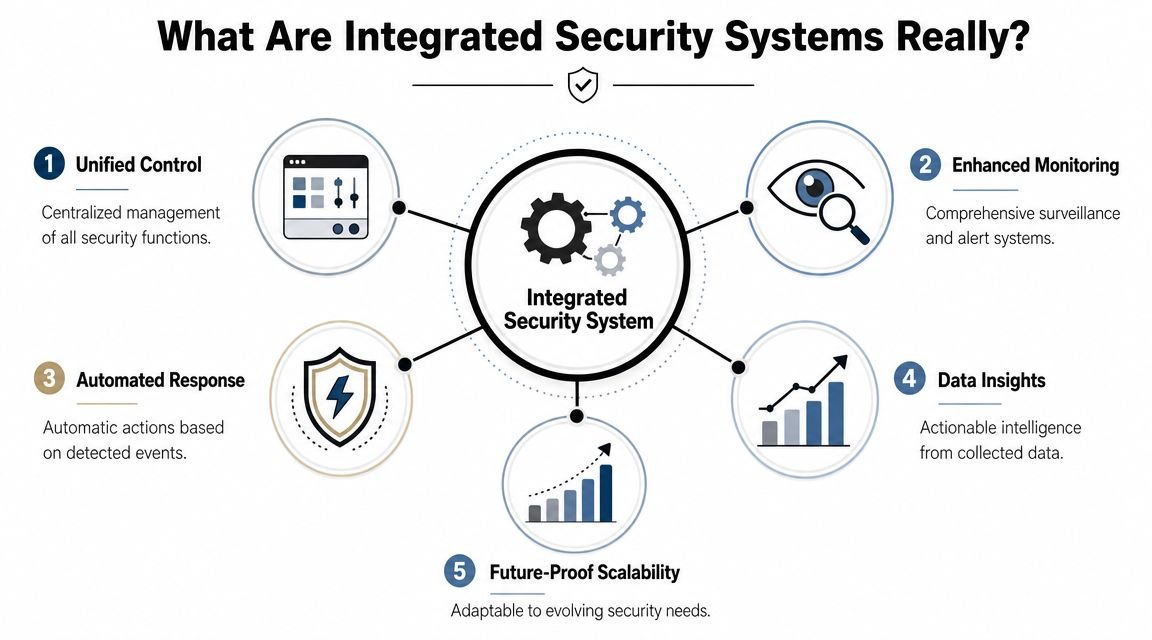
What Are Integrated Security Systems Really
An integrated security system is the central nervous system of a property. Cameras are the eyes. Intruder sensors are the nerves. Access control is the set of rules about who can move where. The software or management platform acts as the brain, taking signals from each part and turning them into something usable.
That's very different from just owning several security products.
Standalone kit versus a true platform
A lot of sites have what I'd call adjacent systems, not integrated ones. There might be decent CCTV, a separate alarm panel, and a door entry system. Each does its own job. None of them really help the others.
A true platform links them so one event informs the next action.
| Setup | What happens in practice |
|---|---|
| Standalone systems | Operators check multiple apps, export separate logs, and manually piece together events |
| Integrated system | Video, alarm, and access events appear together with shared logic and faster verification |
The value isn't just convenience. It's clarity under pressure.
How the system thinks
The strongest designs don't rely on one sensor or one perimeter point. Integrated security architectures are most effective when they fuse detection at the field device, network, and control-system layers, and a well-designed platform correlates video, access, and alarm events centrally so operators can distinguish nuisance activity from real incidents faster and with fewer false positives, as described by the U.S. Department of Energy's integrated security guidance.
That sounds specialist, but the practical meaning is straightforward:
- Field device layer: Door contacts, PIRs, cameras, intercoms, readers
- Network layer: The links carrying data between devices and software
- Control-system layer: The platform that receives, correlates, and presents events
If one part sees something unusual, the system checks the others for context.
Practical rule: If your camera, alarm, and access system can't confirm each other's events, you don't have much more than digital silos.
What integrated security is not
It isn't always one box from one manufacturer. In fact, that can be a trap in retrofit projects if the site already has serviceable hardware. Integration often works better when a stable video platform, a reliable alarm panel, and sensible access control are linked with clear event logic instead of forced into a single-vendor rebuild.
It also isn't “smart” just because there's an app. Remote viewing is useful. Remote control without good permissions, audit trails, and alert logic can create as many problems as it solves.
The Key Components of an Integrated System
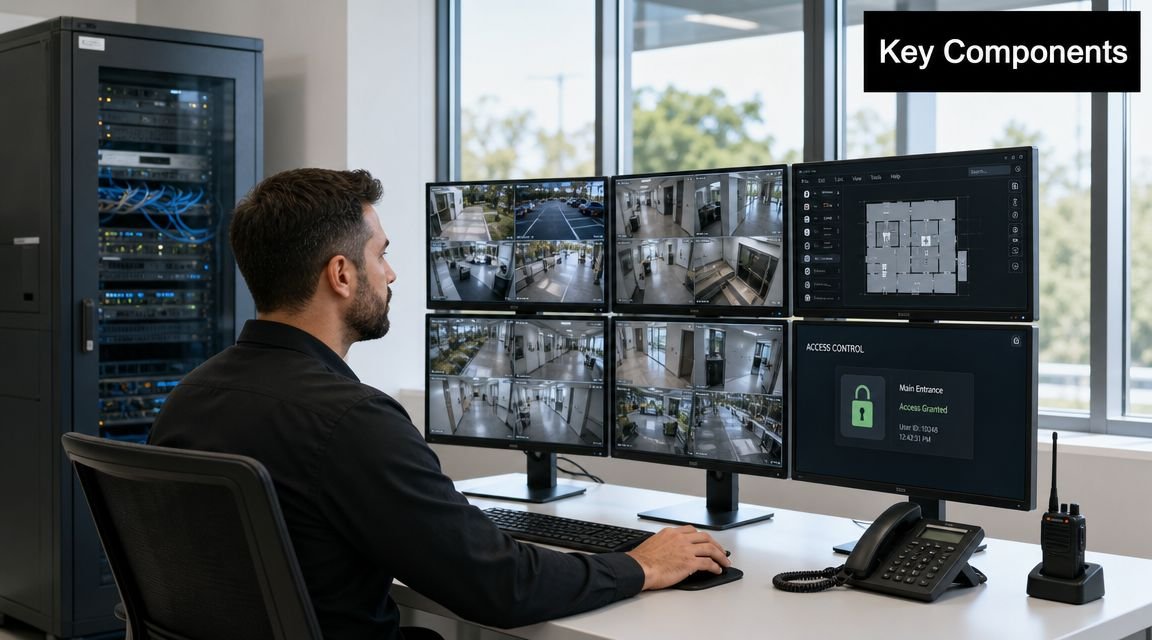
An integrated system only works if each part contributes something useful. Throwing devices onto a network doesn't create a proper solution. Each component needs a clear job, and it needs to improve the job of something else on site.
CCTV that does more than record
Good CCTV in an integrated setup isn't there just to provide footage after the event. It verifies alarms, supports live decision-making, and gives operators or owners instant context.
If a shutter contact activates on a retail unit, the right camera should pop up automatically. If someone uses a valid credential at an unusual time, CCTV should let you confirm whether it's an authorised visit or a borrowed fob.
For sites with vehicle access, barriers or gates, it helps to see how a more controlled perimeter can support the rest of the setup. A practical example is to view Leeds storage security features where gated entry forms part of a broader site-control approach.
Intruder alarms that trigger useful actions
An intruder alarm is often the first thing people think about, but on its own it's blunt. It tells you something happened, not necessarily what happened.
When alarm zones are integrated properly, they can:
- Call the right camera: The system presents the nearest or linked view immediately
- Mark the timeline: Operators can see exactly when the trigger occurred
- Start a response chain: Notifications can go to the relevant manager, keyholder, or monitoring process
False alarm handling becomes more effective. A single trigger might mean very little. A trigger linked to video activity and an out-of-hours access event means far more.
Access control that adds accountability
Access control gives a site memory. It records who entered, where they entered, and when. In homes that may mean gates, video intercoms, or side-entry doors. In business premises it usually means fobs, cards, PINs, or app-based credentials.
Its integration value is often overlooked:
- For businesses: It links staff movement to time-stamped events
- For landlords: It separates tenant, visitor, and contractor movement more cleanly
- For mixed-use buildings: It helps avoid the all-too-common problem of one unsecured area undermining everything else
Fire detection and life safety links
Fire systems need careful treatment because life safety rules come first. They should never be casually folded into a convenience-driven platform.
That said, sensible integration matters. A fire event may need doors released, alerts escalated, intercoms managed, and incident records created. The point isn't to make fire “part of the app”. The point is to make sure related systems respond correctly when life safety takes priority.
Intercoms, gates, and perimeter controls
Video intercoms and automated gates often carry more value than owners expect. They control the first decision point on the property. If they're integrated, that visitor event can be tied to camera recording, access permissions, and audit logs.
A site is usually weakest where people make exceptions. Delivery access, side gates, trade entrances, and shared residential doors deserve more attention than they often get.
Why Integration Is a Game Changer for Your Property
The biggest benefit of integrated security systems isn't that they look modern. It's that they reduce wasted motion. Less switching between apps. Less uncertainty. Less time spent deciding whether something matters.
Smarter alerts and quicker decisions
On a disconnected site, a motion alarm can mean anything. Wind, a missed setting procedure, a staff member returning late, or a genuine break-in. Someone still has to investigate manually.
On an integrated site, the system can stack evidence. Did a door contact trigger as well? Was there recent credential use? What does the nearest camera show? That doesn't guarantee perfection, but it does make alerts far more usable.
Simpler management for busy owners
Homeowners don't want to play control-room operator. Small business owners definitely don't. They want to know the site is secure and be able to check it quickly if needed.
A properly designed integrated platform can give you:
- One operational view: Cameras, access, and alarms in the same place
- Cleaner permissions: Staff can use what they need without seeing everything
- Easier maintenance: Faults and event history are easier to trace
That matters if you're managing a shop in Cardiff, a warehouse in Newport, holiday lets in the South West, or a block of flats in Swansea.
Better evidence when something goes wrong
Security is rarely judged on a quiet day. It's judged after an incident. Insurance questions start. Police ask for timings. You need to know who entered, which route they took, what was recorded, and whether an alarm was genuine.
A joined-up system gives you a cleaner incident trail than separate exports from separate devices. That can make the difference between having “some footage somewhere” and having a usable record.
Better evidence doesn't come from more cameras alone. It comes from time, access, video, and alarm data lining up properly.
Safety and compliance improve as well
Integration also helps with emergency behaviour. The practical examples are often more important than the technical ones. Certain doors may need to release, notifications may need to reach the right people, and event logs need to stand up to scrutiny afterward.
What doesn't work is bolting systems together with no thought for priorities. Convenience should never override safety. Good integrated design respects that from the start.
Planning Your System Installation and UK Compliance
Most problems with integrated security systems start before the first device goes on the wall. They start in the survey, the specification, or the assumption that an older building can be treated like a blank sheet.
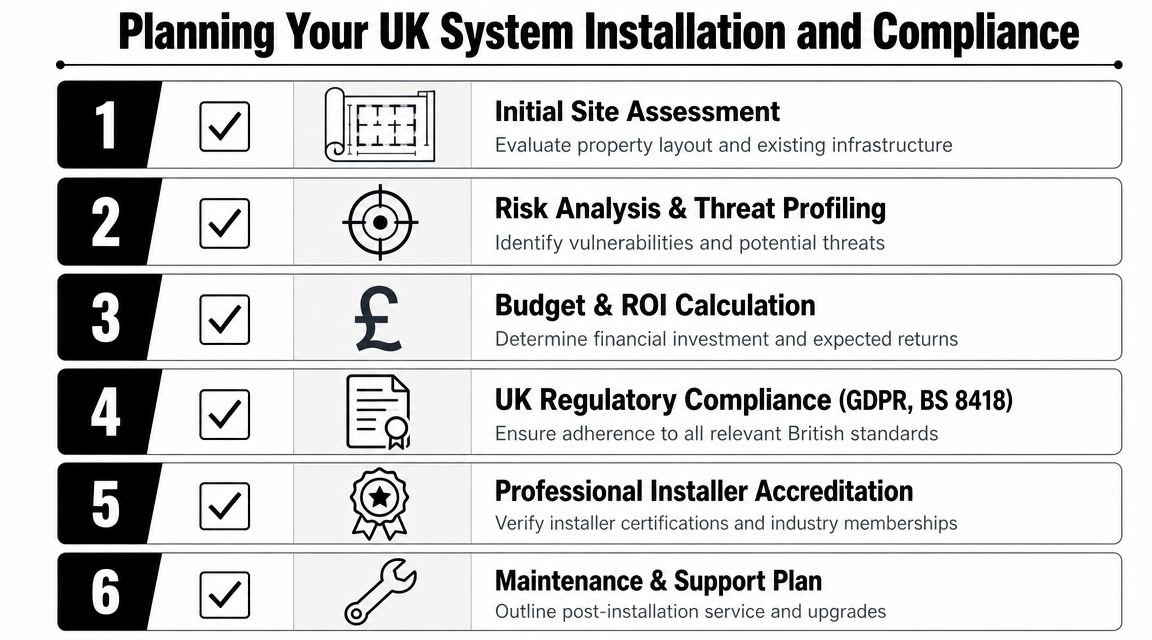
Compliance is part of the design
For UK deployments, the benchmark is regulatory integration. Guidance references BS EN 50131-aligned alarm design and fire safety enforcement around compliant systems. In practice, access control, intruder alarms, CCTV, and fire detection should share event logic to reduce response time and improve evidential quality for SMEs and landlords, as outlined in this guide to integrated security and UK-aligned system design.
That matters for one simple reason. A system that looks tidy on screen but ignores compliance will become a problem later, either in maintenance, insurance conversations, or actual emergency use.
Older buildings need a phased mindset
Across South Wales and the South West, a lot of work happens in buildings with awkward cable routes, thick walls, inherited hardware, landlord restrictions, and piecemeal upgrades from previous tenants.
In those properties, a full rip-and-replace isn't always the sensible answer.
| Approach | When it usually fits |
|---|---|
| Phased integration | Older sites with usable existing equipment, budget limits, or tenancy constraints |
| Full replacement | Buildings with obsolete hardware, chronic faults, or no realistic path to stable integration |
A phased job often starts with the most operationally useful links. That might mean tying the intruder alarm to CCTV first, then bringing access control into the same event workflow later. Fire systems need especially careful treatment because they must remain compliant and dependable throughout any upgrade path.
On retrofit sites: The smartest first step is rarely “replace everything”. It's usually “remove the biggest operational gap without creating new failure points”.
Questions worth asking before installation
Ask these before agreeing any proposal:
- What stays separate: Some systems should retain local fail-safe behaviour if the wider platform is unavailable
- What event logic is being built: A list of devices isn't enough. You need to know what happens when a door is forced, a fire alarm activates, or a gate is left open
- How are users managed: Shared logins and vague admin rights cause trouble quickly
- How is data handled: If cameras cover staff, visitors, shared access points, or public-facing areas, you need a clear understanding of privacy obligations. This guide on CCTV and GDPR in the UK for businesses is a useful starting point.
This short video gives a practical overview of planning considerations before installation.
What usually goes wrong
Poor integrations often fail for boring reasons rather than dramatic ones.
- Too many legacy compromises: New software is asked to carry old faults forever
- No ownership of updates: Firmware, permissions, and maintenance get neglected
- Over-centralisation: One platform is given control of everything, including functions that should still work locally if another layer fails
The better approach is disciplined. Keep life safety priorities clear. Build event logic that helps real users. Don't centralise for the sake of a sales diagram.
Choosing the Right System and Local Provider
This is the point where many buyers get distracted by features. Sharp footage, mobile apps, remote access control, analytics, cloud dashboards. All useful. None of them matter much if the system is awkward to run, insecure on the network, or unsupported after handover.
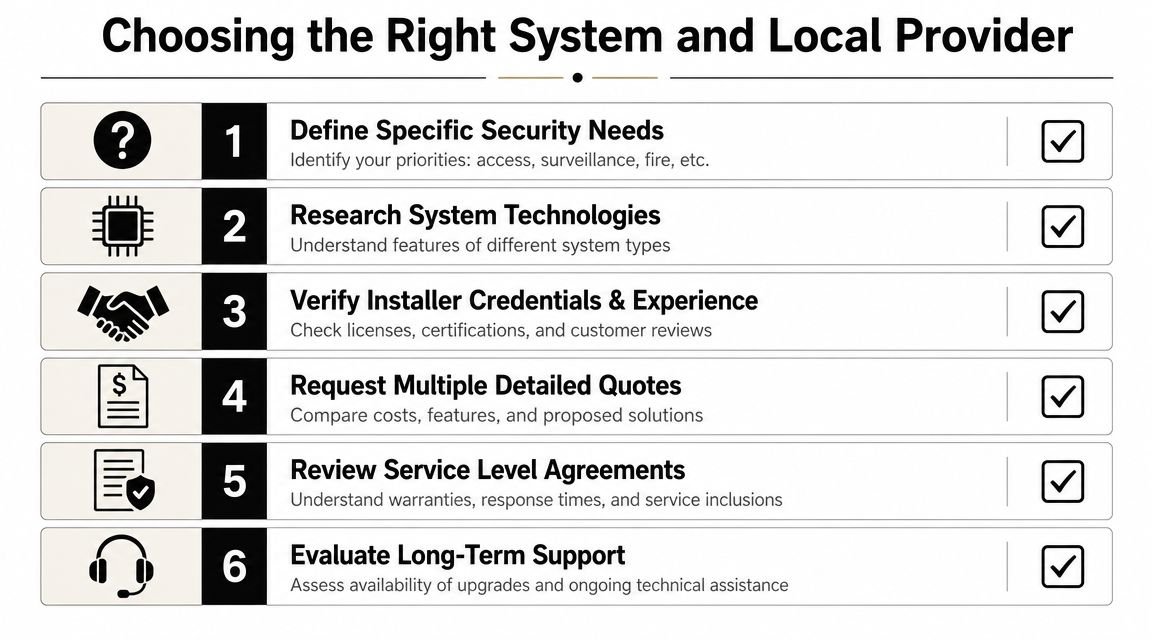
Choose the system like you'll have to live with it
A connected physical security setup is also a cyber risk decision. The NCSC's Cyber Security Breaches Survey found that 50% of UK businesses experienced a cyber breach or attack in the last 12 months, rising to 70% for medium businesses and 74% for large businesses, as referenced in this discussion of connected security and cyber exposure.
If your CCTV, mobile credentials, intercoms, and door controllers are networked, treat these as buying criteria, not technical extras:
- Account control: Every admin account should have a clear owner
- Update routine: Ask who applies firmware and software updates, and how often the system is reviewed
- Logging: You need an audit trail for access changes, user activity, and important events
- Remote access discipline: Convenience is fine. Uncontrolled remote access isn't
A short decision filter
When comparing systems, I'd judge them on these points first:
| Question | Why it matters |
|---|---|
| Can it integrate cleanly with what you already have? | Retrofit projects live or die on compatibility and sensible limits |
| Can non-technical staff actually use it? | A system nobody understands gets bypassed |
| Does it fail safely? | Gates, doors, alarms, and fire-related interfaces need predictable behaviour |
| Who maintains it after install? | Support quality matters more than brochure features |
One relevant option for businesses reviewing door management is professional access control installers, especially where user permissions, logs, and multi-door integration matter as much as the reader hardware itself.
Choose the provider with the same care
The installer matters as much as the kit. A tidy proposal can hide weak aftercare, vague cyber responsibility, or very little experience with older UK properties.
Look for:
- Real local experience: Cardiff offices, Bristol retail units, Newport industrial yards, and Swansea residential blocks all behave differently
- Clear responsibility lines: Who supports the software, the devices, the networking side, and the ongoing maintenance
- Accreditations and checks: Insurance, DBS-checked engineers where relevant, and recognised safe working standards all matter
- Practicality over sales talk: The right provider will tell you what not to integrate as well as what can be integrated
Wisenet Security Ltd is one local option in this market. It installs and maintains integrated systems across South Wales and the South West, including CCTV, intruder alarms, access control, fire systems, intercoms, and gate automation.
If a provider only talks about features and never talks about permissions, updates, maintenance, and failure modes, keep asking questions.
Integrated Security in Action Across the South West
A retail unit in Bristol city centre often has a simple but important problem. Staff arrive at different times, deliveries come through a rear entrance, and the owner wants to check alarm events without driving in. An integrated setup links the rear door contact, staff access records, and the nearest camera view. If the alarm activates after closing, the owner can see whether it was an authorised entry, a delivery issue, or a genuine concern.
A small industrial unit in Newport has a different pressure point. The weak spots are usually the yard, roller shutter, and vehicle gate. When those are linked properly, a gate event can trigger recording priorities, a shutter alert can call up the right camera, and after-hours activity becomes far easier to verify. That's much more useful than having a siren and hoping someone can interpret the footage later.
A multi-tenant residential building in Swansea needs another style of integration again. The issue isn't just intrusion. It's visitor management, shared access, and making sure entry points, intercoms, and safety-related behaviour work sensibly together. In that setting, residents benefit from controlled access and better records, while landlords avoid a lot of confusion around who entered and when.
For owners comparing these sorts of setups, it helps to look at broader examples of CCTV and security systems for homes and businesses. The key is matching the system logic to the building, not forcing every property into the same template.
If you're weighing up integrated security systems for a home, shop, warehouse, block, or mixed-use building in South Wales or the South West, Wisenet Security Ltd can assess what you already have, identify what should be integrated first, and help you plan a practical system that fits the building rather than fighting it.