Fire Alarm Testing Regulations UK: A Practical Guide
In UK non-domestic premises, the responsible person must keep the fire alarm system in efficient working order, with BS 5839-1 setting the practical expectation of activating a different manual call point once a week and arranging a competent service visit roughly every five to seven months. The weekly test only provides defensible evidence when the call point rotates, the alarm receiving centre confirms the signal where monitoring is used, and the result is recorded properly.
It's 8:15 on a wet Monday morning in Newport. Sarah, the facilities manager at a South Wales warehouse, walks past the fire alarm panel with a test key in her hand. She selects a manual call point she hasn't used in twelve weeks, not the one beside the panel that staff usually activate because it's convenient.
The sounders operate. The panel shows the fire condition. The alarm receiving centre confirms receipt. Staff move to the muster point, and Sarah resets the system before entering the result in the dog-eared logbook.
That routine looks ordinary, but it tests far more than whether a bell makes a noise. It checks a selected call point, the control equipment, alarm indication, sounder operation and, where applicable, the external signalling path. The record then shows what happened, who carried out the test and whether anyone needs to act.
That is the purpose of the fire alarm testing regulations UK dutyholders work under. Compliance isn't a calendar ritual. It's a body of evidence showing that the system is being exercised across the premises, defects are identified and competent people are dealing with them.
Table of Contents
- A Monday Morning in a South Wales Warehouse
- The Law and the Standard Behind the Bell
- How to Run a Compliant Weekly Test
- Weekly Tests Versus Professional Servicing
- Where Premises Quietly Fail Compliance
- A Practical Compliance Workflow for Dutyholders
- Fire Alarm Testing Questions Worth Asking
A Monday Morning in a South Wales Warehouse
Sarah's test exposes the difference between a routine and a meaningful control. If she had used the same call point every Monday, the logbook might still contain a reassuring sequence of ticks, but much of the system would remain unverified. A call point in a quiet loading bay, a remote office or a separate zone could be defective without anyone noticing.
The weekly test also has to prove that the alarm travels beyond the device. On a monitored system, Sarah must place the alarm receiving centre on test before activation and notify it again when the exercise is complete. A locally functioning panel doesn't prove that the signal is reaching the external monitoring point.
Practical rule: A test is only as useful as the part of the system it exercises and the evidence it leaves behind.
The logbook matters for the same reason. Sarah records the date, time, selected call point, result, ARC confirmation and any fault. That information gives an auditor a trail rather than a verbal assurance. It also lets her identify whether the weekly rotation is covering the building.
Why the rotation matters
BS 5839-1 practice requires a different manual call point to be activated each week, so every point is tested in rotation over time. The standard is intended to confirm the control panel, alarm indication and sounders, not merely create a brief sound in one part of the building. UK fire alarm guidance on weekly user testing describes this rotational approach and the need to place an alarm receiving centre on test before the drill.
The same principle appears in local authority guidance for HMOs, where at least one detector or call point in each zone should be tested weekly. That makes the duty practical across warehouses, offices, retail premises and shared residential buildings, even though responsibility can be divided between landlords, managing agents, employers and tenants.
Sarah's wet Monday test is therefore a useful audit model. The system was selected deliberately, the monitoring path was checked, occupants responded and the entry was made while the details were fresh. The rest of this guide applies that discipline to the legal framework, servicing regime and common points of failure.
The Law and the Standard Behind the Bell
The legal starting point for most non-domestic premises in England and Wales is the Regulatory Reform (Fire Safety) Order 2005. It places duties on the responsible person, normally the employer, owner, occupier or person with control of the premises, to maintain fire precautions and fire alarm systems in efficient working order.
The Order establishes the duty. It doesn't provide a complete operating manual for every panel, detector and call point. That is where BS 5839-1 becomes important. The British Standard translates the broader legal requirement into recognised practice for fire detection and alarm systems in buildings, including weekly user tests, professional servicing, fault management and records.
Four layers of accountability
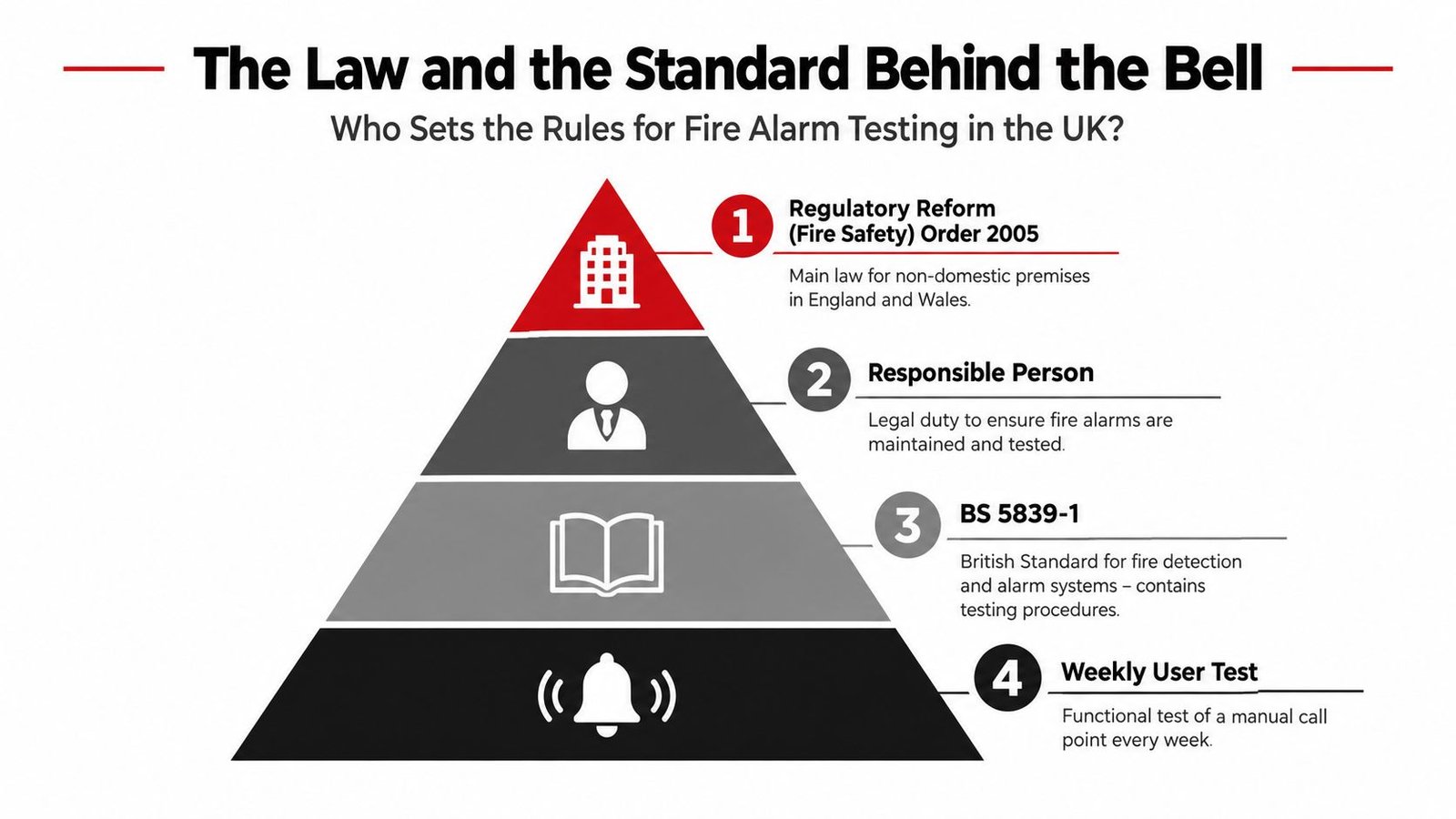
The arrangement is easier to manage when each layer has a clear role:
- The law: The Regulatory Reform (Fire Safety) Order 2005 creates the legal duty for responsible persons in England and Wales.
- The responsible person: This individual or organisation must ensure that fire precautions, including the alarm system, remain effective.
- The standard: BS 5839-1 supplies the technical benchmark for design, maintenance, testing and documentation.
- The user test: A different manual call point is operated weekly to provide regular operational evidence.
British Standards aren't statutes. A departure from BS 5839-1 isn't automatically a criminal offence by itself, but a dutyholder who ignores the recognised benchmark needs a sound, documented alternative approach. In practice, enforcing authorities, insurers and fire risk assessors use the standard as an important test of whether arrangements are competent and reasonable.
England and Wales aren't the whole UK legal picture. Scotland and Northern Ireland have their own fire safety legislation and guidance, so a national organisation must confirm the applicable regime for each site. The technical maintenance principles still need to be matched to the system design, premises use and local legal requirements.
Fire alarm evidence also sits alongside other passive and active fire measures. A facilities manager reviewing the alarm shouldn't overlook compartmentation, escape routes and fire doors. A practical commercial fire door compliance guide can help teams assess that connected part of the building's protection strategy.
For businesses arranging installation, commissioning or maintenance, Wisenet's fire alarm certification guidance is another relevant reference point. The priority is to identify the responsible person, appoint competent support and keep the system's performance demonstrable.
How to Run a Compliant Weekly Test
A proper weekly test should follow a written procedure beside the control panel. The person carrying it out doesn't need to improvise, and the task shouldn't depend on one experienced employee remembering every detail.
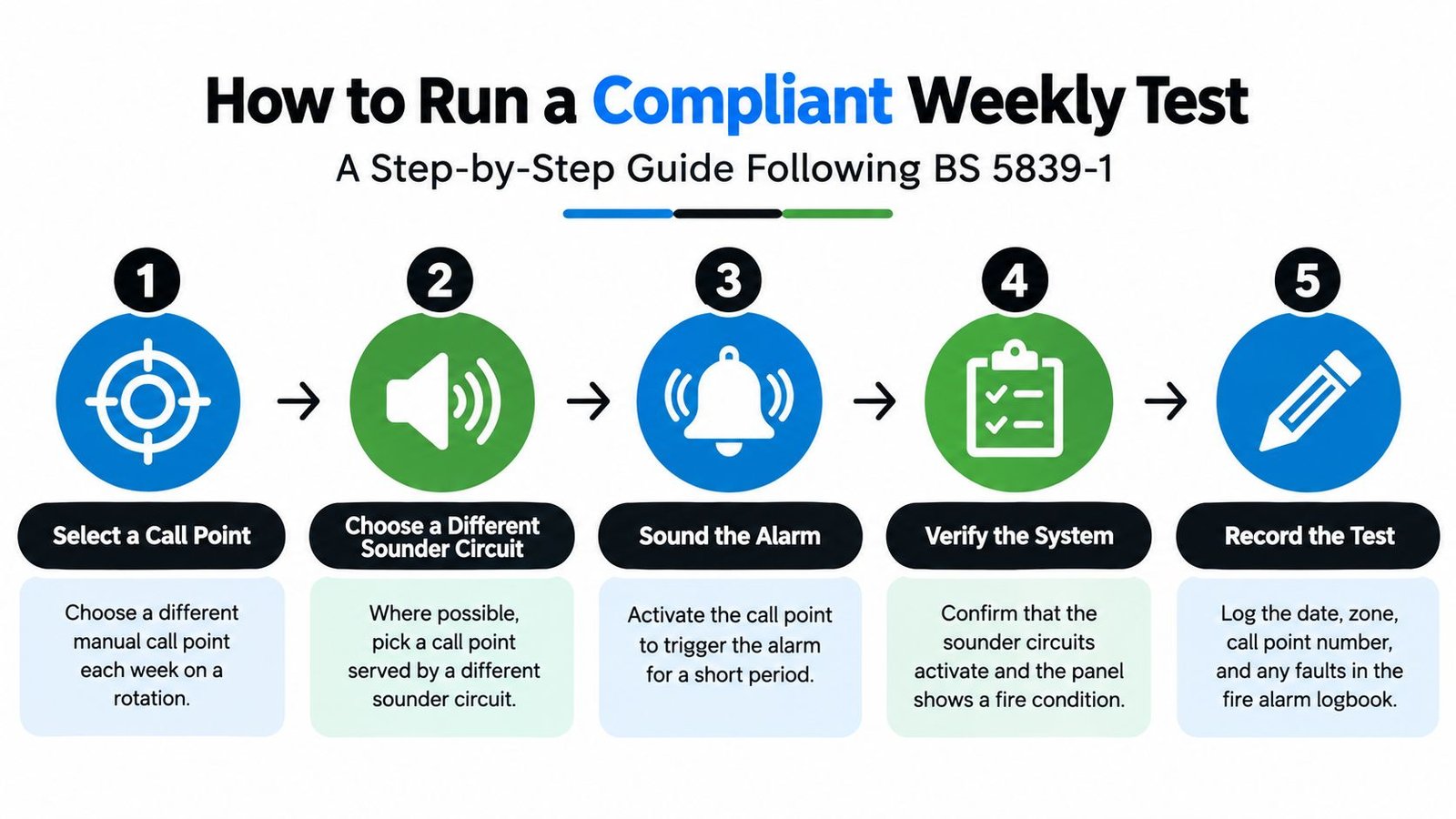
Follow the sequence
Select the next call point. Use a rotation schedule showing each manual call point and zone. Don't keep choosing the point nearest the panel. Select a point that extends coverage across the building and, where possible, exercises a different sounder circuit.
Notify the alarm receiving centre. Tell the ARC when the test will take place and identify the premises. This prevents an avoidable response and creates an opportunity to confirm that the signalling path is available.
Warn occupants. Tell staff that a test is taking place, but make sure everyone understands that an alarm must always be treated seriously unless the agreed test procedure is active. Account for visitors, contractors and people working in noisy or isolated areas.
Activate the manual call point. Operate the selected point with the correct test key. The signal should last long enough to verify operation but remain between 5 and 60 seconds, as described in UK guidance tied to BS 5839-1 practice. Fire alarm testing guidance from Joblogic explains the importance of checking the panel and sounders during this controlled interval.
Check the response. Confirm that the control equipment registers the fire condition, the relevant indicators operate and the sounders can be heard or otherwise perceived throughout the required areas. Check visual warning devices where the premises relies on them for people who may not hear an audible alarm.
Confirm the ARC signal. Ask the monitoring centre to confirm receipt. A sounder test without signal confirmation leaves a serious gap on a monitored system.
Reset and inspect. Restore the panel to its normal condition and check for fault indications. If the system doesn't reset cleanly, escalate the issue rather than treating the test as successful.
Complete the logbook immediately. Record the date, time, zone, call point identity, result, ARC confirmation, tester and any defect or remedial action.
Make the rotation visible
A spreadsheet is sufficient for a small site. A larger warehouse should use a site plan or asset register that links the call point reference to its zone and sounder coverage. Mark each completed test and investigate any point that repeatedly drops out of the schedule.
Varying the day or time can reveal practical weaknesses, such as staff not recognising the signal outside the usual office routine. Don't vary the process so much that people become confused. The rotation should be controlled, predictable and easy for another person to audit.
The weekly fire alarm testing guidance from Wisenet can sit alongside the site's own panel instructions and logbook procedure. Use manufacturer instructions where they impose additional controls, especially for monitored, wireless or integrated systems.
The following video can help staff visualise the basic sequence, but it doesn't replace the building's risk assessment, panel instructions or ARC procedure.
The facilities manager remains accountable for the outcome. Delegate the physical test if appropriate, but retain oversight of the schedule, evidence and defect close-out.
Weekly Tests Versus Professional Servicing
Weekly testing and professional servicing are different controls. Treating them as interchangeable is one of the most common maintenance errors.
The user test is a limited operational check. It exercises one rotated call point, confirms the control equipment receives the signal and checks the alarm indication and sounders. It can reveal an obvious failure, but it won't provide the detailed inspection needed to assess every detector, battery, interface or circuit.
Professional servicing examines the system more broadly. Under newer BS 5839-1:2025 guidance, the service window is flexible at roughly every five to seven months, while the maintenance plan must still achieve coverage of every detector and device across the year. Guidance on fire alarm testing frequency and the flexible service window highlights the need to adapt scheduling without weakening device coverage or records.
| Aspect | Weekly User Test | Periodic Service Visit |
|---|---|---|
| Performed by | A responsible person, nominated staff member or other competent person | A competent fire alarm engineer |
| Main purpose | Check a selected call point, panel response and warning devices | Examine and functionally test the system in depth |
| Coverage | One rotated point per test, building coverage over the rotation | Detectors, call points, batteries, interfaces and system functions within the service programme |
| Typical findings | Obvious alarm, sounder, panel or signalling failure | Battery degradation, contamination, interface faults, loop issues and other latent defects |
| Evidence | Weekly logbook entry | Service report, findings, certificate and remedial recommendations |
The distinction is practical. A weekly user test can expose a dead call point or a local operational fault. A service visit is better placed to identify detector contamination, standby battery deterioration, charger problems, sensitivity issues and interface failures that a single spot-check won't reliably find.
A certificate doesn't make the weekly rotation unnecessary. The two records answer different audit questions.
Facilities managers should compare the engineer's findings with the weekly logbook. If the engineer discovers that a point hasn't been tested for an extended period, fix the rotation process. If weekly tests show repeated faults, don't wait for the next scheduled service. Escalate them.
For broader maintenance planning, this alarm system care resource for facilities managers offers useful context on keeping security systems organised. Fire alarm maintenance still needs its own BS 5839-1 procedure and competent technical input.
Where Premises Quietly Fail Compliance
The most dangerous records are the ones that look complete at a glance. A logbook full of ticks may show regular activity, but it doesn't prove that the right device was selected, that the ARC received the signal or that defects were closed.
Missing rotation is the first failure. Staff choose the same convenient call point because it sits beside the panel and takes seconds to activate. The result is a repeated test of one location while other zones, circuits and devices receive little or no direct verification.
Incomplete records create the second failure. A tick with no call point reference, time, tester or ARC confirmation leaves an auditor unable to reconstruct the event. If a fault appears later, the business also loses the information needed to identify whether the problem was new or had been present during earlier tests.
Shared buildings create shared assumptions
In a multi-tenant building, the landlord may believe the managing agent is testing the common system. The agent may expect each tenant to test its own area. Tenants may assume the landlord's contractor covers everything. That chain of assumptions leaves responsibility undefined.
HMOs and shared blocks need a written allocation of duties. Local authority guidance reflects the practical approach that at least one detector or call point in each zone should be tested weekly, potentially by cleaning staff, maintenance staff or a competent tenant. The person who performs the action must know the procedure, have access to the logbook and understand who receives a fault report.
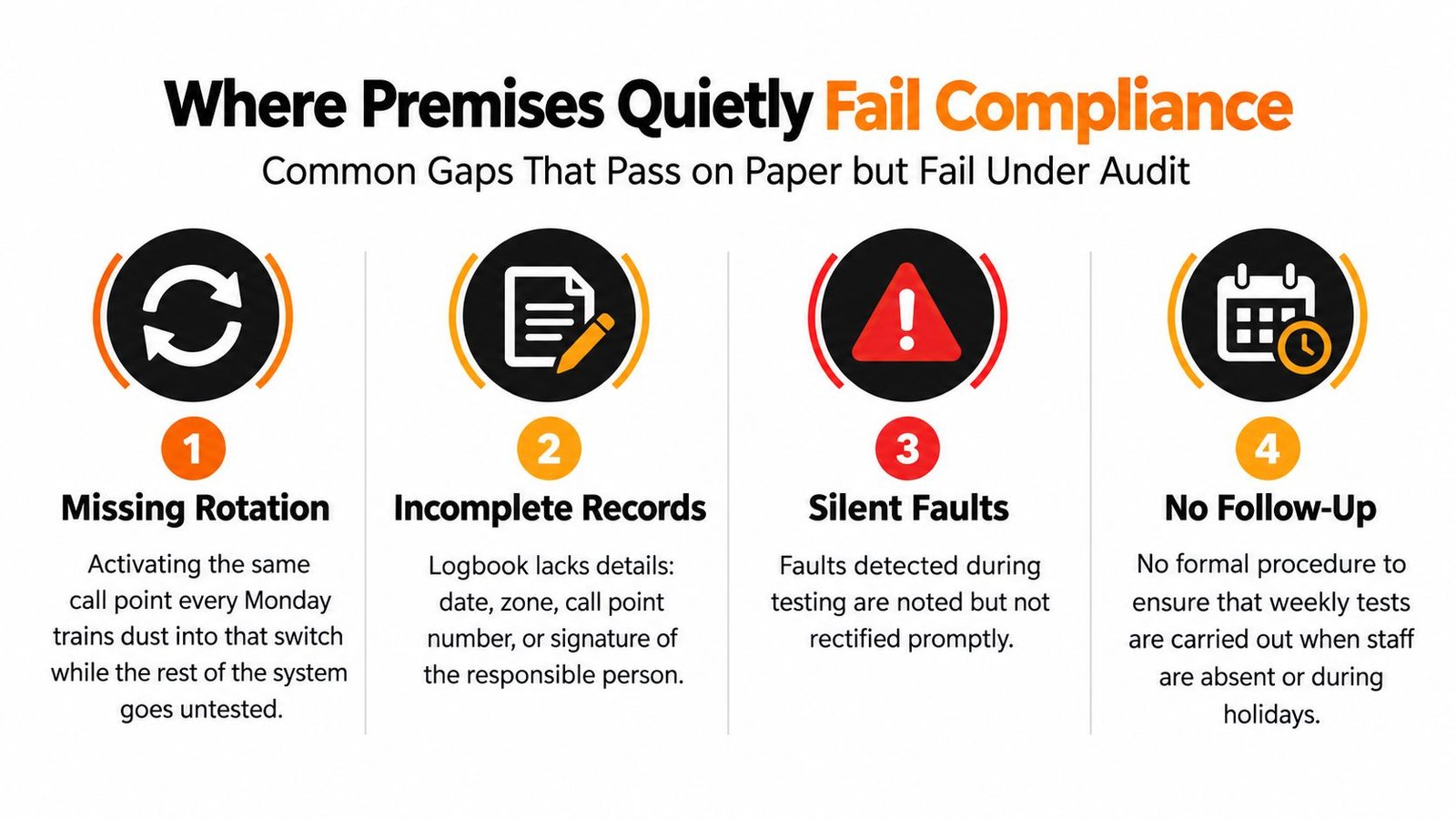
Other failures deserve equal attention:
- Unresolved faults: Recording a fault without assigning an owner and close-out action doesn't restore protection.
- Poor holiday cover: A weekly task skipped because the usual tester is absent breaks the evidence trail.
- Weak communication arrangements: Procedures should account for deaf users and others who may not perceive an audible warning. BS 5839-1 guidance on communication for deaf users must be reflected in the building's alarm strategy.
- Overreliance on monitoring: Remote signalling doesn't compensate for an untested local device or an unrecorded line fault.
Electrical issues can sit behind apparently minor alarm faults. Where a site has recurring supply or circuit problems, facilities teams may also need specialist support such as plant-level electrical fault detection to investigate wider reliability risks.
An enforcing authority, insurer or loss adjuster won't assess only whether someone rang a bell. They'll look for rotation, competence, fault response, device coverage and records that tell a coherent story.
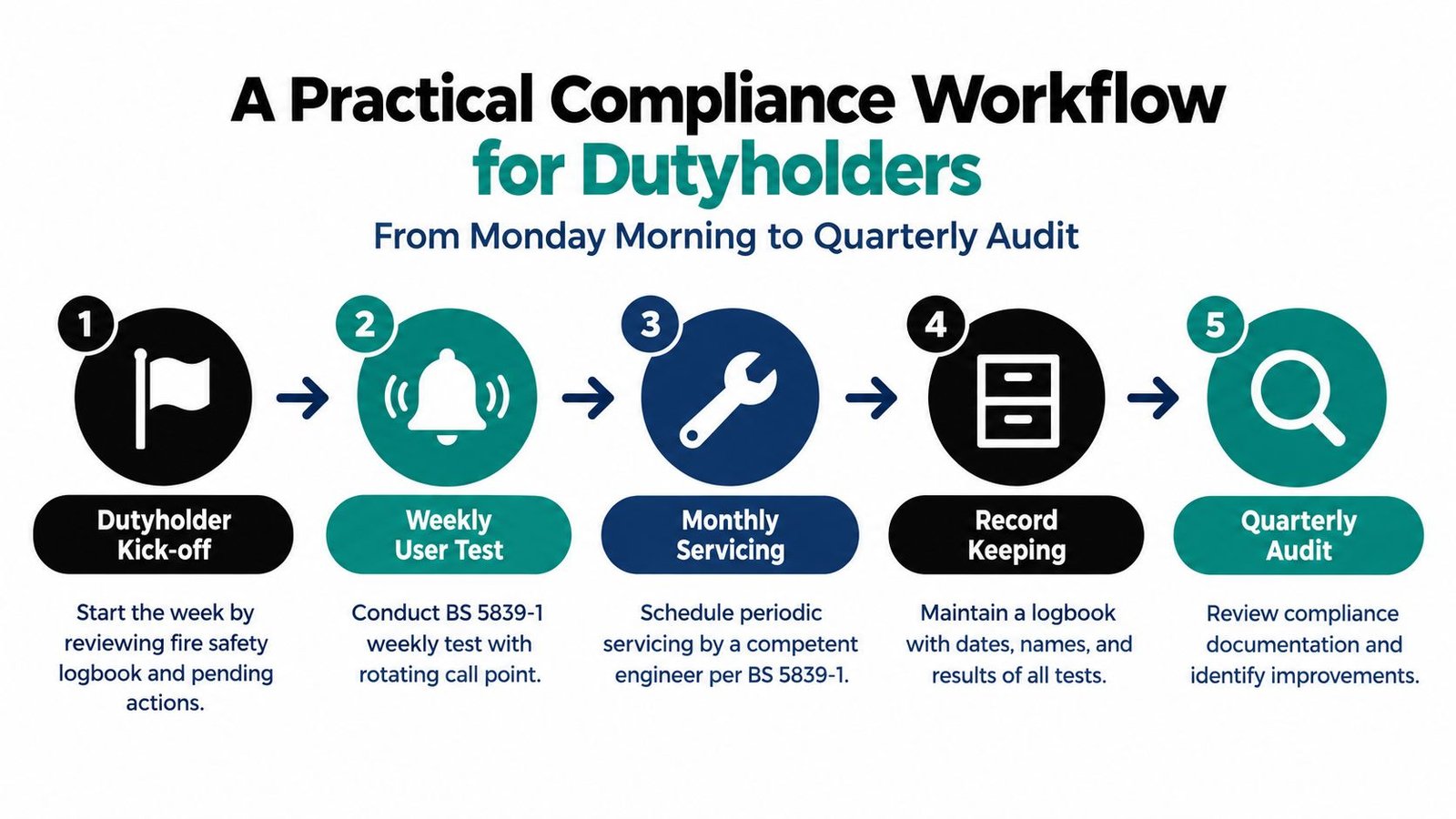
A Practical Compliance Workflow for Dutyholders
Start by naming the responsible person for each premises. Under the Fire Safety Order, that role can't remain an informal assumption between a property owner, employer and managing agent. Record the appointment, define the person's authority and nominate a competent individual to coordinate the weekly routine.
A workable workflow looks like this:
Set the control point
Keep the fire alarm logbook at or near the panel. The dutyholder should review outstanding faults before the weekly test begins, confirm that the ARC contact details remain current and check that the person testing has the correct key, reset instructions and call point rotation list.
Use one simple escalation rule. Any failed alarm, sounder, panel indication, signalling confirmation or reset should be reported immediately to the responsible person and the maintenance contractor. Don't mark the weekly exercise as passed because the system eventually returned to normal.
Run the evidence cycle
The weekly test should include the selected call point, panel, sounders, ARC confirmation where relevant and a complete logbook entry. Add a photograph of the activated call point when the site uses digital records or needs stronger evidence for a large, dispersed system.
Schedule service visits within the roughly five-to-seven-month window associated with BS 5839-1:2025 guidance, rather than treating an old certificate date as the only maintenance control. The service plan still needs to cover every detector and device across the year. Retain service certificates and reports for at least three years only where the site's own policy or an applicable requirement specifies that retention period. The supplied guidance does not establish that retention period as a verified regulatory fact, so confirm it with your fire risk assessor, insurer and legal adviser before adopting it.
A quarterly management review should examine missed tests, recurring faults, false alarm patterns, engineer recommendations and overdue remedial work. A monthly review can also check emergency lighting interfaces and cause-and-effect arrangements where those systems are integrated, but don't claim that these checks replace their own maintenance requirements.
Pin this beside the panel
- Name the dutyholder: Confirm the responsible person and competent coordinator.
- Select the point: Follow the written rotation, including zones and call point references.
- Notify the ARC: Place the monitoring centre on test before activation and confirm receipt afterwards.
- Check the response: Verify the panel, indications, sounders and relevant visual warning devices.
- Reset safely: Return the system to normal and investigate any fault indication.
- Record the evidence: Enter the date, time, tester, point, result and ARC confirmation.
- Escalate defects: Give every fault an owner, action and close-out date.
- Review coverage: Compare weekly entries with service reports and the annual device coverage plan.
- Maintain contingency: Arrange cover for absence, holidays and out-of-hours failures.
- Review the risk assessment: Update the system strategy when the building, occupancy or use changes.
This workflow makes the audit question straightforward. The dutyholder can show who acted, what was tested, what the system did, which defects arose and how the business responded.
Fire Alarm Testing Questions Worth Asking
Use the service visit to question the evidence, not just collect a certificate. A competent engineer should be able to explain what was inspected, which standard and system documents were used, what limitations applied and what needs corrective work.
Ask about competence
Ask for the contractor's relevant competence evidence. This may include third-party certification, BAFE SP203 arrangements, NSI Gold certification or documented in-house training appropriate to the system. Don't accept a logo without checking what activities the certification covers.
Ask whether the engineer understands the installed panel, detectors, signalling equipment and cause-and-effect design. A contractor familiar with one manufacturer's equipment may not be competent to assess a different addressable or integrated system without the right support and documentation.
Ask what the certificate proves
Request an explanation of the inspection and servicing certificate against the relevant parts of BS 5839-1, including the sections covering maintenance arrangements. Ask whether every device is being covered through the service programme, how staged visits are documented and what remains outstanding.
The newer flexible service window doesn't mean a contractor can reduce coverage. Ask for the annual device coverage plan, the reason for the proposed interval and a clear record of devices tested at each visit.
Ask who owns the gaps
In an HMO or shared block, ask the engineer to identify the boundary between landlord, managing agent, tenant and contractor. The written agreement should state who performs weekly tests, who contacts the ARC, who receives faults and who authorises remedial work.
Ask what recommendation codes mean before approving a quotation. If the report uses categories such as A1, A2, A3, B, C or D, require the engineer to define each code in that report and explain the risk, urgency and proposed remedy. Don't approve work based on unexplained shorthand.
Short answers for the site visit
- Is a weekly bell test enough? No. It provides limited operational evidence. Professional servicing is needed for wider technical checks.
- Does every device need attention? The maintenance plan must achieve full detector and device coverage across the year, even where service visits use a flexible interval.
- Can a tenant do the weekly test? A competent tenant may be suitable where the responsibility is clearly assigned and the person has the procedure, access and escalation route.
- What should a cheap quote include? At minimum, ask whether it covers the selected call point, control equipment, sounders, power supplies, signalling path and the professional checks appropriate to the installed system. A bell-only visit is not a full maintenance service.
- Where can I check the selected device? The manual call point guidance from Wisenet explains the role of these devices and supports a more informed conversation with the engineer.
Wisenet Security Ltd offers fire alarm installation, commissioning, servicing and maintenance for premises across South Wales and the South West, with support for conventional and addressable systems, monitoring and emergency lighting integration. Visit Wisenet Security Ltd to discuss a site-specific testing schedule, call point rotation plan and maintenance evidence suitable for your premises.