Alarm System Installations: The Complete UK Guide for 2026
You've come home from a week away and the back door is sitting open. Or you've entered your shop on Monday morning and found the stock room stripped while the alarm's external bell has been flashing for hours. In both cases, the question isn't merely whether an alarm was fitted. It's whether the system was designed for the property, installed to the right standard, maintained properly, and capable of getting the right response.
Alarm system installations involve choices that affect security, insurance, maintenance and police response eligibility. Wired or wireless? Bell-only, smartphone alerts or professional monitoring? Which BS EN 50131 grade matches the actual risk? In older South Wales terraces, listed buildings, retail units and industrial premises, the cheapest option on paper often creates the most trouble later.
This guide focuses on the practical side of those decisions, including realistic disruption, installation planning, false alarm prevention and the standards that shape a compliant UK system.
Table of Contents
- Why Alarm System Installations Matter More Than Ever
- Choosing Between Wired Wireless Monitored and Bell-Only Systems
- Understanding BS EN 50131 and UK Alarm Standards
- The Installation Process From Site Survey to Handover
- Integrating Alarms with CCTV Access Control and Fire Detection
- Monitoring Options and Preventing False Alarms
- Costs Maintenance and Inspection Requirements
Why Alarm System Installations Matter More Than Ever
An alarm is only useful when it works at the point of need. England's household data illustrates the difference between having equipment on a wall and having effective protection. By 2013–14, 20.8 million households, or 92% of all households, reported having at least one smoke alarm, while 19.9 million households, or 88%, said at least one alarm was working when surveyed. The same government data recorded nearly 300,000 households that didn't know whether their alarm worked, and about 2.5 million households, or 11%, with no alarm or one that wasn't working. The government's smoke alarm and fire safety data provides a useful baseline for understanding the maintenance gap.
That distinction applies equally to intruder systems. A siren with a flat backup battery, a wireless contact that has lost communication, or a monitored system that hasn't been tested with the Alarm Receiving Centre can create false confidence. Installation is the starting point, not the finished result.
The decision affects more than deterrence
A homeowner may begin by wanting a visible bell box and a few sensors. A landlord may be responding to a compliance request. A retailer may need protection for stock, staff-only doors and cash handling areas. Each property needs a different design because the consequences of an activation, communication failure or missed detection aren't the same.
The UK's alarm market also operates within a more formal framework than many buyers realise. BS 5839 provides the technical structure for fire alarm design, installation, commissioning and maintenance across domestic and non-domestic premises, while BS EN 50131 provides a risk-based approach to intruder alarm systems. These standards help installers select suitable detectors, control equipment, signalling paths and tamper protection.
Practical rule: an installed alarm isn't automatically a compliant or dependable alarm. Ask what standard applies, what grade has been specified, and how the system will be maintained.
Older properties bring particular challenges. Victorian terraces may have solid walls, suspended floors, awkward loft routes and several independently occupied rooms. Modern commercial units can be easier to cable but may have roller shutters, mezzanine areas, plant rooms, loading doors and shared access. A competent installer designs around those conditions rather than forcing every building into the same template.
Choosing Between Wired Wireless Monitored and Bell-Only Systems
There's no universal winner between wired and wireless alarm systems. The right choice depends on the building fabric, the expected risk, how long the system will remain in place and the response you need after activation. This overview of intruder alarm types is useful background, but the site survey should decide the final design.
Four configurations in real properties
Wired systems use dedicated cabling between detectors and the control panel. They're a strong choice for new builds, major refurbishments and fixed commercial premises because they avoid individual sensor batteries and generally provide reliable communication. The drawback appears in a finished home. Reaching a first-floor window or remote outbuilding may involve lifting boards, opening ceilings or chasing walls, followed by making good and redecorating.
Wireless systems reduce that physical disruption. They suit occupied homes, listed buildings, rented properties and premises where access is limited. They still need engineering, though. Thick masonry, steel framing, foil-backed insulation and competing radio equipment can affect signal performance. A professional survey should test signal strength at proposed detector locations, not just beside the panel. Battery replacement also becomes part of the maintenance plan.
Monitored systems send alarm information to an Alarm Receiving Centre, or ARC. Depending on the installer, system approval and signalling arrangement, an ARC can manage alarm events and support police-response procedures. This is the appropriate direction for properties where an alarm must provide more than a local sounder.
Bell-only systems rely on an external siren and the people nearby noticing and acting. They can deter opportunistic intrusion and may suit lower-risk homes, but they don't provide an independent verification or response path. A loud bell can't contact you when you're away.
Hybrid systems often work well in older commercial premises. Wired contacts can protect accessible doors and shutters, while wireless devices cover areas where cable routes would cause disproportionate disruption. The panel and wireless receiver must be compatible, and the installer must check radio coverage rather than assuming the combination will work.
| System Type | Best For | Installation Disruption | Ongoing Maintenance | Police Response Eligible | Typical Cost Range |
|---|---|---|---|---|---|
| Wired | New builds, refurbishments, fixed commercial sites | Higher in finished properties | Lower sensor battery burden, scheduled servicing still required | Depends on approval, grading and monitoring arrangement | Varies by design and site survey |
| Wireless | Occupied homes, listed buildings, rented premises | Usually lower | Battery and signal supervision required | Depends on approval, grading and monitoring arrangement | Varies by device count and monitoring |
| Monitored | Higher-risk homes, businesses and premises needing remote response | Depends on wired or wireless design | ARC service, testing and system maintenance | Potentially, where the required arrangements are in place | Varies by contract and system |
| Bell-only | Lower-risk residential deterrence | Depends on system design | Batteries, servicing and user testing | Generally not as a standalone local alarm | Varies by property and coverage |
The false alarm risk isn't determined by “wired” or “wireless” alone. Poor detector placement, rushed commissioning and confused users cause more trouble than the transmission method itself. A reliable system is one that occupants understand and can operate consistently.
Understanding BS EN 50131 and UK Alarm Standards
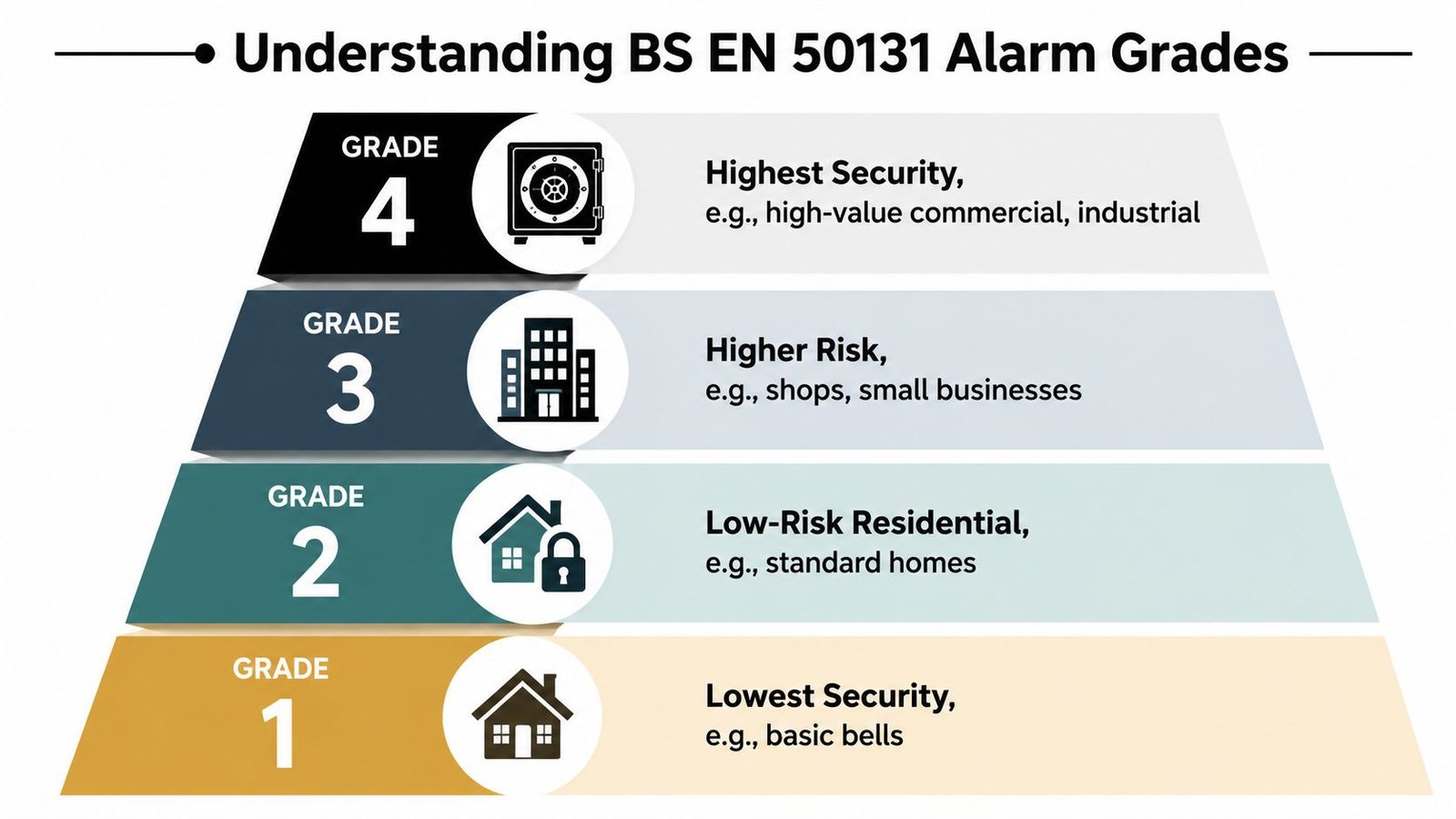
BS EN 50131 grades intruder alarm systems according to the expected threat. It prevents installers from treating a small home, a retail unit and a high-value industrial site as though they face identical attacks. The plain-language guide to EN 50131 explains why the grade influences the equipment and installation method.
Matching the grade to the threat
Grade 1 addresses low-risk, opportunistic intrusion. It may be suitable for basic deterrence where the intruder is unlikely to use specialist tools or plan the attack.
Grade 2 covers low-to-medium risk premises where an intruder may carry simple tools. This is often the level considered for standard residential protection, subject to the insurer's requirements and the property's circumstances.
Grade 3 is intended for medium-to-high risk sites. A shop, office, warehouse or business holding valuable contents may need stronger detection, tamper protection and signalling than an ordinary dwelling.
Grade 4 is reserved for very high-risk environments where attackers may plan the intrusion and use specialist equipment. It's a specialist specification, not an upgrade that should be selected casually.
The grade affects the control panel, detectors, signalling, supervision and resistance to tampering. It can also affect whether an insurer accepts the system and whether a police-linked response arrangement is available. An alarm that falls below the policy requirement may leave the owner with a compliance problem even if the equipment operates normally.
Fire standards need separate attention
Intruder grading doesn't replace fire alarm standards. BS 5839-1:2017 covers non-domestic fire alarm systems, while BS 5839-6:2019+A1:2020 covers domestic premises. The domestic grades reflect different levels of power supply and supervision. Grade A uses a panel, mains supply, standby batteries, manual call points and alarm devices. Grade D2 uses mains-powered detectors with user-replaceable standby batteries and radio interlinking, while Grades F1 and F2 are battery-only arrangements, with F1 interlinked by radio and F2 standalone. The Fire Industry Association's BS 5839 information sets out the standards framework.
Don't choose a grade by price alone. Start with the insurer, occupancy, contents, building use and response requirement. Then ask an approved installer to document the risk assessment, proposed grade, signalling route and maintenance obligations. NSI Gold and SSAIB certification can provide evidence that a company operates within recognised industry approval schemes, but the certificate and system specification still need to match the actual policy conditions.
The Installation Process From Site Survey to Handover
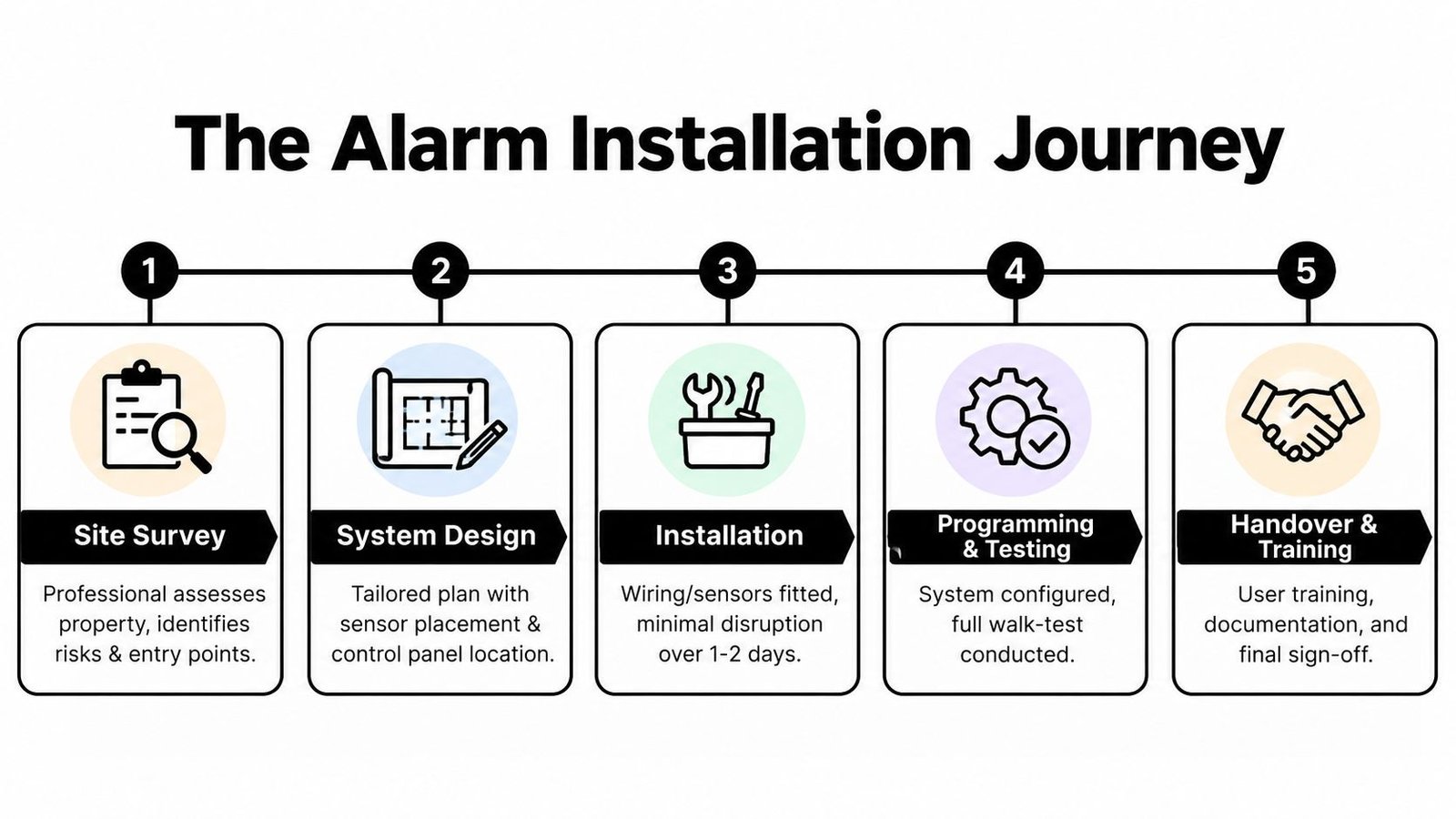
A professional installation begins before anyone reaches for a drill. The survey should identify every likely entry route, including doors, accessible windows, roof access, shutters, gates and internal movement routes. In a South Wales terrace, that may mean reviewing a narrow rear lane and solid masonry walls. In a warehouse, it may involve loading bays, roller doors, offices, plant areas and shared yards.
The engineer should also check likely cable routes, panel locations, mains availability, backup communication and wireless signal conditions. Sensor placement needs to account for pets, heating sources, curtains, shelving and the way occupants use the rooms.
What the timetable really depends on
A straightforward wireless installation in a standard home may take one to two days, while a larger wired installation with extensive cable runs may take three to five days. These are planning ranges, not guarantees. The property's size, number of zones, access arrangements, ceiling construction, out-of-hours requirements and making-good expectations can change the schedule. The supplied installation brief identifies these ranges as practical guidance for typical UK work, rather than a fixed industry rule.
Retrofit disruption comes mainly from access. Engineers may need to lift floorboards, drill through partitions, enter loft spaces, route cables above ceilings and protect furniture from dust. Good teams use floor protection, label cable runs, control debris and explain any unavoidable damage before work starts. Wireless reduces drilling and rewiring, but it still requires careful fixing, programming and testing.
New-build work is different. First-fix cabling can be installed before plastering and decoration, leaving a cleaner result and fewer compromises. The same principle applies during a major refurbishment. Plan alarm routes before walls and ceilings are closed, not after the finishes are complete.
Commissioning is where quality becomes visible
At handover, the engineer should test every zone, detector, tamper circuit, sounder and signalling path. They should programme user codes, configure app access where included, confirm entry and exit delays, and demonstrate setting, unsetting and alarm cancellation.
The handover pack should include:
- Zone information: A clear chart naming each detector and protected area.
- User documentation: Manuals, codes and operating instructions for authorised users.
- Compliance records: Relevant installation, grading, monitoring and maintenance certificates.
- Maintenance guidance: Battery checks, service intervals and the correct process for cancelling accidental activations.
A rushed handover creates avoidable false alarms. Users need to practise the route from entering the property to disarming the system, including what happens when a door is opened before the code is entered.
Integrating Alarms with CCTV Access Control and Fire Detection
An alarm system can become the decision point for a wider security network. A confirmed intrusion may start CCTV recording, move a PTZ camera to a preset, send a snapshot to an ARC or alert a responsible person through an app. Access control can add the missing context by showing which credential was used, when it was presented and whether the door was forced instead.
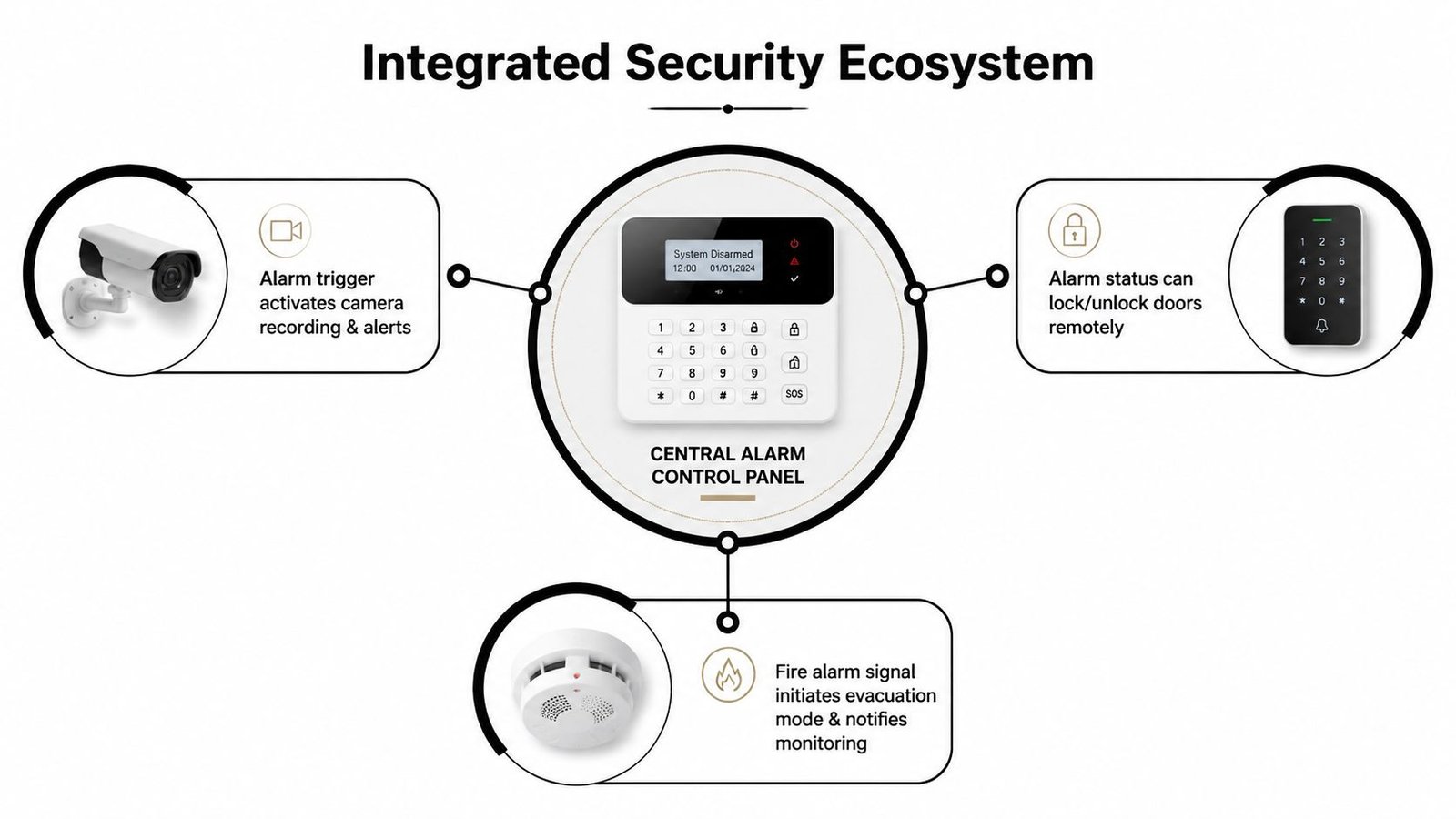
A fire signal follows a different priority. In a commercial building, fire detection should initiate the programmed evacuation response and allow emergency exits to operate safely. Access-controlled doors must not trap occupants because an intrusion configuration has been applied without considering the fire strategy.
Design principle: integration should clarify an event, not create a chain of unrelated reactions.
Where integration reduces uncertainty
Consider a small retail unit with a rear staff door, internal camera coverage and keypad access. A forced-door event can trigger recording, associate the event with access logs and notify the responsible manager. In a warehouse, a perimeter alarm can direct cameras towards the loading area while the monitoring operator checks whether the activation shows a genuine intrusion or an environmental cause.
Integration also creates technical dependencies. Video devices may use Power over Ethernet, and the network must have enough switch capacity, bandwidth and reliable power for cameras, recorders and access devices. The installer should check network layout, storage requirements, communications paths and failure behaviour. A system that works in a demonstration but overloads the customer's network isn't a finished design.
For premises with fire responsibilities, managers can also browse fire safety programmes to support broader staff training and fire-safety planning. The alarm installation itself still needs to be designed and maintained against the relevant fire standard.
Further guidance on combining these technologies is available in this resource on security system integration. The aim is a coherent event record that helps the ARC, site manager, insurer and, where appropriate, investigators understand what happened.
Monitoring Options and Preventing False Alarms
Monitoring is the part of alarm ownership that determines what happens when nobody is at the property. A bell-only system can make an intruder leave, but it depends on neighbours or passers-by. Smartphone alerts give the owner information, but the owner may be driving, asleep, abroad or unable to reach the premises. Professional monitoring adds an ARC that can manage the event according to the agreed procedure.
Police response has specific conditions. Independent guidance states that UK police response requires an approved installer and an approved Alarm Receiving Centre, alongside the relevant system and operational arrangements. NSI guidance on intruder alarm systems and police response explains the approval context. A Unique Reference Number, or URN, is part of police-linked arrangements, and false activations can put that response at risk.
| Monitoring Type | Monthly Cost | Response Time | Police Eligibility | Best For |
|---|---|---|---|---|
| Bell-only | No ARC fee | Depends on people nearby | Not as a standalone arrangement | Local deterrence and lower-risk homes |
| Self-monitored alerts | Depends on service and communications | Depends on the owner | Usually not by itself | Owners who can respond reliably |
| Professional ARC monitoring | Depends on contract and signalling | ARC procedures apply | Potentially, where all approval conditions are met | Businesses, higher-risk premises and absent owners |
Prevent nuisance activations at design stage
False alarm prevention starts with placement. Motion detectors shouldn't face heat sources, moving curtains or unstable storage. Pet-friendly sensors can help in suitable environments, but they aren't a substitute for proper positioning. Dual-technology detectors may be appropriate where a single detection method could be affected by the surroundings.
Users also need practical training. They should know which doors have entry delays, how to cancel an accidental activation, how visitors affect setting and what to do if the app reports a fault. Regular servicing can identify weak batteries, damaged contacts, communication faults and detector problems before they become operational incidents.
The industry has a strong reason to focus on this issue. One industry resource claims 97% of intruder alarm activations are false, while UK fire statistics separately track false alarms by reason code. Those figures come from different contexts and shouldn't be treated as interchangeable, but they point to the same operational lesson. A system that repeatedly calls for unnecessary responses eventually loses trust.
Costs Maintenance and Inspection Requirements
Alarm installation prices vary because properties vary. A small bell-only home system is a different project from a monitored commercial platform linked to CCTV, access control and fire detection. The cost is shaped by sensor count, property size, cable routes, panel capacity, signalling, integration, access hours and the amount of making good required after retrofit work.
The security system services market is estimated at £2.1 billion in 2026, with 2,973 businesses operating in the sector, according to IBISWorld's UK security system services market information. That market context doesn't determine an individual quotation, but it reinforces why buyers should compare detailed specifications rather than headline prices.
Budget for the system after installation
Ask the installer to separate the initial equipment and labour from recurring services. A quote should identify the number and type of detectors, control panel, sirens, keypads, signalling equipment, commissioning, user training, warranty and any monitoring contract.
| System Type | Installation Cost | Annual Maintenance | Inspection Frequency | Insurance Requirement |
|---|---|---|---|---|
| Basic bell-only residential | Depends on property and coverage | Service and battery costs as specified | Follow installer and insurer requirements | Confirm with insurer |
| Wireless residential | Depends on sensor count and signal survey | Scheduled service plus sensor batteries | Follow installer and insurer requirements | Confirm grade and approval requirements |
| Wired residential or small business | Depends on cable routes and making good | Scheduled service and backup battery costs | Follow installer and insurer requirements | Confirm grade, certification and monitoring terms |
| Integrated commercial | Depends on design, interfaces and site complexity | Maintenance across alarm, CCTV, access and fire systems | Based on relevant standards, risk and insurer requirements | Written insurer specification is essential |
Wireless sensors add battery management. Wired systems reduce the number of sensor batteries but still require panel battery checks, detector testing and inspection of cabling, tamper circuits and signalling. Integrated sites also need software, network and user-permission checks.
Insurers may require evidence of an appropriate grade, approved installation company, monitoring arrangement and ongoing maintenance. Don't assume a certificate automatically satisfies the policy. Give the insurer the proposed specification before work begins, then retain zone charts, commissioning records and service reports.
Build a long-term budget around servicing, replacement batteries, fault call-outs, communication upgrades and future expansion. Manufacturers may discontinue older panels or applications, and adding a new building wing can require extra receivers, expanders or a larger control panel. A slightly higher-quality design at the start can be cheaper than replacing an undersized system when the property changes.
Wisenet Security Ltd provides wired and wireless alarm system installations across South Wales and the South West, with bell-only, monitored and smartphone-alert options alongside CCTV, access control and fire detection. For a site survey that considers grading, disruption, integration and ongoing maintenance, visit Wisenet Security Ltd and request a consultation.