
Automatic Gate Systems: A Practical UK Buyer’s Guide
Five reportable injuries were linked to automatic gatelines across the previous five years, despite UK stations handling around 10 billion passenger journeys annually and an estimated 20 billion gateline interactions each year during the period reviewed by the Office of Rail and Road safety report. That contrast tells you something important about automatic gate systems: the technology itself isn't the main danger. Properly designed, tested and maintained gates can manage huge volumes of movement safely. The risk sits in poor design, unsafe retrofits, weak commissioning and legacy equipment that nobody has properly inspected.
For homeowners, landlords and facilities managers, an automatic gate isn't just a motor, a remote control and a decorative panel. In the UK, it is powered machinery. It must be assessed, installed and handed over with the discipline you'd expect from any other moving machine. The Door & Hardware Federation's guidance on legislation and standards places powered gates within the Supply of Machinery (Safety) Regulations 2008 and alongside wider duties under UK health, safety and electrical legislation.
Table of Contents
- What This Buyer's Guide Will Help You Decide
- Matching Gate Type to Your Site and Traffic
- Drive Mechanisms Explained Without the Jargon
- UK Safety Standards and the Numbers That Matter
- Site Assessment Before Anyone Quotes You
- Intercoms and Access Control Integration
- Real Costs and Ongoing Maintenance
- Choosing a Compliant Installer You Can Trust
What This Buyer's Guide Will Help You Decide
The first decision is whether the proposed gate can be made safe for its site. Colour, finish and motor brand come later. A gate beside a public footway, on a sloping drive or between weak masonry pillars can become hazardous despite looking excellent in a brochure. Require the installer to check movement geometry, structural support, accessible danger points and safeguarding before comparing remotes or finishes.
The UK has already shown the cost of casual installation. An industry report cited by the Door & Hardware Federation found that only 5% of electric gates met safety guidelines in 2012. That finding should make a low quote a prompt for closer questioning. The installer must prove that the completed machine is safe wherever a person can reach it, not merely demonstrate that the gate moves.
What a defensible buying decision includes
Use this guide to test the decisions that create problems after handover:
- Gate selection: Match swing, sliding or barrier equipment to gradient, clearance, traffic pattern and security requirements.
- Drive mechanism: Understand the practical differences between an electromechanical ram, underground operator, articulated arm and sliding rack.
- Safety testing: Require documented force measurements and safeguarding checks, not a generic claim that photocells are fitted.
- Site preparation: Confirm foundations, drainage, electrical supply, cable routes and pedestrian separation before accepting a quotation.
- Access integration: Decide whether the entrance needs an intercom, keypad, fob reader, GSM module, ANPR camera or a combination.
- Whole-life cost: Include civil works, safety devices, commissioning and maintenance, rather than pricing only the motor and gate leaf.
- Installer evidence: Demand risk assessment paperwork, technical documentation, test results and a proper handover.
The regulatory stack includes the Supply of Machinery (Safety) Regulations 2008, BS EN 12453 and BS EN 12604. Familiar branding or a CE mark on a control cabinet does not prove compliance. Ask to see what the installer assessed, measured and recorded.
Legacy hardware deserves particular scrutiny. Replacement parts and new controls do not automatically correct crushing, shearing or impact risks created by the original layout. If you're also reviewing an automatic garage door, Danny's automatic closing garage door tips offer useful context on sensors, closing behaviour and safe everyday use. The driveway gate needs the same discipline: convenience follows verified safeguarding.
Matching Gate Type to Your Site and Traffic
Gate type should fall out of the site survey. Swing gates suit many domestic entrances, but their opening arc needs clear space and their leaves can create dangerous interaction zones near vehicles, pedestrians, walls and public footways. A sloping driveway, strong wind exposure or limited space behind the gate line can make a conventional swing arrangement a poor choice even when it looks attractive.
Sliding gates are usually the practical option where rear clearance is restricted. They need either a clear track or enough room for a cantilever arrangement, plus foundations that remain stable under repeated movement. For commercial yards and security perimeters, sliding systems often make more sense because the gate moves laterally instead of occupying the entrance's full opening arc.
Barrier booms belong in a different category. They're suited to controlled parking, car parks and logistics entrances where vehicle flow matters more than creating a solid perimeter. They shouldn't be used as a substitute for pedestrian protection. If people and vehicles share the same approach, the site needs segregation and a control strategy that doesn't invite pedestrians to walk beneath or around a moving boom.
Gate type selection matrix
| Variable | Swing gate | Sliding gate | Barrier boom |
|---|---|---|---|
| Gradient | Works best on level approaches with careful hinge and leaf clearance | Handles restricted depth well, but track drainage and alignment matter | Suitable where the boom can operate clear of vehicle and pedestrian routes |
| Opening space | Requires a full opening arc inside or outside the gate line | Requires side run-out or a cantilever foundation | Needs clear vertical movement and controlled lanes |
| Traffic pattern | Appropriate for lighter domestic or controlled use | Better suited to frequent vehicle movements and perimeter security | Designed for managed vehicle access rather than physical enclosure |
| Security objective | Can provide a strong visual and physical boundary | Usually the workhorse for robust perimeter control | Controls passage but doesn't form a solid barrier |
| Main design concern | Leaf impact, hinge geometry and crush zones | Track, rack alignment, rollers and closing zones | Vehicle detection, lane discipline and pedestrian separation |
A driveway guide from FenceScape on automatic gates for Ottawa driveways is useful for thinking through clearance, approach layout and gate style, even though UK compliance requirements remain the reference point for a UK installation.
For buyers comparing equipment, gate automation kits can help identify the components involved. Don't let a kit list replace a site-specific design. The motor, safety devices and control board must be selected around the actual gate and its hazards.
Drive Mechanisms Explained Without the Jargon
The operator is the machine that moves the gate, but different mechanisms behave very differently in the field. A competent installer should explain why a particular drive suits your gate instead of offering the cheapest motor in stock.
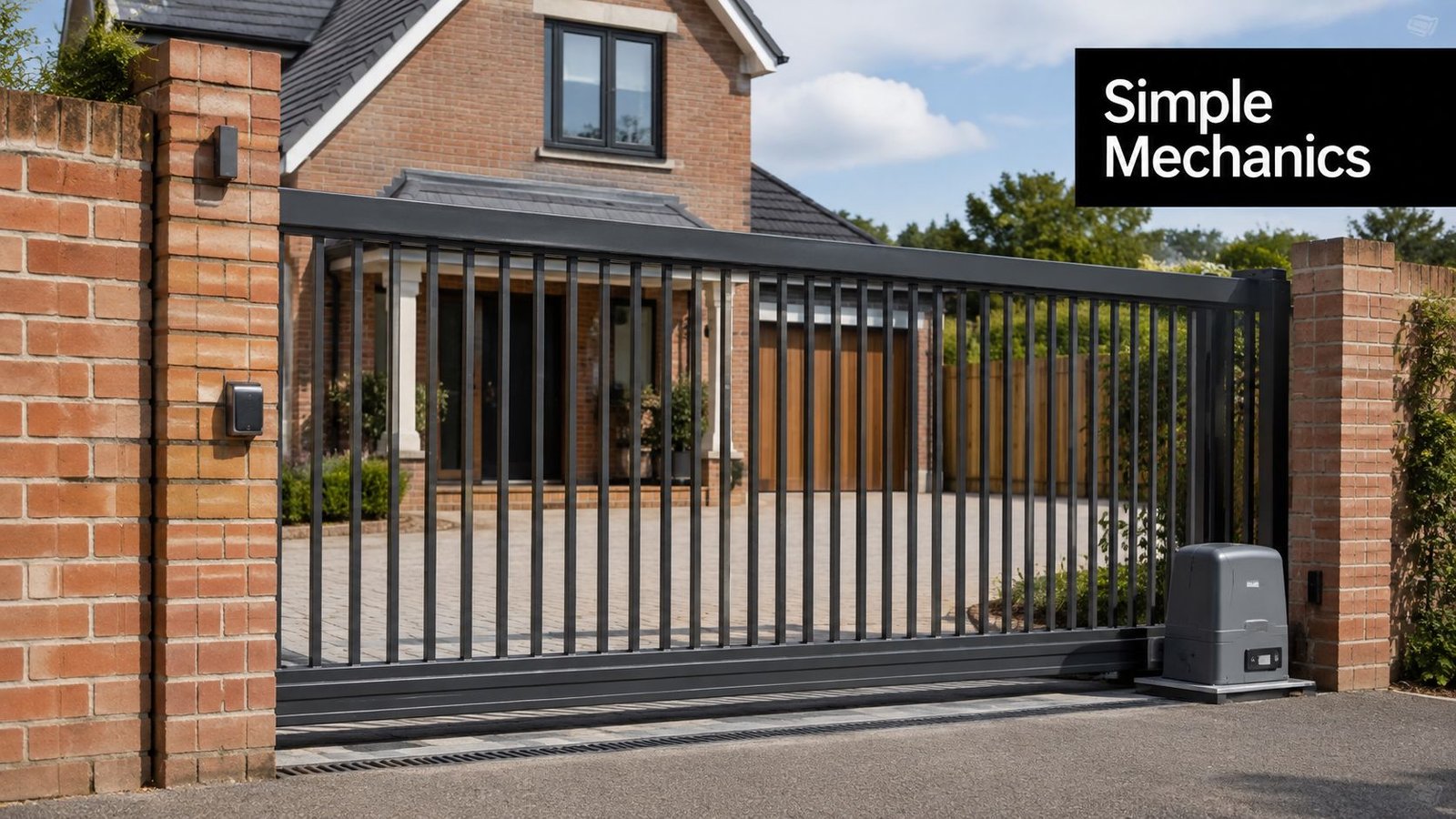
Four common operator arrangements
An electromechanical ram works like a powered linear actuator. Think of the mechanism that drives a vehicle windscreen wiper, but arranged to push and pull a gate leaf. Rammers are visible, relatively straightforward to service and often practical for domestic swing gates. The downside is exposure. Poor seals, water, grit and incorrect mounting angles can turn a modest installation fault into premature wear.
An underground operator sits below the gate hinge area, much like a sealed gearbox hidden beneath an appliance casing. It keeps the visual appearance clean, but drainage and sealing become critical. Water ingress around the bearing or foundation box is a common reason for trouble on exposed, coastal or leaf-littered sites.
An articulated-arm operator uses linked sections, similar to a dishwasher hinge mechanism. It suits situations where a standard ram can't achieve the required geometry or where excavation for an underground unit would be disruptive. It can be useful on set-back pillars, but the moving linkage creates its own accessible zones that must be protected.
A sliding rack-and-pinion drive applies garage-door logic horizontally. The motor turns a pinion, the rack moves with the gate and the leaf travels along its track. Correct rack alignment, clean running surfaces and controlled closing speed determine whether the system remains reliable.
Every mechanism still needs force testing after installation. The operator type doesn't prove safety. The finished gate must be measured at its actual crush and impact points, with safety edges, photocells, slowdown settings or other controls added where the geometry demands them.
The practical installation details are covered in gate automation installation guidance. A good installer will discuss the gate structure and risk zones before recommending a drive.
A visual demonstration can make the difference between understanding the principle and merely recognising the product:
UK Safety Standards and the Numbers That Matter
Legacy hardware is the main danger in UK automatic gate installations, not automation itself. Powered gates fall under a layered legal and technical framework. The Supply of Machinery (Safety) Regulations 2008 applies because an automatic gate is powered machinery. DHF guidance identifies BS EN 12453:2017 for safety in use and BS EN 12604:2017 for mechanical requirements, alongside duties under the Health and Safety at Work Act 1974, the Workplace (Health, Safety and Welfare) Regulations 1992 and the Electricity at Work Regulations 1989, per DHF guidance already cited.
BS EN 12453 is the standard buyers usually hear about when installers discuss contact forces. The Health and Safety Executive's powered-gate guidance explains that force limitation needs documented test results. UK practice commonly uses limits of about 400 N for crushing hazards and 1400 N for impact hazards. These are measured contact forces, not paperwork language. The installer must verify them with a calibrated instrument at the gate's actual risk points.
Turning the limits into commissioning evidence
| Threshold | Force limit | Test method | Pass criterion |
|---|---|---|---|
| Crushing hazard | About 400 N | Measure with a calibrated force gauge at relevant closing and trapping points | Recorded force must remain within the applicable permitted limit |
| Impact hazard | About 1400 N | Measure contact force at relevant impact points during gate movement | Recorded force must remain within the applicable permitted limit |
A safe commissioning test involves more than putting an obstacle in the gate's path and checking whether it reverses. The DHF technical specification for powered gates describes repeated measurements at multiple positions. Results above 90% of the permitted maximum must be repeated three times, with the average used as the final value. Test points also change by position and height, so a single centre-of-leaf reading proves very little.
Practical rule: Ask for the actual force-test sheet, including test points, readings, instrument details and commissioning date.
Require a risk assessment, Declaration of Conformity and the relevant technical file information. A generic CE or UKCA mark does not replace that evidence. Treat building and electrical work separately. The installation needs suitable wiring design and must address applicable requirements under BS 7671 and the Electricity at Work Regulations. The gate machinery file and the property's electrical installation documents serve different purposes. A compliant installer should provide both sets of evidence and explain any limitations in writing.
Site Assessment Before Anyone Quotes You
A proper quotation starts with a survey, not a catalogue. I want to see the entrance working in real conditions before specifying a motor. That means measuring the clear opening, checking the leaf or gate weight, inspecting hinges and pillars, and observing how vehicles and pedestrians approach.
What the survey should uncover
The first concern is geometry. The installer should record the driveway gradient and crossfall, the opening arc for swing leaves, the side run-out for a slider and any point where the gate could trap a person against a wall, pillar or railing. Public footways deserve particular attention because a gate that swings across a pavement creates a risk outside the property boundary.
Traffic changes the specification. A private house with occasional family vehicles has a different duty pattern from a warehouse receiving deliveries throughout the working day. A facility manager should explain peak arrival periods, delivery vehicle dimensions, pedestrian access and whether emergency or service vehicles need a separate operating mode.
The foundations deserve as much scrutiny as the motor. Existing pillars may look solid but still move under load. Sliding gates need stable track or cantilever support, suitable drainage and accurate alignment. Ground conditions determine whether the installer proposes concrete pads, reinforced foundations or another engineered solution. If the quote contains no meaningful discussion of ground support, it isn't complete.
Electrical planning is part of the gate design
Ask where the supply originates, how the cable will cross the drive and whether the control equipment will remain protected from weather and impact. The installer should explain conduit, isolation, protection and voltage-drop considerations rather than leaving the electrical route as an afterthought.
A long cable run or difficult excavation may influence the choice of operator and control arrangement. Intercoms, keypads, cameras and vehicle detection also need planned routes. Wireless accessories can reduce digging, but they introduce battery, signal and maintenance questions. A survey that ignores these details usually produces a quote that grows once the ground is open.
Intercoms and Access Control Integration
Access control should reflect how people use the entrance. A domestic driveway might need a video door station and remote release. A small business may need staff credentials, visitor handling, delivery access and an audit trail. These are different operational problems, even when both use the same gate motor.
Choose the entry method around the user
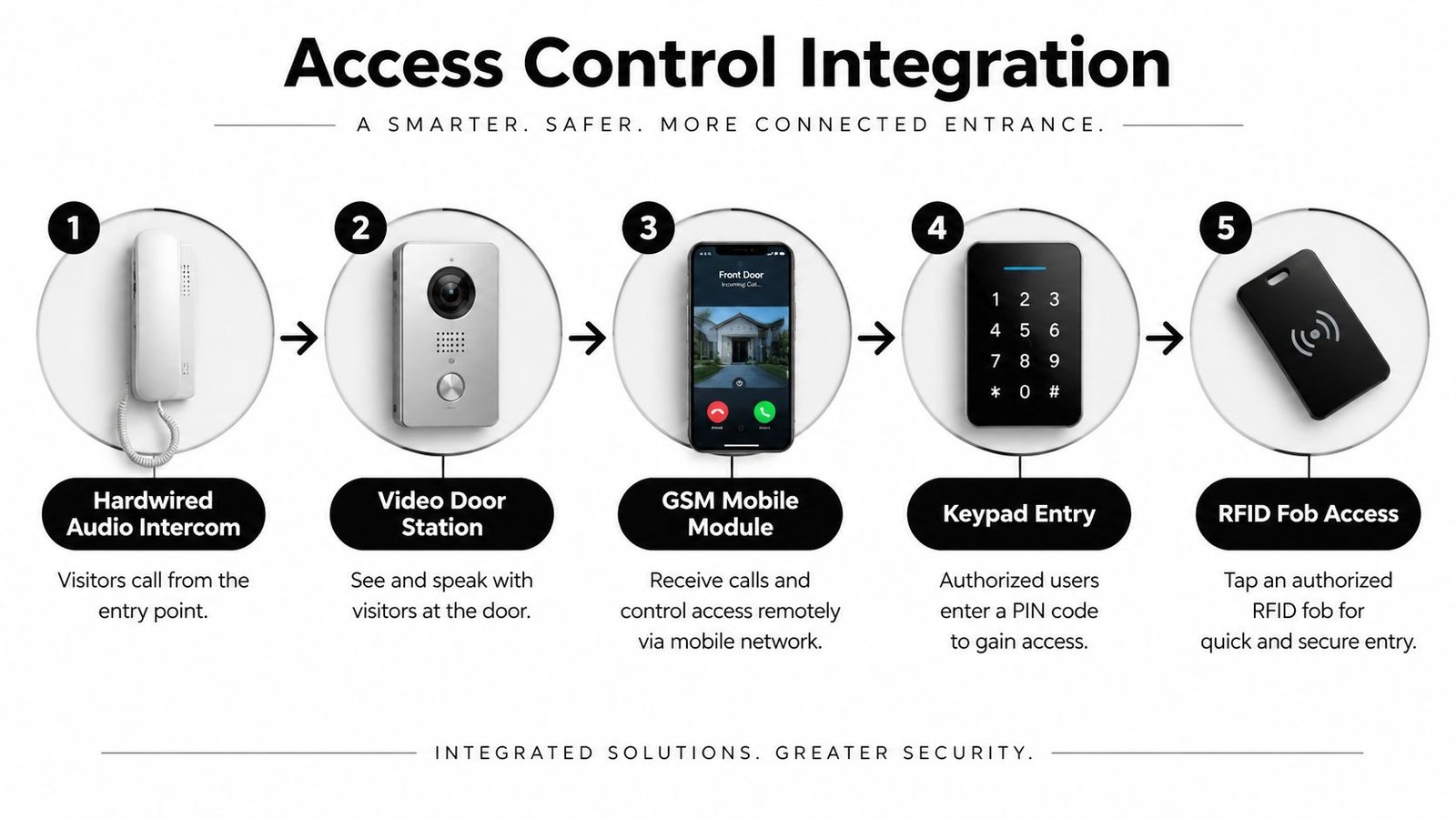
A hardwired audio intercom is simple and dependable where users only need to speak to someone inside. A video door station adds visual confirmation, which is useful when the caller is outside the normal field of view. A GSM module can forward a call to a mobile, avoiding a long internal cable route, but the site still needs a clear process for authorising visitors.
A keypad works well for controlled staff or resident access, provided codes are managed and changed when they should be. RFID fobs and proximity cards identify individual users more effectively than shared codes. ANPR cameras can automate recognition for regular vehicles, but they should be treated as one part of an access decision, not as a replacement for safe gate detection.
Most gate controllers accept a relay trigger. Some systems use a bus such as RS485 for connected devices, while larger access platforms manage permissions and events centrally. The installer should identify exactly what the gate board receives, what it reports and what happens if communications fail.
A workable SME warehouse arrangement
Consider a warehouse with separate vehicle and pedestrian movements. An ANPR camera can identify approved vehicles at the vehicle gate. A fob reader can control the pedestrian entrance, while a video intercom at goods-in lets staff verify delivery visitors. Those events can feed into a wider access-control dashboard rather than leaving each doorway as an isolated system.
The design still needs failover. Ask what happens during a power cut, network outage, failed reader or lost credential. Manual release must remain controlled, and emergency access arrangements must be documented. Networked controllers also need sensible cybersecurity hygiene, including restricted administrator access, current firmware where supported and a clear process for removing former users.
For a broader look at combining gate entry methods with wider security infrastructure, review gate access control systems. Specify the user journey first, then select the hardware.
Real Costs and Ongoing Maintenance
A serious quote separates the gate, operator, safety equipment, installation labour and civil works. If those elements appear as one vague figure, you can't tell whether the installer has allowed for foundations, cable routes, access control or commissioning.
The supplied pricing bands in this brief are useful planning references, but they aren't universal tariffs. A domestic swing arrangement with a ram operator typically falls between £2,500 and £5,500 fitted, while commercial twin-leaf tracked sliding systems can range from £7,000 to £25,000 or more once groundworks, power supply and safety edges are included. These figures should be read alongside the scope, not used to choose the cheapest tender.
| Gate type | Residential supply + install | Commercial supply + install | Annual maintenance |
|---|---|---|---|
| Swing gate | £2,500 to £5,500 fitted | Depends on duty cycle, structure and access requirements | £180 to £400 |
| Sliding gate | Depends heavily on track, foundations and gate size | £7,000 to £25,000 or more for larger tracked systems with associated works | £450 to £1,200 |
| Barrier boom | Usually project-specific | Depends on lanes, detection and controls | £450 to £1,200 |
Costs that appear after the headline quote
The common surprises are not mysterious. They include ducting across an existing driveway, upgrades to the electrical supply, long intercom cable runs, drainage, extra safety edges and remedial work to moving pillars or tracks. Retrofitting a modern control board to an old gate can also require renewed conformity assessment and wider safeguarding changes.
Maintenance should include cleaning tracks and sensors, checking hinges and rollers, inspecting cables and enclosures, lubricating appropriate moving parts and repeating force testing. Commercial sites need a planned service regime because wear can alter closing forces and alignment long before the gate stops working.
For practical upkeep ideas, Lighthouse Energy Services offers useful automatic gate maintenance tips. Budget for maintenance before installation, not after the first failure.
Choosing a Compliant Installer You Can Trust
The installer is the most important component in the system. Motors, photocells and safety edges are available from many manufacturers. The difficult work is selecting the right arrangement, installing it against the site geometry, measuring the completed gate and producing evidence that another responsible person can understand.
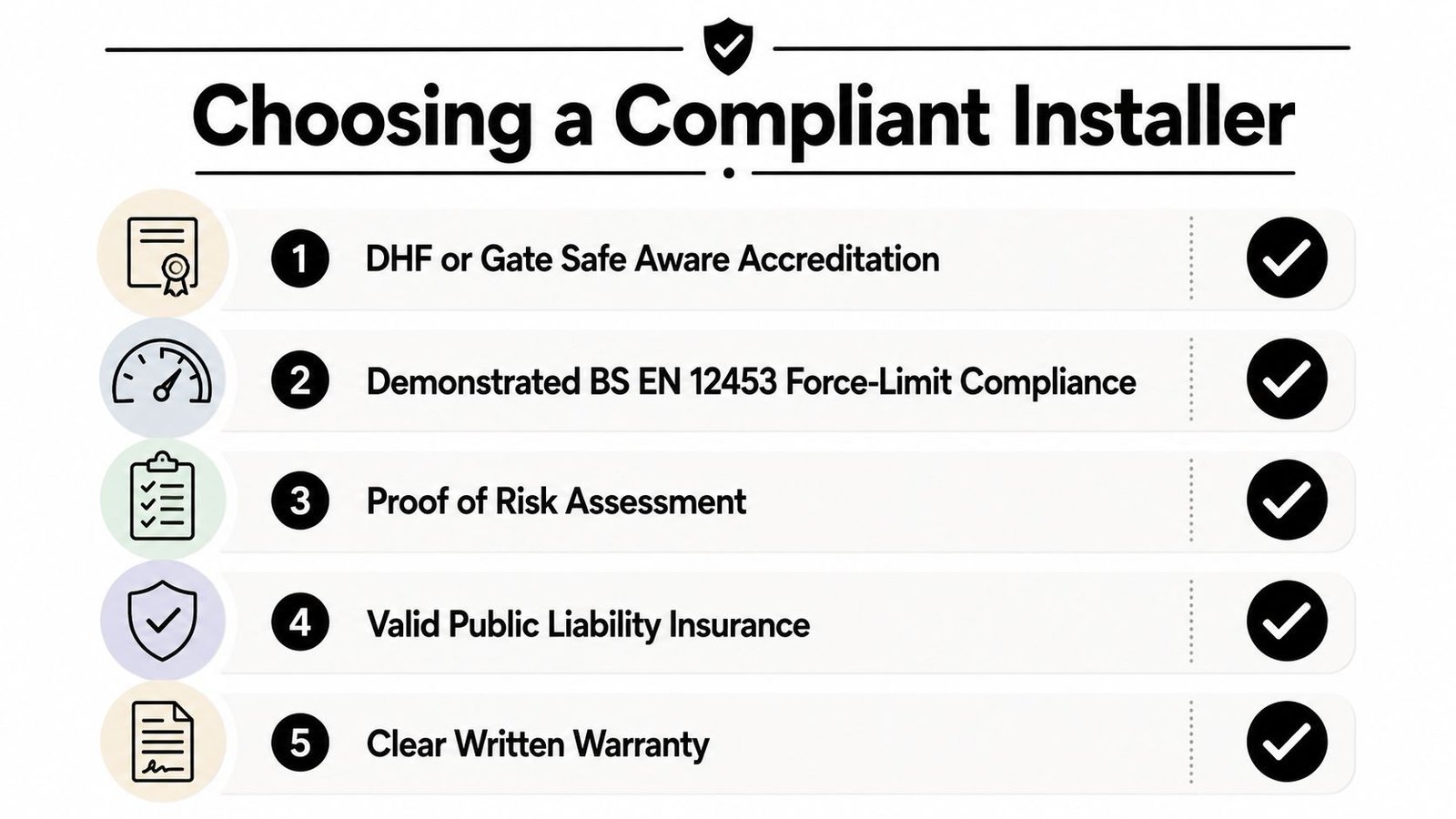
Evidence to request before accepting the quote
Ask the installer for:
- Relevant competence: Look for DHF or Gate Safe Aware accreditation, or equivalent demonstrated competence in powered-gate safety.
- A site-specific risk assessment: It should identify crush, impact, shear and entrapment hazards around the actual gate.
- Force-test records: Require readings taken with a calibrated instrument at the relevant positions and heights, not a tick box saying “tested”.
- Component details: Get the make and model of photocells, safety edges, control board, operator and emergency-release hardware.
- Machinery paperwork: Request the Declaration of Conformity and technical documentation required for the completed machine.
- Handover information: The user should receive instructions for manual release, emergency stops, normal operation and safe response to faults.
- Written warranty terms: Separate workmanship coverage from the manufacturer's equipment warranty, and make exclusions clear.
HSE continues to warn about serious and fatal powered-gate incidents. Its 2025 safety bulletin highlights two separate child deaths linked to crushing zones on automatic vehicle access gates (HSE powered-gate safety bulletin). The same bulletin also illustrates why legacy installations and inadequate maintenance deserve more attention than glossy product specifications. Independent Gate Safe coverage cited in that material reports that 90% of reviewed commercial gates failed safety protocols, while older industry reporting estimates more than 500,000 automated gates are in service in the UK and only a minority were considered safe (HSE powered-gate safety bulletin).
Those figures don't mean every existing gate is dangerous, but they do justify a firm buying position. A gate with no force records, no risk assessment and no maintenance history should be treated as unverified machinery, especially in a school, workplace or shared residential development.
Walk away from a quote that treats safety devices as optional extras or paperwork as an inconvenience.
Three red flags and three green flags
Red flags
- No measured forces: The installer promises compliance but won't provide test readings.
- No technical file: The handover consists of keys, remotes and a generic certificate.
- Cheap retrofit language: The company proposes a stronger motor without addressing gate geometry, trapping zones or structural movement.
Green flags
- Clear survey findings: The quotation identifies the hazards and explains the proposed controls.
- Commissioning evidence: The installer records force tests, device checks and release arrangements.
- Maintainable design: The system includes accessible service points, sensible drainage and a documented inspection plan.
The safest purchase is not the gate with the most features. It's the installation whose design, testing and maintenance can be defended long after the installer leaves.
Wisenet Security Ltd designs, installs and maintains automatic gates, barrier systems, intercoms, keypads, fob readers and related access control for homes and businesses across South Wales and the South West. If you need a site-specific design and documented commissioning process, visit Wisenet Security Ltd to arrange a consultation.