Warden Call System Guide for UK Sheltered Housing
If you manage sheltered housing in South Wales or the South West, you've probably seen the warning signs already. A resident mentions the pull cord didn't seem to register, a scheme manager says the panel needs resetting again, and suddenly an ageing warden call system becomes a live safety issue rather than an abstract maintenance job. In buildings that rely on it, this isn't just another bit of kit on the wall, it's the link between a vulnerable resident and a response when they need help.
That link still matters because the purpose hasn't changed, even if the technology around it has. The strongest systems let residents call for help quickly, let staff respond without confusion, and keep working during everyday pressures like staff absence, busy communal areas, or a change in monitoring arrangements. The weakest systems look fine until they don't, and that's when residents, managers, and contractors all end up dealing with the consequences at once.
Table of Contents
- Why Warden Call Systems Still Matter in 2026
- How a Warden Call System Actually Works
- Analogue Versus Digital Warden Call Systems
- Where Warden Call Systems Are Used Across the UK
- Integrating Warden Call with CCTV and Access Control
- The Hidden Risks of Legacy System Failure
- UK Compliance Standards and Installation Planning
Why Warden Call Systems Still Matter in 2026
A scheme manager spots the fault on a routine walk-round. The master unit is behaving oddly, the corridor sounders are patchy, and the contractor says parts are becoming harder to source. Nobody panics at first, because the building still “has a system”. That's the dangerous assumption.
A warden call system exists to give residents in sheltered and supported housing a direct route to help, usually through a warden, scheme manager, or monitoring centre. The earliest UK installations were put in during the 1960s and 1970s in local-authority sheltered and supported accommodation, when most residents didn't have home telephones and mobile phones didn't exist yet (Alertacall background on hard-wired systems). That history matters, because many schemes still carry the assumptions of that era in their wiring, layout, and operating model.
What happens when it works, and when it doesn't
When the system works properly, residents don't need to understand the backend. They press a button, pull a cord, or trigger an alarm, and someone hears it, logs it, and responds. That simplicity is the whole point. It reduces hesitation for the resident and reduces guesswork for the person answering.
When it fails, the failure is rarely dramatic at first. It often looks like a minor fault, a missed test, or one zone that's “always been a bit temperamental”. In real housing stock, that kind of drift is exactly how protected housing becomes unsafe.
A good rule is simple:
Practical rule: if a resident can't trust the system every single time, the system has already stopped doing its job.
If you want a resident-facing reminder of why response speed matters after a fall, this guide on stay independent with fall safety is a useful companion read. The point isn't to sell more technology, it's to keep the resident's independence tied to a response path that works.
For managers, the question in 2026 isn't whether sheltered housing still needs this infrastructure. It does. The question is whether the current installation can survive the operational reality of ageing stock, staffing changes, and the analogue-to-digital shift now bearing down on older systems.
How a Warden Call System Actually Works
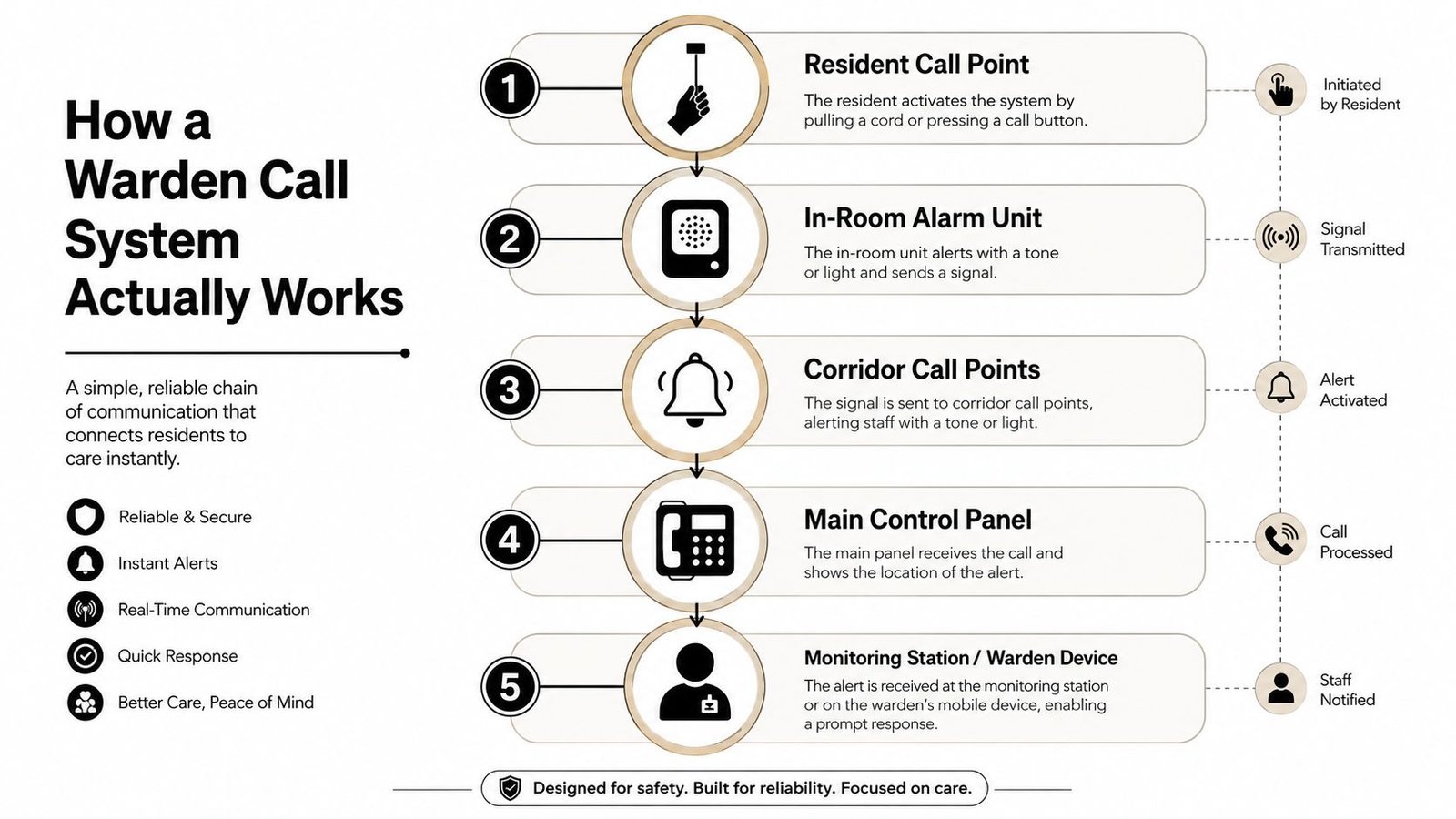
At its simplest, a warden call system is a chain of cause and response. A resident triggers an alarm, the signal travels to a control point, and that control point routes the call to someone who can help. The details matter, because every link in that chain is a possible failure point.
The resident side of the system
The resident interface is usually the visible part, a pull cord, wall-mounted button, pendant, or local call point. In older schemes, that device often feeds into in-wall cabling and then into a central panel. In newer deployments, the interface may sit on a wireless or hybrid backbone, but the logic stays the same, the resident needs a simple way to raise an alarm without navigating menus or apps.
The control and routing layer
Behind the wall, the call reaches a speech unit, a base station, or a central control panel. From there, the alarm can be routed in different ways. UK procurements now commonly ask for systems that support on-site, local off-site, and off-site to central station operation, which matches the way Mid Suffolk District Council described its own warden-call specification (Bidstats tender overview). That operational flexibility matters because a scheme may be managed by on-site staff during the day, then handed over to a monitoring centre or mobile response model later.
The same tender environment also shows why the end point matters as much as the trigger. A dependable installation should be able to call a nominated scheme manager or a 24-hour monitoring centre, and it should do so without forcing residents to learn a different process every time staff arrangements change.
A practical mapping of the signal path
| Component | What it does | Typical weak point |
|---|---|---|
| Resident button or cord | Starts the alarm | Poor positioning or wear |
| Local alarm unit | Receives and transmits the call | Faulty speaker, damaged interface |
| Corridor or communal call points | Extend coverage in shared areas | Coverage gaps, poor commissioning |
| Main control panel | Manages call logic and routing | Obsolete electronics, failed batteries |
| Monitoring station or mobile responder | Receives and acts on the alarm | Handover failure, unavailable contact |
The technical takeaway is that the resident doesn't care how elegant the architecture is. They care that the call gets from point A to point B without delay, confusion, or dependency on a single weak link.
Analogue Versus Digital Warden Call Systems
The biggest mistake I see is treating analogue and digital as a neat upgrade path when things are messier. A lot of schemes still have hard-wired equipment that depends on a PSTN line for alarm and monitoring connectivity, and some systems installed during construction can be up to 30 years old (Scottish housing-sector guidance on legacy telecare). That age alone doesn't prove a system is failing, but it does mean parts, compatibility, and maintenance strategy are all under pressure.
BT announced its nationwide digital telephony transition in 2012, with the network scheduled to finish by January 2027 (same guidance). For any analogue warden call system that still depends on PSTN, that timeline isn't theoretical. It's a hard deadline for migration planning.
What changes in practice
Analogue systems rely on familiar copper-line behaviour and DTMF signalling, while digital systems move alarm traffic over IP or other digital backhaul. In real estates, the practical difference isn't just sound quality or feature count. It's whether the building can still route alarms when the telecoms path changes underneath it.
A lot of UK procurements now ask for BS 8521 DTMF signalling compatibility and dual analogue/digital operation so a scheme can keep running on legacy lines while moving toward digital infrastructure (Portsmouth tender). That's not bureaucracy for its own sake. It's a way to avoid ripping out serviceable infrastructure before the replacement path is ready.
| Feature | Analogue Systems | Digital Systems |
|---|---|---|
| Connectivity | Usually depends on PSTN or similar legacy telephony | Uses IP or digital backhaul |
| Migration path | Often needs staged adaptation | Better suited to phased migration |
| Compatibility | Strong with legacy lines, weak when telecoms change | Better future fit, but needs careful design |
| Maintenance | Parts and line dependence can become difficult | More software and network dependence |
| Resilience planning | Must account for ageing cabling and line closure | Must account for power, routing, and monitoring continuity |
The best approach is rarely “replace everything at once”. In many sheltered schemes, the smarter move is to specify equipment that can work now and still fit the future architecture later. If you're comparing broader networked security choices, the same thinking shows up in this overview of IP and analogue security design, where backwards compatibility and phased change matter just as much as headline features.
Where Warden Call Systems Are Used Across the UK
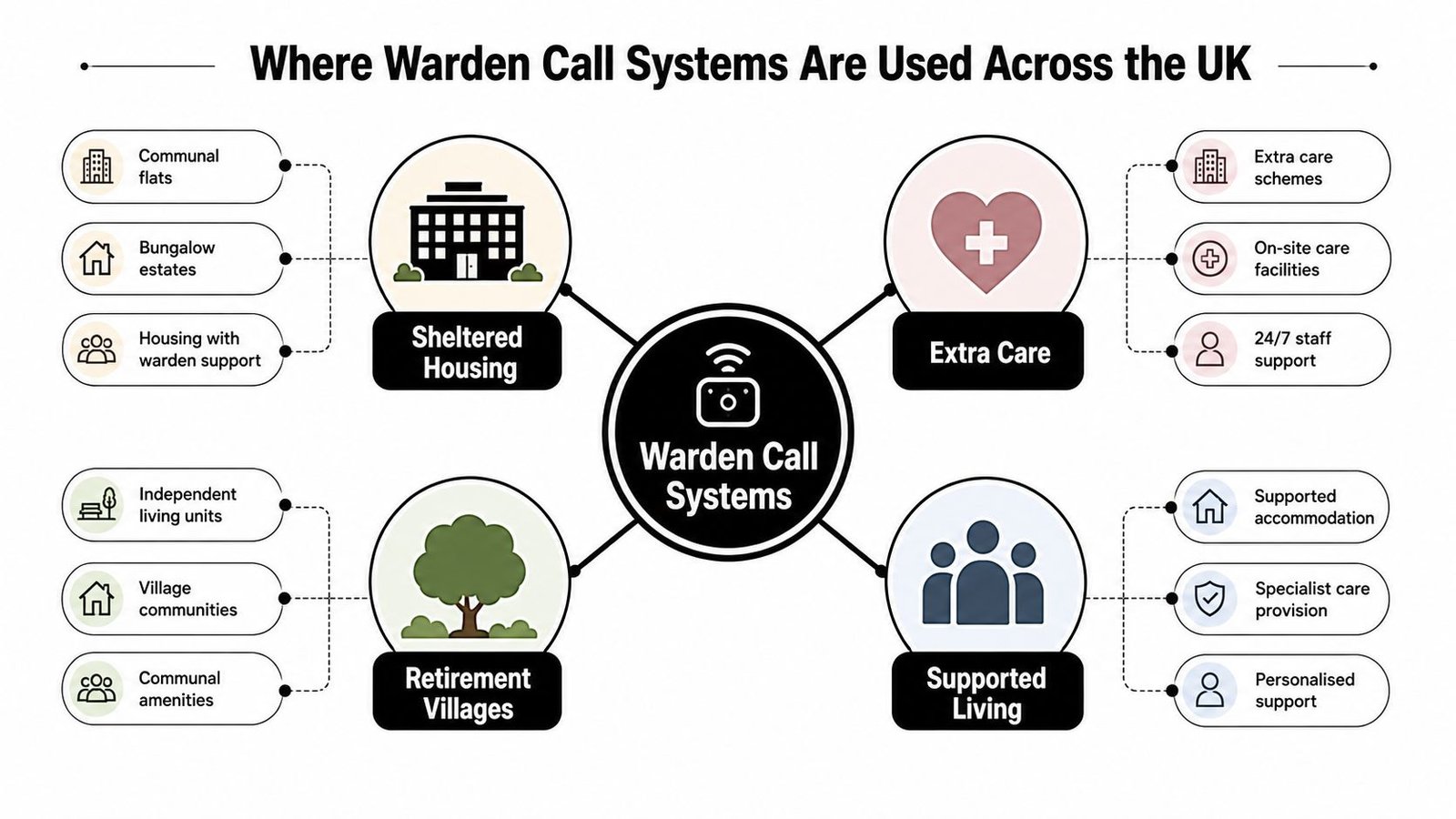
The phrase warden call system sounds narrow until you look at the buildings that depend on it. In practice, it shows up in sheltered housing, extra-care schemes, retirement villages, supported living, and landlord-managed blocks where communal areas and resident independence have to coexist.
Different buildings, different pressures
A small sheltered scheme with a few shared spaces needs a different design from a large extra-care site with front-door release, lift access, and multiple alarm zones. The control logic may look similar on paper, but the operational demands are not. A front entrance that must work for visitors, carers, and emergency responders needs a cleaner integration path than a building where the call system only covers individual flats.
Complex buildings create the toughest reliability issues. Coverage can fail in communal rooms, at entry points, or in outdoor zones if the system wasn't designed around the building's actual layout. That's where installation experience matters more than brochure language.
Common UK deployment patterns
- Sheltered housing schemes: communal flats, bungalow estates, and retirement blocks where residents need a simple, dependable call route.
- Extra-care and care environments: larger schemes where the call system may need to hand over to a monitoring centre or on-site staffing model.
- Retirement villages: mixed occupancy sites with shared amenities, access control, and a wider set of response needs.
- Supported living and multi-tenant blocks: resident alarms sit alongside doors, lifts, and communal circulation routes.
The technical challenge is rarely the call button itself. It's making sure the system still behaves properly when residents are spread across a wider estate, staff aren't always on site, and the building has more than one way in and out. A good design handles that without making the resident learn a different process for every zone.
If you're comparing architecture options for broader site protection, the same integration mindset applies in unified security planning, because isolated systems create more handoff problems than most managers expect.
Integrating Warden Call with CCTV and Access Control
A call button is useful. A call button that also tells the rest of the site what's happening is better. That's why modern housing providers increasingly want warden call systems integrated with CCTV, access control, intercoms, and fire alarms instead of treating each one as a separate island.
The best integrations are practical, not flashy. If a resident triggers an alarm in a corridor, the CCTV system can be set to record that location immediately. If a front-door release event happens at the same time, the manager can see who entered and whether the person matches the expected visitor. That kind of joined-up response is what makes a scheme easier to run.
What good integration looks like
Integrated schemes need a few things to line up. Digital communications should be secured with VPN/TLS where appropriate, manufacturers need to support API compatibility or an agreed interface, and the installer needs to understand how each system behaves when one part drops offline. In the UK, a lot of schemes get into trouble, because they buy components that work individually but don't cooperate cleanly.
Some systems used in the sector are marketed as interoperable with leading names such as Hikvision, Paxton, and Pyronix, but the brand badge alone doesn't guarantee clean integration. The design still has to be checked site by site. Door release, resident call handling, logging, and alarm response all need to work together under real operating conditions.
Practical rule: if the installer can't explain what happens when the CCTV recorder, the access controller, or the monitoring path is unavailable, the integration is unfinished.
Common mistakes to avoid
- Treating fire and warden call as the same thing: they overlap, but they are not interchangeable, and mixed design can create confusion.
- Ignoring smoke detection compatibility: some scheme types can run into conflicts when integrated smoke detection is added too early.
- Assuming APIs solve everything: software compatibility helps, but it doesn't replace commissioning and testing.
- Overlooking control handover: staff need to know which system takes precedence when events happen at the same time.
For managers, the advantage is not just convenience. It's cleaner incident handling, better evidence, and fewer missed responses. If your current system feels fragmented, the problem may not be the devices. It may be that nobody ever designed the building as one response environment.
The Hidden Risks of Legacy System Failure
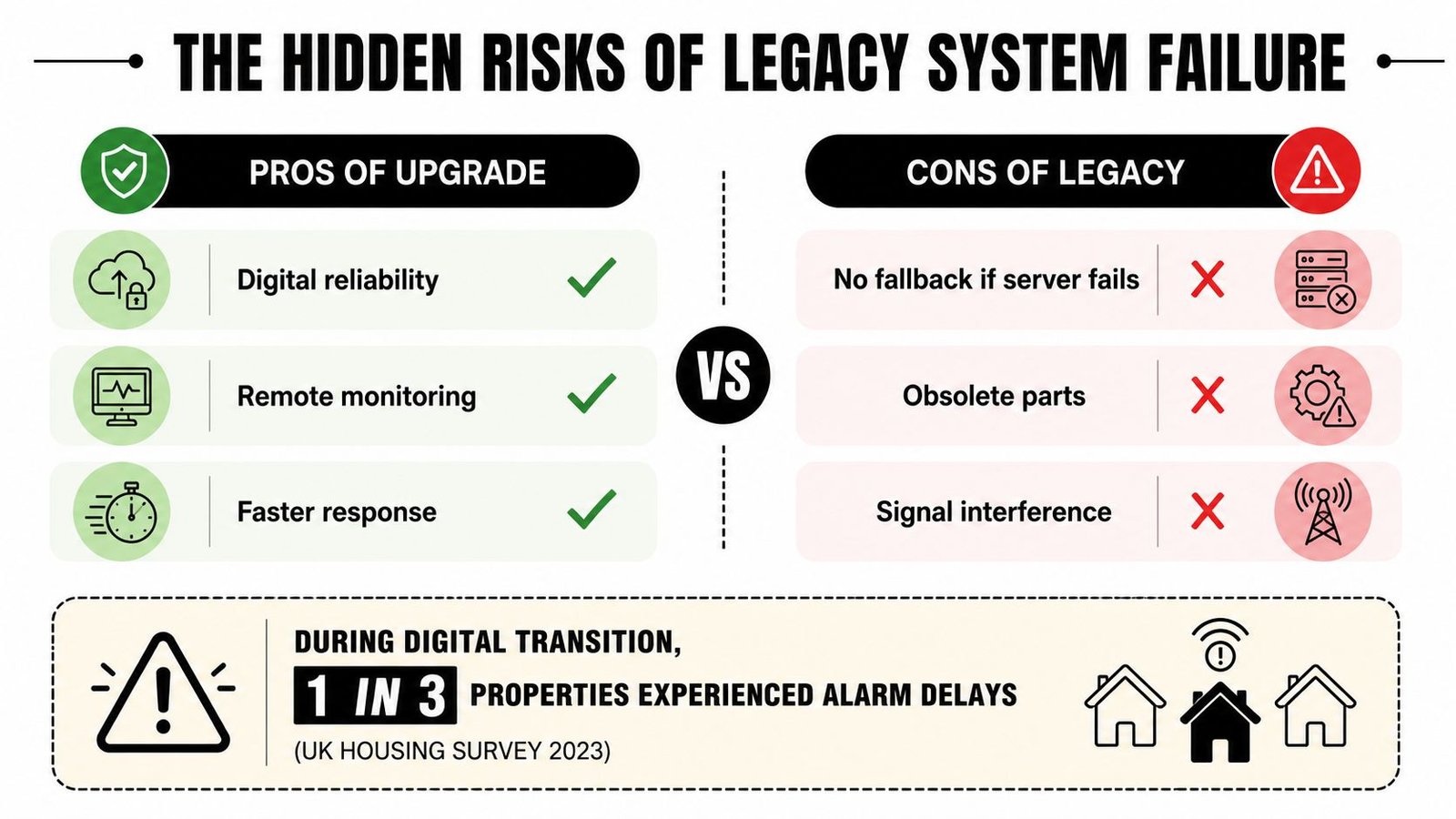
A lot of upgrade conversations start from the wrong assumption. They assume digital is automatically safer, and analogue is automatically the problem. In practice, residents can be left at risk when legacy systems fail during the transition, especially if the migration plan is weak or maintenance has been deferred for years.
There's a hard example of that in UK retirement housing, where a broken warden call system was reported as non-functional in rooms 1 to 19 since 2021, showing how maintenance backlogs can leave residents unprotected for long periods (Ealing retirement housing report). That's not a technology debate. It's a governance problem.
Where migration plans usually go wrong
The biggest failure point is continuity. If you change the telecoms path before you've confirmed alarm routing, backup power, and monitoring handover, you've created a gap. The resident won't see that gap. They'll only find out if they need help during it.
Scottish housing-sector guidance in 2026 frames analogue-to-digital telecare migration as an active operational challenge, not a finished process (Scottish guidance). That lines up with what housing teams face on the ground. The issue isn't whether the building is analogue or digital. It's whether service can continue while the transition is happening.
The engineering question is always the same:
- Power backup must be confirmed, not assumed.
- Alarm routing continuity must be tested during each phase.
- Monitoring centre handover needs a clean process.
- Resident governance matters, especially where older residents may be most affected by downtime.
The contrarian point that matters
Digital systems are not safer if they're poorly planned. A modern panel with weak routing logic, no fallback, or incomplete commissioning can be worse than a tired analogue system that still works reliably. Safety gain comes from a migration designed around failure modes, not marketing claims.
If you're a housing manager, ask a simple question before any upgrade starts. What happens to every alarm if the network, power, or handover path fails on the day of changeover? If nobody can answer that clearly, the project isn't ready.
UK Compliance Standards and Installation Planning
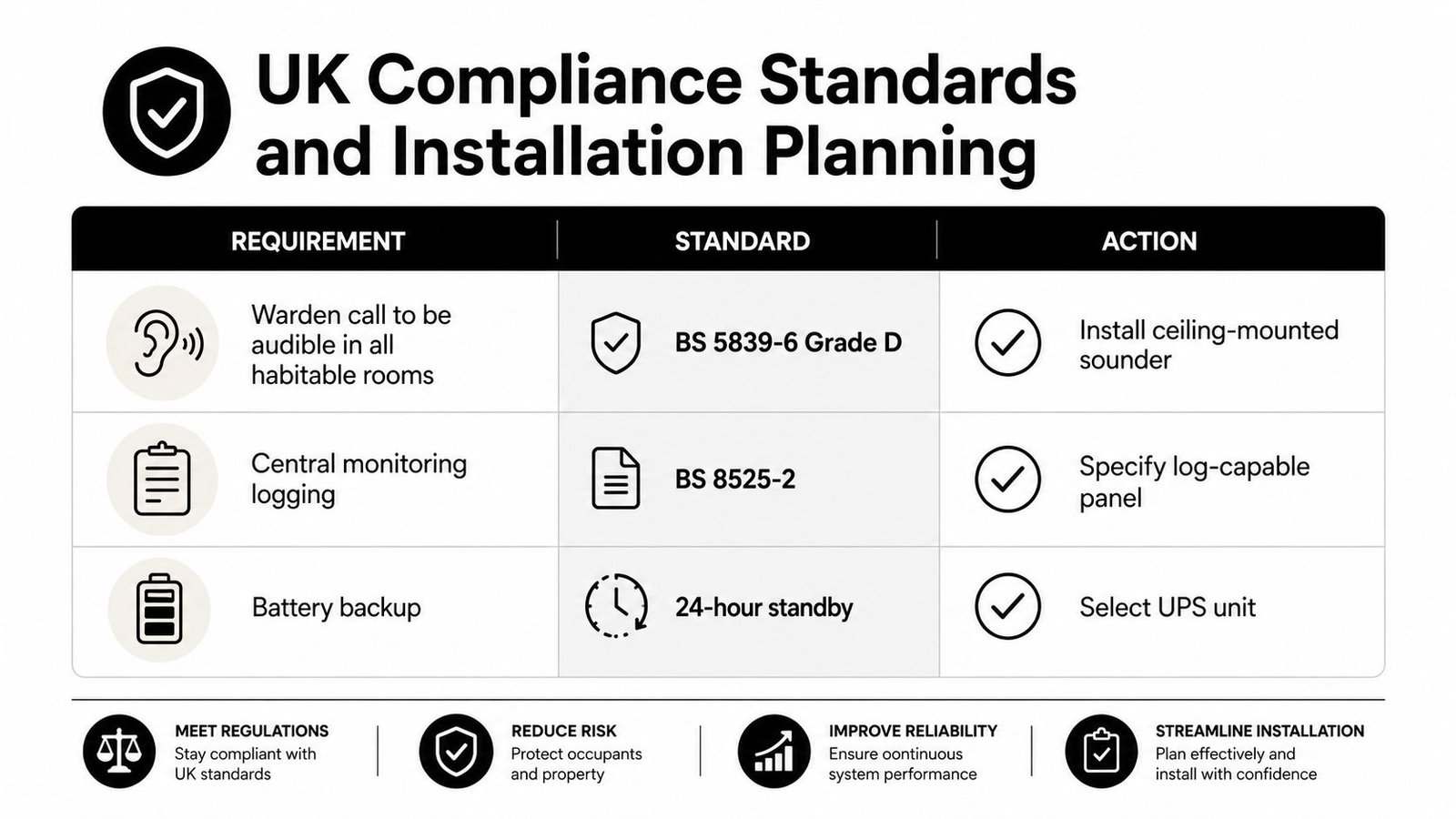
Compliance in this area isn't just about satisfying procurement paperwork. It's about specifying a system that can still be supported, tested, and migrated without creating a stranded asset halfway through its life. That matters in sheltered housing, extra-care, and landlord-managed blocks where the cost of downtime is borne by residents first.
What to put in the specification
Start with the standards and interoperability requirements that show up in real UK tenders. Portsmouth's procurement explicitly required BS 8521 or equivalent and support for both analogue and digital operation, which is a strong signal that migration-friendly design is now a practical requirement, not a nice-to-have (Portsmouth tender). If the system needs to bridge legacy infrastructure and future digital backhaul, say that plainly in the brief.
The compliance checklist should also cover associated alarm standards such as BS EN 50131 where relevant to the wider security stack. If you need a deeper reference point for that framework, this explainer on what is EN 50131 is a useful technical primer.
How to judge the installer
A compliant product still fails if the installation is weak. Look for engineers who understand sheltered housing operating models, not just cabling. In practice, that means asking about:
- Accreditation and vetting: SafeContractor status and DBS-checked engineers matter on occupied sites.
- Maintenance scope: routine testing, fault response, and replacement parts should be written into the contract.
- Migration phasing: the installer should show how the building stays live while upgrades happen.
- Monitoring logic: alarms must route cleanly in each operating mode, not just on day one.
Budget for the whole life of the system
The cost isn't only the hardware. It includes cabling, commissioning, monitoring subscriptions, phased migration work, and the time needed to keep residents informed. If a scheme is still on legacy lines, the safest route is usually a design that can work with today's infrastructure while preparing for tomorrow's digital path.
A warden call project is won or lost in the specification. If the brief is vague, the installation becomes a patchwork of assumptions.
For housing associations and landlords in South Wales and the South West, the next step is straightforward. Review the current panel, confirm whether PSTN dependence still exists, and ask for a migration plan that protects residents throughout the change. If you want a site-specific assessment and a clear route from legacy infrastructure to a compliant modern setup, visit Wisenet Security Ltd and arrange a free consultation with engineers who handle integrated security, access control, and alarm systems across occupied properties.