Access Control Cardiff: 2026 Business Solutions Guide
You're probably dealing with one of these problems right now. A member of staff has left and still has a key. A cleaner needs access before opening hours. A tenant in a Cardiff multi-let wants another fob, but nobody's sure who approved the last one. Or you've got a building with decent locks and still don't feel in control of who comes and goes.
That's when traditional keys start looking less like security and more like admin debt.
Across commercial and residential properties, businesses are moving towards smarter entry systems. The broader market reflects that shift. The global access control market was valued at USD 12.72 billion in 2026 and is projected to reach USD 26.22 billion by 2034, growing at a 9.46% CAGR according to Fortune Business Insights' access control market overview. Cardiff isn't separate from that trend. Local firms, landlords, schools, and property managers want control, audit trails, and fewer weak points.
Table of Contents
- Is Your Keyring a Security Risk
- What Is Access Control and How Does It Work
- Choosing Your System Types and Use Cases
- Beyond the Door The Power of System Integration
- Access Control Is a Human Process Not Just Technology
- Finding the Right Access Control Installer in Cardiff
- South Wales Access Control FAQs
Is Your Keyring a Security Risk
A Cardiff business owner I speak to regularly usually says the same thing at the start. “We've managed with keys for years.” Then the details come out. There are extra copies nobody logged. One manager keeps the spare set at home. The back door gets opened for deliveries and sometimes stays on the latch longer than it should. When someone leaves, the lock doesn't get changed because it's a hassle and the site has too many keyed doors.
That setup feels normal until something goes wrong.
A retail unit in the city centre has different pressures from a small office in Cardiff Bay or a block of flats in Pontcanna, but the weakness is the same. A metal key tells you nothing. You can't see who used it, when they entered, whether they tried after hours, or whether somebody copied it without permission.
Why keys create blind spots
Keys are simple, but they're blunt. They don't handle modern property use very well, especially when you've got:
- Shift patterns: Different teams arriving at different times.
- Shared access: Contractors, cleaners, tenants, delivery staff.
- Staff turnover: Joiners and leavers changing every few months.
- Multiple zones: Front entrance, stockroom, office, server cupboard, gated yard.
With access control, you stop treating every person the same. You assign permission by role, by time, and by area. That's a much better fit for how buildings in Cardiff operate.
Practical rule: If you can't revoke access instantly, you're carrying more risk than you need to.
The primary selling point isn't the reader on the wall. It's control. If someone loses a card or fob, you disable it. If a contractor only needs weekend access, you set that rule. If a tenant disputes an entry event, you check the log rather than guessing.
That's why I push clients away from “just replace the lock” thinking. In most business settings, the keyring is no longer a security tool. It's a liability.
What Is Access Control and How Does It Work
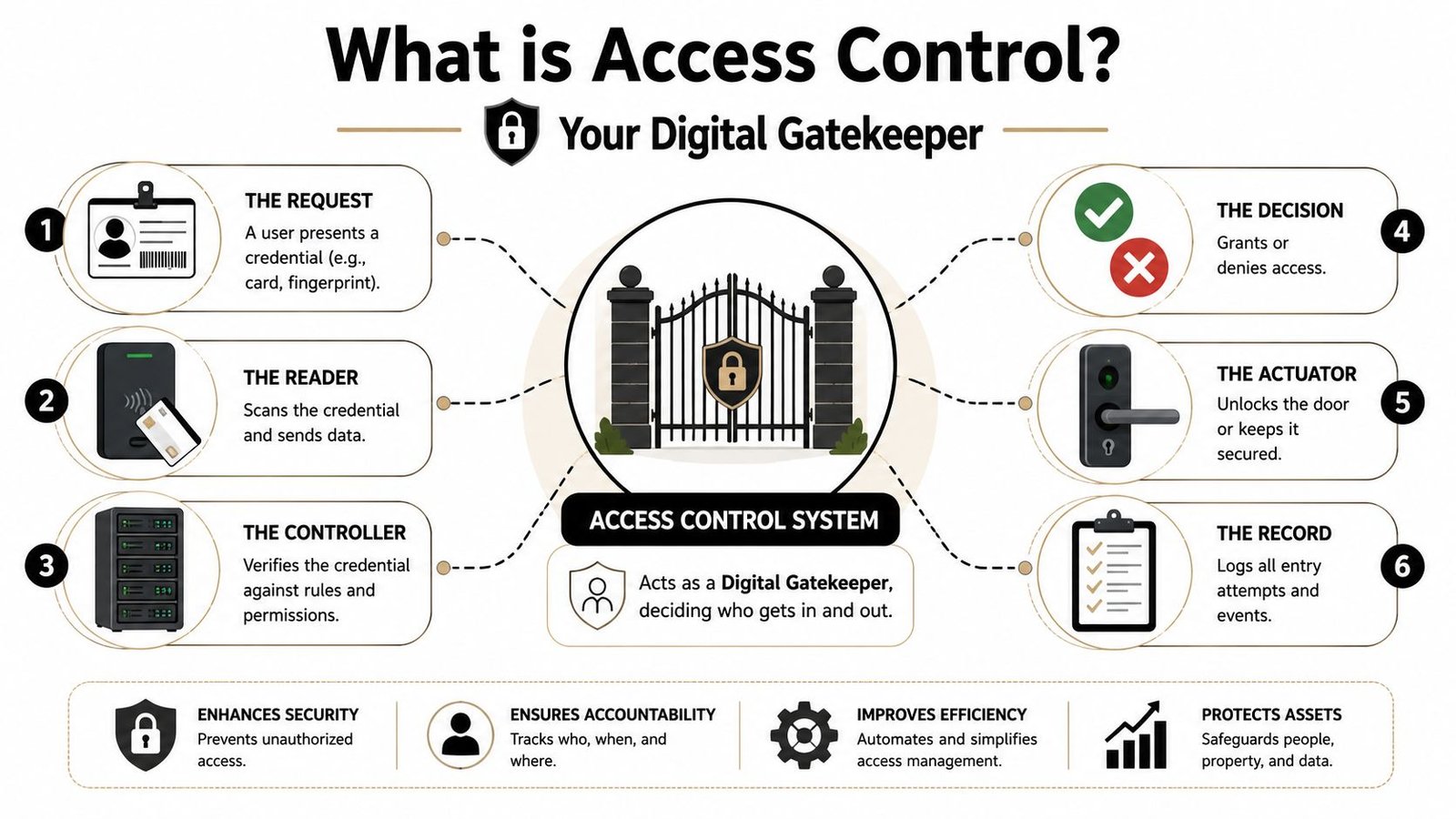
Think of access control as a digital gatekeeper. It checks identity, applies rules, decides whether to open the door, and records what happened. It does that all day without relying on someone remembering who should have access.
The three parts that matter
Every system has lots of parts behind the scenes, but most Cardiff buyers only need to understand three.
The credential is what the user presents. That could be a card, fob, PIN, mobile phone, or fingerprint. If you want a quick refresher on how RFID cards work in day-to-day use, EVChargers.eu's RFID card insights give a clear overview without drowning you in jargon.
The reader is the device on or beside the door. It reads the card, accepts the PIN, or scans the fingerprint.
The controller is the decision-maker. It checks the credential against the rules you've set. If the user is authorised for that door at that time, it tells the lock to release.
What happens at the door
The workflow is straightforward:
- A user presents a credential.
- The reader captures the data.
- The controller checks permissions.
- The system grants or denies access.
- The lock stays secure or releases.
- The event goes into the log.
That final step matters more than many buyers realise. Logs turn a door into a managed asset. You can review entry attempts, investigate incidents, and tighten permissions instead of relying on memory.
Access control isn't only about stopping the wrong person. It's about proving what happened when there's a dispute, incident, or compliance question.
You'll also hear a lot of jargon around battery devices, standalone readers, networked systems, and biometric units. Don't let that distract you. The buying decision comes down to a simpler question. Who needs access, where, when, and how often does that change?
Answer that properly and the right system type becomes much easier to choose.
Choosing Your System Types and Use Cases
Not every door needs the same treatment. That's the mistake I see most often in access control Cardiff projects. Someone picks one technology and tries to force it onto every entrance, office, gate, and cupboard. That usually leads to overspending in low-risk areas and under-protecting the doors that matter.
The hardware side still matters. According to Grand View Research's access control market report, the hardware segment made up over 43% of market revenue in 2024. That fits what you see on the ground in Cardiff. RFID cards, fobs, readers, electromagnetic locks, and sturdy door hardware still do most of the heavy lifting.
Which credential suits which site
Keypads work best where convenience matters more than individual accountability. A cleaners' cupboard, internal storeroom, or low-risk staff-only area can suit a keypad. The downside is obvious. Codes get shared. Once too many people know the number, the control becomes weak unless you change it regularly.
Cards and fobs are the standard choice for many offices, schools, apartment blocks, and mixed-use sites. They're easy to issue, easy to revoke, and simple for staff and tenants to use. For a shared office in Cardiff Bay or a managed block with multiple residents, card and fob systems are usually the practical starting point.
Biometric readers suit spaces where identity has to be tied to the individual user. A server room, medicines store, archive room, or restricted plant area is a better match for biometric control than a main public entrance. The point isn't novelty. It's certainty.
Mobile credentials make sense when users already rely heavily on phones and you want fewer physical passes to manage. They can work well in modern office environments, but they need good rollout discipline. If the admin process is sloppy, phone-based access becomes as messy as any other system.
For buyers comparing options, this guide to available access control system types is a useful reference point when you're weighing door types, user volumes, and site layout.
Access Control Technology Comparison
| Technology | Security Level | Typical Cost | Best For |
|---|---|---|---|
| Keypad | Low to medium | Lower | Internal low-risk doors, storerooms, limited staff areas |
| Card or fob | Medium to high | Moderate | Offices, retail back-of-house, flats, shared entrances |
| Biometric | High | Higher | Server rooms, sensitive areas, restricted internal zones |
| Mobile access | Medium to high | Varies by system | Modern offices, flexible workplaces, reduced card handling |
A few Cardiff-specific examples make the choice clearer:
- Retail shop in the Arcades: Card or fob on the staff entrance. Keypad on a stock cupboard if risk is low.
- Industrial unit in Rumney: Card access on external doors, stronger controls on warehouse office and goods-in areas.
- Block of flats in Pontcanna: Fob entry for communal doors, individual permissions for residents and managing agents.
- Small office near the city centre: Card access at the main entrance, biometric control for one sensitive room if needed.
Don't buy a system because the reader looks modern. Buy it because the credential, audit trail, and admin process match the way your site actually runs.
The best design usually mixes methods. One site might need fobs for the main entrance, a keypad for an internal plant room, and a higher-security reader on a records room. That's normal. Good access control is rarely one-size-fits-all.
Beyond the Door The Power of System Integration
A door reader on its own is fine. A reader that talks to your CCTV, alarm, time and attendance, and life-safety systems is far more useful.
Why standalone systems fall short
A standalone system tells you that a credential was used. It doesn't automatically show you the video of who used it. It doesn't help much if a side door opens during a set alarm period. It won't support a cleaner handoff between occupancy data and building operations. In practice, that means more manual checking, slower response, and more room for confusion.
That isn't a small issue. A 2025 report by the National Security Institute found that 37% of UK businesses with separate, non-integrated security systems experienced delayed emergency responses during incidents. If your systems operate in silos, people have to piece events together during a problem. That's exactly when mistakes happen.
For simpler premises, it helps to understand how keyless entry systems fit into the wider access control picture before you decide whether a single standalone lock is enough or whether you need a joined-up platform.
Later in your buying process, it's worth reviewing examples of integrated security solutions for connected building protection so you can compare a single-door install with a full site approach.
Where integration adds real value
The first integration I recommend is access control with CCTV. When a card is used at a rear entrance, you should be able to pull the related footage quickly. That gives managers visual verification instead of just a name in a log.
Here's a short explainer that shows how integrated systems are often approached in practice.
The second is access control with intruder alarms. If someone tries a door out of hours, the event should support a clear response. Staff shouldn't be guessing whether it was a valid entry, a user error, or a real issue.
The third, and most important for many sites, is access control with fire systems and emergency release logic. If you're managing offices, flats, healthcare settings, or multi-tenant buildings, your doors can't become obstacles during an evacuation. Fire, alarm, emergency lighting, and door release planning must align.
A well-integrated system also improves ordinary operations:
- Time and attendance support: Cleaner arrival and departure records.
- Occupancy awareness: Better visibility of who is on site.
- Reduced admin duplication: Fewer separate logs to check after an incident.
- Faster investigations: One event chain instead of four separate systems.
If you're still thinking about doors as isolated pieces of hardware, you're missing the biggest value in modern security.
Access Control Is a Human Process Not Just Technology
The most common mistake in access control Cardiff projects isn't buying the wrong reader. It's assuming the technology will fix weak habits.
The biggest weakness is usually procedural
According to Security Executive Council guidance on access control fundamentals, 42% of unauthorised entries in commercial properties in 2025 UK security audits were caused by procedural gaps like propped doors or unrevoked credentials, not technology failure.
That should change how you think about the whole subject.
A well-installed Paxton, Hikvision, or similar system won't help much if staff hold open a delivery entrance, managers keep approving access informally by text, or former employees stay active on the system because nobody owns offboarding. That's not a hardware problem. It's a site discipline problem.
Rules every Cardiff site should set
Every business should define a few essential elements.
- Ownership: One named person must approve user permissions. Not three people. Not “reception usually handles it”.
- Joiners and leavers: Access should be issued and revoked through a set process linked to HR or tenancy management.
- Door behaviour: Staff need clear rules on tailgating, propped doors, and visitor escorting.
- Log review: Somebody should check exceptions, failed attempts, and odd access times.
- Contractor control: Temporary access should have an end date.
A secure building runs on decisions and routines. The reader on the wall only enforces what your people have already decided.
Many installers often stop too early. They fit the hardware, hand over credentials, and leave the client with no clear operating rules. A serious access control plan includes permissions, responsibility, escalation, and review. If you manage a multi-tenant property, that matters even more because blurred responsibility creates gaps fast.
Some systems also support battery-powered biometric devices with flexible lock compatibility. Those can be useful where cabling is difficult or where uptime matters across different door types. The key point remains the same. Whatever you install, somebody has to manage it properly.
Finding the Right Access Control Installer in Cardiff
Don't choose an installer based on the reader catalogue alone. Choose the firm that asks the right questions about your building, your staff, your visitors, and your failure points.
Too many buyers in Cardiff start by asking, “How much for a fob system on this door?” That's the wrong opening question. Ask how the installer will handle permissions, fire release requirements, CCTV integration, future expansion, and support after handover.
Questions to ask before you sign anything
Use this checklist when you vet local suppliers.
- Ask about similar sites: Have they worked on retail units, industrial premises, apartment blocks, or offices like yours in South Wales?
- Check integration ability: Can they connect access control with CCTV, alarms, intercoms, gates, or fire interfaces where required?
- Clarify administration: Who sets user permissions, how are logs accessed, and how are lost credentials revoked?
- Review maintenance terms: What happens when a reader fails, a door release sticks, or a tenant needs urgent access changes?
- Confirm engineer standards: Are engineers insured, vetted, and experienced with live occupied premises?
- Look at product fit: Are they specifying equipment that matches the environment, not just what they happen to stock?
One local option in this market is Wisenet Security Ltd's guide to what's involved in an access control installation process, which is useful if you want to compare how installers explain survey work, cabling, commissioning, and handover.
What a solid installation process looks like
A proper installer should start with a site survey, not a guess from a phone call. They should inspect door construction, escape routes, traffic flow, power availability, lock compatibility, and how people move through the building.
Then they should give you a design that answers practical questions such as:
| What to confirm | Why it matters |
|---|---|
| Which doors need control | Stops overspecifying low-risk openings |
| Who gets access | Keeps permissions tied to real roles |
| What happens in an emergency | Prevents door hardware clashing with evacuation needs |
| How events are reviewed | Makes logs and CCTV usable after an incident |
| How the system expands | Avoids ripping out a small system too early |
If the installer only talks about hardware and never asks who controls permissions, keep looking.
Also watch for vague promises. You want specifics. Which lock type. Which reader type. Which doors fail secure or fail safe. How users are enrolled. How training is delivered. What support looks like after go-live. Cardiff has plenty of firms that can fit hardware. Fewer can design a system that still works properly six months later.
South Wales Access Control FAQs
Can access control work in older Cardiff buildings
Yes, but the design has to respect the building. Older offices, converted houses, and architecturally sensitive sites often need more careful cable routes, less intrusive hardware choices, and better planning around door frames and finishes. The mistake is forcing a standard commercial setup into a building that needs a lighter-touch approach.
Wireless or battery-supported devices can sometimes help where cabling is awkward, but suitability depends on the door, the usage pattern, and the level of control required.
Do I need a maintenance contract
If the door is important, yes. Waiting until a fault happens usually creates more disruption than the contract would have. Maintenance also helps with software updates, reader checks, lock alignment, battery replacement where relevant, and keeping your user database under control.
Ad-hoc repair only makes sense when the door is low risk and downtime won't hurt your operation. For main entrances, staff access points, gated areas, and shared residential doors, planned support is the safer choice.
What should I ask at survey stage
Keep it practical. Ask these questions:
- What happens if power is interrupted: You need to know how each door behaves.
- How are users added and removed: This tells you whether admin will stay tidy or become a mess.
- Can the system expand later: Useful if you may add gates, more doors, or tenant areas.
- How does it link to other systems: CCTV, intercoms, alarms, and fire planning should be discussed early.
- Who trains the staff: A good system fails quickly if nobody knows how to manage users or review logs.
If you're looking at access control in Cardiff, don't settle for a quote that only lists readers, locks, and fobs. Ask how the system will be run, who will own it internally, and how it will fit the rest of your building security.
If you want a practical review of your site, Wisenet Security Ltd can assess doors, user flow, integration needs, and day-to-day management requirements across Cardiff and South Wales, then recommend an access control setup that fits the building instead of forcing the building to fit the hardware.