


Number Plate Recognition Camera: Guide & Best Systems For
You're probably looking at one of a few familiar problems right now. Staff keep forgetting fobs. Visitors ring ahead because the gate won't open. Delivery drivers queue outside while someone checks a list. Or at home, you want to know which vehicles came onto your drive or private road without turning the place into a headache to manage.
That's where a number plate recognition camera usually becomes interesting. It can remove the repetitive parts of vehicle access, tighten security, and create a reliable record of movement without asking every driver to stop, press a button, or display a permit. For UK SMEs and homeowners, the value isn't the camera on its own. It's what happens when the camera is installed properly, linked to gates or CCTV, and set up in a way that doesn't create data protection problems later.
Table of Contents
- What Is a Number Plate Recognition Camera
- How ANPR Technology Actually Works
- Key ANPR Performance and Accuracy Factors
- Practical ANPR Use Cases for Your Property
- Understanding UK Legal and Data Protection Rules
- Installation Integration and Maintenance
- A Wisenet Checklist for Choosing Your ANPR System
What Is a Number Plate Recognition Camera
A number plate recognition camera, often called ANPR, is a camera system that reads a vehicle's registration plate and turns it into usable data. In practice, that means the system can recognise an approved vehicle and open a gate, log an arrival time, flag an unknown car, or help you search recorded footage by plate instead of scrubbing through hours of video.
For a small business, that often replaces a messy mix of paper logs, remote controls, keypad codes, and “someone will let you in when they're free”. For a homeowner with gates or a long private entrance, it can mean access that feels automatic instead of awkward.
The wider UK context shows how established this technology has become. The UK operates nearly 13,000 ANPR cameras that capture about 55 million read records every day, with records stored for up to two years in the National ANPR Data Centre for law enforcement purposes, as described in this overview of UK automatic number-plate recognition. That matters because it shows ANPR isn't niche kit. It's a mature way of identifying vehicle movements at scale.
What it looks like in day-to-day use
A practical setup usually does one or more of these jobs:
- Access control: opens a gate or barrier for approved vehicles.
- Vehicle logging: records who arrived, when, and how often.
- Security monitoring: alerts you when a blocked or unknown plate appears.
- Operational tracking: helps reception, warehouses, and site managers verify arrivals.
Some businesses also look beyond standard gate automation and explore advanced vision AI solutions when they need vehicle data tied into wider site intelligence, such as behavioural alerts or custom workflows.
A good ANPR system doesn't just read plates. It removes friction for authorised drivers while giving you better control over everyone else.
How ANPR Technology Actually Works
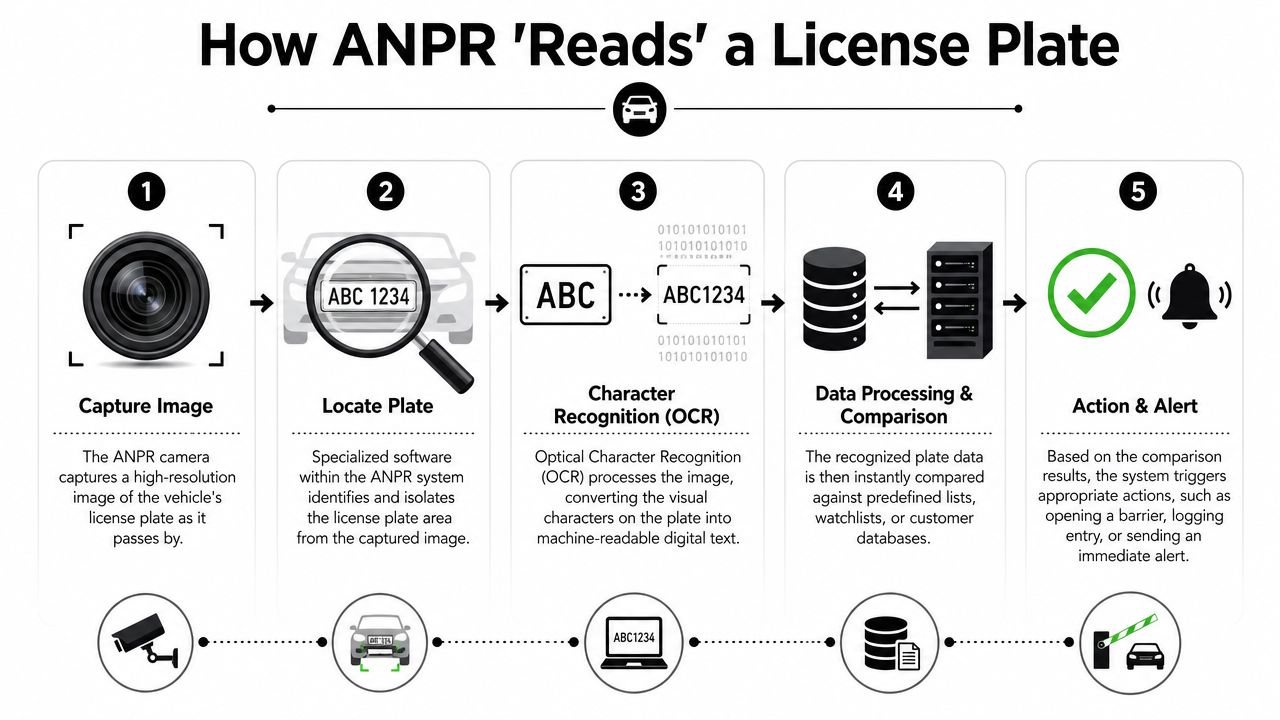
The easiest way to think about ANPR is as a very fast digital librarian. A vehicle arrives, the system spots the plate, reads the characters, checks them against a list, and then decides what to do next. All of that happens quickly enough that the driver often just sees a gate open.
Step one and step two
First, the camera captures an image of the approaching vehicle. Dedicated ANPR cameras use infrared lighting so they can work day and night without depending on visible light alone. That's one reason purpose-built ANPR cameras outperform general CCTV cameras when plate reading is the actual job.
Next, the software locates the number plate in the image. It doesn't care about the whole car in the way a person does. It's looking for the plate area so it can isolate that part of the image and prepare it for reading.
Step three and step four
Once the plate area is isolated, OCR, or optical character recognition, analyses the characters and converts them into machine-readable text. Better systems handle variation in brightness, plate position, and weather more effectively than basic setups.
That text string is then checked against a rule set. For example:
- Whitelist check: if the plate belongs to staff, open the gate.
- Visitor rule: if the plate matches a booked visitor, log entry and notify reception.
- Unknown vehicle: keep the barrier closed and generate an alert.
- Searchable record: store the event so you can review it later with linked video.
Modern dedicated ANPR cameras in the UK achieve 95 to 99% or higher accuracy under normal conditions and can support barrier access in under two seconds, according to this explanation of how ANPR cameras work in UK access control.
Why dedicated ANPR works better than improvised setups
A common mistake is assuming any CCTV camera with decent resolution will do the same job. It usually won't. A true ANPR camera is tuned for plate capture, not just general scene recording.
If you're comparing camera-based automation with broader intelligent surveillance, it helps to understand where AI fits around the core ANPR task. This overview of how AI CCTV systems improve security is useful because it shows how plate reads can sit inside a wider response workflow rather than operating as an isolated trigger.
The camera isn't “reading a car”. It's capturing a very specific target under very specific conditions, then handing that result to the rest of your security system.
Key ANPR Performance and Accuracy Factors
Most buyers ask the right question quite quickly. Will it work reliably on my site, with my gate, in my lighting, and with my traffic flow? That is the critical issue. ANPR performance depends as much on deployment quality as on the badge on the camera.
The best benchmark in the UK comes from policing standards. National ANPR standards require stationary systems to capture 98% of visible VRMs and accurately read 95% of captured VRMs. For moving vehicle deployments, capture drops to 80%, while accuracy must still remain at 95%, according to the National ANPR standards for policing and law enforcement.
What helps good reads
A site with clean geometry is much easier than one with awkward bends, reflective surfaces, or cars approaching too quickly. In practice, these factors matter most:
- Camera angle: the straighter the view to the plate, the better the read.
- Mounting height: too high and you create poor plate geometry. Too low and the camera is easier to obstruct or damage.
- Lighting control: glare from headlights, sunrise, or reflective backgrounds can reduce consistency.
- Approach speed: slower, predictable vehicle movement makes life easier for any ANPR engine.
- Plate condition: dirt, damage, unusual spacing, or non-standard fonts all make recognition harder.
What buyers should ask installers
Rather than focusing only on megapixels, ask practical questions:
| Question | Why it matters |
|---|---|
| How will the camera view the plate? | Angle is often more important than headline spec. |
| What happens at night? | Infrared setup and exposure control matter after dark. |
| How fast will vehicles approach? | A warehouse gate and a roadside entrance need different tuning. |
| Will the system read both regular and occasional visitor vehicles? | Access logic needs to fit actual site use. |
Practical rule: If the installer talks only about camera resolution and not about angle, approach lane, glare, and gate timing, you're not getting the full design conversation.
What usually doesn't work
What tends to fail is predictable. One camera trying to do both overview CCTV and precise plate capture. A barrier placed so close to the read point that the gate hasn't got time to respond. A plate read expected from a sharp corner entry. Or a homeowner buying consumer-grade kit and expecting commercial gate performance.
Good ANPR is rarely about one impressive specification. It's about a camera, a lane, a trigger, and an action all being designed together.
Practical ANPR Use Cases for Your Property
The most useful ANPR projects solve an everyday problem that staff or residents are already tired of. When that's the starting point, the system design is usually better and adoption is easier.
Businesses and car parks
For offices, small industrial units, gyms, clinics, and managed car parks, the usual pain point is access admin. Somebody is forever updating fobs, replacing lost remotes, or explaining to visitors how to get in.
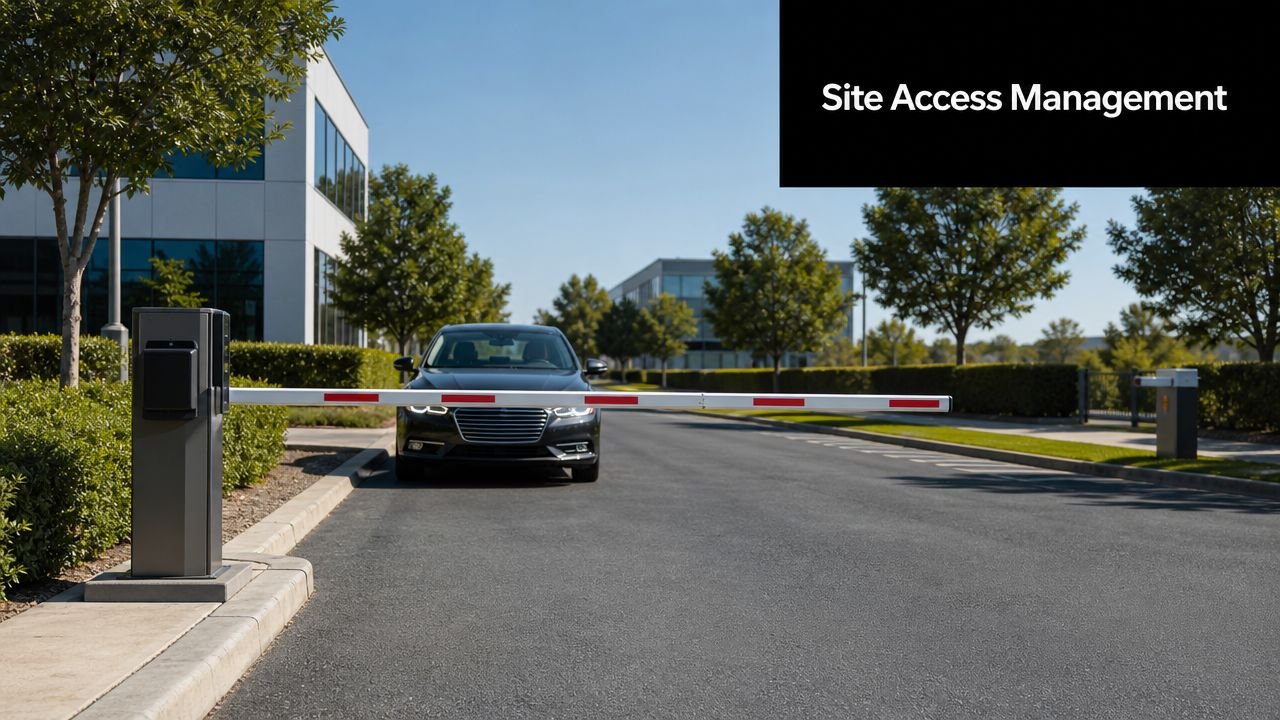
A number plate recognition camera changes that routine. Staff vehicles can sit on an approved list. Regular contractors can have timed permissions. Visitors can be pre-registered. When their vehicle arrives, the gate or barrier responds automatically and the system keeps a searchable log.
That also helps with misuse. If you've got unauthorised parking, out-of-hours arrivals, or disputes over who was on site, vehicle records are easier to review than manual sign-in sheets.
- For staff access: plates replace shared keypad codes.
- For visitor management: reception can register expected vehicles in advance.
- For enforcement: repeated unauthorised users can be flagged without stationing somebody at the gate.
Warehouses and logistics sites
Warehouses have a different problem. It's less about convenience and more about flow, accountability, and secure handover points. Drivers arrive early, late, or at the same time. Security or goods-in staff need to know who turned up and when.
On these sites, ANPR works well when linked to gate automation, intercoms, loading schedules, or wider CCTV coverage. A recognised delivery vehicle can be granted access to the correct zone. An unexpected vehicle can be held at the outer gate until someone checks the booking.
The audit trail matters here. If there's a dispute about an arrival window, a missed delivery, or after-hours access, plate-linked records help narrow down what happened.
A practical example of access-led site security can be seen in Admiral's Yard's secure Leeds storage, where controlled entry is part of the site's security model. ANPR isn't the only way to achieve that, but it often becomes the most efficient method where vehicle access is frequent.
Residential properties
At home, the conversation is usually different. Homeowners don't want an industrial-looking setup or a fiddly app that becomes another job to manage. They want the gate to open for family vehicles, keep a record of arrivals, and avoid unnecessary interaction with unknown drivers.
ANPR can fit gated homes, shared private drives, small developments, and private roads. It's especially useful where several authorised vehicles need regular access and where remote controls become unreliable because people leave them in the wrong car or hand them around.
A residential setup often works best when it performs three functions unobtrusively:
- recognises household vehicles automatically
- logs unknown arrivals
- lets the homeowner review incidents alongside the main CCTV footage
On homes and small residential developments, the best ANPR system is usually the one people stop noticing after the first week because it just works.
Some integrators also deploy specialist options such as Wisenet Road AI where built-in OCR and vehicle event handling are needed as part of a wider CCTV and access control setup, particularly when the client wants plate data tied to other site events.
Understanding UK Legal and Data Protection Rules
This is the part many buyers leave too late. They focus on cameras, gates, and apps first, then realise the compliance side isn't a footnote. If you're using ANPR on private property in the UK, data protection has to be part of the design before installation starts.
When number plates become personal data
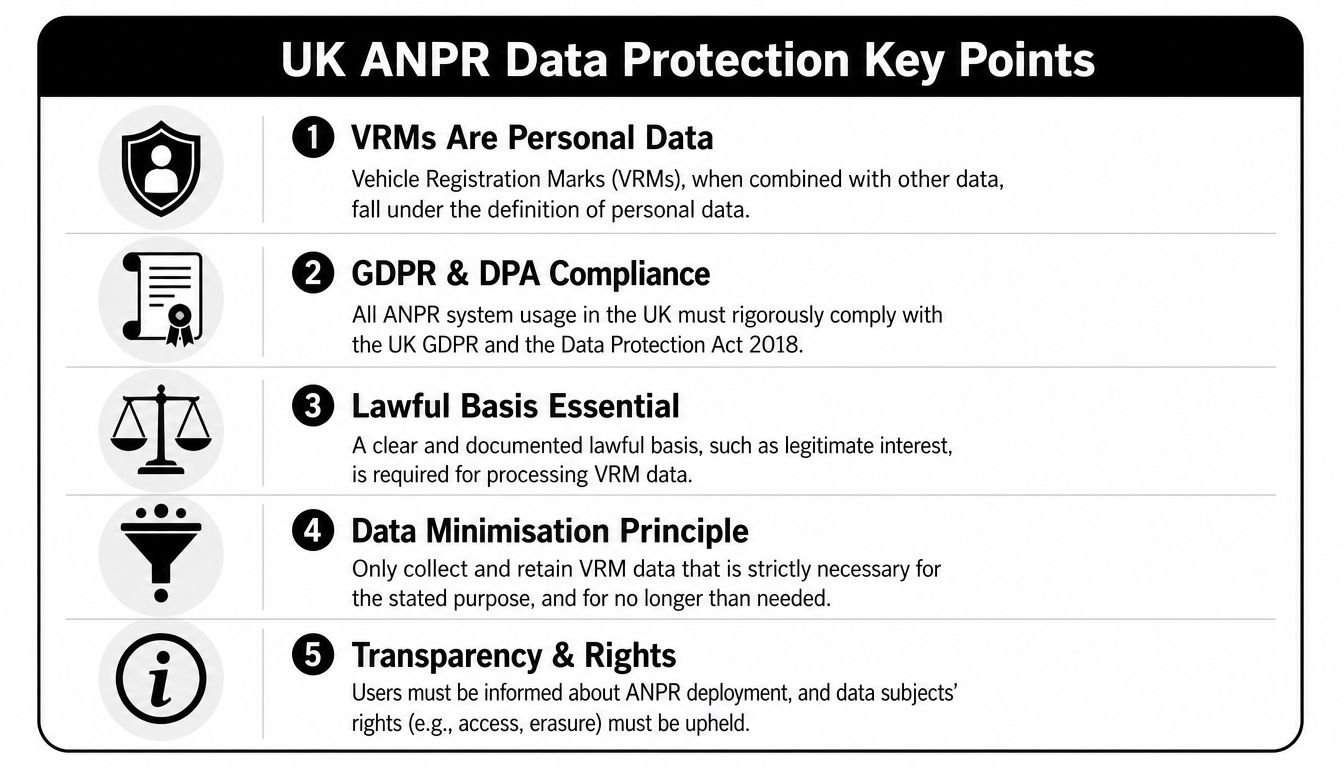
In UK practice, vehicle registration marks can be personal data when they're used in a way that identifies someone, or can be linked to other information about them. That's where many small businesses and car park operators get caught out. They assume a number plate is “just a vehicle detail” when, in context, it may relate to an identifiable person.
The ICO makes this especially important for ANPR because of the volume and continuous nature of collection. It also states that a Data Protection Impact Assessment must be carried out before deployment for this kind of system. That requirement is explained in the ICO's guidance on automatic number plate recognition and video surveillance.
What private operators need to do
For SMEs, landlords, site managers, and residential developments, the practical obligations usually include:
- Choose a lawful basis: you need a clear reason for processing plate data.
- Be transparent: people should know ANPR is in use and why.
- Limit collection: don't gather more than you need for the job.
- Control retention: keep data only for as long as it serves the stated purpose.
- Secure access: only authorised people should be able to view or export records.
The DPIA is the discipline that forces these questions early. It makes you define purpose, risk, data flow, retention, signage, user access, and response procedures before the cameras start recording.
If you need broader background on business surveillance obligations, this guide on CCTV and GDPR in the UK is a helpful companion to ANPR-specific planning.
If you can't explain why you're collecting plate data, who can access it, and when it will be deleted, the system isn't ready to go live.
A practical way to think about compliance
Treat compliance like part of the engineering, not a separate admin task. On a well-run project, the installer, site owner, and whoever handles data protection all agree the answers before commissioning:
| Compliance question | Practical decision |
|---|---|
| Why are we collecting plate data? | Access control, security logging, parking management, or a defined mix |
| Who sees the data? | Named staff or authorised managers only |
| How are people informed? | Clear signage at the point of vehicle entry |
| What happens if someone makes a request? | A simple process for access, review, or deletion where applicable |
That approach is far safer than installing first and trying to justify the setup afterward.
Installation Integration and Maintenance
ANPR projects are won or lost at the installation stage. The camera can be excellent, but if the plate arrives at the wrong angle, under the wrong light, or too close to the barrier, performance drops quickly.
Placement makes or breaks performance
The first job is getting the read zone right. You want vehicles to present the plate cleanly, for long enough, and in a predictable lane position. That often means choosing a point before the gate line rather than directly on top of it.
Installers should also think about tamper risk, cable route, weather exposure, and what happens when larger vans or 4x4s use the same entrance as standard cars. A setup that works for one vehicle type can struggle with another if the field of view is poorly chosen.
Integration is where ANPR earns its keep
ANPR on its own is just a data source. The value comes from what it controls or what it informs. On most sites, that means integration with:
- Gate automation: open a gate or barrier for approved vehicles.
- Access control platforms: manage permissions from one place instead of separate lists.
- Main CCTV recording: tie a plate read to wider video footage of the same event.
- Intercoms or reception workflows: hold unknown vehicles for review.
In practice, the smoother the integration, the more the system feels invisible to authorised users. Drivers don't want to think about technology at the gate. They want a predictable result.
Maintenance is simple but not optional
ANPR maintenance is not complicated, but neglect shows up fast. Dirty lenses, shifted camera angles, overgrown foliage, and outdated firmware all undermine reliability.
A sensible routine includes:
- Cleaning and inspection: keep the lens and housing clear.
- Alignment checks: confirm the camera still sees the plate correctly.
- Software updates: apply firmware and platform updates safely.
- Rule review: remove old staff vehicles and update access lists.
For ongoing upkeep, structured CCTV system maintenance is the right model because ANPR performance depends on both optics and the wider recording and control environment.
A Wisenet Checklist for Choosing Your ANPR System
Most buyers don't need more product brochures. They need a shortlist of decisions. If you can answer the points below clearly, you're already in a much stronger position when you speak to an installer.
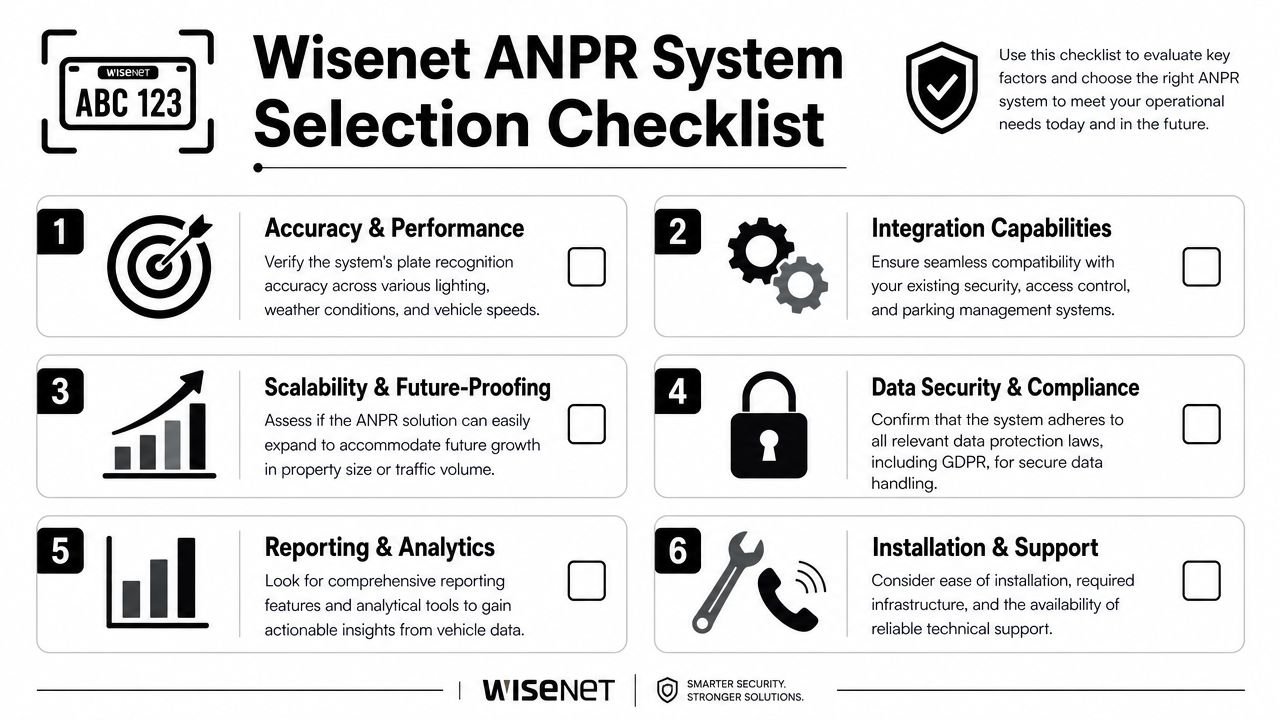
Start with the purpose. Is the main job access control, security monitoring, visitor logging, or parking management? One entrance can do all of those, but one of them should drive the design.
Then look at the environment and the connections around it.
- Entrance layout: is the vehicle approach straight, slow, and well controlled?
- Existing systems: does the camera need to talk to gates, barriers, Paxton, intercoms, or CCTV?
- User types: are you managing staff, visitors, residents, contractors, or delivery fleets?
- Compliance plan: have you completed the DPIA and decided signage, retention, and user access?
- Support model: who will clean, update, test, and adjust the system after handover?
A good buying decision usually comes from asking what can go wrong, not just what the camera can do. If your entrance is awkward, vehicles arrive at mixed speeds, or you need reliable logging for disputes, say that at the start. That's how the design gets shaped properly.
The right number plate recognition camera setup should feel proportionate to the site. A homeowner doesn't need a complex commercial workflow. A busy logistics gate shouldn't be built like a domestic driveway. Matching the system to the property is what gets results.
If you want help scoping a vehicle access or ANPR project, Wisenet Security Ltd can assess the entrance layout, integration needs, and compliance considerations before anything is installed. That usually saves time, avoids poor camera placement, and helps you build a system that fits the way your property operates.