Industrial Security Systems: A South Wales Business Guide
If you run an industrial site in Cardiff, Newport, or Swansea, you probably know the routine. The shutters are down, the yard looks quiet, and critical questions arise. Can anyone get through the rear gate unnoticed? Will the cameras provide usable footage at night? If an alarm activates at 2am, will anyone know whether it's a real intrusion or another false callout?
That's where most South Wales businesses get caught out. They buy bits of security kit, not a security system. A few cameras go up. A keypad gets fitted near the office door. Someone adds an alarm later. On paper, the site is “covered”. In practice, the blind spots stay exactly where they were.
That approach no longer fits the risk. The global industrial security systems market was valued at USD 55.13 billion in 2024 and is projected to reach USD 113.62 billion by 2034, growing at roughly 7.5% CAGR according to Zion Market Research's industrial security systems market report. Businesses don't invest at that scale unless the threat is real and persistent.
Industrial operators also need to think beyond gates and cameras alone. If you work in sectors where site uptime matters, it's worth looking at how specialists approach essential oil & gas cybersecurity, because the same lesson applies in South Wales. Physical security and cyber resilience now sit in the same conversation.
For warehouses and distribution sites, layout matters as much as hardware. A practical starting point is understanding how dedicated warehouse security systems for industrial premises should be planned around loading bays, staff access routes, perimeter lines, and out-of-hours monitoring.
Table of Contents
- Protecting Your South Wales Industrial Assets in 2026
- The Core Components of Modern Industrial Security
- Designing a Unified and Intelligent Security System
- The Foundation of Effective Security Site Surveys and Risk Assessments
- Meeting UK Security Regulations and Compliance Standards
- Essential Maintenance and Monitoring for Long-Term Protection
- A Checklist for Choosing Your South Wales Security Partner
Protecting Your South Wales Industrial Assets in 2026
A lot of sites along the M4 corridor share the same weaknesses. The building is sound enough, but the perimeter is patchy, the yard lighting is poor in places, and the camera coverage was designed around where cabling was easy to run rather than where thieves or trespassers would move.
That matters more in South Wales than many buyers realise. Cardiff industrial estates, Newport warehousing, and mixed-use commercial sites in Swansea often deal with a combination of staff traffic, delivery access, contractors, and quiet overnight periods. Security has to work in all of those conditions, not just produce a tidy equipment list.
Start with risk, not products
The first practical step is simple. Decide what you're protecting and what would hurt the business most if it went wrong. For one site, that's stock. For another, it's plant, fuel, controlled access to a server room, or uninterrupted operation of a production line.
A useful way to think about industrial security systems is to split them into layers:
- Perimeter protection for fences, gates, vehicle entry points, and exposed yard areas.
- Building protection for doors, roller shutters, windows, and internal movement routes.
- Critical zone control for plant rooms, stores, offices, comms rooms, and restricted areas.
- Response capability so an alert leads to a decision, not just noise.
If one of those layers is weak, the rest has to work harder.
Practical rule: Good security doesn't rely on a single device catching a problem. It gives you several chances to detect, verify, delay, and respond.
South Wales sites need practical resilience
Local conditions affect performance. Coastal air, damp weather, night-time glare, and poorly lit service roads all change how detectors and cameras behave. That's why a cheap domestic-style setup rarely lasts on an industrial site. Lenses mist up, housings degrade, and motion alerts become unreliable when the environment changes.
The better approach is to treat security as part of site operations. If the loading bay runs early, the system has to handle early access. If drivers arrive out of hours, gate entry has to be controlled and auditable. If contractors come and go, permissions have to be easy to issue and easy to revoke.
A serious system isn't there to look impressive on a proposal. It's there to keep the site working when something goes wrong.
The Core Components of Modern Industrial Security
Modern industrial security systems work best when each component has a clear role. That doesn't mean buying every available product. It means choosing the right mix, then making sure each part supports the others.
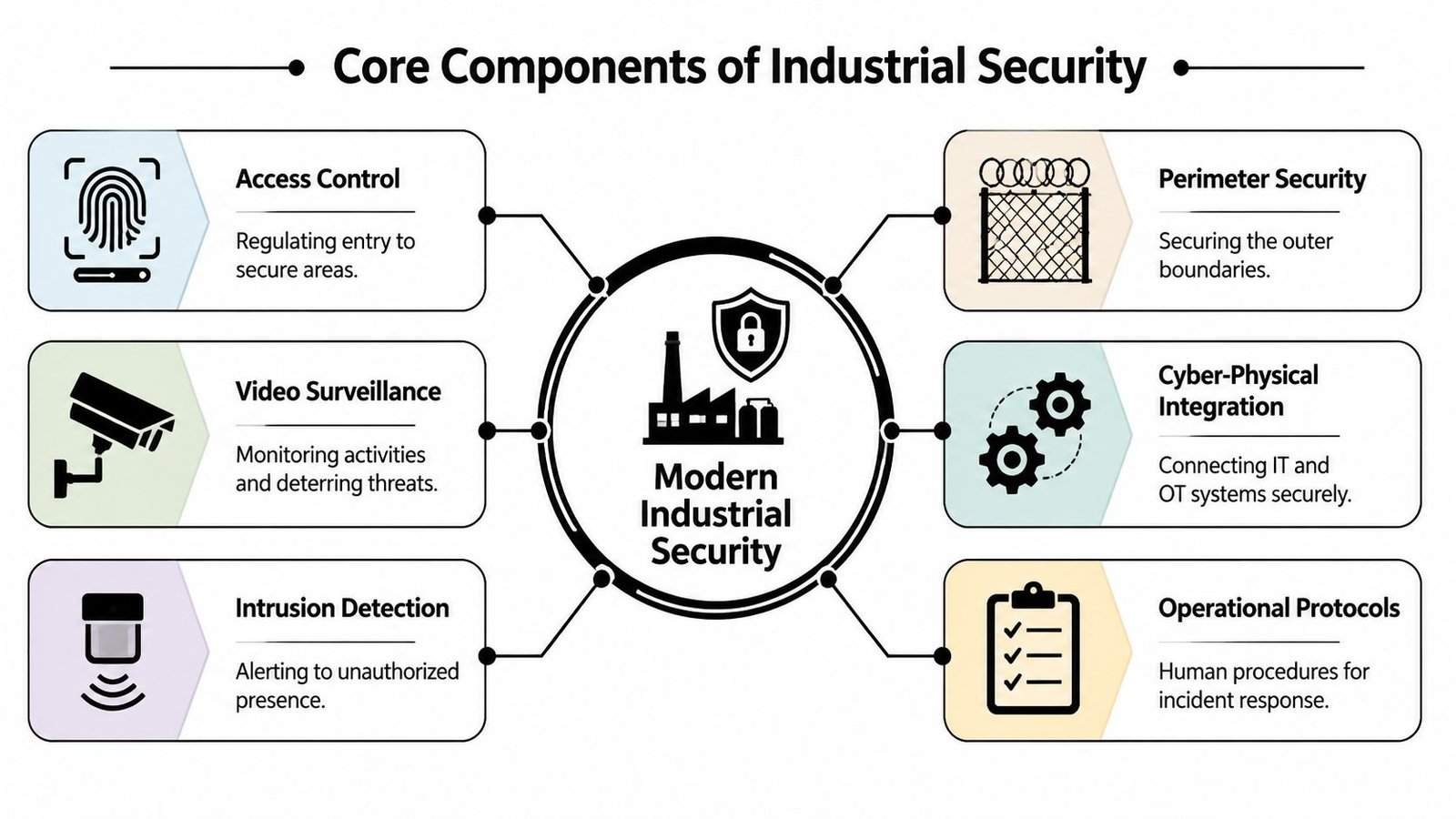
CCTV and video surveillance
CCTV is still the part most buyers ask for first, but it's also the part most often misunderstood. Recording footage isn't the same as securing a site. You need coverage that answers operational questions clearly. Who entered? From where? At what time? What happened before and after?
In industrial settings, camera placement matters more than camera count. A small number of correctly positioned 4K or HD cameras with proper night capability usually beats a larger number of badly placed units. Entrances, loading bays, yard choke points, pallet lanes, external plant, fuel storage, and pedestrian routes all need different views.
The more advanced systems now do more than record. In the UK, 72% of certified industrial security systems in 2024 incorporate AI-driven video analytics, and that technology enables facial recognition with 99.8% accuracy while reducing response times to physical threats by 60% compared with traditional CCTV monitoring, according to Avigilon's industrial security overview.
That sounds impressive, but the practical value is simpler than the marketing. AI analytics can help distinguish a person from a vehicle, identify unusual movement patterns, and reduce the amount of time someone spends scrubbing through footage after an incident.
Access control
Access control decides who gets in, where they can go, and when. On an industrial site, that usually means more than just the main door. It covers warehouse side entries, office areas, roller shutter access, staff welfare areas, plant rooms, and restricted stock zones.
Common options include:
- Fob or card systems for everyday staff movement.
- Keypad entry where occasional code changes are enough.
- Biometric readers for higher-security areas.
- Remote management for adding and removing users without replacing locks.
The key advantage is control. Mechanical keys drift. People copy them, lend them, and forget to return them. Electronic access leaves a user trail and lets managers remove permissions quickly when staff roles change.
Intruder and fire alarms
An intruder alarm should do two jobs. It should detect unauthorised entry, and it should do it reliably enough that people trust the signal. If alarms trigger constantly for the wrong reasons, staff start ignoring them and monitoring responses become harder to manage.
On industrial sites, detector choice needs care. Warehouses, workshops, and logistics units have draughts, temperature swings, dust, and movement from authorised staff at awkward hours. That's why sensor type, zoning, and alarm grading matter.
Fire alarm design needs the same discipline. A small commercial unit may suit one approach. A larger warehouse with office space, stock, and multiple escape routes may need something very different. Coverage, cause-and-effect setup, emergency lighting integration, and ongoing servicing all matter because a fire system has to protect life first, then support business continuity.
A fire alarm and an intruder alarm may share infrastructure on a site, but they should never be treated as interchangeable projects.
Intercoms and gate automation
Intercoms and automated gates often get treated as convenience features. On industrial premises, they're security tools. They control how vehicles, visitors, delivery drivers, and contractors enter the site.
A good gate setup doesn't just open and close. It slows decision-making at the perimeter in a useful way. Staff can verify a caller, view them on camera, grant access remotely, or refuse entry without exposing reception or yard staff to unnecessary risk.
This is especially useful on South Wales sites where the front office may not have a direct line of sight to the gate. Intercoms linked to video and access control remove guesswork. The person granting entry can see who's there and log the event properly.
Cyber-physical integration and procedures
This is the part many businesses skip, even though it decides whether the rest works under pressure. Industrial security systems now sit on networks, connect to apps, and share data across platforms. That creates obvious convenience, but it also creates exposure if the setup is loose.
At site level, cyber-physical integration means:
| Component | Practical purpose |
|---|---|
| Networked cameras | Live monitoring, analytics, and evidence review |
| Access databases | User permissions, audit trails, timed access |
| Alarm signalling | Fast communication to keyholders or monitoring teams |
| Operational procedures | Clear actions when alerts arrive |
The hardware matters, but so do the procedures. If a camera detects movement out of hours, who checks it? If a contractor needs weekend access, who authorises it? If a door alarm repeats all night, who owns the fault?
Without those answers, even expensive equipment underperforms.
Designing a Unified and Intelligent Security System
A site with cameras, alarms, gates, and access control isn't automatically integrated. Plenty of businesses have all four and still end up with a fragmented setup where each system works in isolation. That slows response and leaves staff piecing events together after the fact.
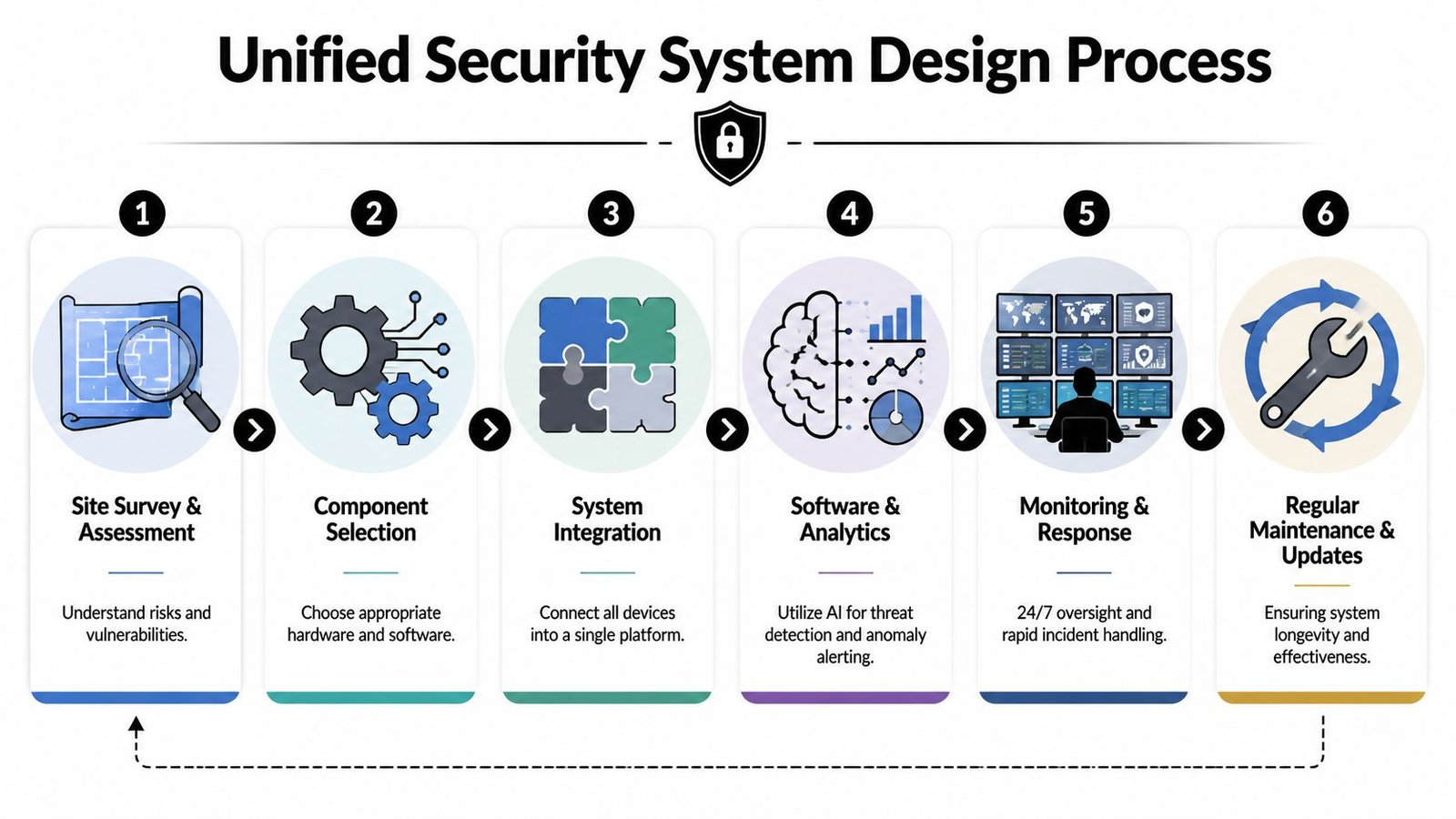
What integrated security actually looks like on site
A unified system links detection, verification, and response. If an intruder alarm activates at a rear service door, the nearest cameras should present the relevant view immediately. The access control system should show whether that door was opened by an authorised user. If it wasn't, the event can be escalated quickly.
That's what intelligent design looks like in practice. You don't force someone in the office, or at a monitoring desk, to jump between unrelated apps and guess what's happening.
A sensible sequence often looks like this:
- A detector activates in a defined zone.
- The relevant camera view appears for rapid verification.
- Access records are checked against the same time window.
- The response follows a rule based on the event and time of day.
- The incident is logged so repeated vulnerabilities can be corrected.
Where piecemeal systems fail
The weak point in many industrial sites isn't the camera image quality. It's unmanaged integration. A 2025 UK National Cyber Security Centre report found that 42% of UK industrial security breaches in 2024 originated from compromised IoT camera firmware in logistics hubs, highlighting why connected systems need secure design from the start. In perimeter planning, the same principle applies to physical barriers as well, and articles such as FenceScape's commercial fencing expertise are useful reminders that boundaries, gates, and detection need to be planned as one system, not as separate purchases.
The practical lesson is straightforward. Don't bolt internet-connected devices onto a site one at a time and hope they'll play nicely together later. That's when default settings stay in place, firmware gets ignored, and no one is fully sure which contractor owns which part of the system.
Buy once with a design in mind. Retrofitting coherence into a patchwork system is usually slower, messier, and more expensive.
For sites that need a joined-up approach, it helps to look at how integrated security systems for commercial and industrial properties are structured around shared events, user permissions, and central management rather than separate boxes on separate screens.
The best unified designs also respect day-to-day operations. A logistics hub can't have security rules that obstruct driver flow all morning. A warehouse can't have constant lockouts every time a sensor misreads movement. The right design gives strong control without creating friction that staff will try to work around.
The Foundation of Effective Security Site Surveys and Risk Assessments
A proper security system starts long before the first cable is run. The survey is where you find out what the site needs, what the obvious risks are, and what the hidden ones look like after dark, in bad weather, or during shift change.

What a proper survey should examine
On a typical South Wales industrial site, a useful survey goes well beyond counting doors and suggesting camera positions. It should examine the route an intruder would take, the operational routines of staff and contractors, and the environmental conditions that affect equipment reliability.
A thorough assessment usually checks:
- Perimeter weakness such as blind fence lines, unmanaged side access, rear service lanes, and easy climbing points.
- Lighting quality at gates, yards, loading areas, and paths between buildings.
- Entry behaviour including who arrives early, who leaves late, and how delivery traffic is processed.
- Asset concentration in stock rooms, fuel areas, tool stores, comms cabinets, and office zones.
- Existing infrastructure including old cabling, legacy alarms, power availability, and network constraints.
On older sites in Newport and Swansea, the biggest issue is often not the building fabric itself. It's the mismatch between how the building was originally used and how it's used now. Storage areas become packing bays. Offices become mixed access points. Temporary routes become permanent ones. Security has to be redesigned around actual behaviour, not the original floor plan.
Why generic quotations usually cost more later
A generic quote often looks cheap because it ignores the awkward parts. It doesn't account for glare across a yard. It assumes one detector can cover a space with stacked racking. It places cameras where installers can reach easily rather than where incidents are most likely.
That's why the survey matters. It prevents overspending on the wrong things and underspending on the critical ones.
Here's a quick comparison:
| Approach | Likely outcome |
|---|---|
| Remote estimate from a floor plan | Misses real-world sightlines and environmental issues |
| Basic walk-round in daylight | Overlooks night performance and out-of-hours workflows |
| Structured site survey and risk assessment | Produces a system matched to the site's actual risks |
The best survey questions aren't “Where do you want cameras?” They're “How does the site operate when nobody is watching?” and “Where would you worry about first after midnight?”
A strong survey gives you a blueprint. It tells you where detection should begin, where verification must be strongest, and where access needs tighter control than you may have assumed.
Meeting UK Security Regulations and Compliance Standards
Compliance is where many industrial buyers either save themselves serious trouble or walk straight into it. A non-compliant system can still switch on, record, and make noise. That doesn't mean it will satisfy insurers, support police response, or perform reliably in a demanding environment.
Why standards matter in day-to-day operation
For high-risk industrial sites in the UK, compliance with BS EN 50131-1 is mandatory, and compliant systems are proven to reduce false alarm rates by 40% compared with non-certified systems, according to the Wisenet Security overview of BS EN 50131 intruder alarm standards.
That's not paperwork for its own sake. False alarms waste staff time, erode confidence, and create a poor response culture. On a warehouse or logistics site, repeated false activations usually point to one of three things: poor detector choice, bad positioning, or a system grade that doesn't match the risk.
In practice, compliance helps in several ways:
- It improves reliability because the equipment and design standard are better matched to the environment.
- It supports response procedures because alarm events are more credible.
- It reduces operational nuisance for staff who'd otherwise deal with needless callouts.
- It protects the buyer when insurers or auditors ask whether the system was specified correctly.
CCTV has a compliance side as well. Recording staff, visitors, contractors, and vehicle activity has data protection implications that shouldn't be guessed at. If your system stores, exports, or shares footage, it's worth reviewing the practical implications of CCTV and GDPR requirements for UK businesses before installation decisions are locked in.
Questions worth asking an installer
A good installer shouldn't struggle with compliance questions. Ask them directly.
- What standard is this intruder system designed to meet? If the answer is vague, that's a warning sign.
- How have you accounted for this site's environment? Warehouses, cold spaces, damp areas, and busy access routes all affect detector choice.
- What maintenance regime keeps the system compliant? A standard met on install day can still drift out of shape later.
- How is CCTV data handled? Retention, access permissions, and lawful use all matter.
The best systems don't just tick a regulation box. They behave predictably under real operating conditions, which is what compliance is supposed to achieve.
Essential Maintenance and Monitoring for Long-Term Protection
A new install can look excellent on day one and still let you down six months later if nobody maintains it. Industrial security systems live in hard environments. Dust builds up, housings weather, batteries age, detectors drift, and network-connected devices need updates managed properly.
That's why maintenance isn't an optional add-on. It's part of whether the system remains trustworthy.
Monitoring choices and their trade-offs
Not every site needs the same response model. A small unit with limited stock and predictable hours may accept a simpler arrangement. A logistics site with regular vehicle movement, valuable goods, or out-of-hours access usually needs stronger oversight.
The usual options break down like this:
| Monitoring approach | What it suits | Main limitation |
|---|---|---|
| Bell-only alarm | Lower-risk premises with reliable local attendance | No professional verification or managed escalation |
| Keyholder response | Sites where responsible staff can attend safely and quickly | Response quality depends on people being available |
| 24/7 monitored system | Higher-risk or operationally critical sites | Requires proper setup and ongoing management |
The cyber side makes this even more important. In the UK manufacturing sector, the average cost of a single cyberattack exceeds USD 2 million, and less than 25% of companies have implemented the infrastructure needed to defend their Industrial Control Systems, according to Splunk's guide to Industrial Control Systems security.
For industrial operators, that figure changes the conversation. Monitoring isn't just about hearing a bell ring. It's about maintaining visibility across a site where physical systems and networked devices increasingly overlap.
What maintenance should include
Maintenance should be structured, not reactive. If the contractor only appears when something fails, you're already behind.
A sensible service arrangement should cover:
- Routine testing of detectors, signalling paths, cameras, recorders, readers, and backup power.
- Cleaning and environmental checks for lenses, housings, external devices, and detection zones.
- User review so access permissions still reflect current staff and contractor needs.
- Firmware and software management for connected devices where updates are part of system safety.
- Fault reporting and corrective work with clear ownership of who responds and when.
If you manage plant, facilities, or site reliability generally, the principles behind Master operation and maintenance are useful because security performs best when it's treated like any other critical asset. It needs planned care, documented checks, and clear operational ownership.
Good maintenance reduces surprises. Great maintenance also tells you where the next failure is likely to come from before it interrupts the site.
The right maintenance and monitoring package should reflect the site's real exposure, not just the installer's standard template.
A Checklist for Choosing Your South Wales Security Partner
The wrong installer usually reveals themselves early. They talk mainly about equipment brands, give a fast price without spending time on the site, and treat CCTV, alarms, access control, and gates as separate jobs. That approach often produces a cheaper proposal and a weaker result.
The better question isn't “Who can fit this quickest?” It's “Who can design something that will still make sense two years from now, after staff changes, layout changes, and operating pressures have shifted?”
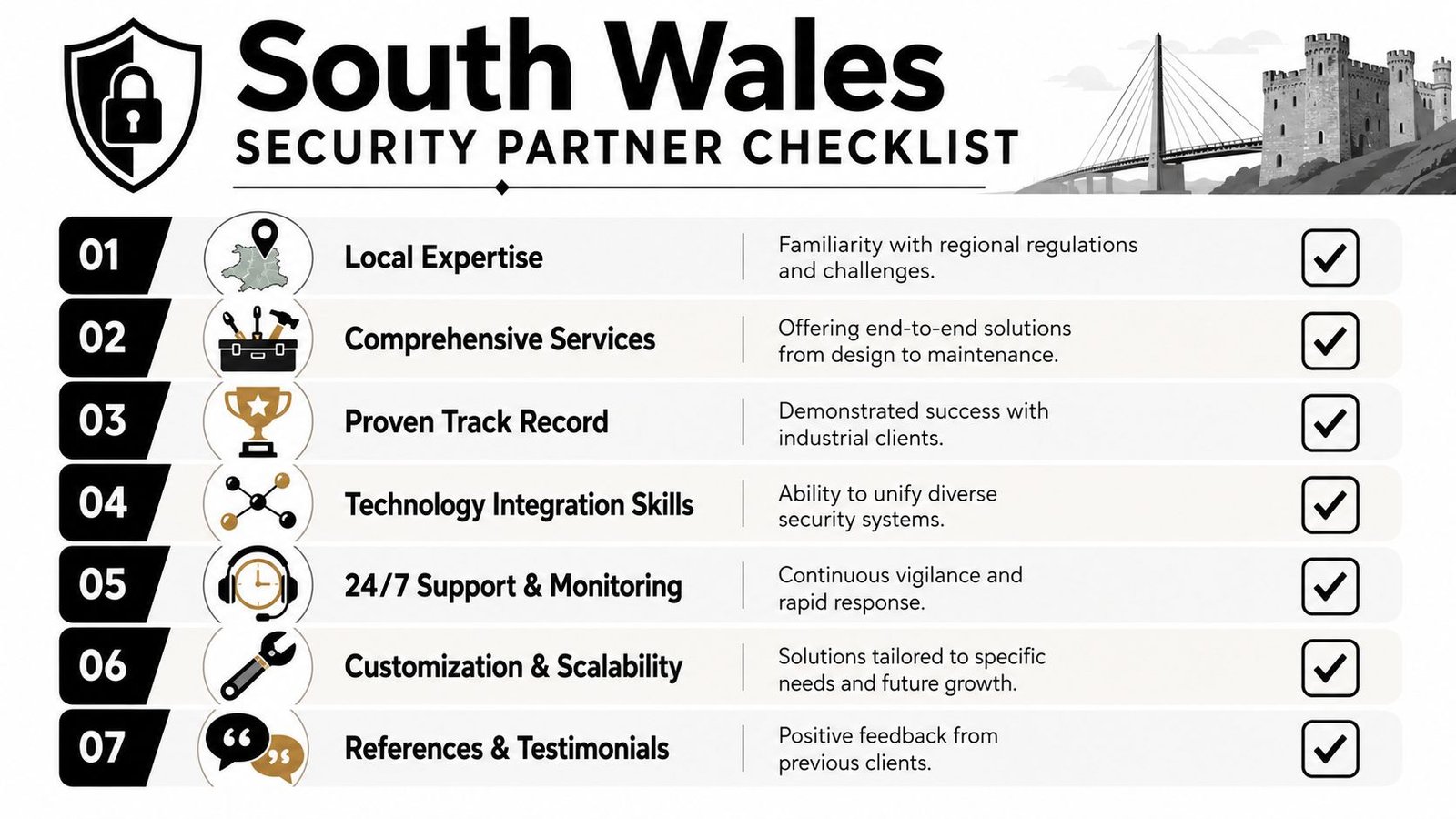
The shortlist criteria that actually matter
Use this as a practical filter when comparing firms for industrial security systems in Cardiff, Newport, Swansea, and across the wider South Wales region.
- Local understanding: They should know the kinds of sites common across the region, from mixed commercial estates to warehousing and logistics properties. Local knowledge helps with travel, support, and realistic design decisions.
- Proven industrial experience: Residential and small retail work doesn't automatically translate to industrial competence. Ask about experience with yards, loading bays, restricted areas, out-of-hours access, and multi-system integration.
- Compliance literacy: They should speak clearly about British Standards, maintenance obligations, and CCTV data handling, not dodge the detail.
- Integrated design ability: One contractor should be able to explain how cameras, alarms, access control, fire systems, intercoms, and gate automation interact on your site.
- Qualified personnel: For industrial premises, it matters who attends your site. Ask whether engineers are DBS-checked and whether the business holds recognised health and safety accreditations.
- Maintenance and support: Installation is only the start. You need to know what happens after handover, how faults are reported, and how preventative maintenance is scheduled.
- Brand familiarity: Experience with established manufacturers such as Hikvision, Paxton, Pyronix, and Fike is useful because it usually means fewer avoidable setup errors and better long-term support.
Red flags to watch for
Some warning signs are easy to miss when the quote looks attractive.
- They skip the detailed survey. If the proposal arrives before anyone has properly assessed the perimeter, lighting, workflows, and risk areas, expect omissions.
- They push one product for every problem. Industrial sites need combinations, not one-size-fits-all packages.
- They can't explain the response process. Detection without verification and action is incomplete security.
- They avoid maintenance detail. That usually means the ongoing service model is weak or undefined.
- They only talk price. Cost matters, but cheap security often shifts expense into false alarms, blind spots, reactive fixes, and early replacement.
A strong partner should leave you with a clearer understanding of your site than you had before they arrived. They should identify risks plainly, challenge assumptions where needed, and explain trade-offs without jargon.
“The best installer isn't the one who promises everything. It's the one who tells you what the site genuinely needs, what can wait, and what shouldn't be compromised.”
That's usually the difference between a contractor who fits devices and a specialist who protects operations.
If you need a practical, site-specific assessment for your premises in South Wales or the South West, Wisenet Security Ltd provides integrated CCTV, intruder alarms, access control, fire systems, intercoms, gate automation, and ongoing maintenance for commercial and industrial properties. Their team serves Cardiff, Newport, Swansea, Bristol, and surrounding areas, with DBS-checked engineers, SafeContractor accreditation, and custom security design built around how your site operates.