Video Intercom System for Home: A 2026 Buyer’s Guide
The usual moment starts like this. The bell goes at an awkward time, you're not expecting anyone, and your first question isn't convenience. It's who's there, and do I need to open the door at all?
That's where a proper video intercom system for home use stops being a gadget and starts becoming part of your security setup. A decent system lets you see the caller clearly, speak without opening up, and control access from an indoor monitor or your phone. If it's linked to a gate, lock, CCTV, or alarm, it becomes even more useful.
Across the UK, that shift is already well underway. The adoption of smart home security is driving 18% growth in the video intercom market, and IP-based systems accounted for 51.4% of the global market in 2025. That matters because IP systems are the ones that handle smartphone access, remote viewing, and integration with wider security equipment properly.
For homeowners in South Wales, the decision usually isn't whether video entry is helpful. It's whether you buy a neat-looking DIY doorbell and live with the compromises, or fit something designed to work reliably in bad weather, on larger properties, and as part of a broader security plan.
Table of Contents
- Welcome to Your Smarter, Safer Front Door
- Core Benefits Beyond Seeing Who Is at the Door
- Key Features to Scrutinise Before You Buy
- Wired vs Wireless Intercoms The Critical Decision
- Budgeting Installation and Ongoing Care
- Your Next Steps to a Secure Home in South Wales
Welcome to Your Smarter, Safer Front Door
A modern front door shouldn't force you to make blind decisions. If someone calls late in the evening, you should be able to check the visitor, speak to them, and decide whether to open a door or gate without standing in the hallway hoping for the best.
That's what a good video intercom system for home use does when it's chosen properly. It gives you verification before access, which is far more valuable than a simple chime or a basic peephole camera. For many households, it also sorts out the everyday friction points. Deliveries, family members arriving without keys, tradesmen needing access, and elderly relatives who don't want to rush to the door.
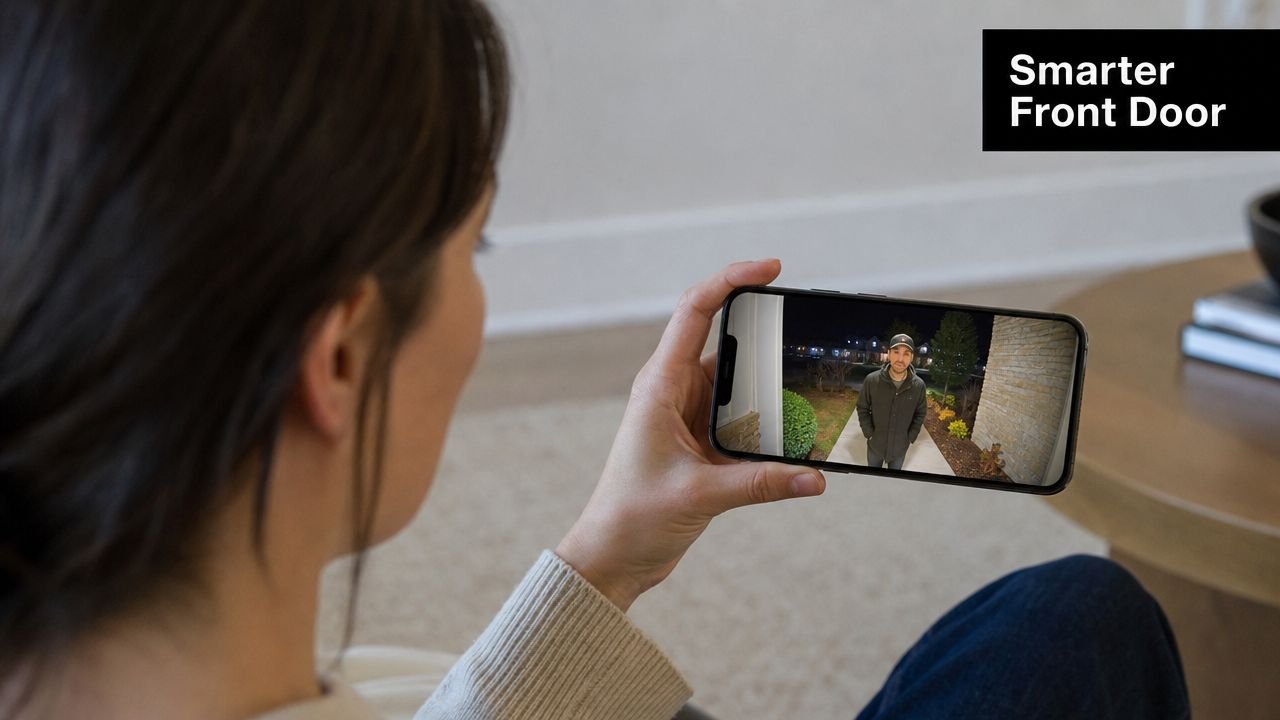
In practice, true improvement comes when the intercom isn't treated as a standalone door gadget. The better setups tie into locks, gates, CCTV, and indoor monitors so the whole entrance behaves like one system instead of four separate bits of kit.
Why this has moved into the mainstream
Homeowners now expect more than a buzzer at the gate or a doorbell camera that only works well on a strong Wi-Fi signal. They want clear video, mobile access, and a system that feels built into the house.
That's one reason connected intercoms have become more common. The UK market is being pushed by homeowners adopting smart homes and connected security, and in residential areas across South Wales and the South West, the appeal is obvious: remote viewing and smartphone-controlled access are no longer specialist features. They're becoming standard expectations.
A front-door system earns its keep in the moments when you'd rather not open first and ask questions later.
What matters locally in South Wales
Homes here vary a lot. A terraced property in Cardiff has different needs from a detached house in the Vale or a larger rural property with gates and a longer driveway. Signal strength, cable routes, night visibility, and weather exposure all change the result.
That's why generic product roundups often miss the point. A video intercom system for home use has to suit the property layout first. The best system on paper can still be the wrong one if the call button is too exposed, the camera angle misses the threshold, or the phone app is doing all the work with no proper indoor station as backup.
Core Benefits Beyond Seeing Who Is at the Door
Most homeowners first look at video intercoms because they want to see who's outside. That's sensible, but it's only the starting point. Its ultimate value is control.
A proper system changes how you manage the entrance to your home. You can screen callers without opening up, answer from another room, and deal with a delivery even when you're not near the front door. If the system also controls a gate or electric lock, you stop making separate trips just to let someone in.
Security value in day-to-day use
The camera matters, but the behaviour change matters more. Instead of reacting after the knock, you decide first. That reduces the chance of opening the door to cold callers, nuisance visitors, or someone you don't want to engage with.
It also gives you a record of who approached the property. That's useful for missed callers, repeated doorstep issues, and checking what happened overnight if the entrance is overlooked by the intercom and nearby CCTV.
- Visitor screening: You can check the caller before granting access.
- Family reassurance: Children, older relatives, and anyone home alone can answer more safely.
- Parcel management: You can speak to the courier and direct where the parcel should go.
- Controlled entry: If linked to a gate or strike lock, you can grant access without handing out spare keys or codes widely.
Practical rule: If the intercom doesn't reduce how often you physically go to the door or gate, it isn't set up to its full potential.
Convenience that actually lasts
Convenience features are only worth having if they still work well after the novelty wears off. That means the call reaches you consistently, the speech is clear, and granting entry is simple enough that every adult in the house will use it.
For busy households, this solves a lot of low-level annoyance. School runs, shopping deliveries, dog walkers, and family visits all become easier to manage. The same goes for homes where the front entrance isn't near the main living space. If your kitchen is at the back or the driveway gate is a fair distance from the house, remote answering stops becoming a luxury and starts becoming practical.
Better when paired with other entry devices
Intercoms are strongest when they connect properly to the rest of the entrance. That might mean an electric strike on a pedestrian gate, a magnetic lock on a side entrance, or a relay for automated gates.
When that's done well, the system becomes one controlled entry point rather than a camera bolted beside a door. That distinction matters. One shows you the problem. The other lets you manage it.
Key Features to Scrutinise Before You Buy
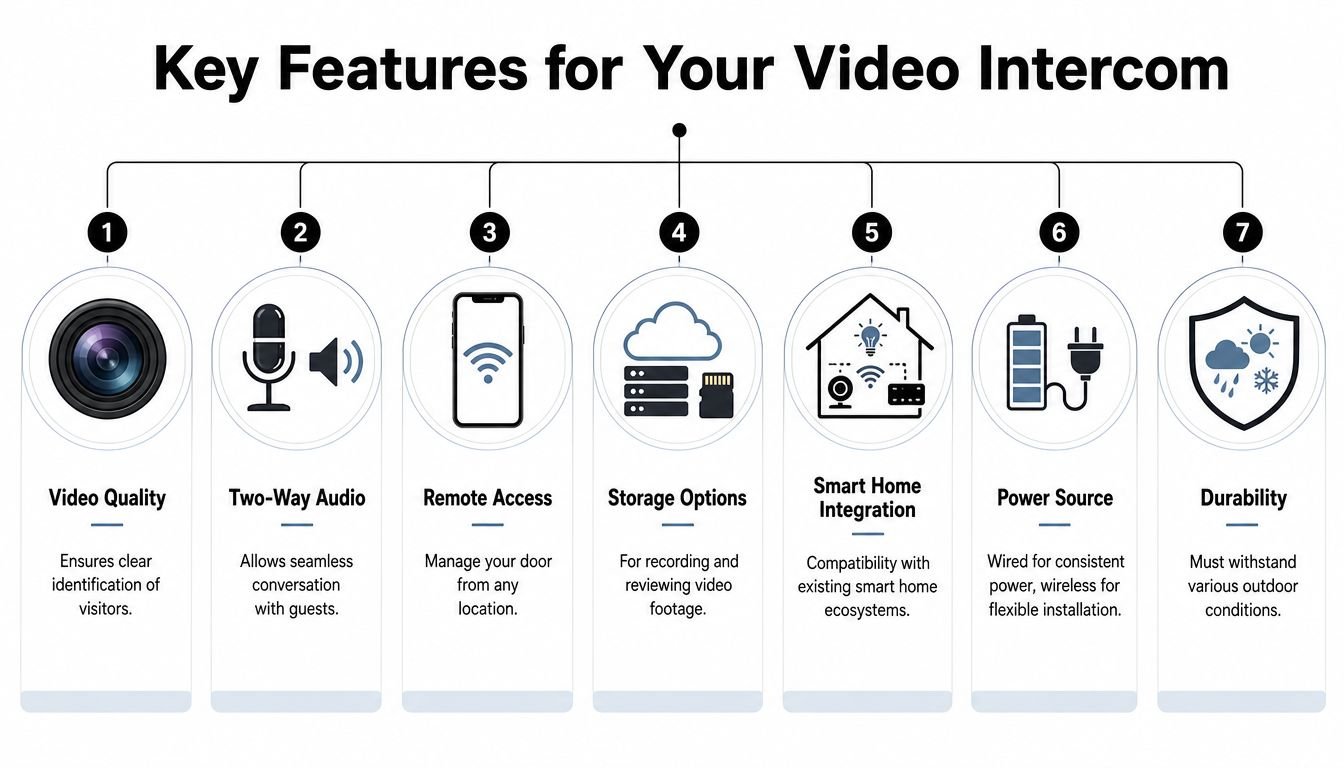
A lot of poor buying decisions happen because buyers compare product lists instead of real-world use. The spec sheet says HD, night vision, app control, motion alerts. Fine. What matters is whether the system helps you identify a visitor quickly and works every single day without fuss.
Video that identifies, not just records
Good video isn't about having a camera. It's about being able to tell who's there, what they're doing, and whether they're alone. That means you should look at image clarity, field of view, backlight handling, and night performance as a package.
If your entrance gets strong sunlight in the afternoon or poor lighting at night, a weak camera will wash out faces or give you a bright porch with no usable detail. The same problem appears if the lens is too narrow and only catches a chest-level view at close range.
Look for these signs of a usable setup:
- Clear day and night coverage: You need identification in poor light, not just a glowing silhouette.
- Sensible camera angle: The unit should capture the approach and the threshold, not just a close-up of a jacket zip.
- Stable live view: Delay makes it harder to judge what's happening in real time.
Audio you can actually use
Bad two-way audio ruins an intercom faster than mediocre video. If there's echo, clipping, wind noise, or half-second delay, conversations become awkward and people stop using it.
Modern Wi-Fi intercoms commonly run on dual-band 2.4GHz and 5GHz with WPA3 security, and the 5GHz band is less crowded, which helps reduce interference and latency for smoother HD streaming and more reliable motion detection and IR night vision. In plain terms, if the wireless side of the system is unstable, both the picture and the conversation suffer.
Remote access that doesn't become a headache
Phone access is useful, but it shouldn't be the only way the system works. Apps get updated, phones change, permissions get blocked, and family members vary wildly in how confident they are with them.
The strongest setups usually give you more than one way to answer:
- Indoor monitor: Fast and simple when you're at home.
- Smartphone app: Useful when you're out, upstairs, or in the garden.
- Local control for entry devices: Important if the internet drops but the house still needs access control.
If you're dealing with an existing property, retrofitting matters too. Some homes can take a modern system with less disruption than owners expect. A practical example of that thinking appears in this guide on intercom retrofitting for Brisbane homes. It's from a different market, but the retrofit logic is sound: assess the cable routes, work with the property's limits, and choose a system that doesn't create unnecessary building work.
Integration separates a proper system from a standalone gadget
Many buyer guides often fall short. They talk about camera quality and phone notifications but ignore the wider system. A video intercom is far more valuable when it works with locks, gates, alarms, and CCTV as one organised entry setup.
If you're comparing options, it helps to understand the wider choices in access control system types for homes and businesses. That gives context for whether your intercom should notify you, grant access to a single door, manage a gate, or become part of a fuller access arrangement.
If you expect the intercom to grow with the property, buy for integration first and looks second.
Wired vs Wireless Intercoms The Critical Decision
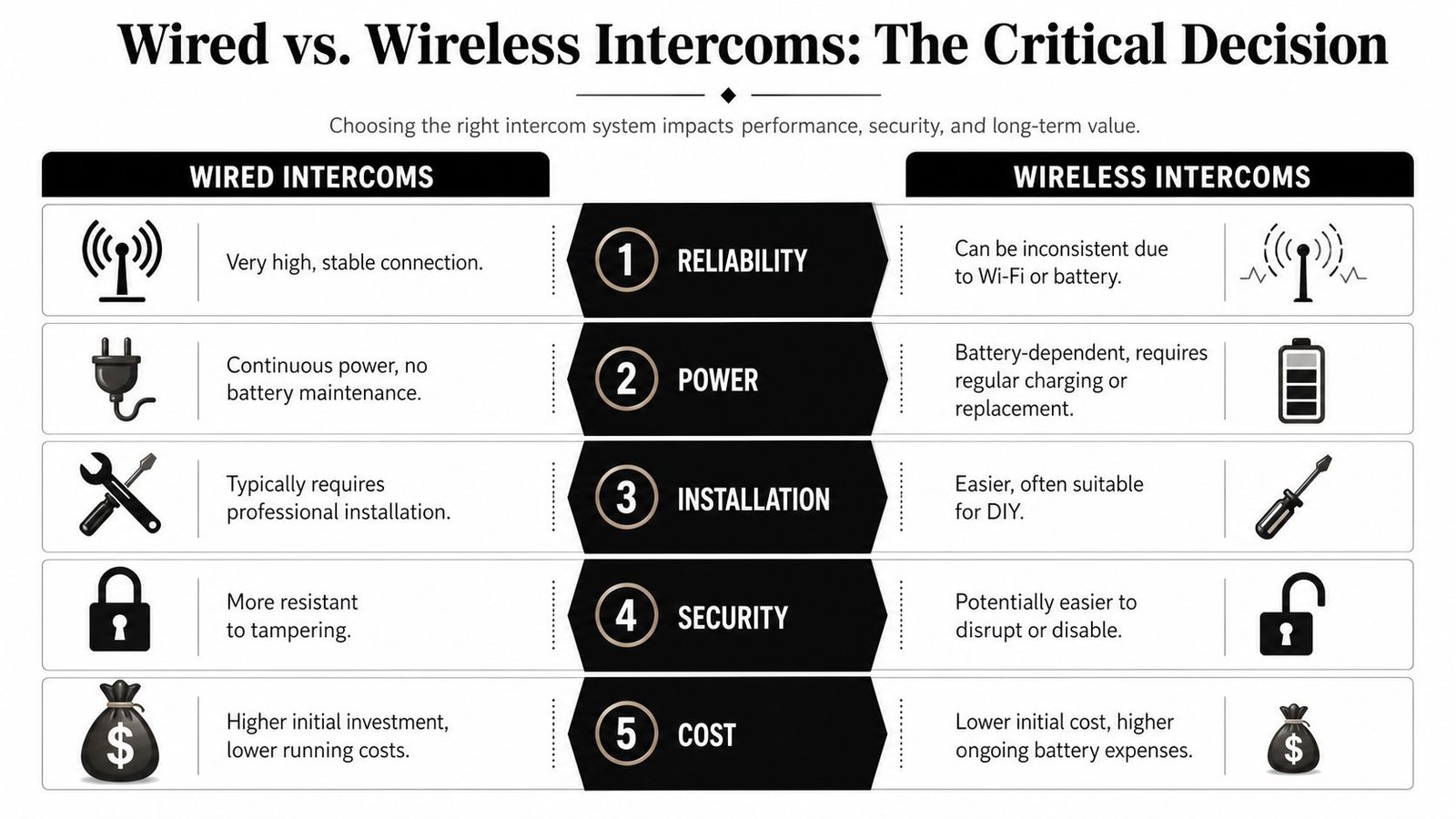
If you only make one careful decision, make it here. The wired versus wireless question affects reliability, security, maintenance, and how often the system annoys you six months after installation.
Wireless units dominate consumer searches because they're easy to buy and easy to fit. That doesn't make them the right answer for every home.
Where wireless works well
A wireless intercom can be a perfectly reasonable choice in a smaller home with strong Wi-Fi at the entrance, a short distance between router and door, and modest expectations around gate control or wider integration.
It suits people who want a lighter-touch install and are happy managing batteries, app settings, and the occasional reconnect. For a basic front-door camera with call notifications, that may be enough.
The weak point is consistency. Consumer wireless products often work well right up until the moment signal quality dips, the battery drops at the wrong time, or the app notification arrives late. Those problems aren't constant, but they're exactly the sort of problems that matter when the device is tied to security.
Here's a useful demonstration of the kind of products many homeowners first look at:
Why wired still wins for serious reliability
For homes in higher-risk areas, larger properties, or any entrance involving gates and electric locking, wired systems are usually the better engineering choice. They provide stable power and a stable signal path, which removes two of the most common failure points in DIY setups.
That matters even more when security is the priority rather than novelty. Security guidance for higher-risk areas often recommends BS EN 50131-compliant hardwired systems, and 68% of UK residential burglaries involve forced entry, where wireless signals can potentially be jammed or bypassed. Hardwired installations reduce that exposure.
There's also a practical installation point many homeowners overlook. In retrofit work, 2-wire digital systems can be very useful because they carry power and digital video over two non-polarised wires instead of needing separate legacy-style cabling. That approach can reduce disruption, and Fermax states it cuts installation complexity and material costs by approximately 40% in retrofit scenarios.
On most homes I'd rather fit one well-designed wired intercom than replace two or three disappointing wireless ones over time.
Wired vs. Wireless Video Intercom Comparison
| Feature | Wired System (Professional Grade) | Wireless System (DIY Grade) |
|---|---|---|
| Reliability | Stable connection and consistent response | Depends heavily on Wi-Fi quality and battery condition |
| Power | Continuous power from the installed system | Battery-based or plug-in, with more user maintenance |
| Installation | Usually needs proper planning and professional fitting | Quicker to deploy in simple locations |
| Security | Better resistance to tampering and signal-related disruption | More exposed to signal issues and casual workarounds |
| Integration | Better for gates, locks, CCTV, and indoor stations | Often strongest as a standalone front-door product |
| Long-term ownership | Less day-to-day upkeep once installed | More ongoing attention from the homeowner |
Budgeting Installation and Ongoing Care
The cheapest quote rarely gives the best result. With intercoms, you're paying for three things at once: the hardware, the installation standard, and how dependable the system will be after the installer leaves.
A lot of homeowners focus too much on the outdoor unit and not enough on the total job. Cable route, power arrangement, monitor position, lock compatibility, weather protection, and commissioning all matter. If any of those are done badly, even good equipment feels poor.
What you're actually paying for
A proper installation usually starts with a site survey. The installer should check the entrance layout, viewing angles, cable paths, current power availability, and whether the intercom needs to trigger a gate, strike lock, or both.
That planning stage prevents the common mistakes:
- Poor monitor placement: The indoor screen ends up somewhere awkward, so nobody uses it.
- Wrong camera height: Visitors are visible, but parcels, children, or side approach paths aren't.
- Weak lock integration: The intercom talks nicely but doesn't release the door or gate cleanly.
- No allowance for future expansion: Adding CCTV or access control later becomes harder than it should be.
If you're trying to sense-check likely spend before speaking to an installer, this guide to security system costs in the UK is a useful starting point. The exact figure depends heavily on whether you're fitting a simple door station or a more integrated entry system.
Power outage planning matters more than most buyers realise
This issue gets brushed past on a lot of product pages. It shouldn't. If the mains fails, what still works, for how long, and what happens to entry control?
That's not a niche concern. A 2025 National Cyber Security Centre survey found that 42% of UK homeowners rank security during a power outage as a top concern, and professionally installed systems can integrate battery backup with 24/7 monitored intruder alarms. In real terms, that means you shouldn't accept vague wording like “battery supported” without knowing what remains operational.
Ask direct questions:
- Does the outdoor unit stay live during a power cut?
- Will the indoor monitor still function?
- What happens to the electric strike, maglock, or gate release?
- Is there a backup supply, and does it support alarm integration?
If an installer can't explain power-failure behaviour clearly, they haven't finished designing the system.
Ongoing care that keeps the system dependable
Wired systems tend to need less hands-on attention than battery-powered wireless units, but they still benefit from periodic checks. The camera lens gets dirty, gate hardware drifts out of alignment, and mobile app permissions can change after phone updates.
Routine care is straightforward if it's built into the handover:
- Clean the lens and call button area: Dirt and spider webs can affect night performance.
- Test audio and release functions: Make sure speech is clear and the entry device triggers first time.
- Review user access: Remove old permissions and confirm current users still have the right level of control.
- Check recording and notifications: If the system stores footage or sends calls to phones, confirm both still work as intended.
Your Next Steps to a Secure Home in South Wales
By this point, the key distinction should be clear. A video intercom system for home use can be either a handy convenience product or a serious part of your entrance security. The difference comes down to the design choices you make up front.
If your property is compact, your Wi-Fi is strong, and you only want basic caller screening, a simpler setup may do the job. If you need dependable entry control, clearer resilience, better integration, and fewer weak points, the answer is usually a professionally designed wired or hybrid system.
That matters in South Wales because homes here aren't all built to one pattern. Some have exposed front doors close to the pavement. Others have side access, gates, sloping approaches, detached garages, or longer drives where off-the-shelf consumer advice quickly falls apart.
A local specialist should look at the actual entrance, not just send over a product link. They should ask how you use the property, who needs access, what should happen during a power outage, and whether the intercom may later need to tie into CCTV, alarms, or gate automation.
For homeowners comparing providers, it's sensible to start with established security companies in South Wales that understand the local housing stock and can install a system that matches the property rather than forcing the property to suit the kit.
The best next step is simple. Get the entrance assessed properly, decide whether wired or wireless makes sense for your layout, and make sure the system is designed around real use, not just online features.
If you want a professionally designed video intercom system for home security from Wisenet Security Ltd, the team can help you assess the right setup for your property in South Wales or the South West. They install integrated security systems including intercoms, CCTV, intruder alarms, access control, and gate automation, with specific advice based on how your entrance works day to day.