SafeContractor Accredited: What It Means for Your Project
You need a contractor quickly. The site needs CCTV, alarms, access control, or fire detection. Staff are on site, tenants are asking for timescales, and the building can't stay exposed for long. Then the awkward question lands. How do you know the contractor is safe, organised, and competent, rather than just sounding convincing on the phone?
That concern is reasonable. A poor installation doesn't just create snags. It can leave cable routes unsafe, put engineers at risk while working at height, delay handover, and create liability for the client who appointed them. In security work, those risks are practical, not theoretical. Installers may be drilling into occupied premises, working near live services, accessing shared areas, and setting up systems that people rely on when something goes wrong.
SafeContractor matters. Properly understood, it isn't a marketing badge and it isn't a self-issued claim. It's an independent check on how a business manages health and safety across its operations. For clients, that gives a more dependable way to assess a contractor before work starts. For contractors, it signals that the company has put real systems in place rather than relying on informal habits and verbal assurances.
The part many buyers miss is that SafeContractor now also has relevance beyond basic site safety. In modern tendering, especially where public bodies and larger organisations are involved, sustainability and responsible business practice matter alongside health and safety. That's particularly important in security installation, where clients increasingly want suppliers who look competent today and credible long term.
Table of Contents
- Introduction
- What SafeContractor Accreditation Really Means
- The Tangible Benefits for Clients and Contractors
- How SafeContractor Differs from CHAS and Other Schemes
- Why This Matters for Your Security System Installation
- Verifying a Contractor and Practical Next Steps
- Frequently Asked Questions About SafeContractor
- Is SafeContractor a legal requirement in the UK
- Does SafeContractor mean a contractor is definitely the best choice
- How long does accreditation last
- Is SafeContractor relevant for residential work or only big commercial jobs
- Does the sustainability part matter for security contractors
- Should I choose SafeContractor over all other schemes automatically
Introduction
A facilities manager arranging a security upgrade usually isn't short of quotes. They're short of certainty. One firm says it has years of experience. Another promises a fast install. A third has a polished website and a long list of services. None of that, on its own, tells you whether the company runs safe jobs, keeps proper records, trains its people, or manages risk in a way that protects your site.
Residential clients face a similar problem. If you're inviting engineers into your home to fit alarms, cameras, or access equipment, you want more than reassurance over the phone. You want evidence that the business takes safety seriously, works in a controlled way, and won't cut corners because the job looks straightforward.
In practice, that's where many projects go wrong. The weak point often isn't the equipment. It's the contractor selection process. Buyers can end up comparing price and product spec while overlooking the management standards behind the work. That leaves too much to trust.
A reliable contractor should be able to show how they work, not just tell you they work well.
SafeContractor helps close that gap. It gives clients a recognised way to judge whether a contractor's health and safety arrangements have been independently reviewed. That matters on larger commercial jobs, but it also matters on smaller installations where access, drilling, ladders, electrics, and occupied spaces still create real exposure.
There's another layer now. SafeContractor isn't only relevant to accident prevention. It can also support how contractors present their sustainability and responsible business approach in tendering. For buyers choosing a security installer, that combination tells you something important. You're not just looking at whether a company can fit a system. You're looking at whether it behaves like a professional partner.
What SafeContractor Accreditation Really Means
It is an independent assessment, not a purchased logo
SafeContractor accreditation is a verified health and safety compliance scheme that independently assesses contractors' policies and operational arrangements. It isn't self-declared and requires an audit by a qualified Alcumus auditor, which is one reason major UK clients accept the certificate as proof of competency in health and safety practice, as outlined in this SafeContractor accreditation overview.
A simple way to think about it is this. It works a bit like an MOT for a business's safety processes. The point isn't that a company once said the right things. The point is that someone independent reviewed whether the systems behind the work are there and are being maintained.
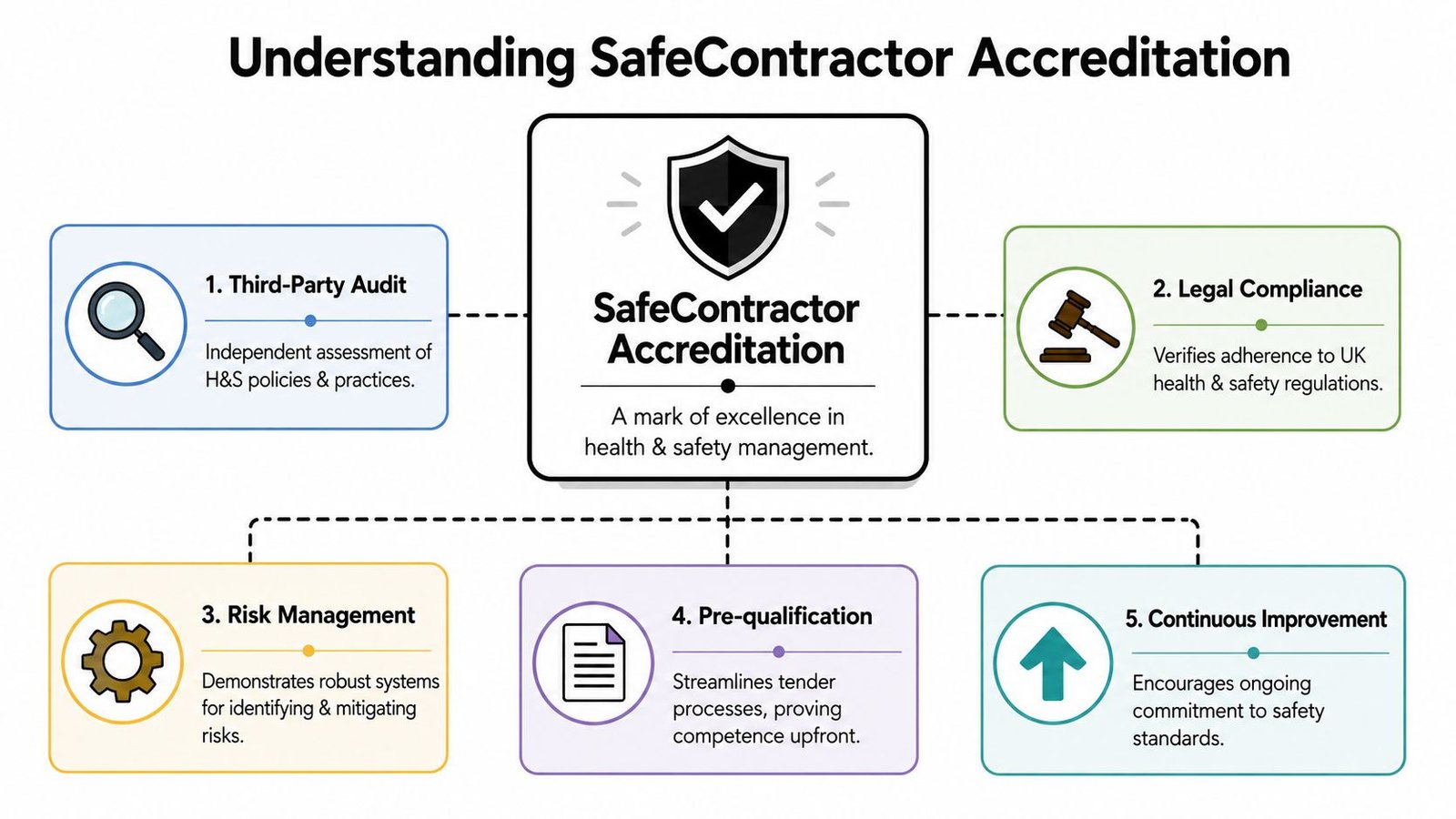
That distinction matters. Plenty of firms can put safety statements on a website. Fewer can back them up with documented processes, evidence, and audit-ready records. When a contractor is SafeContractor accredited, the claim has been tested against a recognised standard.
What gets checked in practice
The assessment is practical. It focuses on whether the business has the right structure in place to manage work safely and consistently. That usually means clients can expect evidence around areas such as:
- Health and safety policy: A current policy that reflects the business and the type of work it carries out.
- Risk assessment controls: Evidence that hazards are identified and managed before work starts.
- Training records: Proof that staff have the right training for the tasks they perform.
- Operational arrangements: Procedures for day-to-day delivery, supervision, and incident handling.
- Supporting documents: Records that show the company's written systems are real and in use.
A contractor without those basics can still appear competent in a sales meeting. The problem only shows up later, usually when access is poorly controlled, permits are missed, equipment is used without proper planning, or a near miss exposes how little structure sits behind the job.
Practical rule: Don't treat accreditation as a guarantee of perfect workmanship. Treat it as strong evidence that the company takes compliance and risk management seriously before your project begins.
For clients, that means less guesswork in procurement. For contractors, it sets a clear bar. If the business wants to be taken seriously, especially for commercial security work, it needs more than technical skill. It needs documented control.
The Tangible Benefits for Clients and Contractors
A recognised accreditation only has value if it changes outcomes on real projects. SafeContractor does that by making contractor vetting faster and more credible at the point where clients are deciding who gets access to the site.

For Clients
For buyers, the first benefit is confidence. You're not relying only on a promise that the contractor is compliant. You're choosing a business that has been through independent review.
That makes procurement cleaner. It also helps when the work involves live environments such as offices, apartment blocks, warehouses, schools, retail units, or shared access areas where poor site control affects more than the installer.
Clients usually see the value in four ways:
- Better pre-qualification: SafeContractor helps screen out firms that can't evidence proper systems.
- Lower procurement friction: Internal teams have a recognised benchmark when approving contractors.
- Clearer accountability: The contractor has already had to organise its policies and records.
- More confidence on occupied sites: That matters when engineers are working around staff, visitors, residents, or customers.
The commercial side is important too. The SafeContractor database is used by over 370 major clients in the UK, including almost one-third of FTSE 100 companies, which is one reason accredited firms are often better placed to access higher-value opportunities, according to BeaconRisk's SafeContractor summary.
For Contractors
For contractors, the main advantage is credibility that scales. It's one thing to tell a local client you take safety seriously. It's another to show a recognised certificate that procurement teams and supply chain managers already understand.
That can shorten early-stage conversations. It can also help a contractor avoid being ruled out before technical competence is even considered. On larger jobs, that's a common failure point. A firm may be fully capable of doing the installation but loses the opportunity because its compliance profile doesn't satisfy the buyer.
A short explainer is useful if you want to see how these accreditations are commonly positioned in procurement discussions:
In practical terms, accredited contractors tend to present better. Their paperwork is more organised, their onboarding is easier, and clients spend less time chasing basics.
Buyers don't only compare price. They compare risk, responsiveness, and whether the contractor looks ready to work within a controlled environment.
That's why SafeContractor often strengthens the relationship on both sides. The client gets reassurance. The contractor gets a more credible route into serious work.
How SafeContractor Differs from CHAS and Other Schemes
One of the most common points of confusion is whether SafeContractor, CHAS, and SMAS are effectively the same thing. They overlap in purpose, but they aren't identical in how buyers use them or how contractors talk about them.
Comparison of UK Safety Accreditation Schemes
| Feature | SafeContractor | CHAS (Contractors Health and Safety Assessment Scheme) | SMAS (Safety Management Advisory Services) |
|---|---|---|---|
| Primary focus | Contractor health and safety compliance, with added relevance in wider supply chain assurance | Health and safety pre-qualification widely recognised in contractor vetting | Health and safety assessment for contractor pre-qualification |
| Assessment style | Independent assessment of policies, qualifications, and operational arrangements | Formal health and safety assessment used for procurement screening | Formal health and safety assessment used in pre-qualification |
| How clients tend to use it | To confirm a contractor meets a recognised benchmark and is suitable for tender lists or approved supplier review | To satisfy pre-qualification requirements and contractor checks | To evidence health and safety competence during supplier selection |
| Typical buyer perception | Strong fit where clients want a known certificate accepted by major organisations | Commonly requested in construction-led procurement environments | Often used where buyers want another recognised route to demonstrate competence |
| Best way to view it | A recognised independent compliance check with strong commercial signalling | A recognised safety assessment route | A recognised safety assessment route |
What the differences mean in practice
For many clients, these schemes sit in the same decision category. They help answer a procurement question: has this contractor been assessed by a recognised external body rather than asserting compliance on its own?
Where the difference shows up is in buyer preference. Some organisations habitually ask for CHAS. Others prefer SafeContractor because it is already embedded in their supply chain process. Others will accept several routes as long as the contractor can demonstrate recognised compliance.
That's why clients shouldn't reduce the conversation to logo spotting. The better question is whether the accreditation matches the buyer's own procurement expectations and whether the contractor can produce the supporting detail behind it.
For contractors, the practical lesson is simple. Don't assume one scheme automatically solves every procurement hurdle. Some clients will accept equivalence. Some will still ask for their preferred route. In that sense, accreditation helps, but it doesn't replace reading the tender requirements properly.
There's also a wider trust issue at play in security and fire work. Buyers often look beyond one badge and check the full compliance picture, including relevant alarm approvals and installation standards. If you're comparing accreditations and wondering how scheme recognition fits into alarm-specific assurance, this guide on SSAIB alarm meaning is a useful companion.
The strongest contractors don't argue that one logo should win the job. They show a consistent compliance culture across safety, technical standards, and documentation.
That's the distinction. SafeContractor is valuable, but it works best when it forms part of a broader pattern of professional discipline.
Why This Matters for Your Security System Installation
Security installation work often looks low risk to people outside the trade. It isn't. A straightforward CCTV or alarm project can involve ladders, access equipment, drilling through different building materials, low-voltage electrical work, lone working, movement through occupied premises, and interaction with gates, doors, entry systems, and fire routes.
Where installation risk actually sits
That matters because the hazards aren't always dramatic. They're usually routine. An engineer fixing cameras at height in a stairwell needs the job planned properly. A technician routing cables through a retail unit needs to control the work area so staff and visitors aren't exposed. An access control upgrade at a multi-tenant building needs coordination so security isn't weakened during the changeover.
The same applies to system design and handover. Good contractors don't only install hardware. They think about user safety, call points, emergency access, equipment placement, power isolation, and whether the site remains workable during the install.
For security projects, a safe contractor also tends to be a better organised contractor. That often shows up in the details:
- Site surveys are more disciplined: Cable routes, fixing points, access restrictions, and user impact are thought through early.
- Install days run more cleanly: Tools, ladders, and materials are managed with less disruption.
- Documentation is stronger: Handover information, maintenance records, and system notes are more likely to be complete.
- Coordination improves: Facilities teams, tenants, and residents get clearer communication about what's happening.
If you're assessing the technical side of intruder alarm standards alongside contractor credentials, this explanation of what EN50131 means is worth reading.
Why the sustainability element now matters too
This is the area many guides miss. Modern tenders increasingly look beyond basic health and safety. They also ask contractors to demonstrate responsible business practice, including sustainability elements linked to PAS 91. That has become harder to ignore in public and larger commercial procurement.
According to this discussion of SafeContractor and PAS 91 requirements, over 480 UK clients now require verification of both health and safety and sustainability, while 60% of SMEs struggle with the sustainability criteria. For security contractors working in areas such as Cardiff and Bristol, that matters because public sector and larger institutional buyers increasingly expect ESG alignment as part of supplier selection.
For clients, this changes what SafeContractor can signal. It no longer points only to accident prevention and site control. It can also indicate that the contractor is taking a more structured, future-facing approach to how it operates.
That matters in security because buyers are often appointing a supplier for more than one visit. They want a firm that can install, maintain, upgrade, and support systems over time. A contractor that can speak credibly about sustainability and supply chain responsibility usually looks more stable in tendering.
If your work touches public procurement, these public sector security service insights give useful context on what buyers tend to look for in the security sector.
A contractor that can satisfy both operational safety and wider tender expectations is often easier to approve, easier to keep on the supplier list, and easier to trust with repeat work.
Verifying a Contractor and Practical Next Steps
If a contractor says it is SafeContractor accredited, checking that claim should be routine. It doesn't need to become a long compliance exercise, but it should be part of your buying process.
How to check a contractor properly
Start with the basics. Ask the company for its accreditation details and check whether the status is current. A certificate that has lapsed tells you something important about how the business manages renewals and compliance administration.
The application and renewal side is structured. Contractors complete a detailed online questionnaire, submit evidence for review, and the certificate is valid for exactly one year, with annual renewal required to remain listed in the public database used by hiring clients, as explained in this guide to achieving SafeContractor accreditation.
Use that information as a checklist:
- Confirm the company name matches the legal trading entity you're appointing.
- Check the certificate date so you know it's still valid.
- Ask what work activities are covered if your job is specialised.
- Request supporting documents where needed if the project involves higher site risk or sensitive premises.
What clients and contractors should do next
For clients, the practical move is to build verification into your shortlist process. If you're comparing local providers for alarms, CCTV, access control, or fire systems, start with companies that can evidence compliance properly. Reviewing established security companies in Cardiff is one sensible way to benchmark what professional local provision looks like.
For contractors, the lesson is that accreditation should support wider due diligence readiness. Larger buyers often assess more than site safety, especially where digital resilience and supplier oversight are in scope. This overview of DORA and NIS2 compliance is a useful reference if you're looking at broader vendor assurance expectations.
Frequently Asked Questions About SafeContractor
Is SafeContractor a legal requirement in the UK
No. It isn't a legal requirement in itself. The practical reality is that many clients still expect recognised evidence that a contractor is competent and properly organised, especially for commercial work and formal procurement.
Does SafeContractor mean a contractor is definitely the best choice
No single accreditation should be the only decision factor. It shows that the contractor has been independently assessed against a recognised benchmark. You should still check whether the firm has the right technical experience, suitable insurance, clear scope control, and a sensible approach to your type of site.
How long does accreditation last
The certificate lasts for one year. After that, the contractor needs to renew it to maintain accredited status and remain listed for client searches.
Is SafeContractor relevant for residential work or only big commercial jobs
It's relevant to both. Residential jobs may be smaller, but they still involve access to the property, safe installation practice, electrical awareness, and clear working procedures. Accreditation can give homeowners extra confidence that the business is managed properly.
Does the sustainability part matter for security contractors
Yes, increasingly it does. It matters most where tenders ask for wider responsible business evidence rather than pure health and safety. That tends to affect public sector and larger organisation procurement more directly, but the expectation is spreading.
Should I choose SafeContractor over all other schemes automatically
Not automatically. You should choose a contractor whose accreditation and technical approvals match the project requirements and the buyer's own procurement rules. In some cases, another recognised scheme may also satisfy the need.
If you're looking for a security installer that combines recognised compliance with practical experience across CCTV, intruder alarms, access control, fire alarms, intercoms, and gate automation, Wisenet Security Ltd serves clients across South Wales and the South West with individualized systems, professional installation, and ongoing support.