Gate Automation Specialists: 2026 Guide
You've inherited a property with an automated gate that opens slowly, stops halfway, or reverses for no obvious reason. The original installer is unreachable, the paperwork is missing, and nobody can say when the safety devices were last tested. That's a common position for homeowners, landlords, schools, managing agents, and businesses across South Wales and the South West.
The motor is rarely the whole problem. A powered gate combines moving machinery, electrical controls, access decisions, vehicle movement, and public safety. Choosing gate automation specialists means choosing someone who can assess that complete system, not attach a drive unit and hand you a remote.
Table of Contents
- The True Role of Gate Automation Specialists
- Choosing the Right Gate Mechanism for Your Property
- Navigating UK Safety Standards and Legal Duties
- Integrating Gates with CCTV and Access Control
- Your Installer Selection Checklist and Key Questions
- The Value of Local Expertise and Ongoing Support
The True Role of Gate Automation Specialists
A sound gate can become a liability after automation if nobody checks how its structure, movement, and surroundings work together. Worn hinges, shifting posts, obstructed tracks, poor visibility, and trapping points can all turn a routine entrance into a safety risk. A gate automation specialist assesses those conditions before recommending an operator. A general fitter often starts with the motor and treats the gate as an afterthought.
The first job is a documented site survey. The technician should inspect the gate leaf or sliding panel, hinges, rollers, guide tracks, stops, posts, foundations, pedestrian routes, and vehicle sightlines. They should also record the gate's weight, movement, wind exposure, usage pattern, and approach routes. A large solid swing gate creates different mechanical demands from a lightweight open-frame design, so the specification must follow the site rather than a standard product package.
Engineering comes before the motor
A motor cannot correct a gate that drags, drops, twists, or catches. Excessive resistance increases wear, places stress on the drive system, and can prevent safety controls from responding as intended.
The specialist should therefore:
- Check mechanical movement: The gate must travel smoothly and reach its intended open and closed positions without excessive drive force.
- Assess structural condition: Posts, hinges, rollers, tracks, stops, and brackets must support reliable movement throughout the system's expected working life.
- Review environmental exposure: Wind loading matters for broad, solid leaves and exposed entrances. The operator must match the physical conditions, not just the gate's appearance.
- Plan the electrical installation: Control equipment, cabling, power supplies, isolation, warning devices, and safety circuits need suitable protection and positioning.
- Map user movement: Pedestrians, children, visitors, delivery drivers, and employees may approach and use the entrance in different ways.
Practical rule: If the gate does not move properly by hand, correct the mechanical fault before adding automation.
Safety must be designed into the layout. The survey should identify hinge areas, closing edges, posts, walls, ground-level gaps, and every other location where someone could be trapped or crushed. Detection, physical protection, and controlled movement must work as one system. The owner should ask the installer to explain how each identified hazard is controlled, rather than accepting a generic motor specification.
Commissioning separates professionals from kit fitters
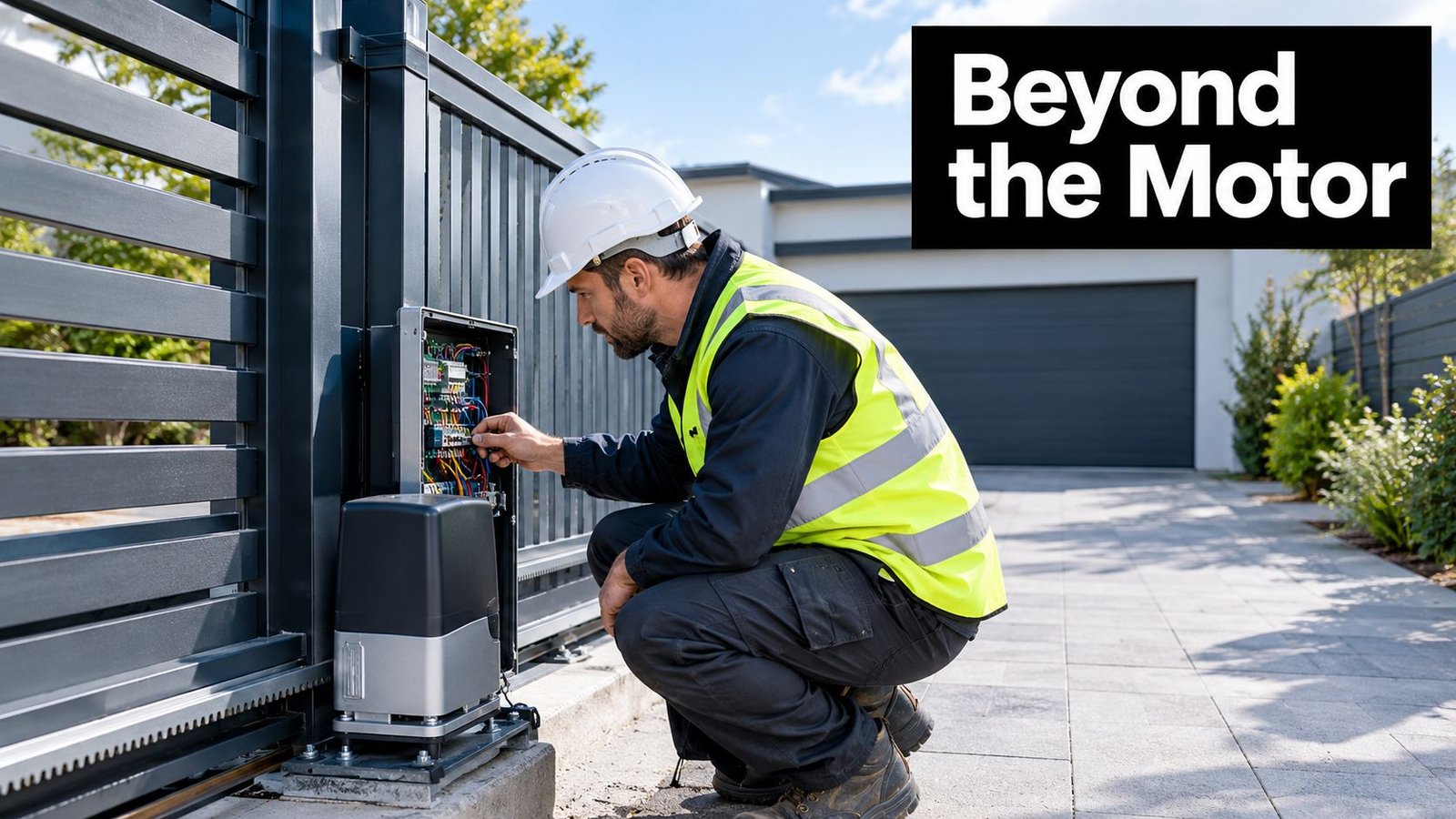
Installation ends only after commissioning, adjustment, and recorded testing. The technician should check detection zones, safety edges, stopping and reversing behaviour, manual release arrangements, warning equipment, controls, and the gate's interaction with connected access systems.
That handover matters because the owner inherits the ongoing duty to keep the installation safe. The specialist should provide usable documentation and explain normal operation, power-failure release, fault reporting, inspection routines, and maintenance requirements. Poor records create a compliance gap when the installer leaves, especially on rented, commercial, or shared premises.
The finished system should be a controlled, testable machine, not an impressive entrance with unknown risks concealed inside the control cabinet. Choose an installer who can prove what was surveyed, what was tested, and what the owner must maintain.
Choosing the Right Gate Mechanism for Your Property
The right mechanism depends on the space available, the gate's construction, traffic levels, gradients, wind exposure, and the security outcome you need. There's no universal “best” motor. A system that performs well on a compact domestic driveway may be a poor choice for a busy car park or logistics entrance.
Sliding gates
Sliding gates travel laterally along a track or cantilever arrangement. They suit entrances where a clear run-back area exists beside the opening, making them useful for driveways with limited space in front of or behind the gate. They can also work well where a swing leaf would interfere with parked vehicles, a public footway, or a sloping approach.
Their weakness is dependence on the travel path. Leaves, gravel, ice, mud, vegetation, damaged rollers, or a misaligned track can interrupt operation. A specialist should inspect drainage, ground conditions, track protection, end stops, and the area behind the gate before specifying the operator.
Swing gates
Swing gates open inward or outward on hinges. They're often suitable for residential entrances and formal driveways where there's enough clear space for the leaves to move safely. They can preserve a traditional appearance and may suit existing masonry piers or ornamental gate designs.
Wind exposure becomes more important as the gate presents a broad surface to the weather. A heavy or solid leaf can place greater demands on hinges, brackets, foundations, and operators. The specialist must also check the opening arc for walls, parked cars, pedestrians, and vehicle turning movements.
Automated barriers
Barrier arms control vehicle access without creating a full-height gate. They're commonly used for car parks, managed residential entrances, business premises, and controlled vehicle lanes where rapid passage and clear visibility matter more than perimeter closure.
A barrier usually doesn't provide the same physical resistance to unauthorised pedestrian entry as a full gate. It should therefore be selected as part of a wider access-control design, with appropriate vehicle detection, reader placement, warning signals, and camera coverage.
| Mechanism Type | Space Required | Ideal Use Case | Wind Resistance |
|---|---|---|---|
| Sliding gate | Clear lateral run-back space | Driveways, estates, commercial entrances, and sites where swing arcs are impractical | Often favourable when the panel is supported correctly, but exposed surfaces and poor tracks still matter |
| Swing gate | Clear opening arc for each leaf | Homes, formal entrances, and sites with suitable hinge posts and approach space | More sensitive to broad, solid leaves and exposed positions |
| Barrier | Controlled vehicle lane and safe arm movement | Car parks, managed entrances, retail premises, and logistics access points | Depends on arm design, support structure, and exposure |
For a broader assessment of readers, credentials, vehicle identification, and control methods, use this gate access control buying guide. The access method must match the mechanism. A keypad positioned where drivers can't safely reach it, or a reader placed outside a camera's useful view, creates inconvenience and weakens control.
Before buying a kit, confirm the gate's condition, clearance, power route, control location, emergency release method, and expected traffic pattern. The equipment should follow the site survey. A useful starting point for understanding available components is this guide to a gate automation kit, but a product page can't replace a site-specific design.
Navigating UK Safety Standards and Legal Duties
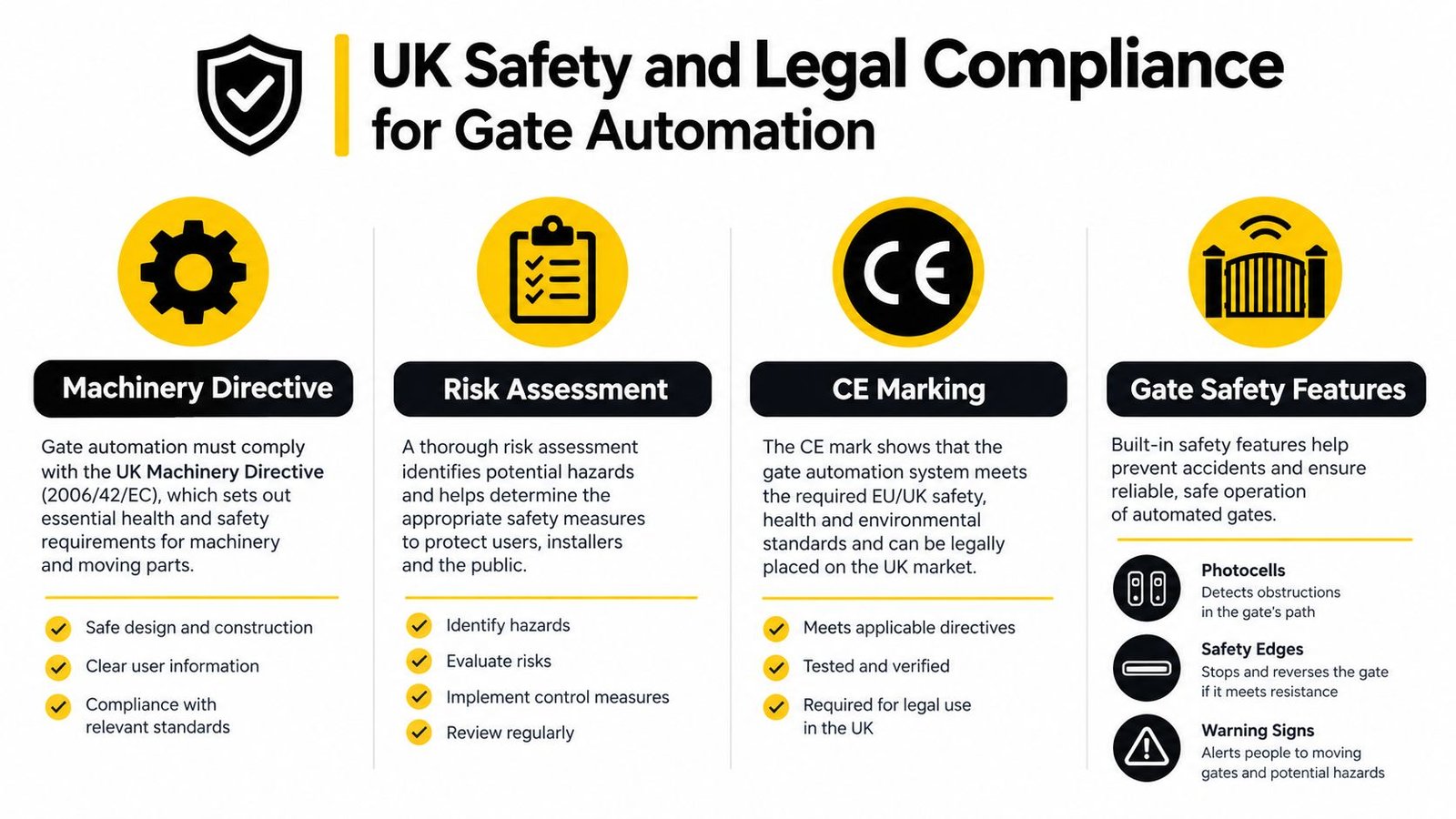
Powered gates aren't just domestic accessories. In the UK, they've been regulated as machinery since the Supply of Machinery (Safety) Regulations 2008 took effect, so gate automation specialists must design, install, and place systems into service in line with product-safety duties. The Health and Safety Executive's powered-gate responsibilities states that, when first supplied or first put into service, powered gates are subject to those regulations.
That has a direct consequence for the buyer. You should receive a Declaration of Conformity and English user instructions. If the installer can't explain the machine's safety design or won't provide the required documentation, treat that as a serious warning sign.
The safety standards have practical consequences
BS EN 12453:2017 addresses safety in use, while BS EN 12604:2017+A1:2020 addresses mechanical aspects. These standards aren't paperwork references. They influence the gate's geometry, protective devices, force settings, mechanical construction, and commissioning process.
A safe design should prevent hazardous contact through a combination of measures, including:
- Photocells or light curtains: These detect an obstruction without requiring physical contact.
- Pressure-sensitive edges: These respond when contact occurs at protected edges or zones.
- Mechanical control: Posts, hinges, tracks, gaps, stops, and moving leaves must be designed to reduce trapping and crushing hazards.
- Force testing: The closing forces need to be tested, assessed, and recorded rather than assumed to be safe because the motor is low-powered.
For workplace-linked sites, including car parks and private roads, the Workplace (Health, Safety and Welfare) Regulations 1992 add duties around maintenance under Regulation 5 and safety under Regulation 18. The HSE also notes that premises managed by businesses, landlords, and managing agents of residential complexes must meet the general safety duty under the Health and Safety at Work etc Act 1974.
Handover doesn't end the owner's responsibility
After installation, the property owner or site operator becomes the practical duty holder responsible for keeping the equipment safe. HSE guidance treats powered doors and gates as work equipment in workplaces. They must be kept safe, maintained, and inspected at suitable intervals by a competent person.
The difficult point is that the law doesn't hand every owner a simple universal service timetable. The appropriate inspection and maintenance arrangements depend on the equipment, use, environment, foreseeable risks, and site responsibilities. Owners should keep records of inspections, force tests, faults, repairs, safety-device checks, and remedial actions.
Owner's responsibility: If nobody can show what was tested, when it was tested, and what happened after a fault was found, the site has a compliance problem even if the gate still opens.
Integrating Gates with CCTV and Access Control
A gate should never be treated as an isolated motor if it controls access to people, vehicles, homes, stock, or shared premises. The stronger approach makes the entrance a coordinated security point. The gate detects or receives a request, the access system decides whether the request is valid, CCTV provides visual context, and the operator moves only when the control logic permits it.
Start with the access decision
Different sites need different credentials. A private home may use remotes, an intercom, or a keypad. A multi-tenant building may require individually managed fobs and a way to remove access when occupancy changes. A commercial site may need user logs, scheduled permissions, vehicle tags, or integration with parking procedures.
The reader's position matters as much as the reader itself. Drivers should be able to use it without stopping in an unsafe position, opening a vehicle door into traffic, or leaving a blind spot beside the gate. Pedestrian access should be considered separately where people share the entrance with vehicles.
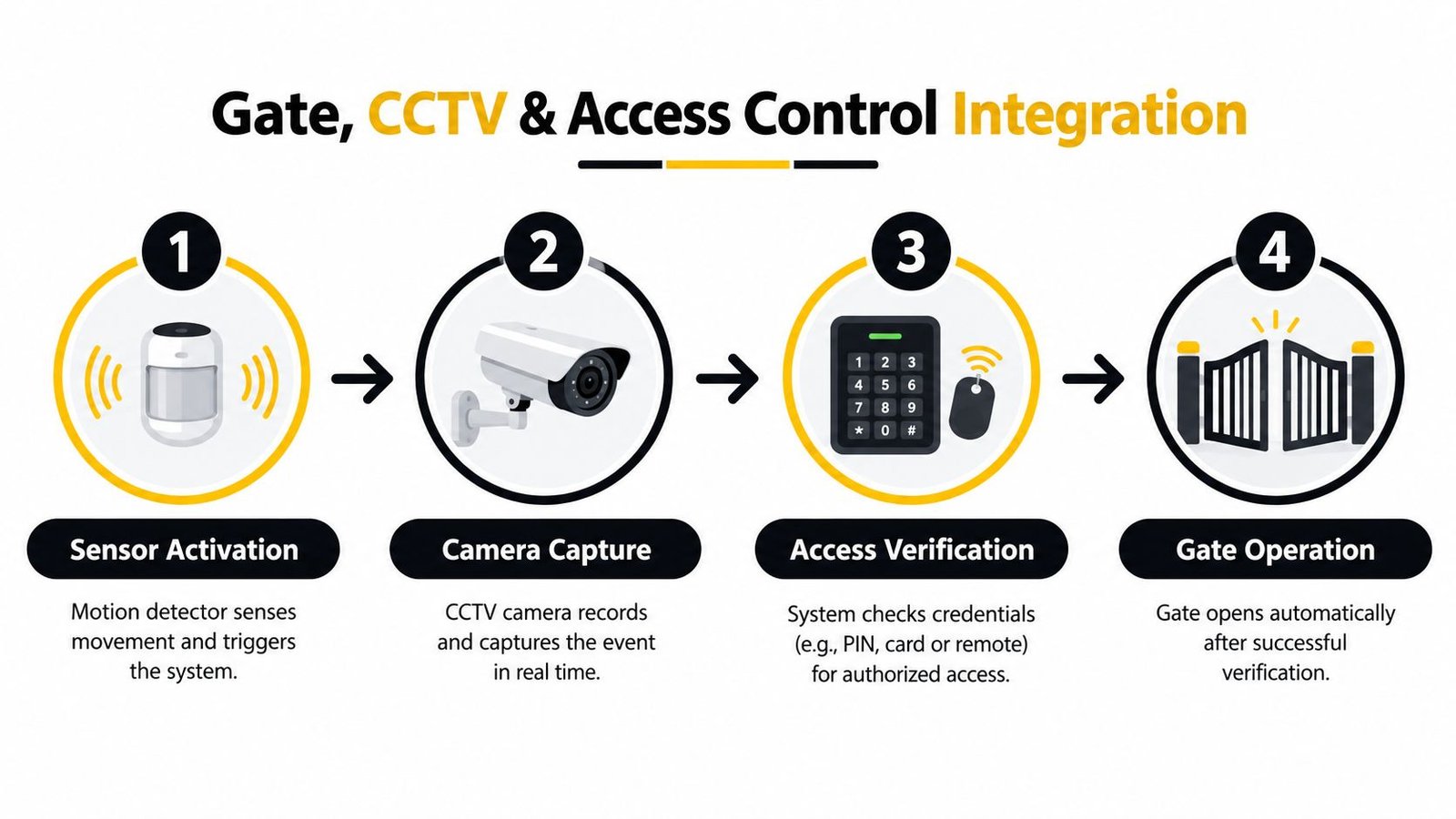
A practical sequence looks like this:
- Detection: A vehicle loop, sensor, credential, or intercom call identifies an access request.
- Verification: The controller checks the credential or allows an authorised user to confirm the visitor.
- Visual review: CCTV shows who or what is at the entrance, especially during remote release.
- Safe operation: The gate opens only when the route is clear and the command is authorised.
- Event recording: The system preserves useful information about access activity and faults.
CCTV adds context, not just footage
A camera can help an operator verify a visitor before releasing a gate, review a vehicle incident, and understand whether a repeated fault is mechanical or caused by obstruction. It shouldn't be positioned as a substitute for photocells, safety edges, force testing, or sound mechanical design. CCTV observes. Safety devices protect movement.
For managers assessing the wider relationship between access permissions, people, procedures, and physical security, this Safety Space guide for managers offers useful context. The same principle applies locally. Technology must support a clear operating process.
For larger premises, consider separate permissions for residents, staff, contractors, visitors, and emergency access. Remote viewing and managed user records can make administration easier, but only if someone owns the process. A gate automation specialist should explain who can add users, remove credentials, review events, release the gate remotely, and respond when connectivity fails.
A properly specified gate access control system becomes more valuable than a standalone opener. The entrance becomes part of the property's security architecture, with safety and authorisation kept distinct but coordinated.
Your Installer Selection Checklist and Key Questions
A low quotation often leaves out the work that makes an automated gate safe and maintainable. Compare the full scope, not only the motor brand or headline figure. Check whether the price includes remedial fabrication, safety equipment, cabling, commissioning, documentation, and future servicing.
Start with responsibility. Ask who will survey the site, design the safety arrangement, commission the system, and support it after handover. The property owner inherits an ongoing duty of care, so vague answers at quotation stage are a reason to choose another contractor.
Ask these questions before signing
- What is wrong with the existing gate, if anything? The survey should identify worn hinges, weak posts, damaged tracks, poor stops, drainage problems, and conflicts with vehicles or pedestrians before an operator is recommended.
- How will you protect crushing and trapping points? Require a clear explanation of the proposed safety devices, mechanical gaps, and gate movement path. As noted earlier, the design must combine detection and physical protection rather than rely on the motor alone.
- How will you verify closing forces? Ask how force testing will be completed against relevant safety requirements, including BS EN 12453, and request the resulting records.
- What documents will I receive? Require the Declaration of Conformity, English user instructions, operating guidance, maintenance information, and commissioning or test records.
- Who owns the maintenance duty after handover? The agreement should state the owner's responsibilities, the installer's service obligations, response arrangements, and what happens when a fault remains unresolved.
- What happens during a power failure? Check the manual release, emergency access plan, battery provisions where specified, and instructions for authorised users.
- How will access control interact with safety systems? A valid credential must not override obstruction detection or safe operating logic. Ask how the system behaves if a keypad, intercom, remote release, or network connection fails.
- What accreditation and insurance do you hold? Ask for current evidence rather than relying on website logos. SafeContractor accreditation can support the assessment, but it does not replace technical questions.
Require the contractor to explain how the installation will be tested in its actual operating conditions, including pedestrian routes, vehicle approaches, visibility, and authorised emergency access. This exposes design gaps that a brief demonstration at the gate may miss.
Watch for these red flags
A contractor who says the gate is safe because the motor is “not very powerful” is avoiding the question. Motor output does not prove that the complete installation is safe. Be cautious if the survey lasts only a few minutes, safety equipment is excluded from the quotation, force testing cannot be explained, or paperwork is promised only after repeated requests.
A maintenance plan that says “annual service” is too vague. It should state what the technician will inspect and record, including mechanical movement, hinges or rollers, tracks, control equipment, safety devices, closing forces, release mechanisms, wiring condition, and changes in site use. Poor maintenance leaves the owner carrying the compliance gap after the installer has left.
Review this gate automation installation service information before comparing quotations. Use the detail to prepare questions, then require every contractor to answer them in writing. That written scope gives you a fair comparison and a record of what the installer agreed to deliver.
The Value of Local Expertise and Ongoing Support
An automated gate can fail at the least convenient time, but the consequences vary by site. At home, you may be locked out or unable to secure the drive. At a business, a failed entrance can disrupt deliveries and staff access. At a managed property, one unresolved safety fault can affect residents, visitors, contractors, and the person responsible for the premises.
A local specialist serving South Wales and the South West can respond with a better understanding of the property's actual operating environment. Cardiff, Bristol, Newport, Swansea, and surrounding areas include exposed driveways, damp conditions, shared developments, commercial car parks, rural approaches, and busy logistics entrances. Those circumstances influence hardware protection, drainage, maintenance, visibility, and emergency access planning.
Look for a partner, not a one-off fitter
The right provider should be able to support the complete entrance system. That may include swing or sliding gate motors, barrier automation, safety sensors and edges, vehicle loop detectors, keypads, fobs, intercoms, vehicle tags, ANPR, CCTV, and parking-management integration. The benefit comes from coherent design and a clear service relationship, not from adding devices without a plan.
Ask whether engineers are DBS checked, whether the company is fully insured, and whether it can provide planned maintenance as well as emergency response. SafeContractor accreditation and established manufacturer relationships can help with due diligence, but you still need to examine the proposed design and documentation.
Wisenet Security Ltd provides gate automation alongside CCTV, access control, intruder alarms, fire systems, and video or audio intercoms for residential and commercial properties across South Wales and the South West. Its stated service includes DBS-checked engineers, SafeContractor accreditation, support for manufacturers such as Hikvision and Paxton, and ongoing maintenance.
A gate is a safety-critical entrance. The installer should still be answerable when the first fault appears, not only when the invoice is issued.
Make the handover process part of the purchase. Keep the Declaration of Conformity, user instructions, force-test records, inspection reports, fault history, and remedial recommendations in one accessible file. Assign responsibility to a named person, especially where a landlord, managing agent, school, business, or residents' organisation controls the property.
The hidden cost of poor installation isn't limited to replacement parts. It includes repeated call-outs, damaged mechanical components, disrupted access, weak audit trails, unsafe operation, and the risk that nobody can demonstrate what happened after a fault was reported. A competent local partner reduces those risks by treating design, commissioning, documentation, and maintenance as one service.
If your automated gate is unreliable, undocumented, or due for a safer access-control upgrade, contact Wisenet Security Ltd for a site-specific assessment covering the gate mechanism, safety devices, CCTV, intercom, and user access. Visit Wisenet Security Ltd to discuss installation, integration, and ongoing maintenance across South Wales and the South West.