Retail Security Systems That Protect Your Business
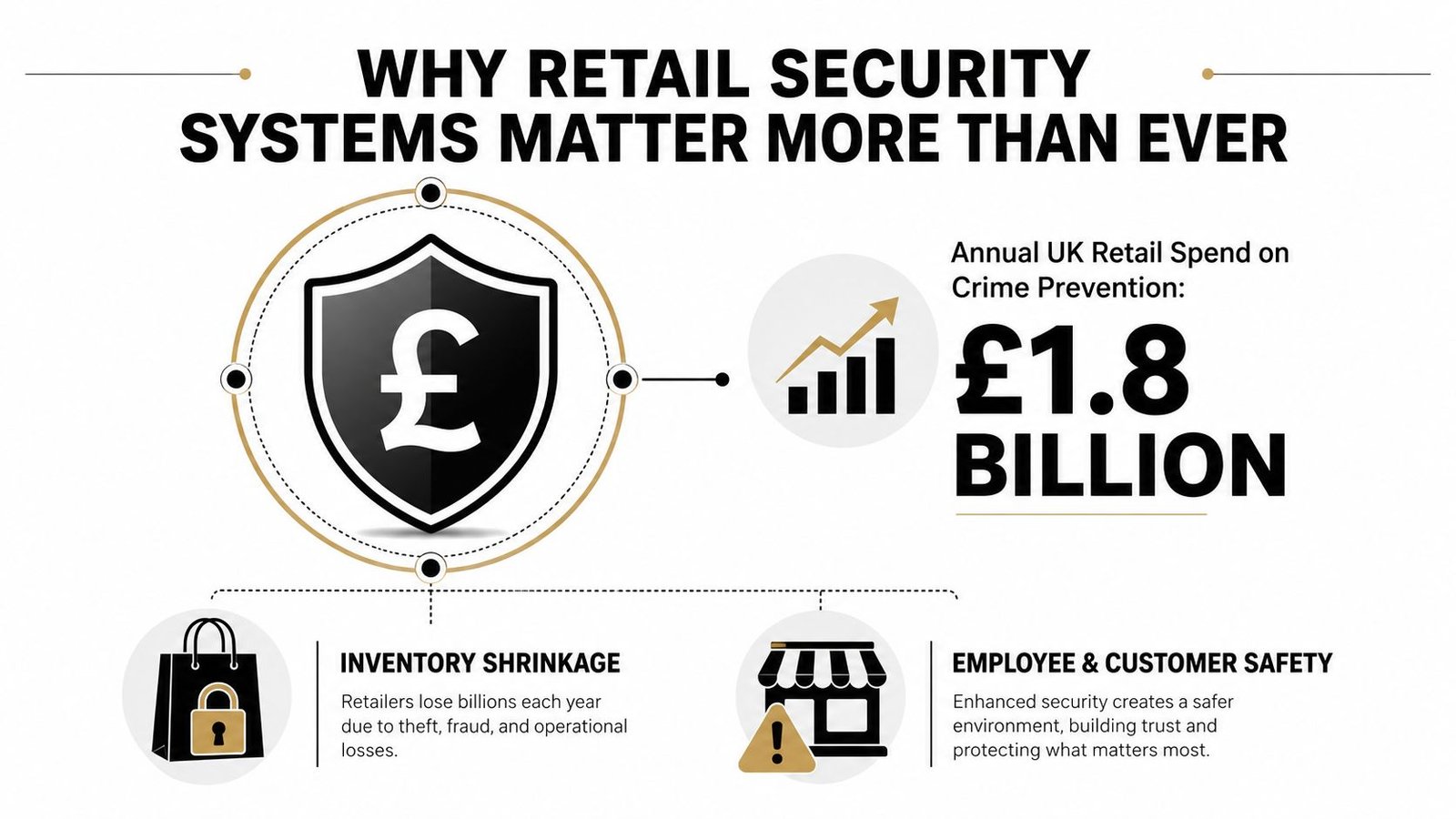
UK retailers spent a record £1.8 billion on crime prevention, up from £1.2 billion the previous year, according to the British Retail Consortium's 2025 Crime and Shrink Benchmark. That figure changes the conversation. Retail security systems are no longer an optional collection of cameras, alarms and warning signs. They're operational infrastructure, and a poorly designed system can cost you stock, staff confidence, evidence and insurance support.
A shop in South Wales doesn't face one neatly contained threat. Theft, abusive behaviour, fire, unauthorised access, payment fraud and compromised security equipment can overlap during the same incident. The practical answer is a unified system that deters, detects, delays, records and helps you respond.
Table of Contents
- Why Retail Security Systems Matter More Than Ever
- The Core Components of a Retail Security System
- Key Features and Specifications to Demand
- UK Compliance and Industry Standards Explained
- Integrating Physical Security with Cyber and Operational Risk
- Cost Factors and Budget Planning for Retailers
- Choosing the Right Provider and Next Steps
Why Retail Security Systems Matter More Than Ever
The BRC survey recorded 20.4 million customer theft incidents in the 12 months to 31 August 2024, with customer theft losses reaching £2.0 billion, the highest level recorded in that survey. The same source records the £1.8 billion crime-prevention investment, including CCTV, body-worn cameras, anti-theft devices and security staff. For a single retailer, that means the pressure isn't theoretical. It shows up in missing stock, disrupted trading, staff absence, damaged premises and time spent reviewing incidents.
Recorded shoplifting in England and Wales reached 530,643 offences in the year ending March 2025, the highest level since current recording methods began in 2003, with a 20% year-on-year increase, according to UK government reporting on the BRC retail crime survey. The same reporting describes more than 2,000 incidents of violence and abuse against retail workers per day in the BRC's 2025 survey. A store security plan that protects stock but leaves staff exposed is incomplete.
What this means on a shop floor
A repeat offender looks for predictable weaknesses. They notice cameras aimed too broadly to capture a face, tills hidden behind promotional displays, delivery doors propped open and alarms that nobody checks after closing. Flash raids and fast grab-and-run incidents also leave little time for staff to improvise a response.
The answer isn't to turn every customer interaction into a confrontation. Use clear lines of sight, controlled staff access, visible but proportionate deterrents, panic or assistance procedures, and evidence-ready CCTV. For a practical overview of how properly deployed CCTV supports homes and businesses, see the real benefits of CCTV for UK homes and businesses.
Site-walk rule: If an incident happens tonight, your team should know who receives the alert, who protects people, who preserves evidence and who contacts the relevant service. If those answers aren't written down, the system isn't finished.
Treat fire safety and cyber hygiene as part of the same risk picture. A fire alarm can identify danger, access control can limit entry to a stockroom, and a secured video system can preserve what happened. Those systems should support one operating plan, not sit in separate folders owned by different suppliers.
The Core Components of a Retail Security System
Think of retail security as layered defence. One layer discourages an incident, another identifies it, another slows access or escape, and another creates a reliable record. Isolated devices underperform because an alarm may tell you something happened while a camera fails to show who did it, or an access reader may log entry while nobody checks the associated footage.
CCTV for shops and commercial spaces
Use IP cameras with a properly documented manufacturer and firmware strategy, including NDAA-compliant options where procurement policy requires it. Put identification cameras at entrances, tills, exits, confrontation points, loading bays and car parks. Use wider overview cameras elsewhere, but don't expect a wide shot to provide a usable face image.
Analytics can flag movement, line crossing, loitering or activity outside trading hours, but configure them around the building and operating pattern. A 24/7 monitored service can provide an active response pathway. An unmonitored system can still support deterrence and investigation, but it leaves your staff responsible for noticing alerts and deciding what to do.
Outdoor cameras need the right housing, lighting and mounting, not merely a weather rating on a brochure. Retailers comparing equipment can use this guide to weatherproof outdoor camera options when assessing cameras for yards, car parks and loading areas. For commercial planning, CCTV for business should be designed around activity and evidence rather than camera quantity.
Intruder alarms and staff protection
An intruder alarm should cover doors, shutters, vulnerable glazing, circulation routes and restricted areas. Bell-only systems provide local deterrence. Monitored systems add an external response pathway, while police response eligibility depends on the system, certification, procedures and the relevant requirements.
Add staff protection where the risk justifies it. Fixed panic buttons, wearable devices and carefully planned escalation procedures can help staff summon assistance without moving towards a threatening person. The system is only useful if employees can activate it discreetly and managers know what happens next.
Access control, intercoms and gates
Keypads, fobs and mobile credentials all have a place. The important feature is the audit trail. You should be able to identify who entered a stockroom, office, server cupboard or yard, and when. Remove leavers promptly, restrict contractors to suitable periods and avoid shared credentials.
Audio and video intercoms control delivery doors and staff entrances while giving the operator visual context. Gate automation adds another controlled boundary for retail parks, trade counters and sites with loading yards. Link the event to CCTV so an access request, gate opening and vehicle movement can be reviewed together.
Fire detection integration
Fire detection must remain a life-safety system, designed and maintained under the appropriate British Standard. Integration should use clear cause-and-effect logic, for example releasing doors, controlling access, supporting evacuation procedures or sending a verified alert to the responsible team. Never allow a convenient security integration to undermine fire strategy.
Key Features and Specifications to Demand
The College of Policing reports an overall 13% crime reduction in places with CCTV compared with similar places without it, with stronger effects for vehicle and property crime at 14%, and drug-related crime at 20%. The evidence also finds no significant overall impact on violent crime or disorder, so don't buy cameras as a cure for every problem. Use them where theft is visually traceable and engineer them for identification, particularly around entrances, tills, exits, delivery points and car parks. The College of Policing CCTV evidence supports that placement-led approach.
A good proposal should state image quality, lens choice, lighting performance, storage, export format and maintenance arrangements. I'd normally treat 4MP as a practical minimum for general retail coverage and specify 4K where facial detail matters, but the installer must validate the result on site. Resolution alone won't rescue a camera aimed into glare, mounted too high or pointed across a long aisle with the wrong lens.
The specification that matters
Demand clear identification at target areas, accurate time synchronisation and an export process that preserves relevant footage without forcing an operator to record a monitor with a phone. Consider audio only where there's a lawful, documented purpose and the system is configured proportionately. Night performance, infrared reflection, backlighting and the effect of shopfront glass all need testing in the actual premises.
Cyber controls belong in the camera specification. Require unique passwords, removal of default credentials, signed or verified firmware where supported, encrypted connections, role-based access and a written update process. Keep cameras, recorders, tills and access-control equipment separated logically on the network, and document who can view or export footage.
| Component | Minimum requirement | Why it matters |
|---|---|---|
| Camera coverage | Identification views at entrances, tills, exits and high-risk routes | A wide overview rarely provides enough facial or product detail |
| Image quality | At least 4MP for general coverage, with higher detail where identification is critical | Evidence quality depends on pixels on the target, not the camera count |
| Low-light performance | Tested night vision, controlled lighting and backlight handling | Poor lighting can make an expensive camera practically useless |
| Recording | Reliable storage, accurate time stamping and protected export | Investigators need complete, correctly timed footage |
| Analytics | Configured rules for site-specific activity | Generic alerts create nuisance notifications and operator fatigue |
| Cyber security | Unique credentials, encryption, access roles and update control | A connected camera is another potential entry point |
| Alarm integration | Video verification or linked event handling where appropriate | Operators can assess context instead of reacting to isolated signals |
| Service | Written maintenance scope and response commitments | A system that fails during an incident has no operational value |
Practical test: Ask the installer to export a short incident clip, with the player and timestamp, before you sign off the system. If the handover process is awkward in daylight, it won't become easier during a robbery.
UK Compliance and Industry Standards Explained
Compliance starts with the intended use of the premises, not the equipment catalogue. Intruder alarms should be designed to the relevant BS EN 50131 grade and installed by a competent, properly certificated provider. Fire detection and alarm arrangements should follow the appropriate BS 5839 design and maintenance approach, while emergency lighting falls within BS 5266 requirements. The standard tells you what the system must achieve, but the site risk assessment determines how it should be applied.
CCTV also creates data-protection responsibilities. You need a clear purpose, proportionate coverage, suitable signage, controlled access, an agreed retention policy and a process for handling subject access requests. The CCTV and GDPR guidance for UK businesses is a useful starting point, but your documented approach should reflect your actual premises and processing.
| Standard or duty | Covers | Why it matters |
|---|---|---|
| BS EN 50131 | Intruder alarm performance and grading | Helps match detection and alarm resilience to risk |
| BS 5839 | Fire detection and alarm systems | Supports life safety, system design and maintenance |
| BS 5266 | Emergency lighting | Helps occupants leave safely when normal lighting fails |
| UK GDPR and Data Protection Act 2018 | CCTV use, privacy, access and retention | Prevents uncontrolled surveillance and poor evidence handling |
| NSI Gold or SSAIB certification | Approved security installation and monitoring practices | Can support insurer requirements and demonstrates controlled processes |
| Equality Act considerations | Accessible customer-facing communication and entry arrangements | Ensures intercoms and access procedures don't exclude customers |
The paperwork is part of the system
At completion, expect a design specification, risk assessment, commissioning certificate, zone and device schedule, user instructions, maintenance terms, network details, test records and operation and maintenance manuals. You should also receive a clear CCTV privacy notice or signage plan and documented training for managers and operators.
Don't accept “compliant” as a verbal assurance. Ask which standard applies, which grade was selected, who commissioned the installation and what routine testing is required. Good documentation helps an insurer assess a claim and gives investigators a coherent account of how the system operated.
Integrating Physical Security with Cyber and Operational Risk
A camera on the wall is not secure because it records. If the recorder uses a default password, shares an unsegmented network with payment or office systems, or runs unsupported firmware, the retailer has installed a surveillance device and created another attack surface.
UK retail cyber-security research found 99.6% of surveyed retail IT security professionals reported a significant increase in cyber threats, while 58% saw more helpdesk or IT-support scams targeting frontline workers and 46% identified third-party suppliers as their biggest security gap. Separately, government cyber-breach data found only 51% of businesses had rules or controls for storing and moving personal data securely. These figures come from the UK retail cyber-threat research, and they expose the weakness of treating CCTV, access control and cyber security as unrelated budgets.
Build one risk register
Start by listing assets and failure points together. Include cameras, NVRs, alarm panels, access readers, fire interfaces, staff accounts, supplier remote access, customer data and the network infrastructure carrying the traffic. Give every item an owner, a maintenance requirement and a response procedure.
Use VLAN segmentation or equivalent network separation so a compromise in one area doesn't automatically expose everything else. Require multi-factor authentication for remote administration where supported, disable unused accounts, schedule firmware reviews and record every supplier connection. Staff awareness matters too. A fake helpdesk call can give an attacker access without anyone forcing a door.
Make the operating model match the technology
Cloud-managed access control can simplify changes across multiple premises, while PoE cameras can feed analytics and recording from a central platform. Those benefits only appear when permissions, connectivity, logging and support are properly managed. Test what happens if the internet fails, power is interrupted or the central service becomes unavailable.
Guest networks deserve separate attention. A retailer providing customer WiFi should review authentication, isolation and data handling rather than allowing visitors onto the same environment as security devices. Purple's secure guest WiFi overview provides useful context for evaluating guest connectivity separately from operational systems.
Management rule: Put physical security, cyber controls and business continuity on one risk register. Separate suppliers can still work, but one person must own the combined outcome.
Cost Factors and Budget Planning for Retailers
Price comparisons become misleading when every supplier quotes a different system boundary. One proposal may include cameras and installation only. Another may include recording, monitoring, maintenance, access control, fire integration, signage, training and evidence export. Compare the complete operating cost, not the number printed beside the hardware.
Capital expenditure covers equipment, design and installation. Operating expenditure can include monitoring, connectivity, software licences, storage, maintenance visits, call-outs and eventual replacement. A self-monitored phone app may look inexpensive, but the owner becomes the response team. That may be acceptable for a low-risk premises, but it's a poor fit where nobody can review alerts during trading or overnight.
Where cheap systems fall short
DIY equipment can be useful for a temporary, low-risk application, but it commonly brings compromises. Image quality may be inconsistent, integrations can be limited, police response eligibility may not apply, and warranty responsibility can become unclear when components come from different sellers. A system that records to a cloud account but cannot produce a clean evidential export is also a false economy.
Monitored alarms add a recurring commitment, while bell-only systems rely on someone hearing the alarm and acting. The right choice depends on the premises, stock profile, staffing, neighbouring properties, insurer conditions and response arrangements. Don't pay for monitoring without asking exactly who receives the signal and what escalation process follows.
| System tier | Typical setup | Indicative price |
|---|---|---|
| Basic single-site deterrence | A single camera and bell-only intruder alarm | Obtain a site-specific quotation |
| Small professional shop | Multiple IP cameras, intruder detection, mobile alerts and controlled staff access | Obtain a site-specific quotation |
| Integrated retail site | Evidence-ready CCTV, monitored alarm, access control, fire interfaces and documented handover | Obtain a site-specific quotation |
| Multi-site deployment | Central management, linked monitoring, reporting, maintenance and standardised permissions | Obtain a site-specific quotation |
Budget by exposure, not floor area alone
A small shop selling high-value goods may need stronger identification, access control and monitored response than a larger low-value premises. A retail unit with a yard, delivery entrance and car park also has more routes to protect than its sales floor suggests.
Ask each provider to separate installation, monitoring, maintenance, licensing, training and future expansion. Include privacy signage, storage capacity, replacement of unsupported equipment and the cost of retrieving evidence. If a quote omits those items, it isn't cheaper. It's incomplete.
Choosing the Right Provider and Next Steps
Choose the provider that can explain the whole site, not the salesperson who offers the most cameras. During a survey, I want to see how people enter, where staff handle cash, how deliveries arrive, which stock is vulnerable, where a person could hide from view and what happens after closing. If the surveyor never leaves the office or asks about your incident history, the proposal is probably based on a template.
Use a five-point provider filter
1. Verify certification and insurance. Ask whether the installer holds NSI Gold or SSAIB approval where the system and insurer require it. Check public liability cover, engineer vetting, manufacturer training and maintenance capability. SafeContractor accreditation can also form part of your procurement checks, but it doesn't replace technical approval for the specific security system.
2. Inspect the paperwork before signing. Request a sample design specification, commissioning certificate, zone schedule, CCTV export procedure and maintenance report. You're checking whether the provider can document a finished installation, not merely sell one.
3. Match the surveyor to the designer. Ideally, the engineer who surveys your store should influence the design. A remote salesperson may miss glare from the front windows, a delivery route that bypasses the alarm or an access-control reader that creates an accessibility problem.
4. Test evidence handling. Ask how footage is exported and shared with South Wales Police, how timestamps are synchronised and whether the export includes a player or verification information. The National Business Crime Centre says retailers should be able to send the full CCTV incident and an offender image quickly through a Digital Evidence Management System, and describes DEMS as a secure and effective way to share material with police. Its retail crime action plan guidance should shape your requirements.
5. Read the service agreement carefully. Find out whether monitoring is in-house or subcontracted, who responds to alarms, how quickly faults are acknowledged, what happens outside trading hours and whether remote support is included. Ask how access is controlled when engineers log in, and how leavers or former contractors are removed from the platform.
Put the system through a commissioning test
Before staff use the installation, test every layer against realistic scenarios:
- Shoplifting: Confirm that the relevant camera captures entry, selection, movement and exit, without relying on one obstructed view.
- Forced entry: Check the alarm signal, camera response, notification route and escalation procedure.
- Staff emergency: Test panic devices discreetly and confirm that the response protects people rather than encouraging confrontation.
- Fire event: Verify the documented cause-and-effect sequence with the responsible fire specialist.
- Evidence request: Export an incident, identify the operator who can retrieve it and record how it would be shared securely.
- Network failure: Confirm what continues locally and what becomes unavailable if connectivity is interrupted.
Wisenet Security Ltd operates across South Wales and the South West, including Cardiff, Newport, Swansea and surrounding areas, designing and maintaining CCTV, intruder alarms, access control, fire alarm systems, intercoms and gate automation. Its service includes free on-site consultations, a written risk assessment and a bespoke quotation, which is the sensible next step if you want a system designed around your premises rather than a generic package.
Retail security works when the components support one another and the people using them understand the response. Start with a site survey, demand evidence-ready integration, and reject any proposal that cannot explain maintenance, cyber controls, compliance paperwork and incident handling.
Speak to Wisenet Security Ltd for a free on-site consultation, written risk assessment and custom retail security proposal covering CCTV, alarms, access control, fire protection and ongoing maintenance. Book the survey before choosing equipment, so your investment is built around the risks your shop faces.