Home Security Systems Wired: A 2026 UK Homeowner’s Guide
You're probably reading this after one of three moments. A neighbour has mentioned a break-in. You've just moved into an older house in Cardiff, Bristol, Newport or Swansea and realised the locks alone don't feel like enough. Or you've spent an evening comparing glossy “smart” alarm kits online and come away less certain than when you started.
That confusion is common. Wireless systems are marketed as easy. Wired systems are often described as old-fashioned. In practice, the opposite is often true for homeowners who want dependable protection year after year, especially in older brick and stone properties across South Wales and the South West. A properly designed wired alarm or CCTV system isn't about hype. It's about stable performance, clean signalling, and equipment that keeps doing its job when a home network has a bad day.
Table of Contents
- Why Wired Security Is Still the Gold Standard for UK Homes
- Understanding the Core Components of a Wired System
- Wired vs Wireless Security Systems The Honest Comparison
- The Professional Installation Process and UK Standards
- Understanding the Costs and Monitoring Options in 2026
- Is a Wired System Right for Your Home
- Your Next Steps to a Secure Home
Why Wired Security Is Still the Gold Standard for UK Homes
If your main concern is simple, “Will this system still protect my home when it matters?”, wired security still sets the benchmark. In the UK, homes without wired burglar alarm systems are 300% more likely to be burgled than those with such systems, according to security industry analysis referencing Office for National Statistics data.
That figure matters because it cuts through a lot of noise. Security isn't won by whichever box is quickest to stick on a wall. It's won by layers that are hard to defeat, stable over time, and designed for the property rather than sold as a one-size-fits-all gadget.
For many homeowners, especially in Victorian terraces, 1930s semis, converted townhouses and detached family homes, home security systems wired are still the professional choice for one reason above all others. The communication path is physical. Devices don't have to compete with thick walls, weak Wi-Fi, crowded wireless channels or battery issues just to report that a door opened or a hallway sensor triggered.
Practical rule: If you want convenience first, wireless can be appealing. If you want dependable signalling first, wired usually wins.
There's also a difference between “smart” and “secure”. App notifications are useful. Remote access is useful. None of that replaces a properly installed intruder alarm with reliable detection, sensible zoning and a strong external sounder. Homeowners often start by asking for a camera or a phone app. Once the conversation gets practical, they usually care more about whether the system will trigger correctly at 2am.
If you're comparing options, it helps to understand the broader types of alarm setup before choosing the wiring method. This guide to key types of intruder alarms is a useful starting point because the best result often comes from matching the alarm category to the property, then deciding how that system should be installed.
Understanding the Core Components of a Wired System
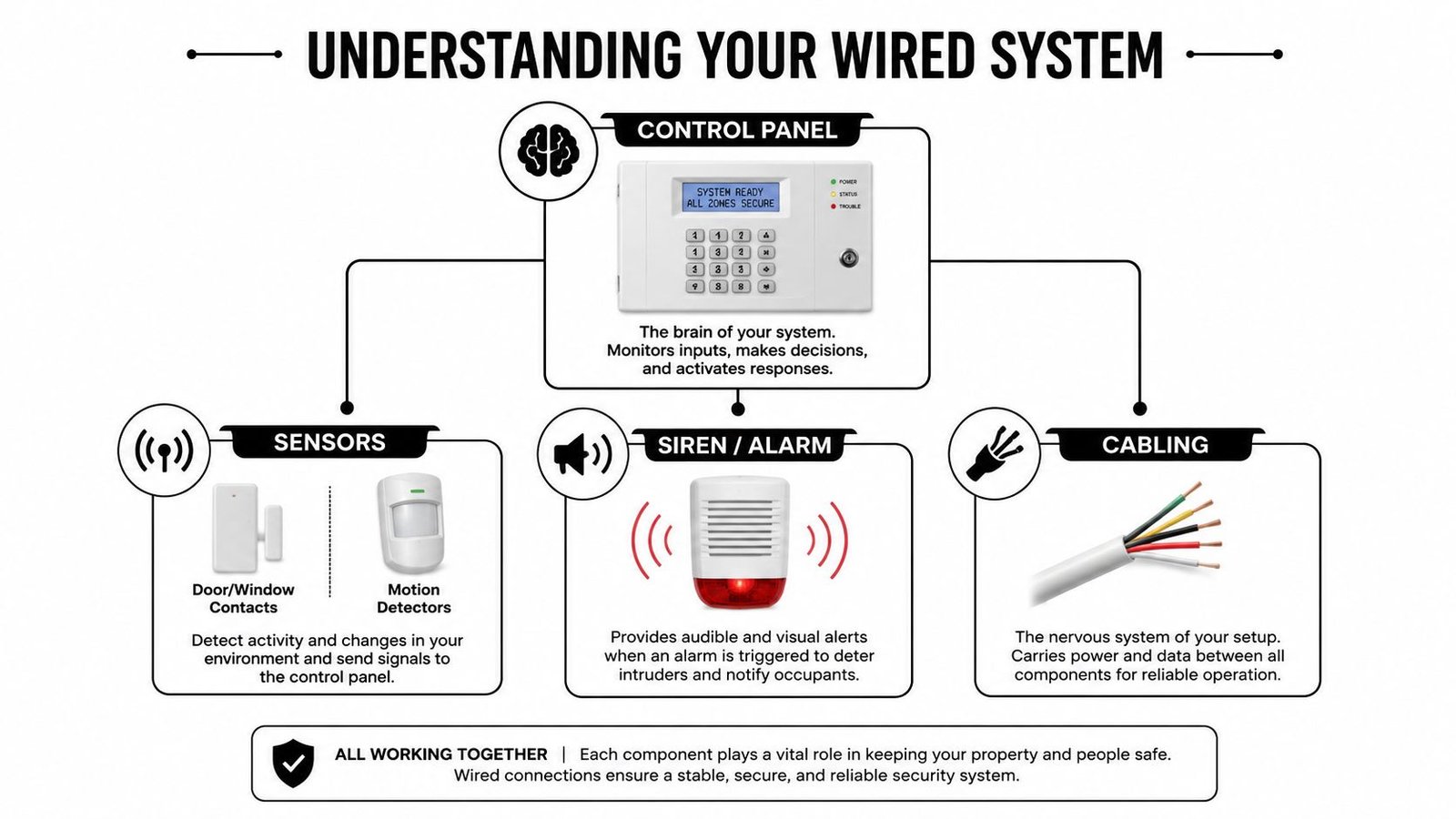
A wired alarm works a lot like a nervous system. One central point receives signals, interprets them, and decides what happens next. The cables are the pathways. The detectors are the nerve endings. The siren is the warning response.
The control panel does the thinking
The control panel is the brain of the system. It receives every signal from door contacts, motion detectors, keypads and sounders. If a zone is armed and a detector changes state, the panel decides whether to start the entry timer, trigger the siren, send a signal for monitoring, or log the event.
A keypad gives you control over the system day to day. In a practical install, that usually means one keypad near the main entrance and sometimes another near a secondary route or upstairs landing, depending on the layout. Good keypad placement matters more than people think. If it's awkward to use, the alarm gets bypassed or left unset.
The cabling is what makes a wired system so dependable. It provides a direct and stable route between devices and the panel. In older houses, careful routing through lofts, cupboards, floor voids and service spaces keeps the finish neat while preserving that reliability.
Sensors, sounders and cameras do the watching
A strong system usually combines several sensor types rather than relying on one.
- Door and window contacts protect the perimeter. They tell the panel when an entry point opens.
- Motion detectors protect circulation areas such as halls, landings and reception rooms.
- Glass-break or specialist detectors can be useful where there are vulnerable glazed areas or awkward openings.
- External and internal sounders create the immediate deterrent and alert.
Pet owners often assume wired alarms and pet-friendly detection don't mix. That's not the issue. Pet tolerance is a detector choice, not a verdict on whether the system is wired or wireless.
Wired CCTV also benefits from the same stable backbone. In the UK, wired CCTV systems support stable 4K Ultra HD video transmission at 3840×2160 pixels without bandwidth limitations, enabling licence plate recognition up to 33 feet away and reducing false motion alarms by 45% compared to wireless alternatives, according to UK-specific performance benchmarks. That matters if you want footage that's useful rather than footage that only proves something moved.
A security system should report clearly, record clearly, and be easy to operate under stress. If any one of those fails, the whole setup feels less trustworthy.
Wired vs Wireless Security Systems The Honest Comparison
Wireless systems have a place. They're quick to deploy, less disruptive to fit, and often attractive for flats, rentals or very small homes where cabling routes are difficult and expectations are modest. But homeowners buying for long-term security usually need a more honest comparison than “wireless is modern, wired is old”.
Where wireless wins
Wireless is easier to install in the short term. There's less drilling, less cable routing and less labour on day one. If you want a fast setup with app-led control, it can be a reasonable option.
It can also be sensible where the property will change soon. If you're renovating in stages, planning to move, or only need temporary coverage, wireless gives flexibility.
Where wired keeps its edge
The internet outage myth causes a lot of confusion. Many homeowners assume a wired alarm somehow depends on home broadband because they've seen “smart” alarm adverts blur everything together. That isn't how professional alarm design works. Professional wired systems built to BS EN 50131 can operate on dedicated radio frequency bands or PSTN, which means they can continue functioning if home broadband fails, as explained in this industry discussion of wired intruder alarm operation.
That difference is huge in practice. A wired alarm's core job is local detection and signalling within the system. Internet features are optional extras, not the foundation.
Here's the side-by-side view most homeowners need:
| Feature | Wired Systems | Wireless Systems |
|---|---|---|
| Installation | More involved. Best handled by a professional survey and fit. | Usually quicker and less disruptive at the start. |
| Reliability | Strong and consistent because devices use physical cabling. | Can be affected by building layout, interference, or device connectivity. |
| Internet dependency | Core alarm operation doesn't rely on home Wi-Fi in a professional setup. | Many consumer setups lean heavily on broadband and app connectivity. |
| Maintenance | Lower day-to-day fuss once installed properly. | Ongoing attention is often needed for batteries and device pairing. |
| Suitability for older homes | Very good when routes are planned properly through lofts, voids and cupboards. | Easier to fit quickly, but not always the most robust long-term answer. |
| Larger properties | Strong option where signal consistency matters across floors and distance. | Can become less tidy and less predictable as more devices are added. |
| Security feel | More like a permanent part of the building. | More like a modular add-on system. |
A lot of frustration with wireless alarms doesn't appear on the sales page. Sensors get mounted in compromise positions. Users ignore low-battery warnings. A router gets replaced and part of the setup drops offline. The system still exists, but confidence in it fades.
Wireless suits convenience. Wired suits permanence.
That's why many larger homes still lean wired, or at least heavily wired at the core. The main trade-off isn't old versus new. It's quick fitting versus long-term dependability.
The Professional Installation Process and UK Standards
A proper wired installation should feel methodical, not chaotic. If an installer turns up ready to “just put a few sensors up” without a detailed survey, that's usually where poor results begin.
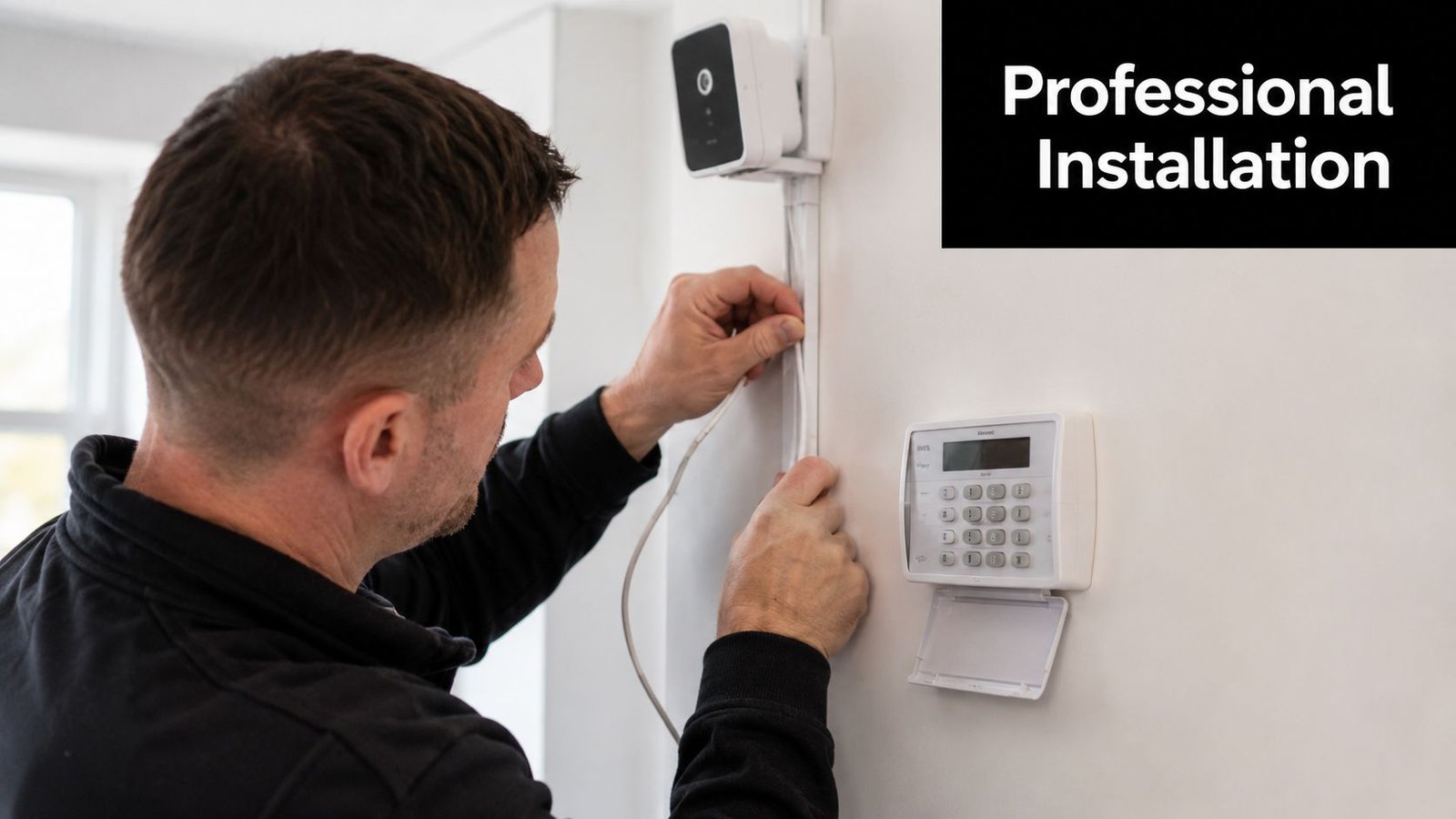
What a proper survey looks like
The survey is where the core design work happens. An experienced engineer looks at entry points, likely approach routes, blind spots, pet movement, cable paths, keypad locations and where the panel can be protected while still remaining serviceable.
In older Cardiff and Bristol properties, the challenge isn't whether a wired system can be installed. It's how to route it cleanly. Good installers use loft spaces, understairs voids, service risers, cupboards, garages and existing access points wherever possible. The work takes planning, but the result is usually far neater than homeowners expect.
There's a wider lesson here too. If you've ever looked into structured network installs, the same principle applies. Good cable work is mostly hidden planning. That's why Constructive-IT advice for IT managers is worth a read even outside the IT world. It explains why cable quality, route planning and workmanship matter far more than is commonly understood.
Why standards matter in the real world
BS EN 50131 isn't just paperwork. It shapes how an alarm is designed, installed and tested so the system performs consistently and can meet insurer or response expectations where relevant. If you want a clearer overview of what the standard covers, this guide on EN 50131 requirements for intruder alarms breaks it down in plain language.
One detail shows why professional installation matters. In the UK, wired home security systems compliant with BS EN 50131 must use CAI-approved coaxial cabling such as WF100, WF125 or WF167 to ensure signal integrity and prevent electromagnetic interference, according to recommended wiring guidance for compliant systems. That's not the kind of thing a homeowner is expected to memorise. It is the kind of thing a competent installer should already know.
A strong install process usually follows this pattern:
Site survey
The engineer maps risks, routes and user habits.System design
Detector types, zones, keypad positions and warning devices are specified for the property.Cable routing and first fix
Wires are run carefully and discreetly, with minimal disruption.Device fitting and programming
The panel, detectors, sounders and any CCTV components are installed and configured.Testing and handover
Every zone is checked, user codes are set, and the homeowner is shown how to use the system properly.
For a visual sense of what that work can involve, this short video gives useful context:
On site advice: The neatest alarm installation usually starts before the first cable is pulled. Survey quality decides finish quality.
Understanding the Costs and Monitoring Options in 2026
Price matters, but it helps to split the discussion into two parts. First, the physical system itself. Second, what happens after it's installed if you want alerts, response handling or ongoing support.
What you pay for up front
In the UK, wired burglar alarm systems typically cost between £200 and £1,000 for equipment, with professional installation adding £100 to £300 or more, according to IBISWorld industry data on UK security system services. The final figure depends on the size of the property, the number of detection zones, whether you're adding external sounders or CCTV, and how straightforward the cabling routes are.
That range is useful because it corrects a common assumption. Wired doesn't automatically mean prohibitively expensive. In many homes, especially owner-occupied properties where the system is staying put for years, the better question is value over time rather than lowest initial outlay.
A basic bell-only setup sits at one end of the scale. A larger home with multiple keypads, perimeter contacts, pet-tolerant sensors and integrated cameras will sit further up. Retrofitting in older homes can add labour, but a good survey will normally make the costs predictable before work starts.
Monitoring isn't one single product
Monitoring is where many quotes become hard to compare. One company may include app alerts only. Another may include keyholder notification. Another may connect the system to a professional receiving centre.
Common options include:
Bell-only systems
The alarm activates local sounders and relies on the audible deterrent.Self-monitored setups
The homeowner gets notifications and decides what to do next.Keyholder response
Alerts are passed on so a named contact can attend or check the property.Professional monitoring
Signals go to a receiving centre under an agreed service arrangement.
If you're not sure which level is right, this explanation of how monitored alarm systems work gives a useful overview.
The right choice depends on your routine. If the house is often empty during the day, if you travel regularly, or if there are vulnerable family members at home, monitoring often becomes more attractive. If your priority is a visible deterrent and a loud response, bell-only can still be a valid choice. What matters is knowing exactly what you are and aren't paying for.
Is a Wired System Right for Your Home
For many homeowners, the honest answer is yes. The bigger question is how the install should be approached, not whether the property is “too old” for wiring.
Older houses need a smarter install approach
South Wales and the South West have plenty of homes with solid walls, awkward loft spaces, later extensions and floorplans that weren't designed with modern cabling in mind. That doesn't rule out wired security. It just means the engineer has to think ahead.
In practice, older houses often suit wired systems well because they are long-term homes. Owners tend to care about reliability, not just fast setup. Once cables are routed properly and devices are placed where they should be, the system becomes part of the property rather than something temporary stuck to it.
New builds are easier still. If you're renovating or extending, pre-wiring for alarm points, keypads and CCTV is one of the smartest moves you can make while access is open.
When wired makes the most sense
Wired is often the stronger fit if any of these sound familiar:
You plan to stay put
Permanent protection makes more sense than a temporary workaround.Your house has multiple floors or awkward corners
Stable cabling removes a lot of uncertainty from signal paths.You want a professional-grade alarm rather than a gadget
The system becomes more predictable, easier to service and less dependent on domestic network conditions.You care about standards and insurer conversations
A properly installed compliant system is easier to document and maintain.You want integrated CCTV and alarm protection
Hardwired infrastructure gives you a solid foundation for both.
There are homes where wireless is the better answer. Small flats, short-term lets and properties where cabling access is disproportionate can fall into that category. But for owner-occupied houses, especially larger ones, a wired system often proves more sensible over the life of the property.
If the house is likely to outlast the current router, the current app and the current smart home trend, a wired security backbone is usually worth serious consideration.
Your Next Steps to a Secure Home
A good security decision usually isn't about buying the most features. It's about choosing the setup you'll still trust in five or ten years. For many UK homeowners, that points back to a professionally installed wired alarm, with CCTV and monitoring added where they improve the outcome.
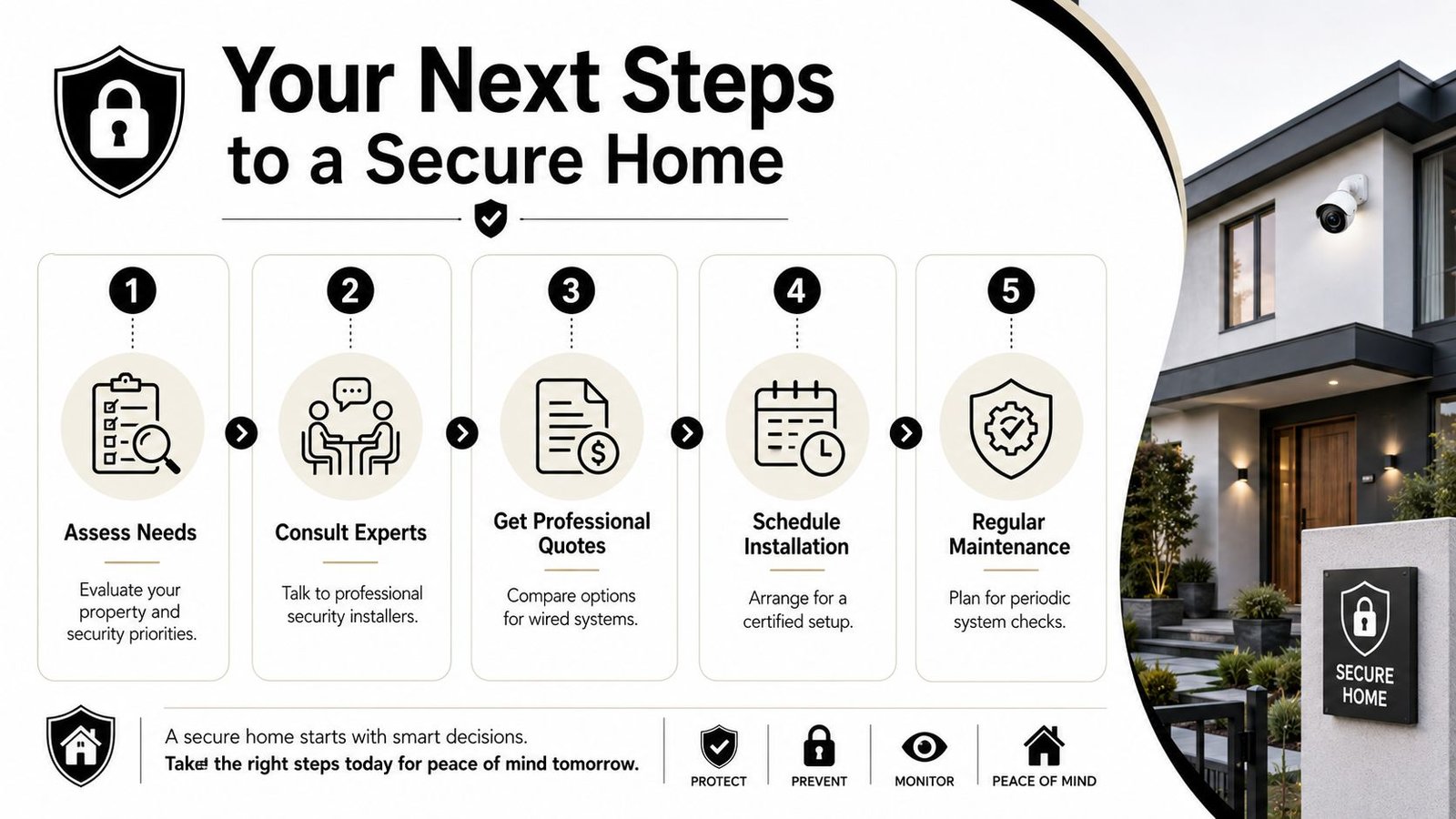
Questions worth asking any installer
Before agreeing to anything, ask direct questions. A credible installer should answer them clearly and without sales waffle.
Which standard will the system be installed to
Ask whether it will meet BS EN 50131 and what grade is appropriate for your property.How will you route cables in this house
The answer should mention real routes, not vague reassurance.What detector types are you proposing and why
You want reasons tied to rooms, access points and habits.Can the system handle pets properly
Pet-friendly protection should be explained as a detector choice, not brushed aside.What does maintenance include
Ask what testing, servicing, battery checks and fault response are covered.What happens if internet service drops
A good installer should explain core alarm operation in plain English.What are my monitoring options
Bell-only, self-monitoring and professional monitoring should be distinguished clearly.
What a good decision looks like
The best quote usually isn't the shortest list of parts or the lowest figure. It's the proposal that shows someone has understood how your home works. Which door gets used first thing in the morning. Which side gate is hidden from the road. Which upstairs windows stay cracked open in summer. Which hallway a burglar is most likely to cross.
That's what separates a real security design from a kit.
If you take one thing from this guide, let it be this. Home security systems wired still matter because they solve the boring, critical problems that ultimately decide whether a system works. Stable connections. Clear signalling. Proper standards. Sensible installation. Long-term confidence.
If you want a local, professional opinion on whether a wired alarm, CCTV system, or integrated setup suits your property, Wisenet Security Ltd provides consultations across South Wales and the South West. That includes homes in Cardiff, Bristol, Newport, Swansea and surrounding areas where older property layouts often need a more thoughtful security design.