Best Burglar Alarm Guide for UK Buyers 2026
Most buying guides still treat the best burglar alarm as the loudest siren or the slickest phone app. That advice fails the moment something happens. A sounder can startle someone. It rarely identifies them, and a handset notification does not satisfy an insurer or a police-response condition.
Judge the system by the response pathway and by the evidence you can still use afterwards. Scale the grade to the building, the hours it sits empty, and who can reach it, not to a national headline. A flat with a neighbour next door is a different job from a warehouse yard at 2am.
Table of Contents
- Grades Confirmation and Signalling Standards
- Match the Alarm to the Property First
- Bell-Only Versus Monitored Response Pathways
- Wired Wireless Pets and App Access
- Homes Shops Warehouses and Shared Buildings
- Installation Monitoring and Upkeep Costs
- Commission the Specification Before You Order
Grades Confirmation and Signalling Standards
An alarm's grade sets the level of intruder resistance the system is designed to provide. Grade 1 is intended for low-risk settings. Grade 2 addresses an opportunist with limited tools and is common in homes. Grade 3 is designed for intruders with greater knowledge and a wider toolkit. It is the right starting point where stock, cash or tools would reward a prepared intruder. Grade 4 is for specialist high-security sites, not ordinary homes. In the UK, PD 6662 applies the European grading standard. See this guide to what EN 50131 requires.
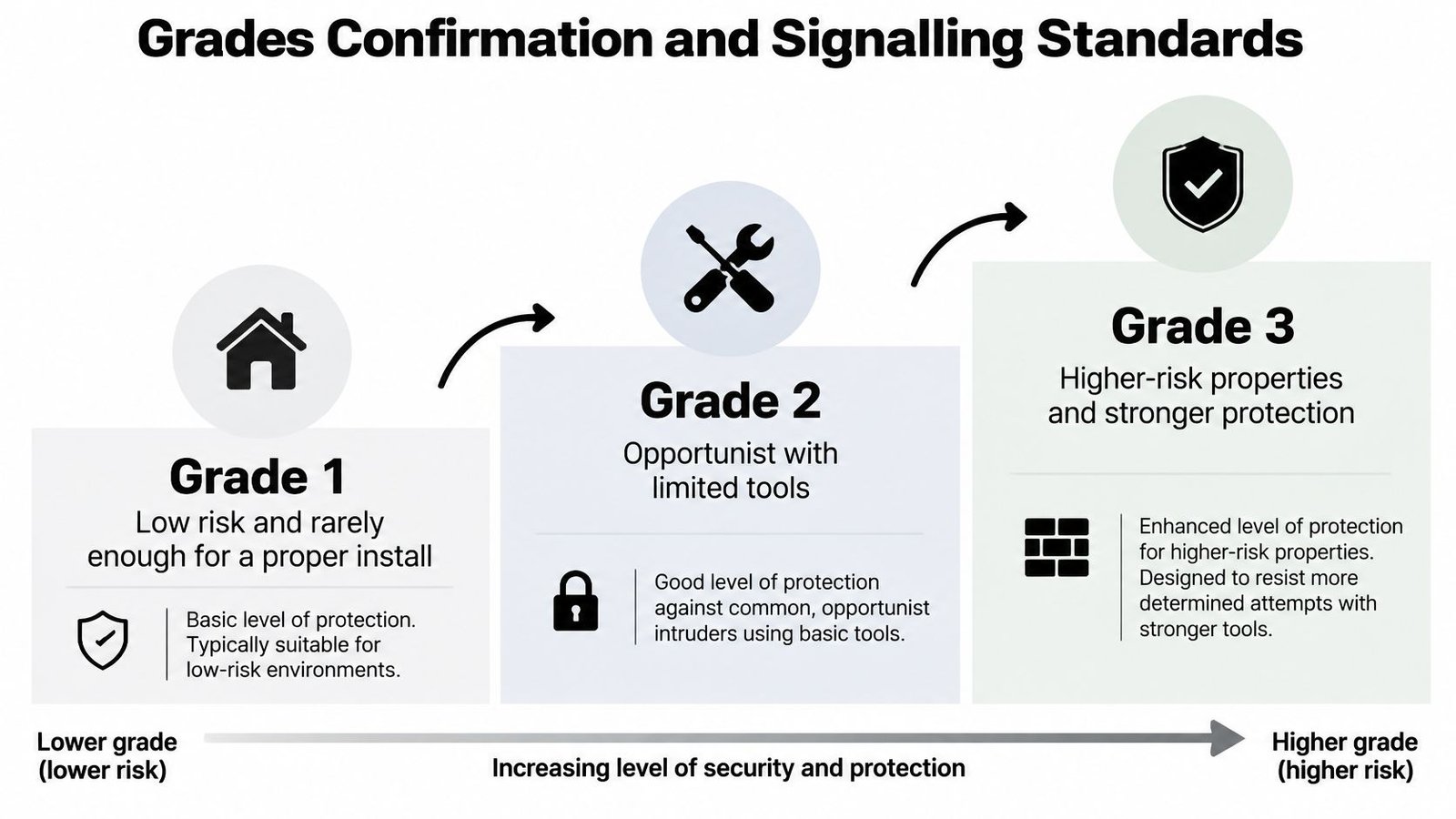
For commercial premises, the insurer's policy wording should set the minimum grade. Check it before accepting a Grade 2 quotation. Where the contents would attract a prepared intruder, specify a professionally designed Grade 3 system under BS EN 50131 and PD 6662.
What insurers actually write into a policy
Grade alone does not define how an alarm is confirmed or how its signal reaches a monitoring centre. Under BS 8243, sequential confirmation requires a second detector to activate within defined conditions before the alarm is treated as confirmed. Signalling should use dual paths compliant with BS EN 50136 or PD 6669. Commercial policies may specify DP3 or DP4, so check the wording rather than assuming one class fits every site.
Demand this on the quotation: certified detectors and control equipment, sequential confirmation where required, dual-path signalling, an accredited alarm receiving centre, and a documented maintenance visit. Siren volume and app features do not replace these requirements.
Put these four details on every quotation:
- Grade: state Grade 2 or Grade 3 against BS EN 50131 and PD 6662, and identify the risk the designer assumed.
- Confirmation method: specify sequential detection under BS 8243 where required by the insurer or police-response arrangement.
- Signalling paths: state the class, such as DP3 or DP4 where specified, and what happens if one path fails.
- Certificate holder: name the firm responsible for the certificate and the accredited centre that receives the signal.
These requirements matter when an insurer or police-response arrangement sets technical conditions. A cheap hub and loud bell cannot meet those conditions on their own.
Match the Alarm to the Property First
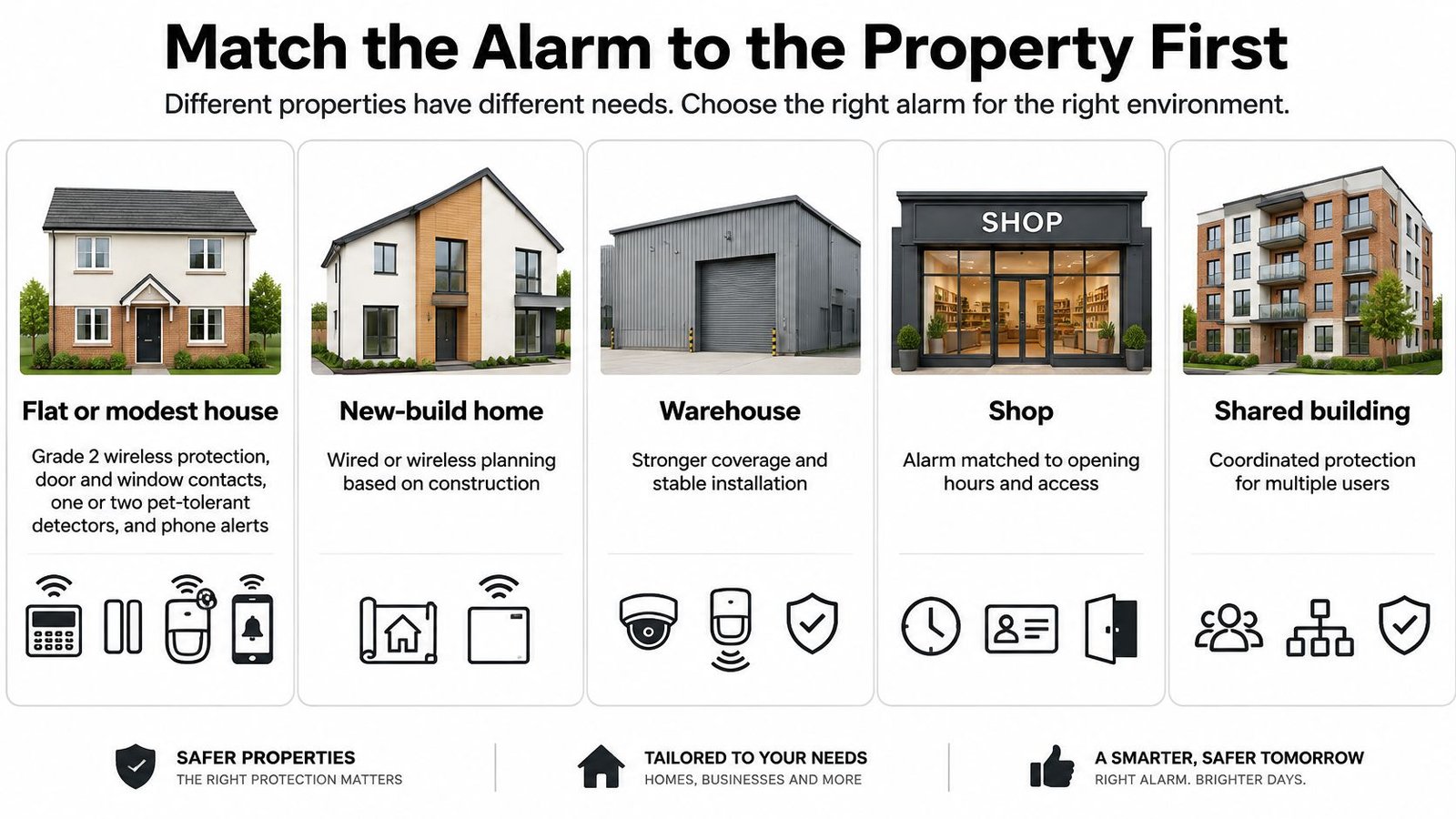
Pick the row that matches the building before you compare brands. Falling national totals do not erase stock in a shop or an empty house on a long drive. Exposure, any insurer wording, and who can attend at 2am set the specification.
| Property | Specification | Signalling | Who is alerted | Why this row |
|---|---|---|---|---|
| Flat or modest house | Grade 2 wireless, bell-only or app | Optional single path | Occupant or neighbour | Opportunist risk and someone nearby can attend |
| Family home with valuables or travel | Grade 2 monitored | Single or dual path | Keyholder and monitoring centre | Empty periods need a managed response |
| Retail unit or stocked office | Grade 3 confirmable | Dual-path DP3 or DP4 | Monitoring centre then keyholder | Insurers expect confirmation and resilient signalling |
| Warehouse or industrial unit | Grade 3 with zoned detectors | Dual-path DP3 or DP4 | Monitoring centre and site keyholder | Larger tools, yards and out-of-hours risk |
| Landlord or multi-tenant building | Grade 2 or 3 with separate users | As the insurer requires | Named managers, not every tenant | Shared access needs permissions and logs |
How to read your row
A flat or modest house usually needs Grade 2 wireless protection: door and window contacts, one or two pet-tolerant detectors, and phone alerts. A bell-only sounder is reasonable if a neighbour or keyholder will go and look.
A family home with valuables, a long drive or frequent travel uses that same Grade 2 design, then adds an accredited monitoring centre and a visible external sounder. Empty weeks are the problem, not the number of rooms.
Shops, stocked offices and warehouses should start at Grade 3 with sequential confirmation and dual-path signalling. A lone night delivery, a yard and shutters change the design. Zone the building so one legitimate movement does not false the whole site.
Landlords and multi-tenant buildings need separate user permissions more than extra sirens. Managers get logs and remote arming. Tenants should not inherit a login that shows other people's rooms.
A new-build can take cable while the walls are open. An occupied stone house usually cannot, so wireless earns its place there even when the grade stays the same. Test only the row that matches your building when you look at response, fitting method and running cost. Buying the row above yours wastes money. Buying the row below yours fails the first insurer survey.
Bell-Only Versus Monitored Response Pathways
A louder siren does not make an alarm better. Judge it by who receives the alert, who can act, and whether the system leaves usable evidence afterwards.
For the year ending March 2025, 73.1% of residential burglary offences were closed with no suspect identified, according to the crime outcomes bulletin for England and Wales. A siren can alert people nearby, but it does not identify an intruder. Pair the alarm with a response pathway and, where identification matters, securely stored footage.
A monitored alarm system suits an empty property, an insurer's requirements, or a site where a professional needs to manage the call list. Bell-only is a sound choice for an occupied home if a reliable person will respond.
| Pathway | Typical speed | Evidence value | Main limit | Best when |
|---|---|---|---|---|
| Occupant on the app | Seconds if the phone is heard | Can view linked cameras and call a keyholder | Useless if asleep, abroad or the cloud is down | Someone responsible is usually reachable |
| Neighbour | Minutes if at home | May see a person leaving | No duty to attend and may ignore repeat sirens | Occupied streets and a known contact |
| Nominated keyholder | Often 20 to 60 minutes if they live a short drive away | Can reset, check and preserve a scene | Holidays and long drives across South Wales or the South West | A named person accepts the role |
| Monitoring centre | Usually within a few minutes | Confirms sequence and calls the list | Fee, and police still need a confirmed alarm | Empty homes, shops and warehouses |
| Police after confirmation | Variable and not guaranteed | Official attendance if the call meets policy | Unconfirmed or repeat false alarms are downgraded | Insurer or response conditions require it |
Where each path fails
An app alert fails if the phone is on silent, the household is away, or the notification never leaves the panel. A neighbour may check once, then ignore repeat sirens. A keyholder who is away cannot reset the system or preserve the scene.
A monitoring centre can follow the call list, but police attendance is not guaranteed. Confirmation and false-alarm policy matter. Assign named contacts and make sure they can reach the property.
Keep the alarm's detection and signalling working during a power or broadband failure. The panel battery and local sounder should remain active. Cloud alerts help, but they are not the response plan.
Wired Wireless Pets and App Access
Choose the system around the building, then control who can change its settings.
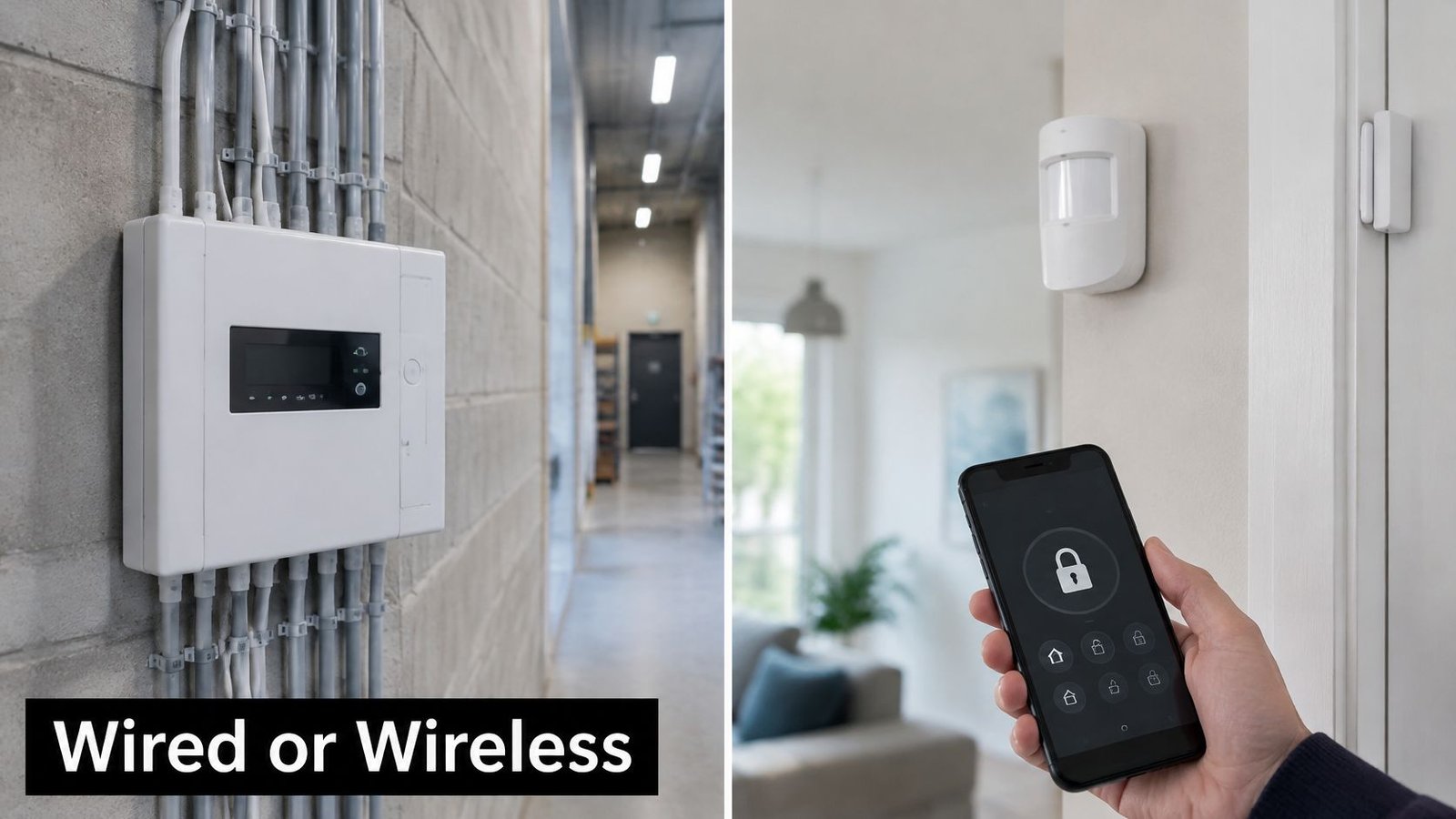
Wired suits new builds, warehouses and sites with existing cable routes. It avoids radio interference, but installation takes longer when cables need to be routed and concealed. Wireless suits occupied homes and retrofits: fitting is quicker, though batteries need replacing every few years and thick stone or metal can weaken the signal. Use wireless when disturbing the building would add more work; choose wired for a site expected to remain unchanged for years.
Pets and the walk-test
Pet-tolerant detectors use a pet-immune lens or dual technology to reduce alarms from animals below the device's stated weight limit, often around 25 to 40 kg. That limit does not account for a cat jumping onto furniture within the detector's field. Place detectors away from regular pet routes, then test each zone with the animals moving through the room. Read this guide to pet-immune motion sensors before choosing a detector location.
The app is a duty
An app adds access, not a response pathway. Secure it as carefully as the alarm panel: the Office for Product Safety and Standards guidance on connected products advises using a new, strong, unique password and changing the default during setup. A lower national burglary total does not justify buying the most expensive connected system for every site. Buy features that suit the property and the people responsible for using them.
- Firmware: Install updates. An unpatched panel can expose the system to network risks.
- Permissions: Decide who can arm the system and view cameras. Give tenants and property managers separate access.
- Retention: Set how long footage is kept and who can export it.
- Cloud loss: Record which features stop working if cloud access fails, and confirm the local panel still sounds.
For managing camera feeds remotely, use named accounts with access logs rather than a shared password. Remote viewing is useful only when you can control who sees the footage and who can change settings.
Homes Shops Warehouses and Shared Buildings
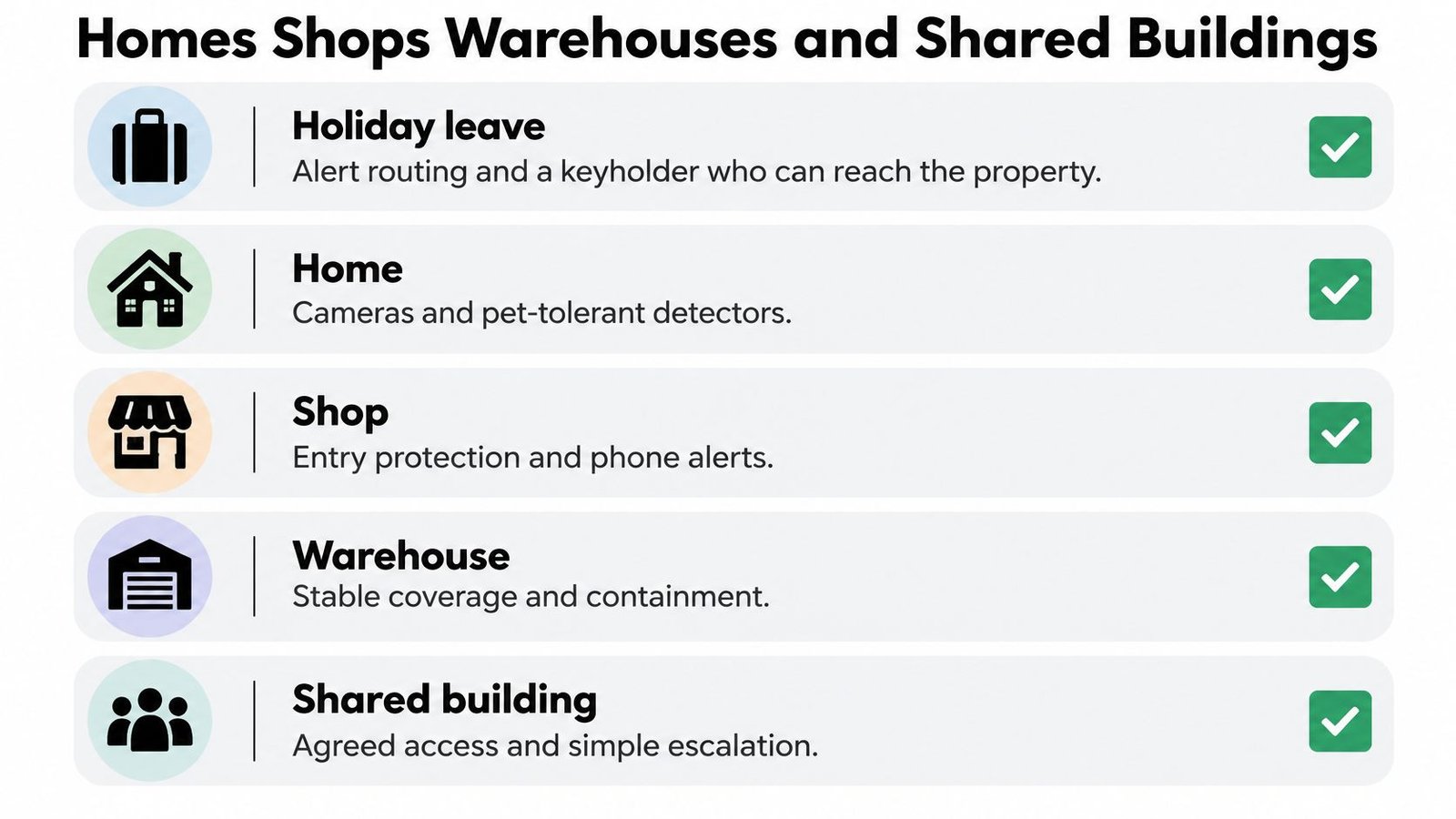
Apply the property row to the way the building is used. The wasted spend is almost always the feature that does not match that routine.
Five operating problems
A household away for a fortnight. Route alerts to a keyholder who can reach the property in South Wales or the South West, not only to a phone in another time zone. Aim cameras at approaches. A louder bell is the wasted feature, because nobody local is there to hear a small difference in volume.
A shop busy by day and empty after closing. Use a part-set so staff can work in a rear office while the shop floor stays live, then a full confirmable set once the shutters are down. The monitoring centre calls the keyholder. CCTV here is evidence of who entered, not a shop-floor television. Extra internal sirens after hours add little once the shutters are the barrier.
A warehouse with night deliveries. Zone the office, the racking and the loading bay separately so one legitimate vehicle does not false the whole site. Link gate or door control where vehicles enter. The response path is the monitoring centre plus a site keyholder. Indoor-style sensors on an open yard are wasted money.
A house in multiple occupation. Refuse one shared login. Managers get logs and remote arming. Tenants do not inherit camera access to other rooms. CCTV, if used at all, covers shared entrances for evidence, not bedrooms. A second external sounder does not fix a governance problem.
A car park or yard. Beams, contacts on gates and recorded video do more than a siren on a pole. Response is a named keyholder or a monitoring centre, because a passer-by will not investigate a dark yard. Pet-tolerant indoor detectors are the wrong product entirely.
Name the person who attends, say whether cameras are for deterrence or for evidence, and strike the one feature that does not serve that job.
Installation Monitoring and Upkeep Costs
Compare quotations on grade and signalling, not on the lowest monthly figure. A cheap subscription attached to an uncertified panel is not a bargain once an insurer asks for the certificate.
| System | Usually includes | Often extra |
|---|---|---|
| DIY wireless bell-only | Sounder and a basic app | No certificate or maintenance |
| Professional Grade 2 bell-only | Design, pet zones, certificate | Extra doors and a second keypad |
| Grade 2 monitored | Keyholder or centre response | Dual-path and CCTV |
| Grade 3 commercial dual-path | Confirmation and resilient signalling | Yards, shutters and access control |
| CCTV added for evidence | Recorded approaches | Lighting and longer retention |
What moves the price
Three items inflate a quote more than the brand name on the panel. Cable routes through listed stone, concrete decks or finished plaster take labour that a wireless retrofit avoids. Extra keypads and a remote sounder add devices and another place a tamper can be raised. Signalling if broadband fails means a second path, which is a different product from a single SIM or a router lead.
Separate the one-off install from the costs people forget. Monitoring is a contract, not a box. Batteries in wireless contacts and in the panel need a planned swap. An annual maintenance visit is what keeps the certificate meaningful. A call-out after repeat false alarms costs more than the detector you declined to walk-test.
Self-fitted kits can be sensible for a low-risk flat if you accept that there is no certificate and nobody professional on the response list. A Grade 3 commercial install costs more because confirmation, zoning and resilient signalling are part of the design, not optional stickers. Linking cameras for evidence adds mounting, lighting and storage on top of the alarm. Ask each firm to price the same grade, the same paths and the same maintenance year. Then the monthly figure means something.
Commission the Specification Before You Order
Write a one-page brief before anyone talks you into a handset. State the property type, whether it is empty at night, whether pets live there, the insurer's wording, who can attend within an hour, and whether video evidence matters more than a siren.
The installer should answer with grade, confirmation method, signalling class, user permissions, battery standby, and what still works if broadband fails. Refuse a quote that only names an app.
A national gadget ranking cannot tell you whether a keyholder in Newport can reach a unit in Bristol before the scene is useless.
For homes and commercial sites in South Wales and the South West, including Cardiff, Bristol, Newport and Swansea, a local maintained install decides the outcome because distance and service visits are the response. Wisenet Security Ltd designs and maintains intruder alarms to BS EN 50131 with bell-only or monitored options, pet-friendly sensors and mobile alerts, and can integrate CCTV or access control where the brief needs evidence or controlled entry.
The practical next step is a free survey against that brief, then a certificate and a maintenance plan. Do not buy the loudest kit online and hope the insurer agrees afterwards.
Wisenet Security Ltd designs, installs and maintains burglar alarms for homes, shops, warehouses and shared buildings across South Wales and the South West, with bell-only or monitored response and maintenance that keeps the certificate current. If you want the grade, the signalling and the keyholder plan matched to your building, book a free survey with Wisenet Security Ltd.