
People Counting Camera: A UK Buyer’s Practical Guide
You're probably looking at a quote right now and wondering if the numbers on the brochure will still hold up once the camera is over your entrance, above your queue, or staring down a glazed frontage in January. That's the test with a people counting camera in the UK. The kit isn't hard to buy, but the difference between a useful system and an expensive disappointment is usually decided by mounting, lighting, and whether the site behaves like the demo room.
For UK buyers, the important point is simple. A people counting camera is not just a CCTV camera with a clever label. It's a measurement tool that turns video into entries, exits, occupancy data, and footfall trends you can use for staffing, cleaning, tenant evidence, and capacity control. The market behind it is growing fast, too, with the global people-counting camera market valued at USD 515.33 million in 2025 and forecast to reach USD 955.90 million by 2032, a 9.22% CAGR over that period (GII Research report).
A smart installer doesn't sell you the dream. They ask where the door is, how people queue, how the light changes, and whether your team needs counts for management or evidence. That's the gap this guide focuses on.
Table of Contents
- What a People Counting Camera Does
- How the Technology Works Step by Step
- Accuracy, Mounting, and Lighting in Real UK Sites
- Where Counting Cameras Earn Their Keep
- Choosing the Right Camera and Integrator
- Privacy, GDPR, and UK Compliance Essentials
- Installation, Placement, and Handover Tips
- Maintenance, ROI, and Working With Wisenet Security
What a People Counting Camera Does
A retail manager in Cardiff once told me she didn't need “another CCTV job”, she needed proof. On Saturdays, her till queue kept stretching past the aisle end, staff kept saying the shop was busy, and the owners kept saying they didn't want to add labour without evidence. Once the entrance counts were visible, the argument changed. The figures showed when people came in, how long they hovered near the front, and why the second till made sense on peak days.
Counting is the point, security is the platform
A people counting camera takes live video and turns it into operational numbers. In practical terms, that means entries, exits, live occupancy, and in some systems dwell-time style analysis for zones such as entrances, tills, lobbies, and waiting areas. Technical guidance from integrators and vendors describes the usual deployment at entrances and counting lines for occupied-space analytics, with overhead positioning preferred because it reduces ambiguity and keeps the count anonymous (Axis guidance).
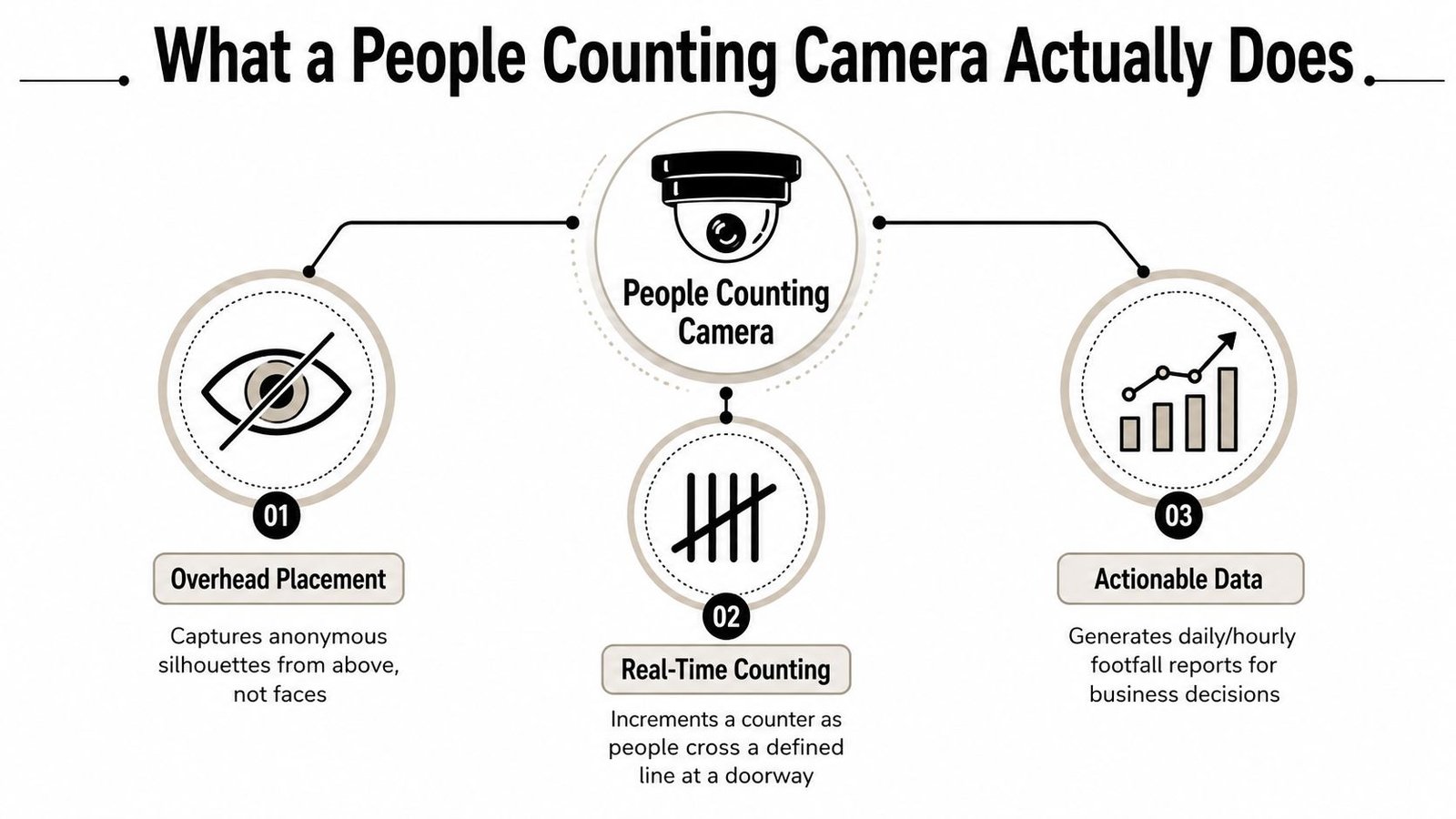
That matters because the camera does two jobs at once. It captures movement from above, and it feeds a dashboard that managers can read without watching footage all day. Used properly, you are not buying a better picture. You are buying usable business evidence.
Practical rule: if the system cannot show a clear hourly count split, it is not giving you management data, it is giving you vague video analytics.
Why UK sites use it
In the UK, the value is usually operational, not decorative. Retail teams use it for staffing and queue decisions. Landlords and facilities managers use it for occupancy evidence and shared-space usage. Transport-facing sites use it to understand flow in doors, lobbies, and pinch points. The right result is not “we can see people”. The right result is “we can make a decision from the count”.
If you want a broader view of how analytics can add value to existing video estates, MV camera analytics is a useful starting point because it shows how counting fits into wider video intelligence rather than living as a standalone gimmick.
How the Technology Works Step by Step
A busy doorway is not a clean test bench. People cross in both directions, arrive in pairs, pause to talk, push trolleys, hold children's hands, and stand under the camera while they decide where to go next. A decent counting system handles that by watching from above, drawing a virtual line across the entrance, and deciding whether a person crossed in, out, or not at all. That is the core logic, and it is the bit buyers should care about, not the glossy language in vendor literature.
From lens to line to dashboard
The camera captures the entrance zone continuously. The software then sets a counting line or a small counting zone across the area where movement is easiest to interpret. When someone crosses that line, the processor decides whether the movement counts as an entry or an exit, then sends anonymous count data to a dashboard, a local recorder, or a connected building system.
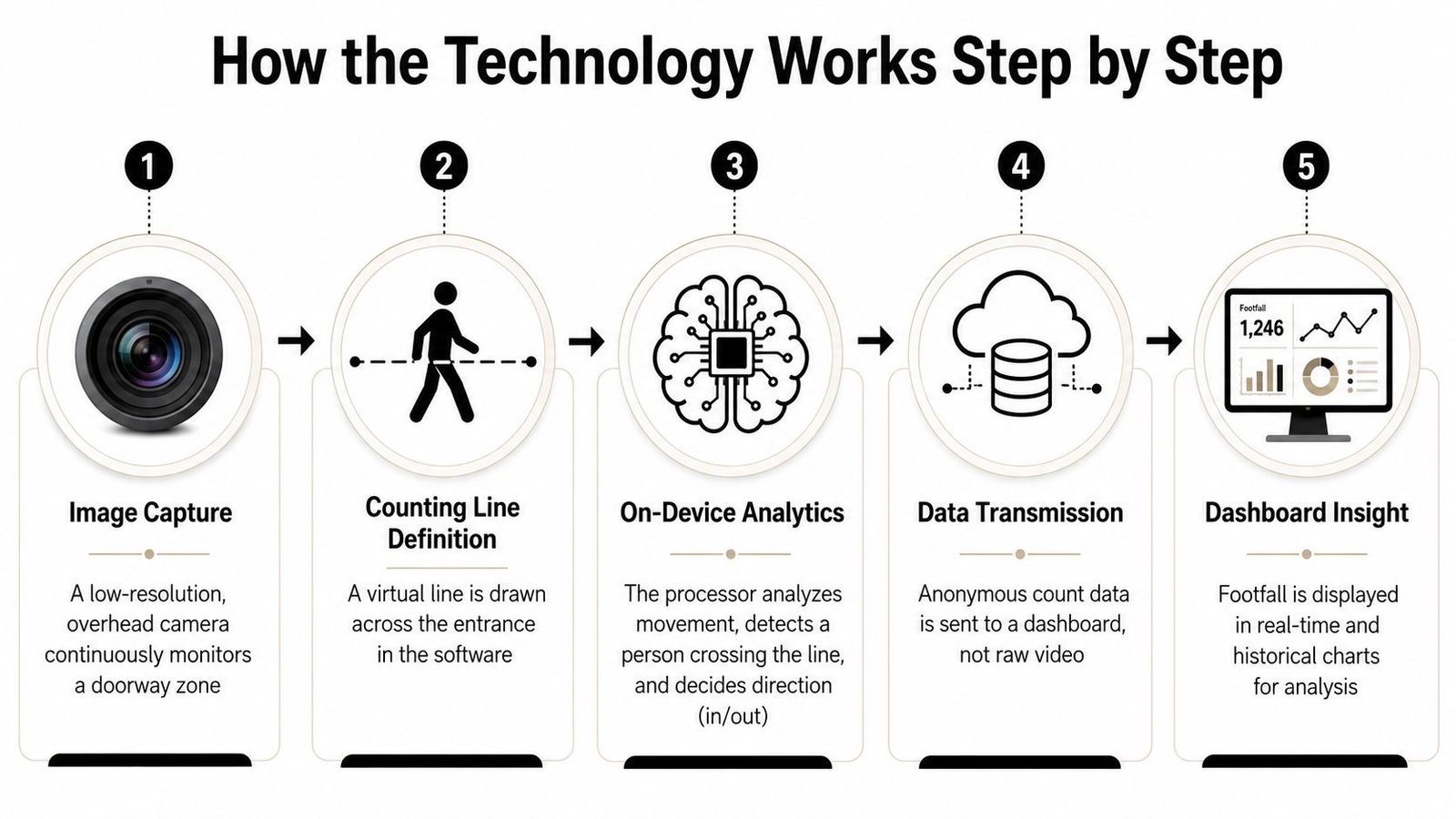
That data path is what you should press suppliers on in a quote. If they cannot explain where the count is made, where it is stored, and where it appears, they are skipping the part that matters. The same basic idea sits behind wider video analytics too, and the internal overview at Wisenet Security's AI CCTV guidance is a useful reference point if you want to see how counting fits into a broader CCTV setup.
What affects the result
The camera's sensor, lens, and frame rate matter because the system needs enough visual detail to separate one person from another as they move through the doorway. Overhead counting units commonly use a 1/2.7" progressive-scan CMOS sensor, 1920×1080 output, a 2 mm fixed lens, and a 104.5° horizontal field of view, which is enough to cover an entrance or aisle without relying on facial detail (EAS Partners overhead counter spec).
That is why the right questions are practical. Ask whether the camera sees the full width of the entrance, whether the count happens on-device or in the cloud, and whether the unit can report into a dashboard your team will open. Some system guidance from the Axis paper also notes that simple entry and exit counts can commonly sit in the 85% to 98% accuracy range when setup is good, but dense crowds reduce performance as the scene gets harder to separate.
If the installer talks only about AI and never about line placement, walk away.
For buyers who want a software-first route, the question is whether the platform can work with what is already on site. That matters more than brand language. It is also where MV camera analytics earns a look, because it shows how counting can sit inside a wider video intelligence setup instead of being sold as a standalone gimmick.
Accuracy, Mounting, and Lighting in Real UK Sites
UK entrances are messy. Glass doors throw reflections back at the lens, side light pours in from shopfront glazing, floors bounce light around, people stop to check phones, pushchairs cut across the line, and a lunchtime queue can sit right where the camera needs a clear view. Vendor brochures rarely show that. Real sites do, and that is where the numbers either hold up or fall apart.
The setup decides the outcome
Accuracy depends on camera geometry, visibility, and scene stability, not just the analytics engine. The usual failure points are obstruction, people lingering on the counting line, crowded entrances, and changing light. Dense crowding and occlusion still drive undercounting or double-counting, and shifting illumination remains a common cause of bad results (Videoloft positioning guidance).
Some manufacturers pitch strong performance when the unit is installed well. Their own technical pages often talk about mounting heights around 1.9 m to 6.0 m, or roughly 3 m for mapped ceiling sensors, and low-light support down to 0.005 lux or lower to keep performance up in dim entrances and covered car parks (Foorir technical page). That can be useful, but only if the site gives the camera the right view.
What works in UK conditions
Overhead 2D units are usually the cleanest fit for straight entrances and smaller retrofits. Stereo or 3D systems handle people moving close together more reliably, because depth helps separate bodies that would blur together in a flat image. AI-based analytics perform well when the scene stays steady, but they do not fix a poor angle or a doorway blocked by retail clutter. The right choice comes down to the doorway itself, not the sales sheet.
A simple installer's checklist is more useful than a feature list.
| Site condition | What usually helps | What usually hurts |
|---|---|---|
| Straight, open entrance | Overhead placement | Tilted side view |
| Glazed frontage | Good wide-dynamic-range handling | Glare and reflections |
| Queueing at the line | Higher mounting and clear counting zone | Lingering customers |
| Low light or covered parking | Low-lux capability | Flat illumination and glare |
Mounting matters just as much as the camera type. A clean overhead view gives the system a clear shape to work from, while side mounting usually adds distortion and makes people overlap in the frame. Lighting needs the same blunt treatment. Harsh daylight through glass, strong reflection off polished floors, and patchy illumination near awnings all make the count less reliable, so the entrance should be checked at the times of day when people use it.
If you want the plain answer, here it is. Accuracy claims of 98% to 99% only mean something when the camera is mounted correctly and the scene is controlled. Outside that, they are brochure numbers, not site results.
Where Counting Cameras Earn Their Keep
Retail, warehousing, car parks, and property management all use the same basic idea, but they need different outputs. A shop wants footfall and conversion evidence. A warehouse wants flow. A car park wants occupancy. A facilities manager wants usage records. If a supplier tries to sell one generic setup for all four, they are making the site harder to manage than it needs to be.
A good installer starts with the question, what decision will this count support?
Retail wants footfall, not just raw entries
A retailer needs to know when people arrive, when they drift away, and whether the front of shop is creating pressure at tills. A counting camera gives cleaner evidence than manual tallies or guesswork. It is useful when managers need to show that extra staffing is justified on specific days or at certain hours. If you are also working on the wider shopper journey, the proven ways to drive retail traffic sit alongside the count data, because traffic planning and traffic measurement should be treated together.
The point is simple. Retail counts only matter if they lead to a decision about opening hours, staffing, queue handling, or layout.
Warehouses, car parks, and property need different answers
Warehouses and logistics hubs use counts to show shift changes, gate movement, and pressure around loading areas. The value is control, not marketing. Car parks need occupancy evidence for signage, safety, and route management, especially when drivers are circling for a space. Property managers care about shared-space usage, tenant charging evidence, and whether a lobby, amenity area, or entrance is being overused.
A good camera count does not replace the rest of the system, it fills the gap. It tells you how many people crossed a point. It will not tell you why they came, whether they bought anything, or what they thought of the experience.
Straight answer: if you need behaviour, you need more than counts. If you need occupancy, counts are usually enough.
For shops, that usually means a counting camera is only one part of the job. The Wisenet Security shop CCTV guide matters because retail sites rarely need a counting-only project. They need a system that sits alongside CCTV, store operations, and the wider site layout, and that is where the data starts to earn its keep.
Choosing the Right Camera and Integrator
Don't compare quotes by headline price alone. Compare them by whether the installer can explain the site, the count logic, and the failure modes without hiding behind product jargon. If they can't answer those points clearly, the price doesn't matter because the system is being sold on trust rather than engineering.
Your shortlist should answer these questions
- Can it count reliably in my actual entrance? Ask for the mounting position, the counting zone, and the expected performance in glare, queues, and low light.
- Does it need cloud processing or can it run on-site? On-device analytics are usually easier to control. Cloud tools can be useful, but they add dependency.
- Will it talk to my existing kit? Look for ONVIF, HTTP APIs, and sensible integration with CCTV or access control, not closed systems that trap the data.
- What happens if the site changes? Ask about retuning, firmware updates, and support if a new display, partition, or door layout changes the view.
- What's the support model? Warranty is fine, but you also need a service path, because a counting camera that drifts out of alignment slowly becomes useless.
That checklist cuts through the noise. It also helps you compare a low-cost import, a mainstream brand such as Hikvision, and a premium analytics engine on equal terms. A budget unit can be fine on a simple entrance. A more capable engine makes sense when the site has crowding, awkward lighting, or a harder privacy brief.
Budget should match site complexity
A cheap camera on a simple doorway can be perfectly sensible. A cheap camera on a glazed lobby with queueing and changing daylight is usually a false economy. The cost of a return visit, a re-mount, or a missed occupancy issue is often greater than the gap between the quotes.
If you're comparing options in South Wales or the South West, Wisenet Security Ltd is one of the local firms that can supply, install, and maintain counting-capable CCTV as part of a wider security package. Use that kind of contractor when you want the camera, recorder, network, and aftercare handled as one job, not as separate trades.
Privacy, GDPR, and UK Compliance Essentials
A counting camera is often less invasive than a standard CCTV setup because the sensible installation is overhead and avoids identifiable facial capture. That doesn't make compliance optional. It means the design can be privacy-aware from the start if the installer is doing the job properly.
What the installer must put in writing
The basic compliance pieces are straightforward. You need a lawful basis, clear signage, sensible retention, staff consultation where appropriate, and a clear distinction between counting video and identifying video. If the footage is only used to count anonymous movement, that should be reflected in the design and the paperwork. If video can be shared for dispute resolution, it needs a proper handling process and a reason for retention.
The GDPR point is not to panic over every camera. It's to make sure the system is proportionate. The internal UK compliance guide at Wisenet Security's CCTV and GDPR article is relevant because most counting jobs sit inside a wider CCTV policy, and the two need to line up.
Anonymisation is a design choice, not a slogan
When a supplier says the system is anonymous, ask how. Overhead placement helps because it avoids facial detail. Edge processing helps because it lets the device turn movement into counts without storing more video than you need. Secure handling matters because count data should be aggregated and protected, not floating around in spreadsheets with no ownership.
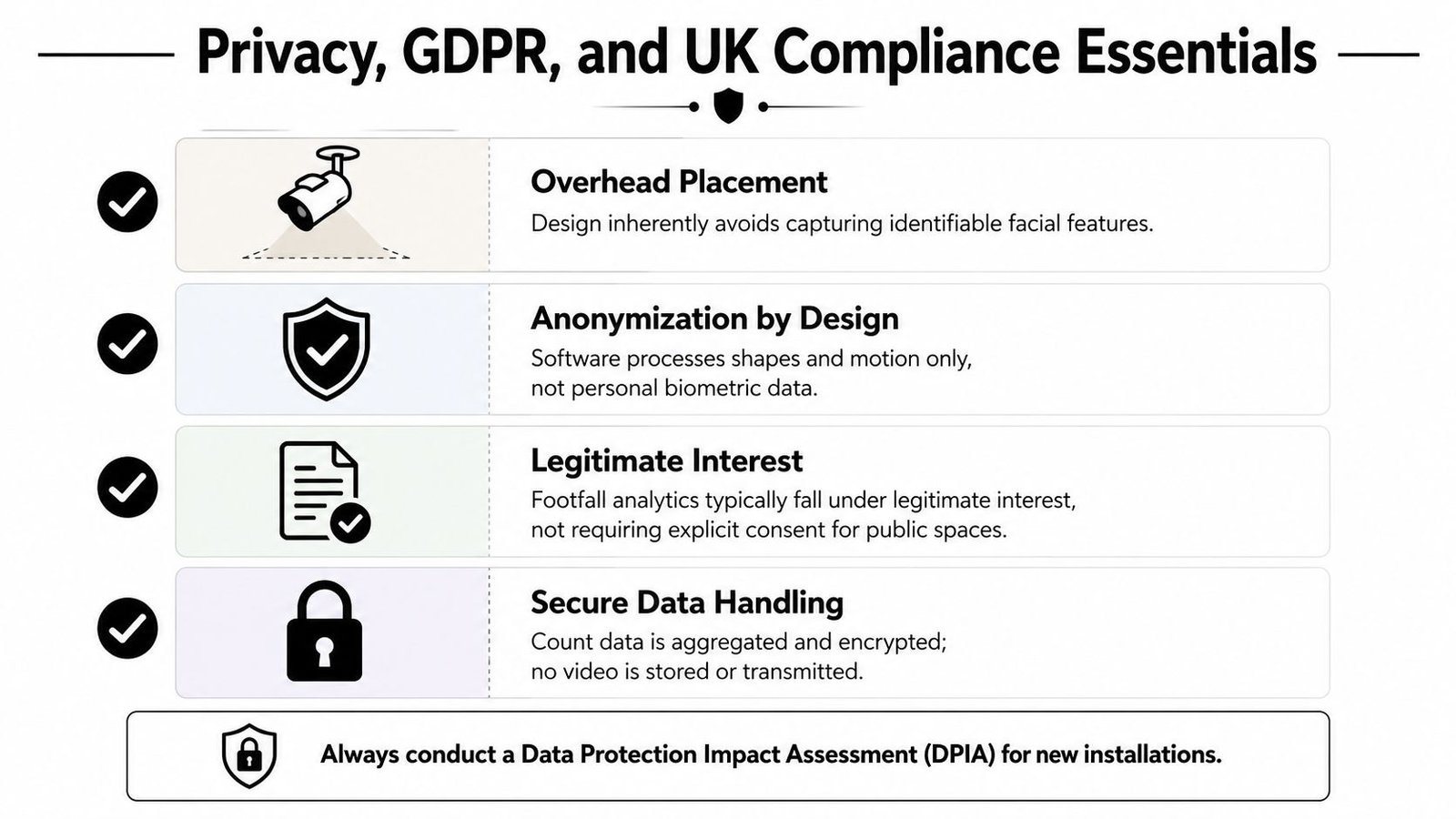
A sensible installer will also push for a Data Protection Impact Assessment on new deployments. That isn't overkill. It's the right way to make sure the layout, signage, storage, and sharing rules all match the actual use case.
If the camera can identify people and the client says they only wanted counts, the design has already drifted off course.
Installation, Placement, and Handover Tips
Most bad counting systems don't fail dramatically. They fail. The counts are just a bit off, the manager stops trusting the dashboard, and six months later nobody uses it except when somebody needs a vague number for a meeting. That's usually a mounting or commissioning problem, not a software miracle waiting to happen.
Get the mount right before you worry about software
The camera should cover the full entrance width, with the line placed where people naturally cross, not where the installer found a convenient fixing point. Avoid tilt unless the manufacturer specifically allows it. If the entrance has glass, reflective flooring, or a bright external view, the installer needs to test for glare at the time of day the site is busiest.
Cabling matters too. PoE is usually the cleanest answer because it keeps power and network on one run and reduces weak points. A proper install also checks bandwidth, recorder compatibility, and whether the camera is joining the same network environment as the rest of the CCTV estate.
Validate the count before sign-off
Commissioning should include a manual tally against the dashboard count. That doesn't need to be theatrical, it just needs to be honest. Walk a few realistic entries, pairs, strollers, and queue movements through the line, then compare the live result with what the staff saw. If the count is drifting badly at handover, it will only get worse once the site goes live.
A good handover includes:
- A baseline accuracy note
- Dashboard training for the client team
- A maintenance schedule
- Clear contact details for support and retuning
If those elements are missing, the install is rushed. Good hardware on a poorly commissioned entrance still gives you bad data.
Maintenance, ROI, and Working With Wisenet Security
A counting camera is not a fit-and-forget box. Lenses need checking, firmware needs updating, and the site needs revalidation if the entrance changes or the lighting shifts with a refurbishment. Ignore that, and the system slowly turns into a vanity dashboard with numbers nobody trusts.
Ongoing service is part of the return
The return on a counting camera usually comes from better staffing, better cleaning schedules, better space use, and better lease evidence. Those gains only show up if the data stays believable. That's why annual recalibration, software upkeep, and analytics subscriptions should be treated as part of the cost of ownership, not optional extras tacked on after purchase.
I'd rather see a client buy one well-installed system with proper aftercare than three cheap ones they never trust. A dependable count that supports decisions is worth more than a flashy platform nobody opens. That's especially true in retail and property, where managers need evidence they can stand behind in front of owners, tenants, or auditors.
If you want a local contractor that can handle the security side as a complete project, Wisenet Security Ltd covers South Wales and the South West, including installation, integration, and maintenance for CCTV and related systems. For a counting project, that kind of support matters because the camera, network, and ongoing service need to stay aligned.
If you're weighing up a people counting camera for a shop, car park, lobby, or warehouse, speak to Wisenet Security Ltd about the site layout, the mounting position, and the level of reporting you need. They can assess whether your entrance will support a reliable count and help you avoid the usual mistakes before you sign a quote.