Video Intercom System with Door Release: A 2026 Guide
A video intercom system with door release combines live video, two-way audio, and a relay-controlled mechanism for opening the door. In the UK, it sits under BS EN 50133-1:2018, so the question isn't whether it's a smart doorbell, it's whether the access control, lock hardware, fire strategy, and power design all work together safely.
Most buyers are standing at a gate, lobby, or side entrance trying to solve the same problem, let people in without weakening the door. The system has to verify who's there, release the lock at the right moment, and stay dependable when the weather, network, or power supply isn't perfect.
Table of Contents
- What Is a Video Intercom System with Door Release
- How Video Intercom Systems with Door Release Work
- Key Benefits for Homes and Businesses
- Technical and Installation Considerations
- Integration Remote Access and Compliance
- Costs and Your Buyer Checklist
- Getting Professional Support in South Wales and the South West
What Is a Video Intercom System with Door Release
A homeowner gets a knock at the side gate. A courier is outside, the driveway is closed, and the front door can't just be left open. A video intercom system with door release solves that by letting someone see the visitor, talk to them, and trigger the lock only after deciding to admit them.
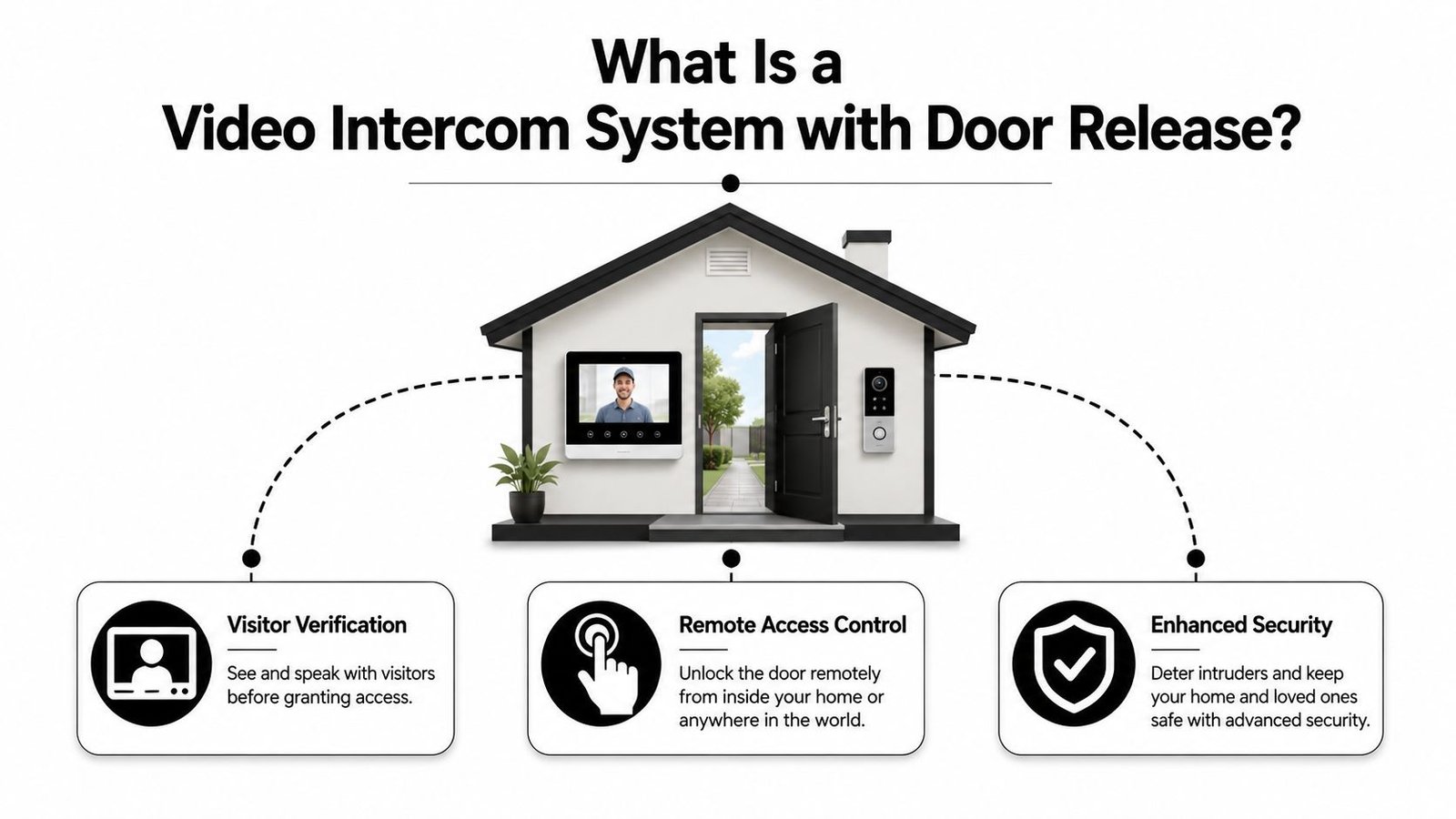
At a practical level, this is not just a doorbell with a camera. It's an access-control device, meaning it sits in the chain between visitor verification and door release, which is exactly how BS EN 50133-1:2018 frames access control, as a means of regulating entry to and exit from a protected area. The standards-led view matters because the “release” part affects the door, not only the conversation at the entrance, and that's why lock compatibility and egress strategy can't be treated as afterthoughts.
A common mistake is to buy a video doorbell and assume it does the same job. Video doorbells are often built for simple residential convenience, while a proper intercom with release is designed to operate an electric strike, maglock, or gate operator as part of a controlled entrance. If you're planning a home layout or a small building, the home security setup guidance from HomeProBadge is a useful companion because it helps you think about placement, coverage, and how the camera fits the rest of the system.
Practical rule: if the door can't safely release, relock, and let people exit as required, the system design isn't finished.
The most useful way to think about it is simple. The visitor speaks, the camera verifies, the user decides, and the relay opens the door for a controlled moment. A product overview like Wisenet Security's video intercom systems fits into that picture because the value is in how the whole entrance behaves, not just in the presence of a screen.
How Video Intercom Systems with Door Release Work
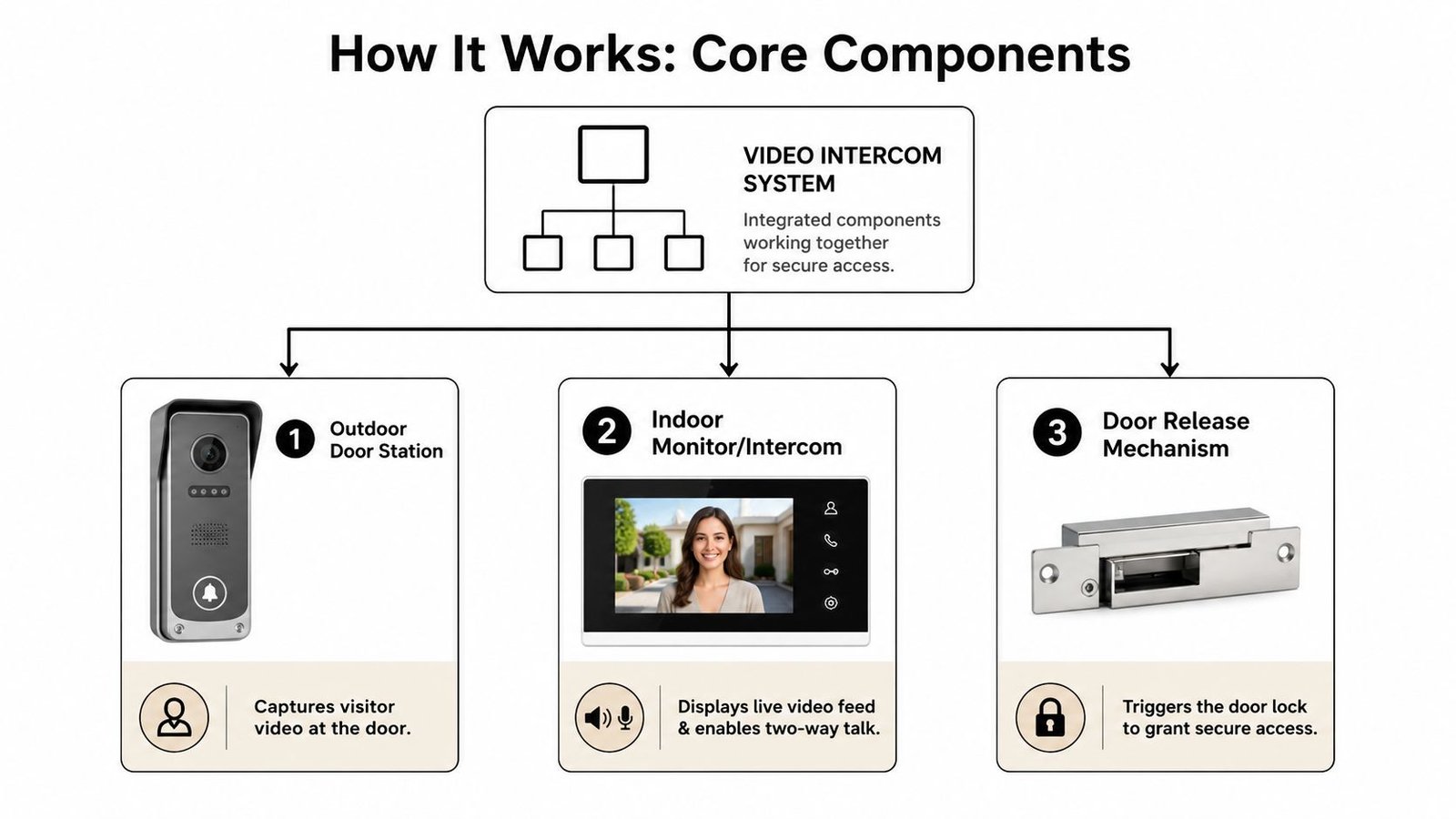
A practical installation starts at the entrance. The door station captures the visitor, sends video to an indoor monitor or app, and waits for a deliberate release command from the user. The indoor side can be a wall monitor, a handset-style unit, or a smartphone interface, but the sequence stays the same, someone is identified first, then the door or gate is released for a controlled moment.
The parts that actually matter
The outdoor station has three jobs. It needs to survive weather, produce usable video, and communicate reliably with the indoor side. For exposed UK entrances, that usually means a housing built to IP65 minimum and IK08 or better, because wind-driven rain and vandal risk are part of everyday site conditions at a front gate.
Image quality affects how confidently a user can identify a visitor. In the manual cited in the brief, one analog-style system uses 420 TVL video, 0.01 lux minimum illumination, 7-inch TFT-LCD, and up to 400 feet total cable distance with 4-conductor 20 AWG minimum. That setup keeps cabling straightforward, but the image detail is limited. The newer IP example in the brief uses H.264, 30 FPS, 1024×600 indoor displays, 2 MP outdoor cameras, and IP55/IK07 protection, which is the better fit where face capture and day-to-day usability matter.
The control method matters just as much as the camera. A video intercom with door release is only doing its job if the indoor unit can trigger the correct output for the lock type in use, whether that is an electric strike, a maglock, or a gate operator. For a clear overview of the wider control options, see this guide to access control system types, because the relay output has to match the way the entrance is built.
Release timing matters more than people expect. If the relay pulse is too short, the user fights the lock. If it is too long, the entrance stays open longer than it should.
Relay output and lock type
The release output is where a lot of systems are underspecified. An electric strike, a maglock, and a gate operator do not behave the same way, so the relay rating, lock current, and power headroom have to match the hardware. The installer guide in the brief flags this directly, and that warning is practical, because a weak power budget can cause boot loops, video dropouts, or release failures when the camera and relay draw power together.
Wired IP systems are now common in UK commercial work because they follow standard Ethernet and PoE architecture instead of proprietary low-voltage cabling. The guide in the brief notes that many stations use 802.3af PoE, 15 W, while units with integrated displays, heaters, or higher-load cameras may need 802.3at, 30 W. That detail matters on site, because a door station that will not power up cleanly is a poor fit for an entrance that people rely on every day.
For retrofit projects, analog can still make sense where long-run simplicity matters more than network features. For new builds, IP usually fits better because it scales more cleanly and works with modern networked access control without forcing a redesign each time the property changes.
Key Benefits for Homes and Businesses
A home user usually wants one thing first, confidence at the door. Being able to see who's there before pressing the release button reduces the guesswork that comes with audio-only intercoms, especially when a visitor sounds unfamiliar or the entrance isn't visible from the room where the monitor is installed. The convenience is real, but the security gain is the main reason people keep these systems in place.
Home use is about control, not just convenience
For homes, the strongest benefit is controlled access for visitors, deliveries, and family members without needing to walk to the gate. If the entrance is set back from the road, a camera intercom makes it easier to manage the doorstep without opening the boundary to everyone who rings. That's especially useful for households where the front door, side gate, or shared driveway all need different treatment.
A wall-mounted monitor also gives the user a clearer decision point than a standard bell button. You can check the screen, speak to the visitor, and only then release the door if the person is expected. That extra step sounds basic, but in daily use it changes how secure an entrance feels.
Business use is about control, records, and access roles
For businesses, the value shifts to operational control. Staff can grant access remotely, but they can also manage who gets in, when, and through which entrance. That matters on retail sites, warehouses, and multi-tenant premises where a single entrance may need different rules for staff, contractors, and visitors.
Independent guidance in the brief also points to a compliance gap when systems don't provide usable logs. For commercial buildings, audit trails and access reporting are not optional in practice, because managers need to know who entered and when. A system that releases the door but can't export access events makes later review much harder than it should be.
The best systems don't just open doors. They leave enough evidence and control behind for the next person on shift.
A modern intercom also fits better into day-to-day operations when the right people can answer remotely. That helps property managers, landlords, and business owners who don't sit beside the entrance all day. The result is less waiting at the door and fewer unnecessary trips to deal with callers in person.
Technical and Installation Considerations
The biggest mistakes happen before the first cable is pulled. Buyers often focus on screen size or app features, then discover the lock hardware, fire-door arrangement, or power supply was never specified for the actual entrance. That is why the UK standards side matters as much as the features list, especially where door release has to work with existing entry hardware and building rules.
Standards, locks, and fire strategy
The relevant UK framework is access-control based, not a standalone intercom standard. BS EN 50133-1:2018 defines access control around regulating entry and exit, while BS 3621:2023 is the current UK mortice-lock standard for key-operated locking devices. If the lock hardware and release equipment do not work together properly, the door's security performance can suffer, and the installer may have to adjust the release method to suit the lock case, strike, or keep.
Fire-door considerations are just as important. Approved Document B has long treated escape doors as needing safe opening arrangements, so any electronic release on a communal or commercial entrance has to be checked against fire strategy and egress requirements. In plain terms, the release must help people get out safely, not create a barrier when conditions change. For teams comparing product features against access-control practice, 2026 access control technology is a useful reference point for how modern systems are being specified around permissions, logging, and release control.
Power, weather, and failure modes
PoE is the cleanest way to run many IP systems, but the power budget has to be realistic. The brief notes 802.3af PoE at 15 W for many commercial-grade stations and 802.3at at 30 W for models with extra loads such as displays or heaters. If the budget is too tight, problems show up as unstable booting, video glitches, or failed door releases.
Outdoor stations also need the right enclosure rating for UK conditions. IP65 and IK08 are good reference points for exposed entries because they help the unit survive rain, spray, and casual impact. Cheaper housings can look fine in a showroom and still struggle after a winter at an exposed entrance.
A useful installer question is the one many buyer guides skip.
What happens if the power fails, the fire alarm trips, or someone needs to leave from inside?
That question forces the installer to explain fail-safe or fail-secure behaviour, relay logic, current draw, and what the door does during an outage. A reliable system is not just about admitting people. It is about predictable behaviour when something goes wrong.
For a practical installation reference, Wisenet Security's intercom system installation guidance sits well beside the standards discussion because installation quality is where theory becomes a working entrance.
Integration Remote Access and Compliance
Remote access sounds simple until you need it to work across tenants, staff roles, CCTV, and existing access control. A video intercom system with door release becomes far more useful when it sits inside a wider security setup, but the integration quality varies a lot from one platform to another. That's where many buyers run into disappointment.
Mobile access and storage choices
Smartphone access is convenient, especially for residents, managers, and on-call staff. It lets the user answer a call or trigger the door from elsewhere, which is helpful when the entrance isn't staffed. The trade-off is that phone-based access only works cleanly when the platform and the network are stable, and when the site's user model really suits mobile use.
Storage also matters. Local recording gives you more direct control over footage and events, while cloud features can simplify remote administration. The right choice depends on who needs access to logs, how long the data must be retained, and how much dependence you're willing to place on a vendor platform.
Multi-tenant control is where the real complexity lives
For flats, landlords, warehouses, and retail units, the harder question isn't whether the door opens. It's who can open which door, at what time, and with what record behind the action. Role-based permissions and exportable access logs matter because they let managers separate resident access from contractor access and show what happened later if there's a dispute.
The brief also notes that video integration with VMS platforms is still “sketchy” across many intercoms. That's a useful warning, because it means integration claims should be checked against the actual CCTV and access control setup on site, not accepted as a sales-line promise.
If the intercom can't pass events cleanly into the rest of the security stack, it becomes another island, not part of a system.
For buyers planning integration, Mena's Key access control integration tips are worth reading alongside the product spec sheets because compatibility is usually a systems question, not a single-device question.
One practical note on the publisher's own ecosystem, Wisenet Security Ltd offers access control with remote door and relay management plus video integration, which is relevant if the entrance needs to operate alongside CCTV and other security layers. That kind of fit matters more than flashy features when the site has multiple users and real compliance requirements.
Costs and Your Buyer Checklist
Costs vary with the building, not just the brand. A small home gate with a single indoor monitor is a very different job from a multi-tenant entrance with multiple users, CCTV handoff, and networked access control. The cheapest quote often leaves out the parts that make the system reliable.
Comparison table
| System Type | Best For | Key Considerations |
|---|---|---|
| Wired IP | Homes, offices, and sites that want modern remote access | Needs proper PoE budgeting, network planning, and compatible lock hardware |
| Analog | Retrofit projects and simpler entrances | Useful where existing cabling can be reused, but image quality and integration are more limited |
| Smartphone-based | Multi-tenant and mobile-first sites | Depends heavily on the platform, user discipline, and integration quality |
What to check before you buy
- Door hardware compatibility: Make sure the strike, maglock, or gate operator suits the release method and power available.
- Power headroom: Ask whether the station needs 802.3af PoE, 15 W, or 802.3at, 30 W, and whether the switch budget can handle it.
- Weather and impact rating: For exposed entrances, ask for IP65 and IK08 or better where appropriate.
- Integration needs: Confirm whether the system can work with CCTV, access control, or visitor logging without awkward workarounds.
- Fail-safe behaviour: Check what happens on power loss, fire alarm activation, and exit-from-inside scenarios.
- Maintenance: Plan for periodic testing, firmware updates, and hardware checks, especially on communal or business entrances.
The most quoted benchmark in the background research says a video door phone intercom system can cost between $1,500 and $10,000 in general market terms, though that figure doesn't include installation, maintenance, or subscription fees. I'd treat that as a rough reference point only, not a planning number for a UK quote, because the final price depends on cabling, lock type, and the site's integration demands.
Getting Professional Support in South Wales and the South West
A good installer spots the problems before the first drill hole is made. In Cardiff, Bristol, Newport, Swansea, and nearby areas, that usually means checking the door type, the release hardware, the fire route, the network path, and the user mix before any equipment is ordered. A fully insured, DBS-checked specialist with SafeContractor accreditation is a sensible starting point for homes, landlords, and commercial sites that need the job done properly.
For properties that need a video intercom system with door release, the right support should include specification, installation, and ongoing maintenance, not just a box of hardware. Wisenet Security Ltd works across South Wales and the South West, and if you want to talk through your entrance, your lock, and your compliance requirements, visit Wisenet Security Ltd to request a free consultation.