
Choosing Fire Alarm Systems Home: A 2026 UK Guide
A single figure should change how most homeowners think about alarms. In the year ending March 2025, 24% of all dwelling fires in England happened in homes with no smoke alarm present, and the risk of death was approximately 11 times higher than in homes with working alarms, according to UK smoke alarm statistics.
That isn't a minor gap in protection. It's the difference between getting an early warning and discovering a fire when smoke, heat and confusion have already taken over.
If you're researching fire alarm systems for home use in South Wales or the South West, the biggest problem isn't usually lack of products. It's bad advice. Homeowners get told that any alarm will do, that heat alarms solve kitchen issues on their own, or that interlinking is a legal requirement everywhere in the UK. None of that is a safe basis for choosing a system. Good fire protection starts with the right standard, the right detector in the right room, and installation that respects how your house is laid out.
Table of Contents
- Why a Proper Fire Alarm System is Non-Negotiable
- Decoding UK Fire Alarm Grades and Standards
- Choosing Your System Types and Detectors
- The Professional Installation Process Explained
- Monitoring Maintenance and Smart Home Integration
- Understanding the Costs of a Home Fire Alarm System
- How to Choose a Reputable UK Fire Alarm Installer
- Frequently Asked Questions About Home Fire Alarms
Why a Proper Fire Alarm System is Non-Negotiable
Fire can move from a small, containable incident to a blocked escape route in minutes. In houses across South Wales and the South West, that is the difference that matters most. A home fire alarm system needs to give early warning in the rooms that create the risk, and it needs to be heard clearly enough to wake people upstairs with doors shut.
A couple of off-the-shelf alarms can help, but they do not automatically add up to a proper system. Good domestic fire detection is planned around the layout of the house, the escape route, the likely fire sources, the power supply, and the people living there. A bungalow occupied by one alert adult has a different risk profile from a three-storey family house with a loft conversion, teenagers behind closed doors, and a kitchen-diner at the back.
That point gets lost in a lot of homeowner advice. In England and Wales, people are often told that every home is legally required to have interlinked alarms, or that a heat alarm in the kitchen solves the nuisance-alarm problem on its own. Both claims are too blunt to be useful. The right answer depends on the property, the standard you are working to, and whether the alarm arrangement will give everyone enough warning time. For a useful overview of how the rules and practical duties fit together, see this guide to UK fire safety compliance for homeowners.
One practical rule has held up well in real homes.
If your fire alarm plan relies on one person hearing a single device first and then alerting everyone else, the plan is too weak.
Property damage matters too. Earlier warning usually means a smaller fire, less smoke spread, and a better chance of keeping the fire to one room. I have seen the difference in ordinary homes where a hallway alarm operated early enough for the occupier to tackle a pan fire safely, call the fire service, and keep the rest of the house usable. I have also seen the opposite. One missing or badly placed alarm can turn a minor incident into a full redecoration job, or worse.
Basic prevention still belongs alongside detection. This short guide to 10-point fire prevention steps is useful for checking the common basics people neglect, such as escape routes, ignition risks and routine testing habits.
The issue is fitness, not just presence
Many UK homes already have alarms fitted. The question is whether they are the right alarms, in the right places, maintained properly, and loud enough where people sleep.
A dead backup battery, a detector placed too close to a steamy bathroom, or a lone unit at the far end of the ground floor can leave a homeowner with false confidence. That is why I advise starting with the house and its risks, then matching the system to that reality, instead of choosing gadgets first.
Decoding UK Fire Alarm Grades and Standards
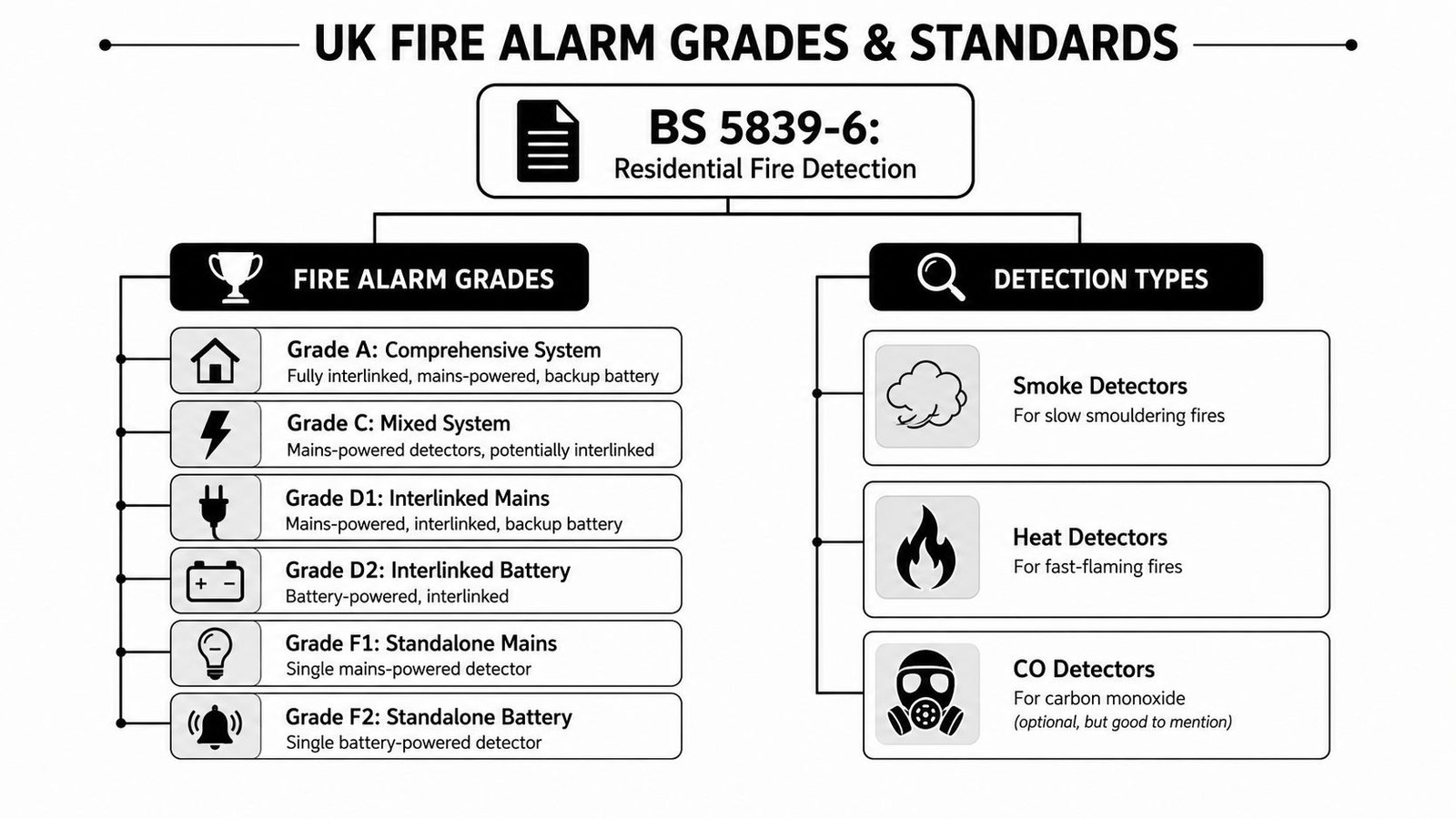
The UK standard that shapes residential fire detection is BS 5839-6, which defines grades A to F and coverage categories such as LD1 to LD3. It also makes clear that Grade A systems with LD1 coverage are the benchmark for high-risk dwellings, as explained in this guide to UK fire alarms.
Think of it this way. Grade tells you how the system is engineered. Category tells you how much of the home it protects. If you mix those up, quotes become hard to compare and installers can talk past you.
Grades tell you how the system is built
A simple analogy is car safety specification. Two cars can both get you from Cardiff to Bristol, but they won't offer the same crash protection, braking support, or stability. Fire alarm grades work in a similar way.
- Grade A usually means a more complete system with dedicated control equipment. It suits larger or higher-risk dwellings where a more advanced arrangement is justified.
- Grade D is familiar in many domestic settings. You're typically looking at mains-powered alarms with battery backup, often interlinked.
- Grade F is at the simpler end. These are standalone battery or mains units and are usually the simplest option.
For homeowners, the practical question is this. Are you protecting a small flat with straightforward escape routes, or a multi-storey home with bedrooms far from the kitchen, loft conversion, garage access or annex areas? The more complex the layout, the less sensible it is to rely on isolated devices.
A useful companion piece if you're comparing legal duties and system design in more detail is this guide on mastering fire safety compliance in 2026.
Categories tell you where detection goes
Coverage categories are about room placement. They matter just as much as the hardware grade.
| Category | What it means in practice | Best fit |
|---|---|---|
| LD1 | Detection in all circulation spaces and all rooms or areas that present a fire risk | Homes needing the highest practical level of life protection |
| LD2 | Detection in circulation spaces and defined high-risk rooms | Many family homes where broader protection is wanted without full-property coverage |
| LD3 | Detection focused on escape routes such as hallways and landings | Basic life protection where the goal is warning during escape |
A good installer should be able to walk through your home and explain why each detector is in each room. If the explanation is vague, the design probably is too.
What homeowners should take from the jargon
Don't get lost in letters. Ask what you're buying.
You want to know whether the alarms are mains-powered, whether they're interlinked, what backup power they have, what rooms are covered, and how the design supports escape during the night. Those questions cut through jargon quickly.
Choosing Your System Types and Detectors
System choice should match how the house is built and how people live in it. A compact two-storey terrace in Newport usually needs something different from a large detached property in Somerset with a loft conversion, garage, and a long hallway that separates sleeping areas from the kitchen.
Conventional or addressable in a home setting
For many homeowners, the easiest way to understand this is by comparing a street name with a full postcode.
A conventional system tells you the alarm has come from a zone, such as downstairs, upstairs, or the garage. That is often perfectly workable in a smaller home where the source is easy to find quickly. It also tends to keep equipment and installation costs lower. If you want a clearer picture of how zoned domestic setups work, this guide to conventional fire alarm systems explains the basics well.
An addressable system identifies the exact detector or call point in alarm. In a larger house, that can save time and confusion, especially at night or when part of the property is used differently from the rest, such as an annex, home office, or converted outbuilding. The trade-off is cost. The hardware is usually dearer, and there is more programming involved.
In practice, many standard family homes do not need the extra granularity of addressable equipment. Some do. The right question is not which system sounds more advanced. It is whether pinpoint identification would make a real difference in your property.
Interlinking in England and Wales. Good practice versus legal myth
This is one of the most common points of confusion I hear from homeowners in South Wales and the South West.
Many people have absorbed UK-wide advice that reflects Scottish rules, then assume the same legal duty applies everywhere. In England and Wales, the better approach is to separate legal minimums from sensible design. Interlinked alarms are often the better answer in real homes because a fire starting downstairs needs to wake people upstairs early enough to react. That matters even more in houses with closed bedroom doors, split landings, or background noise from fans, dehumidifiers, or TVs left on late.
So the myth needs correcting in both directions. Interlinking is not a magic legal phrase that applies uniformly across the UK, but it is also not an optional extra to dismiss on cost alone. In many houses, it is the difference between hearing an alarm promptly and hearing it too late.
Why kitchen advice is often oversimplified
“Just fit a heat alarm in the kitchen” is common advice. It is incomplete.
Heat detection is usually the right starting point in kitchens because smoke alarms near normal cooking activity can cause nuisance alarms. But heat alarms do not solve every kitchen problem. Open-plan layouts, strong extractor fans, poor ventilation, high ceilings, and the exact position of the hob all affect how well a detector performs. A badly placed heat alarm can respond too slowly, while the wrong smoke detector nearby can still false alarm from toast, steam, or frying.
That is why room layout matters as much as detector type. In a closed kitchen, a heat alarm is often straightforward. In a kitchen-diner that opens onto the escape route, the design needs more thought because the circulation space may still need smoke detection positioned carefully enough to avoid constant unwanted activations.
Detector choice should follow room use
Different rooms fail in different ways. The detector should reflect that.
- Hallways and landings: Usually smoke detection, because these are the main escape routes and early warning matters most here.
- Bedrooms: Often smoke detection, especially where occupants may be asleep with doors closed.
- Kitchens: Usually heat detection, but placement must account for cooking position, airflow, and whether the room is open plan.
- Integral garages: Heat detection is often the safer fit because exhaust fumes, dust, and temperature swings can make smoke detection unreliable.
- Loft conversions: These often need more careful thought than homeowners expect because sloping ceilings, stairs, and longer escape routes change how detection should be arranged.
Multi-sensor detectors can also make sense in selected parts of the home. They are useful where one sensing method on its own would be too blunt an instrument. They are not a cure-all, and they cost more, but in the right location they can reduce nuisance alarms without giving up sensible response.
Cheap multi-packs rarely account for any of this.
A good domestic design uses the detector type that suits the room, the risk, and the likely nuisance conditions. That is how you avoid the two failures I see most often. Alarms that trigger so often they get ignored, and alarms that are too sparse or too badly chosen to give enough warning when it counts.
The Professional Installation Process Explained
The installation process feels much less daunting when you know what should happen and in what order. A professional job is usually calm, methodical and far less disruptive than homeowners expect.
A key reason to use a competent installer is that placement rules aren't guesswork. BS 5839-6 requires smoke detector sensing elements to be installed between 25mm and 600mm below the ceiling, while heat detectors should sit 25mm to 150mm below, as set out in the FIA guide to BS 5446-4 and detector positioning. If those details are ignored, a costly system can respond too slowly or unreliably.
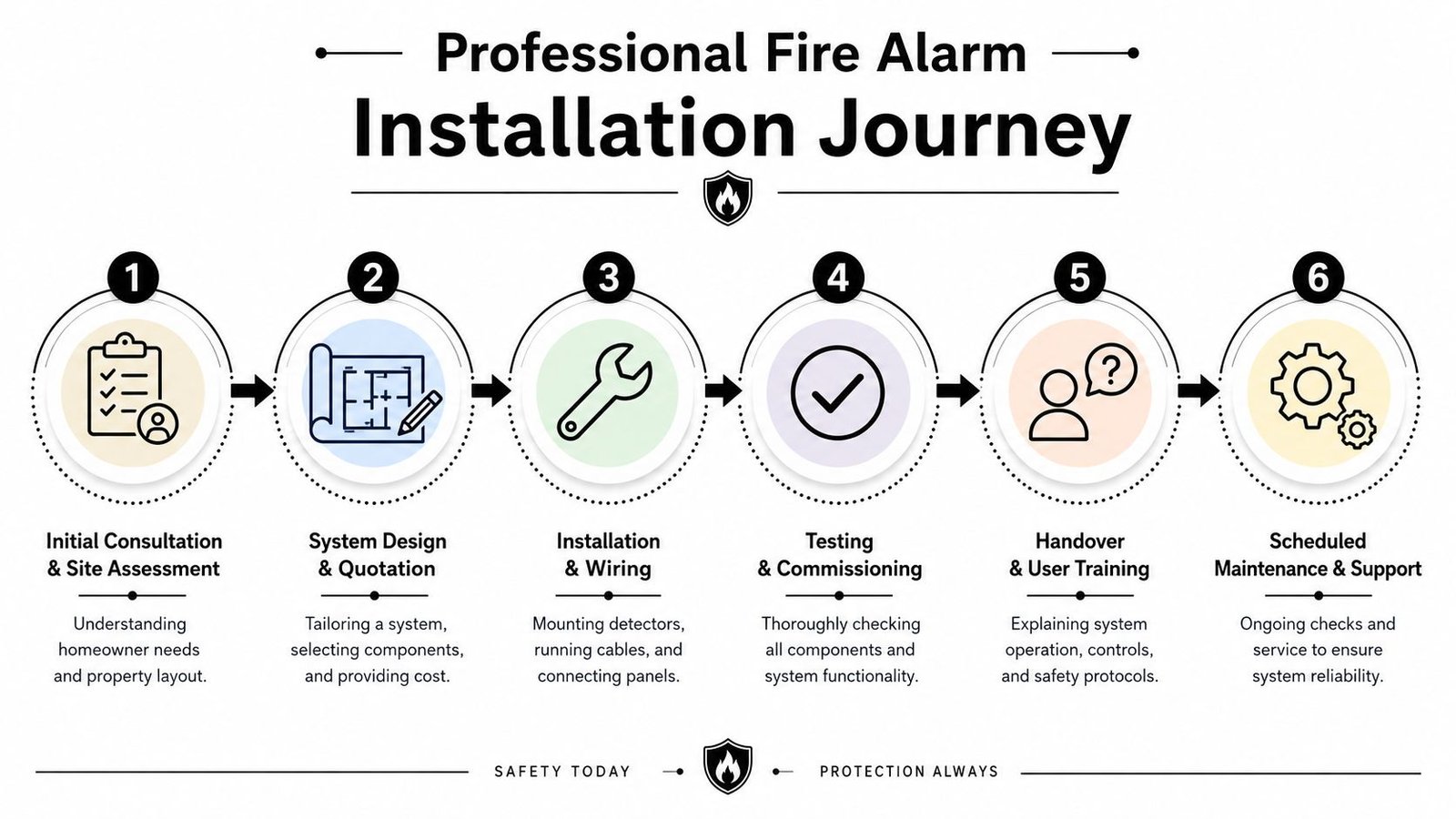
Here's the overall journey most homeowners should expect:
What happens before any drilling starts
A proper installer starts with the property, not the product catalogue. They'll look at storeys, escape routes, kitchen position, ceiling shapes, doors that are usually kept shut, and whether there are vulnerable occupants such as children, older relatives or anyone with reduced mobility or hearing.
Then the design is matched to the house. That includes detector types, likely sounder positions, power arrangements, and whether you'd benefit from a simple domestic interlinked setup or something more structured. If you want to see what a dedicated service usually includes, this page on fire alarm installation gives a practical overview.
A short explainer can also help visualise the process before you book a survey:
Installation commissioning and handover
On the day itself, good engineers work neatly. Cable routes should be planned, visible hardware kept tidy, and detector placement checked against both standards and room use. In lived-in homes, there's always a balance between best technical position and practical aesthetics. The right installer will explain those trade-offs clearly instead of hiding them.
After fitting comes commissioning. Each device is tested, sounders are checked, interlinking is confirmed, and the homeowner is shown how to test the system, silence a nuisance activation safely, and understand any fault indicators.
The handover matters almost as much as the installation. A system you don't understand is a system you won't maintain properly.
Monitoring Maintenance and Smart Home Integration
Many domestic systems are bell-only. They sound locally and depend on someone hearing them. That's suitable for many households, but it has limits. If nobody is home, the system can only alert whoever happens to be nearby.
Bell-only or monitored
A monitored system adds another layer of response. Depending on the setup, alerts can be relayed to a monitoring centre, to your phone, or into a wider property protection arrangement. For homeowners who travel often, leave a property vacant for long periods, or manage a second home, that extra visibility can be valuable.
If you're weighing the pros and cons of monitoring providers and service expectations, this guide on choosing a fire alarm provider is worth reading before you compare contracts.
Maintenance keeps the system trustworthy
Even a well-designed system will drift out of reliability if it's ignored. Detectors get dusty. Batteries age. Homeowners redecorate around devices. Builders alter room airflow. Someone silences a recurring nuisance alarm and forgets to report it.
A sensible maintenance routine usually includes:
- User testing at regular intervals so you know the sounders, interlinking and indicators still work.
- Professional servicing to inspect detector condition, contamination, power supply health and system operation.
- Prompt fault reporting because small faults have a habit of appearing at the worst possible moment.
The big mistake is assuming that because nothing has beeped for months, everything must be fine.
Where smart integration actually helps
Smart home integration is useful when it improves response, not when it adds novelty. A fire alarm linked to a phone app can notify you while you're away. A system linked to CCTV can help you verify what's happening faster. In some integrated setups, doors can release to aid escape, or lighting can support a safer route out.
The best integrated systems behave like a team. The fire alarm detects, the camera confirms, the access system helps movement, and the homeowner gets clear information instead of fragmented alerts from separate apps.
That's far better than a pile of disconnected devices all claiming to be “smart”.
Understanding the Costs of a Home Fire Alarm System
Many articles become frustrating because they either dodge the question or throw out invented price bands. The honest answer is that the cost depends on design decisions, house size, finish expectations and whether you want extras like monitoring or integration.
What affects the initial price
The biggest cost drivers are usually:
| Cost factor | Why it changes the quote |
|---|---|
| Property layout | More floors, awkward access, loft conversions and detached garages all affect device count and labour |
| System grade and coverage | Broader coverage and more advanced equipment increase hardware and commissioning time |
| Wiring route complexity | Finished décor, solid walls and limited cable paths make neat installation more demanding |
| Detector mix | Different rooms may need different sensing methods rather than one uniform device everywhere |
| Integration options | Linking with CCTV, access control or remote alerts adds design and setup work |
A small, straightforward property can often be protected with a simpler interlinked domestic arrangement. A larger family home with several risk areas may justify a more engineered system. Neither is automatically “better”. The question is whether the design matches the risks.
Ongoing costs you should expect
The second part of the budget is the one homeowners forget. There may be ongoing charges for:
- Maintenance visits to test and service the system
- Monitoring if you choose a remotely managed response arrangement
- Battery replacement or component renewal as devices age
- Call-outs if faults or nuisance activations need investigation
The cheapest quote often trims the part that matters later. You see it in vague maintenance terms, no clear servicing scope, or hardware that's difficult to support once installed.
Ask for two figures, not one. The installation cost tells you what it takes to get the system in. The annual ownership cost tells you whether it will still be dependable in a few years.
A good quote should separate those clearly and explain what's included.
How to Choose a Reputable UK Fire Alarm Installer
The installer matters almost as much as the equipment. Good hardware fitted badly is still a bad system. For homeowners in South Wales and the South West, the safest approach is to judge providers on competence, accountability and support, not just who can visit first.
Credentials that matter
Start with credentials you can verify and standards they can explain in plain English. The strongest installers usually show a mix of technical competence, insurance cover, and proper vetting of the people entering your home.
Use this checklist as a baseline:
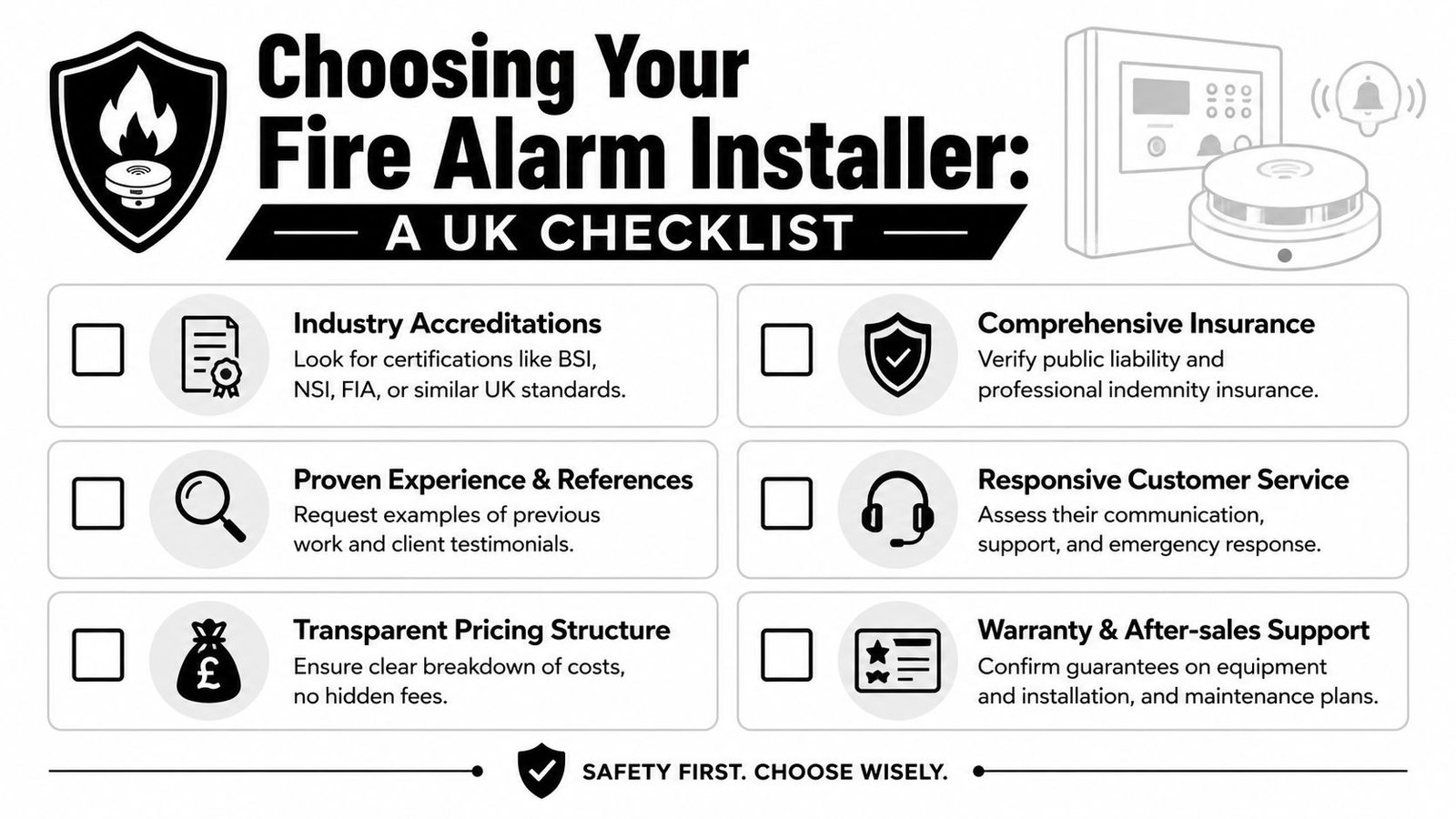
A credible provider should be able to show:
- Relevant accreditations tied to UK fire and security work
- Insurance cover that protects both the company and the customer
- Documented experience with domestic properties similar to yours
- Clear aftercare arrangements for servicing, faults and future upgrades
- Vetted engineers who are trustworthy in occupied homes
For a homeowner, that last point matters more than many realise. You're not hiring a van and a ladder. You're inviting people into your home to work on life-safety equipment.
Questions worth asking before you accept a quote
Don't just ask what it costs. Ask how the design was decided.
A capable installer should answer questions like these without hiding behind jargon:
| Question | What a good answer sounds like |
|---|---|
| Why have you recommended this grade and coverage? | A room-by-room explanation linked to escape routes and risk areas |
| Why is this detector type going in this room? | Practical reasoning based on use, nuisance conditions and response characteristics |
| Will the alarms be interlinked, and why? | A clear justification based on house layout, not a vague claim about “UK law” |
| What maintenance will I need after installation? | Specific servicing expectations and who is responsible for what |
| What happens if I have repeated nuisance alarms? | A process for investigation, repositioning or device review rather than “just silence it” |
The best installers don't rush your questions. They welcome them, because they know a fire alarm system should be understood by the people living with it.
There's also value in choosing a company that works locally and knows the housing stock in your area. A Victorian terrace in Bristol, a new-build in Newport, and a rural detached property outside Swansea present different fitting challenges. Local experience shows up in the details.
Frequently Asked Questions About Home Fire Alarms
Some questions come up in nearly every homeowner conversation, especially when people are comparing DIY products with a professionally specified system. The short answers below should clear up the most common points of confusion.
| Question | Answer |
|---|---|
| Is a DIY store smoke alarm the same as a proper home fire alarm system? | No. A standalone alarm can be useful, but a proper system is selected and positioned as part of an overall design for your property, escape routes and risk rooms. |
| Do I really need professional installation? | If you want a system that aligns with UK standards and performs properly, yes. Detector type and placement make a major difference to how fast the alarm responds and how often it causes nuisance activations. |
| Are interlinked alarms legally required in England or Wales? | Not as a blanket rule in the same way many people assume from Scottish guidance. They're often a very good idea, but legal minimums and best practice aren't always identical. |
| Should I put a smoke alarm in the kitchen? | Usually, a heat alarm is more suitable in kitchens. Even then, placement matters because steam, humidity and airflow can still cause nuisance issues if the device is badly positioned. |
| How long do detectors last? | Components don't last forever. Follow the manufacturer's guidance and include the system in a maintenance routine so ageing devices and backup issues are picked up in time. |
| Can a home fire alarm work with other security systems? | Yes. Some setups can link with monitoring, CCTV, lighting or access arrangements, which can improve visibility and response when used sensibly. |
| Will pets trigger fire detectors? | Pets aren't usually the issue for fire detectors in the same way they can be for some intruder sensors. The bigger concern is using the correct detector type and fitting it in the correct place. |
A final point. The best fire alarm systems home setups are rarely the flashiest. They're the ones that suit the building, avoid obvious nuisance problems, and are maintained well enough that you trust them every night.
If you want help designing a practical, standards-based home fire alarm setup in South Wales or the South West, Wisenet Security Ltd offers free consultations, professional installation, and ongoing maintenance across Cardiff, Bristol, Newport, Swansea and surrounding areas. Their team handles fire alarm systems as part of a wider security approach, so if you need monitoring, CCTV integration or a full home protection plan, you can discuss the options with one local specialist.