Smoke Detectors in Rental Properties: A Landlord’s Guide
A lot of landlords only start thinking seriously about smoke detectors in rental properties when a tenancy is about to begin, a tenant reports a fault, or an inspection notice lands in the post. That's usually when the practical questions surface all at once. Is a battery alarm enough, or does this property need a mains-powered interlinked system? Should there be a smoke alarm in the kitchen, or a heat alarm? If the detector starts chirping halfway through the tenancy, who's responsible for sorting it?
Those are exactly the points where many otherwise diligent landlords get caught out. The broad rule sounds simple. Install alarms and keep them working. In practice, compliance depends on property type, region, alarm type, and how clearly you separate your duties from the tenant's. If you own or manage property in England, Wales, South Wales, or the South West, getting the detail right matters.
If you manage property in more than one country, it also helps to remember that fire alarm rules vary widely by jurisdiction. For example, landlords comparing standards internationally may find resources on Queensland smoke alarm laws 2026 useful for seeing how interlinked requirements are handled elsewhere, even though your compliance duties here are set by UK rules.
Table of Contents
- Your Guide to Navigating Fire Safety Compliance
- Understanding Your Legal Obligations as a Landlord
- Choosing and Placing Alarms for Maximum Safety
- Landlord vs Tenant A Clear Division of Duties
- HMOs and Integrated Fire Alarm Systems
- Your Practical Compliance and Maintenance Checklist
- Frequently Asked Questions for Landlords
Your Guide to Navigating Fire Safety Compliance
A landlord gets a letter from the council about a routine inspection. The property has alarms fitted, so at first glance it feels manageable. Then the doubt creeps in. Are they the correct type, in the correct places, and still within date? That's the point where broad assumptions stop being useful.
I see the same pattern repeatedly with smoke detectors in rental properties. The issue usually isn't that nothing has been installed. It's that the system was fitted in stages over several years, perhaps by different contractors, with a battery unit in one hallway, an older detector on the landing, and a kitchen smoke alarm that goes off whenever someone fries food. On paper, the landlord believes the property is covered. In reality, the setup may be awkward, incomplete, or non-compliant.
Practical rule: Fire alarm compliance is rarely about having “an alarm somewhere”. It's about having the correct alarm, in the correct room, mounted properly, and maintained properly.
The stakes are not theoretical. In licensed properties, non-compliance with mandatory standards can lead to a civil penalty of up to £30,000 under the Northern Ireland regulations, and standard non-compliance can carry up to £5,000 depending on the circumstances and property context, as set out in the Northern Ireland alarm requirements update.
Most landlords don't need more jargon. They need a working decision path. Know the minimum legal baseline for your region. Choose the right alarm type for each area. Be clear about who handles testing, battery issues, and repairs once the tenancy starts. Keep records. Those four habits solve most problems before an inspector, insurer, or tenant raises them.
Understanding Your Legal Obligations as a Landlord
The legal starting point differs by nation, and that's where many landlords trip up. A property in England may lawfully operate to a lower alarm standard than an HMO, a Welsh rental, or a Scottish home. If you own across different areas, don't assume one setup works everywhere.

England and Wales basics
For rental properties in England and Wales, the minimum legal requirement is at least one smoke alarm on every storey used as living accommodation, and carbon monoxide alarms are required in any room containing a fixed combustion appliance, excluding gas cookers, positioned at head height and 1 to 3 metres from the source, according to the NRLA guidance on smoke and carbon monoxide requirements.
That “every storey used as living accommodation” point matters. If tenants use a converted loft, basement room, or upper floor as part of day-to-day living, that level needs to be covered. Hallways and landings are usually the right places for smoke detection because they protect escape routes.
In England, the baseline is simpler than in Wales or Scotland, but simple doesn't mean casual. The alarm still has to be working, in date, and fit for the property.
The same NRLA guidance states that alarms should be replaced before or on expiry, typically 10 years from manufacture, because sensor degradation over time can reduce detection sensitivity by up to 40%. That's one of the clearest reasons not to leave old devices in place just because the test button still works.
Where Wales and Scotland become stricter
Wales takes a more demanding approach. Best practice becomes much closer to a compliance requirement because mains-powered interlinked alarms on each storey are required under Welsh fitness rules, while HMOs and properties in Wales and Scotland require mains-powered interlinked alarm systems as a higher standard than the battery-powered units that may still be acceptable in a standard single let in England, as explained in the same NRLA fire alarm requirements resource.
Scotland is stricter again on interlinking across homes. Northern Ireland's clarified rules also underline the importance of ceiling-mounted and interlinked smoke and heat alarms in rental settings, with at least one smoke alarm in the room most frequently used for daytime living, smoke alarms in circulation spaces on each storey, and a heat alarm in every kitchen, as outlined by the Department for Communities in Northern Ireland.
What landlords should do in practice
If you're trying to avoid under-specifying a system, this is the safest working method:
- Check the property region first: England, Wales, Scotland, and licensed HMO standards are not interchangeable.
- Check the tenancy type second: A single let and an HMO should never be treated as the same risk profile.
- Check alarm age third: If the manufacture or expiry date is approaching, replacement is usually the sensible move.
- Check interlinking last: If the property falls into a category where interlinking is required, standalone replacements won't solve the problem.
Landlords who use agents should still understand the standard being applied. If a managing agent handles inspections and tenancy setup, it's worth comparing their process against specialist Property management solutions and your own fire risk records, so nothing slips between contractor, agent, and owner.
For a practical compliance overview specific to system design and maintenance obligations, this fire safety compliance guide is a useful place to sense-check your current setup.
Choosing and Placing Alarms for Maximum Safety
Alarm selection is where compliance and common sense need to work together. Fitting the wrong detector in the wrong room creates two failures at once. You either get nuisance activations that tenants start ignoring, or you leave a real risk area badly protected.
Use the right alarm for the room
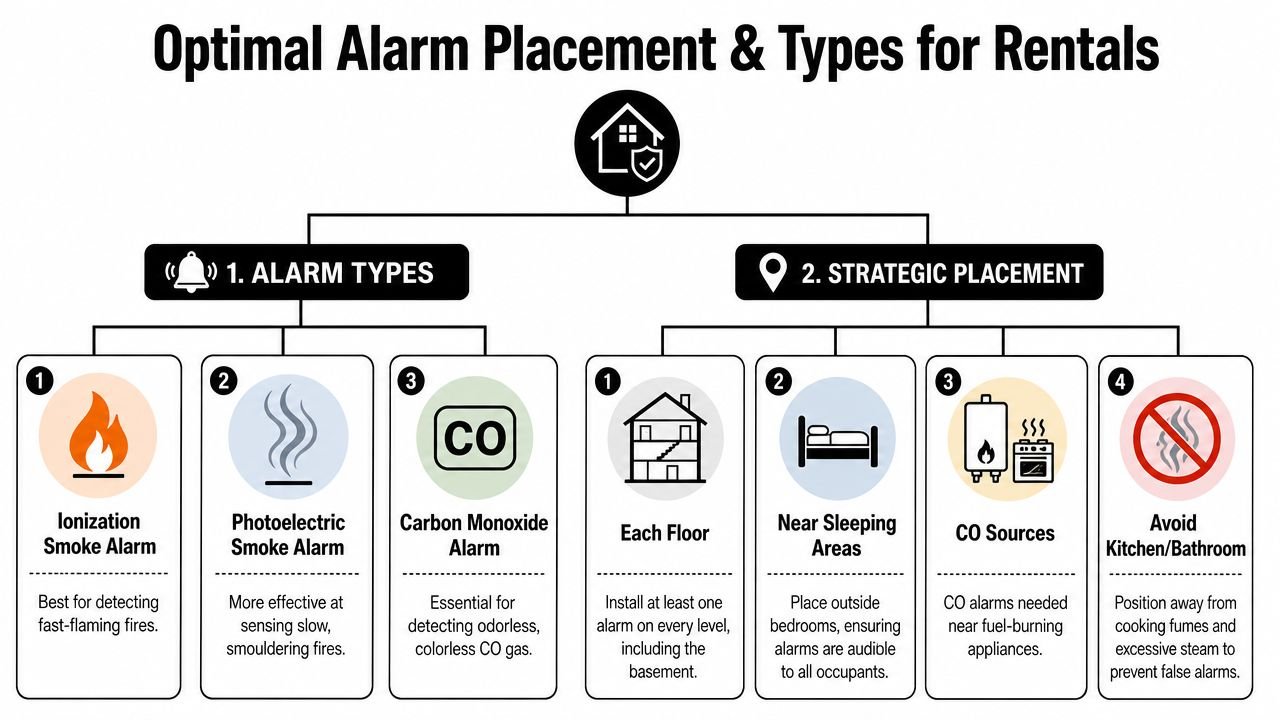
The kitchen is the clearest example. A heat alarm belongs there, not a smoke alarm. Cooking fumes and aerosols are a leading cause of nuisance false alarms in residential settings, which is why the kitchen needs heat detection rather than smoke detection under the stricter approaches used in Wales and Scotland.
The practical reason is simple. A smoke alarm above or near a kitchen area often trains tenants to silence, cover, or disable it. That turns a safety device into a frustration. A heat alarm reduces those nuisance call-outs while still giving protection where fire risk is genuine.
Fit smoke alarms to escape routes and living areas. Fit a heat alarm to the kitchen. Don't swap one for the other because they are not serving the same purpose.
A practical room by room layout
A sensible layout in a standard rental usually looks like this:
- Living room or main daytime room: A smoke alarm, especially where the room is used regularly and forms part of the main occupancy pattern.
- Hallways and landings: Smoke alarms to protect circulation spaces and the escape route on each occupied storey.
- Kitchen: A heat alarm, ceiling-mounted.
- Room with a fixed combustion appliance: A carbon monoxide alarm fitted in line with applicable rules.
If you're working out coverage for an awkward layout, split-level property, or conversion, this guide on how many smoke detectors you need helps frame the decision around storeys, circulation spaces, and room use.
This short video gives a straightforward visual reminder of how domestic alarm setups are commonly approached in practice.
Why interlinking changes the level of protection
Interlinking means that if one alarm activates, all linked alarms sound at the same time. In a small flat, that may seem like an upgrade. In a house with several rooms, separate floors, or sleeping occupants behind closed doors, it becomes far more important.
Using a heat alarm in kitchens is critical to avoid nuisance alarms from cooking. In Wales, where fitness regulations require mains-powered, interlinked alarms on each storey, and in Scotland, where all alarms must be interlinked, that kitchen heat alarm must be connected to the smoke alarms in hallways and living areas. Failure to do so can lead to non-compliance and penalties of up to £5,000, according to this explanation of smoke alarm regulations in rental properties.
What doesn't work is mixing isolated devices and assuming proximity is enough. A hallway smoke alarm may never be heard clearly in a rear bedroom with the door shut. Interlinking fixes that weakness by turning separate detectors into one warning system.
Landlord vs Tenant A Clear Division of Duties
Most disputes over smoke detectors in rental properties happen after installation, not before. The alarms are in. The tenancy has started. Then one unit chirps, another fails a test, or a tenant says they thought battery changes were your job. That's where vague tenancy wording causes trouble.
Where the landlord's duty starts and stays
A landlord's core obligations are the fixed ones. You install the required alarms. You make sure they're working at the start of the tenancy. If a tenant reports a fault, you arrange repair or replacement promptly.
That duty becomes clearer with sealed-battery and mains-wired units. Where the alarm is a modern sealed device or part of a wired interlinked system, the issue is not routine household upkeep in the ordinary sense. It is part of the property's safety infrastructure.
What tenants should do during the tenancy
Tenants still have an active role. They should test alarms in line with the instructions you give them, avoid tampering, and report faults as soon as they notice them. A tenant who removes a battery, covers a detector, or ignores repeated warning chirps creates a risk for everyone in the building.
A good tenancy handover includes two things. Demonstrate the alarms working, and tell the tenant exactly how faults must be reported.
That second point matters more than many landlords realise. If the tenant knows to report a problem in writing straight away, you create a clean timeline for response and a record that can help if there's later a dispute about maintenance.
The battery issue that causes most disputes
The grey area is battery replacement. Older guidance often assumes tenants replace user-changeable batteries during the tenancy. Modern systems don't always fit that model.
While landlords must repair or replace faulty alarms promptly after a tenant reports an issue, ambiguity often exists around battery changes. For modern sealed-battery or mains-wired units, this falls under the landlord's repair obligation. Confusing this duty can lead to non-compliance and potential fines of up to £5,000, a risk heightened since regulations were extended to social housing in October 2022, as set out in this landlord guide to smoke detector regulations.
Here's the clearest way to allocate responsibility in writing:
| Task | Landlord Responsibility | Tenant Responsibility |
|---|---|---|
| Initial installation | Install the correct alarm types in the required locations | Allow access if arranged before move-in |
| Start of tenancy testing | Confirm alarms are working on day one | Witness testing where possible |
| Fault repair | Repair or replace faulty alarms after report | Report faults promptly |
| Sealed-battery unit failure | Replace the unit or arrange repair | Notify landlord or agent |
| Mains-wired alarm fault | Arrange qualified repair | Report issue quickly |
| Routine user test | Provide instructions and expectations | Press test button as instructed |
| Tampering prevention | Fit compliant tamper-resistant equipment where required | Do not remove, cover, or disable alarms |
If your property uses sealed units, say so in the tenancy pack. If it uses replaceable batteries in older alarms, spell out what the tenant should do and when to report instead of attempting a fix.
HMOs and Integrated Fire Alarm Systems
A House in Multiple Occupation needs a different mindset. The risk profile changes because more occupants are using shared routes, doors are often closed, daily routines differ, and the chance of a delayed response rises. A battery alarm approach that may scrape by in a basic single let isn't the right benchmark here.
Why single let thinking fails in HMOs
HMOs typically require a mains-powered interlinked system and a more robust overall fire safety design. That means the system has to behave as one network, not as separate devices dotted around the building.
In licensed HMOs, non-compliance with advanced fire safety standards, including mains-powered interlinked alarms, can carry a civil penalty of up to £30,000. Those systems must ensure that if one alarm activates, all alarms sound simultaneously, according to the Northern Ireland private rental alarm requirements.
The practical consequence is straightforward. If you are still thinking in terms of “how many battery alarms do I need”, you're probably asking the wrong question for an HMO.
What an integrated system looks like in practice
In larger or more complex properties, a better answer is often an integrated fire alarm system rather than a collection of domestic standalone alarms. That can include detectors linked to a control panel, emergency lighting, sounders in the right zones, and planned maintenance that isn't dependent on a tenant remembering to mention a problem.
A properly integrated setup does two useful things for landlords. It improves response across the building, and it simplifies management because faults, test routines, and maintenance sit inside one organised system rather than across mixed devices from different eras.
In shared buildings, consistency matters almost as much as coverage. Mixed alarm types and piecemeal upgrades create blind spots in management even when every room appears to have a detector.
For landlords of larger HMOs, blocks, or converted properties, the gold standard is not just legal minimum compliance. It's a system that can be inspected, tested, maintained, and understood without guesswork.
Your Practical Compliance and Maintenance Checklist
Compliance becomes much easier when you stop treating it as a one-off installation job. The landlords who stay out of trouble usually follow a repeatable routine for every new tenancy and every periodic check.
Before the tenancy starts
Handle the property as if an inspection were due next week.
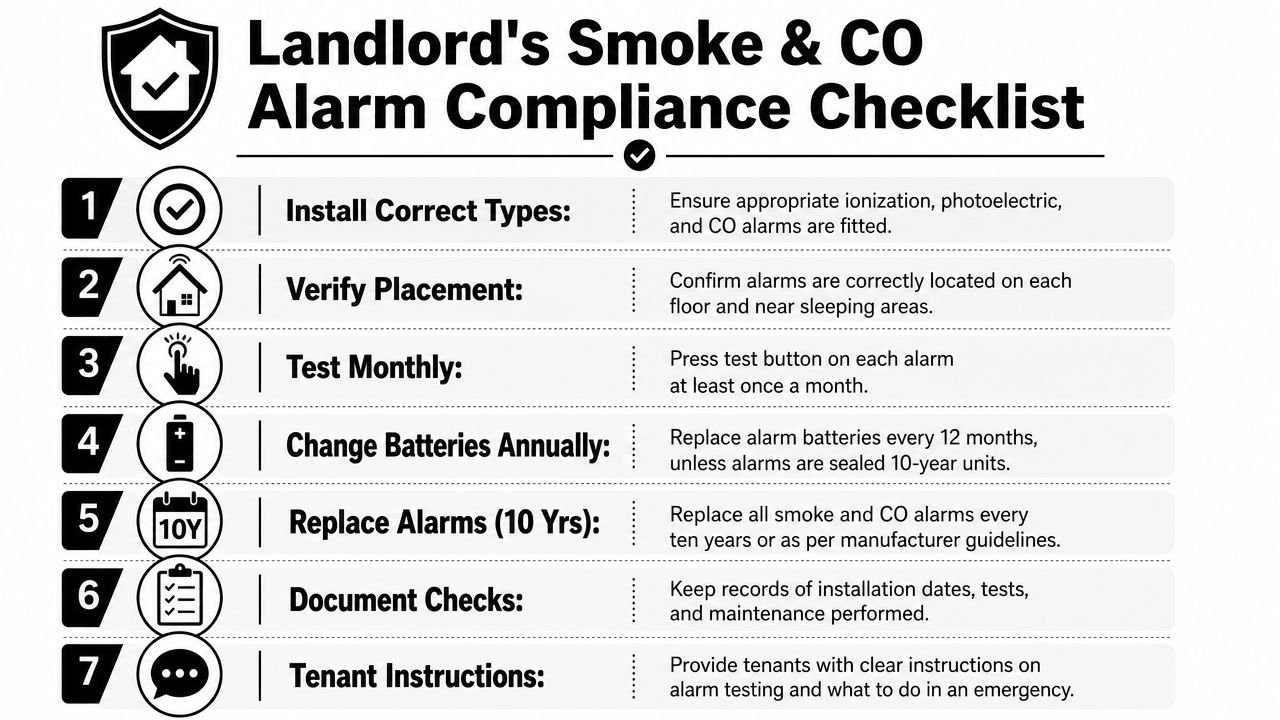
- Match alarms to the property: Check whether the property is in England, Wales, Scotland, or licensed as an HMO, then specify alarms accordingly.
- Check expiry dates: Replace any unit that is at or near its service life rather than carrying risk into a new tenancy.
- Confirm placement: Living room, circulation spaces, kitchen heat alarm, and carbon monoxide coverage where required.
- Check interlinking: In properties where alarms should operate together, test the whole chain, not just individual heads.
A structured property inspection process helps here. If you already use a move-in checklist, adapting ideas from Edinhart's rental property inspection guide can help keep alarm checks documented alongside the rest of the property condition report.
On move in day
Landlords often miss easy evidence.
Test each alarm with the tenant present if possible. Record that the system was working at handover. Give the tenant a short written instruction sheet covering routine testing, what the warning sounds mean, and how to report faults.
Don't bury this in a long tenancy booklet. A one-page instruction sheet usually works better because tenants read it.
During the tenancy
Once the tenancy is live, keep the process tight and documented.
- Require prompt fault reporting: Email or portal reporting is better than verbal messages because it creates a record.
- Respond based on alarm type: A mains-wired or sealed-battery issue should be treated as a repair matter, not an informal battery discussion.
- Keep dated records: Log reports, call-outs, replacements, and any tenant instruction issued.
- Carry out periodic checks: Use inspections to confirm alarms haven't been covered, removed, painted over, or replaced with non-matching units.
If you want a cleaner schedule for routine checks, this advice on how often fire alarms should be tested is a practical benchmark for setting reminders and maintenance habits.
A paper trail matters. If a tenant later says the alarms never worked, or an inspection questions your compliance, your records are what turn a vague defence into a credible one.
Frequently Asked Questions for Landlords
Can I install the alarms myself?
Sometimes, yes. Whether that's sensible depends on the system type. A straightforward standalone alarm swap is very different from fitting a mains-powered interlinked system. If the property needs interlinking, wiring, or HMO-level protection, a professional installation is usually the safer route because layout, testing, and documentation all matter.
What proof should I keep?
Keep the basics together in one place. Installation dates, alarm model details, expiry dates, photographs, tenancy handover notes, fault reports, and repair records are the core documents. If an inspection happens, you want to show not just that alarms exist, but that you actively manage them.
What if a tenant tampers with an alarm?
Treat it as a safety issue, not just a tenancy annoyance. Instruct the tenant in writing to stop using the property without a working alarm setup, restore safe operation quickly, and keep records of what you found and what you did in response. If the issue repeats, escalate through your formal tenancy process.
Do I need a smoke alarm in the kitchen?
For the kinds of properties covered earlier, the practical answer is no. The kitchen is where a heat alarm is usually the correct choice because it avoids nuisance activations from cooking while still giving proper protection.
Is one alarm per storey always enough?
Not always. It may be the legal minimum in some cases, but layout, occupancy type, and local requirements can push the correct solution higher. HMOs, Welsh properties, and interlinked systems often need a more considered design than the bare minimum.
If you want a professional second opinion on smoke detectors in rental properties, Wisenet Security Ltd provides fire alarm design, installation, maintenance, and integrated safety systems across South Wales and the South West. For landlords, agents, and HMO operators, that means practical help with compliant alarm layouts, interlinked systems, fault diagnosis, and ongoing maintenance that stands up to inspection.