
How Many Smoke Detectors Do I Need? a UK Guide for 2026
In the UK, the starting point is at least one smoke alarm on every storey. For many homes that means two alarms minimum in a two-storey property and three in a three-storey home, but that's only the legal floor, because the actual number depends on your layout, your use of the building, and whether you're a homeowner, landlord, or running a business.
This is a common sticking point. You search for how many smoke detectors do I need, one page says one per floor, another says one in every bedroom, and a third starts talking about standards without clarifying what specifically applies to your house in Cardiff, your rental in Newport, or your shop unit in Bristol.
From a fire system design point of view, the number is never the whole answer. A badly chosen alarm in the wrong place can be almost as unhelpful as no alarm at all. I see this regularly in domestic properties across South Wales. One detector sits above a stairwell, the kitchen alarm gets silenced because it keeps going off, and nobody can hear the landing unit clearly once bedroom doors are shut.
The practical answer is to separate minimum compliance from proper protection. If you do that first, the rest becomes much easier.
Table of Contents
- Why Asking How Many Smoke Detectors Is Just the Start
- The Legal Minimum vs Best Practice Protection
- Choosing the Right Type of Detector for Each Location
- Optimal Smoke Detector Placement in Your Home
- Fire Alarm Requirements for Businesses and Landlords
- Installation Maintenance and Local South Wales Compliance
- Your Smoke Detector Questions Answered
Why Asking How Many Smoke Detectors Is Just the Start
People usually ask the question when they're already trying to do the right thing. They've moved house, renovated a loft, taken on a rental, or realised the existing alarms look older than they should. The problem is that “how many” sounds like a simple counting exercise when it's really a design question.
A small flat, a Victorian terrace, a modern townhouse, and a warehouse office all behave differently in a fire. Smoke movement changes with ceiling height, door positions, open-plan layouts, and how people use the building. A detector that works well on a first-floor landing might be the wrong choice in a kitchen-diner or a long corridor in an HMO.
The number follows the risk
The count should come after you answer a few practical questions:
- What type of property is it. Owner-occupied home, rented house, HMO, office, retail unit, workshop, or mixed-use building.
- How is it laid out. Open-plan spaces, separate bedrooms, long escape routes, split levels, loft conversions, and basements all matter.
- What's happening in each area. Kitchens, sleeping spaces, plant rooms, stock rooms, and circulation routes need different thinking.
- Who needs warning. A family in bed, tenants on different floors, or staff spread across a unit won't all hear a single alarm in the same way.
Practical rule: Count alarms after you've mapped the escape routes, sleeping areas, and nuisance-alarm risks.
That's where many generic guides fall short. They give a broad recommendation but don't separate legal obligation from the standard you'd choose if you wanted early warning and a realistic chance of safe escape.
South Wales properties often need a bit more thought
Across South Wales and the South West, a lot of the stock isn't simple box-shaped new build housing. You've got terraces with narrow stair cores, maisonettes over shops, extensions that create dead spots, and open-plan refurbishments where a kitchen sits close to the main living route. Those layouts can make a basic one-per-floor approach feel compliant on paper and weak in practice.
For domestic and commercial systems alike, the better approach is straightforward. Start with the minimum that applies to your property, then improve the coverage where sleeping, escape, and compartmentation make a delay more dangerous.
The Legal Minimum vs Best Practice Protection
A landlord with a three-storey terrace in Newport can fit one alarm on each level and meet the basic rule for an English rental. That still may not give the people sleeping on the top floor the earliest warning if a fire starts in a rear ground-floor room with doors shut. That gap between compliance and real protection is where many property owners get caught out.
For rented homes in England, the baseline requirement is set out in the Smoke and Carbon Monoxide Alarm (Amendment) Regulations 2022 on GOV.UK. In simple terms, that means at least one smoke alarm on each storey used as living accommodation, plus a carbon monoxide alarm in rooms with a fixed combustion appliance. That is a legal floor, not a design target.
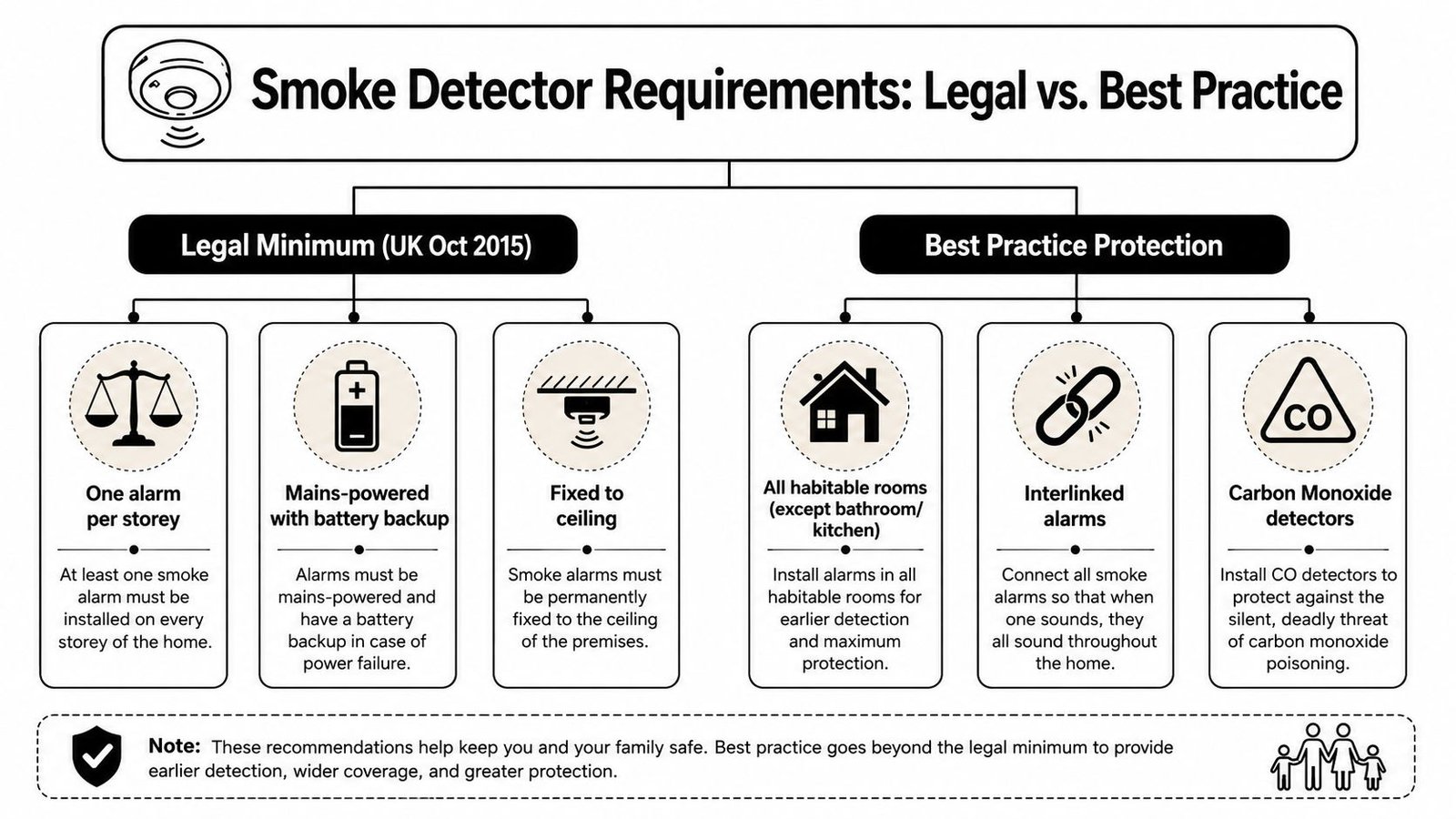
The phrase "one per floor" comes from that baseline. It is useful as a starting point, but it is regularly treated as if it answers every domestic fire safety question. It does not.
BS 5839 makes the distinction clearer. The domestic standard, BS 5839-6, sets grades and categories for different levels of protection, and the right answer depends on the property type, layout, and who is expected to escape. In larger houses, loft conversions, maisonettes, and mixed-use buildings, a basic minimum can leave blind spots or delay warning where it matters most.
The legal position also changes across the UK. Wales has its own domestic requirements under the Welsh Government guidance on smoke alarms and carbon monoxide detectors, and Scotland has separate standards for all homes through the Scottish Government's fire and smoke alarm guidance. Anyone managing rental stock across Cardiff, Bristol, and the wider South West needs to treat each nation separately. A rule that satisfies one address may fall short at another.
Commercial property is a different question again. Once you move into offices, shops, HMOs with more complex arrangements, or mixed residential and business premises, the discussion shifts from domestic alarm guidance to fire alarm system categories under BS 5839-1 and the findings of your fire risk assessment. For that kind of setup, a conventional fire alarm system for commercial premises may meet the need in a small, straightforward building, but coverage still has to reflect the actual risk and escape strategy.
Best practice usually means covering escape routes properly, giving earlier warning near sleeping accommodation, and avoiding token compliance in awkward layouts. In South Wales, that often means adding protection beyond the bare minimum in older terraces, townhouses, and flats over shops, where stairways, compartment walls, and later alterations change how smoke and sound travel.
If the only question is "what do I have to fit?", the result is usually the least warning the law will tolerate. If the question is "how do I give people time to get out and limit fire spread?", the answer is often more carefully planned coverage.
Choosing the Right Type of Detector for Each Location
The next mistake people make is assuming every alarm does the same job. It doesn't. If you fit the wrong sensor in the wrong room, it'll either react too often or not in the way you need.
UK domestic guidance is clear on the broad principle. Smoke alarms are for escape routes and living areas, heat alarms are preferred for kitchens to reduce nuisance alarms from cooking, and interlinked alarms are emphasised because if one activates, the whole household is alerted faster, as explained in this guidance on interlinked alarms and detector choice.
Smoke alarm, heat alarm, and why the difference matters
A smoke alarm is usually what you want in spaces where you need early warning of smoke movement. Hallways, landings, and living rooms are typical examples. These are the parts of the home that support escape, so you want the alarm to react before smoke builds enough to block the route.
A kitchen is different. In real homes, cooking fumes and normal steam are common false triggers. If you fit a smoke alarm there, people often start muting it, removing batteries, or ignoring the sound. That turns a safety device into background noise.
A heat alarm solves that problem better in kitchen spaces because it's chosen to reduce nuisance activations from ordinary cooking conditions.
Interlinking changes the real answer
Interlinking is one of the most worthwhile upgrades in domestic fire protection. The reason is simple. A detector in the downstairs hall may activate first, but if bedroom doors are shut and somebody is asleep on the top floor, that local sounder may not be the warning that reaches them fastest.
When alarms are interlinked, activation at one point becomes warning everywhere. In practical terms, that makes each alarm more valuable because it isn't protecting only the space where it's mounted.
A house with well-placed interlinked alarms is usually safer than a house with the same number of isolated units.
If you're comparing setups, that's often the deciding factor. It's also worth looking at complete domestic systems rather than treating each alarm as a standalone gadget. For a more structured domestic or small-premises approach, conventional fire alarm systems are often the next step up from disconnected single-room alarms.
Smoke and Heat Detector Types Compared
| Detector Type | Best For | Detection Method | Ideal Location |
|---|---|---|---|
| Smoke alarm | Early warning in circulation and living spaces | Detects smoke | Hallways, landings, lounges |
| Heat alarm | Areas where smoke alarms would nuisance-trigger | Detects heat rise | Kitchens |
| Interlinked smoke alarm | Homes where warning must reach all occupants quickly | Detects smoke and triggers linked units | Multi-storey homes, bedroom routes |
| Interlinked heat alarm | Kitchens within a linked domestic system | Detects heat and triggers linked units | Open-plan kitchen areas |
What works and what doesn't
A few patterns come up again and again on site:
- What works. Smoke alarms on circulation routes, heat in kitchens, linked devices across floors, and clear audibility at night.
- What doesn't. Standalone bargain alarms scattered without a plan, smoke detectors too close to cooking areas, and systems that people disable because they go off during normal living.
- What needs judgement. Open-plan homes, loft conversions, and properties with unusual room use. These are the ones where generic retail advice usually falls short.
The right question isn't only how many smoke detectors do I need. It's also which sensing method belongs in each part of the property.
Optimal Smoke Detector Placement in Your Home
Placement is where a sensible plan becomes a useful one. A detector can be technically present and still be badly positioned for the way smoke will travel through the home.
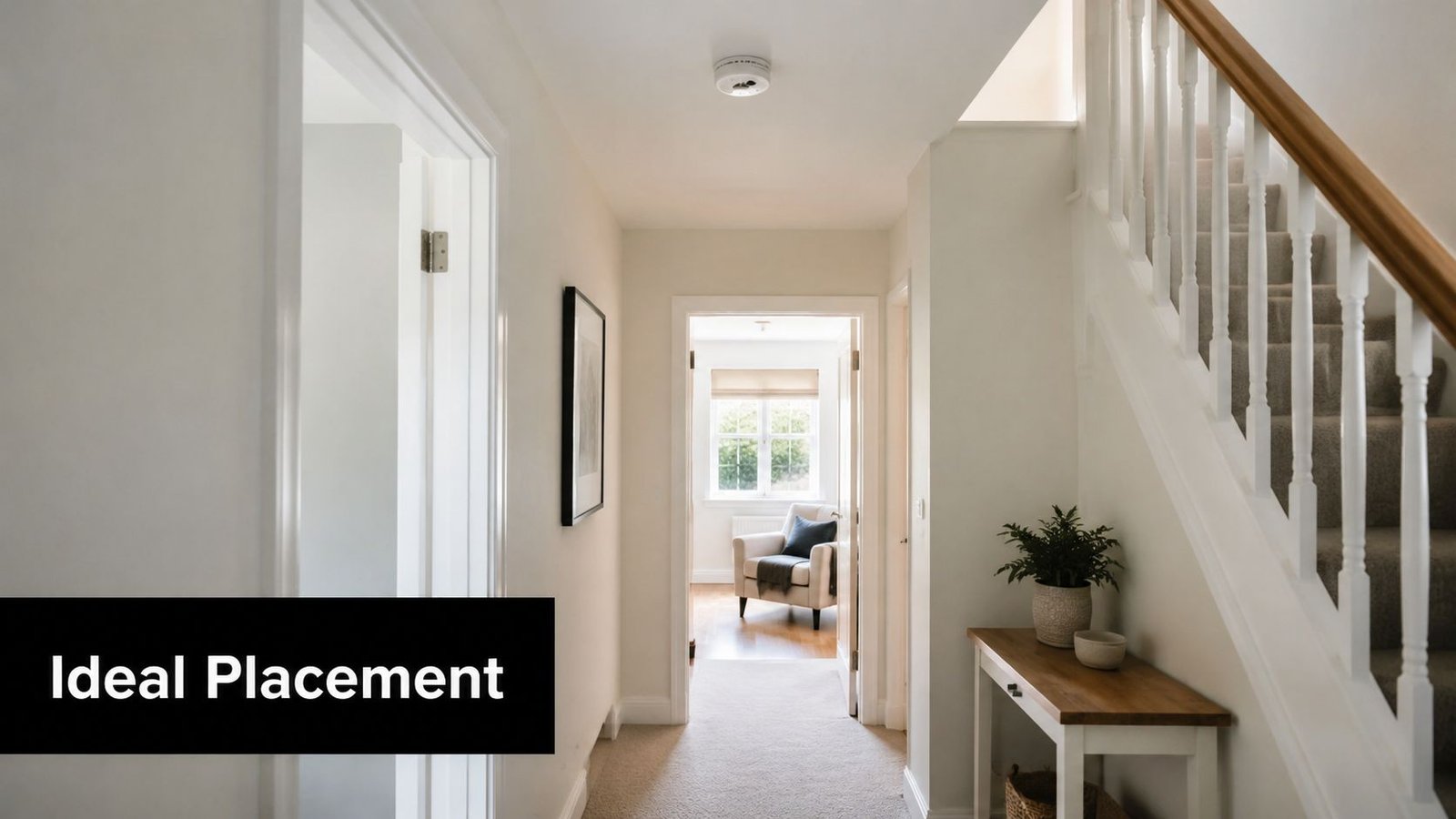
The reason careful placement matters is backed by the risk data. Smoke alarms reduce the risk of dying in a house fire by around half when they are present and working, and around 40% of fire deaths in England occur in homes where the alarm was absent or failed to operate, according to this summary of UK smoke alarm fire death evidence.
A two-storey house in real terms
Take a standard two-storey terraced house. The legal baseline points you towards one alarm downstairs and one upstairs. That's workable as a minimum. In a better domestic layout, the downstairs unit sits in the main circulation route leading towards the exit, and the upstairs unit sits on the landing where it can warn people coming out of bedrooms.
If the kitchen is enclosed, a heat alarm there often makes sense. If the lounge is separate and the property has a longer route to the front door, an additional smoke alarm may also be sensible because the first smoke may build in that room before the hall detector sees enough.
That's why counting by storey alone can be too crude. The actual movement path of smoke matters.
Open-plan flats and larger townhouses
A modern flat with an open-plan kitchen and living area needs more care, not less. If you put a smoke alarm too close to cooking activity, you're asking for nuisance alarms. In those layouts, the exact siting of the living-area smoke alarm and the use of a heat detector in the kitchen zone can make the difference between a system residents trust and one they keep silencing.
A three-storey townhouse is a different problem. Yes, the baseline count is higher because there are more storeys, but the bigger issue is audibility and escape route protection from top floor bedrooms. Interlinking becomes much more important there because the first activation may happen two levels away from the people at greatest risk.
In multi-storey homes, the detector that spots the fire first is often not the detector the occupants need to hear first.
This short visual guide helps show how domestic placement principles work in practice:
A practical domestic checklist
When mapping your own home, start with these points:
- Protect the route out. Prioritise hallways, landings, and the path people will use to escape.
- Think about sleeping areas. Warning needs to be heard clearly from bedrooms, especially with doors shut.
- Treat kitchens differently. Use heat detection where cooking fumes would make a smoke alarm a nuisance.
- Watch open-plan layouts. Positioning is more sensitive where kitchen and lounge areas blend together.
- Don't rely on one central alarm. Homes with bends, split levels, or separate reception rooms often need more than the bare minimum.
For most domestic properties, the best placement strategy is simple. Cover each floor, protect the circulation route, and add targeted detection where layout or room use creates delay.
Fire Alarm Requirements for Businesses and Landlords
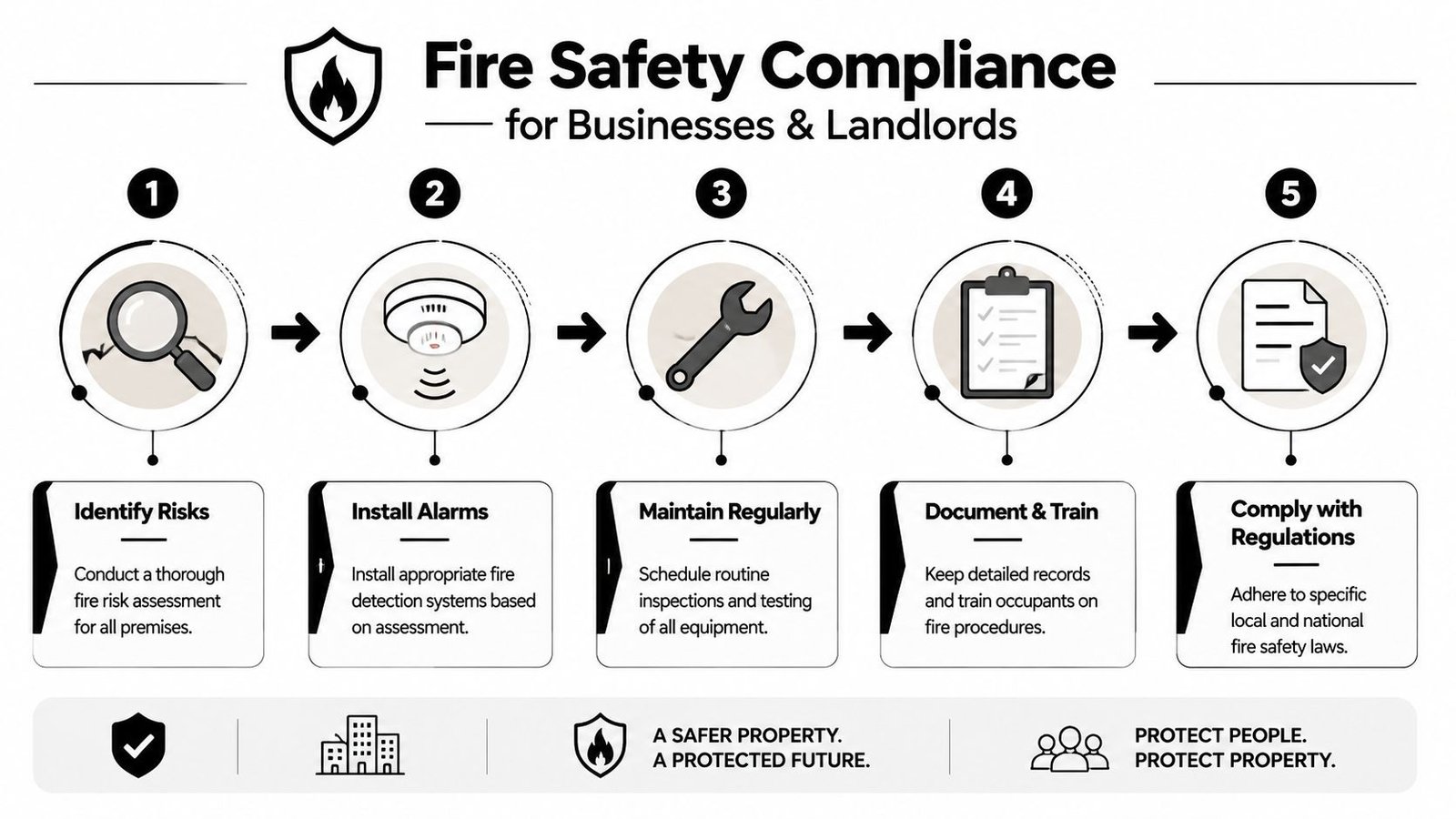
Domestic advice only gets you so far. Once you're dealing with a business, an HMO, a block common area, or a mixed-use property, the answer stops being “how many rooms have I got?” and becomes “what level of detection does this risk profile need?”
That's why detector count in larger or more complex UK buildings should be based on coverage geometry rather than room count. Fire-engineering guidance uses a maximum protected travel distance approach, so the number of detectors is driven by floor area, ceiling layout, and room use, as described in this guidance on detector spacing and coverage geometry.
Why commercial buildings need a design approach
In an office, one detector in the middle of the ceiling might seem fine until you factor in meeting rooms, storage cupboards, suspended ceilings, and a long corridor leading to the final exit. In a warehouse, racking, high roofs, loading areas, and office pods create a very different detection problem again.
Landlords run into the same issue in HMOs and converted buildings. A multi-room property with shared circulation spaces and separate sleeping occupants can't be planned like a standard family home. The count changes because the building use changes.
A proper fire risk assessment is the starting point in non-domestic property because it defines what the system needs to achieve. Only after that do you get to sensible choices on detector types, zones, sounders, call points, and panel design.
Conventional and addressable systems
For small and simple premises, a conventional system can be enough if the building is straightforward and the required zoning is clear. For larger or more complex sites, addressable systems become easier to manage because they identify exactly which device has activated or developed a fault.
That matters in schools, offices, care environments, warehouses, and multi-tenant spaces where speed of identification affects response. It also matters for maintenance because fault finding is more efficient when devices are individually identifiable. If you're working through what your legal duties mean in practice, fire safety compliance support can help turn a broad obligation into a workable scope.
Landlords and mixed-use buildings
Landlords often sit in the middle ground between domestic and commercial thinking. A single buy-to-let flat is one thing. A house in multiple occupation, a building with a shop below and flats above, or a portfolio with different layouts is another.
Useful administration matters here as much as hardware. If you manage several properties, All Well's landlord compliance guide is a practical reference point for the wider compliance picture around rented accommodation.
Consider these common detector drivers:
- Long escape routes. More corridor length usually means more detection points.
- Separate sleeping occupancies. Bedrooms off shared circulation spaces raise the need for dependable warning.
- Compartmented layouts. Storerooms, offices, kitchens, and service areas interrupt smoke travel.
- Mixed use. A premises with public, residential, and back-of-house areas rarely suits a simple one-rule answer.
Commercial fire alarm design is rarely about counting rooms. It's about making sure no important part of the building is left waiting too long for detection.
Installation Maintenance and Local South Wales Compliance
A detector count on paper means very little if the units are badly sited, never tested, or left chirping on a flat battery. I see this regularly in South Wales. The property technically has alarms, but the warning arrangement would still fail the people inside when it matters.
Local rules need a local reading
This is the point where legal minimums and real protection often split. In England, landlords are generally used to the one-smoke-alarm-per-storey rule for rented homes. In Wales and Scotland, the position is more specific, and the correct answer depends on the property type, layout, and whether the alarms are mains powered and interlinked. For Welsh homes, the safest reference point is the Welsh Government guidance on smoke alarms and heat alarms in rented homes.
That difference matters across Cardiff, Newport, Swansea, and the Valleys, where a "rental property" might mean a standard terrace, a converted Victorian house split into flats, or a shop with accommodation above. A landlord who assumes the English minimum applies everywhere can end up under-protected in practice and out of step with Welsh requirements. If you manage rentals, it also helps to keep the wider compliance picture straight. This guide to Mastering landlord legal duties is a useful companion resource.

Maintenance keeps the system dependable
False confidence is a common problem. The alarms were fitted years ago, nobody remembers the last test, one unit has been removed after nuisance activations, and another is coated in dust from a loft conversion or kitchen refurb.
Domestic systems need simple routine checks done consistently. Commercial systems need scheduled inspection, logbook records, and servicing that matches the category of system installed under BS 5839. The bigger or more complex the building, the less sensible it is to rely on guesswork.
For practical testing intervals and day-to-day checks, this guide on how often fire alarms should be tested is a good place to start.
Across South Wales and the South West, professional support becomes worthwhile as soon as the property is more complex than a straightforward house. Wisenet Security Ltd provides fire alarm design, installation, and maintenance for domestic and commercial premises. That matters when you need the detector count, device type, siting, records, and compliance position to line up properly.
Your Smoke Detector Questions Answered
Should I put smoke alarms in bedrooms
If bedrooms open onto a landing or hall with good audibility, that circulation protection may be the starting point. In many homes, though, extra bedroom coverage is sensible, especially where occupants sleep with doors shut, where there are children, or where the layout is spread out. The right answer depends on the escape route and whether the warning will be heard quickly enough.
Are wireless interlinked alarms reliable
Modern wireless interlinked systems can work very well when they're selected and installed properly. The main benefit is that they let one activation warn the whole property without the disruption of new cabling. They're often a practical fit for finished homes, listed features, and retrofit work where cable routes are awkward.
How do I know if I need more than the minimum
You probably do if any of the following apply:
- You have more than one sleeping area on a floor.
- The layout is broken up with separate rooms and doors between risk and escape route.
- Your kitchen is open-plan with the main living area.
- You have three storeys, a loft conversion, or a basement.
- The property is rented, shared, or mixed-use.
If any of those sound familiar, don't stop at the legal floor.
What matters more, quantity or placement
Placement wins first. A badly sited extra alarm can add little value. Once the key routes and room types are mapped properly, quantity follows naturally from the building layout.
The strongest domestic setups usually share the same traits. They use the right detector type, cover escape routes properly, and interlink alarms so everyone hears the warning in time.
If you want a clear answer for your property rather than a generic rule, Wisenet Security Ltd can assess the layout, explain the compliance position for your building, and recommend a practical fire alarm setup for homes, rentals, and business premises across South Wales and the South West.