CCTV and Video Surveillance: A Practical UK Guide
Adding another camera won't automatically make your property safer. For a retailer closing alone in Newport or a homeowner whose driveway faces a lane, the useful question is whether someone could act before an incident develops, or whether they'd have a clearer recording afterwards. CCTV and video surveillance should start with that distinction, not a camera count or a 4K badge.
Table of Contents
- Why CCTV and Video Surveillance Matter Now
- How a Video Surveillance System Works
- Camera Features That Change the Evidence
- CCTV Uses for Homes and Business Sites
- Monitoring Options and Real Crime Reduction
- UK Privacy Rules for CCTV Systems
- Choosing an Installer and Your Next Step
Why CCTV and Video Surveillance Matter Now
A warehouse manager notices damage beside an after-hours gate and asks for another camera. That might be sensible, but first ask what the existing recording missed. Was the vehicle outside the view, was the image unusable, or did nobody see the incident until the following morning?
Those are different problems. Adding coverage could address the first, but it wouldn't necessarily solve the others.
CCTV, short for closed-circuit television, means more than a camera fixed to a wall. In everyday use, a video surveillance system includes cameras, recording, storage and a controlled way for authorised people to review what happened. Its value depends on how those parts support a defined purpose.
Camera totals need context
The UK's long history of surveillance can make widespread camera coverage seem like proof of protection. However, national totals aren't a reliable shopping guide, and they shouldn't be presented as a precise census.
A 2002 academic estimate of approximately 4.2 million cameras was later cited in a Parliament briefing, which also noted that the Home Office didn't centrally hold national or local totals; subsequent government strategy documents suggested between 4 million and 6 million, excluding ANPR, body-worn video, vehicle-mounted cameras and drones, as described in the National Surveillance Camera Strategy.
Practical rule: Judge a proposed system by the problem it solves at your property, not by how many cameras appear on the quotation.
For a homeowner, the priority might be understanding who approached the front entrance without recording the neighbour's garden. For a shop manager, it might be finding a relevant transaction quickly. A landlord could need a fair, controlled way to investigate damage at a shared entrance.
Each purpose calls for a different design. Before discussing products, write down:
- The event that matters. Describe the incident you want to understand or interrupt.
- The information you need. Decide whether you need a recognisable person, a vehicle registration or a general account of events.
- The person responsible. Name who will review footage and decide what happens next.
That gives quality, secure storage and proportionate placement a practical meaning. None is improved merely by increasing the camera total.
How a Video Surveillance System Works
Start with a simple requirement: “I need to recognise someone approaching the staff entrance.” That tells an installer more than “I want the highest resolution”, because it identifies what the finished recording must show.
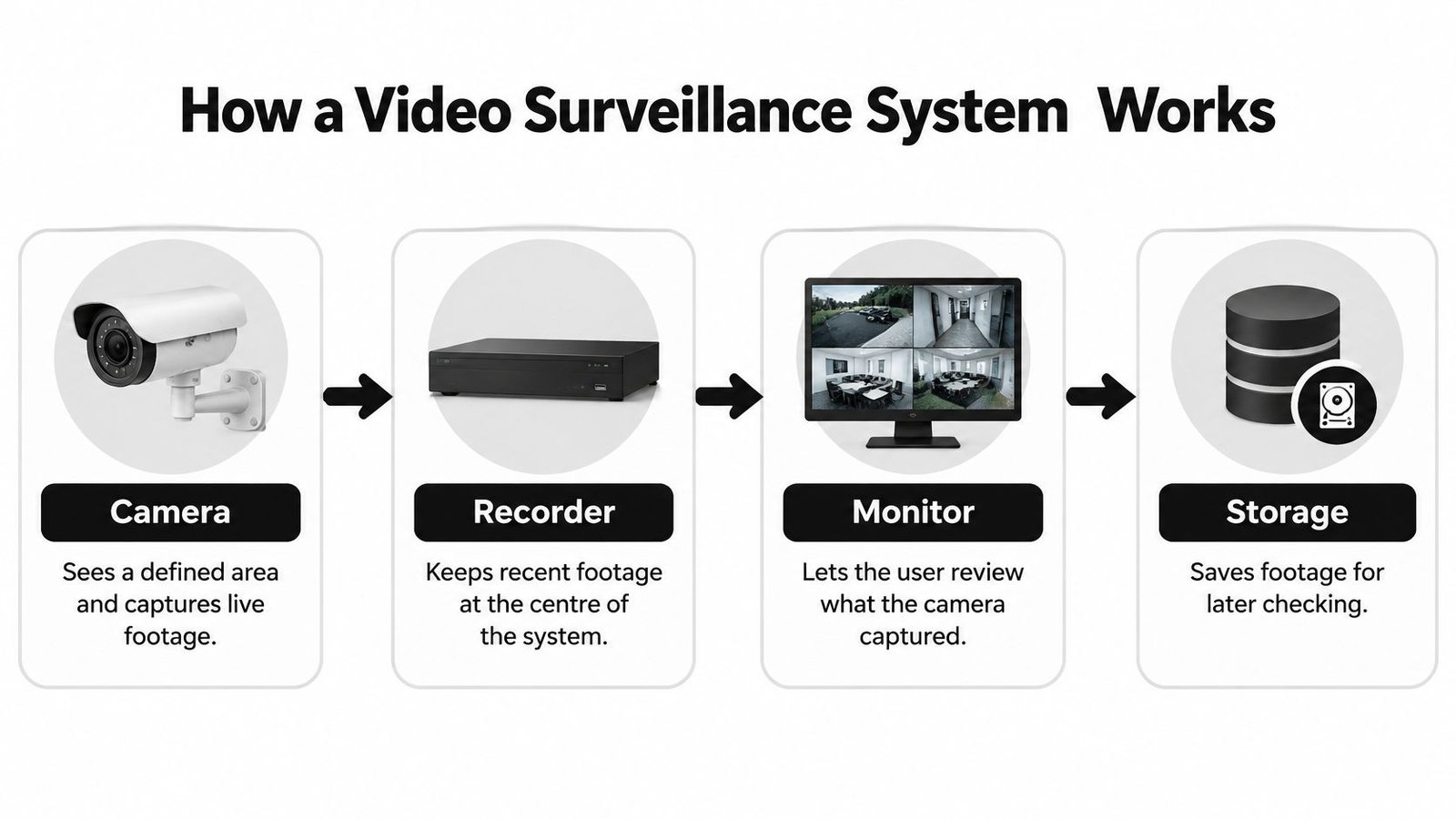
The basic system connects capture, recording and review.
Follow the footage from capture to export
The camera sees a defined area. The recorder receives its footage, storage keeps the recordings, and a monitor or authorised viewing device lets someone inspect them. The diagram is a useful overview, although storage normally works alongside the recorder rather than waiting until someone watches a clip.
UK police requirements for CCTV systems explain that no single performance threshold guarantees admissibility: relevance, reliability and evidential integrity matter, while retention beyond 31 days can sometimes help but mustn't reduce the quality of newer recordings.
Turn that guidance into a practical specification:
- Define the task. Recognising a face, reading a number plate and observing activity across a yard require different views.
- Test the scene. Check field of view, pixel density, illumination, shutter speed and compression under representative conditions.
- Calculate storage properly. Include camera count, frame rate, resolution, codec, motion activity and the justified retention period.
- Control the evidence. Restrict access to the recorder and record who handles exported footage.
Pixel density means how much image detail falls on the subject you care about. Compression reduces the data needed to store video, but it mustn't remove the detail that justified installing the camera.
Don't overlook the recorder
A recorder sitting openly beneath a shop counter deserves attention just as much as a poorly positioned lens. Ask where it will be secured, who can operate it and how an authorised user will retrieve footage without changing the original recording.
Product terminology can distract from those questions. The practical difference between an NVR and DVR is worth understanding when discussing recorder choices, especially if you're retaining existing equipment.
At handover, ask for a demonstration using a real recorded event. The installer should show you how to find it, export it and check that the exported clip plays correctly. A sharp live picture isn't enough if nobody can recover a usable recording afterwards.
Camera Features That Change the Evidence
A camera aimed at a till has a different job from one overlooking an open yard. Comparing them by resolution alone ignores the subject, distance and conditions in which each must work.
Use the feature comparison as a starting point, then ask for a demonstration of your actual view.

Detail versus coverage
4K and HD are choices, not verdicts. Extra detail may be useful around a doorway or transaction point, provided the subject occupies enough of the picture and the recording preserves that detail.
For a yard where the purpose is to establish when loading activity occurred, a suitably framed HD view may be a reasonable choice. It shouldn't be sold as a substitute for a dedicated identification view if that's what the site needs.
| Feature choice | Ask the installer to demonstrate |
|---|---|
| Higher resolution | The required detail in recorded footage, not just the live display |
| Wider coverage | What remains identifiable at the edges and far end of the view |
| Night performance | A moving subject under the site's normal after-dark conditions |
| Remote viewing | Appropriate access for each user and a controlled export process |
A wide view can be useful for understanding an event while still being unsuitable for identifying a distant person. Ask what each camera is intended to achieve rather than expecting every view to do everything.
Night vision and smartphone access
“Night vision” should lead to a test, not end the conversation. Ask to see movement near the entrance, the effect of vehicle headlights and the darkest relevant part of the scene. Assess the recorded result rather than relying on a colourful demonstration image.
Remote viewing needs equally practical questions. Who needs live access, who needs playback, and who should be allowed to download footage? Avoid treating a shared password on several phones as an access policy.
Discreet installation should mean tidy positioning, protected cables and fewer obvious weak points. It shouldn't mean hiding surveillance from people who ought to know they're being recorded.
For an existing analogue or mixed system, ask what can genuinely be reused. Compare compatibility, remote-access limitations and maintenance requirements before replacing everything, but insist on a coherent retention and export plan across the finished installation.
CCTV Uses for Homes and Business Sites
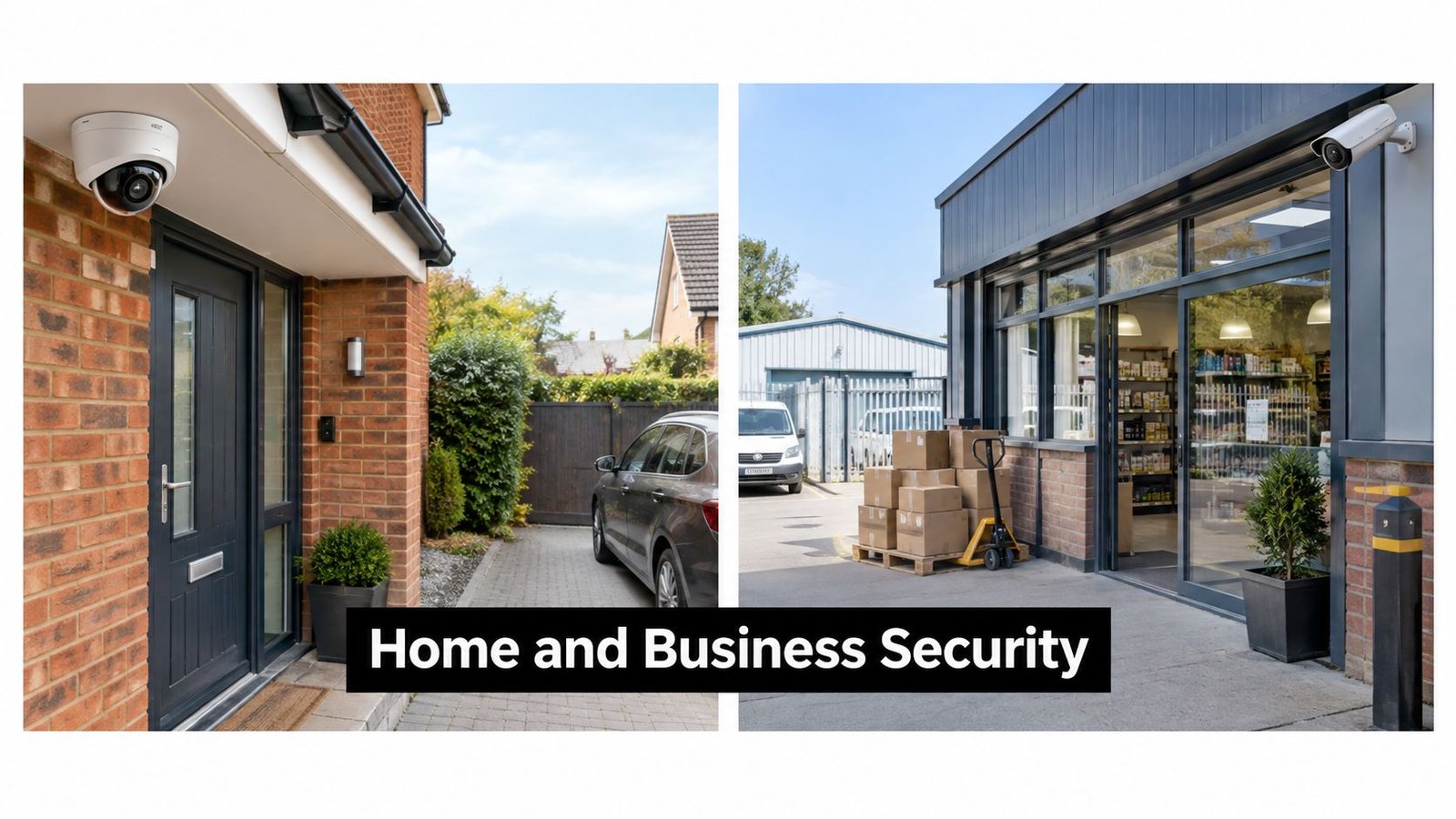
Across Cardiff, Bristol, Newport, Swansea and surrounding towns, the same starting question applies to a terraced house and a commercial entrance: which view would help explain the incident you're concerned about?
These entrance examples show why the property boundary and the working environment matter.
Match the view to the premises
At home, consider a driveway beside a shared lane. Aim to understand approaches to your property without allowing the camera to linger unnecessarily on neighbouring windows or gardens. Marking the intended view during a site visit helps reveal that trade-off.
In a small shop, examine the entrance and the transaction area separately. A ceiling-dominated overview might show that somebody was present without explaining what happened at the counter. Ask for views that answer the owner's actual concerns.
At a warehouse or logistics bay, follow a hypothetical vehicle from gate to loading door. Check whether the recorded sequence would let the manager establish where it went and relate its movements to site activity.
Treat shared spaces differently
For a landlord or multi-tenant building, start with the communal entrance rather than residents' routines. A proportionate recording should help investigate an event, not turn ordinary use of the building into a reason for continual scrutiny.
For a car park, consider arrival, exit and the locations where incidents need investigation. Don't assume an overview of parked vehicles will also provide the detail needed at an entrance.
This video can support a site discussion, but it shouldn't replace checking the proposed views on your own premises.
Plan for the people reviewing footage
The Surveillance Camera Commissioner's annual report recorded more than 80,000 cameras across 6,000 systems among surveyed organisations, including 16,901 in housing, 14,702 in town centres, 12,051 in municipal buildings and 8,842 in vehicles; around 60% of respondents reviewed more than 250 pieces of footage annually, while over one quarter reviewed more than 1,000.
Those are survey findings, not a national camera census. For a smaller operator, the practical lesson is to budget attention for retrieval and review, not just installation.
- Name the essential views. Identify the entrances, boundaries or activity points that matter.
- Give each view a purpose. Explain what it should establish.
- Assign a reviewer. Decide who can investigate an incident without giving everyone unrestricted access.
Monitoring Options and Real Crime Reduction
A clear recording can help identify someone after an offence without having stopped it. Evidential value and prevention aren't the same outcome, and a quotation should make clear which outcome the proposed service supports.
A local-authority CCTV strategy citing meta-analysis describes modest-to-significant crime reductions, infrequent displacement to nearby areas and substantially stronger reductions from actively monitored systems than from passive recording. That's evidence for taking monitoring seriously, not a promise that a particular installation will prevent an incident.
Passive, Alert and Monitored CCTV
| Option | What happens after an event | Prevention depends on | Often proportionate for |
|---|---|---|---|
| Passive recording | An authorised person reviews footage later | Other protective measures and any deterrent effect, not an immediate video response | A home, small shop or landlord block primarily needing incident evidence |
| Event-triggered alerts | A nominated person receives a notification and checks it | Their availability, useful alerts and a safe response plan | An owner-managed shop or home where someone can realistically respond |
| Professional monitoring | An operator assesses events and follows an agreed escalation process | Clear instructions, suitable coverage and an available response | Industrial premises, exposed commercial sites and car parks with relevant risks |
These are starting points, not fixed categories. A landlord block may justify monitoring for a specific risk, while an industrial site with other controls might use recording mainly for investigation.
The key question is what happens when nobody answers. A mobile notification isn't an effective intervention merely because the system successfully delivered it.
Make the response realistic
Write down who receives alerts, who covers absence and what each person should do. The plan should favour safe assessment and escalation rather than expecting a homeowner or lone employee to confront an intruder.
For a human-centred explanation of how live video supports personal safety, 3rd-i offers a useful resource to consider alongside a site-specific response discussion. When comparing CCTV monitoring services, ask exactly what operators assess, what they communicate and where their responsibility ends.
More cameras don't necessarily mean more prevention. An appropriate view and an available, authorised responder may be more useful than additional unattended coverage.
Position, lighting, accurate time and date, and secure export still need checking as operational prerequisites. Put them into an acceptance test, alongside a trial alert that demonstrates the agreed response.
Don't buy monitoring solely because it sounds reassuring. Choose it when the risk justifies the service and when the response arrangement can do something useful.
UK Privacy Rules for CCTV Systems
A camera mounted on your house isn't automatically outside data protection rules. If its view extends beyond your boundary, privacy needs attention before you settle on the installation.
The government's guidance on domestic CCTV explains that recording neighbours, shared areas or public space can bring domestic systems within UK GDPR and the Data Protection Act, and that footage shouldn't be retained longer than necessary.
Start with the least intrusive useful view
Begin with the purpose and work outwards. If the concern is unauthorised entry through a gate, ask whether the useful view can stay around that gate rather than covering the neighbouring property.
Build clear signage, where appropriate, and a retention decision into the proposal. Businesses can also use this explanation of CCTV and GDPR in the UK to prepare questions about responsibilities.
- Limit the scope. Record what's needed for the stated purpose.
- Explain the recording. Make appropriate information available to affected people.
- Set review responsibilities. Decide who handles access requests, objections and retention reviews.
Don't treat facial recognition as an ordinary upgrade
Recording a person and attempting to identify them through biometric matching are different decisions. A shop's need to understand an incident doesn't automatically justify maintaining a facial watchlist.
The ICO's facial-recognition guidance explains that deployments can involve personal, biometric and, in most cases, special-category data; uniquely identifying people generally requires a UK GDPR lawful basis and an Article 9 condition, alongside a Data Protection Impact Assessment addressing necessity, proportionality and effects on people before deployment.
For a retailer, workplace or shared building, ask whether non-biometric person or vehicle detection could meet the objective. Don't assume customer or employee acceptance just because the feature is available.
Privacy checkpoint: If ordinary recording meets the need, the availability of facial recognition isn't a reason to enable it.
Before considering biometric identification, establish who would control a watchlist, how trained staff would review possible matches before adverse action, and how accuracy would be assessed. False matches need measured evaluation, not confidence in a default setting.
Retention of footage and biometric data, signage, objections and accountability also need explicit decisions. If those questions can't be answered convincingly, pause and obtain specialist advice rather than treating installation as permission to proceed.
Choosing an Installer and Your Next Step
A useful installer should be comfortable discussing what a system won't achieve. If the conversation begins and ends with camera quantity, resolution and an app demonstration, ask for a written explanation of how the proposal addresses your property's risks.
Compare suppliers against the same requirements. That makes a modest, well-specified installation easier to distinguish from a larger package that leaves responsibility unclear.
Ask for an operational proposal
Use the site visit to request:
- A purpose for every camera. Each proposed position should answer a defined question.
- A realistic demonstration. Ask how lighting and night performance will be assessed.
- An access plan. Identify remote viewers, playback users and export permissions.
- A protected recorder. Agree its location and authorised access.
- A retention calculation. Require storage assumptions that preserve the intended recording quality.
- A response arrangement. Establish who handles alerts and what happens during absence.
- An integration outline. Show how CCTV relates to the intruder alarm, access control, intercom or gate.
Ask the installer to explain those decisions in language the person managing the premises can use. A homeowner shouldn't need engineering knowledge to find a clip, and a site manager shouldn't have to guess which contractor handles a fault.
Include upkeep in the buying decision
Treat maintenance as planned verification rather than waiting for a camera to fail. Agree checks for time settings, actual recordings, playback, exports and unavailable cameras, with clear responsibility for reporting and correcting problems.
For an integrated installation, discuss how a gate event, intercom call or alarm activation will be reviewed. Don't accept integration as a label without an explanation of what the user will see and do.
A local supplier can be one option alongside other qualified installers. Ask for evidence of insurance, engineer vetting, relevant accreditation and experience with comparable premises, rather than assuming those credentials from a polished quotation.
For homes and smaller commercial sites across South Wales and the South West, it's also sensible to ask about support coverage in Cardiff, Bristol, Newport, Swansea and nearby towns. Discuss the proposed manufacturers, such as Hikvision, Paxton, Pyronix or Fike where relevant, but judge the complete design rather than the badge.
Choose an integrated proposal you can operate and maintain. The right next step is a walk around the actual risk points, not an agreement to fit a predetermined number of cameras.
Wisenet Security Ltd offers CCTV design, installation and maintenance alongside intruder alarms, access control, fire alarms, intercoms and gate automation for homes and businesses across South Wales and the South West. Book a free consultation to walk through your entrances, boundaries and response arrangements, then ask for an integrated proposal covering useful recordings, controlled access and ongoing upkeep rather than camera count alone.