Automatic Gate Motors for Sale: A Practical UK Guide
You've watched a neighbour's gate open smoothly in the rain and decided it's time to automate yours. Then the online search begins, and the choice appears simple: pick a motor, compare the price, and arrange fitting. That approach causes most expensive mistakes.
Automatic gate motors for sale are only one part of a powered gate system. The gate's weight, hinges, pillars, usage pattern, control board, safety devices, wiring, drainage and installer documentation all affect whether the finished entrance is reliable and compliant. A motor can have impressive torque and still be the wrong choice for a sagging gate or an unsafe closing gap.
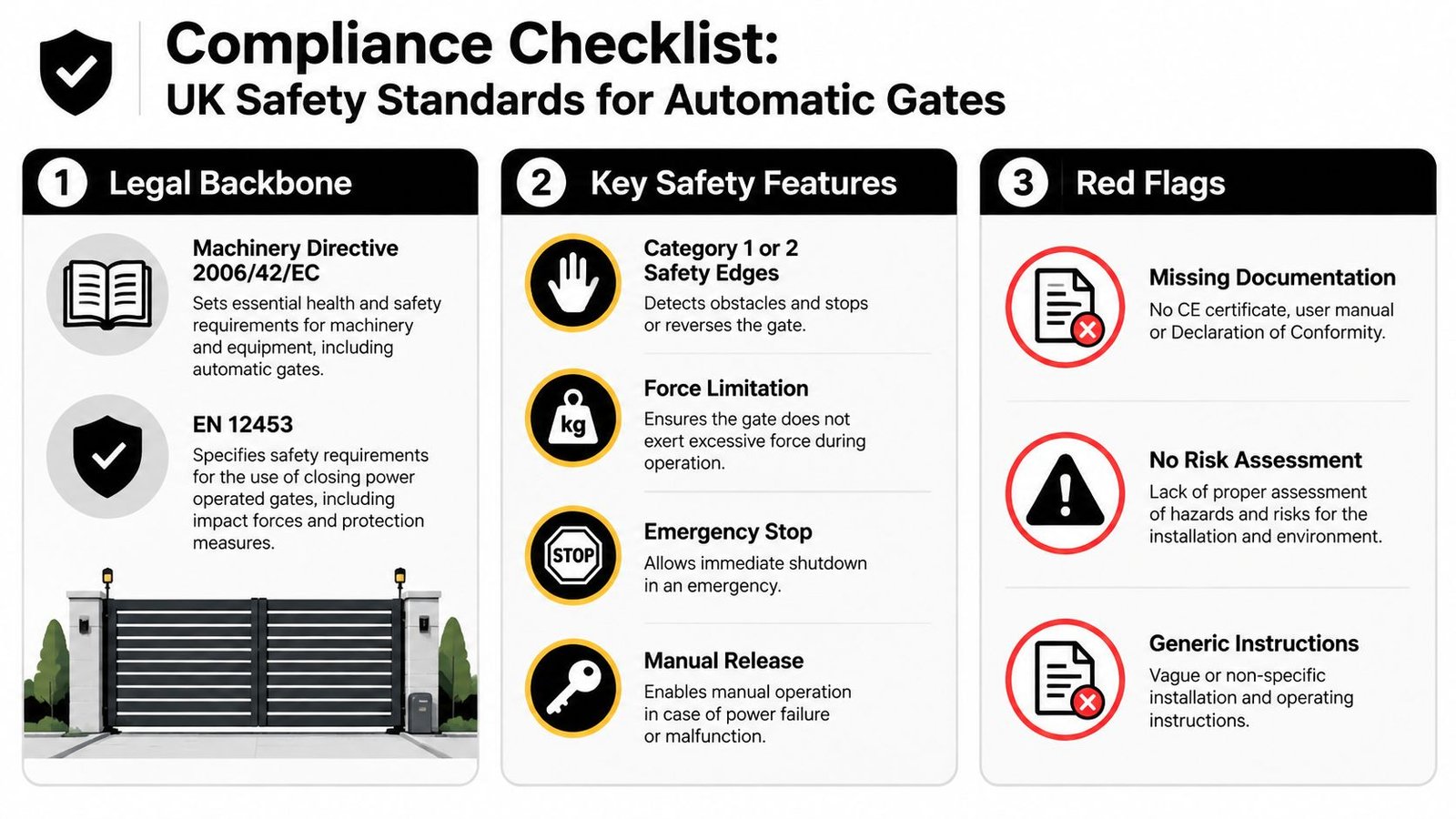
The UK market has moved towards a more formal safety environment. Powered gates fall within the Machinery Directive 2006/42/EC, while EN 12453 focuses on crushing, shearing and impact risks. The UK gate safety legislation timeline explains how current British and European standards replaced earlier versions and consolidated requirements across powered doors, gates and barriers.
Table of Contents
- Why the Motor You Choose Sets the Tone for the Whole Gate
- Matching Motor Type to Gate Style, Weight and Usage
- The Technical Specs That Actually Matter on a Product Page
- UK Safety Standards and the Compliance Burden Most Listings Hide
- What Installation and Maintenance Really Involve
- Realistic UK Costs for Motors and Installed Systems
- Choosing a Reputable Local Installer
- Putting It All Together Before You Buy
Why the Motor You Choose Sets the Tone for the Whole Gate
A powered gate doesn't become dependable because someone bolts a motor to it. The motor interacts with every mechanical and electrical part of the installation, so choosing it first, before checking the gate itself, is the wrong order.
A heavy steel leaf with worn hinges needs mechanical attention before automation. A wide gate catches wind differently from a compact timber leaf. A shared driveway needs a different duty profile from a private home used occasionally. The control board must also work with photocells, pressure edges, emergency controls and the chosen access system.
The motor is the system's driving force
An under-specified unit becomes the weak link. It may move the gate during a calm test but struggle when friction, wind resistance, cold weather or poor alignment adds load. That strain affects gears, hinges, fixings and the control electronics. Frequent faults then become a maintenance problem rather than a one-off purchase issue.
A larger motor isn't automatically the answer either. Excessive force can increase risk if the safety system isn't correctly designed and tested. UK guidance says opening and closing forces must be limited to values in the relevant British and European standards, measured with suitable test equipment and checked again during planned maintenance. The HSE guidance on powered gate safety places attention on the complete installation, not motor strength alone.
Practical rule: If a seller asks only for the gate's advertised weight, but not its width, hinges, pillars, wind exposure and daily use, the recommendation is incomplete.
Before comparing brands, inspect the gate as a machine. It should move freely by hand, stop squarely, have sound hinges and posts, and leave enough space for safe cable routes and safety-device positioning. The motor should then be selected to suit that working environment.
Matching Motor Type to Gate Style, Weight and Usage
Start with the movement, not the catalogue. A swing gate needs a different drive arrangement from a sliding gate, and a visually discreet solution often creates more demanding groundwork.
Swing gate motors
Articulated arm motors suit residential swing gates where the hinge arrangement and pillar geometry leave limited room for a straight ram. They're useful on narrow driveways and decorative or wide pillars, but they're not a universal solution. Their articulated movement can be poorly suited to wide-pillar layouts or gates that impose awkward force.
Ram or linear motors are the conventional choice for many swing gates. They can handle heavier leaves and wider pillars, provided the hinge posts are solid and correctly aligned. If a gate needs force to move by hand, fitting a stronger ram only hides the underlying defect.
Underground motors keep the appearance clean because the drive units sit below the gate. That visual advantage comes with more demanding installation work. Drainage, access to the housings and protection from standing water matter, because below-ground components are harder to inspect and repair.
Sliding gate motors
Choose a sliding gate motor when the gate runs along a track or a cantilever arrangement. It's also the sensible direction for very wide swing openings, particularly where a sliding layout removes the need for a large swing arc. Heavy gates and shared access points generally need a commercial-duty sliding operator rather than a light domestic unit.
Use the gate automation kit guide to think in terms of the complete package, including control equipment and safety accessories, rather than the motor body alone. For wider property maintenance planning, practical garage door service tips are also useful because both systems rely on alignment, moving parts and regular safety checks.
| Motor Type | Best For | Typical Weight Limit | Limitations |
|---|---|---|---|
| Articulated arm | Residential swing gates with awkward or decorative pillars | Around 350kg per leaf | Can struggle with wide-pillar geometry |
| Ram or linear | Heavier swing gates with strong hinge posts | Varies by model and gate design | Needs sound posts and accurate geometry |
| Underground | Clean-looking swing gate installations | Varies by model and foundation design | Drainage and below-ground maintenance are critical |
| Sliding operator | Track or cantilever gates, heavy or wide entrances | Over 600kg in suitable applications | Needs a correctly built track, rack or cantilever structure |
Usage decides the duty rating. A private driveway with roughly 20 daily cycles can suit a residential operator, while commercial, logistics and shared-access sites need a higher duty cycle and may require three-phase equipment. Don't specify a motor from weight alone. Count opening activity, vehicle flow, pedestrian access and peak periods.
The Technical Specs That Actually Matter on a Product Page
Product pages often make torque and speed prominent because those figures are easy to compare. They're not enough. A useful listing should tell you how the operator behaves under real load and how it connects to the safety system.
Torque and duty cycle
Torque indicates the motor's ability to move the gate, but the figure only means something alongside the gate's width, weight distribution, hinge condition and wind exposure. Ask whether the quoted capacity assumes an ideal, well-balanced gate. It should have enough reserve for the worst normal operating conditions, without relying on excessive force to overcome mechanical resistance.
Duty cycle matters just as much. A domestic operator intended for occasional use isn't suitable for a business entrance, apartment development or service yard where several users may trigger it repeatedly. Look for a manufacturer's stated duty information and compare it with actual daily activity, not an optimistic estimate.
Weather protection and power
The IP rating describes protection against dust and water. For an outdoor UK installation, treat IP44 as a practical minimum for exposed equipment, while IP67 is preferable for components installed at ground level, particularly where splash, mud or moisture is likely. The rating doesn't fix poor drainage or an incorrectly sealed cable gland, so installation quality still matters.
Power choice affects both design and cost. 230V single-phase is common for homes, 24V DC can support safer low-voltage arrangements and battery backup, and three-phase is used for demanding commercial applications where the site supply supports it. A low-voltage motor still needs properly designed protection and wiring.
The control board deserves scrutiny
A good control board should support:
- Obstacle detection: The board should react appropriately when resistance changes.
- Soft start and stop: Controlled movement reduces shock loading on the gate and fixings.
- Adjustable sensitivity: Settings must be configured for the actual gate, not left at factory defaults.
- Safety-device compatibility: Check support for photocells, light curtains, pressure edges and emergency controls.
- Manual release and backup operation: Users need a safe way to open the gate during a power failure.
Specification test: If the listing gives torque but says nothing about duty cycle, safety inputs, force adjustment or weather protection, it isn't giving you enough information to buy responsibly.
UK Safety Standards and the Compliance Burden Most Listings Hide
A compliant powered gate is a complete safety system, not a motor with a remote. The installer who completes or substantially modifies the installation must treat the gate as machinery, assess the whole risk profile and accept responsibility for the finished arrangement.
The Machinery Directive 2006/42/EC and EN 12453 provide part of the regulatory background. A standard number on a product page proves little. The completed system needs suitable force limitation, protection against entrapment and safety devices placed around the hazards found on site. Photocells, light curtains, pressure edges and control-board anti-crush functions may all be required.
The HSE responsibilities guidance for powered gates explains that duties can fall on installers and other economic operators. New or substantially modified gates must meet applicable machinery safety requirements before first use. That means assessment, testing and records, a burden that motor-only listings usually leave out. Review the requirements for automatic gate systems before comparing packages on price alone.
What should be included
A proper proposal should name the safety devices, risk controls and paperwork, rather than listing only a motor and remotes. Independent gate-safety guidance discusses measures including at least two different safety devices, an independent pedestrian gate, warning signage and a Declaration of Conformity or suitable product marking. Read the DHF legislation and standards guidance before accepting a package that leaves these points unclear.
Ask who will produce the final documentation. The motor manufacturer may supply technical information or a Declaration of Incorporation, but the completed automated gate is a separate machine. The installer must assess the finished arrangement, complete commissioning checks and record what was supplied and tested.
A “complete kit” without safety edges, photocells, release arrangements, warnings and documentation is incomplete. Compare the cost and contents of the compliant system, not the headline motor price.
What Installation and Maintenance Really Involve
A competent installer earns their fee through the work surrounding the motor. Before anyone drills a fixing hole, they should inspect the gate, posts, foundations, power route and hazards around the opening.
Before and during installation
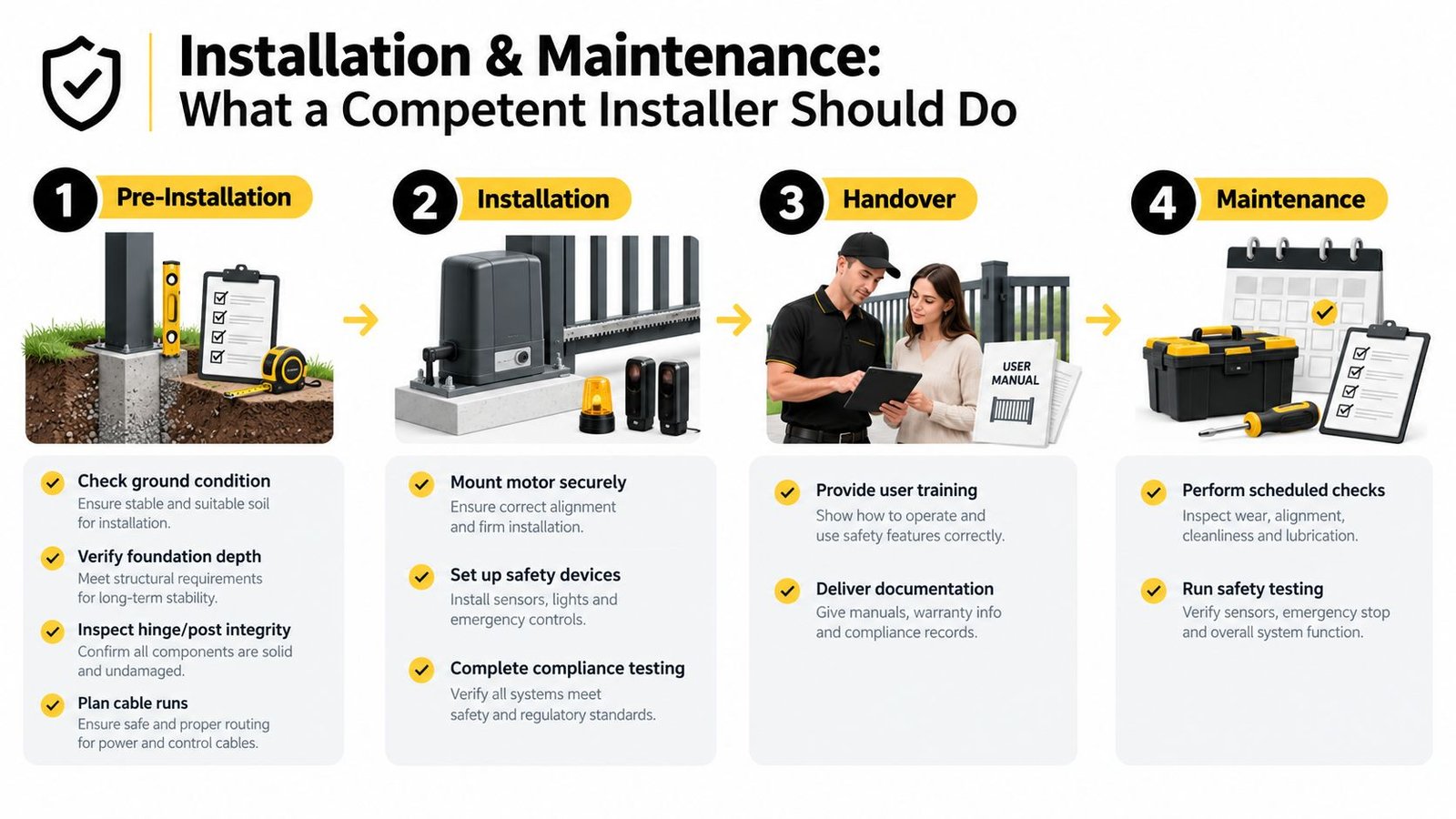
The survey should cover ground conditions, foundation requirements, hinge and post integrity, cable routes and the proposed electrical supply. Mains supplies need suitable protection, including correct RCD arrangements, while low-voltage cables must be routed and protected so they won't be damaged by vehicles, digging or future landscaping.
Installation then involves more than attaching the operator. The engineer should set mounting or foundation plates, align the drive, establish mechanical end-stops, install photocells at suitable positions, wire the control board, programme travel limits and configure force settings. Safety devices must be tested as part of the complete movement, not merely connected and left unverified.
Commissioning and servicing
Handover should include user instructions, a record of the risk assessment, operating guidance and a demonstration of the manual release. Ask the installer to explain what happens during a power cut and how to keep pedestrians away from vehicle movement.
The HSE expects force limitation to be measured with suitable equipment and re-checked periodically. That makes maintenance part of the safety arrangement, not an optional add-on. A planned service should inspect force limits, photocell alignment, safety edges, tracks, hinges, fixings, debris, lubrication and battery backup where fitted.
Maintenance reality: A powered gate is machinery. Rain, grit, frost, impact and gradual hinge wear change how it behaves, even when the motor still sounds normal.
Use this electric gate troubleshooting guide for symptoms and first checks, but don't treat online troubleshooting as a substitute for force testing or repair. The video below gives a visual example of the kind of practical operation and maintenance discussion an installer should be able to provide.
Realistic UK Costs for Motors and Installed Systems
The cheapest way to buy an operator is usually to buy the motor only. The cheapest way to own a safe, dependable gate is rarely the same thing.
A bare swing-gate ram kit typically costs £250 to £600 per leaf, while a domestic sliding-gate motor for a 400kg to 600kg gate commonly sits at £450 to £900. Underground systems start at about £600 per leaf, before housings, drainage and foundation work are properly costed. These figures are planning ranges, not quotations, and the final choice depends on the gate and site.
| Gate Type | Motor-Only Kit | Fully Installed | Key Cost Drivers |
|---|---|---|---|
| Domestic swing gate | £250 to £600 per leaf | £1,800 to £3,500 | Gate condition, cabling, safety devices and commissioning |
| Domestic sliding gate | £450 to £900 | £2,500 to £5,500 | Track or cantilever work, power distance and gate weight |
| Underground swing gate | From about £600 per leaf | Site-dependent | Housings, drainage, foundations and access for maintenance |
A fully installed domestic swing system generally lands between £1,800 and £3,500, while a typical residential sliding installation falls between £2,500 and £5,500. The ranges reflect groundwork, cabling, safety equipment, commissioning paperwork and warranty support, not labour added to a motor.
For planning excavation and structural work, these garage foundation planning tips offer useful context on why ground preparation should be treated as a separate cost consideration. Budget for servicing too. Annual maintenance commonly sits around £150 to £300, particularly where the installation needs documented force checks and continued warranty support.
Cost warning: An online motor price is not a like-for-like alternative to an installed system. Ask what's missing before deciding that the installer's quote is expensive.
Choosing a Reputable Local Installer
The installer matters more than the logo on the motor casing. A capable engineer can select, fit and commission a suitable system properly. An unprepared installer can make a reputable kit unsafe.
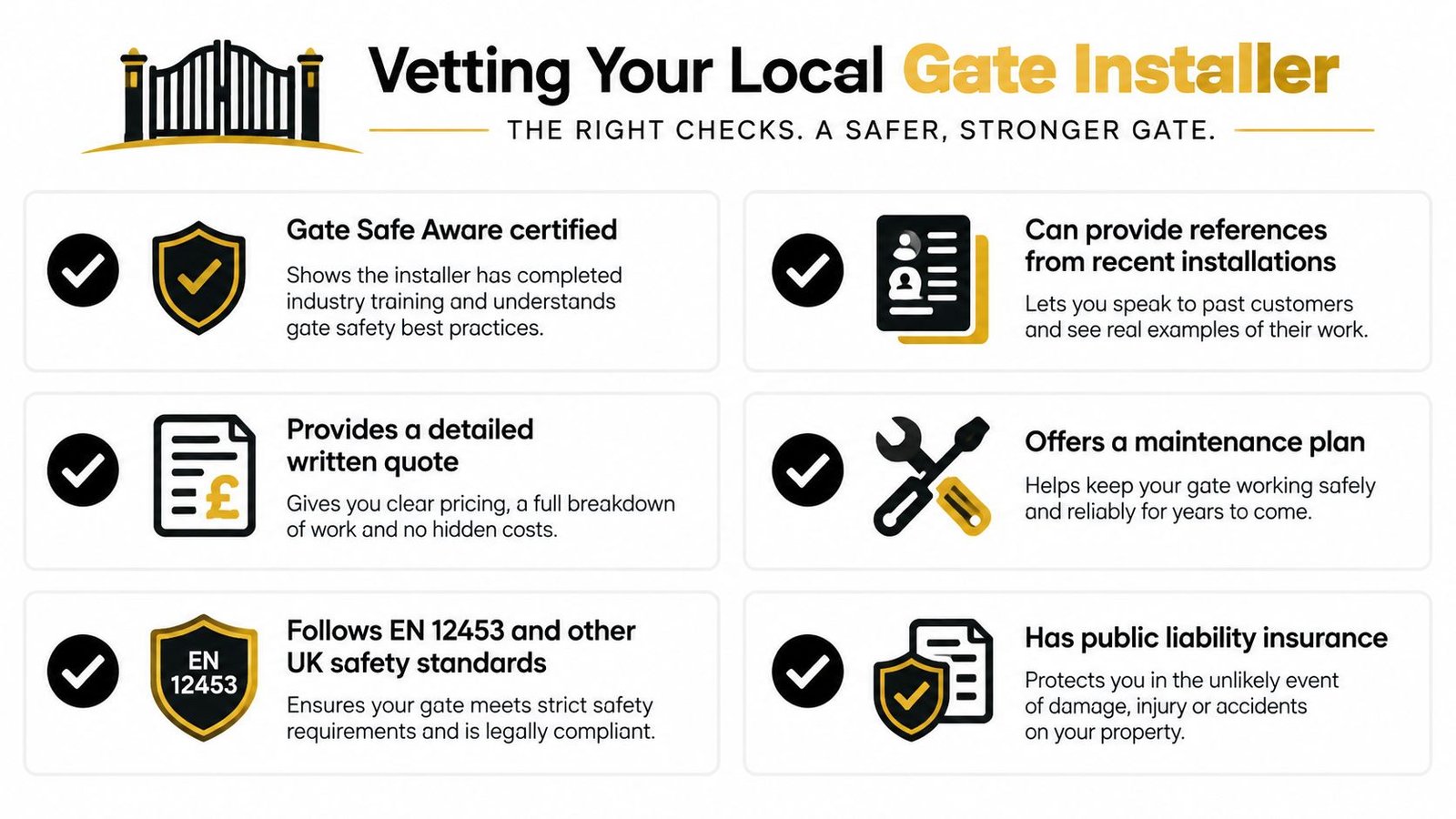
Start by asking for evidence, not reassurance. A credible firm should be comfortable discussing the gate's hazards, the proposed safety devices, force testing and the documentation supplied at handover.
Your installer checklist
- Safety awareness: Ask whether the company is Gate Safe Aware or a DHF member, and ask what that means for its installation process.
- Written risk assessment: The quote should identify entrapment points, pedestrian routes, vehicle movement and proposed controls.
- Force-test evidence: The engineer should use suitable test equipment and provide commissioning records rather than relying on the motor's factory settings.
- Public liability insurance: Request confirmation of appropriate cover before work starts.
- Declaration of Conformity: Establish who will issue the declaration for the completed automated gate and what technical documents you'll receive.
- Maintenance support: A planned service option shows that the installer expects the system to remain safe after handover.
A reputable firm will survey the site before quoting. It should explain photocells, edges, manual release and pedestrian separation in plain language, then price the civil and electrical work instead of hiding it under a vague installation line.
Look at wider access-installation experience as well. Practical local CT fence installation tips illustrate why gate automation depends on the supporting structure, not just the operator. Posts, foundations, clearances and alignment all influence the final result.
Wisenet Security Ltd is one example of an engineer-led specialist offering gate automation alongside broader security systems, with installation and maintenance for residential and commercial properties. That whole-system approach is the standard to look for, regardless of which motor brand appears on the quotation.
Putting It All Together Before You Buy
Use a short decision process and don't purchase the motor first.
Assess the gate
Confirm whether the gate swings or slides, then check its measured weight, leaf width, hinges, posts, track and available movement. Record how often vehicles and pedestrians use the entrance, including busy periods. A residential driveway, shared access route and logistics entrance shouldn't receive the same duty assumption.
Shortlist suitable motor families
Reduce the choice to two or three motor types that suit the physical arrangement. For swing gates, compare linear, articulated and underground options where the structure permits them. For a track or cantilever gate, focus on sliding operators. Reject any product that only works if the gate is lighter, narrower or better aligned than it is.
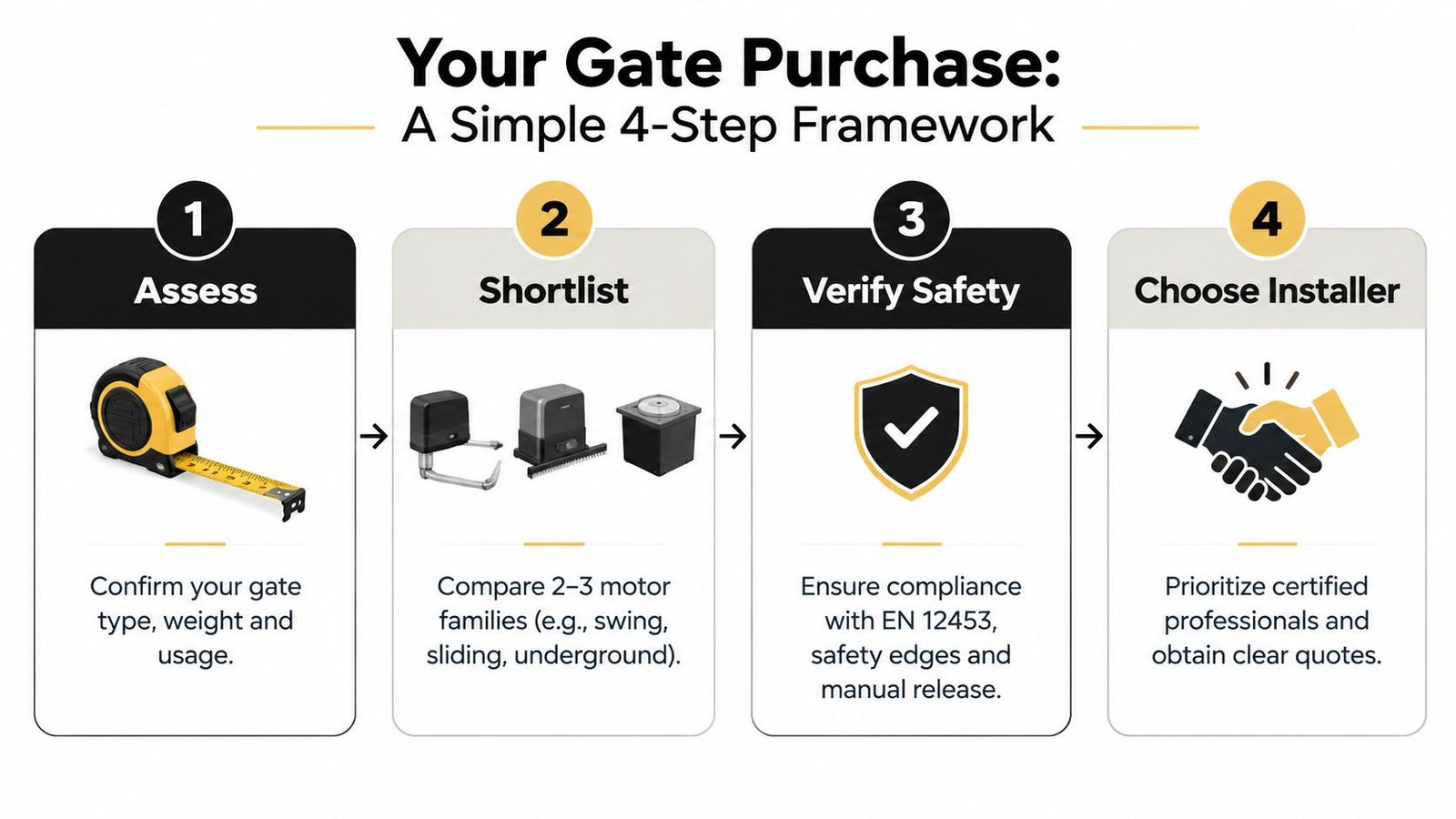
Verify the complete safety scope
Request a written kit list covering the motor, control board, photocells or light curtains, safety edges, warning signage, emergency arrangements, manual release and access controls. Ask how the installer will measure force, where the entrapment zones are and what documents will be issued at handover.
Choose the installer before paying for hardware
Get a site survey and a total installed price. Then ask these questions:
- Which standard and safety requirements are being applied?
- Who completes the risk assessment?
- How will force limitation be measured and recorded?
- Which safety devices are included, and where will they be installed?
- Who issues the completion documentation?
- What maintenance plan and response support are available?
- Which costs could change after excavation or electrical inspection?
Buying a motor before answering those questions can leave you with incompatible equipment, unplanned groundwork and a system nobody wants to sign off. Compare complete proposals, not product photographs and torque figures.
Wisenet Security Ltd designs, installs and maintains automated swing and sliding gates for homes, businesses, warehouses and managed properties across South Wales and the South West. For a site-specific recommendation covering motor selection, safety equipment, commissioning paperwork and ongoing servicing, visit Wisenet Security Ltd and arrange a consultation.