
Alarm System Battery Backup: UK Guide
A winter storm moves across South Wales, the lights flicker, and the mains supply drops just after you leave home or close the shop. The alarm keypad may still look normal, but the key question is whether the battery can support the complete system, including detectors, sounders, communicators, network equipment, and any connected CCTV.
Alarm system battery backup isn't just a spare battery inside the control panel. It's the part of a wider security design that has to keep the right equipment operating for the required period, under the actual load of the installation. A basic bell-only intruder alarm and a monitored system with an IP communicator have very different power demands.
For homeowners, landlords, and business managers, the practical test is straightforward: will the system detect, report, and alarm during a realistic outage, or will it only keep the panel's display alive?
Table of Contents
- How Alarm System Battery Backup Works
- UK Regulatory Standards and Compliance
- Sizing and Runtime Calculations
- Battery Chemistries and UPS Integration
- Maintenance Schedules and Replacement Timelines
- Troubleshooting Common Faults and Failures
- Security Recommendations for the South West
How Alarm System Battery Backup Works

When mains power fails, the control panel's power supply transfers the load to its internal standby battery. A correctly designed system makes that change automatically, so sensors remain powered, the keypad continues communicating with the panel, and the alarm can still activate if somebody enters the premises.
The battery normally supplies the system's quiescent current, which is the energy required while the alarm is set or unset but not sounding. That current can include wired detectors, wireless receivers, keypads, tamper circuits, external sounder supervision, and the communicator used to send alerts. During an alarm, the load rises because the panel may operate internal sounders, external sirens, strobes, relays, and signalling equipment at the same time.
A panel is only one part of the load
A small residential installation with a control panel, a few wired PIRs, and a bell-only external sounder places a relatively modest demand on its battery. Add an IP communicator, mobile signalling, several keypads, access control readers, or network-connected equipment and the standby calculation changes.
IP communication is particularly important. The alarm panel may have enough stored energy to operate, but its message still needs a functioning route out of the building. If the router, network switch, fibre termination equipment, or CCTV recorder has lost power, an alarm communicator that depends on that infrastructure may not deliver an app notification or monitoring signal.
Practical rule: Design the backup system around everything that must continue working, not just the enclosure labelled “alarm panel”.
A dual-path communicator can improve resilience by using more than one signalling route, but it still needs suitable power. This is why a business with cameras and remote access control often needs a coordinated backup arrangement rather than a replacement panel battery alone. For a useful overview of the options available for wider premises resilience, compare the best backup generator type for the property and its operating needs.
The battery also has to recharge after an outage. A charger that's undersized, damaged, or overloaded may leave the system apparently restored while the battery remains below its usable capacity. Battery age, temperature, cable losses, and additional peripherals can all reduce the runtime available during the next failure.
The result is a simple engineering principle. Backup power is an active part of the security ecosystem, not a passive emergency accessory. The system should be measured as installed, with its actual load and communication path taken into account.
UK Regulatory Standards and Compliance
UK compliance depends on the alarm type, building use, and assessed risk. Intruder systems are generally designed around BS EN 50131 and PD 6662. Fire detection and alarm systems follow BS 5839, with the category and risk assessment determining the required arrangement.
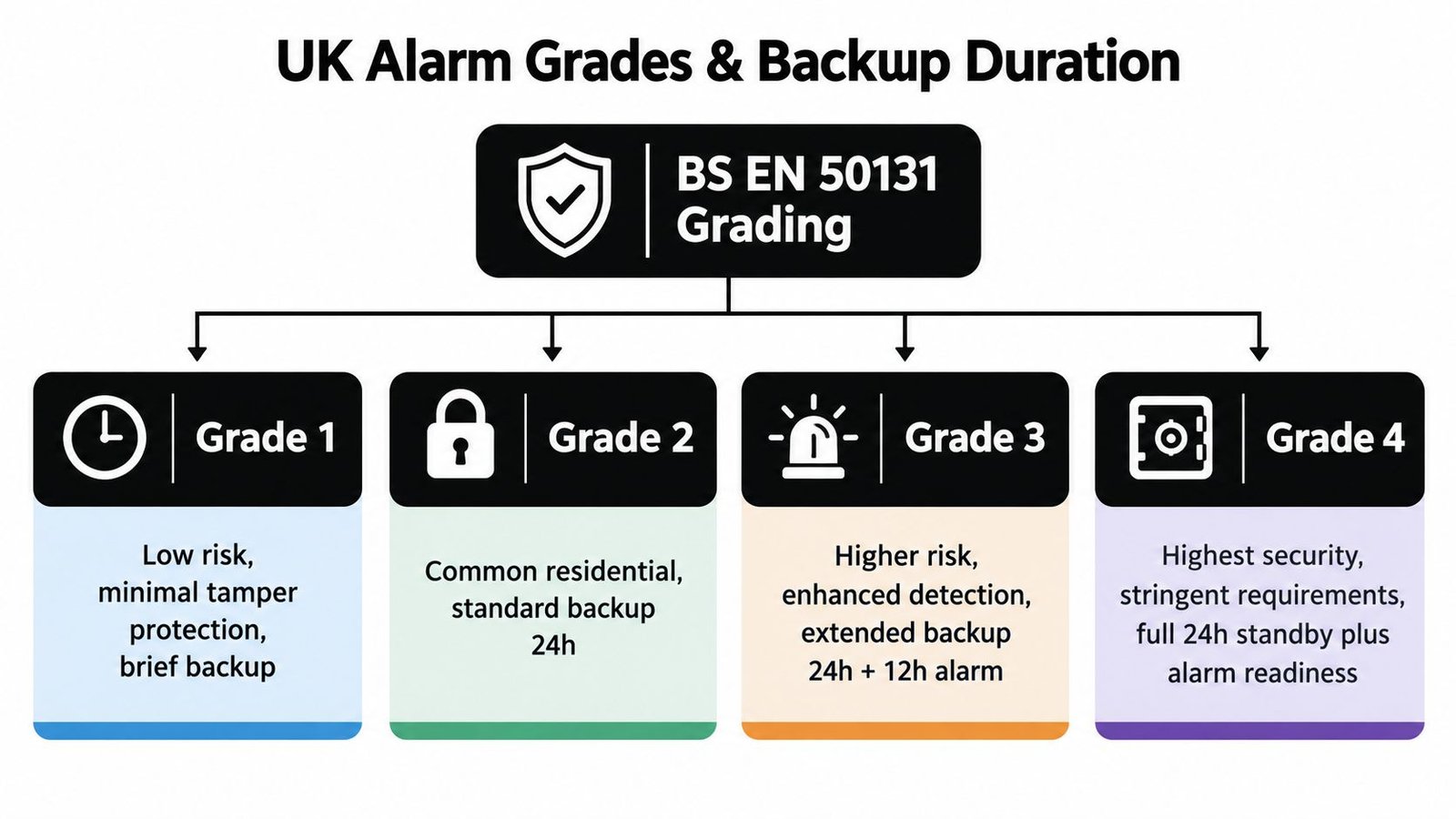
For intruder alarms, Grade 1 and Grade 2 installations typically require 12 hours of standby battery support, according to UK trade guidance on intruder alarm backup systems. Grade 3 systems may require 12 hours or 24 hours, depending on whether the system can transmit a mains-failure signal to an alarm receiving centre. Grade 4 systems commonly require 24 hours.
The grade changes the engineering brief, not just the battery specification. Higher grades generally involve greater resistance to tampering, more demanding detection, and more dependable signalling. A Grade 2 residential panel and a Grade 3 warehouse with monitored signalling have different endurance requirements, so the standby calculation must follow the grade and the installed load, not the panel model.
Fire alarms use a different endurance model
BS 5839 treats fire alarm backup as a life-safety requirement. Category M and Category L systems commonly need 24 hours on standby followed by at least 30 minutes of evacuate signal, as outlined in this UK fire control panel battery guidance. Where an automatically started standby generator is installed, the standby period can be reduced to 6 hours.
Category P systems commonly use the same 24-hour standby plus 30-minute alarm arrangement. If the premises are not continuously staffed and faults are not automatically routed to an alarm receiving centre, the battery may need to cover up to 72 hours total or 24 hours beyond the maximum expected unoccupied period, whichever is less.
Official fire data show why compliance is only the starting point. In England, 19% of dwelling fires in the year to March 2025 involved a smoke alarm that failed to operate. Among those failures, a missing battery accounted for 2.1% and a defective battery for 3.4%, according to the government's detailed fire analysis.
Coverage and installation determine whether that stored energy protects anyone. 15% of failed alarms were associated with fire in an area not covered by the system, while 2.9% were linked to faulty or incorrectly installed systems, using the same official analysis. A compliant battery can still provide poor protection if a detector is badly positioned, wiring is defective, or the alarm signal does not reach the people responsible for responding.
For a concise explanation of the framework, see this guide to BS EN 50131 alarm grades. Stewardship means checking the complete installation against its grade, risk assessment, signalling route, and actual standby load.
Sizing and Runtime Calculations
The control panel's nameplate rating isn't a battery calculation. It tells you what the panel can support, not what your completed installation consumes during an outage.
Start with an inventory. Record every device powered by the panel or auxiliary supply, including wired PIRs, smoke detectors, wireless expanders, keypads, external sounders, access control readers, network communicators, and relays. Then obtain the manufacturer's standby and alarm current for each item. If the figures aren't available, the installer should measure the current directly rather than guess.
Build the standby load first
Add the quiescent current for all devices. This gives the continuous standby demand, usually expressed in milliamps. Perform a separate alarm-load calculation for the period when sounders, strobes, relays, and signalling equipment operate.
A useful planning formula is:
Required capacity in Ah = standby current in amps × required standby hours
That result is only a starting point. The installer should then account for alarm current, battery ageing, temperature, charging performance, cable losses, and the manufacturer's permitted depth of discharge. A cold, unheated warehouse and a temperature-controlled office won't offer identical battery performance.
The practical guidance is to include a documented engineering margin rather than treating the calculated result as the target battery size. A commonly used planning allowance is 20% for ageing and temperature derating, but the final design should follow the relevant standard, manufacturer instructions, and the site risk assessment.
A simple load schedule
The table below shows the type of information an installer should collect. These are illustrative placeholders for the calculation method, not universal product ratings. Use the exact figures from the equipment documentation or a measured test.
| Component Type | Typical Quiescent Draw (mA) | Alarm State Draw (mA) |
|---|---|---|
| Control panel electronics | Manufacturer data required | Manufacturer data required |
| Wired PIR detector | Manufacturer data required | Manufacturer data required |
| Wireless receiver | Manufacturer data required | Manufacturer data required |
| Keypad | Manufacturer data required | Manufacturer data required |
| External sounder and strobe | Manufacturer data required | Manufacturer data required |
| IP or dual-path communicator | Manufacturer data required | Manufacturer data required |
| Access control reader | Manufacturer data required | Manufacturer data required |
A standard 7Ah lead-acid unit may suit a basic residential alarm after the calculation confirms the load. It shouldn't be selected automatically for a system with app notifications, multiple keypads, access control, and network equipment. The communicator may draw continuously, while repeated signalling attempts during a poor network condition can increase demand further.
Measure the finished installation
The most reliable approach is to measure the system in its normal set condition, then test the alarm condition separately. Record the current with every connected peripheral operating as it will during an outage. This catches the common mistake of sizing from the panel before the installer has connected the final devices.
A battery calculation is only credible when it reflects the system that actually exists on the wall.
The calculation should be recorded with the battery model, measured current, required endurance, alarm load, environmental conditions, and replacement date. That record makes later maintenance far more useful because engineers can compare the system's present demand with its original design.
Battery Chemistries and UPS Integration
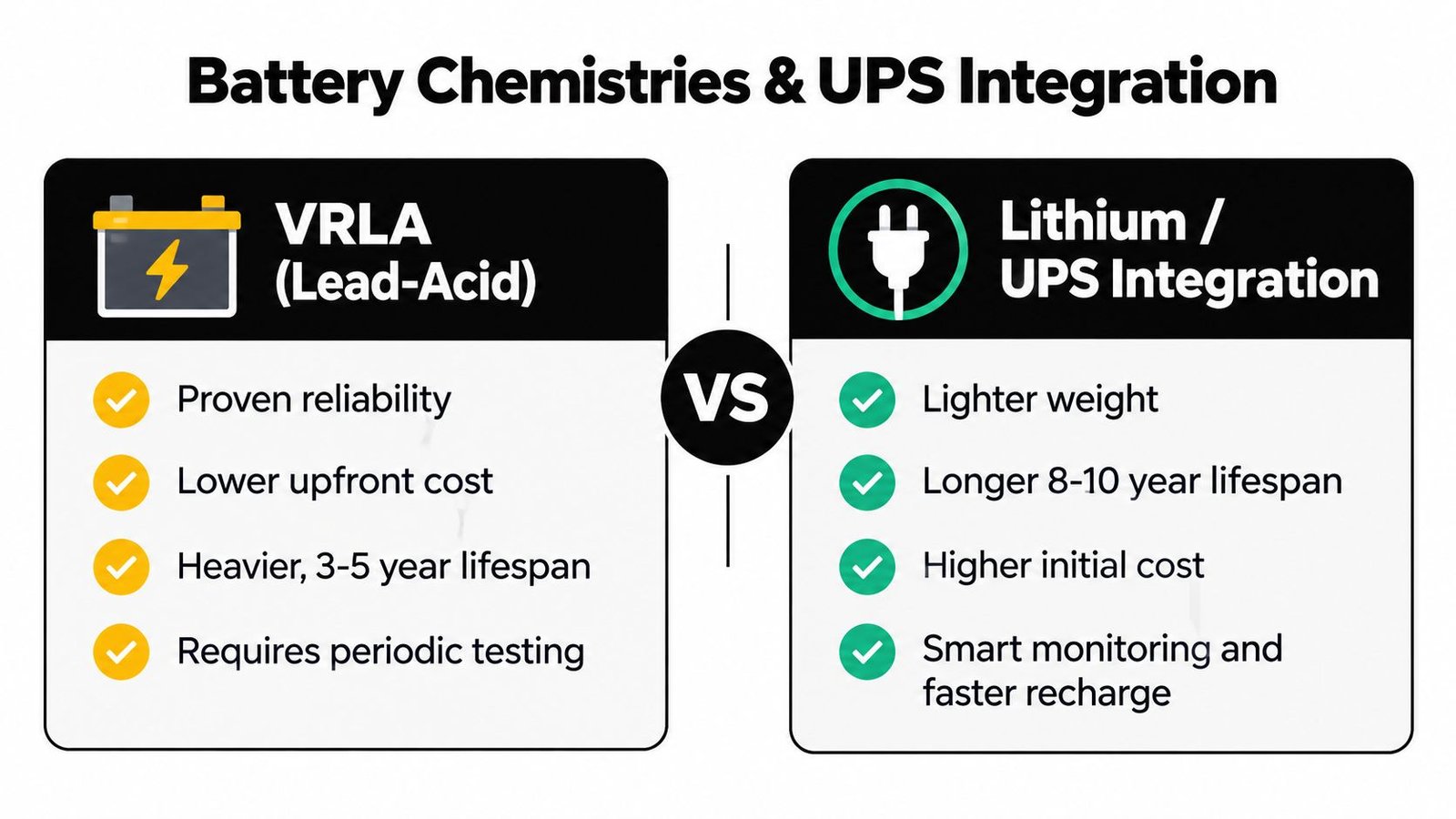
VRLA and AGM batteries remain common choices for alarm panels because they're sealed, familiar to installers, and available in the formats used by many control panels. AGM is a form of valve-regulated lead-acid construction, with the electrolyte held in an absorbent glass mat. These batteries can offer dependable standby service when the charger, temperature, and load are correctly controlled.
Their weaknesses are practical. They're heavy, sensitive to unsuitable charging, and their capacity falls as they age or operate in poor environmental conditions. They also need inspection and testing, even though they don't require the same fluid maintenance as older flooded batteries.
Lithium-based systems can reduce weight and may offer longer service life, faster recharge, and intelligent battery monitoring. They usually cost more at installation, need compatible charging and protection electronics, and aren't automatically suitable as a direct replacement inside an alarm panel. The battery management system, enclosure, certification, charging profile, and fire considerations all matter.
Choose the architecture before the chemistry
A dedicated panel battery is appropriate when the main requirement is to keep the alarm controller and its field devices operating. It won't necessarily keep cameras, routers, switches, access control servers, or recording equipment alive.
An external UPS can support an entire security rack, provided its output capacity, battery runtime, bypass arrangements, ventilation, and maintenance plan suit the installation. This is particularly valuable for IP systems, because the alarm communicator needs a working network path. Keeping the alarm powered while the switch and router are off solves only half the problem.
This overview of uninterruptible power supplies helps explain the distinction between local panel backup and wider equipment protection. A UPS may also protect against short interruptions and voltage disturbances, but it introduces extra equipment that must be monitored and serviced.
Design decision: If a power cut must leave you with live video, remote access, and alarm signalling, specify backup for the network and cameras as well as the panel.
UPS integration needs a clean shutdown strategy for equipment that can't run for the full outage. CCTV recorders, PoE switches, and servers may consume more power than the alarm itself, so runtime should be based on the business outcome required. A homeowner may prioritise notification and entry detection. A logistics site may also need recording continuity and controlled access.
When batteries reach the end of their useful life, don't place them in general waste. Arrange compliant safe UPS battery disposal through a suitable recycling route and keep disposal records for managed sites.
Maintenance Schedules and Replacement Timelines
A standby battery can show a healthy-looking voltage and still collapse under load. Maintenance must therefore combine visual inspection, functional transfer testing, capacity assessment, and planned replacement.
Start with the panel's history. Record the battery chemistry, model, installation date, test results, fault history, and any changes to connected equipment. A new communicator or extra keypad changes the load and can invalidate an old runtime assumption.
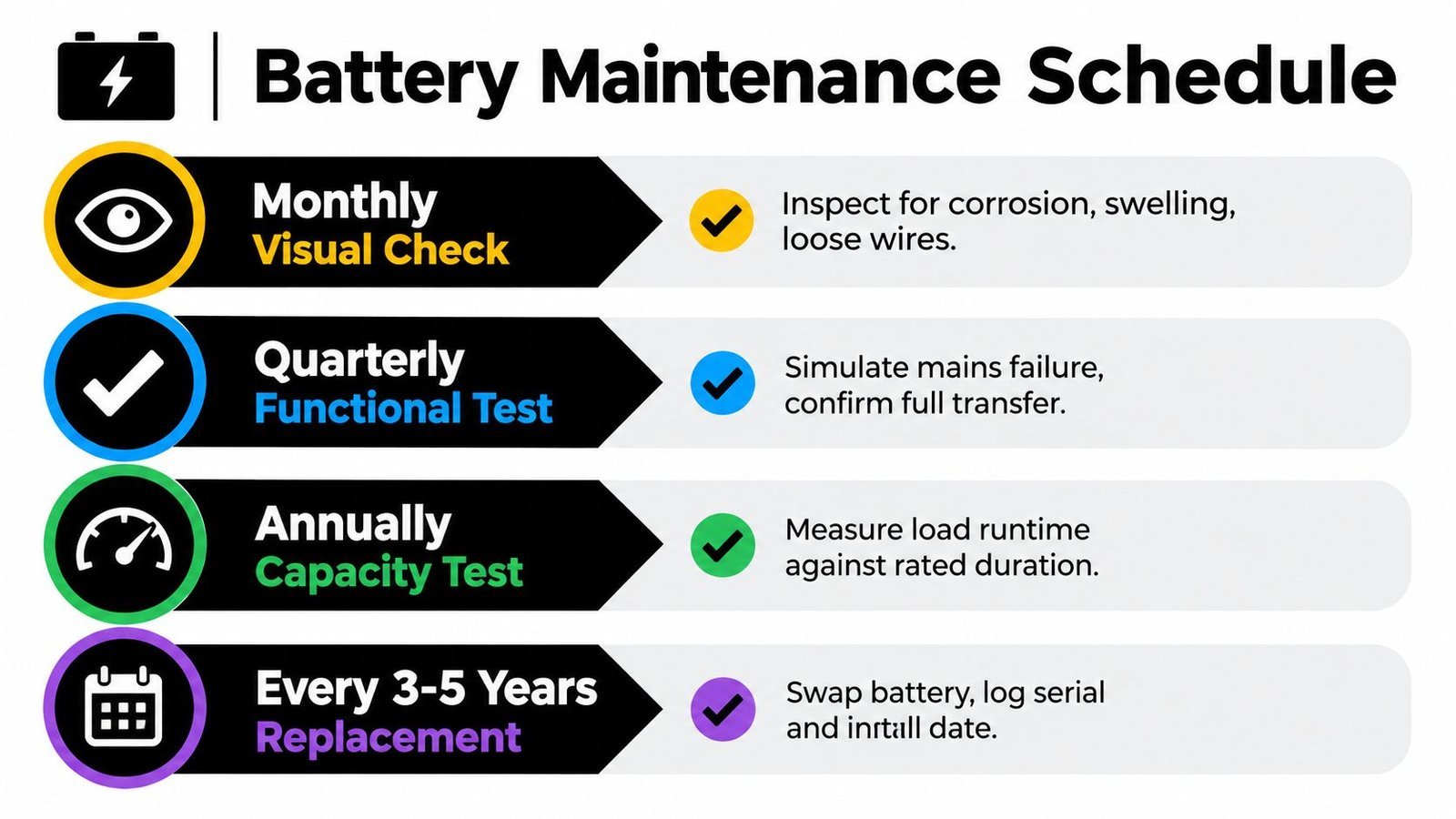
A workable maintenance rhythm
- Monthly visual check: Look for swelling, cracks, leakage, corrosion, loose terminals, damaged cables, and signs of overheating. Check that the panel shows no battery, charger, mains, or tamper fault.
- Quarterly functional test: Simulate a controlled mains failure and confirm that the panel transfers to standby power without losing detection or signalling. Restore mains and verify that charging resumes.
- Annual capacity test: Have a competent engineer test the battery against the installed standby and alarm load. A voltage reading alone doesn't prove usable capacity.
- Planned replacement: Lead-acid alarm batteries are commonly replaced on a three-to-five-year cycle, with the exact timing affected by temperature, load, charging quality, and test results. The replacement range is supported by commercial fire alarm battery testing guidance.
Test the charging circuit as well
A replacement battery won't fix a defective charger. Engineers should check the panel's charging output, fuse, terminals, earth condition, and battery connections. If the charger is overcharging, undercharging, or carrying a persistent fault, it can damage a new battery quickly.
Multi-battery banks need particular care. Don't replace one old battery beside another with a new unit unless the manufacturer and engineer explicitly approve that arrangement. Mismatched age, capacity, internal resistance, or chemistry can make the bank unreliable and place extra stress on the charger.
A maintenance contract should define who responds to a battery fault, how tests are documented, and what happens after a mains failure. The alarm system maintenance guidance provides useful context for organising this work across domestic and commercial properties.
Troubleshooting Common Faults and Failures
A battery fault message does not prove that the battery has failed. Check the event history first. Note whether the warning followed a mains interruption, alarm activation, service visit, or system change. That sequence often distinguishes a discharged battery from a charging, wiring, or peripheral fault.
Start at the supply path. Check the dedicated supply, fused spur, RCD, panel fuse, power supply, and battery terminals. A failed tamper switch or IP communicator can also create a persistent fault that appears to be low battery. Modern systems may keep the panel running while a router, PoE switch, communicator, or other peripheral has already dropped offline.
A controlled diagnostic sequence
- Confirm mains input: Check the supply and isolation point. Do not repeatedly reset protective devices without finding the cause.
- Inspect the panel: Look for corrosion, heat damage, loose conductors, damaged fuses, or battery swelling.
- Check charging behaviour: A competent person should measure charging voltage with a multimeter and compare it with the manufacturer's specification. Resting voltage alone cannot confirm charging performance.
- Measure system current: Isolate peripheral circuits methodically to locate a short, damaged cable, or device drawing excessive current.
- Test signalling: Confirm that the communicator reaches its monitoring route during a mains failure, not only while broadband and mains power are available.
Record the measured load and the devices that remain operational. A system can pass a panel battery test while its communication path, external sounder, or detector circuit is compromised by excessive demand.
Do not open a live panel or disconnect life-safety equipment unless qualified. Fire alarms and monitored intruder systems may require a controlled service procedure, notification to an alarm receiving centre, and documented restoration. As the fire statistics in the compliance section show, a battery can pass every test while protection remains incomplete. If incidents are missed despite satisfactory battery results, review detector coverage, installation quality, alarm audibility, and signalling design.
Security Recommendations for the South West
South Wales sites face different outage and environmental pressures. Coastal premises around Swansea need regular checks of external sounder connections and exposed equipment, where moisture and salt can accelerate corrosion. Older terraced homes, converted buildings, and mixed-use premises often gain extensions that were absent from the original battery calculation.
For a home, plan power for the alarm panel, communicator, router, and any network equipment needed during an outage. Ask the installer to record the installed standby load and identify which functions remain available when mains power fails. App alerts work only if both the panel and its communication path stay powered.
Small businesses should assess the alarm, CCTV, access control, and network as one security service. A UPS may support the communications rack, while the alarm panel keeps its approved local battery. The installer should check UPS runtime, PoE demand, recorder settings, and monitored signalling against the site's risk and operating needs.
Warehouses, logistics hubs, retail premises, and multi-tenant buildings need a documented review of grade, fire category, occupancy, generator arrangements, ARC routing, and maintenance ownership. Large detection and access-control systems in Newport and Cardiff can place substantial demand on peripheral devices. A panel-only battery may therefore leave cameras, readers, or communications unavailable when managers expect the site to remain protected.
Wisenet Security Ltd surveys homes and businesses across South Wales and the South West, measuring installed load, checking charger and signalling condition, and specifying panel or UPS improvements to suit the site. A local, insured, SafeContractor-accredited specialist can assess coverage, power resilience, and emergency response requirements together.
Wisenet Security Ltd can survey your alarm system battery backup, measure the installed system load, test charging and signalling paths, and coordinate panel or UPS improvements for homes and businesses. Visit Wisenet Security Ltd to arrange a consultation covering Cardiff, Bristol, Newport, Swansea, and surrounding areas.