
Fire Alarm Battery Replacement: Your 2026 UK Guide
It usually starts the same way. You're in bed, the house is quiet, and then a smoke alarm gives that sharp little chirp every so often. It's easy to treat it like a nuisance and put it off until morning, or until the weekend, or until you've bought the “right” battery.
That's the wrong move. A chirping alarm is warning you that part of your fire protection has weakened, and the fix depends on what type of alarm you have. In UK homes, that could mean a simple battery swap, a safe backup battery change on a mains-wired unit, or no battery replacement at all because the whole alarm has reached the end of its life.
Table of Contents
- That Chirping Sound Is a Warning Not an Annoyance
- Identify Your Alarm Type Before You Begin
- A Step-by-Step Guide to Replacing the Battery
- Essential Safety Checks After Battery Replacement
- When to Call a Professional Fire Alarm Engineer
- Frequently Asked Questions About Fire Alarms
That Chirping Sound Is a Warning Not an Annoyance
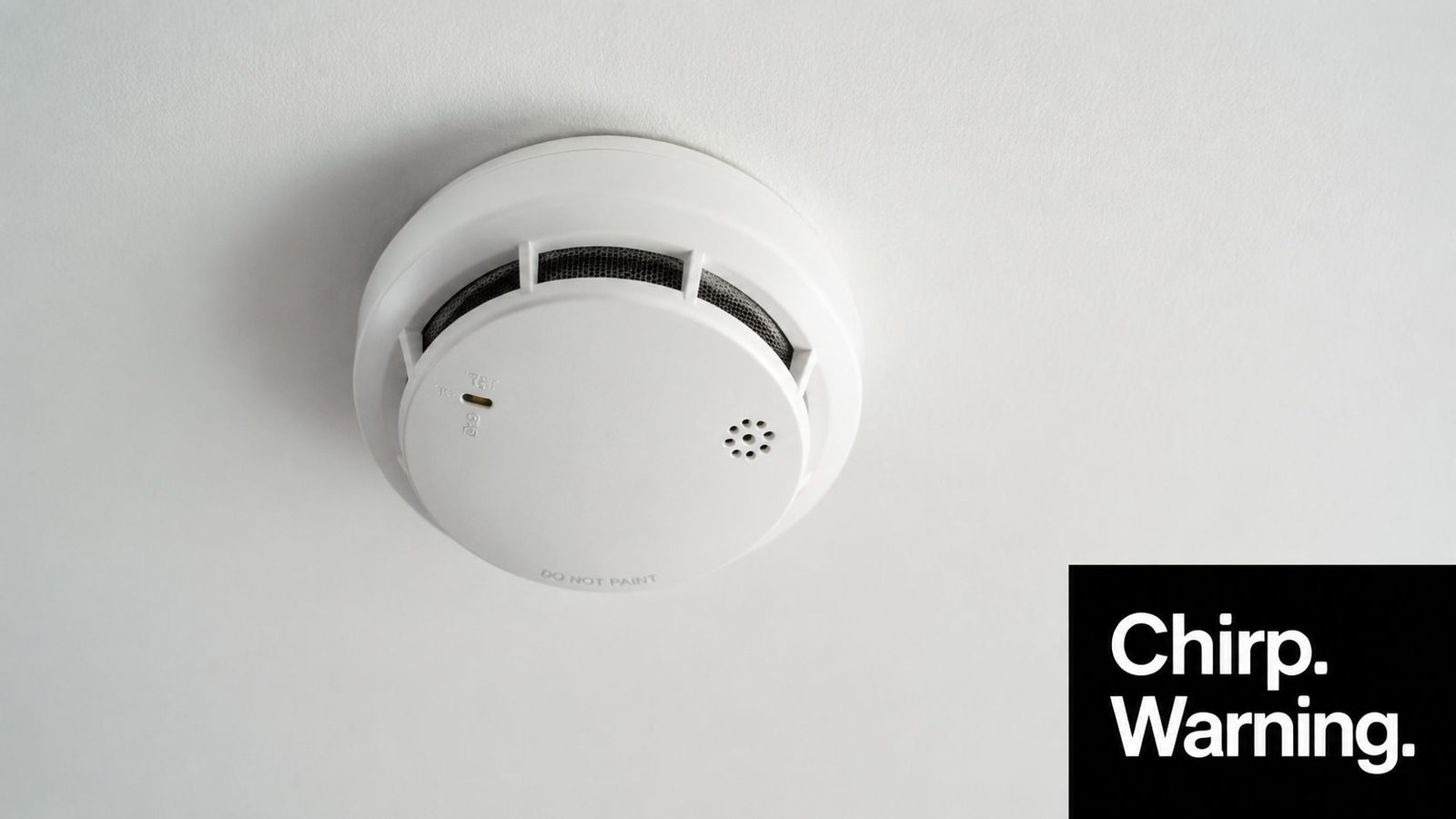
That intermittent chirp is the alarm telling you its power source needs attention. If you ignore it, you're not just living with an irritating noise. You're accepting a weaker warning system in the room where you sleep, the hallway outside it, or the landing that protects your escape route.
Battery problems matter because they're a major reason smoke alarms fail when they're needed. Wisu Alarm's summary of fire safety data states that battery failure remains the leading cause of non-functional smoke alarms, and where alarms failed to operate, the most likely reason was a disconnected or non-working power source.
What the chirp usually means
In most homes, the chirp points to one of three things:
- A replaceable battery is running down in a standard battery alarm.
- A backup battery needs attention in a mains-powered alarm.
- The whole unit has reached end of life on a sealed alarm that isn't meant to be opened.
Those are very different jobs. Treating every chirp as “just change the battery” is where people get stuck.
Practical rule: If you haven't identified the alarm type yet, don't force it open, don't pry at sealed sections, and don't assume the chirp means the same thing on every model.
A lot of frustration comes from trying the wrong fix on the wrong device. Someone buys a 9V battery for an alarm with a sealed lithium pack. Someone twists off a mains head without isolating the circuit. Someone silences a chirp temporarily but never restores proper protection.
What this guide focuses on
This guide keeps the job simple and safe. It separates the three alarm types commonly found in UK homes, shows where DIY fire alarm battery replacement is sensible, and draws a clear line around the jobs that need an engineer.
If your only goal is to stop the noise, you can make a poor decision quickly. If your goal is to restore protection, you need the right method for the unit on your ceiling.
A silent alarm isn't necessarily a working alarm. The job ends when the unit is powered correctly and passes a proper test.
Identify Your Alarm Type Before You Begin
Before you fetch a ladder, identify the alarm. That one decision tells you whether you need a new battery, a full replacement alarm, or no DIY work at all.
The key point is simple. The National Fire Chiefs Council says all smoke alarms, including hard-wired models, should be replaced after 10 years from the manufacture date or by the replace-by date shown on the base. So even if the battery is fresh, an old alarm may still need to go.
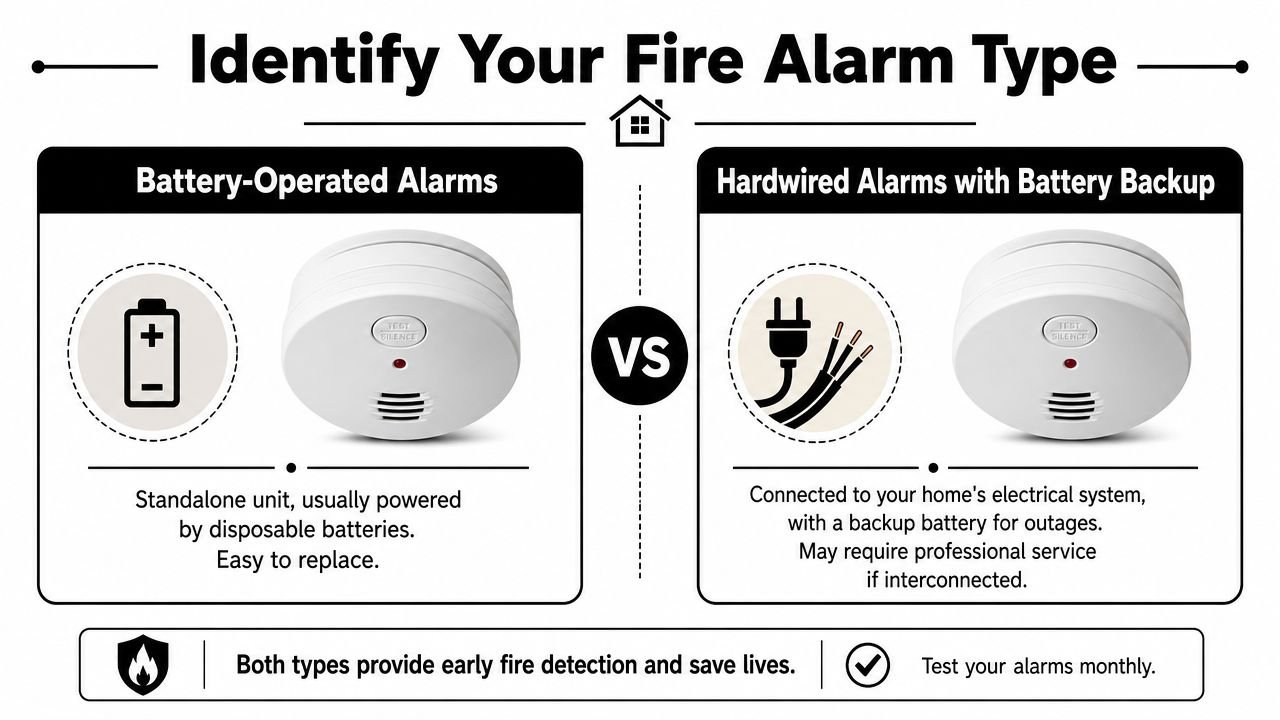
Three alarm types you'll usually find in UK homes
| Alarm type | What it looks like | Can you replace the battery | What to check |
|---|---|---|---|
| Standard battery alarm | Standalone unit, often no visible mains connection | Yes | Battery type, fitment, manufacture date |
| Mains-wired with backup | Mounted on a base and connected to household power | Sometimes, depending on model | Isolating power first, connector type, backup battery access |
| Sealed 10-year unit | Often labelled as sealed or long-life | No | Replace the whole alarm at end of life |
A standard battery alarm is the most straightforward. It's a single unit powered by a removable battery, often a 9V or AA format depending on the model.
A mains-wired alarm is connected to your home's electrical supply and may also have a removable backup battery. In larger or interconnected domestic systems, the wiring and linking matter just as much as the battery.
A sealed 10-year alarm is different again. It's built so the battery isn't serviceable. When that unit starts giving an end-of-life warning, you replace the entire alarm, not the cell inside it.
A quick way to tell which one you have
Start with the label on the side or back of the alarm. Look for wording such as “sealed for life”, “10 year”, “replace by”, or a battery door. If you need a broader overview of household system styles, this page on conventional fire alarms helps explain how simpler domestic setups differ from more complex installations.
Use this quick checklist:
- Look for a battery drawer or hatch: That often points to a serviceable battery model.
- Check for a manufacture date or replace-by date: If it's at the end of its stated life, battery replacement may be the wrong fix.
- Look for a mains connector when removed from the base: That indicates a wired unit with extra precautions.
- Read the housing before opening anything: If it's sealed, leave it sealed.
The biggest mistake here is forcing a unit that was never designed to be opened. If it says sealed, believe it. If it's wired, isolate power before touching it. If it's old, check the date before spending time on a battery that won't solve the underlying problem.
A Step-by-Step Guide to Replacing the Battery
Once you know the alarm type, the job gets easier. The method for a standalone battery alarm is simple. The method for a mains-wired unit is still manageable, but only if you treat the electrical side properly.
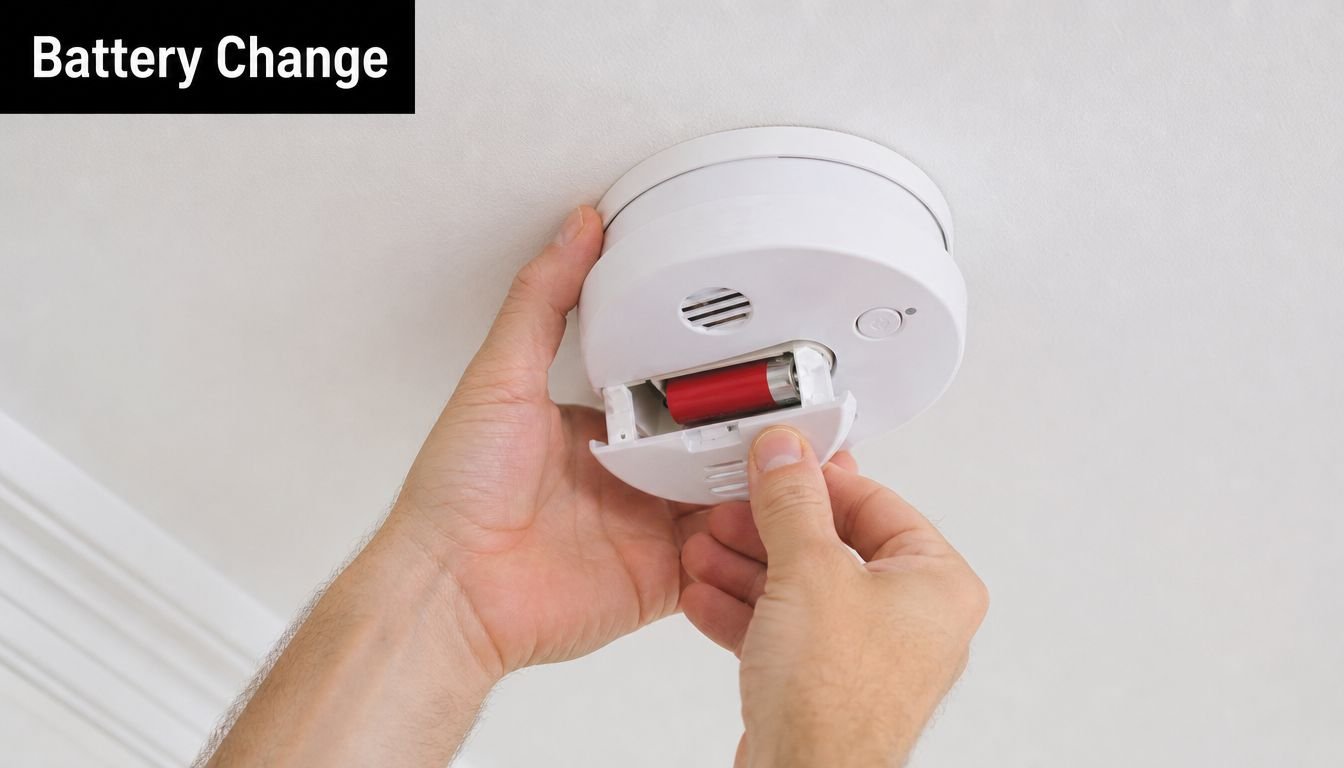
Battery-only alarms
For a standard battery alarm, work steadily and don't rush the fit.
- Open the cover carefully: Most domestic units either twist open or have a small battery door.
- Check the battery orientation before removing it: A quick phone photo helps if the terminals aren't obvious.
- Fit the exact battery type required by the alarm: Don't improvise with a battery that “almost fits”.
- Close the compartment fully: A half-latched cover can leave the battery disconnected or trigger a continuing chirp.
If the battery doesn't sit firmly, stop and inspect the contacts. Bent terminals, leftover packaging tabs, and misaligned clips cause more trouble than people expect.
Mains-wired alarms with backup batteries
Safety matters more than speed. For UK residential mains-powered smoke alarms, the correct method includes isolating the electrical supply at the fuse box before twisting the alarm head off its base. The supporting video guidance also notes that many user-reported problems come from poor reconnection rather than a dead battery.
The practical sequence is:
- Isolate the circuit at the fuse box before touching the alarm.
- Confirm the unit is no longer live using the normal safe checks you'd follow for household electrical work.
- Twist the alarm head anticlockwise to release it from the mounting bracket.
- Disconnect the white plug connector if your model uses one.
- Replace the backup battery only if the unit is designed for that.
- Reconnect the plug properly and make sure it's seated cleanly.
- Refit the alarm to the base and restore power.
- Test the unit immediately.
If you're not confident around isolation and reconnection, it's worth reviewing a solid electrical installation guide before you start. It won't replace model-specific instructions, but it does reinforce the right safety mindset for work involving household circuits.
Here's a visual walkthrough that helps if you prefer to see the process before you touch the alarm:
If a mains-wired alarm keeps chirping after a correct battery change and reconnection, stop treating it like a battery job. It may be signalling a different fault or end-of-life condition.
Essential Safety Checks After Battery Replacement
The chirp stopping is only part of the job. You still need to prove the alarm works.
A proper post-change check does two things. It confirms the battery is seated and connected correctly, and it gives you confidence that the alarm will respond when needed. That matters more than the silence.
Test it properly
Press and hold the Test button until the alarm sounds clearly. A quick tap isn't enough on many models. Hold it long enough for the unit to complete its normal self-test behaviour.
Use this short sequence:
- Stand clear before pressing test: Smoke alarms are loud at close range.
- Hold the button until the sounder activates: You're checking response, not just button movement.
- Listen for a strong, uninterrupted sound: Weak or erratic sound may point to a fitting issue.
- Test interconnected domestic alarms as a system if applicable: One device may trigger others.
If you want a more detailed routine for regular checks after fire alarm battery replacement, this guide on how often fire alarms should be tested is a useful reference.
One check many people skip: test after the cover is fully shut and the unit is back on its base. An alarm can behave differently once it's completely reassembled.
Clean it before you forget
Dust and cobwebs don't just look untidy. They can interfere with normal operation and create nuisance behaviour that people mistake for battery trouble.
A simple clean is enough:
- Use a vacuum with a soft brush attachment: Run it gently around the vents.
- Wipe the outer casing lightly: Keep moisture out of openings.
- Don't paint the alarm: Paint can obstruct vents and sensing areas.
- Don't spray cleaners into the unit: Liquids and residues can damage the internals.
After cleaning, run the test button again. If the unit passes, the battery is correctly fitted, and the chirping has stopped, the alarm is back in service.
If it still behaves oddly, don't keep resetting it over and over. Re-check the model type, the age of the unit, and whether you're dealing with a sealed alarm or a wired one with a fault beyond the battery.
When to Call a Professional Fire Alarm Engineer
Domestic battery changes are one thing. Commercial fire alarm battery replacement is another job entirely.
In commercial systems designed to comply with BS 5839-1, battery replacement is not a casual swap based on time alone. The fire industry discussion of the standard explains that compliant systems use specific sealed batteries with a minimum expected life of 4 years, and the requirement is tied to performance verification so the system can support 24 hours in standby plus 30 minutes in alarm.

Commercial systems are a different job
If the alarm system serves a shop, office, warehouse, logistics site, shared building, or monitored premises, leave battery work to a qualified engineer. These systems rely on the right battery type, the right charging conditions, and proper verification after fitting.
That means more than opening a panel and swapping parts. An engineer has to confirm the system still meets its standby and alarm duty, that the panel reports correctly, and that no fault has been introduced during the work.
A DIY approach goes wrong in predictable ways:
- Wrong battery specification: The panel may charge poorly or report faults.
- No performance verification: You don't know whether the system will hold up during a power loss.
- Missed compliance issues: A quiet panel today doesn't guarantee a compliant system tomorrow.
- Unintended disruption: In monitored or occupied premises, errors can affect the whole building.
Domestic situations that still need expert help
Even in homes, there are times to stop and call someone qualified.
Do that when:
- The alarm is interconnected and one change affects several devices
- The unit keeps faulting after a correct battery replacement
- You can't safely isolate the circuit
- The alarm is in a rented or multi-occupancy property with management responsibilities
- You're dealing with a control panel rather than a simple household detector
For ongoing care of more complex systems, a structured alarm system maintenance service is the right route. That's especially true for landlords, businesses, and anyone responsible for staff, tenants, or customers.
Frequently Asked Questions About Fire Alarms
Some issues don't fit neatly into “replace the battery and test it”. These are the ones that cause repeat callouts, confusion between tenants and landlords, and plenty of unnecessary alarm replacements.
Who replaces a chirping alarm in a rented property
A tenant should report it promptly. But if a mains-wired alarm keeps chirping after a battery change, the responsibility may move well beyond the tenant.
Fire Response's explanation of rented property responsibilities highlights an important UK nuance. If a mains-wired alarm continues chirping after the battery has been addressed, the landlord is responsible for replacing the entire unit where the issue points to a sealed, non-replaceable backup battery in an end-of-life alarm. The same source notes that many chirping incidents are misdiagnosed by tenants as simple battery problems, which delays the correct fix.
That matters because a tenant can spend time trying to solve a problem that isn't theirs to repair. Once the fault points to the unit itself, the landlord needs to act.
What if it still chirps after the battery change
Start with the obvious checks. Make sure the battery is the correct type, the contacts are aligned, the drawer or cover is fully closed, and the unit passed a proper test after reassembly.
If the alarm is hard-wired and still misbehaving, the issue may be the connection, the head not seated correctly on the base, or an end-of-life warning rather than a low battery signal. For a practical homeowner troubleshooting reference, this homeowners' guide to smoke detector fixes covers several common causes of persistent nuisance behaviour.
A repeated chirp after a careful battery change usually means one of two things. The battery isn't properly connected, or the alarm is telling you the unit itself needs attention.
Don't keep removing and refitting batteries endlessly. That often wastes time and leaves you with an unreliable detector.
How should I dispose of old batteries
Don't throw used alarm batteries into general household waste if you can avoid it. Take them to a proper battery recycling point, which you'll usually find at supermarkets, recycling centres, and many hardware shops.
A few practical habits help:
- Tape the terminals on loose 9V batteries: It reduces the chance of accidental contact in storage or transport.
- Keep old and new batteries separate: Don't let them mix in a drawer.
- Recycle promptly: The longer dead batteries sit around, the more likely they are to leak or be reused by mistake.
If you've removed an old sealed alarm rather than a loose battery, check your local recycling guidance for electrical items as well. The alarm body and the power source may need different disposal routes.
If you need help with a chirping smoke alarm, a wired detector that won't reset properly, or ongoing maintenance for a domestic or commercial fire system, Wisenet Security Ltd provides professional support across South Wales and the South West. They handle fire alarm systems, compliant maintenance, and wider security integration for homes, landlords, and businesses that need the job done safely and correctly.